Finding John Mann’s family: a case study

John Mann was born 26th December 1792 and baptised four days later at Norwich St Michael at Thorn. He is my 4x great uncle, but for years I knew nothing more about him. He seemed simply to have disappeared. Eventually, a set of military discharge papers came online via FindMyPast.1 Through them I learned something really exciting: My 4x great uncle John was at the Battle of Waterloo!

A close reading of the nine pages of his discharge papers provided the following information:

  • He enlisted with the Royal Horse Artillery in 1807, when he was fourteen (…so that’s where he went!)
  • He served at the Battle of Waterloo as a Driver (meaning he rode a horse, working as part of a team that pulled cannon, ammunition limbers, and wagons), after which he served in France as part of the Army of Occupation
  • All other service was in England and Ireland; no dates or locations were given
  • On 1st July 1820 he was promoted to the rank of Trumpeter
  • He was discharged on 30th September 1832 after treatment in the Royal Ordnance Hospital following a fit of palsy fourteen months earlier, in Dublin. 
  • There were testimonies from several high-ranking officers: John was held in high regard.
  • One tantalising piece of information was a comment from Lieutenant Colonel Whinyates, who stated that John had a large family and had ‘brought them up in a most creditable manner’.

Tantalising, of course, because I had absolutely no idea of any of their names, nor where they were born, nor even how many children there were. Since the discharge papers are dated 1832, these children were clearly all born before the introduction of Civil Births, Marriages and Deaths, and before the first name-rich decennial census in 1841. Clearly, the marriage, too would have taken place before these changes.

My research objective was to use all these clues to find John, his wife, and all his children

But where to start?
John Mann is a common Norfolk name.  The only search parameters I had were “John Mann” + “born Norwich 1792” with effectively a nationwide search. The search was further compromised by a tendency for modern transcribers to get this surname wildly wrong.  e.g. Although original spellings are always Mann or Man, I have seen it indexed as ‘Cooke’. 

One more document was on my radar. There was a John Mann of the right age with the right birthplace living in Leeds at the time of the 1851 Census. There was no evidence at all to confirm that this was my John Mann, and in fact my assumption was that it was not. John was the brother of my 3x great grandfather who had been a silk weaver in Norwich, migrated to Blubberhouses in Yorkshire for work, and eventually moved to the Leeds area for work at a large mill in Holbeck. It seemed too tidy that his brother John, having led quite a different life, would coincidentally have ended up living just a mile away in the same large northern industrial town, for no apparent reason. If I were to be able to accept this as my John Mann, definite corroborative evidence would be needed.

A stroke of luck: locating the 1841 Census entry
The eventual location of the 1841 Census entry for a John Mann and family in Leeds permitted further research. It had not previously been identified because it had been indexed on Ancestry.co.uk as “Marson”. This document was key: all later discoveries about John and his family flow from it.

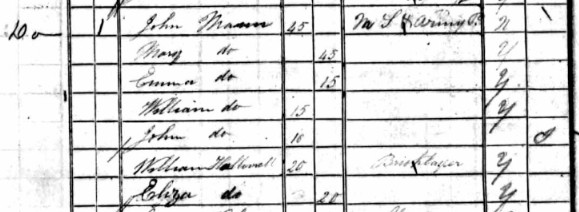
John Mann (age 45, occupation: ‘M[ale] S[ervant] & Army P[ensioner]’) was living at Brick Street, Leeds, with Mary (45), Emma (15), William (15) and John (10).  William and Eliza Hallawell (both 20) were at the same property.  Birthplaces are significant: John senior’s birthplace was England or Wales but not Yorkshire, while John junior was born in Ireland: his age and birthplace fit with information on John senior’s Discharge Papers which indicate he was in Ireland prior to and until July 1831.  Everyone else was born in Yorkshire.2 

This was almost certainly the same couple previously identified in the 1851 Census: John Mann (58, occupation ‘Groom Pensioner’) and wife Mary (54), residing 21 Brick Street.  Therefore John, born Norwich, c.1793, now receiving a pension, had worked with horses in a military capacity.  Mary’s birthplace was Pontefract. Age discrepancies are explained by the 1841 census instruction to enumerators to round down the ages of people over fifteen years to the nearest five.

Information flowing from death records
Neither John nor Mary being located on the 1861 Census, both were found on the General Register Office (GRO) Death Index and local cemetery register (Beckett Street), and also a photograph of the headstone.  John, 58, died 17 September 1851, and was buried 21 September.  Still resident at Brick Street, the occupation recorded was ‘servant’.  Mary, dying 30 August 1857, was buried 2 September.  She was 62/63 and widowed.  Both were buried as Nonconformists.

The headstone image3 provided further useful information:

  • Son John died 17 June 1849, aged 18. This ties in with the 1830-31 birth in Ireland.
  • Grandson Arthur William Cudbartson died 4 September 1855
  • Walter Ernest Hallewell died 6 March 1857, aged 17 months.
  • Hallewell being the second surname at the family home in 1841, this suggests the Eliza Hallewell on that record is the oldest child of John and Mary, and that William Ernest is her son. It also suggests Cudbartson as the married name of daughter Emma. All new information from the headstone was verified by GRO Birth and Death Indexes. Both birth records indicate mothers’ maiden name of Mann.

These suspected marriages were then confirmed by parish register entries (online digital images of original documents).

  • Eliza married William Hallewell 18 July 1840 at Leeds
  • Emma married Charles Frederick Cudbartson 8 April 1849 at Leeds
  • Son William married Elizabeth Taylor 15 March 1847 at Rothwell

Pontefract: baptisms
Armed with marriage details we can now identify Eliza, Emma and William in the 1851 Census. (Online digital images of original documents.) This provides us with the actual birthplace for each, which of course is not available on the 1841 Census. The various entries indicate the birthplace for all as Pontefract, Yorkshire.

This new information regarding specific birthplaces facilitated location of baptisms:

  • Eliza: Eliza, 25 June 1820
  • Emma: 10 Nov 1822
  • William: 11 April 1824

All three baptisms took place at Pontefract St Giles/ St Mary. The marriage of John Mann and Mary Dawson is recorded at the same church on 6 September 1819. As noted above, Pontefract is also Mary’s birthplace.

Apart from son John who died 17 June 1849, aged 18, and is known to have been born in Ireland, only one more son has been identified as the child of John and Mary. A birth record for Alfred Robert Mann was located on the GRO Index. The mother’s maiden name of Dawson is correct. Alfred Robert died in August 1840, aged fourteen months. The ‘abode’ recorded on the burial record is Brick Street, which matches the 1841 and 1851 Censuses. The baptism and burial services at St Peter’s Wesleyan Chapel, are consistent with the move to Nonconformity, suggesting John and Mary’s own religious burial records may also be found here.

Detailed examination of the Pontefract registers reveals no further children for John and Mary there.  This might point to miscarriage, stillbirth, simply no pregnancy, or removal to Ireland, where son John was born, 1830-31.  Without a precise location, no attempt has yet been made to locate John’s or any other baptism/burial in Irish parish records.  Indeed, any such records may not have survived. If there were other children, their births would have predated the introduction of Civil Births, Marriages and Deaths; and given that the movements of John and his family are not fully known, finding all additional children could not be guaranteed. Certainly, no other children survived to adulthood.

Using the same records to develop John’s military timeline
The Pontefract baptism and marriage records outlined above also provide information about John’s Royal Horse Artillery career.  Not only do they suggest he was stationed there for the years the children were born; the register entries themselves record details of his progress within the Royal Horse Artillery.  Only Emily’s and William’s baptisms record John as Trumpeter.  This supports evidence on the Discharge Papers of his promotion on 1 July 1820, and that was six days after Eliza’s baptism. 

These records evidence that John was stationed in Pontefract from before September 1819 to some time after April 1824.  Wider examination of Pontefract baptism registers from 1818 to 1830 shows that between 1820-1825 forty-eight babies of fathers serving with the RHA were baptised. After this, baptisms reduce to just four in 1826-27, and then none.  This could point to mobilisation to Ireland circa 1827. 

Ongoing research
It is interesting that this research into John started with a little information on his military Discharge Papers – just enough clues to permit corroboration of, and following through on, the information on the Leeds Census documentation. That information, followed up with newspaper reports, military records and wider reading, then enabled the placement of John within a specific Troop during the years after Waterloo and before his discharge in 1832. What has not yet been possible is locating him within a definite Troop at Waterloo, although this has been narrowed down to two. Within the next year I plan to do more research focused on the Royal Horse Artillery troops to try to locate him at a specific place in Ireland, and also to try to find out more about the two troops at Waterloo. After that I would like to visit Waterloo. The circle would be completed if this information also helped me to locate a baptism for son John in Ireland and perhaps any other births of children at the same location.

However, for now, I’m happy to have achieved something that, initially, I didn’t think would be achievable. I have followed up on a single phrase on John’s discharge papers: that John had a large family and had ‘brought them up in a most creditable manner’, and I have tracked down him and all those children. One thing I wish I knew, and never will: did John and his brother Thomas (my 3x great grandfather) each know the other was in Leeds? I like to think they might, but both arrived there by complete coincidence and it’s entirely possible that they lived a mile or so apart for eight years without ever knowing the other was there.

This is the resulting family tree. Click for a better view.

  1. John Mann, Royal Hospital Chelsea: Soldiers Service Documents 1760-1854, Original data: The National Archives WO 97/1249/78. Source: www.findmypast.co.uk ↩︎
  2. John Marson [Mann], 1841 England Census. Original data: The National Archives, Class: HO107; Piece: 1347; Book: 2; Civil Parish: Leeds Town; Enumeration District: 24; Folio: 20; Page: 2. Source:  www.ancestry.co.uk ↩︎
  3. John Mann, Family burial plot, UK and Ireland Find A Grace Index entry with headstone photograph, https://www.findagrave.com/memorial/234824558/john-mann ↩︎

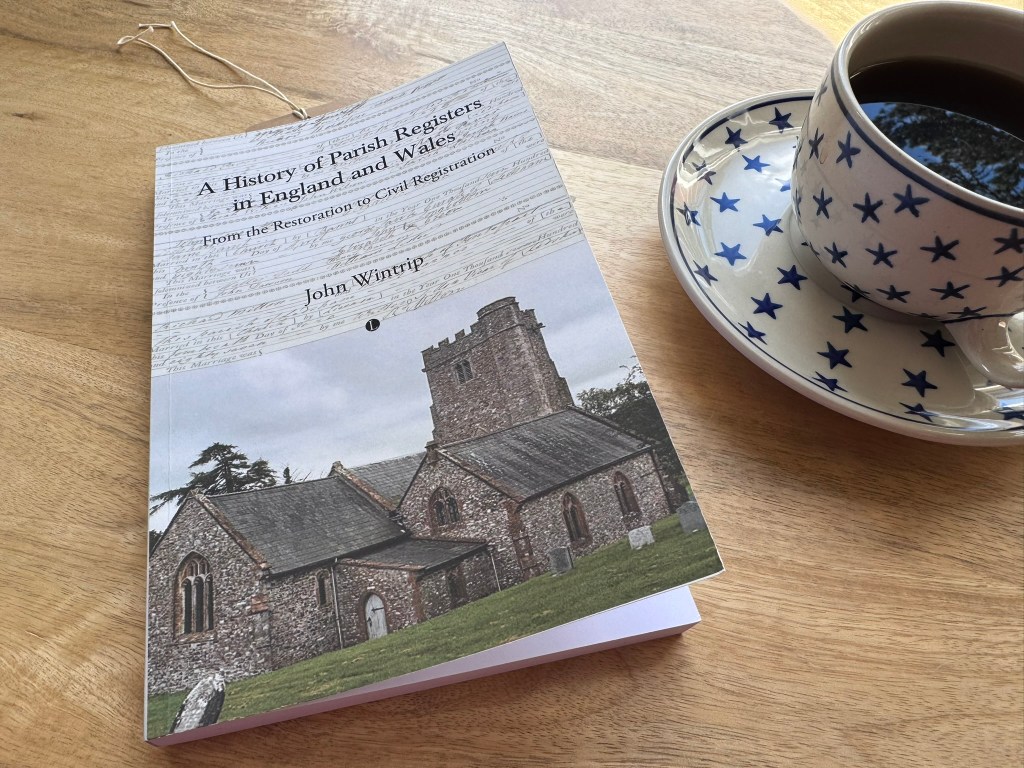
John Wintrip: A History of Parish Registers in England & Wales

I first met John Wintrip when I applied to become an Associate of the Association of Genealogists and Researchers in Archives (AGRA). John was at that time Chair of the Board of Assessors. We met again several months later when I progressed to Member. I was struck by his encouraging manner and passion for genealogy, and was delighted when he asked me to review his latest book. In the interests of full disclosure, I received this copy of the book when I agreed to do the review. However, all views expressed below are my own.

The book is very readable. Indeed, the parish registers of England and Wales have been a personal passion for John for some time, being also the topic of original research culminating in his dissertation submitted for Licentiateship of the Institute of Heraldic and Genealogical Studies, awarded in 2019.

This is not a ‘How To’ manual. Rather it is an overview and account of the history and development of parish registers, the goal being to encourage readers to recognise changes in their format, and to understand what’s behind those changes and the references or symbols we sometimes come across alongside our ancestors’ entries in baptism, marriage and burial registers.

The focus of the book is the period 1660 to 1837. Nevertheless, a short summary chapter of the key issues of the earlier years (1538-1660) is included, as is a summary of the post-1837 era, when civil birth, marriage and death registration came into operation and the secular role of parish registers ended. Having set the direction of the book, the chapters are set out largely with a chronological account of the changes in three main periods: 1660 to 1753; 1754 to 1812; and 1813 to 1837. Each of these periods is recognisable to family historians as commencing with an important change impacting the keeping of parish registers. The Restoration in 1660 overturned the Commonwealth period rules for the maintenance of the registers as a civil matter and restored the diocesan structure of the Church; Hardwicke’s Marriage Act of 1753, implemented in 1754, brought in new strict rules for the administration of marriages; and 1813 saw the implementation of George Rose’s Act of 1812, which applied primarily to baptism and burial registers.

Taken as a whole, the period witnessed the transformation of a society ordered by the Church to a more diverse one, where secular and governmental matters gradually took precedence. The rules relating to parish registers were set down in 1604 by canon 70 of the Church of England. Yet parish registers were not simply a record of who had undergone the sacramental rites. Prior to the introduction of civil births, marriages and deaths in 1837, it was the local parish church that kept track of the population. Baptism entries evidenced paternity, while marriage enabled the presumption of paternity; and entries on marriage registers sealed the legal contract that placed the property and inheritance of the bride into the hands of her new husband. However, the decades following 1660 were characterised by a gradual acceptance of the right to religious freedom. This necessitated a recognition that, since it was the Church of England parish registers that evidenced paternity, property and inheritance rights, somehow the Dissenters needed to be accommodated within them.

Within this context, John outlines the gradual development from the early years in which often, baptism entries might simply have included the child’s name, to an understanding that the descent from one generation to the next also needed to be recorded. Although the rules governing the content and layout of parish registers, the writing surface used and even requirements for their safe keeping, were set down by canon 70, gradually accommodations were reached whereby births of the children of Dissenters/ Nonconformists could be included in registers and in burial arrangements.

John outlines the introduction of various requirements over time, such as ‘burial in wool’ and taxes on entries in parish registers – and how these might be identified in the parish registers. They are, of course, governmental intrusions into the parish registers, and further evidence of the secular aspect of the Church’s record-keeping. However, it was not until 1754 that the secular imperatives took precedence. In that year, with the implementation of Hardwicke’s Marriage Act, specifically ‘An Act for the Better Preventing of Clandestine Marriages’, marriage became subject to statute law. Although the circumstances in which marriages could take place had been set down by the Church in 1604, over time they had often been ignored, sometimes with serious consquences for respectable yet unwitting bigamous wives and their children, as well as ruined heiresses. Hardwicke’s Act set down new strict requirements for the administration and recording of marriages, alongside significant penalties for clergy who failed to comply. In a chapter entirely devoted to the paperwork created by this Act, John explains the administrative changes, the statutory requirements, the role of private printing companies in their interpretation and practice and many other aspects. This was also the first time the subjects of an entry in a parish register were required to sign. John covers reasons why the absence of a signature might be a choice, rather than evidence of our ancestor’s illiteracy or limited literacy skills. (It clarified an anomaly relating to one of my own 3x great grandfathers.)

Something all family historians come to realise is that the records we use for our research were never intended to be for our benefit; rather we are accidental beneficiaries. I was surprised, then, to learn that our pains were shared by antiquarians as long ago as the late seventeenth century. Prominent Leeds historian Ralph Thoresby (1658–1725) seems to have been the originator of the first published proposals for more detailed baptism and burial entries in 1715, but he was influenced in this by the fabulous register entries devised by Thomas Kirke in the nearby parish of Adel. (If you have access to Ancestry, they start here, in 1685, on page 2) Thoresby’s needs when searching the registers in the course of constructing pedigrees of prominent local families and for local history research led him, like us, to desire more information about the parentage or other family connections of the individuals recorded.

Over the course of the following decades, the developments we see when consulting parish registers, came about as a result of many men of the cloth improving the arrangement of their entries in the registers of their own parishes and sharing their ideas with fellow ministers; others publishing pamphlets with their ideas for improving the system; and in several dioceses after around 1770, the issuing of directives by bishops or archdeacons for the adoption of fuller register entries. There are chapters in the book devoted to initiatives in the dioceses of Carlisle, St Asaph and Norwich, the wonderful William Dade system recommended in the dioceses of York and Chester, and in Salisbury and Durham, where Shute Barrington’s recommendations were widely followed. (I previously wrote about the Dade Registers here.)

To reiterate my previous point, it is fortunate for us as genealogists that our passion for ancestor-hunting correlates so closely to more practical matters of wealth and inheritance. As Shute Barrington wrote in 1789:

“Real and extensive benefits would […] result from the introduction of a better form of register than that at present in common use. Ascertaining claims of property, especially maternal property, and the investigation of lineal and collateral descents, would be among those benefits.”

[Shute, Lord Bishop of Sarum, extract from A Letter to the Clergy of the Diocese of Sarum (Salisbury: Printed by B.C.Collins, 1789) In: John Wintrip: A History of Parish Registers in England and Wales from the Restoration to Civil Registration. Appendix 10]

Indeed, so good were the entries in some parts of the country that when, following the Rose Act of the previous year, standard printed papers for baptisms and burials were introduced in 1813, the absence of dedicated spaces for the actual date of birth and for the mother’s maiden name was viewed by some as an extremely retrograde step. Some ministers continued to include the same information as they had done previously, fitting the extra notes into the tabulated forms now required.

Who will benefit from this book?
It will be useful for anyone starting to work with earlier parish registers. The combination of the chronological layout, broken into identifiable topics via chapter headings and more focused searching in the index when you come across some inexplicable symbol or abbreviation in a parish register, should cover all bases. (I will certainly be doing this from time to time!) All of that is reinforced by a useful timeline of major changes and proposals for change at Appendix 1. When we know about diocesan-wide changes in register entries, but our ancestor falls just outside the operative dates, it’s sometimes useful to switch to older or younger siblings to get the extra information from their baptisms.

However, there is likely to be new information even for more advanced genealogists. Amongst the new finds for me was that, although the terms ‘baptism’ and ‘christening’ are largely interchangeable in the Church of England, a practical distinction has sometimes been made between them in connection with arrangements for private baptisms.

Discussion of ‘Day Books’ also provided food for thought. Although the rules set down in 1604 required that the registers be completed on a weekly basis by the vicar in the presence of at least one of his churchwardens, in practice many kept a Day Book to record baptisms and burials as they happened, writing the notes into the parchment registers at a later date – often much later. The whole issue of ‘originals’ and ‘transcriptions’ is of much importance to genealogists: the original or a digital image of it is always to be preferred; and that means the parish register. But what if the parish register is not, in fact, the ‘original’? What if, in copying over information from the Day Book to the official register, mistakes were made, or entries left out, or worse still – if the entire Day Book goes missing before they are copied across?

With an interest in social history, alongside the detailed focus upon parish registers, I found myself thinking of the impact on society, what was happening in the country to bring about these changes when they happened, and how did they affect the ordinary person.

Whilst reading, knowing that some of the information related to parishes with which I’m well acquainted, I found myself going back to my own and other family trees I’ve worked on, to check if the wording on these specific entries complied with the new rules. I confess I hadn’t realised that some of the more modest ‘enhanced’ entries were the result of directions from the bishop; I had assumed them to be personal preferences of the parish incumbent.

In conclusion, I found John’s book to be readable, authoritative and meticulously researched. While his focus here is on the parish registers themselves, when the point under discussion encompasses a broader question, footnotes point to other texts where that issue is more fully discussed. Other key texts are reprinted in the appendices, and the various changes in registers are illustrated throughout.

John Wintrip: A History of Parish Registers in England and Wales from the Restoration to Civil Registration is published by The Lutterworth Press, Cambridge, 2026.
ISBN 978 0 718 89848 9

Shackleton’s Fold: Exploring the area

This is the second video post in my Shackleton’s Fold One Place Study series.

A One Place Study brings together aspects of family history, local history and even house history. They are often carried out by family historians looking to learn more about their ancestors. A One Place Study might add new records, broaden out the focus or just bring a new perspective to our research.

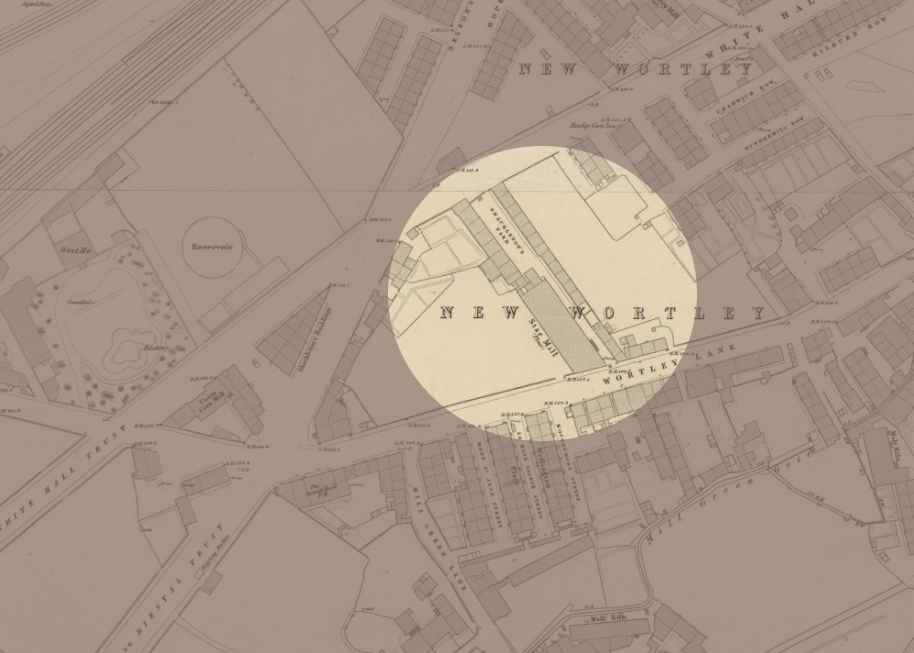
Shackleton’s Fold was a small ‘street’ of just nineteen houses that stood in the New Wortley area of Leeds for more than ninety years. It was demolished by the end of the 1930s. In the video linked below I use maps and old photos to try to explore the area where it once stood.

I found this process so useful in helping me to imagine what Shackleton’s Fold was like. Poring over old maps and finding photographs of buildings all around the Fold – alas none of Shackleton’s Fold itself – really helped me to focus.

I hope this video will be of interest to family historians, local historians and people doing or thinking of doing a One Place Study. In addition, people with a general interest in Leeds history, specifically the history of New Wortley may find it interesting.

I’m particularly keen to attract other family historians whose research has taken them back to Shackleton’s Fold between the mid 1840s and 1938. Alongside this visual exploration, I’m in the process of creating a database of every person on the censuses and every voter listed on the electoral registers. I’m looking for stories and photographs and would be very grateful if anyone could help out in that regard. I’ve already found some interesting stories.

If you fall into any of these categories, or know someone who does, please do share a link to this post and/or the YouTube link – and please ‘Like’ the video if you have a YouTube account. I hope you’ll find it useful.

Information and Links for photos and maps used

All photographs from Leodis:  https://Leodis.net
Go to Advanced search and key in the ID given.

  • JR Holmes and Star Maltings on Wortley Road, 1965.  ID: 2003729_72382754
  • Star Maltings and Shackleton’s Fold on Wortley Road, 1965.  ID: 2003729_99482364
  • View from St John’s Street to side view of Star Maltings and former Shackleton’s Fold, 1965. ID: 2003729_88186282
  • 107-109 Whitehall Road, with view of St John’s Street, 1965.  ID: 2003729_31147402
  • Whitehall Road School and Kildare Terrace, 1948.  ID: 5624
  • Whitehall Road School, 1948.  ID: 2818
  • Whitehall Road at the junction with Gelderd Road, Trolley and Tram Junction, undated but possibly 1911.  ID: 2011127_173010
  • St John’s Sunday School (bombed 24th/25th August 1940).  ID: 200828_166072
  • St John’s Street, from L to R: 11 to 15, 1965.  ID: 2003729_52465457

Tithe apportionment of Wortley (township in the parish of Leeds)
1846.  The National Archives, Kew.  Reference: IR 29/43/444

Ordnance Survey Maps located at National Library of Scotland Maps: https://maps.nls.uk
Reproduced with the permission of the National Library of Scotland

OS: Leeds Sheet 13: Surveyed: 1847, Published: 1850. (Railway revision to c. 1862)
https://maps.nls.uk/view/229947003

OS: Leeds Sheet 17: Surveyed: 1847,  Published: 1850. (Railway revision to c. 1854)
https://maps.nls.uk/view/229947015

OS 25-inch England and Wales: Leeds – Yorkshire CCXVIII.5.13: Surveyed: 1888,  Revised: 1910,  Published: 1911
https://maps.nls.uk/view/229947306

OS 25-inch England and Wales: Yorkshire CCXVIII.5: Revised: 1906, Published: 1908
https://maps.nls.uk/view/125642449

O.S: Yorkshire CCXVIII.5: Revised: 1932 to 1933, Published: 1934
https://maps.nls.uk/view/125642455

In search of Shackleton’s Fold (and other lost places)

Ordnance Survey: Leeds Sheet 13: Surveyed: 1847. Published: 1850.
Reproduced with the permission of the National Library of Scotland
https://maps.nls.uk/view/229947003 

The last post I published in my ‘Ancestral Tourism’ series focused on preparing for visiting former ancestral homes and business premises that are still standing. I said I would cover trying to locate buildings no longer in existence in a future post.

This is that future post. It finishes my Ancestral Tourism theme, and also forms part of my One Place Study on Shackleton’s Fold.

In this video linked below I provide two examples from my own family history of using maps, censuses, technology and sheer determination to work out where a property used to be. The first example is in Birmingham’s Deritend and Bordesley; the second is Shackleton’s Fold. If you have ‘disappeared’ houses in your ancestry, I hope you’ll find it helpful.

Please do ‘like’ it if you have a YouTube account. You could even ‘Subscribe’ to the channel if you want. It’s free. 🙂

As far as the Shackleton’s Fold theme is concerned, there will be at least two follow-on videos (currently in preparation). The first of these will use maps and old photos to focus on the area where it stood. In the second I turn detective and try to gather as many clues as possible about what Shackleton’s Fold looked like.

If you have ancestry in Shackleton’s Fold, New Wortley, Leeds (1840s-c.1938) and have an interesting family story about it, or a photograph of the street, I would love to hear from you. If you don’t have ancestry there but have access to a photograph of the street, again, please do contact me.

*****

The maps used in this video came from the National Libraries of Scotland Maps website, and as part of their permission to use I’m required to provide a link to each of the maps. Although I did put this information at the end of the video, these were not usable as hyperlinks to the original map online. I therefore provide all map information and links below.

Borough of Birmingham by J. Pigott-Smith: Sheet 190, Published: 1855
Public Domain (Wikimedia Commons)
This map is also available at the National Library of Scotland:
https://maps.nls.uk/view/260803014

Side by Side Map:  Google Maps, 2025:
Part of New Wortley, Leeds

The following maps are reproduced with the permission of the National Library of Scotland:

OS: Leeds Sheet 13
Surveyed: 1847,  Published: 1850. (Railway revision to c.1862)
https://maps.nls.uk/view/229947003

OS: OS 25-inch England and Wales: Yorkshire CCXVIII.5
Surveyed: 1888 to 1890, Published: 1893
https://maps.nls.uk/view/125642446

Half relationships in genetic genealogy

Getting your head around ‘Half’ relationships can be tricky. In regular life we probably wouldn’t make a distinction between a half cousin and a full cousin. Yet when we’re working with DNA, and indeed if we’re looking for a missing parent or grandparent, ‘Half’ relationships are important. The Shared centiMorgan Project chart shows that we are likely to share different amounts of DNA with full and half cousins. On average, we share 866 centiMorgans (cM) with a full cousin – although because of the random nature of DNA inheritance it could be as low as 396 and as high as 1397cM. By contrast, we share, on average, 449cM with a half cousin, although it could be as little as 156 and as much as 979cM. Similarly, with a second cousin twice removed the average is 71cM, but it could be as little as zero and as much as 244cM. For a half second cousin twice removed the average is 48, but the range is from zero to 144cM.

(If you’re having trouble working out what relationship a person is to you, I shared a Cousin Calculator a few years back which should help with that… but doesn’t include Half relationships.)

Half relationships, then, are important in genetic genealogy. The amount of DNA we share with someone is a clue as to how far back we connect, that is, where we should be looking for our Most Recent Common Ancestor. In fact, if you go back to the Shared centiMorgan chart, there’s a little box at the top where you can type in the amount of DNA you share with someone and it will provide you with a range of possibilities, and the likelihood of each.

What is it that makes someone a half cousin, a half aunt, or a half sibling?
It’s all about our direct line ancestry

We all have:
2 biological parents
4 biological grandparents
8 biological great grandparents
16 biological great great grandparents
and so on.

If, instead, we think of them as ‘pairs’, we all have:
1 pair of biological parents
2 pairs of biological grandparents
4 pairs of biological great grandparents
8 pairs of biological great great grandparents
and so on.

It doesn’t matter if these people were married, having a clandestine relationship or any variation on that. The fact is that any individual (let’s say person ‘A’) is born of two specific people. If one of these people – these biological parents – has another child (we’ll call that child person ‘B’) with a different partner, then biologically A and B are Half siblings, and anyone descended from each of them will also have the Half DNA relationship in relation to the other ‘branch’ of descendants..

The point to emphasise here is that whether someone is your Half sibling, your Half aunt, your Half cousin or your Half 3rd cousin twice removed depends on what happened in your direct line at the point where you and your DNA match’s lines intersect. If your Most Recent Common Ancestors are a pair, your relationship will be a full sibling/ aunt/ cousin or 3rd cousin twice removed, etc. If your Most Recent Common Ancestor is just one person, your relationship will be ‘Half’.

Cousins and Half Cousins
All of the above may be obvious, but it’s an essential foundation for what I think may be the bit most people have trouble with: first cousins.

If my uncle has children, my cousins, and then remarries and has more children, those younger children are half siblings to his older offspring. So are they my half cousins?
No, they are not. The reason for this is that for a Half relationship to exist between you and another person, there must have been a change of partner in YOUR direct line. The remarriage of an aunt, uncle, great aunt, great uncle, and so on, has no impact on YOUR direct line.

In the above scenario, the reason my uncle’s two sets of children are half siblings is because there is a difference in the biological partnering in their own direct line, that is: at the level of their own parents. However, the reason my cousins are my cousins is because their father is my parent’s brother. Our Most Recent Common Ancestor is our grandparent couple. The mother of my uncle’s children is linked to me only through that marriage/ relationship, and not through biology. Therefore his children may be half siblings to each other, but they are all full cousins to me.

How about if my uncle died and his wife – my ‘aunt’ only by marriage to him – remarried and had more children with her second husband. We may all get on like a house on fire. My aunt by marriage may be as much a part of our family as I am; and we may welcome her new husband and consider their children, alongside the children my ‘aunt’ had with my uncle, as our cousins. But in the true biological/ DNA sense, whereas her older children are my full first cousins, the second tier of her family has no connection to me whatsoever.

Whichever way you look at it, all of my uncle’s children are my full first cousins, regardless of how many partners he has had, because we are all descended from one Most Recent Common Ancestor couple: our grandparents.

Searching for an unknown father
Let’s suppose I’m searching for an unknown biological father. If he has other children, they and their descendants would share only one Most Recent Common Ancestor with me: that would be our father. We would have different mothers and would therefore be Half siblings. Children of the half siblings would be my half nieces and nephews, and they would be Half cousins to my children. Their descendants would always retain the ‘Half’ biological relationship.

But something changes when you start to work back from the biological father. Beyond him, right back into the past, all relationships are ‘Full’, not ‘Half’.

The biological father’s sister would be my full aunt, because our Most Recent Common Ancestor is a couple – her parents/ my biological grandparents; and her children would be my full cousins.

This applies at whatever position in your family tree you have an unknown ancestor: father, grandfather, a grandmother who ‘disappeared’ and turns out to have had a second family, and so on. Everyone descending from that SINGLE Most Recent Common Ancestor is a ‘Half’ relationship; all ancestors further back beyond that person is ‘Full’ – a full aunt, cousin, great uncle, and so on.

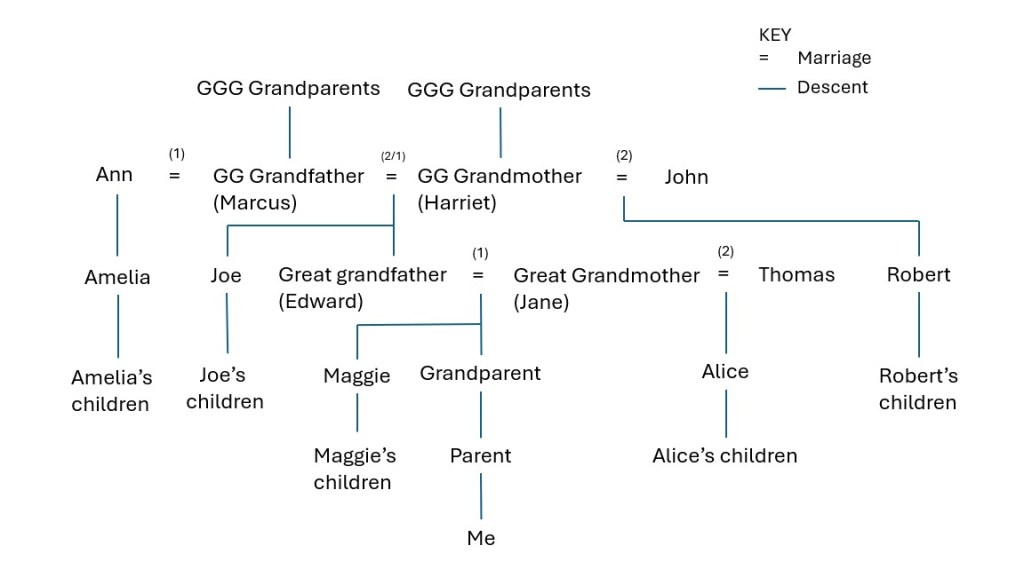
To conclude, here’s a family tree chart from one line of my own family tree. Right at the bottom in the centre you see me, my parent and my grandparent.

My great grandmother, Jane, was married to Edward and they had several children, including my grandparent and Maggie. When Edward died Jane married Thomas and they had one child, Alice.
Alice is half sibling to my grandparent and great aunt Maggie, although within the family she was simply their sister.
Maggie’s children are my parent’s full cousins. Biologically, because the Most Recent Common Ancestor is just one person – their grandmother Jane – Alice’s children are half cousins to Maggie’s children and my parent. Within the family no such distinction was ever made, but in DNA terms there is a distinction.

My great grandfather Edward’s mother, Harriet, also married twice. She was married to Marcus, and had several children, including Edward and Joe. Before marrying Harriet, Marcus had been married to Ann and they had a daughter, Amelia, who was brought up by Harriet after Ann died very young. After eight years of marriage to Harriet, Marcus also died. Harriet then married John and had more children, including Robert.
Joe and Edward are full siblings. Amelia is their half sister, because they share the one Most Recent Common Ancestor: their father, Marcus.
Robert is also half sibling to Joe and Edward, because they share the one Most Recent Common Ancestor: their mother, Harriet.
Amelia and Robert may well have considered each other as siblings, but biologically there is no connection whatsoever between them.
The children of Edward and Joe (including Maggie and my grandparent) are full cousins. Amelia’s children are their half cousins.
Alice, and Robert’s children, have no DNA connection to Amelia’s children, nor do they have a DNA connection to each other, although they may have thought of each other as cousins.

However, further back than Marcus and Harriet, all ‘Half’ relationships cease. If Marcus is the Most Recent Common Ancestor of Amelia, Joe and Edward, then Marcus’s parents are also common ancestors. Therefore any brothers or sisters of Marcus will be full uncles or aunts to all of Marcus’s children. Similarly, if Harriet is the Most Recent Common Ancestor of Joe, Edward and Robert, then her parents will also be their common ancestors, and as such any full brother or sisters of Harriet will be full uncles and aunts to all of Harriet’s children, regardless of who the father is.

The reason for including that chart and explanation was to illustrate some of the points raised above. It turns out also to illustrate how complicated this can be! So if you’ve been scratching your head trying to understand full and half relationships, and why the ‘Half’ has come about, I hope the first half of this post will help. If, after that, you can interpret the chart and work out who is ‘Half’, who is ‘Full’, who has no biological connection, how this impacts on previous generations, and how this affects DNA, then you have nothing to worry about. 😀

Ancestral Tourism 4: Houses & Business Premises

This is part four in my ‘Ancestral Tourism’ series. It follows on from Part 1: Churches and Churchyards, Part 2: Municipal & other Public Cemeteries and Part 3: Graves and Gravestones. The focus in this little series is on planning ahead so that you can spend the time when you’re there exploring, wandering, taking photographs and soaking up the vibes of the place.

In this post we’re looking at preparing for visiting former ancestral homes and business premises that are still standing. Trying to locate buildings no longer in existence will be covered in a future post.

Before you go

How do we know where our ancestors lived?
A range of documents may include the specific address or property name, or other clues as to the location of a former home or business of our ancestors. Examples are:

  • Church records, such as Baptism, Marriage, Burial and maybe wider parish records
  • Civil Registration: Birth, Marriage and Death Certificates
  • Census records
  • Correspondence between the person and an official body, sometimes found in archives, e.g. National Archives
  • Directories
  • Electoral Rolls
  • Family business records
  • Family documents, including letters and perhaps a family bible or other religious text
  • Immigration and Naturalisation documents
  • Military Records, including attestations and next of kin
  • Newspaper reports
  • Poll Books
  • Probate Records, Wills, etc
  • Property and Land records, including deeds, local tax, etc
  • Public and Municipal Cemetery registers
  • School records

It’s certainly easier to track our more recent ancestors.
For earlier generations, even where we find an abode in the examples above, often an exact ‘address’ was not used. A street name without house number, or for smaller places even just the name of the village or hamlet may be the closest we’ll get. During the second half of the 19th century we find more documents that include information to guide us to a specific property. Earlier this year I visited Kinver in Staffordshire, where my 2x great grandfather and some of his siblings were born. The image below shows the extent of Kinver now, as viewed from the churchyard high on a hill above the village. The main High Street, dating from medieval times, is clearly seen in the image. Most of the properties beyond that are more recent. ‘Somewhere in this photo’ is the closest I will ever get to knowing where my ancestors lived here – but I’m happy with that.

Kinver viewed from the church. © Janice Heppenstall

Beware! House names and even house numbers can change
Even when documents do bear a house number or name, these may have changed – particularly if there was much additional building in the twentieth century. I researched the history of a house built around 1837 in what is now a built-up area of the Isle of Wight. The house number is 21, and my clients had already done some research into the nineteenth century inhabitants of ‘number 21’. However, using maps and other documentation I found that the house became number 21 only in the early twentieth century. For the first eighty or so years it was number 3. The change had become necessary to accommodate new building over the previous decades.

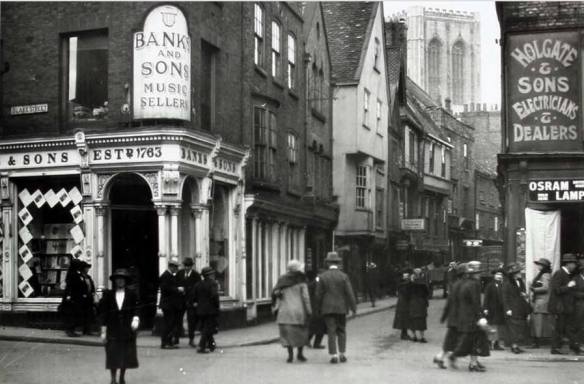
Similarly, a few years ago, I visited York to see my family’s properties there. Census records had my 4xG grandparents at 58 Stonegate. I found the property and photographed it, but afterwards realised Stonegate had been renumbered. Eventually I worked out that their shop (and the floors above above, where they lived) had been this well-known corner plot, below, that was later taken over by Banks & Sons. I had been sitting right opposite this shop (in Betty’s tearoom, for those who know!) without knowing it was my ancestral home. It took a lot of research to work this out. But this is what happens when we don’t do our homework before we set off! Now I have to go back to York to step inside this lovely shop. Luckily, visiting York is never a chore.

An early twentieth century scene from York, showing part of Stonegate and featuring the corner shop at that time occuped by Banks and Sons Music Sellers. York Minster is visible in the background
Junction of Stonegate with St Helen’s Square, York. Image in public domain, photographer unknown.

Changes in house name can be even more difficult to work with, particularly if several houses on the street seem to have changed name, and possibly more houses may have been built between the original ones.

So how can we be sure we have the right house?
Here are some ideas.

Photographs
If you’re lucky you may have an old family photo of the house. Even photos of people standing outside a property may provide visual clues in the form of distinctive architectural features. You can then use Google Street View to ‘walk’ along the road to find the property, if it’s still there.

Family and Local History groups on Facebook are also extremely useful for identifying the exact location of a photograph. I once witnessed someone posting an ancestral holiday snap and asking if anyone knew where in the world it could be. Within fifteen minutes it was identified as beneath a specific lamp post in a named piazza in Rome!

It’s also worth exploring whether there’s a website with old photos of your area of interest. The best one I know is Leodis, a photographic archive with over 62,000 images of Leeds, managed by the Local and Family History team at Leeds Libraries. I have found many old images of houses my ancestors lived in on there – in streets that now no longer exist. If you know of such a website for any of your areas of interest, please do share in a comment.

Maps
Mention has already been made of Google Street View. Modern day maps – including Google and other online maps – can be scrutinised alongside historic maps. My go-to place for online Ordnance Survey maps is here: https://maps.nls.uk/os/ I’ve written before about their Side-by-Side maps, but there are many other features. Something you could do is find a detailed historic map (the 25 inches to one mile series if possible) on the nls site, and see if you can compare the shapes of buildings then to existing buildings on satellite view now.

‘Walking the route’ with the census enumerator
With no photos and only documents to go on, it may be possible, using modern and contemporary maps, to ‘follow the route’ of a census enumerator. Using landmarks and occurences of smaller streets, you may be able to find the house, or at the very least to work out its general whereabouts, even if it’s not possible to narrow it down to a specific property.

Getting to know the neighbours
Using census returns for the street where your ancestors lived, it might be possible to track any changes in housenames or numbers of specific families whose occupation spans two or more decades. If the Jones family live at number 42, the Smiths at 44 and the Browns at 46, and then ten years later the same three families are at 58, 60 and 62, it is more likely that the numbering has changed than that all three families relocated together further along the same street. You can do the same thing far more accurately by consulting Electoral Registers. In the example above of my clients’ house starting out as Number 3 and eventually becoming Number 21, I could see from the Electoral Registers that this change happened in 1931. However, Electoral Registers are often not accessible online, meaning this may be something you could do only when you arrive in the area. Local archives and central libraries will usually have these registers.

What if your family’s presence predates the census?
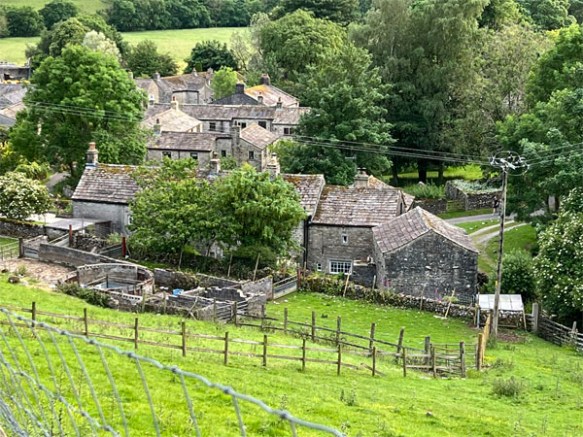
Below is part of Starbotton, in Upper Wharfedale, where my period of interest, before 1750, predates the census. Before going I ‘walked the route’ using Google ‘Map View’ on one device and ‘Street View’ on another to be sure to cover the whole village. By the time I visited, last summer, I knew this small village like the back of my hand. However, I had no idea which house had been owned by my 8x great grandparents and later their son, my 7x great grandfather. Apart from church records and similar, indicating that the family lived in ‘Starbotton’, I was very lucky to come across a collection of property reports made over the years by the Yorkshire Vernacular Buildings Study Group. These, in turn, drew upon other property documentation at the County Record Office. I was able to identify several specific houses formerly owned by my wider ancestral family in Starbotton, and to pay special attention to them when I visited. I never did find out where my 7x and 8x grandparents lived, though, and it’s possible their house may no longer be standing. However, I can name the late seventeenth century inhabitants of around half of the properties, and I know that most of mine lived in the part of the village pictured below.

A rural village scene with seventeenth century stone houses surrounded by hills and trees
Part of Starbotton, Upper Wharfedale, Yorkshire. © Janice Heppenstall

When you arrive

If the occupants were in the garden I would probably chat to them, tell them about my connection and ask permission to photograph the house from the street. If they wanted to know more about who lived there I would tell them. If they were not there I’d take the photos anyway. Just taking a few photos, wandering up and down the street, touching the wall… I find all these things bring me closer to my ancestors who lived there.

If your ancestors had a shop or public house, if the school they attended is now a business centre, or if for some other reason their former home or premises are open to the public, it would be lovely to step inside and spend a little time there.

I also enjoy seeing historic buildings and landmarks that my ancestors would have known, and just getting a feel for the area and the local history. You can do this even if the house they lived in is no longer there.

Depending on the size of the place you’re visiting, and its historic importance or embracing of tourism, you might be able to pre-book a tour with an accredited guide.

If you can’t get there

It really does make a difference going there, but if that’s not possible, just doing the research outlined above will leave you knowing a great deal more about your ancestral homes and the localities they lived in. You can also take a screen shot of your ancestral properties using Google Street View, and of course connect with online and local groups to find out more and see if anyone has any photos.

*****

If you have other ideas please do leave a comment.

Getting the most from cemetery records

Today’s post is an interloper amongst my little ‘Ancestral Tourism’ series. It follows on from Part 1: Churches and Churchyards, Part 2: Municipal & other Public Cemeteries and Part 3: Graves and Gravestones. I’ve stepped away from the ‘Ancestral Tourism’ series here because this is something you can do online, whether you visit the grave or not – although it is, of course, also great preparation for a trip to the actual cemeteries.

The aim here is to show how the information from various records relating to burials, and even the same records on different platforms – including the gravestone itself if there is one – can be combined to give a greater depth of knowledge and understanding about an ancestor and their family. This technique of layering up information from different records works equally well with other aspects of an ancestor’s life, of course, but here I’m focusing on burial.

I hope this will be of interest to readers researching at Intermediate level, or moving on from Beginner to Intermediate level.

First, a comparison of records from two different cemeteries

Precisely what is included on the record varies from one cemetery to another, and possibly from time to time. I can illustrate this by comparing burial records for two of my ancestors: a 4xG grandmother and a 2xG grandmother. Both died after the introduction of Civil Birth, Marriages and Deaths, and I had already located the death entries on the General Register Office (GRO) online register, and bought one of the Death Certificates.

What the records include
This first record is from York’s Fulford Cemetery. It includes so much information that there is no need to buy a Death Certificate. CLICK FOR BIG!

Burial record of Sarah Wade, 14 Mar 1860, Fulford Cemetery York. Source: FamilySearch.org York: Cemetery Records 1837–1871, image 363/812

Here, we see that Sarah Wade, bottom entry, was buried in the York Public Cemetery at Fulford Road in 1860. She has the burial reference ID of 11,365 and is interred in Grave number 3837. She died on 9th March 1860 and was buried on 14th March. Sarah was 75 when she died and was the wife of John Wade, gentleman. They lived in Stonegate, York, but the number of the property is not given. Cause of death was pneumonia. The informant was Edwin Wade of 4 Coney Street, York. The final column is the name of the officiating minister.

There is more to this information than meets the eye. Sarah is the wife of John Wade. This means he is still living. You can see that the entry above Sarah’s describes the deceased, Emily Johnstone, as ‘Relict of the late Spearman Johnstone, Gentleman’. A less formal term would simply be ‘Widow’.

The second and third entries in this extract are both men. One is a Captain in the Militia; the other a Fishmonger. Men, then, are described by their Trade, Occupation or Profession. Women are described by their marital status, or ‘condition as to marriage’. The top entry is a child. Children are described as ‘Son/Daughter of’ followed by the father’s name.

The informant is not John the husband, but another man with the surname Wade, therefore probably related. He is in fact the oldest son of Sarah and John, and he is clearly used to signing documents with a flourish!

*****

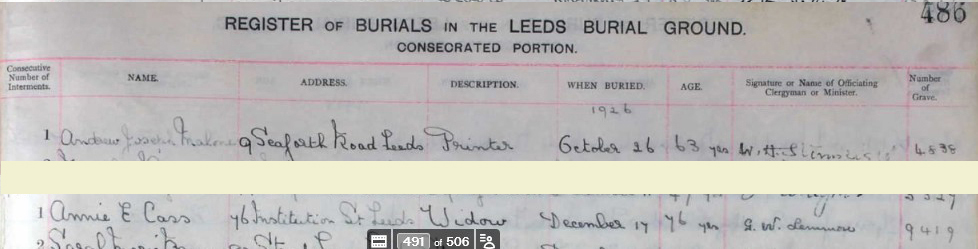
The next record is from Beckett Street Cemetery in Leeds.  The cream line just indicates where I have removed several lines from the page because it’s only Annie E Cass that we’re considering here.

Extract from a burial register dated 1926. The original image has been edited to remove several entries, leaving only the top one, plus the headings for each of the columns, and the record of Annie E Cass who was buried on 17th December 1926.
Burial record of Annie E Cass, 17th December 1926, Beckett Street Cemetery, Leeds.
Source: ancestry.co.uk Leeds, England, Beckett Street Cemetery, 1845-1987

In this record we see that Annie E Cass, bottom entry, was buried at The ‘Leeds Burial Ground’.  This is the same as ‘Beckett Street Cemetery’.  She was buried in the consecrated portion on 17th December 1926.  Address at time of death was 76 Institution Street, Leeds.  Annie was 76 years old and a Widow – again, we see that the top entry, a man, is described by his profession.  Annie in fact ran a business after her husband’s death 28 years earlier, but this is not mentioned.  The penultimate column is for the signature or name of officiating clergyman or minister, and finally we have the Grave plot number, which is 9419.

There is not as much information as on the Fulford Cemetery entry above.  We don’t have an informant or date of death, and the late husband’s name is not included.  We also don’t have a cause of death.  To cover all bases on this one we might want to purchase the Death Certificate. What we do know, however, is that Annie was buried in the Consecrated Portion of the cemetery. She was therefore Church of England. (I already knew that as I have her baptism record, but sometimes every little helps!)

*****

Gathering information from several documents and platforms

Now I’m going to home in on Annie, or Annie Elizabeth Cass to use her full married name. I want to see if I can add to my knowledge and understanding of her life and family by looking closely at all the records I can find relating to her burial.

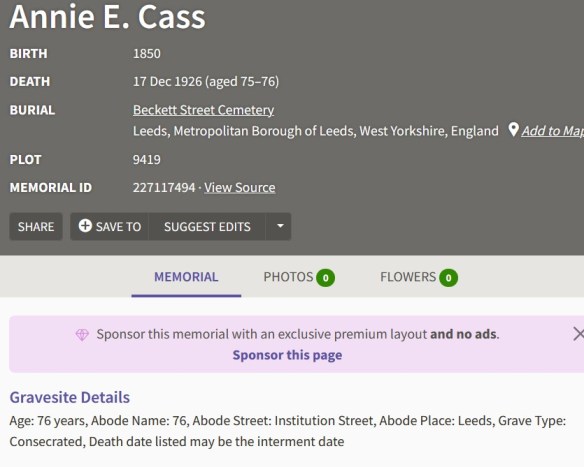
The information from FindAGrave (below) is a transcript compiled directly from Annie’s burial entry above. You can see that all the information is accurate, but the marital status is not included, and it is not clear whether Annie died on 17th December or was buried on that date. This is why seeing the original is always preferable, but if that’s not possible, a transcript is infinitely better than nothing. In fact I do already know that Annie died on 14th December, because I did previously buy a copy of her Death Certificate. I also know that she was in hospital when she died, not at her home in Institution Street; and I know which of her children was the informant, and his address at the time – which in turn tells me he was still living in December 1926.

Screenshot from FindAGrave showing information about the burial place of Anne E Cass, including the location of the plot and a transcript of information from the original burial register.
Extract from FindAGrave showing burial information for Annie E Cass. © FindAGrave

So why did I bother looking at FindAGrave?
In this case I had two reasons for doing so:

  • I wanted to see if there was a photograph of the gravestone;
  • I was creating a list of all my ancestors and their children buried at Beckett Street Cemetery, and since I already had information from the GRO online register about the deaths of each, the search process on FindAGrave is much quicker and easier than searching on Ancestry. The resulting list is below:
A table created in Word with a list of people, all with the surname 'Cass', and other information about each of them, specifically about their place of burial.

By compiling a list of all my ancestors and their children at this cemetery I was able to see which ones were buried in the same plots as other family members. Here, I identified six members of the Cass family, all in Plot 9419. I made similar lists for all my family members at various public and municipal cemeteries. This will make it easier to navigate the cemeteries when I visit.

The fact that Annie Elizabeth and her husband John William Cass were able to purchase a family plot tells me something about the financial situation of this family. Many of my ancestors at this time couldn’t do so. I already knew they had a family business so this was not a surprise. I expected, too, that there would be an inscribed headstone. However, although many of the entries at FindAGrave are accompanied by a photograph of the grave, this one isn’t.  My plan was to take a photograph when I visited myself.

Additional information on Friends of Becket Street Cemetery website
This was the point I had reached when I wrote my last post, about Municipal and Public Cemeteries; and that was when I found the fantastic Friends of Beckett Street Cemetery website.

Using the public search facilities on the Friends website, and bearing in mind I already had a lot of information about this family, including the plot number where they are buried, I was able to do the following:

  • View the cemetery register. I already had access to this register via my subscription to Ancestry.co.uk. so there was nothing new for me personally here.
  • Locate the grave on a map of the cemetery.
  • Locate the grave on a spreadsheet. Here, it is recorded that in fact there is no headstone for the family plot. This surprised me.
  • The spreadsheet also provided a tantalising promise of some extra information. I found there were seven people buried in this plot, rather than the six I already knew about. However, to see the list of people (and more) I needed to become a Friend of the cemetery. This costs £10 per year. Bearing in mind the number of ancestors I have in this cemetery, and the good work the Friends do, this was worth it.
  • Having paid the membership fee I could now view the names of all occupants of this plot, and use various methods of searching the dedicated Beckett Street Cemetery database, which yielded better results than searching on the huge Ancestry database.
  • There is also a virtual walk along the various paths so that you can locate and see the plot you’re interested in.

**Obviously, every ‘Friends Of’ group will provide different search facilities.**

Here’s the new information I got about this family, and how I was able to use it

The first thing to note is that the ‘Person ID’ on the FindAGrave website is a ‘FindAGrave’ ID. The cemetery Person ID/Reference is different, so I have amended my lists to include both.

Next, I was anticipating the the unknown additional person could be a missing child. My research showed that Annie Elizabeth lost four of her children in infancy, but on the 1911 Census she wrote that she had lost seven children and had six still living. I knew this to be inaccurate, because seven of the children were still living in 1911. However, this still suggests two missing babies. Might one of them be buried in the family plot?

Alternatively, could the extra person be Annie Elizabeth’s oldest daughter. Aged 40, she was still living with her mother in 1911 but was nowhere to be found in 1921. Had she died? It seemed inconceivable that she wouldn’t have been buried in the family plot.

The extra person turned out to be Annie Elizabeth’s mother-in-law, Elizabeth Cass. Elizabeth died in 1878. She is the mother of Annie Elizabeth’s second husband, John William Cass, and they are not my ancestors. Although I had her name and some brief details from a census record I had not researched her. This record provided her burial dates and also her address, which was the same shop and living quarters above the shop that I knew to be the home of Annie Elizabeth and husband John William Cass in the 1870s.

This prompted me to look for a burial record for Elizabeth’s husband, William Cass, located quickly on the Friends of Beckett Street Cemetery website. He too had died at the same address, five years earlier. Using death certificates and baptism records for several of Annie Elizabeth’s children, I was able to calculate that she had moved into the shop with her husband and children after the death of Elizabeth’s husband/ John William’s father. The possibility that they had taken over an existing family business was not something I had previously considered.

As for the missing deceased children – the little ones are still missing. I suspect Annie Elizabeth may have included stillborn children in her totals. I have long suspected that women did this on the 1911 Census as a way of commemorating their children who never had a proper burial.

However, this new information also prompted me to renew my efforts to find Annie Elizabeth’s oldest daughter. I found she had married shortly after the 1911 census and in 1921 was living with her husband and a daughter, whose life I will now have to follow through.

How strange that all this should be resolved as a result of examining cemetery records! Plus I am now a member of the Friends of Beckett Street Cemetery!

It all goes to show we should examine closely, keep an open mind, follow all leads and cross-reference. I hope you’ve found this useful, and that it might prompt you to look again at some of your mysteries.


Ancestral Tourism 3: How to read a cemetery

Ryde Cemetery, Isle of Wight. © Janice Heppenstall

This is the third in my ‘Ancestral Tourism’ series, and follows on from posts about preparing for visiting Churches and Churchyards and Public & Municipal Centuries featuring in our ancestry. In those previous posts, the focus was on knowing the history, finding the records and then finding any maps of the churchyards and cemeteries. In this post we’re going to be ‘reading’ the burial ground. What can we deduce from the location, the headstone (or absence of a headstone), the symbolism and anything else that will give us clues as to our ancestor’s life and social standing?

Please be prepared before applying what follows to your own family that there is a possibility that not all your ancestors will have well-kept headstones in peaceful and picturesque settings within the churchyard or cemetery. Some may have been buried with unrelated people in common graves, with or without a headstone. This is part of their story, and the story of the times in which they lived, but it can be upsetting to find.

Consecrated or Unconsecrated?

As outlined in my last post, from the middle of the nineteenth century the Burial Acts required that half of any new Municipal or Public cemetery was to remain ‘unconsecrated’. The other half would therefore be ‘consecrated’. What does this mean?

Consecrated

  1. Dedicated to a sacred purpose; made sacred; hallowed, sanctified.
  2. Dedicated, ‘sacred’ to a tutelary divinity.
  3. figurative. Sanctioned by general observance or usage.

Oxford English Dictionary (Online)

Although the online Oxford English Dictionary gives the above definition, in relation specifically to burial grounds in England and Wales it is a centuries-old term referring to land that has been blessed and set apart for Christian burial according to the rites of the Church of England (in Wales now, Church in Wales). ‘Unconsecrated’ referred to any portion not blessed or made sacred according to those rites. Before the mid-1800s, when most burials took place in the graveyard of the parish church, the official burial had to be conducted by an Anglican clergyman in accordance with the Church of England prayer book service. This applied even to those who had, in life, followed different religious practices. However, such people were not eligible for burial within the Consecrated area of the graveyard. They were buried in a separate Unconsecrated section. This applied also to babies who died before they were baptised and, before 1823, to suicides.

Also mentioned in my last post, the development of the new Public Cemeteries from the 1820s and Municipal Cemeteries from the 1840s coincided with a greater acceptance and recognition of different religious practices. Here, the term ‘Consecrated’ was kept but now, in the ‘Unconsecrated’ portion of the cemetery, the burial service itself was likely to have been carried out in accordance with the rites of the deceased’s religion. Today there is greater recognition of the different rites and practices developed by different religions and cultures in commemorating their dead. Although some dedicated cemeteries exist, there are also separate areas for specific faiths within public cemeteries. However, back when our ancestors were being buried it was simply ‘Consecrated’ or ‘Unconsecrated’, and eventually over time the terms ‘Anglican’ and ‘Nonconformist’ came to be used. Although in England and Wales today we use the latter term for Protestants who are not part of the Church of England, in earlier times it was used for anyone whose religious beliefs differed from the established church, the Church of England. It therefore referred also to Roman Catholics, for example. As can be seen from the image above and that below, separate registers were kept for these two sections of the cemetery.

Follow the clues

Finding your ancestor in one or the other may come as a surprise. If so, this is extra valuable information about your ancestors. Precisely what it tells you will depend on the context. For example, all in the same cemetery:

  • My Irish-born 2x great grandfather’s burial is recorded on the very page you see above. He was buried in the Unconsecrated part because he was Roman Catholic.
  • My 4x great uncle’s burial is also in the Unconsecrated part. This is because he and his family worshipped at the Wesleyan chapel.
  • I had a question mark about the denomination of an ancestor from Ulster. He was buried in the Consecrated portion of the cemetery, but his first child with his English, Anglican, wife was baptised in the Roman Catholic church. His burial seem to settle the question… or did it? There remains the possibility that he was simply not a church goer, and by the time of his death his adult children just didn’t know he was actually Roman Catholic.
  • The burial of another 2x great grandfather in the Anglican part of the cemetery in 1898 was interesting because he took his own life. This gave me a reason to research the burial of suicides. Suicides had traditionally been buried at a crossroads, sometimes with a stake through the heart. The Burial of Suicides Act, 1823, banned such practices. It permitted burial of suicides in consecrated ground, but only at night and without a Christian service. With the passage of the nineteenth century came a greater understanding of mental health, and the term ‘Of unsound mind’ came to be used by Coroners. In 1882, the 1823 Act was repealed, and replaced with the Internments (felo de se) Act. This permitted the burial of those who had taken their own lives at any hour and with the usual religious rites, including in a churchyard at any hour. However, suicide would not be decriminalised until 1961.

Burying in style!

There were great differences between the funeral and burial practices of rich and poor. For the wealthy, this could be a no-expense-spared event from start to finish: an opportunity to be seen to be ‘doing things properly’ according to the etiquette that had grown up around funerals. Obituaries in the newspapers will give you an idea of the size and scale of a grand funeral.

In the cemetery there are more clues. These include the location of the grave. A prime position with good views cost more. It may also have been possible to pay extra for a nine foot deep grave rather than the usual six feet, although you won’t be able to see that from the grave itself. A deeper burial was thought to help preserve the body.

A range of funerary monuments were also available, ranging from mausolea, cenotaphs, tomb chests and sculptures to headstones and more simple marker stones. Historic England have produced a guide to Caring for Historic Cemetery and Graveyard Monuments which includes descriptions of the various types.

If you’d like to know more about a whole range of roles, customs and traditions linked to death and funerals, Friends of Beckett Street Cemetery in Leeds have compiled an excellent overview of Victorian funeral traditions and etiquette. Some of these would have been de rigeur amongst the wealthier folk but others applied more widely. Even when I was growing up I remember people closing the sitting room curtains after a death in the home.

Symbolism

Victorians loved symbolism, and the various monuments and gravestones were the perfect canvas for this form of expression. On their website, Arnos Vale Cemetery, Bristol, make the point that when larger public cemeteries started to appear, much of the population was not literate. The symbols found on graves made them more meaningful for someone who may not be able to read the words. Even today, if we understand the symbolism, a whole new layer of understanding opens up to us as we walk amongst the gravestones. Perhaps there might be clues on the gravestones of some of your ancestors, letting you know what was important to them and their loved ones. You might even come across some symbolism pointing you to membership of the Freemasons or similar, which would then open up a new line of research for you. The Funeral Directors association and Family Tree Magazine have also published useful lists of symbolism and meanings.

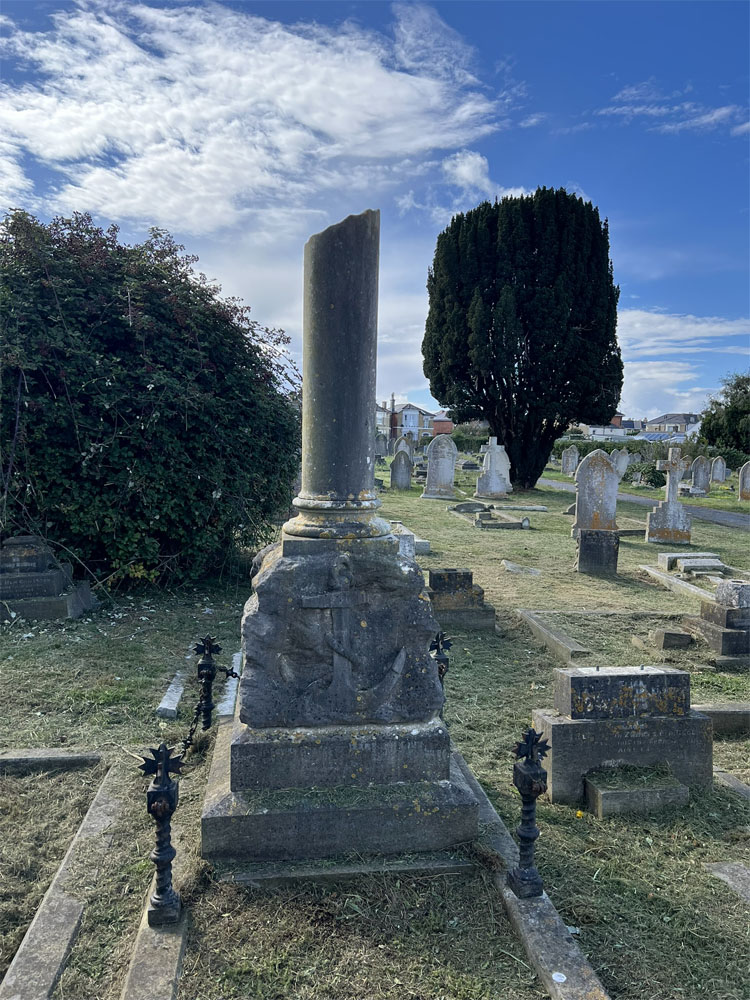
It was a surprise to walk around Ryde Cemetery after reading them and to note the symbolism on a lot of the stones and monuments. This ‘broken’ column represents a life cut short, and the anchor symbolises EITHER hope, steadfastness, and the secure connection to God or eternal life OR a seafaring life, perhaps with the Navy – or perhaps both. Since Ryde is on an island, either is possible and now I’m thinking I should have spent longer and read the inscription to find out more…

Symbolism of elaborate headstone in Ryde Cemetery, Isle of Wight. Image © Janice Heppenstall

Different types of grave

For those with the ability to pay for a private grave, there were:

  • single plots, intended for one person in a coffin
  • companion plots, intended for a couple, perhaps side by side
  • family plots, where several members of the same family can be buried together.

A certificate or “grave paper” documented the purchase. (I have one of these, purchased by a 2xG grandfather on the death of his wife in 1875.)

A purchased plot does not necessarily mean our ancestors will also have purchased a headstone, so you may need to navigate to your ancestor’s final resting place with the aid of only the plot number and a site map. The location of such plots, amongst others with headstones, should enable you to differentiate them from the common graves detailed below.

One of the motivations for the publicly-funded Municipal Cemeteries was the ability to provide for all social levels, including some lower cost options so that the labouring classes could afford to bury their dead with dignity.

A Common grave was a plot that belonged to the cemetery, not an individual or family, and was used to bury unrelated people. There were several different types of common grave, and the costs for the different types varied:

  • Lock-up graves: these were the cheapest type of grave. They were filled over the course of a few days as more bodies became ready for burial. Between each burial the soil was not replaced. Instead, a wooden ‘door’ was locked in place over the grave. When the grave had the required number of deceased people, the earth was piled on top. These were also called Open graves.
  • Public graves: like lock-up graves, these were filled up as newly deceased unrelated individuals became ready for burial. The difference is that these graves were refilled with earth after each new burial. They were therefore a little more expensive.
  • Note that ‘Pauper’s grave’ was not an official term and probably more rightly refers to the burial administration rather than to the grave itself – a Pauper’s burial. Essentially, before 1834, paupers were buried at the expense of the parish, and after that at the expense of the Board of Guardians. There was no unnecessary expense. The actual grave would have been one of the above types of common grave with no inscription, probably a lock-up grave where that was an option. Local authorities remain responsible today for the burial of a deceased person leaving no funds for a funeral and no one else to arrange it.
  • Inscription graves: For a small additional fee, a deceased person could be buried in a common grave but with a headstone inscribed with the name, date of death and age of every occupant. Some of the headstones may have had bodies arranged on both sides with inscriptions on both sides of the stone. These are a feature of the municipal cemeteries in Leeds – in fact every reference I have come across online relates to Beckett Street or another of the Leeds cemeteries. Here, they are known as ‘Guinea Graves’, that being the original cost of burial in one of these Inscription graves. If you are aware of this type of grave (Inscription or Guinea Graves) elsewhere in the country, please leave a comment saying where and by what term they are known – thanks.
Guinea Graves at Hunslet Cemetery © Stephen Craven at Wikipedia Commons

Some notes

For overseas readers (or very young British readers, perhaps!), a guinea was a British coin, originally minted in 1663 with a value of £1 (One Pound). Eventually it came to have the value of £1 – 1 s (One pound one shilling, i.e. 21 shillings). Even after the guinea coin ceased to circulate, the term remained as a unit of account worth 21 shillings. As late as the 1970s it was used for the quoting of professional fees and luxury items.

I have previously written about how to ‘read’ a Commonwealth War Graves Cemetery [here].

*****

I have become rather more fascinated with municipal cemeteries than anticipated! My next post will be about getting the most from different cemetery records, before returning in the post after that to Ancestral Tourism: houses and places our ancestors knew.

Ancestral Tourism 2: Public & Municipal Cemeteries

Ryde Cemetery, Isle of Wight. © Janice Heppenstall

This follows on from my last post: Ancestral Tourism 1: Churches and Churchyards. It focuses on locating and visiting graves of our ancestors whose final resting place is in one of the large municipal or other public cemeteries in our towns and cities rather than in a church graveyard.

First, a bit of history

The emergence of large public cemeteries is an interesting part of our social history, connecting with several other developments of the nineteenth century that will be familiar to local and family historians. The migrations and population booms of the eighteenth and nineteenth centuries created not only a lack of housing for the living but also of burial grounds for the dead – and all the more so in the growing industrial towns and cities. The historic churchyard burial grounds posed problems on several fronts: they were generally small, overcrowded, often laid out in a haphazard manner; and as knowledge of hygiene and sanitation developed, there were concerns about the spread of disease, particularly since in towns and cities these small burial grounds were generally alongside the church and surrounded by closely packed housing.

The initial response to this problem was to turn to the private sector. Throughout the 1820s and 1830s a number of ‘garden cemeteries’ were established to serve big industrial towns, including Manchester, Liverpool, Birmingham, Leeds, Sheffield, Newcastle and later, London. These cemeteries were private commercial ventures set up under individual Acts of Parliament. They were large, well-planned spaces, often designed by the same architects and landscape designers who created public parks. Some of these garden cemeteries may be well-known to us. They include Highgate in London, Undercliffe in Bradford and Arnos Vale in Bristol.

Some of the early cemeteries were developed by and for Nonconformists. As outlined in my last post, the general practice was for Nonconformists to be buried in the parish churchyard and the service officiated by the Anglican vicar. Many prominent philanthropic capitalists were Nonconformists, and by this time were able to use their wealth and influence to bring about changes including, here, the freedom to bury their dead and conduct services according to their own beliefs and traditions. Well-known Nonconformist cemeteries include Chorlton Row Cemetery in Manchester, which opened in 1821, Low Hill Cemetery in Liverpool, opened 1825, and Woodhouse Cemetery in Leeds, 1835. It is interesting to note that it was around the same time that the State removed control of recording births (or rather baptisms), marriages and deaths (or rather burials) from the Church of England and placed that responsibility with a new General Register Office: the introduction of Civil BMDs in 1837.

Generally speaking, though, these cemeteries were money-making enterprises, serving the upper and middle classes. There was no increase in provision for the labouring classes. The response from some local authorities was to develop more cemeteries but funded by public money. Early examples are St Bartholomew’s Cemetery in Exeter, which opened in 1837, Beckett Street and Hunslet Cemeteries in Leeds, both opened 1845, and Southampton Old Cemetery, 1846. This was the beginning of the Municipal Cemeteries – publicly funded, and owned/ managed by the local corporation.

The Metropolitan Burial Act of 1852, and other Acts of Parliament that followed, empowered local authorities to establish public cemeteries and close previous overcrowded burial grounds. The new cemeteries would have uniform hygiene standards and procedures for burial, would cater for all social levels, including some lower cost options for decent burials, and would offer burial options with dedicated areas for people of all religious affiliations. Half of any new cemetery was to remain unconsecrated, allowing for burials without the Church of England service. Later, in 1879, the The Public Health (Interments) Act made it a duty of local health authorities to provide cemeteries if local conditions required it.

Historic England have produced a List of Registered Cemeteries, arranged in date order. Information is provided for each, including design, designer, whether private or municipal, and important or interesting features.

There is also a nationwide map published by the Institute of Cemetery and Crematorium Management which includes every cemetery and crematorium in the land. I’ve checked out all the ones I know and they are all present and correct.

Since there is a similarity in records of these different types of public cemetery, the following notes about how to plan for your visit is intended to cover all of them. There are in any case differences from one cemetery to another, regardless of how they came into being.

Planning your visit

Allow plenty of time for this – there is a lot of research and planning to do!

Locating the records

  • Needless to say, the first thing you need is to know the cemetery in which your ancestor is buried. We’ll start by looking at who holds the records, moving on to which of them might be online.
  • Since Municipal Cemeteries are managed by the local authority, it is they who hold the records for these cemeteries. Often, this team is known as ‘Cemeteries and Crematoria’, or ‘Cems and Crems’ for short. You can find them online by using either of these phrases as search terms and adding the name of your town or city of interest.
  • Some local authorities offer a look-up service. For example, Leeds Cems and Crems provide a list of all cemeteries, together with opening date. They require the name of the deceased, the date of burial and the cemetery, and will ‘check the records and if the information is correct […] let you know the grave number and section or where in the grounds the cremated remains were strewn.’ Some Cems and Crems teams charge for this service; others do not.
  • Some local authorities have databases available online so you can check for yourself. For example, Birmingham Cems and Crems have separate online searchable databases for each of their twelve cemeteries.
  • Privately owned cemeteries keep their own records. Information can be accessed via their websites. For example, at the time of writing, Highgate Cemetery charges £40 for a search. However, they also state that copies of all their records are free to consult at Camden Local Studies and Archives Centre.
  • That said, digital images of the records of some cemeteries are available online. You might find records from your cemetery of interest on your genealogy subscription website; or try looking on FamilySearch. From the home page navigate to Search > Images > insert the name of your place of interest and then select the appropriate era from the drop-down list. From here, you will have to scroll through to see if the records you need are included, and if they are, you will need to browse through the images of the records. Knowing the death date or at least month of death will speed things up. I found all the records from York’s Fulford Cemetery on here – and they are excellent!
  • Transcripts of the records of your cemetery of interest may have been included on FindAGrave (free to use). I have found on there most of my ancestors and their families who were buried in a municipal cemetery, but it is primarily run by volunteers so is inevitably a work in progress.
  • There is also DeceasedOnline, which helps burial authorities and crematoria to convert their register records, maps and photographs into digital form and bring them together into a central searchable collection. There is a fee to see the individual records, and I have not used this website, but it is there as an option should you wish to use it.
  • Locating a Map of the Cemetery

    The cemetery records will hold certain essential information about your ancestor: name, address, date of burial, occupation. There may be more information, but this little lot will enable you to identify the person and be sure it’s your ancestor. There will be one other very important piece of information: the number of the grave or plot where your ancestor is buried.

    Armed with this, what you need now is a map. And on this point it’s a question of digging about online. Here are some places to look:

    • The cemetery’s own website, if they have one. Example: York’s Fulford Cemetery provide section maps on their website.
    • Local authority Cems & Crems may have pages for each of their cemeteries, possibly including maps. Example: Isle of Wight have plot maps of all their cemeteries available for download, for a fee.
    • A lot of the cemeteries have ‘Friends’, and these often have a website with maps. Examples: Friends of Beckett Street Cemetery have an astonishingly good series of online tools to help you locate and navigate your way to your ancestor’s plot. These include locations of plots, numbers and names of occupants in each, whether there is a monument or gravestone, and whether this has been photographed. A different approach is taken at Friends of Southampton Old Cemetery. They provide assistance in locating graves and request a small donation towards their conservation work. Some ‘Friends’ groups have even carried out research into the lives of those buried in the cemetery.
    • Local history or heritage groups may have websites with maps. One the best set of static maps I have found to date is for Ryde Cemetery by Ryde Social Heritage Group. Every plot is shown with the names of the occupants.
    • The local Family History Society may have mapped the cemetery. Example: Isle of Wight.
    • There may be a site map at the cemetery itself, but you will need to know this in advance to avoid disappointment.

Going alone or with a companion
In the course of researching this post I have located every one of my ancestors and all of their children buried in Municipal and Public Cemeteries. Armed with this information, including details of family plots, plus a better understanding of the significance of each of the cemeteries, I feel sufficiently well-informed to be able to make a decision as to whether to inflict a visit to any of them on my nearest, dearest, yet genealogically disinterested. Based on this, I consider one cemetery in Leeds with a single family plot of interest to be acceptable, and another in York with just three relevant family plots. The rest have far too many plots that I would need to visit; and although one – Beckett Street Cemetery in Leeds – may be acceptable on grounds of social history, I simply couldn’t put anyone else through the monotony of locating and visiting the number of graves. Definitely, these will have to be solitary trips for me.

Part of the problem leading to this decision is that although the nineteenth century cemeteries were intended as public landscapes, and are of great historic and heritage value, lack of funding means that many of them have now become neglected. It is here that ‘Friends of’ the individual cemeteries provide a valuable service, carrying out conservation and environmental work and delivering ecological benefits – but not every cemetery has a Friends group, and some are less active than others.

You might find that the ‘Friends of’ your cemetery of interest provide tours from time to time. It might be possible to arrange your visit to coincide with that, then stay on afterwards to visit your family’s graves. Interesting for you and they will appreciate the income.

If you can’t go

There is so much information to be found online. By doing the research outlined above, making full use of online material and even, where possible, via the ‘Friends of’ website, FindAGrave or a Facebook page, requesting a photo. You can also search online for images of the cemetery. Adding “wikimedia commons” to your search term will return a selection of images that are free to use provided you credit the photographer.

Be forewarned though that the inscription on images is not always legible. This could be because of sunlight conditions on the day, severe weathering over time, or possibly just because of the quality of the image when reduced for web use. The following wonderfully clear image is from FindAGrave, but some of the images of my family’s gravestones cannot be read at all.

Image © Rachel79; source: FindAGrave

*****

I hope this has given you some ideas for how to plan for a visit to a Municipal or Public Cemetery. Researching it has certainly focused my mind and I’ve found it fascinating. So fascinating, in fact, that I will be slotting in an extra couple of posts about cemeteries before progressing to finding about former homes and business premises of our ancestors in the post after that. 🙂

Ancestral Tourism 1: Churches and Churchyards

For many of us, there comes a time in our ancestral journey that we want to know more about the places where our ancestors lived. For the truly obsessed, this can take the form of a One-Place Study. However, for the majority of family historians, and indeed for many of our ancestors, simply visiting the place where they lived will be enough to provide that extra insight we’re looking for.

Bringing a companion

What might, for us, be termed ‘Ancestral Tourism’ could simply be an enjoyable day out for any family and friends accompanying us. The little stops and circuitous routes wouldn’t be too burdensome on companions, and might be thought to add dimension to a place.

I say this from a position of experience, since I’ve done quite a bit of visiting the ancestors over the years, often accompanied by my husband and dog. The trick is to intersperse the family history with other sightseeing and activities and, above all, to know where to draw the line. There are certain family history activities I would not expect anyone else to put up with. Obviously, visits to the archives and local history libraries fall within this bracket. I would also make a distinction between a small, picturesque churchyard and a huge, sprawling, possibly unkempt municipal cemetery. I would definitely walk alone around inner city industrial or derelict areas where ancestors used to live in streets and houses that no longer exist. For all of those, if I can’t make the time to go alone, I don’t go.

A bit of ancestral tourism can involve an hour’s diversion, or a full or half day during a week away. But whether we’re going alone or with companions, there are things we can do to plan ahead to ensure we make the most of our valuable time there.

What to see

There are certain buildings and features I home in on when visiting an ancestral town:

  • the churches or chapels where my ancestors were baptised, married or buried;
  • the churchyard;
  • municipal and/or public cemeteries;
  • former homes and work/business premises;
  • historic buildings and landmarks, and just getting to know the area;
  • pinpointing where an ancestral home that no longer exists used to be;
  • if I’m alone, probably the local County Record Office.

Perhaps you have more suggestions or useful experiences? If so please do leave a comment.

Today’s post will deal with churches and churchyards. The rest will be covered in future posts.

The church

Most of us will never see a photograph or portrait of any of our ancestors beyond the generation living in the last quarter of the nineteenth century.  I have long thought of the parish church as a stand-in.  

I take several photographs of the church from outside, and then if possible move inside to sit awhile and take more photos.  I have a particular connection with baptismal fonts. It seems very personal to me to know I’m standing exactly where my ancestors once stood, right before the font where their child, also my ancestor, was baptised. It’s almost like a portal to that long-ago time.  I also photograph the altar and any other significant features. Some of the churches are of wider historical significance, and beautiful to see. You may also find monuments on the walls or around the church honouring the memory of your ancestors, or possibly inscribed flagstones.

Before you go

It cannot be emphasised enough that you need to allow plenty of time for this research stage. You may need to spend quite a bit of time tracking down this information.

  • Chances are you already know which churches are important in your family history, since you’ll have records from the parish registers, but what we now need to do is look online to see if the church has a website. The Church of England has a site called A Church Near You which includes a page for each church. Some also have their own website with history and lots more information. There may also be information on a local history/ heritage website, or even a Facebook page.
  • For other denominations, Roman Catholic churches may be listed by diocese at The Catholic Church. Baptist churches may be found via The Baptist Union of Great Britain. Quaker Meeting Houses can be located via Quakers in Britain, and so on. Alternatively, you can do an online search for a specific known church or chapel. Again, what we need from all this is the website.
  • Really importantly, check when the church will be open.  Some are open for visitors to walk in any time, but many open only on certain days or certain times of the day, like for a regular lunch or coffee morning. The website may specifically give times when visitors are not welcome to wander around, and clearly we must be mindful of services and private prayer. Obviously, we can photograph the exterior even if the church is closed, but it’s always disappointing not to be able to go inside – and all the more so if you could have organised your visit for the following day when it would have been open.
  • Check that it is in fact the same church your ancestors used.  It may have been completely rebuilt, or at least renovated or had later additions.  Based on this information you may decide not to go – perhaps an image of the original church might be better for your needs.
  • Baptismal fonts, too, may have been replaced.  Again, it’s good to check this before you go. 
Twelfth century baptismal font carved of stone and set on a stone plinth in a church.

St Mary’s church at Kettlewell in Yorkshire’s Upper Wharfedale has been rebuilt twice since the original Norman church was founded in 1120. Of that original twelfth century church, all that remains is the baptismal font. My 7x great grandfather was baptised at this very font (but in the original Norman church) in 1678.

Image: © Janice Heppenstall

A quick tip!
When visiting a lot of places on one trip you can easily forget which photos came from which church/ churchyard. I always take a photo of the noticeboard outside featuring the name of the church and other information.

If you can’t get there – or if the church has been rebuilt

  • Even if you can’t visit yourself, much of the above information is still useful and interesting. I always feel more of a connection if I’ve taken the photographs myself, but you will generally be able to find images online. Searching for your church (or any building of interest) and adding “wikimedia commons” to your search term will return a selection of images that are free to use provided you credit the photographer.
  • Paintings, sketches and engravings of a former church may also be located in this way, and while researching you might find other interesting information. Some of my ancestors were amongst the early dissenting worshippers at the Unitarian Mill Hill Chapel in Leeds. The present chapel was rebuilt around 1849, but images of the original chapel are to be found online. While following a link for one of these images I found [this article] and learned that some of the pillars of the original chapel were removed to a park in north Leeds. I will now have to try to work a visit to that park into a future ancestral tourism trip!

The churchyard

Strictly speaking, the cemetery alongside or adjacent to the church is referred to as the ‘churchyard’, ‘graveyard’ or ‘burial ground’.  Before around the mid-1800s, most burials – and not just burials of Anglicans – took place in the graveyard of the parish church. Although other denominations kept their own records of deaths/burials, the official burial had to be conducted by an Anglican clergyman in accordance with the Church of England prayer book service. You will therefore find burials of ancestors of different faiths in the Church of England parish registers – and you may also find additional records in the registers of their usual places of worship.

The parish register will give the name of the deceased, date of burial and possibly some additional information, such as date of death; if a child, the father’s name; if a woman, the husband’s name; and possibly the cause of death. What it rarely says is where, exactly, the person is buried and that’s unfortunate because that’s what we need right now. I have seen references on parish registers to ‘in the churchyard’; and my 8x great grandfather’s burial record states that he is buried in the ‘South Ile’ [South Aisle] at Wakefield All Saints. There would once have been an inscribed flagstone, but these have long been replaced and no map survives. When I visited I walked up and down the aisle a few times, certain that he was there somewhere but not knowing exactly where. So to be sure of finding our ancestor’s resting place, what we need is a map.

Extract from burial register, 1663.  The extract is in seventeenth century handwriting and reads 'South Ile Will[ia]m Clareburne de Westgate buried eodem die'
Will[ia]m Clareburne burial 6 Jul 1663, Wakefield All Saints.
Original data: West Yorkshire Archive Service; Reference: WDP3/1/3

Before you go … and this could take some time!

Find out if a map of the church and churchyard burials exists, and if so, where. Many thanks to friends/ colleagues at the South Central branch of AGRA for help with compiling this list:

  • An original map could be held at the church or at the local County Record Office
  • If at the Record Office, it is likely to be found under ‘Miscellaneous’ records for that particular parish.
  • If an official original record doesn’t exist, there is the possibility that volunteers may have compiled something
  • Some County Record Offices have maps compiled by their volunteers.
  • A map may have been drawn up by ‘Friends of’ a particular graveyard.
  • Often, the local Family History Society may have mapped a graveyard. You may need to be a paid member of the Society to access the information on their website; or you may find a map inside the church itself – it’s worth checking this before you visit.
  • There is the possibility that a map may be incomplete
  • An original map/record may be only partially complete.
  • For maps created by volunteers, unless they were working with an official/ original list of plots and names, there is the possibility that they may only be able to include occupants of plots as seen on headstones, and that remains in unmarked plots may not be included.
  • Even if the precise location of your ancestor’s grave is not known…
  • based on parish registers, time periods, and denomination, a church official may be able to tell you in which section of the graveyard your ancestor was buried.
  • Check if anyone in your family has a photograph of the headstone – making it easier to identify when you’re walking around the churchyard. Even a photograph of the unmarked grave may have clearly identifiable gravestones close by, thereby enabling you to work out the precise location of that unmarked grave.
  • You may find information online at FindAGrave. Although FindAGrave does not have maps, it gives precise plot information. My experience is that they tend to have more records from municipal cemeteries and that parish graveyards are perhaps at this stage an ongoing project.

In the future, it may become easier! The Church of England has created a digital map and database of all burial grounds in England. This does not include specific burial plots. However, the National Burial Grounds Survey (which I wrote about HERE) is under way and will eventually build into a detailed map and record of all burial plots for all Church of England dioceses signing up to the scheme. You’ll find a map of progress HERE and more information elsewhere on that website.

If you can’t get there

You may still be able to get plot information via one of the above resources, and possibly a photo of the gravestone. A general photo of the churchyard may be available online.

*****

I hope this has given you some ideas for visiting ancestral churches and churchyards – or indeed an ‘Ancestral Staycation’. My next post will look at visiting public and municipal cemeteries.