Citing your sources

My last post was about the Genealogical Proof Standard. It focused on four of the five elements of the Standards:

  • Reasonably exhaustive research;
  • Analysis and correlation of the collected information;
  • Resolution of any conflicting evidence; and
  • A soundly reasoned, coherently written conclusion.

The remaining element, left for consideration in today’s post is this:

  • Complete and accurate source citations.

*****

What do we mean by ‘citation’?
A citation states the source of information used in a piece of writing or research. It typically includes the author’s name, title of the work, publication date and publisher. However, genealogical citations differ from this standard, in that they must pinpoint the exact physical location of a unique, handwritten record.

Why are citations so important in genealogy?
A family tree with no supporting evidence could be built on castles in the air. Indeed, some family stories do turn out to be castles in the air. What we need is to prove the facts of an ancestor’s life one way or the other; and for that we need evidence. My last post focused on using various sources in conjunction to build a reasoned argument and conclusion. However, before these various documents can be transformed into the evidence we need, we need to be sure that every single document is traceable. Citations are how we do that.

Citing your sources therefore provides:

  • Essential information giving you a way of finding the same documents/ evidence again quickly
  • Proof of your conclusions
  • Essential information for someone else looking at our work and deciding whether they can trust our conclusions. This might be another family historian now, or in the future. If they can see what we looked at, they can also see what we didn’t look at. Perhaps something we missed, or didn’t know about. Possibly something that has come online since we did our research, or maybe something that’s available only at the local County Record Office that we were not able to visit.

*****

The Art and Mystery of Citations!
But how do we create a citation. How do we know what to put in it?
For a long time citations puzzled me. I understood entirely why they were necessary but had no idea how to construct one. They seemed to be some sort of magic spell. You had to have all the right words, and all in the right order, but it seemed you had to be a member of the Magic Circle to be in on what the words or the order were.

With more understanding and experience, eventually it dawned on me. The precise order of the words is not what’s important. To a certain extent even absolutely specific words are not always important. What is important is the information we provide. But how do we know what information is important? And when is a citation ‘complete and accurate’?

What a citation needs to include

  • the precise identifying details of the document (points 1-4 below)
  • where the original of that record is kept, and their reference for it (5-6 below)
  • where you saw it (7-8 below)

Breaking that down, it looks like this:

  1. The name of the person to whom the record relates
  2. The purpose of the record, e.g. baptism or probate and the date
  3. The body/organisation that created the record, e.g. church (which one and where), school, the General Register Office
  4. What, precisely, it was that you saw, e.g. the original papers, a microfilm copy, a transcript
  5. Where the original record is kept, e.g. The National Archives, the local County Record Office, the town’s Local History Library
  6. The title given to the record set in that repository, and the reference they use for it
  7. Where you saw it, e.g. at the County Record Office in person, online at FindMyPast. In other words, your Source
  8. If online – the date you accessed it.

Based on that, a citation for a baptism record would look something like this:

John Robert Payne, Baptism Register entry, 17 February 1791, Bloomsbury, St George. Original located at: The London Archives: London Church of England Parish Registers, Reference P82/GEO1/002. Source: www.ancestry.co.uk  Accessed 14 July 2026

Note that if you’re studying a recognised genealogy programme, or if you provide work for a publishing house, or if you work for a larger organisation dealing with genealogy, they will have their own precise way of creating citations, and you will have to comply with that. If you’re not, you’re at liberty to create citations that make sense to you. You may find your own word order that you like better than mine. What matters is what’s included, and being consistent and understandable to anyone else in the future.

Where does the information about the archive and their reference details come from?
If you’re working online, there should be details of the original data along with the version of the record that you’re looking at. You may need to look around the transcript information linked to the record to gather all the information you need.

On Ancestry, if you key in the name, year and location for the John Robert Payne baptism, that record will be close to the top of those returned. Click on the ‘Record’ (not the image) and scroll down. You’ll see ‘Source Citation’, and that’s the information I’ve used for the ‘Original located at’ part of my citation. I have changed the words ‘London Metropolitan Archives’ to ‘The London Archives’ because the name of that archives has recently changed.

On FindMyPast the information is to be found when you click to view the Transcript of the record, but it’s not presented in such a way that you can just copy and paste. You have to gather the required information from several lines.

*****

If you are working at the archives this information will be on their own catalogue. You will need the reference number to request the documents, and the document itself or the box in which it’s stored will show the reference number.

Example:

Charles Burden Baptism Register entry, 31 January 1813, St Helens. Source: original parish register at Isle of Wight County Record Office: ST.H/REG/BAP/1A

Why do we need to include ‘precisely what we saw’ in the citation?
Below are three records. They are presented here in the order I found them. That was more than a decade ago, but it was some years between locating the first and the last of the three.

Apologies for the poor quality of the first document, which has faded terribly over the last 200-plus years. The first column says “bap 15th; born 13th”. Then we have “James Sword son of Tho[ma]s & Sophia Mann of this parish, Weaver, and the signature of the officiating priest.

Thomas is my 3x great grandfather, but my 3x great grandmother is Lucy, not Sophia. When I found this I assumed Sophia had died, perhaps shortly after son James was born. I looked for a death for Sophia but couldn’t find one. Some time later I bought the civil Birth record for my 2x great grandfather, son of Thomas and Lucy and was surprised to find that Lucy’s maiden name was Sword – the same as James’s middle name. So was Lucy the sister of the Sophia in this record? (A second marriage to the sister of his deceased first wife would not have been legal at that time.)

At around the same time I found this:

James Sword Mann, Baptism Record entry (Index transcript), 15 August 1819, Norwich. Source: “England, Births and Christenings, 1538-1975”, database, FamilySearch (https://www.familysearch.org/) Accessed 14 July 2026

This is from FamilySearch’s record set England, Births and Christenings, 1538-1975. On their website they now refer to this as a ‘Legacy Collection’, meaning no more records will be added to this set. It was intended as an index of records, rather than a full transcription of the records themselves. However, since FamilySearch is a free-to-use website, it offers easy access to records that may be unavailable to anyone without a subscription to a commercial genealogy site; and indeed, if your locality of interest does not have a licence arrangement with one of the commercial websites for digitising and offering their parish registers online, it may be the only means of gathering information about your ancestors.

It’s difficult to give a full citation including the original data location unless you already know it because that information is not included on the citation FamilySearch ask you to include, which is this:

“England, Births and Christenings, 1538-1975”, , FamilySearch (https://www.familysearch.org/ark:/61903/1:1:N1MZ-5HW : 4 February 2023), James Mann, 1819.

This doesn’t fit with my own preferred citation layout. It doesn’t give the actual source of the original information (Norfolk Record Office). Also, since the volunteers creating this Index were required to fit all information into prescribed boxes (fields), a very important piece of information has been omitted. A map dating from the exact year of the baptism of James Sword Mann shows that there were 36 parish churches in the historic city in that year – in an area a little over one square mile – and in earlier times there had been as many as 63 parishes. At the Norfolk Record Office, all of these records are arranged by parish, and we really do need to have that additional information if we are to locate the original record.

Moving on…
The final record was first brought to my attention by a distant cousin working on the same line. I had the first of these three records in my collection; he had the final one, below. What I had was the Bishop’s Transcript, a contemporary copy of the original entry on the parish register, sent to the Bishop at the end of the year. What he had found was the original entry on the parish register.

We can see that the information sent to the Bishop was absolutely correct. It is identical to the original. However, seventeen years later, the parish clerk added the following text to the original:
“This [Chris]t[ia]n name sh[oul]d be Lucy as appears to me from street enquiry Geo[rge] Pearce 14 Aug 1836]”

This solves the original mystery about who Sophia is. ‘Sophia’ is Lucy! It was a mistake. It does of course create another mystery: why on earth was the parish clerk cross-referencing the 1819 Baptism Register in the year 1836?!

The point of all this is that each of these records purports to provide information about the same event, and yet all have different information. The original has a mistake. This mistake was faithfully copied over on to the Bishop’s Transcript in 1819. It was also copied onto the modern Index created by FamilySearch. Seventeen years later the error was corrected on the original, but not on the Bishop’s Transcript; and even though the indexer may have been looking at the original record with the correction, they did not include the additional words which really do change the significance of this record. They were also not able to include the actual parish. This is why we need to cite exactly what we saw. Was it the original? Was it the BT? Was it a transcript? Was it a full transcription or an Index? Did we see the actual original document or were we looking online, or perhaps we viewed a microfilm image of it. Any one of these variations may be significant; and in future years a better version coming to light may change our conclusions.

*****

For other types of document, this basic layout of the details + what/ where the original is + where you saw it can be adapted, sometimes in reduced format. For example, a family bible with lists of births and baptisms could be cited as:

‘Joe Brown, baptised (date), (location). Information transcribed from family bible in the possession of his 2x great granddaughter Margaret Jones.’

If creating your own citations is new to you, try piecing one together using the elements I set out above, and looking online for the additional information.
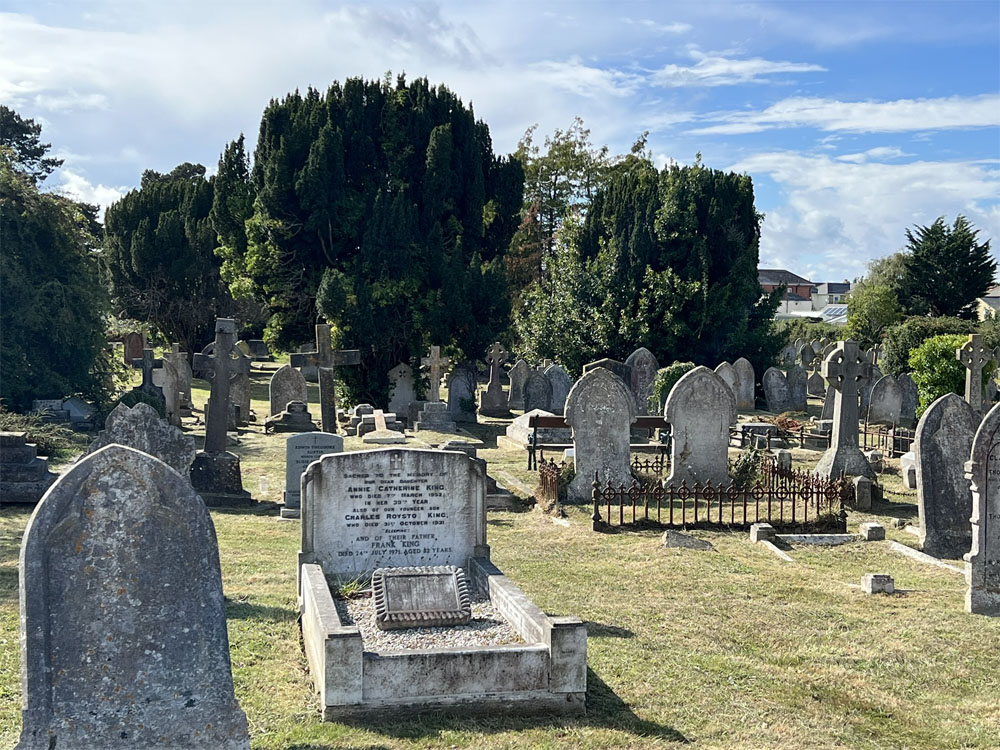

Ancestral Tourism 3: How to read a cemetery

Ryde Cemetery, Isle of Wight. © Janice Heppenstall

This is the third in my ‘Ancestral Tourism’ series, and follows on from posts about preparing for visiting Churches and Churchyards and Public & Municipal Centuries featuring in our ancestry. In those previous posts, the focus was on knowing the history, finding the records and then finding any maps of the churchyards and cemeteries. In this post we’re going to be ‘reading’ the burial ground. What can we deduce from the location, the headstone (or absence of a headstone), the symbolism and anything else that will give us clues as to our ancestor’s life and social standing?

Please be prepared before applying what follows to your own family that there is a possibility that not all your ancestors will have well-kept headstones in peaceful and picturesque settings within the churchyard or cemetery. Some may have been buried with unrelated people in common graves, with or without a headstone. This is part of their story, and the story of the times in which they lived, but it can be upsetting to find.

Consecrated or Unconsecrated?

As outlined in my last post, from the middle of the nineteenth century the Burial Acts required that half of any new Municipal or Public cemetery was to remain ‘unconsecrated’. The other half would therefore be ‘consecrated’. What does this mean?

Consecrated

  1. Dedicated to a sacred purpose; made sacred; hallowed, sanctified.
  2. Dedicated, ‘sacred’ to a tutelary divinity.
  3. figurative. Sanctioned by general observance or usage.

Oxford English Dictionary (Online)

Although the online Oxford English Dictionary gives the above definition, in relation specifically to burial grounds in England and Wales it is a centuries-old term referring to land that has been blessed and set apart for Christian burial according to the rites of the Church of England (in Wales now, Church in Wales). ‘Unconsecrated’ referred to any portion not blessed or made sacred according to those rites. Before the mid-1800s, when most burials took place in the graveyard of the parish church, the official burial had to be conducted by an Anglican clergyman in accordance with the Church of England prayer book service. This applied even to those who had, in life, followed different religious practices. However, such people were not eligible for burial within the Consecrated area of the graveyard. They were buried in a separate Unconsecrated section. This applied also to babies who died before they were baptised and, before 1823, to suicides.

Also mentioned in my last post, the development of the new Public Cemeteries from the 1820s and Municipal Cemeteries from the 1840s coincided with a greater acceptance and recognition of different religious practices. Here, the term ‘Consecrated’ was kept but now, in the ‘Unconsecrated’ portion of the cemetery, the burial service itself was likely to have been carried out in accordance with the rites of the deceased’s religion. Today there is greater recognition of the different rites and practices developed by different religions and cultures in commemorating their dead. Although some dedicated cemeteries exist, there are also separate areas for specific faiths within public cemeteries. However, back when our ancestors were being buried it was simply ‘Consecrated’ or ‘Unconsecrated’, and eventually over time the terms ‘Anglican’ and ‘Nonconformist’ came to be used. Although in England and Wales today we use the latter term for Protestants who are not part of the Church of England, in earlier times it was used for anyone whose religious beliefs differed from the established church, the Church of England. It therefore referred also to Roman Catholics, for example. As can be seen from the image above and that below, separate registers were kept for these two sections of the cemetery.

Follow the clues

Finding your ancestor in one or the other may come as a surprise. If so, this is extra valuable information about your ancestors. Precisely what it tells you will depend on the context. For example, all in the same cemetery:

  • My Irish-born 2x great grandfather’s burial is recorded on the very page you see above. He was buried in the Unconsecrated part because he was Roman Catholic.
  • My 4x great uncle’s burial is also in the Unconsecrated part. This is because he and his family worshipped at the Wesleyan chapel.
  • I had a question mark about the denomination of an ancestor from Ulster. He was buried in the Consecrated portion of the cemetery, but his first child with his English, Anglican, wife was baptised in the Roman Catholic church. His burial seem to settle the question… or did it? There remains the possibility that he was simply not a church goer, and by the time of his death his adult children just didn’t know he was actually Roman Catholic.
  • The burial of another 2x great grandfather in the Anglican part of the cemetery in 1898 was interesting because he took his own life. This gave me a reason to research the burial of suicides. Suicides had traditionally been buried at a crossroads, sometimes with a stake through the heart. The Burial of Suicides Act, 1823, banned such practices. It permitted burial of suicides in consecrated ground, but only at night and without a Christian service. With the passage of the nineteenth century came a greater understanding of mental health, and the term ‘Of unsound mind’ came to be used by Coroners. In 1882, the 1823 Act was repealed, and replaced with the Internments (felo de se) Act. This permitted the burial of those who had taken their own lives at any hour and with the usual religious rites, including in a churchyard at any hour. However, suicide would not be decriminalised until 1961.

Burying in style!

There were great differences between the funeral and burial practices of rich and poor. For the wealthy, this could be a no-expense-spared event from start to finish: an opportunity to be seen to be ‘doing things properly’ according to the etiquette that had grown up around funerals. Obituaries in the newspapers will give you an idea of the size and scale of a grand funeral.

In the cemetery there are more clues. These include the location of the grave. A prime position with good views cost more. It may also have been possible to pay extra for a nine foot deep grave rather than the usual six feet, although you won’t be able to see that from the grave itself. A deeper burial was thought to help preserve the body.

A range of funerary monuments were also available, ranging from mausolea, cenotaphs, tomb chests and sculptures to headstones and more simple marker stones. Historic England have produced a guide to Caring for Historic Cemetery and Graveyard Monuments which includes descriptions of the various types.

If you’d like to know more about a whole range of roles, customs and traditions linked to death and funerals, Friends of Beckett Street Cemetery in Leeds have compiled an excellent overview of Victorian funeral traditions and etiquette. Some of these would have been de rigeur amongst the wealthier folk but others applied more widely. Even when I was growing up I remember people closing the sitting room curtains after a death in the home.

Symbolism

Victorians loved symbolism, and the various monuments and gravestones were the perfect canvas for this form of expression. On their website, Arnos Vale Cemetery, Bristol, make the point that when larger public cemeteries started to appear, much of the population was not literate. The symbols found on graves made them more meaningful for someone who may not be able to read the words. Even today, if we understand the symbolism, a whole new layer of understanding opens up to us as we walk amongst the gravestones. Perhaps there might be clues on the gravestones of some of your ancestors, letting you know what was important to them and their loved ones. You might even come across some symbolism pointing you to membership of the Freemasons or similar, which would then open up a new line of research for you. The Funeral Directors association and Family Tree Magazine have also published useful lists of symbolism and meanings.

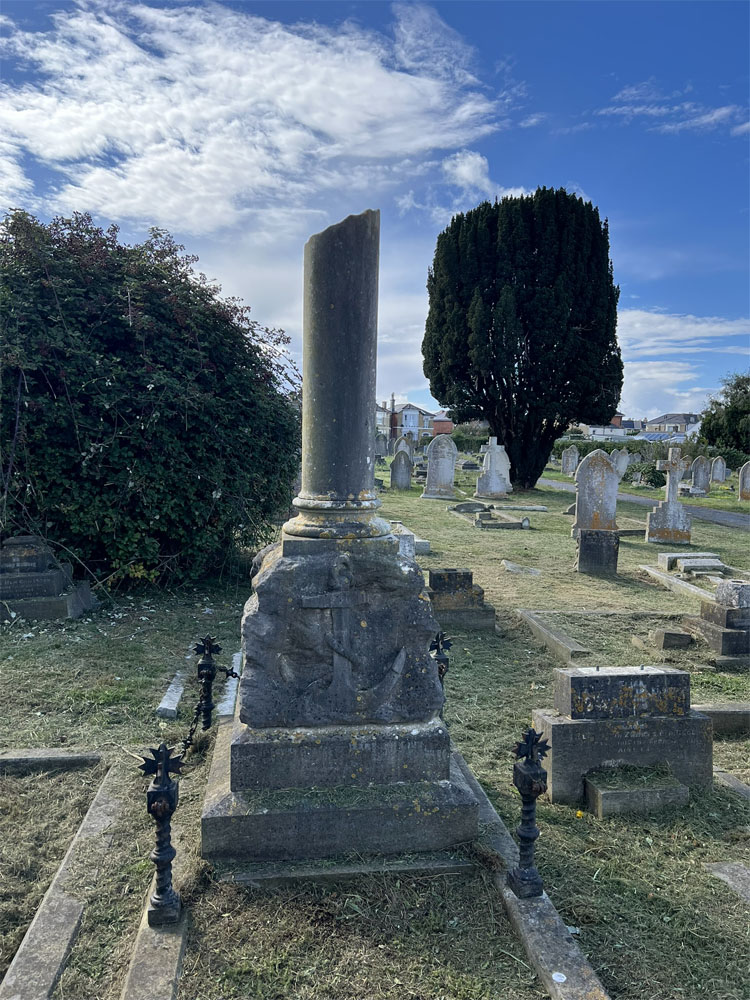
It was a surprise to walk around Ryde Cemetery after reading them and to note the symbolism on a lot of the stones and monuments. This ‘broken’ column represents a life cut short, and the anchor symbolises EITHER hope, steadfastness, and the secure connection to God or eternal life OR a seafaring life, perhaps with the Navy – or perhaps both. Since Ryde is on an island, either is possible and now I’m thinking I should have spent longer and read the inscription to find out more…

Symbolism of elaborate headstone in Ryde Cemetery, Isle of Wight. Image © Janice Heppenstall

Different types of grave

For those with the ability to pay for a private grave, there were:

  • single plots, intended for one person in a coffin
  • companion plots, intended for a couple, perhaps side by side
  • family plots, where several members of the same family can be buried together.

A certificate or “grave paper” documented the purchase. (I have one of these, purchased by a 2xG grandfather on the death of his wife in 1875.)

A purchased plot does not necessarily mean our ancestors will also have purchased a headstone, so you may need to navigate to your ancestor’s final resting place with the aid of only the plot number and a site map. The location of such plots, amongst others with headstones, should enable you to differentiate them from the common graves detailed below.

One of the motivations for the publicly-funded Municipal Cemeteries was the ability to provide for all social levels, including some lower cost options so that the labouring classes could afford to bury their dead with dignity.

A Common grave was a plot that belonged to the cemetery, not an individual or family, and was used to bury unrelated people. There were several different types of common grave, and the costs for the different types varied:

  • Lock-up graves: these were the cheapest type of grave. They were filled over the course of a few days as more bodies became ready for burial. Between each burial the soil was not replaced. Instead, a wooden ‘door’ was locked in place over the grave. When the grave had the required number of deceased people, the earth was piled on top. These were also called Open graves.
  • Public graves: like lock-up graves, these were filled up as newly deceased unrelated individuals became ready for burial. The difference is that these graves were refilled with earth after each new burial. They were therefore a little more expensive.
  • Note that ‘Pauper’s grave’ was not an official term and probably more rightly refers to the burial administration rather than to the grave itself – a Pauper’s burial. Essentially, before 1834, paupers were buried at the expense of the parish, and after that at the expense of the Board of Guardians. There was no unnecessary expense. The actual grave would have been one of the above types of common grave with no inscription, probably a lock-up grave where that was an option. Local authorities remain responsible today for the burial of a deceased person leaving no funds for a funeral and no one else to arrange it.
  • Inscription graves: For a small additional fee, a deceased person could be buried in a common grave but with a headstone inscribed with the name, date of death and age of every occupant. Some of the headstones may have had bodies arranged on both sides with inscriptions on both sides of the stone. These are a feature of the municipal cemeteries in Leeds – in fact every reference I have come across online relates to Beckett Street or another of the Leeds cemeteries. Here, they are known as ‘Guinea Graves’, that being the original cost of burial in one of these Inscription graves. If you are aware of this type of grave (Inscription or Guinea Graves) elsewhere in the country, please leave a comment saying where and by what term they are known – thanks.
Guinea Graves at Hunslet Cemetery © Stephen Craven at Wikipedia Commons

Some notes

For overseas readers (or very young British readers, perhaps!), a guinea was a British coin, originally minted in 1663 with a value of £1 (One Pound). Eventually it came to have the value of £1 – 1 s (One pound one shilling, i.e. 21 shillings). Even after the guinea coin ceased to circulate, the term remained as a unit of account worth 21 shillings. As late as the 1970s it was used for the quoting of professional fees and luxury items.

I have previously written about how to ‘read’ a Commonwealth War Graves Cemetery [here].

*****

I have become rather more fascinated with municipal cemeteries than anticipated! My next post will be about getting the most from different cemetery records, before returning in the post after that to Ancestral Tourism: houses and places our ancestors knew.

Ancestral Tourism 1: Churches and Churchyards

For many of us, there comes a time in our ancestral journey that we want to know more about the places where our ancestors lived. For the truly obsessed, this can take the form of a One-Place Study. However, for the majority of family historians, and indeed for many of our ancestors, simply visiting the place where they lived will be enough to provide that extra insight we’re looking for.

Bringing a companion

What might, for us, be termed ‘Ancestral Tourism’ could simply be an enjoyable day out for any family and friends accompanying us. The little stops and circuitous routes wouldn’t be too burdensome on companions, and might be thought to add dimension to a place.

I say this from a position of experience, since I’ve done quite a bit of visiting the ancestors over the years, often accompanied by my husband and dog. The trick is to intersperse the family history with other sightseeing and activities and, above all, to know where to draw the line. There are certain family history activities I would not expect anyone else to put up with. Obviously, visits to the archives and local history libraries fall within this bracket. I would also make a distinction between a small, picturesque churchyard and a huge, sprawling, possibly unkempt municipal cemetery. I would definitely walk alone around inner city industrial or derelict areas where ancestors used to live in streets and houses that no longer exist. For all of those, if I can’t make the time to go alone, I don’t go.

A bit of ancestral tourism can involve an hour’s diversion, or a full or half day during a week away. But whether we’re going alone or with companions, there are things we can do to plan ahead to ensure we make the most of our valuable time there.

What to see

There are certain buildings and features I home in on when visiting an ancestral town:

  • the churches or chapels where my ancestors were baptised, married or buried;
  • the churchyard;
  • municipal and/or public cemeteries;
  • former homes and work/business premises;
  • historic buildings and landmarks, and just getting to know the area;
  • pinpointing where an ancestral home that no longer exists used to be;
  • if I’m alone, probably the local County Record Office.

Perhaps you have more suggestions or useful experiences? If so please do leave a comment.

Today’s post will deal with churches and churchyards. The rest will be covered in future posts.

The church

Most of us will never see a photograph or portrait of any of our ancestors beyond the generation living in the last quarter of the nineteenth century.  I have long thought of the parish church as a stand-in.  

I take several photographs of the church from outside, and then if possible move inside to sit awhile and take more photos.  I have a particular connection with baptismal fonts. It seems very personal to me to know I’m standing exactly where my ancestors once stood, right before the font where their child, also my ancestor, was baptised. It’s almost like a portal to that long-ago time.  I also photograph the altar and any other significant features. Some of the churches are of wider historical significance, and beautiful to see. You may also find monuments on the walls or around the church honouring the memory of your ancestors, or possibly inscribed flagstones.

Before you go

It cannot be emphasised enough that you need to allow plenty of time for this research stage. You may need to spend quite a bit of time tracking down this information.

  • Chances are you already know which churches are important in your family history, since you’ll have records from the parish registers, but what we now need to do is look online to see if the church has a website. The Church of England has a site called A Church Near You which includes a page for each church. Some also have their own website with history and lots more information. There may also be information on a local history/ heritage website, or even a Facebook page.
  • For other denominations, Roman Catholic churches may be listed by diocese at The Catholic Church. Baptist churches may be found via The Baptist Union of Great Britain. Quaker Meeting Houses can be located via Quakers in Britain, and so on. Alternatively, you can do an online search for a specific known church or chapel. Again, what we need from all this is the website.
  • Really importantly, check when the church will be open.  Some are open for visitors to walk in any time, but many open only on certain days or certain times of the day, like for a regular lunch or coffee morning. The website may specifically give times when visitors are not welcome to wander around, and clearly we must be mindful of services and private prayer. Obviously, we can photograph the exterior even if the church is closed, but it’s always disappointing not to be able to go inside – and all the more so if you could have organised your visit for the following day when it would have been open.
  • Check that it is in fact the same church your ancestors used.  It may have been completely rebuilt, or at least renovated or had later additions.  Based on this information you may decide not to go – perhaps an image of the original church might be better for your needs.
  • Baptismal fonts, too, may have been replaced.  Again, it’s good to check this before you go. 
Twelfth century baptismal font carved of stone and set on a stone plinth in a church.

St Mary’s church at Kettlewell in Yorkshire’s Upper Wharfedale has been rebuilt twice since the original Norman church was founded in 1120. Of that original twelfth century church, all that remains is the baptismal font. My 7x great grandfather was baptised at this very font (but in the original Norman church) in 1678.

Image: © Janice Heppenstall

A quick tip!
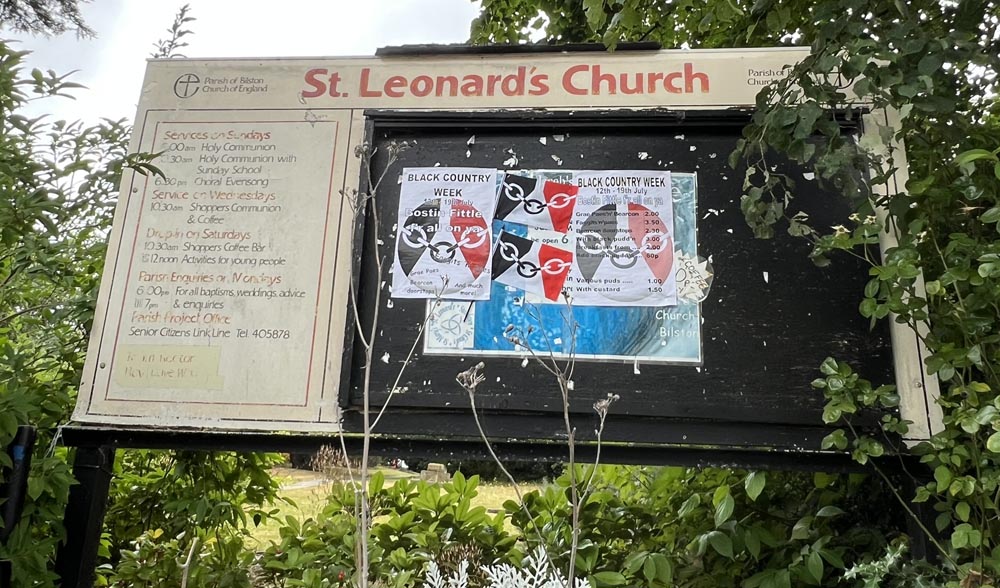
When visiting a lot of places on one trip you can easily forget which photos came from which church/ churchyard. I always take a photo of the noticeboard outside featuring the name of the church and other information.

If you can’t get there – or if the church has been rebuilt

  • Even if you can’t visit yourself, much of the above information is still useful and interesting. I always feel more of a connection if I’ve taken the photographs myself, but you will generally be able to find images online. Searching for your church (or any building of interest) and adding “wikimedia commons” to your search term will return a selection of images that are free to use provided you credit the photographer.
  • Paintings, sketches and engravings of a former church may also be located in this way, and while researching you might find other interesting information. Some of my ancestors were amongst the early dissenting worshippers at the Unitarian Mill Hill Chapel in Leeds. The present chapel was rebuilt around 1849, but images of the original chapel are to be found online. While following a link for one of these images I found [this article] and learned that some of the pillars of the original chapel were removed to a park in north Leeds. I will now have to try to work a visit to that park into a future ancestral tourism trip!

The churchyard

Strictly speaking, the cemetery alongside or adjacent to the church is referred to as the ‘churchyard’, ‘graveyard’ or ‘burial ground’.  Before around the mid-1800s, most burials – and not just burials of Anglicans – took place in the graveyard of the parish church. Although other denominations kept their own records of deaths/burials, the official burial had to be conducted by an Anglican clergyman in accordance with the Church of England prayer book service. You will therefore find burials of ancestors of different faiths in the Church of England parish registers – and you may also find additional records in the registers of their usual places of worship.

The parish register will give the name of the deceased, date of burial and possibly some additional information, such as date of death; if a child, the father’s name; if a woman, the husband’s name; and possibly the cause of death. What it rarely says is where, exactly, the person is buried and that’s unfortunate because that’s what we need right now. I have seen references on parish registers to ‘in the churchyard’; and my 8x great grandfather’s burial record states that he is buried in the ‘South Ile’ [South Aisle] at Wakefield All Saints. There would once have been an inscribed flagstone, but these have long been replaced and no map survives. When I visited I walked up and down the aisle a few times, certain that he was there somewhere but not knowing exactly where. So to be sure of finding our ancestor’s resting place, what we need is a map.

Extract from burial register, 1663.  The extract is in seventeenth century handwriting and reads 'South Ile Will[ia]m Clareburne de Westgate buried eodem die'
Will[ia]m Clareburne burial 6 Jul 1663, Wakefield All Saints.
Original data: West Yorkshire Archive Service; Reference: WDP3/1/3

Before you go … and this could take some time!

Find out if a map of the church and churchyard burials exists, and if so, where. Many thanks to friends/ colleagues at the South Central branch of AGRA for help with compiling this list:

  • An original map could be held at the church or at the local County Record Office
  • If at the Record Office, it is likely to be found under ‘Miscellaneous’ records for that particular parish.
  • If an official original record doesn’t exist, there is the possibility that volunteers may have compiled something
  • Some County Record Offices have maps compiled by their volunteers.
  • A map may have been drawn up by ‘Friends of’ a particular graveyard.
  • Often, the local Family History Society may have mapped a graveyard. You may need to be a paid member of the Society to access the information on their website; or you may find a map inside the church itself – it’s worth checking this before you visit.
  • There is the possibility that a map may be incomplete
  • An original map/record may be only partially complete.
  • For maps created by volunteers, unless they were working with an official/ original list of plots and names, there is the possibility that they may only be able to include occupants of plots as seen on headstones, and that remains in unmarked plots may not be included.
  • Even if the precise location of your ancestor’s grave is not known…
  • based on parish registers, time periods, and denomination, a church official may be able to tell you in which section of the graveyard your ancestor was buried.
  • Check if anyone in your family has a photograph of the headstone – making it easier to identify when you’re walking around the churchyard. Even a photograph of the unmarked grave may have clearly identifiable gravestones close by, thereby enabling you to work out the precise location of that unmarked grave.
  • You may find information online at FindAGrave. Although FindAGrave does not have maps, it gives precise plot information. My experience is that they tend to have more records from municipal cemeteries and that parish graveyards are perhaps at this stage an ongoing project.

In the future, it may become easier! The Church of England has created a digital map and database of all burial grounds in England. This does not include specific burial plots. However, the National Burial Grounds Survey (which I wrote about HERE) is under way and will eventually build into a detailed map and record of all burial plots for all Church of England dioceses signing up to the scheme. You’ll find a map of progress HERE and more information elsewhere on that website.

If you can’t get there

You may still be able to get plot information via one of the above resources, and possibly a photo of the gravestone. A general photo of the churchyard may be available online.

*****

I hope this has given you some ideas for visiting ancestral churches and churchyards – or indeed an ‘Ancestral Staycation’. My next post will look at visiting public and municipal cemeteries.

So why ‘English’ Ancestors?

This is a blog about English Ancestors – mine, and perhaps yours too.

But why ‘English’ ancestors?  Why not ‘British’?

Well, for the simple reason that whilst the principles and practice of ancestry will be the same the world over, the records and sometimes the knowledge required even for researching the various parts of the United Kingdom can be quite different.  My area of expertise is with English records.  I know, and am constantly learning more about, which English records would likely provide the information I need to help me progress.

That isn’t to say that my ancestry is entirely English.

I have connections to the island of Ireland – North and Eire – and would love to be able to trace my Irish roots further back in time.  Alas, the records can differ quite considerably from English ones.  What’s more, many – but not all – were destroyed in a huge fire at the Public Records Office in Dublin in 1922.  There’s also the issue of surnames: the same name may have been recorded in English or Gaelic, and with various spellings.  And on top of all that, records may never have existed in the first place.  I haven’t given up on my Irish roots; learning more about Irish family research is on the ‘To Do List’, but all my Irish forebears pre-date 1830, and I’ve accepted, sadly, that I may never find them.

So what about other parts of Great Britain?  I haven’t had much need to delve into the records of these nations, although there are as yet unproven hints of Scottish and Welsh ancestry in my research.  Scottish records too, have some differences in comparison with the English, with some Scotland-specific websites, such as Scotland’s People.  Even researching distant Welsh ancestors requires certain specialist knowledge; while the wide usage of certain surnames brings its own problems.  (My probable Welsh connections, for example involve the surnames Thomas and Jones, which I have found is like seeking a needle in a haystack!)

Researching our ancestry gives us knowledge and reason to celebrate every part of our roots.  Our ancestors’ stories and experiences are the back-story to our own lives: they are part of who we are.  Anyone who considers themselves ‘British through and through’ will likely have a mosaic of cultures and heritage running through their past.  I’m proud of my mysterious great great grandfather who seems to have hailed from Prussia.  I’m intrigued by the 10x great grandfather who likely reached these shores after fleeing religious persecution in Flanders or the Netherlands.  And being from Yorkshire, I’m delighted at the hefty chunk of Scandinavian in my DNA – my thousand year-old Viking roots.

But the English records are where most of my ancestors are to be found for the past few hundred years, and this is where my expertise has developed.  Since in this blog I hope, amongst other things, to show you how you can research your own family history, it seems appropriate to limit it to what I know best.

I hope you’ll join me. 🙂