Shackleton’s Fold: Exploring the area

This is the second video post in my Shackleton’s Fold One Place Study series.

A One Place Study brings together aspects of family history, local history and even house history. They are often carried out by family historians looking to learn more about their ancestors. A One Place Study might add new records, broaden out the focus or just bring a new perspective to our research.

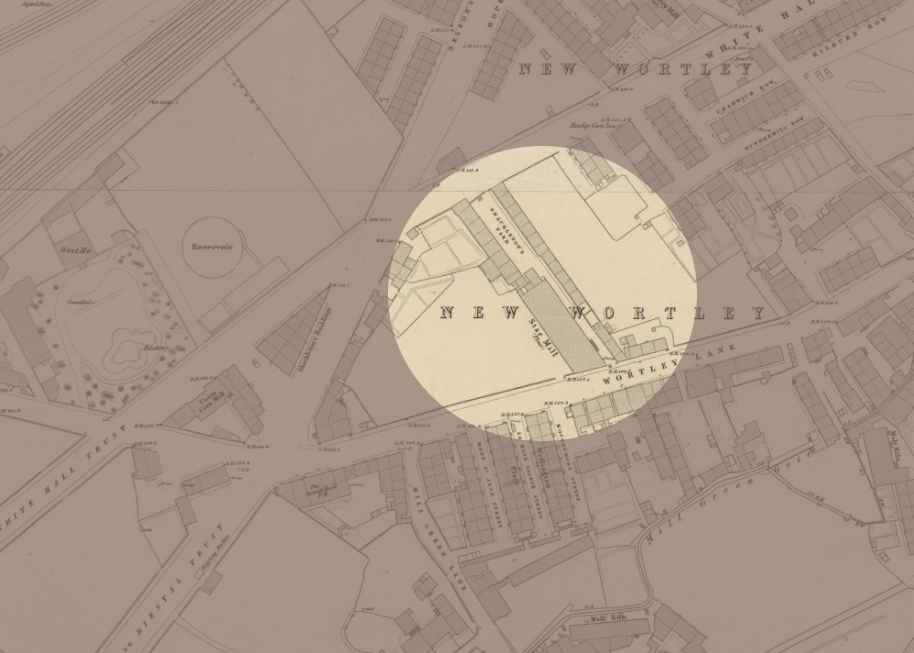
Shackleton’s Fold was a small ‘street’ of just nineteen houses that stood in the New Wortley area of Leeds for more than ninety years. It was demolished by the end of the 1930s. In the video linked below I use maps and old photos to try to explore the area where it once stood.

I found this process so useful in helping me to imagine what Shackleton’s Fold was like. Poring over old maps and finding photographs of buildings all around the Fold – alas none of Shackleton’s Fold itself – really helped me to focus.

I hope this video will be of interest to family historians, local historians and people doing or thinking of doing a One Place Study. In addition, people with a general interest in Leeds history, specifically the history of New Wortley may find it interesting.

I’m particularly keen to attract other family historians whose research has taken them back to Shackleton’s Fold between the mid 1840s and 1938. Alongside this visual exploration, I’m in the process of creating a database of every person on the censuses and every voter listed on the electoral registers. I’m looking for stories and photographs and would be very grateful if anyone could help out in that regard. I’ve already found some interesting stories.

If you fall into any of these categories, or know someone who does, please do share a link to this post and/or the YouTube link – and please ‘Like’ the video if you have a YouTube account. I hope you’ll find it useful.

Information and Links for photos and maps used

All photographs from Leodis:  https://Leodis.net
Go to Advanced search and key in the ID given.

  • JR Holmes and Star Maltings on Wortley Road, 1965.  ID: 2003729_72382754
  • Star Maltings and Shackleton’s Fold on Wortley Road, 1965.  ID: 2003729_99482364
  • View from St John’s Street to side view of Star Maltings and former Shackleton’s Fold, 1965. ID: 2003729_88186282
  • 107-109 Whitehall Road, with view of St John’s Street, 1965.  ID: 2003729_31147402
  • Whitehall Road School and Kildare Terrace, 1948.  ID: 5624
  • Whitehall Road School, 1948.  ID: 2818
  • Whitehall Road at the junction with Gelderd Road, Trolley and Tram Junction, undated but possibly 1911.  ID: 2011127_173010
  • St John’s Sunday School (bombed 24th/25th August 1940).  ID: 200828_166072
  • St John’s Street, from L to R: 11 to 15, 1965.  ID: 2003729_52465457

Tithe apportionment of Wortley (township in the parish of Leeds)
1846.  The National Archives, Kew.  Reference: IR 29/43/444

Ordnance Survey Maps located at National Library of Scotland Maps: https://maps.nls.uk
Reproduced with the permission of the National Library of Scotland

OS: Leeds Sheet 17: Surveyed: 1847,  Published: 1850. (Railway revision to c. 1854)
https://maps.nls.uk/view/229947015

OS 25-inch England and Wales: Leeds – Yorkshire CCXVIII.5.13: Surveyed: 1888,  Revised: 1910,  Published: 1911
https://maps.nls.uk/view/229947306

OS 25-inch England and Wales: Yorkshire CCXVIII.5: Revised: 1906, Published: 1908
https://maps.nls.uk/view/125642449

O.S: Yorkshire CCXVIII.5: Revised: 1932 to 1933, Published: 1934
https://maps.nls.uk/view/125642455
In search of Shackleton’s Fold (and other lost places)

Ordnance Survey: Leeds Sheet 13: Surveyed: 1847. Published: 1850.
Reproduced with the permission of the National Library of Scotland
https://maps.nls.uk/view/229947003 

The last post I published in my ‘Ancestral Tourism’ series focused on preparing for visiting former ancestral homes and business premises that are still standing. I said I would cover trying to locate buildings no longer in existence in a future post.

This is that future post. It finishes my Ancestral Tourism theme, and also forms part of my One Place Study on Shackleton’s Fold.

In this video linked below I provide two examples from my own family history of using maps, censuses, technology and sheer determination to work out where a property used to be. The first example is in Birmingham’s Deritend and Bordesley; the second is Shackleton’s Fold. If you have ‘disappeared’ houses in your ancestry, I hope you’ll find it helpful.

Please do ‘like’ it if you have a YouTube account. You could even ‘Subscribe’ to the channel if you want. It’s free. 🙂

As far as the Shackleton’s Fold theme is concerned, there will be at least two follow-on videos (currently in preparation). The first of these will use maps and old photos to focus on the area where it stood. In the second I turn detective and try to gather as many clues as possible about what Shackleton’s Fold looked like.

If you have ancestry in Shackleton’s Fold, New Wortley, Leeds (1840s-c.1938) and have an interesting family story about it, or a photograph of the street, I would love to hear from you. If you don’t have ancestry there but have access to a photograph of the street, again, please do contact me.

*****

The maps used in this video came from the National Libraries of Scotland Maps website, and as part of their permission to use I’m required to provide a link to each of the maps. Although I did put this information at the end of the video, these were not usable as hyperlinks to the original map online. I therefore provide all map information and links below.

Borough of Birmingham by J. Pigott-Smith: Sheet 190, Published: 1855
Public Domain (Wikimedia Commons)
This map is also available at the National Library of Scotland:
https://maps.nls.uk/view/260803014

Side by Side Map:  Google Maps, 2025:
Part of New Wortley, Leeds

The following maps are reproduced with the permission of the National Library of Scotland:

OS: Leeds Sheet 13
Surveyed: 1847,  Published: 1850. (Railway revision to c.1862)
https://maps.nls.uk/view/229947003

OS: OS 25-inch England and Wales: Yorkshire CCXVIII.5
Surveyed: 1888 to 1890, Published: 1893
https://maps.nls.uk/view/125642446

The Rotten and Pocket Boroughs of the Isle of Wight

This post is published to coincide with the release of my video presentation for All About That Place 2024: The Rotten and Pocket Boroughs of the Isle of Wight.

The 15-minute video starts with an overview of some useful information and terminology about voting arrangements for counties and boroughs throughout the United Kingdom before the Reform Act of 1832. This could be of relevance to your research interests if you have ancestry or a special place of interest anywhere in the UK. The information presented below the video will help you to find out if your place was a borough or a parliamentary borough; and if the latter, what the voting arrangements were. It will also help you to work out if your place was a rotten or pocket borough, and why. Some of the linked articles are quick and easy to navigate and will provide the information you need. Others are longer, in-depth reads. I hope you’ll find it all useful and interesting.

If you’d like to know more about the three places on the Isle of Wight mentioned in the video, there are links to more information about them too.

Information about the ‘Unreformed House of Commons’ (before 1832)

Check if your place of interest was a borough:
Wikipedia: Ancient Boroughs
Here you’ll find information about the history of boroughs right back to Anglo-Saxon times. Towards the end there is a list of English boroughs during the period 1307-1660 and an incomplete list of Welsh boroughs (with a request for additional information). You’ll notice some surprising ommissions. e.g. Manchester was granted borough status in 1301 but lost it in a court case in 1359.
Wikipedia: List of burghs in Scotland
In this list the ‘earlier burghal history’ of each modern day burgh ‘from the coming into force of the Burgh Police (Scotland) Act 1892’ is included. This is not, therefore, a complete list of all ancient Scottish burghs.

For a more scholarly and in-depth look at medieval borough charters, see:
John West: Town Records, 1983. London, Phillimore. Chapter 4: Medieval Borough Charters c.1042-1500.
Here we learn, for example, that Birmingham, omitted from the Wikipedia article, was granted the right to hold a weekly market in 1166 but this is known only by virtue of alternative records: no charter has survived.

Check if your place was a parliamentary borough:
Wikipedia: List of counties and boroughs of the unreformed House of Commons in 1800
Constituencies are listed for each of England, Wales, Scotland, Ireland by counties and boroughs, then special arrangements for certain Universities.

Check the voting qualification for your parliamentary borough (constituency):
The voting qualification is given in the List of counties and boroughs indicated above, but See also:
Wikipedia: Unreformed House of Commons
Scroll halfway down the page for a description of the different types of borough franchise.
Rural Historia: What is a Medieval Burgage Plot?

***Remember! Depending on the voting qualification type of your borough, there could be name-rich documents showing the names of the voters and how they voted.***

Check if your place was a ‘Rotten borough’ or ‘Pocket borough’:
See:
ECPPEC: Rotten Boroughs
This article includes a map showing all the Rotten Boroughs. They are all in England.
Wikipedia: Rotten and Pocket Boroughs
There’s an interesting list of references to Rotten Boroughs in literature and popular culture at the end of this page.
Wikipedia: List of constituencies enfranchised and disfranchised by the Reform Act 1832
The 1832 Reform Act did not resolve all ills in the political landscape, but it was a start. Some were disenfranchised entirely in 1832; for others, changes were made to their entitlement to political representation.
History of Parliament Online: The Constituencies [1754-1790]
A long read. Scroll down about one fifth of the page to reach the long section on The Boroughs. Dealing with each type of borough in turn (Freeholder, Corporation, etc) it shows how bribery, corruption and ‘patronage’ were at large in almost all of the boroughs at some level or another, not just in Rotten and Pocket boroughs. Examples of specific boroughs are given throughout so you may well find info about your place of interest here.

*****

Information about Newport, Newtown and Yarmouth on the Isle of Wight

Newport
Wikipedia: Newport, I.O.W. History of Parliamentary Constituency
Wikipedia: Newport, Isle of Wight
Visit Isle of Wight: Newport

Newtown
Wikipedia: Newtown, I.O.W. History of Parliamentary Constituency
Wikipedia: Newtown, Isle of Wight
I.O.W. History Centre: Medieval Newtown and the benefits of failure
This includes a useful modern-day map with medieval overlay showing the location (and preservation) of the original burgage plots.
National Trust: History of Newtown National Nature Reserve and Old Town Hall

Yarmouth
Wikipedia: Yarmouth, I.O.W. History of Parliamentary Constituency
Wikipedia: Yarmouth Town Hall, I.O.W.
Visit Isle of Wight: Yarmouth
C.W.R. Winter: The Ancient Town of Yarmouth, 1981, Isle of Wight Country Press, Newport. Viewed at: Isle of Wight Record Office.
A.G. Cole: Yarmouth Isle of Wight, 3rd edition, 1951,Isle of Wight Country Press, Newport. Viewed at: Isle of Wight Record Office.

There is a detailed discussion of the three Isle of Wight boroughs in:
Jack Donald Lavers: The Parliamentary History of the Isle of Wight 1779-1886, March 1991: M Phil thesis. Viewed at: Isle of Wight Record Office

Hallie Ribenhold: The Scandalous Lady W: an eighteenth century tale of sex, scandal and divorce. 2008, Vintage, London
Relates the story of Lady Seymour Worsley and her abusive husband, Sir Richard Worsley, baronet, of Appuldurcombe House, wroxall, I.O.W. He was MP for Newport 1774-1784, then for Newtown 1790-93 and 1796-1801. A fascinating read, which encompasses the position of women before the Married Women’s Property Acts and the availability of divorce, as well as rotten and pocket boroughs in operation. With the backing of other landed families, the Worsley family regularly represented all three of the Island’s boroughs.