
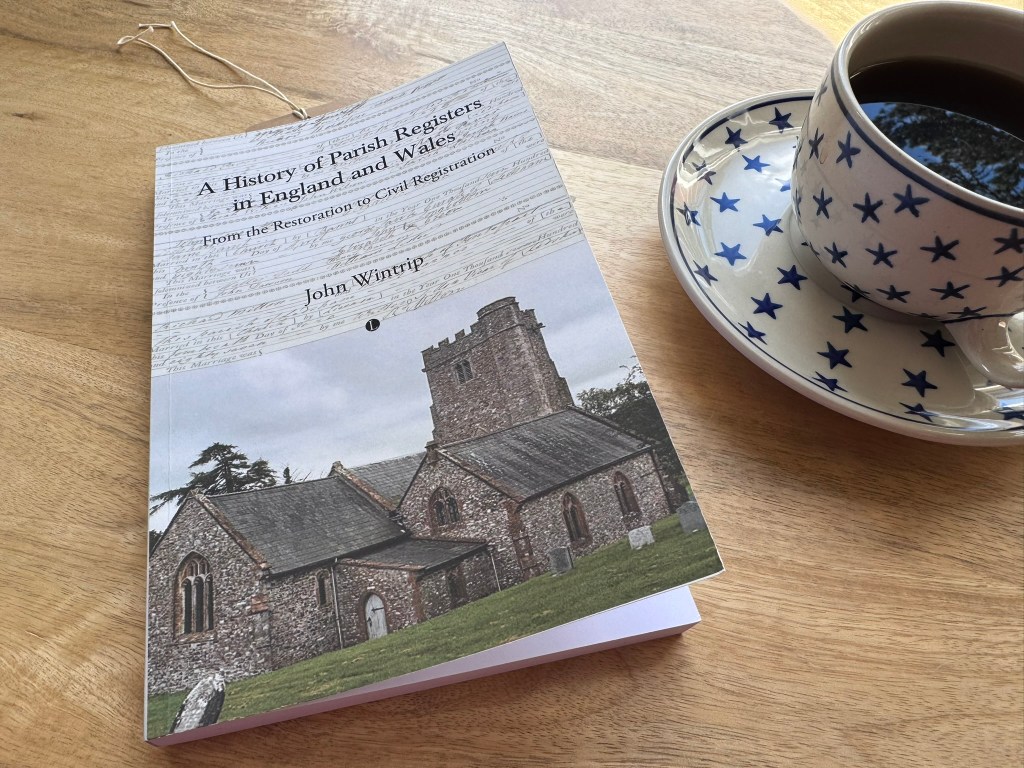
I first met John Wintrip when I applied to become an Associate of the Association of Genealogists and Researchers in Archives (AGRA). John was at that time Chair of the Board of Assessors. We met again several months later when I progressed to Member. I was struck by his encouraging manner and passion for genealogy, and was delighted when he asked me to review his latest book. In the interests of full disclosure, I received this copy of the book when I agreed to do the review. However, all views expressed below are my own.
The book is very readable. Indeed, the parish registers of England and Wales have been a personal passion for John for some time, being also the topic of original research culminating in his dissertation submitted for Licentiateship of the Institute of Heraldic and Genealogical Studies, awarded in 2019.
This is not a ‘How To’ manual. Rather it is an overview and account of the history and development of parish registers, the goal being to encourage readers to recognise changes in their format, and to understand what’s behind those changes and the references or symbols we sometimes come across alongside our ancestors’ entries in baptism, marriage and burial registers.
The focus of the book is the period 1660 to 1837. Nevertheless, a short summary chapter of the key issues of the earlier years (1538-1660) is included, as is a summary of the post-1837 era, when civil birth, marriage and death registration came into operation and the secular role of parish registers ended. Having set the direction of the book, the chapters are set out largely with a chronological account of the changes in three main periods: 1660 to 1753; 1754 to 1812; and 1813 to 1837. Each of these periods is recognisable to family historians as commencing with an important change impacting the keeping of parish registers. The Restoration in 1660 overturned the Commonwealth period rules for the maintenance of the registers as a civil matter and restored the diocesan structure of the Church; Hardwicke’s Marriage Act of 1753, implemented in 1754, brought in new strict rules for the administration of marriages; and 1813 saw the implementation of George Rose’s Act of 1812, which applied primarily to baptism and burial registers.
Taken as a whole, the period witnessed the transformation of a society ordered by the Church to a more diverse one, where secular and governmental matters gradually took precedence. The rules relating to parish registers were set down in 1604 by canon 70 of the Church of England. Yet parish registers were not simply a record of who had undergone the sacramental rites. Prior to the introduction of civil births, marriages and deaths in 1837, it was the local parish church that kept track of the population. Baptism entries evidenced paternity, while marriage enabled the presumption of paternity; and entries on marriage registers sealed the legal contract that placed the property and inheritance of the bride into the hands of her new husband. However, the decades following 1660 were characterised by a gradual acceptance of the right to religious freedom. This necessitated a recognition that, since it was the Church of England parish registers that evidenced paternity, property and inheritance rights, somehow the Dissenters needed to be accommodated within them.
Within this context, John outlines the gradual development from the early years in which often, baptism entries might simply have included the child’s name, to an understanding that the descent from one generation to the next also needed to be recorded. Although the rules governing the content and layout of parish registers, the writing surface used and even requirements for their safe keeping, were set down by canon 70, gradually accommodations were reached whereby births of the children of Dissenters/ Nonconformists could be included in registers and in burial arrangements.
John outlines the introduction of various requirements over time, such as ‘burial in wool’ and taxes on entries in parish registers – and how these might be identified in the parish registers. They are, of course, governmental intrusions into the parish registers, and further evidence of the secular aspect of the Church’s record-keeping. However, it was not until 1754 that the secular imperatives took precedence. In that year, with the implementation of Hardwicke’s Marriage Act, specifically ‘An Act for the Better Preventing of Clandestine Marriages’, marriage became subject to statute law. Although the circumstances in which marriages could take place had been set down by the Church in 1604, over time they had often been ignored, sometimes with serious consquences for respectable yet unwitting bigamous wives and their children, as well as ruined heiresses. Hardwicke’s Act set down new strict requirements for the administration and recording of marriages, alongside significant penalties for clergy who failed to comply. In a chapter entirely devoted to the paperwork created by this Act, John explains the administrative changes, the statutory requirements, the role of private printing companies in their interpretation and practice and many other aspects. This was also the first time the subjects of an entry in a parish register were required to sign. John covers reasons why the absence of a signature might be a choice, rather than evidence of our ancestor’s illiteracy or limited literacy skills. (It clarified an anomaly relating to one of my own 3x great grandfathers.)
Something all family historians come to realise is that the records we use for our research were never intended to be for our benefit; rather we are accidental beneficiaries. I was surprised, then, to learn that our pains were shared by antiquarians as long ago as the late seventeenth century. Prominent Leeds historian Ralph Thoresby (1658–1725) seems to have been the originator of the first published proposals for more detailed baptism and burial entries in 1715, but he was influenced in this by the fabulous register entries devised by Thomas Kirke in the nearby parish of Adel. (If you have access to Ancestry, they start here, in 1685, on page 2) Thoresby’s needs when searching the registers in the course of constructing pedigrees of prominent local families and for local history research led him, like us, to desire more information about the parentage or other family connections of the individuals recorded.
Over the course of the following decades, the developments we see when consulting parish registers, came about as a result of many men of the cloth improving the arrangement of their entries in the registers of their own parishes and sharing their ideas with fellow ministers; others publishing pamphlets with their ideas for improving the system; and in several dioceses after around 1770, the issuing of directives by bishops or archdeacons for the adoption of fuller register entries. There are chapters in the book devoted to initiatives in the dioceses of Carlisle, St Asaph and Norwich, the wonderful William Dade system recommended in the dioceses of York and Chester, and in Salisbury and Durham, where Shute Barrington’s recommendations were widely followed. (I previously wrote about the Dade Registers here.)
To reiterate my previous point, it is fortunate for us as genealogists that our passion for ancestor-hunting correlates so closely to more practical matters of wealth and inheritance. As Shute Barrington wrote in 1789:
“Real and extensive benefits would […] result from the introduction of a better form of register than that at present in common use. Ascertaining claims of property, especially maternal property, and the investigation of lineal and collateral descents, would be among those benefits.”
[Shute, Lord Bishop of Sarum, extract from A Letter to the Clergy of the Diocese of Sarum (Salisbury: Printed by B.C.Collins, 1789) In: John Wintrip: A History of Parish Registers in England and Wales from the Restoration to Civil Registration. Appendix 10]
Indeed, so good were the entries in some parts of the country that when, following the Rose Act of the previous year, standard printed papers for baptisms and burials were introduced in 1813, the absence of dedicated spaces for the actual date of birth and for the mother’s maiden name was viewed by some as an extremely retrograde step. Some ministers continued to include the same information as they had done previously, fitting the extra notes into the tabulated forms now required.
Who will benefit from this book?
It will be useful for anyone starting to work with earlier parish registers. The combination of the chronological layout, broken into identifiable topics via chapter headings and more focused searching in the index when you come across some inexplicable symbol or abbreviation in a parish register, should cover all bases. (I will certainly be doing this from time to time!) All of that is reinforced by a useful timeline of major changes and proposals for change at Appendix 1. When we know about diocesan-wide changes in register entries, but our ancestor falls just outside the operative dates, it’s sometimes useful to switch to older or younger siblings to get the extra information from their baptisms.
However, there is likely to be new information even for more advanced genealogists. Amongst the new finds for me was that, although the terms ‘baptism’ and ‘christening’ are largely interchangeable in the Church of England, a practical distinction has sometimes been made between them in connection with arrangements for private baptisms.
Discussion of ‘Day Books’ also provided food for thought. Although the rules set down in 1604 required that the registers be completed on a weekly basis by the vicar in the presence of at least one of his churchwardens, in practice many kept a Day Book to record baptisms and burials as they happened, writing the notes into the parchment registers at a later date – often much later. The whole issue of ‘originals’ and ‘transcriptions’ is of much importance to genealogists: the original or a digital image of it is always to be preferred; and that means the parish register. But what if the parish register is not, in fact, the ‘original’? What if, in copying over information from the Day Book to the official register, mistakes were made, or entries left out, or worse still – if the entire Day Book goes missing before they are copied across?
With an interest in social history, alongside the detailed focus upon parish registers, I found myself thinking of the impact on society, what was happening in the country to bring about these changes when they happened, and how did they affect the ordinary person.
Whilst reading, knowing that some of the information related to parishes with which I’m well acquainted, I found myself going back to my own and other family trees I’ve worked on, to check if the wording on these specific entries complied with the new rules. I confess I hadn’t realised that some of the more modest ‘enhanced’ entries were the result of directions from the bishop; I had assumed them to be personal preferences of the parish incumbent.
In conclusion, I found John’s book to be readable, authoritative and meticulously researched. While his focus here is on the parish registers themselves, when the point under discussion encompasses a broader question, footnotes point to other texts where that issue is more fully discussed. Other key texts are reprinted in the appendices, and the various changes in registers are illustrated throughout.
John Wintrip: A History of Parish Registers in England and Wales from the Restoration to Civil Registration is published by The Lutterworth Press, Cambridge, 2026.
ISBN 978 0 718 89848 9

