
John Mann was born 26th December 1792 and baptised four days later at Norwich St Michael at Thorn. He is my 4x great uncle, but for years I knew nothing more about him. He seemed simply to have disappeared. Eventually, a set of military discharge papers came online via FindMyPast.1 Through them I learned something really exciting: My 4x great uncle John was at the Battle of Waterloo!
A close reading of the nine pages of his discharge papers provided the following information:
- He enlisted with the Royal Horse Artillery in 1807, when he was fourteen (…so that’s where he went!)
- He served at the Battle of Waterloo as a Driver (meaning he rode a horse, working as part of a team that pulled cannon, ammunition limbers, and wagons), after which he served in France as part of the Army of Occupation
- All other service was in England and Ireland; no dates or locations were given
- On 1st July 1820 he was promoted to the rank of Trumpeter
- He was discharged on 30th September 1832 after treatment in the Royal Ordnance Hospital following a fit of palsy fourteen months earlier, in Dublin.
- There were testimonies from several high-ranking officers: John was held in high regard.
- One tantalising piece of information was a comment from Lieutenant Colonel Whinyates, who stated that John had a large family and had ‘brought them up in a most creditable manner’.
Tantalising, of course, because I had absolutely no idea of any of their names, nor where they were born, nor even how many children there were. Since the discharge papers are dated 1832, these children were clearly all born before the introduction of Civil Births, Marriages and Deaths, and before the first name-rich decennial census in 1841. Clearly, the marriage, too would have taken place before these changes.
My research objective was to use all these clues to find John, his wife, and all his children
But where to start?
John Mann is a common Norfolk name. The only search parameters I had were “John Mann” + “born Norwich 1792” with effectively a nationwide search. The search was further compromised by a tendency for modern transcribers to get this surname wildly wrong. e.g. Although original spellings are always Mann or Man, I have seen it indexed as ‘Cooke’.
One more document was on my radar. There was a John Mann of the right age with the right birthplace living in Leeds at the time of the 1851 Census. There was no evidence at all to confirm that this was my John Mann, and in fact my assumption was that it was not. John was the brother of my 3x great grandfather who had been a silk weaver in Norwich, migrated to Blubberhouses in Yorkshire for work, and eventually moved to the Leeds area for work at a large mill in Holbeck. It seemed too tidy that his brother John, having led quite a different life, would coincidentally have ended up living just a mile away in the same large northern industrial town, for no apparent reason. If I were to be able to accept this as my John Mann, definite corroborative evidence would be needed.
A stroke of luck: locating the 1841 Census entry
The eventual location of the 1841 Census entry for a John Mann and family in Leeds permitted further research. It had not previously been identified because it had been indexed on Ancestry.co.uk as “Marson”. This document was key: all later discoveries about John and his family flow from it.
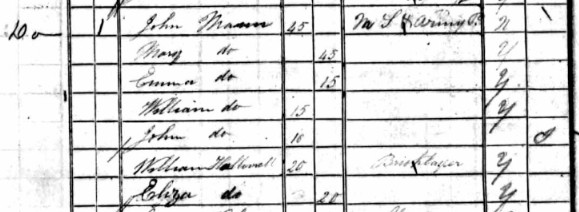
John Mann (age 45, occupation: ‘M[ale] S[ervant] & Army P[ensioner]’) was living at Brick Street, Leeds, with Mary (45), Emma (15), William (15) and John (10). William and Eliza Hallawell (both 20) were at the same property. Birthplaces are significant: John senior’s birthplace was England or Wales but not Yorkshire, while John junior was born in Ireland: his age and birthplace fit with information on John senior’s Discharge Papers which indicate he was in Ireland prior to and until July 1831. Everyone else was born in Yorkshire.2
This was almost certainly the same couple previously identified in the 1851 Census: John Mann (58, occupation ‘Groom Pensioner’) and wife Mary (54), residing 21 Brick Street. Therefore John, born Norwich, c.1793, now receiving a pension, had worked with horses in a military capacity. Mary’s birthplace was Pontefract. Age discrepancies are explained by the 1841 census instruction to enumerators to round down the ages of people over fifteen years to the nearest five.
Information flowing from death records
Neither John nor Mary being located on the 1861 Census, both were found on the General Register Office (GRO) Death Index and local cemetery register (Beckett Street), and also a photograph of the headstone. John, 58, died 17 September 1851, and was buried 21 September. Still resident at Brick Street, the occupation recorded was ‘servant’. Mary, dying 30 August 1857, was buried 2 September. She was 62/63 and widowed. Both were buried as Nonconformists.
The headstone image3 provided further useful information:
- Son John died 17 June 1849, aged 18. This ties in with the 1830-31 birth in Ireland.
- Grandson Arthur William Cudbartson died 4 September 1855
- Walter Ernest Hallewell died 6 March 1857, aged 17 months.
- Hallewell being the second surname at the family home in 1841, this suggests the Eliza Hallewell on that record is the oldest child of John and Mary, and that William Ernest is her son. It also suggests Cudbartson as the married name of daughter Emma. All new information from the headstone was verified by GRO Birth and Death Indexes. Both birth records indicate mothers’ maiden name of Mann.
These suspected marriages were then confirmed by parish register entries (online digital images of original documents).
- Eliza married William Hallewell 18 July 1840 at Leeds
- Emma married Charles Frederick Cudbartson 8 April 1849 at Leeds
- Son William married Elizabeth Taylor 15 March 1847 at Rothwell
Pontefract: baptisms
Armed with marriage details we can now identify Eliza, Emma and William in the 1851 Census. (Online digital images of original documents.) This provides us with the actual birthplace for each, which of course is not available on the 1841 Census. The various entries indicate the birthplace for all as Pontefract, Yorkshire.
This new information regarding specific birthplaces facilitated location of baptisms:
- Eliza: Eliza, 25 June 1820
- Emma: 10 Nov 1822
- William: 11 April 1824
All three baptisms took place at Pontefract St Giles/ St Mary. The marriage of John Mann and Mary Dawson is recorded at the same church on 6 September 1819. As noted above, Pontefract is also Mary’s birthplace.
Apart from son John who died 17 June 1849, aged 18, and is known to have been born in Ireland, only one more son has been identified as the child of John and Mary. A birth record for Alfred Robert Mann was located on the GRO Index. The mother’s maiden name of Dawson is correct. Alfred Robert died in August 1840, aged fourteen months. The ‘abode’ recorded on the burial record is Brick Street, which matches the 1841 and 1851 Censuses. The baptism and burial services at St Peter’s Wesleyan Chapel, are consistent with the move to Nonconformity, suggesting John and Mary’s own religious burial records may also be found here.
Detailed examination of the Pontefract registers reveals no further children for John and Mary there. This might point to miscarriage, stillbirth, simply no pregnancy, or removal to Ireland, where son John was born, 1830-31. Without a precise location, no attempt has yet been made to locate John’s or any other baptism/burial in Irish parish records. Indeed, any such records may not have survived. If there were other children, their births would have predated the introduction of Civil Births, Marriages and Deaths; and given that the movements of John and his family are not fully known, finding all additional children could not be guaranteed. Certainly, no other children survived to adulthood.
Using the same records to develop John’s military timeline
The Pontefract baptism and marriage records outlined above also provide information about John’s Royal Horse Artillery career. Not only do they suggest he was stationed there for the years the children were born; the register entries themselves record details of his progress within the Royal Horse Artillery. Only Emily’s and William’s baptisms record John as Trumpeter. This supports evidence on the Discharge Papers of his promotion on 1 July 1820, and that was six days after Eliza’s baptism.
These records evidence that John was stationed in Pontefract from before September 1819 to some time after April 1824. Wider examination of Pontefract baptism registers from 1818 to 1830 shows that between 1820-1825 forty-eight babies of fathers serving with the RHA were baptised. After this, baptisms reduce to just four in 1826-27, and then none. This could point to mobilisation to Ireland circa 1827.
Ongoing research
It is interesting that this research into John started with a little information on his military Discharge Papers – just enough clues to permit corroboration of, and following through on, the information on the Leeds Census documentation. That information, followed up with newspaper reports, military records and wider reading, then enabled the placement of John within a specific Troop during the years after Waterloo and before his discharge in 1832. What has not yet been possible is locating him within a definite Troop at Waterloo, although this has been narrowed down to two. Within the next year I plan to do more research focused on the Royal Horse Artillery troops to try to locate him at a specific place in Ireland, and also to try to find out more about the two troops at Waterloo. After that I would like to visit Waterloo. The circle would be completed if this information also helped me to locate a baptism for son John in Ireland and perhaps any other births of children at the same location.
However, for now, I’m happy to have achieved something that, initially, I didn’t think would be achievable. I have followed up on a single phrase on John’s discharge papers: that John had a large family and had ‘brought them up in a most creditable manner’, and I have tracked down him and all those children. One thing I wish I knew, and never will: did John and his brother Thomas (my 3x great grandfather) each know the other was in Leeds? I like to think they might, but both arrived there by complete coincidence and it’s entirely possible that they lived a mile or so apart for eight years without ever knowing the other was there.
This is the resulting family tree. Click for a better view.

- John Mann, Royal Hospital Chelsea: Soldiers Service Documents 1760-1854, Original data: The National Archives WO 97/1249/78. Source: www.findmypast.co.uk ↩︎
- John Marson [Mann], 1841 England Census. Original data: The National Archives, Class: HO107; Piece: 1347; Book: 2; Civil Parish: Leeds Town; Enumeration District: 24; Folio: 20; Page: 2. Source: www.ancestry.co.uk ↩︎
- John Mann, Family burial plot, UK and Ireland Find A Grace Index entry with headstone photograph, https://www.findagrave.com/memorial/234824558/john-mann ↩︎


