John Wintrip: A History of Parish Registers in England & Wales

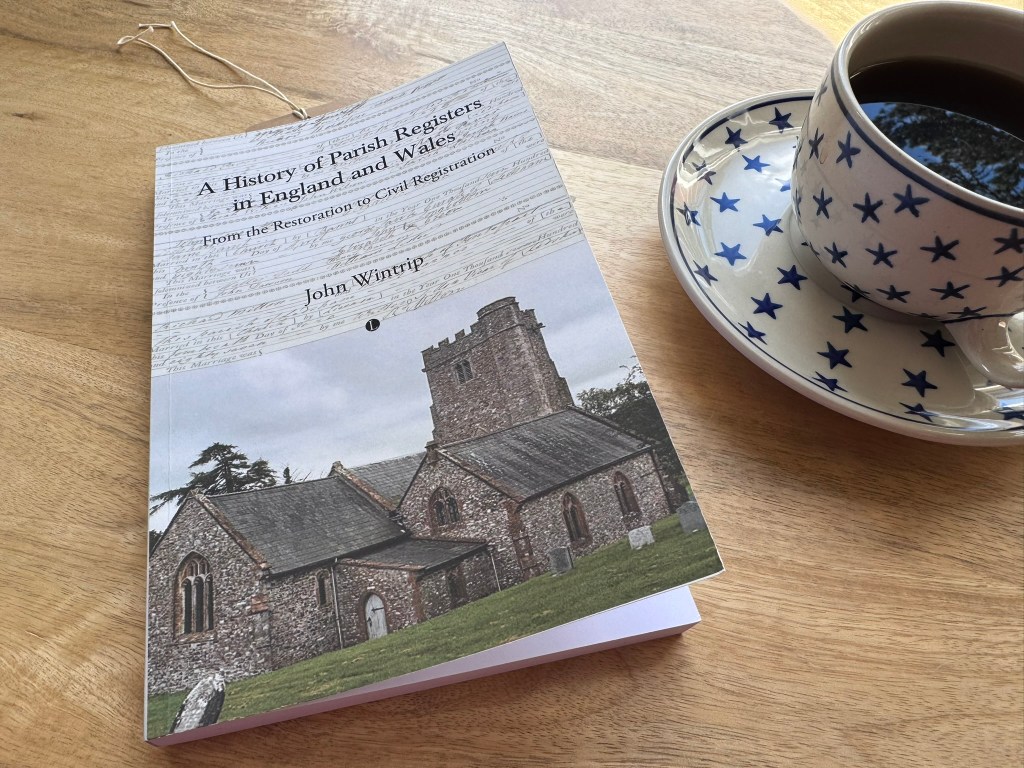
I first met John Wintrip when I applied to become an Associate of the Association of Genealogists and Researchers in Archives (AGRA). John was at that time Chair of the Board of Assessors. We met again several months later when I progressed to Member. I was struck by his encouraging manner and passion for genealogy, and was delighted when he asked me to review his latest book. In the interests of full disclosure, I received this copy of the book when I agreed to do the review. However, all views expressed below are my own.

The book is very readable. Indeed, the parish registers of England and Wales have been a personal passion for John for some time, being also the topic of original research culminating in his dissertation submitted for Licentiateship of the Institute of Heraldic and Genealogical Studies, awarded in 2019.

This is not a ‘How To’ manual. Rather it is an overview and account of the history and development of parish registers, the goal being to encourage readers to recognise changes in their format, and to understand what’s behind those changes and the references or symbols we sometimes come across alongside our ancestors’ entries in baptism, marriage and burial registers.

The focus of the book is the period 1660 to 1837. Nevertheless, a short summary chapter of the key issues of the earlier years (1538-1660) is included, as is a summary of the post-1837 era, when civil birth, marriage and death registration came into operation and the secular role of parish registers ended. Having set the direction of the book, the chapters are set out largely with a chronological account of the changes in three main periods: 1660 to 1753; 1754 to 1812; and 1813 to 1837. Each of these periods is recognisable to family historians as commencing with an important change impacting the keeping of parish registers. The Restoration in 1660 overturned the Commonwealth period rules for the maintenance of the registers as a civil matter and restored the diocesan structure of the Church; Hardwicke’s Marriage Act of 1753, implemented in 1754, brought in new strict rules for the administration of marriages; and 1813 saw the implementation of George Rose’s Act of 1812, which applied primarily to baptism and burial registers.

Taken as a whole, the period witnessed the transformation of a society ordered by the Church to a more diverse one, where secular and governmental matters gradually took precedence. The rules relating to parish registers were set down in 1604 by canon 70 of the Church of England. Yet parish registers were not simply a record of who had undergone the sacramental rites. Prior to the introduction of civil births, marriages and deaths in 1837, it was the local parish church that kept track of the population. Baptism entries evidenced paternity, while marriage enabled the presumption of paternity; and entries on marriage registers sealed the legal contract that placed the property and inheritance of the bride into the hands of her new husband. However, the decades following 1660 were characterised by a gradual acceptance of the right to religious freedom. This necessitated a recognition that, since it was the Church of England parish registers that evidenced paternity, property and inheritance rights, somehow the Dissenters needed to be accommodated within them.

Within this context, John outlines the gradual development from the early years in which often, baptism entries might simply have included the child’s name, to an understanding that the descent from one generation to the next also needed to be recorded. Although the rules governing the content and layout of parish registers, the writing surface used and even requirements for their safe keeping, were set down by canon 70, gradually accommodations were reached whereby births of the children of Dissenters/ Nonconformists could be included in registers and in burial arrangements.

John outlines the introduction of various requirements over time, such as ‘burial in wool’ and taxes on entries in parish registers – and how these might be identified in the parish registers. They are, of course, governmental intrusions into the parish registers, and further evidence of the secular aspect of the Church’s record-keeping. However, it was not until 1754 that the secular imperatives took precedence. In that year, with the implementation of Hardwicke’s Marriage Act, specifically ‘An Act for the Better Preventing of Clandestine Marriages’, marriage became subject to statute law. Although the circumstances in which marriages could take place had been set down by the Church in 1604, over time they had often been ignored, sometimes with serious consquences for respectable yet unwitting bigamous wives and their children, as well as ruined heiresses. Hardwicke’s Act set down new strict requirements for the administration and recording of marriages, alongside significant penalties for clergy who failed to comply. In a chapter entirely devoted to the paperwork created by this Act, John explains the administrative changes, the statutory requirements, the role of private printing companies in their interpretation and practice and many other aspects. This was also the first time the subjects of an entry in a parish register were required to sign. John covers reasons why the absence of a signature might be a choice, rather than evidence of our ancestor’s illiteracy or limited literacy skills. (It clarified an anomaly relating to one of my own 3x great grandfathers.)

Something all family historians come to realise is that the records we use for our research were never intended to be for our benefit; rather we are accidental beneficiaries. I was surprised, then, to learn that our pains were shared by antiquarians as long ago as the late seventeenth century. Prominent Leeds historian Ralph Thoresby (1658–1725) seems to have been the originator of the first published proposals for more detailed baptism and burial entries in 1715, but he was influenced in this by the fabulous register entries devised by Thomas Kirke in the nearby parish of Adel. (If you have access to Ancestry, they start here, in 1685, on page 2) Thoresby’s needs when searching the registers in the course of constructing pedigrees of prominent local families and for local history research led him, like us, to desire more information about the parentage or other family connections of the individuals recorded.

Over the course of the following decades, the developments we see when consulting parish registers, came about as a result of many men of the cloth improving the arrangement of their entries in the registers of their own parishes and sharing their ideas with fellow ministers; others publishing pamphlets with their ideas for improving the system; and in several dioceses after around 1770, the issuing of directives by bishops or archdeacons for the adoption of fuller register entries. There are chapters in the book devoted to initiatives in the dioceses of Carlisle, St Asaph and Norwich, the wonderful William Dade system recommended in the dioceses of York and Chester, and in Salisbury and Durham, where Shute Barrington’s recommendations were widely followed. (I previously wrote about the Dade Registers here.)

To reiterate my previous point, it is fortunate for us as genealogists that our passion for ancestor-hunting correlates so closely to more practical matters of wealth and inheritance. As Shute Barrington wrote in 1789:

“Real and extensive benefits would […] result from the introduction of a better form of register than that at present in common use. Ascertaining claims of property, especially maternal property, and the investigation of lineal and collateral descents, would be among those benefits.”

[Shute, Lord Bishop of Sarum, extract from A Letter to the Clergy of the Diocese of Sarum (Salisbury: Printed by B.C.Collins, 1789) In: John Wintrip: A History of Parish Registers in England and Wales from the Restoration to Civil Registration. Appendix 10]

Indeed, so good were the entries in some parts of the country that when, following the Rose Act of the previous year, standard printed papers for baptisms and burials were introduced in 1813, the absence of dedicated spaces for the actual date of birth and for the mother’s maiden name was viewed by some as an extremely retrograde step. Some ministers continued to include the same information as they had done previously, fitting the extra notes into the tabulated forms now required.

Who will benefit from this book?
It will be useful for anyone starting to work with earlier parish registers. The combination of the chronological layout, broken into identifiable topics via chapter headings and more focused searching in the index when you come across some inexplicable symbol or abbreviation in a parish register, should cover all bases. (I will certainly be doing this from time to time!) All of that is reinforced by a useful timeline of major changes and proposals for change at Appendix 1. When we know about diocesan-wide changes in register entries, but our ancestor falls just outside the operative dates, it’s sometimes useful to switch to older or younger siblings to get the extra information from their baptisms.

However, there is likely to be new information even for more advanced genealogists. Amongst the new finds for me was that, although the terms ‘baptism’ and ‘christening’ are largely interchangeable in the Church of England, a practical distinction has sometimes been made between them in connection with arrangements for private baptisms.

Discussion of ‘Day Books’ also provided food for thought. Although the rules set down in 1604 required that the registers be completed on a weekly basis by the vicar in the presence of at least one of his churchwardens, in practice many kept a Day Book to record baptisms and burials as they happened, writing the notes into the parchment registers at a later date – often much later. The whole issue of ‘originals’ and ‘transcriptions’ is of much importance to genealogists: the original or a digital image of it is always to be preferred; and that means the parish register. But what if the parish register is not, in fact, the ‘original’? What if, in copying over information from the Day Book to the official register, mistakes were made, or entries left out, or worse still – if the entire Day Book goes missing before they are copied across?

With an interest in social history, alongside the detailed focus upon parish registers, I found myself thinking of the impact on society, what was happening in the country to bring about these changes when they happened, and how did they affect the ordinary person.

Whilst reading, knowing that some of the information related to parishes with which I’m well acquainted, I found myself going back to my own and other family trees I’ve worked on, to check if the wording on these specific entries complied with the new rules. I confess I hadn’t realised that some of the more modest ‘enhanced’ entries were the result of directions from the bishop; I had assumed them to be personal preferences of the parish incumbent.

In conclusion, I found John’s book to be readable, authoritative and meticulously researched. While his focus here is on the parish registers themselves, when the point under discussion encompasses a broader question, footnotes point to other texts where that issue is more fully discussed. Other key texts are reprinted in the appendices, and the various changes in registers are illustrated throughout.

John Wintrip: A History of Parish Registers in England and Wales from the Restoration to Civil Registration is published by The Lutterworth Press, Cambridge, 2026.
ISBN 978 0 718 89848 9

Shackleton’s Fold: Exploring the area

This is the second video post in my Shackleton’s Fold One Place Study series.

A One Place Study brings together aspects of family history, local history and even house history. They are often carried out by family historians looking to learn more about their ancestors. A One Place Study might add new records, broaden out the focus or just bring a new perspective to our research.

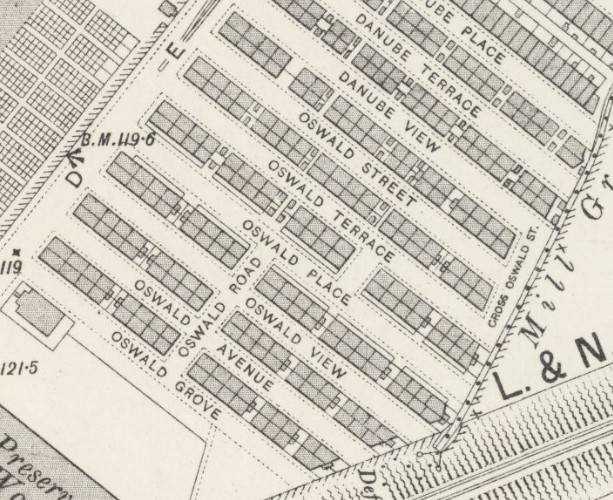
Shackleton’s Fold was a small ‘street’ of just nineteen houses that stood in the New Wortley area of Leeds for more than ninety years. It was demolished by the end of the 1930s. In the video linked below I use maps and old photos to try to explore the area where it once stood.

I found this process so useful in helping me to imagine what Shackleton’s Fold was like. Poring over old maps and finding photographs of buildings all around the Fold – alas none of Shackleton’s Fold itself – really helped me to focus.

I hope this video will be of interest to family historians, local historians and people doing or thinking of doing a One Place Study. In addition, people with a general interest in Leeds history, specifically the history of New Wortley may find it interesting.

I’m particularly keen to attract other family historians whose research has taken them back to Shackleton’s Fold between the mid 1840s and 1938. Alongside this visual exploration, I’m in the process of creating a database of every person on the censuses and every voter listed on the electoral registers. I’m looking for stories and photographs and would be very grateful if anyone could help out in that regard. I’ve already found some interesting stories.

If you fall into any of these categories, or know someone who does, please do share a link to this post and/or the YouTube link – and please ‘Like’ the video if you have a YouTube account. I hope you’ll find it useful.

Information and Links for photos and maps used

All photographs from Leodis:  https://Leodis.net
Go to Advanced search and key in the ID given.

  • JR Holmes and Star Maltings on Wortley Road, 1965.  ID: 2003729_72382754
  • Star Maltings and Shackleton’s Fold on Wortley Road, 1965.  ID: 2003729_99482364
  • View from St John’s Street to side view of Star Maltings and former Shackleton’s Fold, 1965. ID: 2003729_88186282
  • 107-109 Whitehall Road, with view of St John’s Street, 1965.  ID: 2003729_31147402
  • Whitehall Road School and Kildare Terrace, 1948.  ID: 5624
  • Whitehall Road School, 1948.  ID: 2818
  • Whitehall Road at the junction with Gelderd Road, Trolley and Tram Junction, undated but possibly 1911.  ID: 2011127_173010
  • St John’s Sunday School (bombed 24th/25th August 1940).  ID: 200828_166072
  • St John’s Street, from L to R: 11 to 15, 1965.  ID: 2003729_52465457

Tithe apportionment of Wortley (township in the parish of Leeds)
1846.  The National Archives, Kew.  Reference: IR 29/43/444

Ordnance Survey Maps located at National Library of Scotland Maps: https://maps.nls.uk
Reproduced with the permission of the National Library of Scotland

OS: Leeds Sheet 13: Surveyed: 1847, Published: 1850. (Railway revision to c. 1862)
https://maps.nls.uk/view/229947003

OS: Leeds Sheet 17: Surveyed: 1847,  Published: 1850. (Railway revision to c. 1854)
https://maps.nls.uk/view/229947015

OS 25-inch England and Wales: Leeds – Yorkshire CCXVIII.5.13: Surveyed: 1888,  Revised: 1910,  Published: 1911
https://maps.nls.uk/view/229947306

OS 25-inch England and Wales: Yorkshire CCXVIII.5: Revised: 1906, Published: 1908
https://maps.nls.uk/view/125642449

O.S: Yorkshire CCXVIII.5: Revised: 1932 to 1933, Published: 1934
https://maps.nls.uk/view/125642455

National Trust Birmingham Back to Backs

A row of houses built in the 1940s. At the left corner there is a shop window on the ground floor with the shop sign 'Backs to Backs' over the window.  Above the window is a road sign which reads 'Inge Street'.  To the right of the shop there are three houses, each with three storeys.  Between the first two of these houses a passage is visible leading to the back of the houses.
Image: Janice Heppenstall, 18 July 2025

I’ve wanted to visit the Back to Backs Museum in Birmingham for several years, and finally last week had the opportunity to do it.

Maintained and operated by the National Trust, the museum is located at the junction of Hurst Street and Inge Street, about ten minutes’ walk from New Street Station. On the map below – surveyed in 1887 – I have outlined the exact location and extent of the museum.

The ‘museum’ is actual nineteenth century housing. Building commenced in 1802, and by 1831 what we see on the map was complete. The three houses fronting onto Inge Street were numbers 51, 52 and 53, although the numbering seems to have changed over time. Initially known as Wilmore’s Court, the courtyard is accessed via a passage between two of the houses, and would become known as ‘Inge Street, Court 15’

Map showing the location of the National Trust Back to Back Museum in Birmingham. The map was published 1890. It centres on the junction of Hurst Street and Inge Street, and the exact location and extent of the National Trust properties are indicated.
Ordnance Survey 25 inch Warwickshire XIV.5 Surveyed: 1887, Published: 1890
Reproduced with the permission of the National Library of Scotland
CLICK HERE for link to original on nls website

Back to back housing is a particular interest of mine. During the nineteenth and early twentieth centuries, all of my family lived in back to backs. The difference was that as the nineteenth century progressed, there had been an acceptance that the arrangement of back to backs around courtyards was unhealthy – particularly as such housing was generally of poor quality and included very unhygienic shared toilet facilities. Hence back to back housing in Leeds came to be built in rows of parallel streets, making a huge difference in terms of airflow and the health benefits flowing from that.

If you have ancestors living in urban areas, particularly in the rapidly-growing industrial towns like Leeds, Manchester, Liverpool and of course Birmingham, you can tell if they lived in back to back housing by looking at a large scale map – the 25 inch to a mile, like the one shown above is best. Using census records and, later, precise addresses on other documents, you may be able to work out the exact location on a map. Back to backs are identfiable by the line across the middle of what would otherwise appear to be one house. Each unit between the various lines was a separate dwelling. So you can see on the above map that almost every house in this part of Birmingham was a back to back. You can also see that some of the properties fronted on to the streets. These, being healthier and less malodorous, had correspondingly higher rents. However, far more of the properties were built in the courtyards: Birmingham had 20,000 of them.

The Public Health Act of 1875 allowed, but did not compel, municipal corporations to ban construction of new back to backs. By this time back to backs made up 45 per cent of Birmingham’s total housing stock, housing 170,000 people. Building new properties to replace them would have been a huge undertaking. It was not until 1909 that Birmingham actually prohibited the building of new back to backs. As new housing estates were built, the old housing was gradually demolished. The area around Inge Street and Hurst Street was designated for redevelopment in 1930, and gradually the courts were pulled down. However, Court 15 remained, and was inhabited right up until 1967. By the 1980s this little group of houses at the corner of Hurst Street and Inge Street was recognised as an important part of the social history of Birmingham – and indeed the country – and in 1988 the court was listed as a Grade II building.

It was not just the back-to-back formation and the cramped, unhealthy courtyard arrangements that made this type of housing problematic. It was also the number-of-family-members to number-of-rooms ratio; and this combined with the tendency for householders to take in lodgers, who often shared rooms or even beds with family members. Court 15 regularly housed as many as 60 people at one time. On top of this, there was the fact that the buildings themselves were quickly and cheaply built. There were no nationwide building regulations in 1831, and even when they did come into force in the final quarter of the nineteenth century, they did not apply retrospectively.

In fact back to backs are nothing unusual to me. My home town of Leeds still has about 19,000 such properties – about one third of the original number; and they are very popular with people looking for starter homes or on a lower income and preferring their own ‘house with a front door’ rather than a flat. I have been in many. The difference is that these 19,000 remaining back to backs are the better quality specimens. Some of them have small gardens, some have cellars and attics, and all are of sound construction. I wanted to understand the problems of the presumably 38,000 that were demolished. It was for this reason that I wanted to visit the National Trust Back to Backs ‘museum’ at Court 15.

Visitors to the site must pre-book on a guided tour. You can find out more and book tickets on the National Trust/ Birmingham Back to Backs website. The tours last about 90 minutes and you have to be able to climb (lots of!) very steep, cramped stairs with sharp bends and narrow, pointy treads. For people with limited mobility there is an alternative ground floor tour which lasts around 60 minutes and takes in the ground floors of each property.

My tour did not disappoint – and in fact lasted two full hours. Our guide had grown up in similar housing a few streets away in the 1940s and 1950s and had actually known one of the residents of Court 15. He was generous in answering questions about life in the courts and even had a photograph of his family with a huge damp patch on the wall behind. There was nothing ‘nostalgic’ about the presentation: these were terrible places, life was hard and the streets were dangerous. We learned about sleeping with a pole to crush the bugs, we saw the most awful damp attic and the cellar where sometimes children slept, and we learned about actual families who lived in these houses and the lodgers who sometimes shared their beds. It was exactly what I needed to know to help with my Shackleton’s Fold One Place Study as well as my nineteenth century ancestry in Leeds and – just a short distance from Court 15 – in 1850s Aston.

You can take as many photos as you want while walking around the court and houses; and I did. However, this is a National Trust property, and it wouldn’t be right for me to include any of them here other than these two views that you can see from the street. So instead, I recommend that you visit! If you have ancestry in Birmingham or Aston, or anywhere else where back to back housing was considered ‘the solution’ to the rapidly increasing populations of the nineteenth century, I’m sure you would learn something from a visit to the Birmingham Back to Backs.

A red brick building built in the 1830s. It is a corner unit. On the ground floor there is a shop with the sign 'National Trust'. Above the shop window the road sign is 'Hurst Street'.
Image: Janice Heppenstall 18 July 2025

Additional Source:
National Trust publication: Back to Backs Birmingham, 2004 available at the NT Birmingham Back to Backs reception.

Meeting the people of Shackleton’s Fold

In Leeds last month, I spent two days in the Local History department of the wonderful Leeds Central Library. I had a big task to complete, started last year, that will help me progress my Shackleton’s Fold One-Place-Study.

Comprising only nineteen properties, Shackleton’s Fold existed for less than a hundred years. It was built around the mid-1840s, precise year not yet known; and from 1895 until demolition circa 1938, was populated by quite a lot of my family members.

There are various strands to this One-Place-Study. First, the properties themselves – poor quality Back-to-Backs, or rather ‘Blind Backs’, since Shackleton’s Fold comprised just two rows of houses, each with the door and windows only on the front. The back of the house, instead of joining onto another identical property with the windows and doors on the other side, was simply a solid wall. No windows, no doors, and no other house. My study will include contextual information about Back-to-Backs, the industrial era working class housing for which Leeds is famous. Next, there are of course the people who lived there: the family members who lived in each of the houses during the time they stood. I’m interested in their stories, as well as what their lives reveal more generally about the lot of the labouring classes in this part of Leeds, during the second half of the nineteenth and first half of the twentieth centuries.

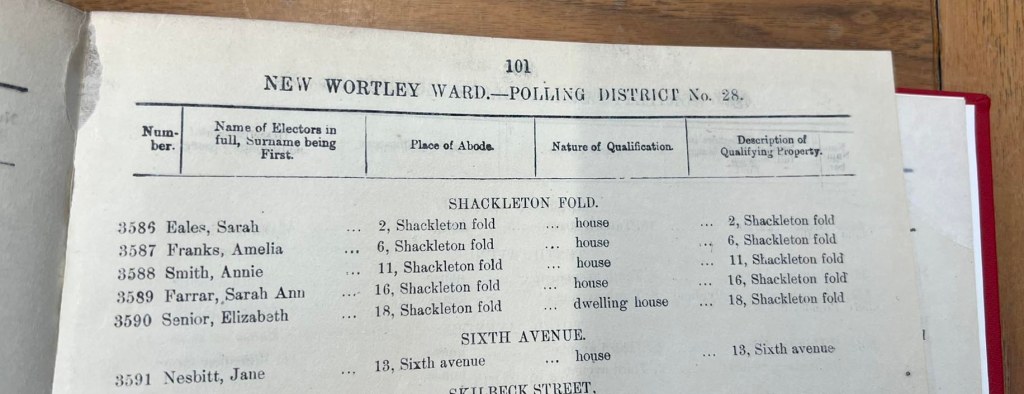
Before I can delve into their stories I need to find out who they are, and that’s what I was doing in the library: compiling a list of everyone on the Electoral Registers and Ward Lists. The objective was to use these to fill the gaps between the decennial censuses. This would enable a fine-tuning of the periods of residence for each household. If a named head of household was present for the 1861 and 1871 censuses but not the 1881, the registers could allow me to pinpoint the exact year they moved out.

Cataloguing the voters of just nineteen houses for around ninety-five years didn’t seem like such a big task, particularly since at the beginning of the period none of the residents had the vote. However, it has taken three full library days for me to do it – and even now I’ll need to return to check a few omissions and discrepancies.

A scene from a library. A red book with the title 'Leeds Register of Electors, West Division, 1896' and showing the catalogue number, is being held upright.  On the desk is a handwritten notebook with lists of dates, and a laptop.  Other desks and library users are visible beyond

Throughout the nineteenth century the population of the Borough of Leeds grew rapidly. In 1861 it was 311,197, rising to 503,493 in 1891 and by 1931 – the last Census for which Shackleton’s Fold was inhabited – the population stood at 646,119. This meant that the arrangement of the registers had to change. The sheer numbers of voters in these various registers meant they had to be divided into manageable chunks. Navigating these was a huge task. For example, a volume might bear the title ‘Borough of Leeds Ward Lists 1881 Part 2’, but with no indication as to which parts of Leeds were in Part 1, Part 2, etc; and this meant each ‘Part’ had to be browsed until the area needed was located. There was no guarantee that the following year would be similarly arranged, so the whole process had to be repeated.

Header page for electoral register, bearing the title 'Borough of Leeds Polling District Number 31, Township of Wortley, Number 3 Division'.  A note below indicates that the list that follows is of people entitled to vote in any Parliamentary election throughout 1870

If you’ve worked with Electoral Registers you’ll know that they are further divided into specific polling districts. The only way to work out which one you need is to look at the most likely ones until you find streets with names you recognise as local to your place of interest. Once you’ve done that you might think you’ve cracked it, and you’ll be able to whizz through the rest in no time. However, these polling districts also change. For example, in 1870, Shackleton’s Fold was in Polling District No. 31. In 1894 it was in West Division Polling District No. 28; changed to District No. 32 by 1899; then District 33, later to 39 and so on.

Front page of The Ward List for the Holbeck Ward, Township of Wortley, Number 1 Division, for the year 1876-77.  The beginning of a list of people is visible below the header

It gets worse! Electoral Registers list only those people entitled to vote in Parliamentary elections; and part of the appeal of a One-Place-Study for Shackleton’s Fold is that it existed throughout a period of great social change, including the move towards universal adult suffrage. During this time, some people were entitled to vote in Municipal but not Parliamentary Elections, and it’s interesting to chart the changes and know that behind each gain there was an important piece of legislation granting the vote to another group of people. This will definitely be covered in my One-Place-Study. However, since those entitled to vote only in Municipal elections could not be included in the Electoral Registers, there had to be another series of registers to list them. Therefore, alongside the Electoral Registers, there are also Ward Rolls, sometimes called Burgage Lists. Here, alongside the men included on the Electoral Registers, we find women and other men whose situation entitled them only to this local level of voting. Consequently there are (at least) two volumes of voters for every year. And guess what… the Polling Districts in the Ward Rolls have different names to those in the Electoral Registers! Shackleton’s Fold starts out in 1860 in ‘Holbeck Ward, Township of Wortley’. By 1874 it is the ‘Holbeck Ward Township of Wortley No. 3 Division’, and a couple of years later it’s No. 1 Division. By 1881 we have ‘Polling District No. 23 New Wortley Ward, Township of Wortley’, then ‘New Wortley Ward Polling District No 28’, and so on. By the 1920s even the township changes, to ‘Armley & Bramley’ and briefly to ‘Polling District MM Township of Leeds’.

As if that wasn’t difficult enough, it wasn’t until 1880 that voters were arranged by address. From this point forward, voters in Shackleton’s Fold are listed together, from number 1 to number 19. Before that year, locating each person involved line by line examination of every entry in the appropriate Polling District – once that had been found – and looking for the magic words ‘Shackleton’s Fold’, then making a note of the name of the person shown. Numbers of individual properties are not given, and since people often tended to move from house to house as their needs changed, there is no way of knowing for sure where each person resided other than at the decennial Census check-ins. Certainly from 1880 onwards the process was quicker, allowing for the speedy capturing of names and addresses with photographs of the relevant pages… at least, provided the Polling District hadn’t been renamed.

Top of page in Burgess List indicating that the named people who would follow were entitled to be enrolled as Burgesses, but not to be Registered as Parliamentary Electors

That said, for quite a few of the years, even after 1880, the women are listed in a separate part of the book, at the end of the entries for that polling district. Special mention must be made of the ‘Borough of Leeds Ward Lists 1872 Part 4’ in which, possibly because of a misunderstanding on the part of whoever compiled it into the one bound volume, locating the information involved examining every line on all 190 pages.

Extract from Burgess List showing the women who were entitled to vote in local elections.  These women were separated out from the male householders who, since 1867, had the right to vote also in Parliamentary elections
Women voters only. The men, who were now entitled to vote in Parliamentary as well as Municipal elections, were listed in the main part of the Ward Roll.

If you’ve ever worked with Electoral Registers, I’m sure some of the above will be familiar; but I suspect not so many of you will have been tracing the families of an entire street throughout a ninety-five year period! My advice to anyone planning on using Electoral Registers and Ward Rolls is: to allow far more time than you expect you’ll need; to understand the difference between the two, and their layout; and to make notes of the different Polling District names for each as you progress. This was a lesson hard learned for me, and explains why I now have a list of queries, and even a few volumes I now realise I missed.

That said, doing this is an essential foundation for everything that will follow. In addition to the decennial censuses from 1851 to 1921, the Electoral Registers and the Ward Rolls, I have information from The Borough of Leeds Poll Book. This was the first general election to be held after the passage of the Reform Act 1867, which enfranchised many male householders. Poll Books differed from Electoral Registers in that whereas the latter list who is entitled to vote, the former list not only who did actually vote, but also for whom they voted. It would not be until 1872 that the Secret Ballot was introduced, and so for many of our ancestors this is a once-only insight into their political affiliations. Other useful name-rich listings may include Directories and even addresses included on baptism and marriage registers. Luckily for me, for much of this period, all Church of England registers for Leeds are available on Ancestry.co.uk. – but not Roman Catholic or most Nonconformist registers.

These lists of people will form the basis of a database of every household, arranged alphabetically by surname. What I had really intended was simply to use these voter lists for fine-tuning periods of residence. I had anticipated that the real sources of information about the families would be the censuses. However, some residents lived in Shackleton’s Fold for only a very short period of time; and since all I have is the name of the head of household, there is no way of finding out more about them. The identity of a Thomas Brown, for example, who is listed on the Electoral Roll of 1871 and nowhere else – not even on the Census of that same year – will forever be unknown. However, Isaac Lord, also resident just briefly in 1870, turns out to have a sufficiently uncommon name for me to be able to track him down. Similarly, the juxtaposition of the head of household with his wife’s name on the Ward Lists may be sufficient to track a couple down via a marriage record.

My brain hadn’t flagged up that the lists themselves would also, with very little additional research required, witness the expansion of suffrage. It will be interesting to compare each increase of names with the relevant legislation. The lists even chart the final years of Shackleton’s Fold, helping me to narrow down the likely year of demolition. In 1938 only one resident remained, and by the following year he, too, was gone. Soon, Shackleton’s Fold would be no more.

If you want to follow progress on this One-Place-Study, you’ll find all blog posts and other information [here].

Ryan Littrell’s ‘Reunion’ and Y-DNA in family research

I’ve just finished reading Ryan Littrell’s book Reunion: A Search for Ancestors, published in 2012. It’s an account of how, following a surprising find amongst old family papers, Ryan set about uncovering the story of his Scottish ancestors. A complete beginner in family history at the time, his interest was purely on his mother’s paternal line, the McDonalds.  He wanted to learn about the clan and whereabouts in Scotland his family originated.

If you have a Scottish clan ancestral line, particularly Clan McDonald/ MacDonald/ Macdonald or simply Clan Donald, then I think you’ll find this book interesting and helpful. It will also be useful to anyone wanting to know more about Y-DNA testing, and how it can be used in genealogy. Alongside this, you’ll see an example of an active Y-DNA surname project, and learn more about how you might be able to use this type of DNA testing in your own research.

None of the above apply to my own family research. For me personally, I realised as I was reading that there was a gap in my knowledge of Scottish history and particularly the Jacobite movement. I’ve since been exploring that, and this, broadly, will be the topic of my next post. Today’s post focuses on the Y-DNA.

After a more general introduction, from Chapter 8, Ryan’s story alternates between his developing knowledge about his own family and the Clan history. Starting with events of around a thousand years ago, the history moves forward in time as Ryan’s own research moves backwards so that at some point the stories meet. The documentary research was hampered by the fact of being spread over several counties in four different American states. At times a professional genealogist was hired to plough through documents in archives local to the places where his family had lived in the States. I did wonder at times why baptism registers were not mentioned. Perhaps they had been used, but they were not included in the account. In the UK, they would have been a starting point for any research prior to 1837.

So it was, really, the way the usual documentary research was used alongside Y-chromosome DNA (Y-DNA) testing that was the more interesting part for me. Used alongside wider Clan history reading, this was key in helping Ryan to home in on his ancestral home and indeed other Y-DNA testers descended from the same people.

How Y-DNA tests work
The main DNA test we use for genealogical research is autosomal. Autosomal testing is useful for finding ancestors and close blood relatives up to around five generations back. Y-DNA is different, and we use it in genealogy for a very specific reason.

Y-DNA is passed from fathers only to their sons. This means every male can be shown to be connected to his father, his paternal grandfather, great grandfather, and so on, right back through time. Passing largely unchanged down the male line, it links back thousands of years.

A Y-DNA test places each tester into a group known as a Haplogroup. Individual Haplogroups are often associated with specific parts of the world. For example Haplogroup E is primarily found in Africa, with some presence in other regions; Haplogroup O is primarily found in East and Southeast Asia. A number of Haplogroups are to be found in Europe. These include Haplogroup R, common in Europe and parts of Asia. At the very top of each of these Haplogroup lines is one man. We will never know the names of these individual men, but each one is the furthest ‘identifiable’ ancestor of every male sharing that broad Haplogroup.

Over time, there are mutations on the Y chromosome. We use these mutations to work out how far back two male testers share a common ancestor. If they both share a particular mutation this is evidence that their common ancestor lived after the mutation occurred. Another way of looking at this is that when mutations occur, a new branch in the Haplogroup occurs. If a mutation occurs for one brother in a family, his descendants will have the mutation but his remaining brothers and their descendants will not.

In this way, as a result of mutations, the wider Haplogroup can increasingly be subdivided, and this enables us to place a tester in ever more specific branches, or Subclades, of the Haplogroup. For example, the Haplogroup R has two branches, or subclades: R1 and R2. R1 is further subdivided into two descendent subclades: R1a and R1b.

Surname Projects
Since Y-DNA follows the direct paternal line, assuming that there have been no adoptions, no elective name changes and no ‘non-paternity events’, the line should coincide exactly with the surname. This has led to the creation of Y-DNA Surname Projects, often run by experienced leaders who may be able to recognise specific branches of the surname based on the very specific subclade as revealed by the Y-DNA test.

It was one of these Y-DNA surname projects that Ryan Littrell joined when he was carrying out his own research. Through them, he learned that the MacDonald clan, also known as Clan Donald, is associated with the R1a and R1b haplogroups. Testers potentially descended from a man named Somerled, who is important in the Clan’s history, are associated with the R1a haplogroup, while The Macdonalds of Sutherland, for example, belong to the R1b haplogroup, specifically the R-FTA93010 subclade.

As his connection to the McDonalds was through his mother rather than his father, Ryan was not able to test his own Y-DNA for this project. Instead, he needed to find a male member of his mother’s McDonald family who was prepared to test. His mother’s uncle was happy to do so, and it was his Y-DNA test results that Ryan worked with thereafter. Working with the surname group, these test results enabled Ryan to connect with a small number of testers whose origins could be traced to a specific village in the Scottish Highlands. Through connections and visits to the area, more McDonald men offered to test and they too shared the same subclade.

Ultimately, this combination of documentary research, Y-DNA testing, reading about the history of the clan and speaking with distant cousins who had grown up in the area, enabled the small group of distant cousins to work out where they fit into the history of the Clan.

You will have to read the book yourself to find out how, but I hope this account has enabled you to work out whether firstly this book and secondly Y-DNA testing might help you in your research.