Time Travelling in Spitalfields: the decline into poverty

My last post was about the Huguenots in Spitalfields in London’s East End. My intention was to move straight from that to the late nineteenth century and the Jewish migration when I know, from looking at census records, that conditions were very different from the elegant living of the Huguenots still in evidence today through the presence of their fine Georgian townhouses.

However, I found I hadn’t yet satisfied myself about how the area enjoyed by the Huguenot merchants and master weavers could become what it was by the 1880s. I needed to close that gap. That’s what this post is about.

As with the previous Spitalfields post, I am indebted to Dan Cruickshank and his excellent book: Spitalfields: The history of a nation in a handful of streets (2016) for much of the information that follows. He, too, highlighted this issue of wealth alongside poverty:

‘One of the defining features of Spitalfields life through the centuries is the extent to which is has constantly embodied paradox: great wealth alongside appalling poverty, beauty juxtaposed with squalor.’

Dan Cruickshank: Spitalfields (2012) page 323

The previous post, then, focused mostly on the wealthier Huguenots – the merchants and master weavers who had the money and business acumen, and made the decisions about the direction of the silk weaving industry in Spitalfields. Today’s post comes down the social and weaving hierarchy to the journeyman weavers – the men and their families who actually did the weaving. They were paid by the completed piece and worked from their homes. Below is a typical street where such people lived. The wide window on the upper floor of the two houses closest to the camera mark them out as weavers’ cottages. The general look of the street indicates skilled artisan rather than wealth. By the time this photo was taken the street had fallen into serious levels of poverty. It has since been demolished.
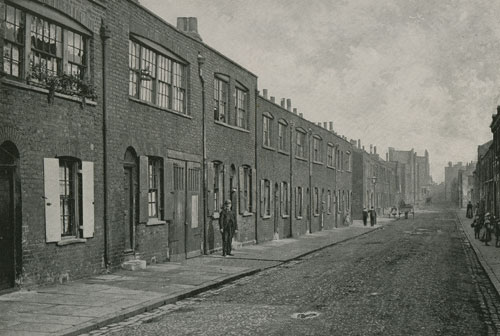
Weavers’ houses on Florida Street, Bethnal Green, since demolished. Image dated 1896. Public domain.

Unrest, division and rioting
From the very beginning, away from the genteel homes of the Huguenot merchants and master weavers, disputes and unrest were often the order of the day in Spitalfields. The experienced journeyman silk weavers were well-organised and ever-ready to defend themselves. They were skilled artisans, and expected to be paid fairly for their work. We cannot condone their methods, but should bear in mind that no other way existed for them to achieve change. The power was with the merchants and master weavers – not just power and control of the business, but within society as a whole. For centuries the vote had been the preserve of those with property – beyond the reach of most artisans; and there were few peaceful means of demanding reform of country and society.

In 1675 the silk weavers of Spitalfields had rioted against the introduction of new machines. Later, the importing of inexpensive cotton from India brought more riots that included attacking women wearing dresses made of muslin, calico or linen, tearing the dresses from them or pouring ink or chemicals over them.

In the 1730s Irish weavers came to the area to work alongside the existing weaver workforce. Weaving in Ireland had developed significantly, in parallel with that in England, and for the same reason: Huguenot settlement. However, there, the cloth was linen and although most of the actual weavers were Roman Catholic, the industry was Protestant owned and managed. A series of punitive anti-Catholic laws gradually deprived them of any power, wealth and rights unless they converted to Protestantism. Their choice was to remain as second class citizens in their own land; to convert; or to leave. Many of those who came to settle on the edges of Spitalfields were impoverished unskilled workers, but the skills of the experienced weavers adapted to silk weaving.

All this led to new tensions and more riots. In weaving, as in other trades, the Irish workers were prepared to work for much less pay than the locals: as little as two-thirds or even half of the going rate. The Huguenot masters and merchants were hard businessmen. They took advantage of this, reducing wages for the existing working population. This, combined with general anti-Catholic hostility and additional segregation for some created by a language barrier, resulted in anti-Irish aggression and protests. It was said that, even in an area clearly spiralling into poverty, for more than a century the even more extreme poverty of the Irish in Spitalfields remained visible.

As the eighteenth century progressed and wages for skilled weavers continued to reduce, such was the anger amongst the weavers that they turned their modus operandi to forming ‘combinations’, stalking the streets in heavily-armed gangs and breaking into homes of master weavers to smash the looms and cut the woven silk upon them. The same fate was extended to any journeymen weavers believed to be working for lower rates. From 1765 such activity was punishable by death.

Protection for Spitalfields silks and silk weavers
However, alongside the public executions, in 1772 the government passed The Silk Manufactures Act, commonly known as the ‘Spitalfields Act’. Amongst other measures, this established that the wages of journeymen silk weavers within the legally recognised boundary of Spitalfields should be fixed by magistrates at Quarter Sessions. There were penalties on masters paying below the set rate, as well as for journeymen who demanded more. The number of apprentices any silk weaver could have at any one time was limited to two; and the ‘combinations’ were banned. The provisions applied only to male weavers, and were not extended to female weavers until 1811.

In addition to this, throughout the eighteenth century there were prohibitions on foreign silks, some aimed directly at luxury French items; and there were high tariffs and import duties on other related items that were not specifically banned.

The impact of the French Revolution
The years following the French Revolution were worrying times for the British government, who were concerned that the same fate should not befall the monarchy, aristocracy and status quo here. Given the melting pot of French Protestant Huguenots who had suffered at the ruthlessness of the monarch in France, alongside the Roman Catholic Irish population whose ancestors had suffered at the hands of the Protestant British upper echelons, together with the history of Radicalism amongst the English silk weavers, Spitalfields was considered a high risk for sedition and treason.

For the weavers, the now outlawed ‘combinations’ had been a means (albeit dangerous, violent and destructive) of ‘taking back control’ after suffering decades of increasing poverty and uncertainty. Now, in 1792, a new means of taking control was established: the London Corresponding Society. Their goal was the promotion of the reform of Parliament, and their existence highlights the decent levels of literacy amongst the men of humbler backgrounds who formed their membership. In general these were journeymen of English and Irish heritage rather than the Huguenot journeymen weavers. The London Corresponding Society, along with many other similar groups up and down the country, was outlawed by the Unlawful Societies Act of 1799. In the same year, the Combinations Act – aimed more widely, not just at silk weavers – banned any attempt to organise within work sectors, including collective bargaining.

An absence of flowers…
Alongside the radical groups, the Spitalfields community had enjoyed a whole range of cultural and intellectual interests, and various learned societies. These continued long after the earlier decades of prosperity when there was money to spare. In retrospect, it could be said the pastime of rearing flowers was a barometer for the living standards of the Spitalfields weavers. The weavers were known for displaying pots of home-grown flowers along the ledges of their weavers’ windows, arranged with evident artistry, and perhaps even providing artistic inspiration for their work. Many also had small flower gardens where they spent their leisure hours raising flowers or pigeons. The weavers’ love of songbirds is also well-documented. Of course, when times are hard, such pastimes will gradually cease, either for lack of money or lack of spare time when more hours must be worked to bring in the same amount of money. In 1795 John Thelwall wrote:

“[…] those gardens are now fallen into decay. The little summer-house and the Monday’s recreation are no more; and you will find the poor weavers and their families crowded together in vile, filthy and unwholesome chambers, destitute of the most common comforts, and even of the common necessaries of life.”

From John Thelwall: ‘On the Causes of the Late Disturbances’.
In: Dan Cruickshank: Spitalfields (2012)

The death throes of the Spitalfields silk industry
Since the end of the seventeenth century, the silk industry had somehow, and often uneasily, accommodated the tensions between the English Protestant, the Calvinist Huguenot and the Irish Catholic journeyman weavers. It had found a way to contain the hard-nosed business minds of the Huguenot masters and merchants and to balance that with a fairer system for the weavers. There were also protectionist measures in place to prevent, or at least reduce the threat of foreign imports.

John Thelwell wrote the above passage in 1795, but the first two decades of the nineteenth century seemed to herald a new ‘Golden Age’ of the silk trade in Britain. This was in no small measure thanks to the Napoleonic wars, and Napoleon’s plan to ban all Continental trade with Britain. This period of apparent success culminated, however, in the 1824 repeal of the Spitalfields Acts, and with that the removal of safeguards on journeymen’s wages. It also opened the way for increased use of machinery rather than cottage-based handlooms, and it was around this time that the French Jacquard mechanical loom entered the British weaving industry.

It wasn’t just the sudden flooding of the market with cheaper imports that harmed the silk industry in Britain. Fashions change. Women were looking for lighter, more practical dresses. Spitalfields silk, whilst undoubtedly stunningly beautiful, was created through a complex manufacturing process that produced a woven fabric resembling embroidery. It was heavy to wear, time-consuming and expensive to produce, and the dyes used in creating the floral designs meant the garments could not be washed for fear of colour runs. It was, really, the natural end of Spitalfields’s silk industry.

If you’re interested, this is a good time to watch Julia Sawalha’s episode of the BBC’s Who Do You Think You Are? Although Julia’s father is Jordanian (and the second part of her story here focuses on that), her mother is of French Huguenot descent.

The Huguenot story really gets under way at around 9 minutes.
From 11 minutes to 13:37 you’ll see actual examples of exquisite Spitalfields silks, with realistic floral decoration of the type designed by Anna Maria Garthwaite (mentioned in my last post) as recreated by the hands of the weavers.

After that there are some scenes filmed in the streets discussed in my last post, where the fine Huguenot houses are still to be found.

From around 18:22 the story focuses on the impact of the decline of the silk industry in Spitalfields, and on Julia Sawalha’s ancestor who was Huguenot, but a journeyman weaver rather than a moneyed master weaver.

Finally, from around 23 minutes there is historic information about why the Huguenots fled France


Poverty and deprivation

‘It is not in the power of language to describe their long and continued miseries not brought on by idleness, intemperance or a dissolute course of life, but human wretchedness absolutely produced by want of employment’

Dr William Hawes, Physician to the London Dispensary, 1792-93

Dr William Hawes recorded his thoughts, above, while witnessing the impact on the Spitalfields silk weavers of the severe trade crisis of 1792-93. The London Dispensary offered medical advice and medicines at minimal cost to the poor and needy of the area and remained in operation on that basis until the creation of the National Health Service. In 1797, such was the distress of the inhabitants that local philanthropists formed the Spitalfields Soup Society to to serve good quality soup, again at cost, to local people. By 1812, 6000 people were fed daily. Bearing in mind the creativity and curiosity that had thrived in Spitalfields when times were good, it is telling that in that same year – 1812 – a group of Quaker philanthropists, concerned at the widespread illiteracy levels, established a school for local children aged 6 to 14. The cost to parents was a penny per day. What all these initiatives had in common is that they were aimed at the ‘industrious’, or ‘deserving’ poor; and yet such was the poverty that increasingly, they were out of the reach of local people. After the repeal of the Spitalfields Acts in 1824, when thousands more weavers were thrown into destitution, few local families could afford the penny fee, and by the end of the 1830s the school had closed.

By 1839 the most skillful journeyman weavers in Spitalfields were earning around fifteen shillings a week – a fall of five shillings since 1823. However, for the less skilled ‘plain weavers’ the overall average appears to have been more like seven or eight shillings per week. By 1849 the average weaver’s wage was 5 shillings and sixpence per week. The nation’s response, from 1834, was the workhouse.

As the nineteenth century progressed, Spitalfields became increasingly densely populated. This came about through different means. First the existing houses, intended for one family, were occupied by several families. Even the fine Huguenot houses gradually fell into disrepair and over-occupation, although the merchants and master weavers themselves moved away, diversified their business interests and expanded their activities into other trades, other parts of the UK and in the New World. Second, the growing spaces and open areas behind terraces of housing were transformed into narrow alleyways crammed with very poor quality housing accessed via passages from the main street. In many parts of Spitalfields, the view along the streets may have seemed little changed, but behind them was a whole other world, with damp, cramped and filthy conditions created by overcrowding, poor building, inadequate water supplies and inability to pay for removal of ‘night soil’. Finally, to return to the weavers’ love of flowers, many of them had taken small plots of land where they could enjoy their hobby and relax in the sunshine. Often they erected small sheds or cabins on these plots. As conditions worsened for the weavers and other inhabitants of Spitalfields, these sheds were used as dwellings.
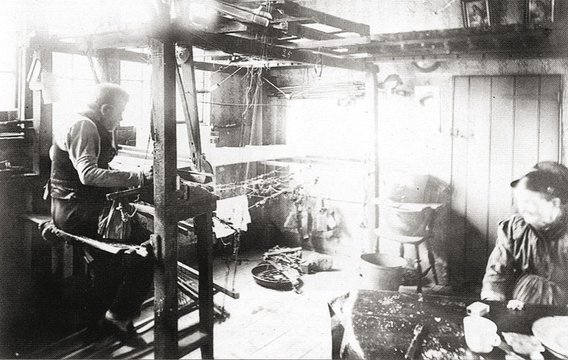
Interior of Weavers’ Cottage. Image dated 1894. Original: © Tower Hamlets Local History Library and Archive

The Industrial Revolution
The severity of conditions in Spitalfields after the repeal of the Spitalfields Acts and onwards throughout the nineteenth century were just one half of a double whammy impacting the area. Alongside the collapse of the Spitalfields silk industry and consequential reduced income and unemployment, the population of the area continued to grow. While the population of the civil parish of Spitalfields (Christ Church) at the time of the 1831 census was 16,200, in 1834 the Poor Law authorities calculated the total population of the area of Spitalfields in its wider sense (that is, including the parishes of Bishopsgate-without-the-wall, St Dunstan Stepney, St Mary Whitechapel, St Leonard Shoreditch, and St Botolph Bishopsgate plus the Liberties of Norton Folgate and the Old Artillery Ground) at 64,141. This represented a doubling of the population in around three decades.

Of course, Spitalfields was not alone in experiencing such sudden population growth and extreme deprivation. As elsewhere, this was a time of push and pull factors, away from the rural areas and sucked into the large towns and cities where by now the Industrial Revolution was well underway and it was hoped work would be available. The additional issue for Spitalfields was that the work for the existing population had collapsed. Weavers without work went to work at the docks or tried to find other employment, or indeed ended up at the workhouse. The situation compares to that in Norwich where my own 3x great grandfather, also a silk weaver, found himself unable to secure work. More recently, we might compare it to the deep, generational unemployment and economic loss of people in the mining communities after the mass pit closures of the 1980s.

The gap has been bridged
The events and reasons behind the downward spiral of this once elegant and prosperous community into abject poverty and despair are now clear. It was into this new incarnation of Spitalfields that thousands of Jews fleeing persecution in Eastern Europe would arrive towards the end of the nineteenth century. Here, they would make their home while establishing themselves in their new country. That will be the topic of my next post.

Shackleton’s Fold: Exploring the area

This is the second video post in my Shackleton’s Fold One Place Study series.

A One Place Study brings together aspects of family history, local history and even house history. They are often carried out by family historians looking to learn more about their ancestors. A One Place Study might add new records, broaden out the focus or just bring a new perspective to our research.

Shackleton’s Fold was a small ‘street’ of just nineteen houses that stood in the New Wortley area of Leeds for more than ninety years. It was demolished by the end of the 1930s. In the video linked below I use maps and old photos to try to explore the area where it once stood.

I found this process so useful in helping me to imagine what Shackleton’s Fold was like. Poring over old maps and finding photographs of buildings all around the Fold – alas none of Shackleton’s Fold itself – really helped me to focus.

I hope this video will be of interest to family historians, local historians and people doing or thinking of doing a One Place Study. In addition, people with a general interest in Leeds history, specifically the history of New Wortley may find it interesting.

I’m particularly keen to attract other family historians whose research has taken them back to Shackleton’s Fold between the mid 1840s and 1938. Alongside this visual exploration, I’m in the process of creating a database of every person on the censuses and every voter listed on the electoral registers. I’m looking for stories and photographs and would be very grateful if anyone could help out in that regard. I’ve already found some interesting stories.

If you fall into any of these categories, or know someone who does, please do share a link to this post and/or the YouTube link – and please ‘Like’ the video if you have a YouTube account. I hope you’ll find it useful.

Information and Links for photos and maps used

All photographs from Leodis:  https://Leodis.net
Go to Advanced search and key in the ID given.

  • JR Holmes and Star Maltings on Wortley Road, 1965.  ID: 2003729_72382754
  • Star Maltings and Shackleton’s Fold on Wortley Road, 1965.  ID: 2003729_99482364
  • View from St John’s Street to side view of Star Maltings and former Shackleton’s Fold, 1965. ID: 2003729_88186282
  • 107-109 Whitehall Road, with view of St John’s Street, 1965.  ID: 2003729_31147402
  • Whitehall Road School and Kildare Terrace, 1948.  ID: 5624
  • Whitehall Road School, 1948.  ID: 2818
  • Whitehall Road at the junction with Gelderd Road, Trolley and Tram Junction, undated but possibly 1911.  ID: 2011127_173010
  • St John’s Sunday School (bombed 24th/25th August 1940).  ID: 200828_166072
  • St John’s Street, from L to R: 11 to 15, 1965.  ID: 2003729_52465457

Tithe apportionment of Wortley (township in the parish of Leeds)
1846.  The National Archives, Kew.  Reference: IR 29/43/444

Ordnance Survey Maps located at National Library of Scotland Maps: https://maps.nls.uk
Reproduced with the permission of the National Library of Scotland

OS: Leeds Sheet 13: Surveyed: 1847, Published: 1850. (Railway revision to c. 1862)
https://maps.nls.uk/view/229947003

OS: Leeds Sheet 17: Surveyed: 1847,  Published: 1850. (Railway revision to c. 1854)
https://maps.nls.uk/view/229947015

OS 25-inch England and Wales: Leeds – Yorkshire CCXVIII.5.13: Surveyed: 1888,  Revised: 1910,  Published: 1911
https://maps.nls.uk/view/229947306

OS 25-inch England and Wales: Yorkshire CCXVIII.5: Revised: 1906, Published: 1908
https://maps.nls.uk/view/125642449

O.S: Yorkshire CCXVIII.5: Revised: 1932 to 1933, Published: 1934
https://maps.nls.uk/view/125642455

Robert Blincoe and Litton Mill

Every so often, you read a book that resonates deep within you, and for me one such book was The Real Oliver Twist by John Waller.  I posted a review of it back in March 2019, and although it was one of my earliest posts for this blog, I’ve since referred to it in several more recent posts.  This ‘real Oliver Twist’ – the real-life boy on whom Dickens is thought to have based his novel, is in fact called Robert Blincoe.  Ever since reading his story I’ve considered him a hero.

Waller’s book was published in 2005.  It runs to 450 pages, but his starting point for the work was a 68-page pamphlet written by John Brown and published in 1822 with the title A Memoir of Robert Blincoe.  Born around 1792 in St Pancras and living as an orphan in the parish workhouse, in 1799 Blincoe, together with about fifty other children from the workhouse, was apprenticed by the Parish Overseers first to a cotton stocking manufacturer in Nottinghamshire and then to Ellis Needham, owner of Litton Mill in the parish of Tideswell in Derbyshire, where he remained until about 1813.  Blincoe didn’t set out to publish a memoir. By the time he was approached by John Brown he was living in Manchester, married with children, and the owner of his own waste cotton business, but he had made no secret of his humble origins and the cruellest treatment imaginable he suffered as a pauper apprentice at Litton Mill. 

Crucially and perhaps almost astonishingly, despite his experiences, Robert himself was a good man of unblemished reputation, who somehow knew right from wrong.  Those who worked under him, either in his capacity as employer or as adult employee in someone else’s business, had only the highest praise for him.  Following publication of the pamphlet in 1822, his story became the focus for campaigns highlighting working conditions for children and also for factory reform and the short time cause.  Despite this, and even with plentiful evidence of the cruel excesses of capitalists and mill owners, it would not be until 1847 that the Ten Hours Bill passed into law.

With the benefit of almost two hundred years’ perspective, John Waller analyses the story in the pamphlet, verifies facts using original records, and sets the whole story in the context of social and political history.  I cannot recommend it highly enough, and if I’ve whetted your appetite please read my earlier post to find out more.

Last month I had reason to revisit Robert Blincoe’s story – quite literally: during a week’s holiday in Derbyshire I walked part of the Monsal Trail.  Here, along the deep ravine forged over millennia by the river Wye, Litton Mill still stands.  Now beautifully restored and converted to luxury apartments, the setting of the former mill is breath-taking.  A row of workers’ cottages adjacent to the building, probably also known to Robert, look out onto the river.  This is a popular beauty spot within the Peak District, of great interest to geologists, walkers and rock climbers.  A beautiful setting for a truly dreadful story. A get-away-from-it-all destination that, in Robert’s day, amounted to complete isolation. No-one was coming to rescue him and his fellow apprentices.

Litton Mill: former cotton mill of late 18th century construction, located in the valley of the river Wye near Tideswell, Derbyshire
Litton Mill. Photo: Janice Heppenstall

When I wrote that first post about Robert Blincoe I always intended to read the pamphlet that started the whole thing off.  That original pamphlet, with the full title A Memoir of Robert Blincoe, An Orphan Boy; Sent from the Workhouse of St Pancras, London, at seven years of age, to endure the Horrors of a Cotton Mill, through his infancy and youth, with a minute detail of his sufferings, being the first memoir of the kind published, is available online via Internet Archive [here]. Finally, after my visit to Litton Mill, I read it.

I remembered the cruelty meted out to the children, the overwork, the inadequate food, both in terms of quality and quantity, and the lack of sleep.  Now, reading the pamphlet I found it was much worse than I had understood from the excerpts in John Waller’s book.  Children would routinely be required to work sixteen hours a day, but on Saturdays they worked until midnight, Sunday being a day of rest.  On at least one occasion they worked a full twenty-four hours without break.  The children were required to wash morning and night, but were not given soap.  Since they worked with heavily greased machinery, plain water was no match for this; and since they were so hungry, the bran they were given instead of soap was eaten instead.  Food was coarse, often mouldy and foul-smelling, but eaten anyway.  The children would be bribed to keep working without a meal break during the day with the promise of a halfpenny – but often the halfpennies did not materialise.  When they did the children bought food, collected for them by a kindly blacksmith who worked on the floor below.  Insufficient clothing was provided, and the children were covered in lice.  Effectively, they were commodities.  If one died, no matter – there was an inexhaustible supply of them from more workhouse orphanages.

Wandering around the site, I tried to work out where the Apprentice House had stood.  It is referenced in the 1822 pamphlet as accommodating two hundred, and standing about half a mile from the mill.  Waller describes its location as across the river, and therefore in the adjacent parish of Taddington, meaning that burial of any children dying in the Apprentice House was the responsibility not of Tideswell but of that neighbouring parish.  The building no longer stands, but given that the opposite bank of the river was, like the mill side, bordered by the steep ravine, it is difficult to imagine any reason for housing the apprentices there other than that given by Waller.  There is no village nearby, no other form of habitation, and no road or obvious footpath. It would appear to be difficult to access from other parts of the parish of Taddington.  Robert did recall that the children who died were buried half and half in the two parishes – so as not to attract too much attention at the number of them.

Plaque adjacent to churchyard at Tideswell, Derbyshire, commemorating burial of orphans of Litton Mill
Plaque adjacent to churchyard in Tideswell. Photo: Janice Heppenstall

What was truly shocking, though, was the violence.  Those were different times, and violence used as a means of ‘correction’ was acceptable.  It can even be argued that overseers needed the children to work as quickly as possible so that they themselves were not punished for insufficient output.  Hence the children were beaten to leave them in no doubt that slowing down was not an option.  It’s difficult for us to think that way, but back then it was the norm.  What wasn’t the norm, however, was the level of beating, the cruelty, and the enjoyment derived from this by the men in charge at Litton Mill.  Children were made to dangle over moving machinery, having to lift their legs at the knee with every motion of the machine.  They had clamps weighing up to one pound attached to their ears and noses, and were expected to work that way.  Rollers were aimed at their heads.  Supple leather belts with brass buckles were used to whip them.  Teeth were filed. These, and other activities, were done for fun.  The children were, in consequence, constantly covered in bruises, cuts and welts.  When they did finally reach their beds it was often impossible to find a position they could lie in without pain from the injuries. If the acceptable use of beating was as a means of making the children work harder, then the thugs at Litton Mill were either too stupid or too evil to recognise that they and the children would produce more if they did not take time out for this particular form of ‘fun’.

Obviously all of this took its toll on the children’s health.  Malnutrition and insufficient rest meant that some of the children’s bodies were deformed – Robert Blincoe included.  Children were often sick, and many died.  Why didn’t the doctor raise his concerns with the authorities?  For the simple reason that the doctor, the magistrate, the magistrate’s clerk and the factory owners, in this case Ellis Needham, were all on the same side.  They socialised together, as Robert found to his cost on two occasions when, as a teenager, he tried to alert the authorities to the cruelty at Litton Mill.  The only outcome was more brutality.  Knowing this, some prayed to God to take them during the night, there were suicide attempts, and some of the boys committed crimes, purely in the hope that their punishment would be transportation to Botany Bay, which they believed would be better than the cruelty they were enduring at the mill.

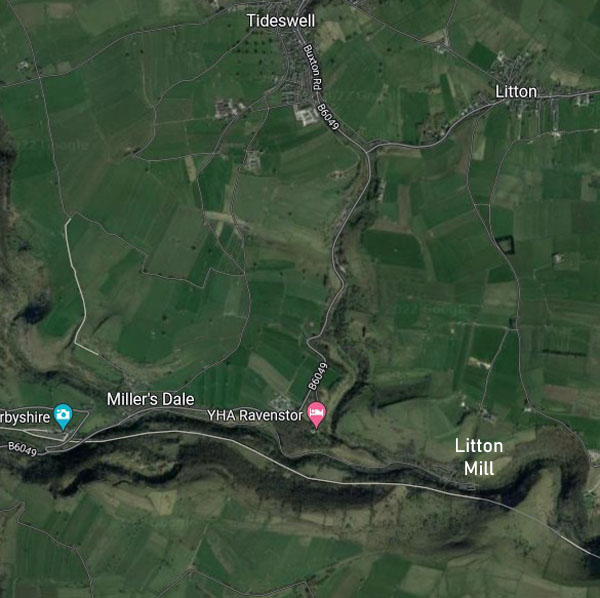
Map showing location of Litton Mill alongside the river Wye and in relation to Tideswell and Litton, Derbyshire
Google Maps
The steep ravine forming the valley of the river Wye alongside which Litton Mill is situated is shown.

As outlined above there is, ultimately, a happy ending to Robert’s story.  He retained a sense of justice and was a good man; he married, established his own business and had children.  His son won a scholarship and went to Cambridge, and one of his daughters made a very good marriage.  Meanwhile, Ellis Needham was bankrupt in 1815 and died a pauper.

What can we, as family historians, take from Robert’s story? 

Starting with the obvious and the specific, if you have ancestors in the Tideswell or Litton areas of Derbyshire – or in Lowdam, Nottinghamshire, location of the first mill to which the St Pancras children were apprenticed – you may recognise a name or two from the text.  Even if your ancestors aren’t named, the story still serves as background history to the area where they lived. Today, Robert Blincoe is very much part of the history of Tideswell.

However, even if this part of the country has no relevance to your research – as is the case for myself – there is still much to be learned from reading texts like John Brown’s or John Waller’s. This can then be applied to the reality for your own ancestors.

If you have ancestors in Yorkshire, Lancashire or other areas where large-scale textile production was a major part of the local economy during the 19th century, understanding about life in a textile mill might be useful to you. Mills, for example, needed to be situated alongside water for powering the wheel, hence others were built in locations like Litton that we might now consider beauty spots but back then, with no local amenities other than what the mill owner chose to provide, increased the likelihood that children of workers would also be sucked in to the same work. Some might even be paid with tokens so that families had to buy their food and provisions at the mill owners’ shop.

More broadly, there is the social history, the operation of the Poor Laws, the Factory Acts and the apprenticing of parish and pauper apprentices.  The nature of these apprenticeships is quite different from that of privately negotiated apprenticeships for sons of families who could pay. Robert Blincoe’s apprenticeship happened before the Poor Law Reform Act of 1834, when the earlier system of relief of the poor was coming under strain.  Many parishes in the south sought to save money by offloading their orphans and children of paupers to the northern mills.  My impression is that these mills could operate only because of the slave labour of the pauper children.

If you have an ancestor in the northern mills with no baptism record or identifiable parentage, it’s worth considering whether they might have been taken from the south to work in the mills.  Conversely, if the sibling of an ancestor in the south disappears but no burial record is found, consider looking for them in the booming industrial towns in the Midlands or the North.  They would have to remain living until 1851 for their place of birth to be confirmed on the census – Robert Blincoe gives his place of birth as London in the 1851 census.

The Real Oliver Twist

After finding my orphaned great grandfather and his brother in the local workhouse I wanted to learn more about how life was for them.  I remembered from ‘A’ level history the distinction between the ‘deserving’ and ‘undeserving’ poor; and it seemed that a six-year-old orphan could not in any scenario be painted as ‘undeserving’.  But did they know kindness?  Were they well-clothed and properly fed?  Was life constrained on all sides by rules?

Think of a small boy in a Victorian workhouse, and chances are you’ll end up with Oliver Twist.  This, then, was my first port of call.  But it wasn’t much help: of the 53 chapters in Dickens’s novel only six deal with his time in the workhouse, after which he sets off to London to find himself in the care of Fagin, Artful et. al.  (If you’ve not read it, I can tell you they’re all significantly less cuddly than they seem in Lionel Bart’s musical.)

More recently I came across John Waller’s book, The Real Oliver Twist, and felt sure this would provide me with the information I wanted.  Reviewed in The Guardian as ‘a compelling history of the lives of workhouse children in the industrial revolution’, I assumed it would be a collection of testimonies by former workhouse children, inspectors, etc., looking at different aspects of life inside the system.  But no.  It is in fact, the astonishing, heart-breaking but ultimately inspiring story of the actual, real Oliver Twist – the boy whose story is thought to have inspired Charles Dickens to write his novel.

His name was Robert Blincoe, and he was born around 1792, probably out of wedlock, in St Pancras, at that time a rural parish just outside London.  For some reason, he believed himself to be the illegitimate son of a vicar, and found comfort in that.  John Waller sets out his story in six parts, the first of which does deal with Robert’s workhouse years.  It helps to understand that the Poor Law system at this time was based upon each parish looking after their own.  The workhouse was legally obliged to feed, clothe and house workhouse inmates, but life was dictated by rules, and there was no room for the tenderness and kindness that would help a child to thrive.  Records show that the St Pancras workhouse, designed to accommodate about 50, in fact had 450 inmates by 1787, and half of these were children.  It was dirty, smelly, a breeding ground for disease, and shortly after Robert’s departure the buildings were declared unfit and perilous.  Nevertheless, Robert was adequately dressed and fed, receiving a pint of milk porridge for breakfast, bread and cheese for supper and a hot lunch which included meat four times a week – a far better diet than many struggling families outside the workhouse.  He was also taught basic literacy skills.

St Pancras, like every other parish, would do whatever required to offload paupers to other parishes.  In the case of pauper children they did this by way of apprenticeship.  This was not the fine apprenticeship system that resulted in a young man skilled in the ‘Art and Mystery’ of Tailoring, Carpentry, Physick, or other trade.  ‘Parish apprentices’, as the workhouse children were known, were offloaded to employers requiring their nimble fingers and little bodies to do whatever couldn’t be done by an adult.  The fact that often, their employment didn’t prepare them for meaningful work in adulthood was neither here nor there.  Chimney sweeping was a prime example, and the smaller the boy the better.  However, chimney sweeps were notorious for cruelty towards their young charges.  It was normal for a sweep’s boy to sleep on the floor of his master’s cellar, with only his tattered clothing and soot bag for warmth.  Often they would go barefoot, with bent legs, respiratory conditions; and one particularly horrific occupational hazard was scrotal cancer.  Six-year-old Robert was so desperate to leave the workhouse that when news broke of the impending visit of a group of master sweeps, he managed to sneak in alongside the selected group of slightly taller boys, hoping to be chosen.  He wasn’t, and was as devastated to be left behind as the chosen ones were to leave.

By the first decade of the 19th century, with the Industrial Revolution well under way, a new method of offloading workhouse children was found.  Parish apprentices would be carted off to work in the northern mills.  This was eventually how Robert left St Pancras, in the company of 31 other boys and girls.  What followed is dealt with in parts two and three of Waller’s book, when Robert and the other children were sent first to Lowdham Mill near Nottingham, and then to Litton Mill in Tideswell, Derbyshire.

There is only one way to describe the use of pauper children in the textile mills.  It was slave labour.  The children were forced to work up to sixteen hours a day, and sometimes all night.  There was no pay, except occasionally a penny for working even longer hours when deadlines required.  They were housed in an adjacent apprentices’ house, where they would return, exhausted, at the end of the day, often too tired to eat their woefully inadequate diet – porridge made with milk, or often with just water, and stale rye bread or oatcakes.  Barefoot, and wearing the coarsest of dusty, greasy clothing, the smallest children were forced to work as ‘scavengers’, picking up any loose cotton that fell to the floor below the fast-moving machines.  It goes without saying that this was dangerous work.  Yet all this was justified by the moneyed classes who seem genuinely to have believed that pauper workers were a race apart, unable even to feel physical pain as they themselves would.  One incident stands out:  One of the St Pancras girls, Mary Richards, got her apron caught in the loom shaft:

[Robert] saw her whirled round and round with the shaft – he heard the bones of her arms, legs, thighs, etc. successively snap asunder, crushed, seemingly, to atoms, as the machinery whirled her around and drew tighter and tighter her body within the works, her blood was scattered over the frame and streamed upon the floor, her head appeared dashed to pieces – at last, her mangled body was jammed in so fast, between the shafts and the floor, that the water being low and the wheels off the gear, it stopped the main shaft.  When she was extricated, every bone was found broken – her head dreadfully crushed – her clothes and mangled flesh were, apparently, inextricably mixed together, and she was carried off quite lifeless.

(from John Brown: A Memoir of Robert Blincoe, page 26)

Amazingly, Mary survived, but would remain severely disabled and unemployable for the rest of her life.  There was no compensation for workplace accidents; Mary was thrown on the scrap heap and would have to depend on payouts from the people of Lowdham parish.

Incidents of this kind were not uncommon.  Children might lose fingers or even arms in the machinery.  Even if they didn’t, they were subjected to severe beatings from the overlookers.  Robert’s entire body was almost permanently covered in bruises.  He was made to stand outside, naked, in the cold; was hung from a low beam over moving machinery; and had heavy hand vices and pincers hung from his ears.  By the age of 21, when he was released from his ‘apprenticeship’ he was knock-kneed, his lower legs splaying out to the sides.  Walking would be increasingly difficult as his life progressed. He was also small, with a body disproportionate to the size of his head; and his ears would forever bear the scars of the vices and pincers.

The difference between Robert and perhaps most parish apprentices is that he instinctively knew all this was wrong.  Throughout his fourteen years’ servitude he tried several times to escape and to alert the authorities to the sadistic torture and working conditions endured by the children.  Often, this resulted in even worse treatment for himself, yet he continued.  In fact Acts of Parliament did set down minimum conditions in the mills, but the mill owners were powerful: the country was becoming rich by their efforts, and so the means by which they achieved their output was respectfully overlooked.  Upon his release, Robert worked for short spells in several mills, always moving on because conditions were not to his liking.  Eventually, in his mid-twenties and now in Manchester, he decided the only way to take control of his life was to save every penny he earned, and set up his own waste cotton business.

So how do we know all this about Robert Blincoe?
Somehow his story reached John Brown, a writer of apparent independent means yet suffered from severe ‘melancholy’ and identified with the underdog.  After meeting Robert in 1822 he knew that here, in this small, twisted and scarred yet temperate rather than bitter man, he had found the ideal ‘poster boy’ for the ‘short time’ cause – the struggle to reduce the hours worked in factories and mills from 15 or 16 hours per day to twelve or even ten.  It’s to this nationwide campaign that Waller’s story – parts 4 and 5 – now moves.  Having interviewed Robert and worked his notes into a Memoir, John Brown passed his manuscript to Radical London publisher Richard Carlile.  By the time it was published in 1828 in Carlile’s Radical newspaper The Lion, John Brown had taken his own life.

Publication brought Robert’s story to hundreds of textile workers, artisans, trades unionists and Radical politicians.  As it was told and retold, many corroborated not only his account, but also added their own experiences to the cause.  Significantly, the testimony of all who worked under him evidenced that he never resorted to the violence and cruelty that had been his lot during his formative years.  In April 1832, Manchester trades union leader John Doherty printed an extract from the Memoir in his Radical newspaper, and later that year published the whole thing in pamphlet form.  You can read A Memoir of Robert Blincoe, An Orphan Boy; Sent from the Workhouse of St Pancras, London, at seven years of age, to endure the Horrors of a Cotton Mill, through his infancy and youth, with a minute detail of his sufferings, being the first memoir of the kind published. By John Brown, in its entirety here.

Robert Blincoe was now the poster boy not only for the campaign highlighting working conditions for children, but also for factory reform and the short time cause.  Over the following years the tide started to turn against the cruellest excesses of capitalists and mill owners.  In April 1833, as part of the Commission for Inquiring into the Employment of Children in Factories, four teams of commissioners, each comprising two civil servants and a physician, were sent to the country’s main industrial cities.

Photo taken circa 1858 of man aged about 60.

One of these commissioners was Dr Bisset Hawkins; and it was in Manchester’s York Hotel that he sat with ‘small manufacturer’ Robert Blincoe to hear his story first-hand.  After learning so much of him through the over-blown language of John Brown, reading his own words for the first time, noting his gentle manner and ‘hearing’ his, by now, Lancashire accent, was like meeting an old friend.  It would not be until 8th June, 1847, though, that the Ten Hours Bill finally passed into law.  The photograph, left, was taken around 1858. Robert Blincoe died in 1860, having secured his children positions far exceeding the offspring of his former, cruel, and now bankrupt, employers.  (Yaay! Go Robert!)

Charles’s Dickens’s Oliver Twist; or, The Parish Boy’s Progress, was published in instalments in 1837-39.  Although there is no absolute proof that Dickens had read Robert Blincoe’s Memoir, it’s almost certain that he did.  There is the same gentle, innately good boy who rises from the workhouse to a better life, the same blood connection (never proven in Robert’s case) to a higher class of person (given the Victorian belief in the innate badness of paupers, this was the only believable explanation for Oliver’s goodness).  Also included is a narrow escape from a master sweep looking to take on an apprentice.  What is absolutely certain, however, is that Fanny Trollope’s The life and adventures of Michael Armstrong, the factory boy, penned after visiting the Manchester factories in 1832 and taking away a copy of the Memoir, was heavily based on Robert Blincoe’s life.

John Waller’s work is magnificent in its breadth of detail.  Using John Brown’s Memoir as his starting point, he is able to verify almost every statement using parish and other records, also corroborated by testimonies of other victims of the system.  Alongside Robert Blincoe’s biography, he also explores the life of John Brown and other key players in the Radical and factory movements.  As the story moves from the personal to the wider campaign for improvement of workers’ conditions, this, too, is fully discussed.  (I wish I could have read it all those years ago when I was doing my history ‘A’ level!)  The book will be of interest to anyone looking to understand more about the Poor Law system, parish apprentices, the Industrial Revolution, conditions in textile mills (one of my interests) and ultimately the success of the campaigns for improvement of working conditions.

It didn’t of course, give me the information I wanted about life as a workhouse orphan in the 1870s and 1880s.  The search for that continues!


Note: The book seems to be out of print, but very inexpensive copies are available second hand from Amazon Marketplace.  Click the image above.