Using overseas records to learn about our ancestors in the UK

In my last post I showed how we can use DNA matches to home in on a common ancestral homeland. I then used a different DNA match to follow up on a document linking an immigrant entering the US with the name Nachman/ Nathan Zirklin to another with the name Solomon Rudow, to prove that these two men were, respectively, the son and brother of a certain Fanny Chirklin née Rudow in England.

In this post we remain with Solomon Rudow and Nachman/Nathan Chirklin, but leave the DNA behind, focusing now on documentation about them.

Now confident of the connection between Solomon and Fanny (brother), and also between Nathan and the Chirklin family in England (son), there was another way of using these connections. Certain documents in the US required citizens to provide information that was not, at that time, required of UK citizens. These relate to languages, countries of origin and on some documents, the naming of parents. It’s clear why this was necessary in the US at the beginning of the twentieth century. The large numbers of immigrant families from all over Europe meant that the authorities needed to know what languages were spoken, and what facilities needed to be put in place to accommodate the needs of these diverse populations. In my own family research – Irish migrants in my case – I’ve used this method to learn more about the life and language of my County Mayo ancestry through responses of ancestors of my DNA matches to questions asked on US censuses and death certificates. Now, I would be looking for information about Eastern European languages and Jewish migration. My goal here was not just to learn about Solomon and Nachman/ Nathan for their own sake, but more particularly what this said about their close family who, like them, had migrated from an area within modern-day Belarus but had settled in the UK. The fact that, through these US documents, I’ve learned that my own great great grandparents would have spoken Irish Gaelic rather than English, along with information needs of the London-based family of Solomon and Nachman/Nathan suggest that it would have been worthwhile if the UK authorities had included this on UK censuses too.

This is what I found.

Solomon
The following records were consulted, all via Ancestry.co.uk:

  • US City Directories: New York
  • US Federal Census 1910-1950
  • New York State Census 1915, 1936
  • New York Death Index

The following information was revealed:

  • No precise birthplace is given on any record so far located: he is from ‘Russia’.  Solomon was naturalised, but no Naturalisation record has been located online.
  • However, the Naturalisation application of Solomon’s daughter’s husband gives her place of birth in 1900 as Dzisna, Russia. In my last post it was established that at least two of Solomon’s sister’s children had been born in this town.
  • Two ‘mother tongues’ are given: Polish and Yiddish.  The language question is also asked with regards each individual’s parents (even if they are not in the US), and for them Solomon gives the same information: Polish and Yiddish. 
  • Initially, Solomon and his wife are unable to speak English. Despite immigrating in 1902, as of 1910 they still do not speak English. This changes by 1920.
  • In 1930 only, the birthplace changes – now all parties concerned are stated to have been born in Poland rather than Russia.
  • Solomon and his wife have seven children, all born in ‘Russia’, and no records located for any of them that gives a more precise birthplace.
  • If I had been able to locate a death certificate for Solomon, or indeed a gravestone, these would likely have confirmed the names of his parents.  Unfortunately these have not so far come to light.

Nachman/ Nathan
The following records were consulted, all via Ancestry.co.uk:

  • US City Directories, Minnesota
  • US WW1 Draft Registration Cards
  • Naturalisation documentation
  • US Federal Census 1930-1950
  • Illinois Death Index

The following information was revealed:

  • Once settled in the US, Nachman adopts the name Nathan and amends his surname to Sirkin.  My enquiries indicate that both Nachman and Nathan are names in use in the home countries, but since Nathan is also in common usage in the English-speaking world, a person originally named Nachman would often adopt the more usual ‘Nathan’ after immigration.
  • From Nathan’s US census records we learn that his birthplace, and that of both parents, is alternately Russia or Poland.  However, his actual place of birth is given on his Naturalisation Declaration: “Disna, Russia, Poland” (sic.), confirming without doubt his connection to the London Chirklins. 
  • On that declaration Nathan has to renounce all allegiance to his former nation, and here two nations are stamped: ‘The Republic of Poland’ and ‘The Present Government of Russia’.
  • Also on this document he gives his last foreign residence as Poland, but this is at odds with information on the ship’s manifest (see last post), and a period of eight months with his family in London seems probable.  A likely explanation is that the purpose of the US requesting the previous nations was not, in fact, about residence, but about allegiance; and Nathan had never sworn allegiance to the UK during his eight months of residence.
  • His mother tongue, and that of his parents, is given as Yiddish. 

Conclusions: What we can extrapolate from these US records about the UK Chirklin family?

Clearly, there is now a good deal of documented evidence for two distant family members: Fanny’s brother Solomon, and all his descendants in New York; and Marks and Fanny’s son Nathan, who settled in the US and did not marry.

We have evidence that, at least for a specified period when two of their children were born, the Chirklins lived in Dzisna, now in Belarus, but at various times considered to be in Russia and/or Poland.  If the descendants of the family would like to research further, we now know that a researcher local to this town would be the best starting point. A local researcher would understand all of the national and local history, including movement, settlement, persecution and emigration of Jewish families.

We also have evidence that Solomon was living in Dzisna, at least at the time his final daughter was born, in 1900. This seems to suggest the two families – the Rudows and the Chirklins – could have been settled in Dzisna, and may have known each other before the marriage of Marks Chirklin and Fanny née Rudow.

As mentioned above and in the previous post, Nathan’s entry on the 1907 ship’s manifest, and the reference to eight months living in London suggests a likely immigration date for the whole family of around July 1906.

We can also narrow down the original Cyrillic spelling of the Chirklin surname.  It is only the initial sound that is in question, since all versions of this surname end with IRKLIN or ERKLIN.  Enquiries via a Belarusian genealogy group on Facebook indicate that the likely original spelling would be Цирклин.  This is an important piece of information that might help in any ongoing search for records in Belarus.

Language, Culture and Nationality are also of interest.  Whilst Yiddish and Hebrew languages were to be expected, with a confirmed homeland of what is now Belarus, and usual birthplace citations as ‘Russia’ on UK records, the Polish language was unexpected.  Standing back, all of this explains the family belief that the Chirklins were from Lithuania or Poland.  What we are seeing here is evidence of the fluctuating borders and overlapping cultures between these countries.  This is evidenced by information on a few Wikipedia pages, although more in-depth research would provide further detail and will now be undertaken.

Drawing upon Solomon’s experience in New York where he would have been surrounded by people from the homelands and therefore did not develop his English as quickly as he might have hoped, it seems likely that the same would have applied to the Chirklins in London.

*****

Together with my last post, this shows how we can benefit in several ways from targetted research of distant cousins and closer relatives found via DNA matches. Although these two posts have focused on Eastern European and Jewish ancestry, I have used the same methods for Irish emigrés and indeed people within the UK who have a connection to my own ancestral lines. It’s a question of getting to know the basic records and learning what information is requested on each. We also need to bear in mind that online availability of these various record sets varied from state to state.

Many of us will have the odd ancestral family member who emigrated from or immigrated to the UK. If this applies to you, I hope you will find something in this post that will help you to progress.

Embracing 3rd and 4th cousin DNA matches!

I’ve often heard people who are interested in their family history say they won’t take a DNA test because they’re not interested in connecting with 3rd or 4th cousins: they just want to know about their own ancestors. This is a misunderstanding of how DNA matching works. The point is that we share 2x great grandparents with our 3rd cousins, and we share 3x great grandparents with our 4th cousins. Unless our ancestors have lived extraordinarily long lives and reproduced the following generation at scandalously early ages, none of those ancestors of ours will still be living. However, if we can connect with other people who are descended from them via siblings of our direct line, we might learn new stories about them that were passed down their line but not ours. We might even find new photographs or documents, or a family bible. If we’re not absolutely sure that we have the correct parentage assigned to one of our forbears, the DNA will prove that and help us to work out who the correct person is. If all this seems like an impossible puzzle – well, yes, there is a lot to learn. Sometimes the connection is very clear; other times we have to work hard to find it. But it’s worth it.

In my own family research I’ve used DNA to home in on birthplaces in Ireland (from where my ancestors migrated before the advent of civil registration and before the big fire in Dublin); to verify a hypothesis I had about a mysterious ancestor; to help several other people to find missing grandfathers; and to connect with people who had photos. However, this post is not about my own ancestry.

Today I’m going to share with you how I used three unknown DNA matches of a person whose DNA I manage:

  • to identify beyond doubt the birthplace in modern-day Belarus of certain named individuals;
  • to identify beyond doubt two family members, brothers of direct ancestors, about whom very little was known.

All this is published here with that person’s permission. 

The case is complicated because it involves several countries, constantly changing national boundaries, two continents, several languages and two types of script: the Latin script we use in English, and the Cyrillic script used in Russia and Belarus. It involves people of Jewish heritage, where the high incidence of endogamy can skew estimates of cousin matches, making them appear closer than they really are. At no time did I make contact with any of the DNA matches. All research was carried out using only the sparse information they each had on the trees linked to their DNA results as my starting point.

The research relates to Marks Chirklin, his wife Fanny Chirklin née Rudow and one of their daughters, who I will not name here. 

The Chirklins immigrated to the UK early in the twentieth century, and were believed by their living descendants to have come from Poland or Lithuania.  In the 1911 census their country of birth is recorded as ‘Russia’.  None of this is incompatible, since boundaries changed regularly.  However, the Russian Empire was huge, so this documentary evidence did nothing to permit a homing in on the actual birthplace of the family.

In all UK records the name of this family is written as Chirklin or Cherklin.  This too is not without complications.  For any of our ancestors originating in a non-English speaking country, names may have been anglicised.  If they have come from a place where an alphabet other than our Latin script is used, the complications are even greater.  Often in such cases we lack a letter to write the sounds required to pronounce the original word.  In the case of immigrants this will impact on names of people and also place-names.  As we shall see, both of these were an issue in this research.

Using records and DNA matches to locate a birthplace for the Chirklins

In the 1921 UK census Marks and Fanny gave their birthplaces as Vilna.  Vilnius is the capital of Lithuania, but ‘Vilna’ is a government district, or ‘Oblast’. Although it did include Vilnius, it was much larger, including territories in present-day Belarus as well as Lithuania.  At the time the family came to the UK it was part of the Russian Empire. 

However, in the same census, the now-married daughter of Marks and Fanny gave her birthplace as ‘Dishna, Russia’.  This was problematic for the linguistic reasons outlined above.  Just writing this down involved transforming the sounds of her homeland and somehow finding a way to make sense of these sounds in English language and script.  So ‘Dishna’ was unlikely to be entirely correct, but it was a starting point; and since the rest of the family were born in the Vilna Oblast, this narrowed down the search for a town within Vilna with a name that sounded like ‘Dishna’.

I had already noticed that the Chirklin descendant whose DNA I manage had two reasonably close DNA matches with names in their trees similar to Chirklin.  Specifically, those names were Tsirklin and Tzerklin.  One was in the US; the other location not known. Both were showing with a probability of a 2nd-3rd cousin match.  For reasons outlined above, this estimated match level needed to be taken with a pinch of salt to some extent.  Even so, a DNA match stretching back far enough to be just out of reach as far as our UK and US records are concerned seemed likely – perhaps a 3rd-4th cousin match.

Should my linking of Chirklin, Cherklin, Tsirklin and Tzerklin require any explanation, it’s easily explained by the linguistic conversion of the sounds of one language family to another.  There is often even a difference between the way surnames were recorded upon immigration into the US and immigration into the UK.  (For example the name pronounced phonetically in the US as Pet-Raow-Skee is both spelled and pronounced differently in the UK: Piotrowski and Pee-Ot-Roff-Skee.) In a new language which doesn’t have an equivalent sound, ‘Tz’ could easily be the same sound as ‘Ch’. 

I had no way of knowing how these Tsirklins and Tzerklins were connected to the Chirklins.  The family trees linked to the DNA results were sparse, and it seemed clear that any connection would be back in the old homeland.  What I could see, however, was that the earliest known Tsirklin was from ‘Volintsi’ in Belarus, and the earliest known Tzerklin from Polatsk in Belarus.  These towns are about 35 km apart – but Polatsk is a much larger town and could easily have been a ‘shorthand’ for “I come from a tiny settlement called XXX about 10 miles from Polatsk”.

Locating these on the map I then searched for ‘Dishna, Belarus’ and found it: Dzisna – just a short distance south of Volyntsy.  By combining the documentary evidence of the placename given on the 1921 census with the location of these reasonably close DNA matches with the same family name, we finally had a definite birthplace for this Chirklin daughter and possibly for her siblings and parents too.

Google map showing the locations of three towns in Belarus.  The towns are Volyntsy, Dzisna and Polatsk.  The place names are recorded on the map with Latin script and Cyrillic script.
Location of Volyntsy, Dzisna and Polatsk in Belarus. Google Maps.

There are various spellings of this town’s name.  I have come across Disna, Dysna, Dzisna (Polish), but also in the Russian Cyrillic script Дзісна in Belarusian (which is pronounced Dzisna, as in the Polish pronunciation), and Дисна in Russian, which would be pronounced as Disna. Today, the boundaries of the Oblasts have also changed.  Dzisna is now within the Molodechno Oblast of Belarus. 

Using records and a third DNA match to identify and locate two missing family members

In addition to the known siblings living with the family at the time of the censuses, the Chirklins were thought to have another son: Nathan.  The descendants of the family knew of him only from a reference on a memorial headstone.  He was generally assumed to have gone to America, but no one knew for sure.  One of the descendants found a new document via Ancestry.com, and thought this could be him.

The new document was a ship’s manifest, dated 1907, including the passenger Nachman Zirklin.  Could ‘Zirklin’ be yet another anglicisation of Chirklin/ Cherklin/ Tzerklin/ Tsirklin?  And could ‘Nachman’ be the missing person thought to be Nathan?

Entry for Nachman Zirklin on the Shop's manifest for his ship from Liverpool to Philadelphia, PA, arriving March 1907. The entry gives name, occupation of watchmaker, last residence of London and the name and address of an uncle with whom Nachman will be starying upon arrival.
Nachman Zirklin, Ship’s Manifest entry, March 1907, Liverpool to Philadelpia PA.
CLICK FOR BIGGER

According to the ship’s manifest, Nachman Zirklin was 21 years old in 1907 – the right sort of age to be the missing brother.  He was departing from Liverpool, bound for Philadelphia, PA, and his last place of residence was London, where he had lived for eight months.  The immigration date of the Chirklins into the UK was not known but was likely to be around this time.  Therefore if this Nachman was the correct person, this record would also give us a likely immigration date for the whole family of around July 1906.  Nachman’s birthplace is noted as ‘Lisna’, which is very similar to Disna and an easy mistake to make if the clerk has never heard of the place and has noted down what they thought the person with very little English has said, or indeed if that information is being copied from another document where the upper round stroke of the ‘D’ was very faint.

There was one other very interesting piece of information.  Nachman was heading for New York City, where he would be staying with his uncle, a Mr Rudoff.  Rudoff, of course, is a phonetic spelling of Rudow, which is, as we knew, the maiden name of Fanny, the mother of the Chirklin family in England.  It looked very much like Fanny had a brother in New York, and that her son Nathan/ Nachman was going to stay with him.

As luck would have it, there was another DNA match, estimated 2nd-3rd cousin, to a US-based person with Rudow ancestry.  Again the linked tree was very sparse, and while acknowledging the obvious surname link between that family and Fanny back in London, there were no clues at all as to how they might fit in.  The earliest known Rudow ancestor on that tree was a Solomon, with an estimated birth year of 1866 and a birthplace of ‘Russia’.  However, when I went now to look at this DNA match again I saw that the Ancestry algorithms had been hard at work, and had found a link between ancestors that this match didn’t even have on her tree and two people on the one I had created for the person whose DNA I manage.  The two people were Fanny’s parents.  I had been given their names by family members and knew nothing more about them.  However, Ancestry was suggesting these people were also the parents of Solomon Rudow in New York.  If correct, this would make Solomon Fanny’s brother, and therefore the uncle of Nathan/ Nachman. 

We should never simply accept hints on Ancestry or any other genealogy website.  Hints are suggestions, nothing more.  It’s up to us to prove or disprove them.  So I now set about researching Solomon Rudow of New York.  Through a series of US Federal and NY State censuses I tracked him from his arrival circa 1902 to his death in 1956.  On the 1906 US directory I found his address: right next door to that given the following year by Nathan/ Nachman as the address of his uncle Mr Rudoff, on the ship’s manifest.  We have our man!  This Solomon Rudow is indeed the uncle of Nathan Zirklin/ Chirklin, younger brother of Fanny née Rudow; and Nathan is the son of Marks and Fanny.

Extract from the family tree chart, showing all the people who have been named in the text of this blogpost.

This post has looked at how DNA was used to confirm birthplaces, plus connections to two missing people who had emigrated to the USA. In view of the lack of information amongst the living descendants of the Chirklin family, I couldn’t have proven any of this without the DNA.

While in this post we have been looking from England to find out more about people who went to America, in my next post I’ll be staying with Solomon Rudow and Nachman/ Nathan Zirklin/ Chirklin, and investigating what might be learned about the family back in England and their origins in Dzisna/ modern day Belarus by looking at the US records about the two of them.

Tracing Your Marginalised Ancestors: Book Review

Ever since genealogist and historian Janet Few’s book Tracing Your Marginalised Ancestors: a guide for family historians, was published earlier this year, I’ve been looking forward to having the time to read it. I finally got around to it this week.

Our ancestors may have been marginalised for several reasons. Janet deals with the possibilities across eleven chapters: Poverty; Criminality; Immigration and Ethnicity; Prostitution; Illegitimacy; The Inebriate; Sickness and Disability; Mental Ill-Health; The Romany and Traveller Community, Witchcraft; and Other Marginalised Groups. Almost all of us are sure to have ancestors that fall into at least some of those groups.

The Introduction sets the tone of the book. This is not about sensationalising the antics of our ancestors; it’s about understanding what might have been going on in their lives or in the wider society to bring about the situation they found themselves in. For many of the issues, attitudes have changed considerably over the decades/centuries. Indeed, even the language used in relation to groups of people has changed, so that for some of these marginalised groups our own discomfort may be more about the words used and the treatment of individuals than about their lifestyle, condition or behaviours that were so unacceptable in past times. We have all seen, for example, the columns in the earlier censuses for the enumerator to tick if an individual was an ‘Imbecile, Idiot or Lunatic’ – and that’s just the tip of the iceberg. Janet deals with this very thoughtfully, to the extent that her text was read and edited for ‘sensitivity’ by an expert prior to publication.

This need for sensitivity extends to us too, and to what we do with the information when we’ve discovered it. Older generations may be uncomfortable, embarassed or ashamed when learning of certain ancestral behaviours, and all the more so if they knew the people involved. In the case of my own parents, I realised long ago that, if they were still living, some of the discoveries I’ve made about their ancestors would be off limits for them.

Each chapter/ topic commences with an overview of the issues including the attitudes of the day. Poor people, for example, were blamed for their own poverty and considered lazy. Prostitution was considered a necessary evil, but the women were punished while their male clients were not. Even ill health – which of course led to poverty – was not excusable, since it was considered to be a result of an imbalance of the four humors, and since keeping these in balance was the responsibility of the individual: a belief that was sanctioned by the Church. All of this is important, since we need to understand that the world our ancestors inhabited was often very different to the one we know. We cannot judge them or their society from our standpoint, and the more we learn about their times, the more we will understand their lives.

Following from the above, there is then an overview of the kinds of records that you might find. In general, books published by Pen & Sword for family historians are pitched at a certain level. As beginners we tend to be led by what records are available on our subscription website of choice (Ancestry, FindMyPast, MyHeritage, TheGenealogist…). However, as we progress, we realise that even though the number of records on these websites increases constantly, it is still only a limited amount of what is actually available – and is there only by licence from the relevant archives. We have to turn our thinking on its head. It is no longer a case of ‘I found this on Ancestry’, but ‘These records are lodged at XXX archive and are available on FindMyPast’. It is the location of the originals that is the most important part of our citation, even though we should add that what we viewed was the digital image on a named website. So of course, this is how Janet refers to the types of records available. Sometimes the records are part of a national set and lodged at The National Archives, in which case Janet provides references for the sets. Others, such as Quarter Sessions records, are of uniform application but will be lodged at local county archives. Certain incidents or events will also have been reported in newspapers, which may be available online or locally. Other types of records of a more local nature may or may not have survived, but Janet gives specific examples of the types of records that may hold the information we seek. Knowing what might be possible is then our starting point for browsing the archives’ online catalogues or speaking to the archivist.

Each chapter ends with a case study of an individual whose story has been traced through the relevant records. Some of these case studies demonstrate that sometimes the full story cannot be found – for example in the case of a woman whose range of pseudonyms prevented the location of a definite baptism.

Covering such a range of societal issues, the book is inevitably a starting point for each one. If you want to go further, there is a list of further reading for each chapter, and of course more in-depth books will be found via those.

To conclude, this is a very useful book suitable for anyone who has moved or is ready to move away from the comfort of the subscription website and prepared to look wider and actively seek out records that will help you to progress. The individual chapters are interesting, sensitively dealt with, and the lists of record sets within each chapter will be a useful resource for the future should a particular type of marginalisation come to light within your own ancestry.

Click the image below to find this book on Amazon.co.uk.

Cover of Pen & Sword book authored by Janet Few: Tracing Your Marginalised Ancestors: a guide for family historians

(Affiliate Link)

Recording place names

In March I wrote about the additional layers to ‘geography’ that genealogists and historians have to be aware of. Today’s post builds on that, looking at how we might record information about places on our family trees in a way that makes sense not only for the logical flow of information about a person’s life, but also to the algorithms of any website we’re using to build our family tree.

The following are my own thoughts on this. How you choose to record places on your own tree is a matter for personal preference. My ideas are also based on personal experience of what works best when working with my online tree at Ancestry.co.uk. but the issues that inform this are not restricted to the Ancestry website, so if you have an online tree somewhere else some of the issues might be the same, others quite different.  The point is to develop a system that works for you, based on good practice but also one that the particular website’s search engine understands.

On Ancestry, there are two ways of adding new information/ ‘event’s to our tree. The first is by following Hints, by a Search from that profile page, or by starting a Search from the top menu bar. The second is when we enter new life events that we’ve located from different sources. Although we’re more likely to move onto this method as we progress, we’ll start here by looking at this first, because it’s here that we really need to think about what information the different ‘fields’, including specifically here, the Location field, are asking for.

Entering ‘Location’ information on a new life event

There are all kinds of reasons why you might be entering information yourself, rather than linking from information offered up to you by the website. Here are some examples:

  • You went to a cemetery and found a gravestone with dates and additional family members
  • You’re entering information from a family Bible, or from original Birth/ Marriage/ Death certificates or other special documents or artefacts handed down within your family
  • You found information on another website: genealogy website, Family History Society, newspaper archive, etc
  • You went to the local Record Office and found a record that relates to your ancestors, such as a Settlement Hearing

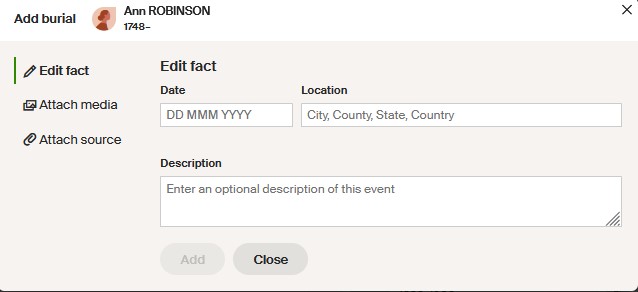
On Ancestry, to enter this kind of information, we click Add above the list of Life Events on the person’s profile page. A pop-up box appears: Add fact or event, with a list of life events to choose from, or you can make your own ‘Custom Event’.

Now we must fill in all the fields ourselves. Having to do this really makes us think about what the issues are, and why this may not be as straightforward as it might seem. Remember that in this post we’re just thinking about the Location.

In the pop-up box above, the words ‘City, County, State, Country’ is our hint as to how to arrange our place name. Of course, that’s based on the USA rather than UK, where we don’t have separate ‘states’.

Write place names as they are on the record, not what would be correct today
For example, today, Brighton is in East Sussex, but historically was in Sussex.  We should input the county as it is on the record, which before 1974 would have been Sussex.  Similarly, Gisburn was in the West Riding of Yorkshire, but since 1974 has been in Lancashire, so a 1980 birth should be recorded in Lancashire; a birth in the same house in 1970 would be recorded as Yorkshire.  Some of the newer counties didn’t even exist when the record was created.  For example, Wolverhampton, now in the ‘West Midlands’, was formerly in Staffordshire.

The further back we go, there may be even more archaic county names, for example, the Isle of Wight was in ‘the County of Southampton’. These ancient counties don’t work with Ancestry. I always record this as ‘Hampshire’, but would use the description box (see image above) to record that ‘the County of Southampton’ was given on the record.

Use official place descriptions, not ‘the way we referred to it in our family’
When I was little I used to write to my great uncle who lived in a village called Methley, about ten miles from Leeds.  My mother showed me how to write the address as ‘Methley, nr. Leeds, Yorkshire’. When I started my family tree it seemed important to me to preserve this memory, so I wrote ‘Methley, nr. Leeds, Yorkshire’ for the location of that great uncle.  This was my family history, after all! I also referenced every incidence of the main church in Leeds as ‘Leeds Parish Church’, that being how it was referred to locally. Sadly, algorithms don’t understand our happy memories! We can still include this information, but put it in the little box for ‘description of this event’ rather than in the ‘Location’ field.

When entering residence, limit this to the place, not the actual street address
If you include the full address in the location, forever more when you write the place name, Ancestry will offer up every single address you’ve ever written in that location for you to select. Below, here’s what happens every time I write ‘Hunslet’. You can still write the full address if that’s the way you want to do it, but it’s better to put it in the Description box linked to the event. 

Recording church names for baptisms, marriages and burials
One of my ancestors was baptised at St Leonard’s church in Bilston, Staffordshire. If I write this information in the Location box on Ancestry, this could be confused with the town called St Leonards, which is in East Sussex. Similarly, St Helen’s church could be confused with the town of that name in Merseyside; St David’s after the Welsh city, and so on. For this reason I always put the placename first, then the church: Bilston, St Leonard, Staffordshire, England. Usually, I only include the church name when recording religious rites that took place within the church.

Recording the historic parish name in cities of multiple parishes
There is an important exception to the last sentence in my above ‘rule’. In larger historic towns and cities that developed around the 11th Century there tended to be many small parishes within the walls, and since the Anglican parish was also the administrative unit for secular administration, it’s useful to record this parish information for all events. I wrote about this previously, using Norwich as an example. There, prior to the introduction of Civil Births, Marriages and Deaths in 1837, I would record a birthplace and place of death like this: ‘Norwich, St Martin at Oak, Norfolk, England’. It is true and accurate, and it gives us additional information about where, precisely, in Norwich, the event occurred. The same applies for London, Winchester, York, and other historic towns.

When recording the Registration District doesn’t tell the true story
Since 1837, Civil Births, Marriages and Deaths are recorded within Registration Districts. You’ll find a list of every single Registration District (RD) that has existed since then on the UKBMD website [here]. Often, these make perfect sense. For example, a birth between 1837 and 1998 in the Wiltshire town of Devizes will have been registered in the RD of Devizes. However, as the UKBMD page for the Devizes RD shows, many other settlements in the area came within its boundaries. So if your ancestor was baptised in Pewsey, 11 miles to the east of Devizes but registered in Devizes, what location do you record for the birth? What if you also know from subsequent censuses that your ancestor was in fact born in the village of Sharcott that lies within the ancient parish of Pewsey? Which one would you record as this person’s place of birth? This is what I would do:

  • Record the birth as the actual village if I know it, but also add the General Register Office reference in the description box. This includes the RD of Devizes. e.g. Name xxx; Mother’s Maiden Name xxx; GRO Reference: 1837 D Quarter in DEVIZES IN THE COUNTY OF WILTS Volume 08 Page 250
  • Record the baptism with the name of the parish church in Pewsey.

Remember to add county and country
As you can see from my ‘Hunslet’ example, above, I didn’t always do this when I was starting out, and am still plagued by the fact!

The problem with simply writing the town or city is that many places in the New World settled by British migrants were given the names of former hometowns of the settlers. See what happens when I just type ‘Portland’.

In future searches, the search engine doesn’t know if we mean Portland in Dorset or one of these other Portlands, and may offer up all kinds of unrelated records.

If, instead, we consistently record the county and country, it helps the search engine and also helps us to keep our research tidy, enabling us to see at a glance where the person was.

If you’re an old hand at this family history research, all this is nothing new to you – but if so, please do share any examples from your own research, showing how you dealt with an unusual location situation. If you’re fairly new to researching your own family tree, I’m guessing you never knew there could be so much to recording someone’s ‘location’!

Linking a new event after searching on Ancestry

Most of the above points apply to building your own tree, whatever application you’re using to record the information. Let’s move on now to how information gets added to our trees when we’ve done a search on the Ancestry website. If you’re using a different subscription website for your tree the process will be different but the same issues may apply.

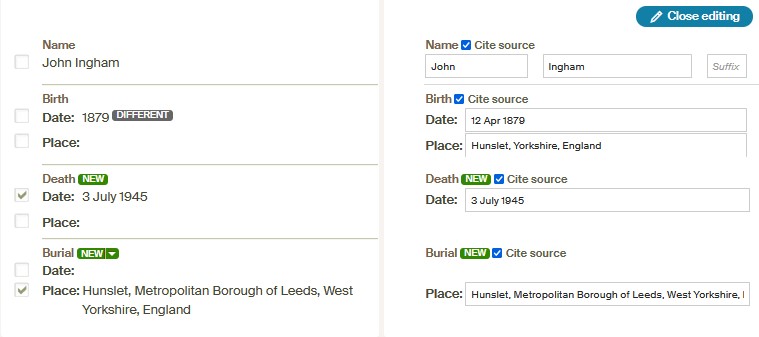
If we search for records from the person’s profile page, or by following a ‘Hint’, or by filling in details on the general search pages, when we find a record we want to add to our person’s profile page, the information fields will already be completed. This information is based on someone else’s transcription of the record, and how it was indexed. Here’s an example:

In this box information I already had, and new information, are separated out. Any differences between the two are highlighted. We can edit, accept or decline any changes to existing information. In the above example I decided to accept it as it is (although I can see a problem), and now, on this person’s profile page, if I click on the entry for his burial, I get a similar pop-up box as the one at the top of this post, but with some of the facts filled in – actually in this case, just the location:

The problem here is that the location for this record is not indexed in a way the Ancestry algorithms will understand. Hunslet is good. Leeds is sufficient without the ‘Metropolitan Borough of’ part (although I would not necessarily include ‘Leeds’). West Yorkshire did not exist in 1945; it is a county level authority that was created in 1974, so the county should just be ‘Yorkshire’. Although the country is the United Kingdom, since the law and administrative arrangements are different in Scotland and Northern Ireland, in ancestry research we usually just refer to England, Northern Ireland, Scotland or Wales, therefore the country here is England (which you can’t see because of the length of the location information) and is correct on this record. For me, this location should simply be ‘Hunslet, Yorkshire, England’, or ‘Hunslet, Leeds, Yorkshire, England’, and that is how I would amend it.

Yorkshire ‘Ridings’
Some of the old Yorkshire records include the ‘Riding’ in the indexing.  Unfortunately, Ancestry cannot cope with this at all. If we leave it in, the record entry will forever default to Riding in Northumberland – a place I cannot find on the map, but which has definitely caused me some problems over the years.  So my advice is to remove any reference to the Riding from old Yorkshire records.  If you want to include the Riding, do it in the ‘Description’ box attached to the Event.

Be vigilant!

The lesson here is that just because information is presented to you in a certain way, does not mean it is correct, and does not even mean it is algorithm-friendly on that website! If we have our own sense of what is needed for recording the location – what we personally would like, and what we have come to understand the website requires – we can record information more consistently, more correctly and in a manner that makes future Hints and Searches more effective.

I hope you’ve found something useful in all this.

April Fool’s Trees

Hand on heart, this is a family tree chart based on the plot of a well-known series of novels and TV adaptation.

Look closely!
I found myself breaking out in a cold sweat when I realised the DNA implications…

A drop line family tree chart based on the plot of a well-known book in which time travel features.

Some of you will know the series as soon as you look at the chart. Please don’t give it away in the comments in case it might spoil the enjoyment of someone yet to read it!

The rest of the trees in this post are genuine. The next three are from my own family tree. There’s something unusual about each of them. If you’re not practised at interpreting the symbols on family tree charts, look at each one to work out what’s happening before reading the explanation below each chart.

What’s happening here?

Drop line family tree showing two couples and one child of each.  After the death of the wife of one and the husband of the other, the remaining man and woman married.  Their children also then married.

Explanation: Joseph was married to Susanna and was widowed in 1865 when Susanna died. Jane was married to William and was widowed in 1872 when William died. After this, Joseph and Jane met, and they married in 1873. Through them, two of the children from their first marriages also met, and they married in 1874. So the children of this married couple are also a married couple.

What’s happening here?

Drop line family tree chart showing marriage of man to his late wife's niece, after death of the first wife

Explanation: Edwin and Mary Ann had two children, Frederick and Ada Harriot. Frederick had a daughter: Ada Mary. His sister, Ada Harriot married Richard Barton. Ada Harriot died in 1887. Four years later Richard remarried. His new wife was his niece-by-marriage, Ada Mary. Richard’s older children by his first wife are cousins of their new stepmother. They are half siblings and first cousins once removed to the children of that second marriage. The late Ada Harriot is great aunt to the children of her widower’s second marriage.

My natural tendency would be to put a diagonal ‘ = ‘ (indicating marriage) between Ada Mary and Richard on the line above. If I was sketching this out by hand that’s what I would do. However, it wouldn’t be ‘proper’… although I do think it illustrates more immediately what the situation is than this formal version, which keeps to set lines for the generations and has Richard and Ada Mary in their proper places, each therefore appearing twice.

This is an example of an avunculate marriage. It was actually forbidden in England and Wales until two years before Ada Mary’s death – and I suspect the couple knew this, since they married 200 miles from home. The Marriage (Prohibited Degrees) Relationship Act of 1931 removed the barrier to marriage between widowed uncle-by-marriage and niece.

What’s happening here?

Drop line family tree chart showing one woman with two marriages, and a son from each marriage.  These two sons (consecutively) both married the same woman.  Children were born to both these marriages.

Explanation: Harriet had two husbands: Marcus, and then when widowed she married John in 1862. She bore several children within each marriage, including Edward, son of Marcus; and Thomas, son of John.

Edward married (or possibly cohabited with) Jane. After Edward’s death, Jane married (or possibly cohabited with) Edward’s half brother, Thomas. Jane had seven children with Edward and one child with Thomas. This child was half sibling to the others, and also their cousin.

This marriage was also prohibited in England & Wales, until the passing of the Deceased Brother’s Widow’s Marriage Act in 1921. In the particular example above, no marriage record has been found for a marriage between Jane and either brother, so the forbidden marriage situation may not have been an issue.

The next one is based on an online article I saw a couple of weeks ago. You might have realised from the above that I have a fascination with people with multiple connections, and how to illustrate them in a family tree chart.

What’s happening here?

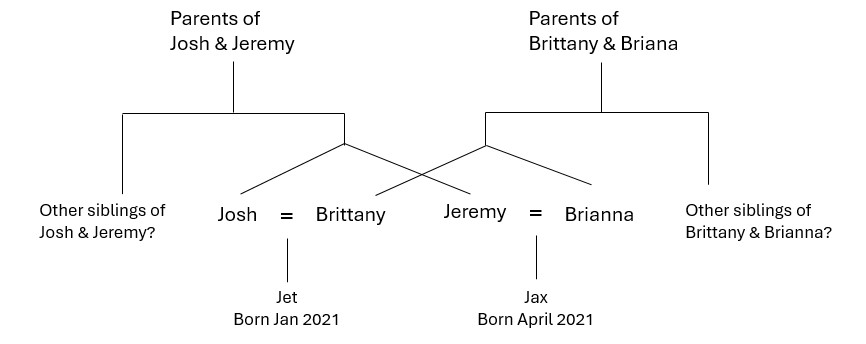
I shared a post about this family on my English Ancestors page on Facebook a couple of weeks ago. Here is a fuller article about the family, from The Independent. Identical twins Josh and Jeremy married identical twins Brittany and Brianna. Each of the couples had a baby early in 2021. As sons of two sets of identical twins (whose genetic information is identical) the children are cousins, but also, since it was exactly the same DNA that created both, they are genetic brothers. If they took an ancestry test they would show as brothers.

There is a serious side to looking at these unusual family trees. They help us to become more practised at using family tree symbols, as well as thinking about the most ‘elegant’ way to illustrate unusual relationships.

All of these family tree charts were drawn using PowerPoint. Doing this provides more control over what you include, and how to illustrate it, than a lot of the tree-building applications on genealogy software or websites. Online family history education providers like IHGS and the Society of Genealogists offer courses and one-off tutorials about using PowerPoint for tree-building. They include the functions of PowerPoint you will use, but also the rules about building pedigree charts, and the information to be included for each person. In the above charts I limited the information included to the story I wanted to tell, but a standard tree chart would include more. We also need to know about the standard abbreviations. In the first chart I had to make up a symbol – the one for ‘several generations between the two people shown’, but the rest are standard. Just a note that in the last tree I didn’t know if the two sets of twins actually have any siblings, but included them as a possibility just to highlight the difference in how we show single births and twins.

Hope you enjoyed. How about you – what unusual connections or multiple connections have you found in your trees?

Geography for Genealogists

My knowledge of the geography of places where I do genealogy research has come on in leaps and bounds over the years of doing this, and I’m sure it will be the same for most of you too. There are places I’ve never even visited in real life, yet can visualise their location on the map, together with surrounding villages or parishes. When we come across a likely record in an unfamiliar place, we need to assess the probability of this being our person.  Finding the place is a village just two miles from the expected location adds weight to that possibility. It goes without saying that maps, old and new, become our friend, but I thought it would be interesting to think of how ‘geography for genealogists’ differs from the geographical needs of regular people just finding their way from A to B or planning to visit a new area.

Essentially, of course, we need to understand the geography not only as it is today, but also as it was at different periods through history. It’s almost as if we have to peel back the layers to get to the place as it was during our period of interest.

Knowing all the names that apply to a specific place
Historically, our towns and villages have been organised into different administrative levels. We need to know what these are – what they were called, the nature of the administrative level bearing that name, the historical period in which it operated, and why each one is sometimes the place-name used… but not always. It all boils down to different types of record and where they were created. These different types of places and administrative levels include:

  • County
  • Hundred / wapentake / rape
  • Town or village
  • District
  • Parish
  • Diocese
  • Civil Registration District
  • Poor Law Union
  • Manor
  • Another name grouping places together, such as ‘Upper Wharfedale’ or ‘Cinque Ports’, or in Yorkshire the three Ridings.

Some of these are more important as we progress our trees further back; others come into play in the nineteenth century.

I wrote about some of these different administrative levels in a couple of posts back in 2019, and how confusing it can be to find a death recorded in two apparently different places – the parish and the registration district – particularly when neither of these named places is the known abode of the deceased. When we understand the function of all these administrative levels, these apparent ‘discrepancies’ fall into place. Even so, if we’re working with a new, unfamiliar area, we’re likely to have a bit of researching to do before it will all fall into place.

Good sources of information around all this include:

  • The UKBMD website, useful for helping you work out which Registration District your place of interest was in.
  • GENUKI has listings and information about all parishes, arranged by county.
  • FamilySearch Maps enables you to search for the parish on a map, to see other place names within the parish, to locate it in amongst adjacent parishes, and to see what ‘jurisdictions’ it fell within before or as at 1851, including the county, Registration District, diocese, Poor Law Union and others.
  • You’ll find useful information on Wikipedia, for example a search for “high peak district wapentake” returned this page about Hundreds of Derbyshire.
  • Also try FamilySearch Research Wiki, which you can access via the home page → Search → Research Wiki, or you can access simply by Googling “FamilySearch” and the name of a place you’re interested in. Using both methods, I searched for “Staffordshire”, and from there navigated to the parish of Kinver, which has a good selection of historical/geographical information about that parish.
  • The Manorial Documents Register on the National Archives Discovery pages enables you to search for manors by name or within specific parishes.
  • In addition to any old maps you can find, the National Library of Scotland Side by Side maps can really help you to pinpoint and understand where a specific place used to be.
  • A Family History or Local History group’s website is likely to have other relevant information.
  • And of course your search engine of choice.

Historic accent and dialect
An additional feature of ‘genealogical geography’ is that in a time when many people could not read and write, and even before that when rules for spelling were not as established as they are now, place names were written as they sounded, or as the scribe heard them. It can take much poring over online maps to work out what a placename was meant to be, or what we would call it today. It’s easier if you’re familiar with the local accent or dialect. One that had me stumped for years was ‘Aul Court Somersetshire’, recorded as grandfather’s place of origin on a Dade style baptism register in York. If it hadn’t been for a friend who used to live in this long-elusive and mysterious place, I would still not know that this is a reference to the parish of Walcot, today part of Bath. It does give us a bit of extra information though, about the person who gave this place-name to the clerk. She spoke with a Somerset accent with which the York-based clerk was unfamiliar.

Variations in information given about places
Sometimes our ancestors gave different information about key places on different records. Often, we can explain this by distance – and the same would apply today. If I lived in Tedburn St Mary, about 5 miles west of Exeter, and I was talking to someone in Exeter, I would say I lived in Tedburn St Mary. If I moved to Norwich and was asked where I was from, I might say ‘Exeter’. In other circumstances I might say ‘The West Country of England’.

Map showing the area around Hopperton in North Yorkshire, including the villages of Coneythorpe, Cowthorpe, Great Ouseburn and Little Ouseburn.

It would have been just the same for our ancestors who migrated.

However, this doesn’t explain why a person I previously researched gave his place of origin variously as ‘Coneythorpe’, ‘Cowthorpe’, ‘Hopperton’, Ouseburn’ and ‘York’. Even if we accept York as the nearest big place and therefore more likely to be reported to a stranger, it still doesn’t explain why this person gave so many tiny places as his birthplace on different documents.

We have to be prepared to think out of the box!

Some places have disappeared
Sometimes the only geographical indication that a place ever existed is a lane bearing that name, and presumably once leading to it. The only modern day indication of a place of significance to one of my 6x great grandfathers is a Service Station bearing that name. On these occasions we may just have to take what we can and accept that our place of interest is ’round about here somewhere’.

Knowing the lay of the land
Going further back in time, knowledge of other geological features such as mountain ranges could be useful in indicating where networks are unlikely to extend. Conversely, historic places such as abbeys, and the trading routes once linked to them, or the land holdings of important families, might explain why people did turn up in unexpected places.

***

Some of the above, of course, applies equally to local history, while the nature of the records we use means that some of the challenges are more prevalent for family historians. I’m sure you’ll be able to think of examples of all this from your own research, and perhaps other aspects of geography that have extra layers when researching our family histories. If you do, please do tell us about it in a comment.

My response to MoJ consultation: Storage and retention of original wills

Only four days remain before the deadline of the Ministry of Justice consultation paper regarding proposals to destroy all post-1858 original Wills and related documents, with the exception of those of famous people, and to retain only digital files of the rest. The full consultation paper may be viewed here.

You can respond directly at the following address or by email: civil_justice_poli@justice.gov.uk

Will Storage consultation
Ministry of Justice
Civil Justice and Law Division,
Postpoint 5.25
102 Petty France
London
SW1H 9AJ

The deadline for replies is this coming Friday, 23 February.

Below, is my own response in full, which was emailed this morning.

***

Response to the Ministry of Justice Open consultation paper: Storage and retention of original will documents, Published 15 December 2023

Question 3: Are there any reasons why the High Court should store original paper Will documents on a permanent basis, as opposed to just retaining a digitised copy of that material?

Yes.  As a professional genealogist/ researcher working with documents in archives as well as online digitised copies of certain documents, I object strongly to proposals set down in the above consultation paper to destroy the majority of Wills and related documents after a prescribed period, replacing them with digital images of the same.  My reasons are below.

Question 5: Do you agree that there is equivalence between paper and digital copies of wills so that the ECA 2000 can be used?

No.  In archival terms  paper wills and digital copies are not equivalent.  Only the original is ‘the original’.  A digital copy of that, no matter how perfect, is a stand-in: a ‘surrogate’.  Even the citation appropriate for these types of documents is different: if a researcher is in the presence of the original document, the citation will be to that document and its location; if using a ‘digital copy’ of that, the citation requires extra information: what, precisely was viewed, via what website or other source, and when was it accessed?  There is a reason for this: only the original can be guaranteed to include every mark and every page.

Digital preservation is not infallible.  Despite the ‘huge advances that technology has made over recent years’ (Point 27) it does not follow that ‘digital copies of original documents can be extremely detailed and all relevant marks on the original will be retained in the digital version.’  JPEGs are ‘lossy’ files.  Lossy compression compresses an image, making it smaller (and more economical) to store, but the trade-off is a permanent loss of detail.  As a researcher who regularly downloads images from archives and commercial genealogy websites I know that those images are much-reduced JPEGs.  Consequently, there are times when only the original will do, for example when comparing signatures with other documents to confirm this is the same person; or if a stain on the original document renders text illegible in digital format: in a good light, the eyes may be able to decipher the original. 

Digital files can also corrupt, resulting in permanent loss of all contents.  In any case, the technology available to us now may be surpassed in the not too distant future. 

There is also the issue of human error.  During the photographing process, it is possible to turn over two pages at once, to leave off useful information on the rear of a document, or even to omit an entire document.  All researchers using online digital images will have experience of this.  On occasion, too, documents may be incorrectly indexed, making the correct digital files very difficult to find.  In 2023 entries on the GRO Births and Deaths registers were made available for direct download – a development greeted with delight by the genealogy world; and yet some of the digital photographs of the entries are not usable, owing to having been photographed at an angle, thereby cutting off essential information.  The point with all these difficulties is that the original documents remain intact: they have not been destroyed.  The digitisation is a great thing, but we need the originals too.

Question 4: Do you agree that after a certain time original paper documents (from 1858 onwards) may be destroyed (other than for famous individuals)?

No.  History is not just about ‘famous people’.  Concepts have changed.  History is also about the many millions of others who were impacted by decisions of the powerful.  Their Wills are important too.

Question 6: Are there any other matters directly related to the retention of digital or paper wills that are not covered by the proposed exercise of the powers in the ECA 2000 that you consider are necessary?

It is clear from the wording of the consultation paper that a rather narrow understanding of the enduring value of Wills and Probate documents is at play.  Point 27 asserts that ‘All parties and courts will […] be equally able to rely on digital copies of wills to challenge the validity of that will or another as they would be if relying on the paper will.’  Undoubtedly that is true; and in this regard legal issues such as time limits for contesting a Will are relevant, and the comparison with time limits for retention of other Court documents (Point 45) is valid.

However, once Probate is granted, the Will and associated documents become public documents.  As such, the original purpose of the Will and Probate documents is not its enduring value.  It is not appropriate to restrict considerations to the immediate legal purposes and to the emotional attachment of the testator’s nearest and dearest.  The wider value of a Will may become apparent many years into the future.  Genealogists use them to learn about the immediate and wider family of the individual, their lifestyle and social standing.  Historians and social scientists may take a much broader approach, for example examining Wills made by individuals in a particular location, or a particular ‘type’ of person, using their findings to draw conclusions about, and better understand that location, or our society more generally in the past.

Question 9: Do you agree with the principle that wills of famous people should be preserved in the original paper form for historic interest?

I agree of course that wills of famous people should be preserved, but not that this should be the exception to the rule of mass destruction.

The suggestion (Point 51) that this already happens for pre-1858 Wills is misleading and untrue.  Before 1858, Probate was a matter for the ecclesiastical courts, and these valuable historic documents are stored in diocesan archives, with some original and copy Wills of the Prerogative Court of Canterbury held at The National Archives.  While it is true that Prerogative Court of Canterbury: Wills of Selected Famous Persons have been separated out and stored in record series PROB 1, the implication that only these Wills have been kept is false.  Not a single Will was destroyed; Wills of individuals not deemed ‘Famous Persons’ are archived within a different part of the collection.

Question 10: Do you have any initial suggestions on the criteria which should be adopted for identifying famous/historic figures whose original paper will document should be preserved permanently?

The mere posing of this question illustrates the problem: there is a value judgement linked to this.  Since your values may be different to mine, who will decide?  Might society’s assessment change over time?  A suffragist in the nineteenth century might be considered a tiresome person, yet that same person today may be considered a trailblazer, playing an important part in the road to universal suffrage.  What a travesty if it turned out this person’s Will was destroyed because they were not sufficiently ‘famous’, or their fame did not accord with contemporary values.

Janice Heppenstall

Save Our Wills!

First of all, a very Happy New Year to you all.

You may already know about the UK Ministry of Justice’s proposals to destroy original copies of post-1857 Wills after 25 years. The proposal is to retain only a digital copy of each Will. Information about the proposals is contained in the Ministry of Justice’s Consultation Paper, which you will find [here].

As genealogists we are all in favour of digitisation of documents, and easy availability online. The government’s online Wills and Probate service is an example of this, allowing us to search, and for just £1.50, to receive a digital copy of the relevant Will by email.

However good the digital image, though, there is a difference between it and the original document. In archivist terms, it is only the original which is the ‘original document’. The digital images we mostly use via subscription websites or indeed the GRO’s online Wills and Probate service, are termed ‘surrogates’. There is always the possibility that part of a document is not included, that one page is blurred, that part of one page is missing, or that a few handwritten words on the reverse that might just be the clue to a mystery are not included. As all of us who work regularly with genealogy websites know, it could be months or years before such a problem is noticed. If the original exists somewhere this can be resolved. However, if the original has already been destroyed, valuable information is lost for ever.

Genealogist and former archivist of many years at The National Archives, Dave Annal, has put together an excellent video in which he summarises in just over five minutes the main problems with these proposals.

My friend and colleague Richard Holt has taken a particular interest in this matter from before the launch of the present proposals and consultation by the Ministry of Justice. In his blogpost Justice for Wills and Probate Documents he writes about times in his research when only an original will do. Initially his concern was with the operation of the Freedom of Information request process, but since the launch of the proposals to digitise and destroy original post-1857 Wills, his concerns have increased, and these are covered in the second half of that blogpost. 

I will not spend time adding my own thoughts to those of Richard and Dave, since I do agree with all they say. Indeed, online and via any groups that you are part of, you will find an increasing number of articles and robust responses from other genealogists, historians, archivists and societies/ associations linked to these fields.

So what can we do about it?

Richard has launched a petition to the UK Government and Parliament: Do not allow original wills to be destroyed after 25 years – Petitions (parliament.uk). If you are a UK citizen or resident you will be able to sign it. At the time of writing this, there are 7410 signatures.

You can also respond directly to the Ministry of Justice’s consultation. This option is open to anyone, anywhere in the world – and of course many people have UK ancestry so this affects all of us. Replies must be received by 23 February, using the email civil_justice_poli@justice.gov.uk or the following address:

Will Storage consultation
Ministry of Justice
Civil Justice and Law Division,
Postpoint 5.25
102 Petty France
London
SW1H 9AJ

Finally, please share this information with others who you think will be concerned by these proposals.

#SaveOurWills

Happy Xmas (and other abbreviations)

So go on then… you have a pile of cards to write and a hundred other things to do before Christmas Day. What do you write on your cards – ‘Christmas’, or ‘Xmas’?

I always write ‘Merry Christmas’ in full – at some point in my teen years I decided it was lazy not to write the full word. Your decision may have been for more serious reasons, like the campaign to “Keep the ‘Christ’ in Christmas” or concerns about the over-commercialisation and secularisation of the religious event, as seemingly represented by the word ‘Xmas’. All the more so because it’s well-known that in algebra ‘X’ stands in for ‘the unknown’.

It came as a surprise then, as my family research progressed, when I started to notice ‘X’ as an abbreviation for ‘Christ’ in church records. 

In this extract from the parish register of Norwich St Martin at Oak, an 1819 Baptism entry was amended in 1836 to correct the mother’s name of Sophia: ‘This Xpn name sh[oul]d be Lucy…’

Baptism record for James Sword, son of Thmas and Sophia Mann.  A later note on the register indicates that the mother's Christian name should be Lucy, not Sophia.  The abbreviation 'Xpn' is used instead of the full word 'Christian' being written out in full.

Instead of ‘Christian’, the letters ‘Xpn’ are used.

There are also of course many examples of the name Christopher being recorded as Xpher or Xpoferus. Thankfully, I have not found any document in which my 5x Great Grandfather Christopher Christian is recorded as Xpher Xpn. (Perhaps he is, but no one indexed it correctly!)

These seemed to me to fall foul on all counts – first, because this was supposed to be a solemn record and teenage me had already decided such documents needed to be written in full; and secondly in that these were *Church* records, where Christ was by definition at the forefront of procedings.

There had to be another explanation; and of course there is. In fact, in English ‘X’ was first used as a scribal abbreviation for ‘Christ’ in 1100; in 1551 ‘X’temmas’ appeared; and by 1721 ‘Xmas’ was in regular use as an abbreviation for ‘Christmas’. (See: Wikipedia: Xmas) It is thought that these abbreviations came about as a cost-saving practice: the cost of parchment was so expensive that any ways of saving space in the text were welcomed.

However, the history behind the abbreviation is even more susprising. The first letter is not actually Latin script, but a Greek X, pronounced Ch (as in ‘Christmas’). In the abbreviation for Christopher (Xpher) the second letter is not necessarily part of the ‘pher’: the Greek letter ‘ρ’ is pronounced ‘r’; and in Roman Catholic, Eastern Orthodox, Church of England and Episcopalian forms of Christianity, the ‘Xρ’ has long been an accepted abbreviation for Christ, or ‘Christos’ (Χριστός). Over time, in English scribal abbreviations, the second letter – the ‘ρ’/ ‘r’ – was dropped in the word ‘Xmas’.

So there you are - when we write ‘Xmas’, we’re not being lazy; we’re following a long tradition in Christian scripts of abbreviating using the ancient Greek alphabet.

Now… since this is supposed to be a blog about genealogy research, not linguistics, I hope you’ll find the following link useful: more abbreviations you may find in parish registers and other genealogy records, courtesy of FamilySearch.

And on that note all that remains is for me to wish you a very Happy Christmas (or Xmas, if you wish) and a Happy and Healthy New Year. See you in January.

Will there be another Census for England & Wales?

As genealogists we know that the historic records we rely upon were not created with us in mind. Always, there was a significant contemporary reason behind the collection of data. The list of heads of household may have been compiled to keep track of who had paid taxes, or rentals. The list of adult males may have been required for selection of local militia. Parish registers, while being a record of religious rites, were also a means of keeping track of the population, and so on.

When the first censuses were carried out in 1801-1831 the purpose was to collect basic information about numbers of inhabited/ uninhabited houses, numbers of families occupying them, numbers of people (male/female) with a very basic breakdown of their occupations, and information about numbers of baptisms, marriages and burials. It was not until 1841 that names, ages and occupations of individual household members were collected, along with a rough indication of birthplace. The real need at that time was to get a handle on the size of the population (for military purposes and food requirements) and to understand migration within the country. Since then, with every new decade, changing societal conditions and increased understanding of links between, for example, living conditions and health, led to additional questions. In more recent decades, there has been a need to understand religious diversity, language needs as a result of immigration, gender identity, and so on. This then feeds into planning of services and facilities.

However, there has been another huge change in the past thirty years: information technology. Such is the ‘ready’ availability of timely data that the need for a decennial snapshot of the nation is in question. In June of this year the Office for National Statistics (ONS) produced a consultation paper on its proposals for The future of population and migration statistics in England and Wales.

In it, they explain their proposals to replace reliance on a decennial census, creating information that is essentially out of date as soon as it is published by instead using administrative data collected by a range of state organisations as a by-product of their work. This, they say, would enable the ONS to provide completely accurate, up-to-date information, when needed, and at a fraction of the cost. It is estimated that the cost of the 2021 Census was around £1 billion.

In response to these proposals a group of leading academics whose work draws heavily on data provided by the censuses have published an Open Letter in which they express their concerns.

Whereas we, as genealogists, are interested in personal information – and we’re not permitted to access that personal information until one hundred years have lapsed – impersonal statistical information from each census is released very soon after the information is collected. Already, a good deal of data is available following the 2021 census, and undoubtedly this is the data essential to the work of the sociologists, medical sociologists, criminologists, epidemiologists, social policy, population and health experts who signed the Open Letter.

Reading their letter, it is interesting to note that, despite the differences in our use of the census data, they broadly use the census in a very similar way to us: as a decennial benchmark against which the representativeness of other data may be assessed. For them, that would be statistics and other studies; for us it is Civil BMDs or parish register entries. Administrative data produced as a by-product of a service, they say, cannot fulfil this function. Although the census completion is not actually 100 percent, it is a legal requirement and completion is in fact very high. By contrast there is no mechanism for administrative data owners to be held accountable for the quality of their data. There are also opt-outs, not to mention the fact that some people are not even registered with the services in the first place and would therefore slip through the net. Their suggestion is that if the alternative ‘patchwork of administrative data’ is seriously to be considered as a replacement for the census, then at least in 2031 the two systems should be run in tandem, to ensure complete coverage and a smooth handover. They also assess that the cost of collection of data from these other sources and bringing them together as a seamless whole would be about the same cost as the decennial census.

Essentially, of course, our interest is in the genealogists of 2131 and beyond. It is with them in mind, as well as my own privacy concerns, that I am worried about the future of family history. The contents of our medical records and other information collected or created about us in the operation of public services should remain private – but a census is different. Whilst fully mindful of the real, administrative benefits to the nation of collecting all that information, on a personal level I enjoy sharing my information (my choice what to share) on the census. I think of it as a message to my descendants. In Ireland, last year, the 2022 Census even had space for a Time Capsule Message to be available to descendants in 2122. How wonderful would it be to open that!

Anyway… what do you think? Have you been involved in any of the consultation surrounding this? Do you have strong views either way? Do leave a comment.