1752: the year the calendar changed

The Julian calendar was introduced in 45BC by Julius Caesar.  Based on a solar year, it had twelve months, but a miscalculation of 11 minutes resulted in a leap year formula that overcompensated to the extent that every 128 years, a whole day was added.  By the 16th century, astronomical events such as the equinoxes and solstices were falling ten days early, and since the timing of Easter was linked to the vernal equinox, it was increasingly becoming removed from its proper season.  To overcome these problems, in 1582 Pope Gregory XIII introduced the ‘Gregorian’ or ‘New Style’ Calendar.  Not all countries followed suit immediately.  In fact it wasn’t until 1927 when Turkey finally made the switch, that everyone was on board.  However, since the change-over involved cutting ten days from one month in the first year of adoption of the new calendar, countries that didn’t change over were ten days ahead of those that did.

It was in 1751-52, following the Calendar (New Style) Act of 1750, that the UK (and British dominions) adopted the Gregorian calendar.  By this time the UK calendar was eleven days out of sync with the astronomical events and seasons, and these days were removed in one fell swoop in September 1752.  In that year, September 2nd was followed by September 14th.  Many of our ancestors were distinctly unhappy about the loss of eleven days.  There was a genuine fear that their lives would be shortened by that number of days.  They were also concerned at the interference with the Church calendar, particularly with the moving of Easter, and on top of all that they objected to the imposition of what they viewed as the ‘popish’ calendar.  This may or may not have resulted in the ‘English Calendar Riots’ of 1752.  Many historians today view them as a sort of Georgian urban myth.

However, the removal of the eleven days was not the only important change to flow from the Act of 1750, and it is this other aspect that impacts upon us as genealogists.  Prior to 1752 the English year began on 25th March.  This was Lady Day, one of the four Quarter Days, the others being Midsummers Day (24th June), Michaelmas Day (29th September) and Christmas Day (25th December).  I first learned of Lady Day while studying Tess of the d’Urbervilles for English Literature A-level – it was the day tenancies changed and rents were due; and Tess, with her recently widowed mother and siblings, were evicted from their cottage.

Before 1752, then, December 31st and the next day, January 1st were in the same year.  The year continued until March 24th after which, on March 25th, the new year would begin.
The 1750 Act provided for a changeover involving the following series of steps:

  • 31st December 1750 was followed (as usual) by 1st January 1750, and 24th March 1750 was followed by 25th March 1751.
  • 1751 was a short year, running from 25th March to 31st December, then December 31st 1751 was followed by January 1st 1752.
  • Finally, with the removal of the eleven days in September 1752, September 2nd of that year was followed by September 14th.

For us as genealogists it’s the period between 1st January and 31st March in each year before 1752 that can confuse.  If you look at any parish register before this time you’ll see for yourself that the recording year did indeed start on 25th March and end on the 24th.  So if your ancestors married on 1st April 1632 and their first child was born on 1st February 1632, that child was born ten months after the marriage, not two months before it!  You might also have come across unlikely coincidences in record sets such as the birth of Elizabeth to parents James and Mary on 15th January 1732, and another Elizabeth to the same parents on 15th January 1733.  What really happened is that one transcriber amended the date to the Gregorian calendar and the other didn’t.

Historians and genealogists can get around this confusion by using a technique called ‘double dating’.  Any date after 25th March is recorded as usual (e.g. 1st April 1632).  However, any date from 1st January to 24th March is recorded in a way that recognises its position both within the Julian and the Gregorian calendars: e.g. 1st February 1632-33, or 1st February 1632/3.  If you’ve already got your research back to these earlier parish registers, you may decide to use this system.  However!!!! the online trees find it difficult to cope with.  After asking you repeatedly if you’re sure this date is correct, it will accept it but only show the earlier of the two years in the person’s profile.  Be strong!  It’s your tree!  😀

One final aside….
There’s another important side-effect of these changes, and one that remains with us today.  Formerly, being the start of the year as well as the first Quarter Day on which rents were due, Lady Day was also the start of the English tax year.  However, with the loss of the eleven days in September 1752, it was deemed appropriate to delay the collection of taxes to April 5th, thereby avoiding the loss of eleven days of tax revenue. That’s why, following another tweak to the calendar in 1800, the UK tax year starts on the surprising date of 6th April.  And after a quick revision online, I now see that the date in Tess of the d’Urbevilles is ‘Old Lady Day’: 6th April.  Is this an indication that a hundred years after the event, rural England hadn’t fully embraced the new calendar, or did landlords move the day rents were due to coincide with the new tax year…?

Finding Registration Districts and Parishes

In my last post I wrote about the different records produced by parishes and Registration Districts (RDs) in relation to births/baptisms, marriages and death/burials.

We’ve talked about parishes in recent posts, and the importance of their secular role alongside the spiritual.  We’ve also noted the existence of RDs in several past posts.  But what exactly is a Registration District?

In England and Wales, RDs came into being on 1st July 1837.  Until 1930 they were responsible for the registration of births, marriages and deaths.  The RDs didn’t always coincide with county boundaries, so they were grouped into ‘Registration Counties’.  This 1888 map of England and Wales shows counties, Registration Counties and Registration Districts.

If your ancestor lived in a big town or city, the RD might be quite obvious, e.g. Norwich.  However, some very large towns and cities were too big for just one RD.  What we think of as Leeds, for example, comprised several RDs over the period 1837-1930.

Since the introduction of civil registration closely followed the creation of Poor Law Unions, established by the Poor Law Amendment Act 1834, it was the boundaries of the Unions that became the boundaries for the Registration Districts.  For a while the RDs even included the word ‘Union’, so you may come across an ancestor’s BMD registration at e.g. ‘Sevenoaks Union’ or ‘Dudley Union’.  This does not mean your ancestor was born or died in the workhouse. The ‘Union’ part was dropped in relation to civil registration around 1860.  In fact this apparent link to the ‘Poor Law’ had deterred many people from taking advantage of the new possibilities for civil marriage in the Register Office.  RDs and Poor Law Unions were all abolished in 1930, by the Local Government Act 1929, and their responsibilities transferred to the county councils and county boroughs.

You can find Registration District boundaries very easily, on the UKBMD website.
Click on the county of interest, e.g. Yorkshire West Riding.
Then on the RD, e.g. Hunslet.
At the top of the page you’ll see information about when this RD was created, the area it covers and where the registers are now held.

I’ve chosen Hunslet for a reason…  It has to be said that some of the boundaries appear to have been drawn up by crazy people!  For a brief period, from 1845-1861, Hunslet seems to have been created as a sort of ‘miscellaneous Registration District’, including many unlikely villages that were later thankfully reorganised to more suitable RDs.  You can see all the changes in a table at the bottom of the page.  I was completely thrown on one occasion by a birth that seemed to have taken place simultaneously in Hunslet and Horsforth.  Shortly after the time of that birth, Horsforth was, very sensibly, passed to the Wharfedale RD.  It was this UKBMD web page that helped me untangle it all.

*****

So now you know where to look for RD boundaries, you might also appreciate a similar resource for parish boundaries.  There’s an excellent map resource available through FamilySearch.
Enter a location in the search box, e.g. Bilston
If there’s more than one place of that name, all will appear.  Click on the one you need, e.g. Bilston Staffordshire.
The parish will be pinpointed on the map, showing its boundaries, and an Info box lists other places within that parish, the dates from which Parish Registers and Bishop’s Transcripts are available, etc.
Jurisdictions provides information relating to the County, Diocese, ecclesiastical Province, etc that Bilston falls/ has come within.  You’ll also see that the RD and Poor Law Union are shown, which in this case are Wolverhampton.  So we now know that BMDs will be registered there in Woverhampton, not at Bilston.
Options suggests other things you can do on this page, e.g. obtain a list of neighbouring parishes.

A very useful source, I think you’ll agree, particularly as our research takes us further back in time.  Note though, that the jurisdictions given are as at 1851.  We already know that some RDs changed their boundaries after this time (e.g. Hunslet).  Other changes included the creation of new parishes as populations increased.  E.g. Killingworth, mentioned in my last post as the burial place of Jonah Shepherd, was still part of the parish of Longbenton in 1851, only becoming a parish in its own right in 1865, following the development of the local coal mining industry.  So always remember – Google is also your friend!

Untangling places, parishes and Registration Districts

Jonah Shepherd was born in Yorkshire but in the late 1850s moved with wife Alice and daughter Jane to Germany.  They were still in Germany in 1872 when Jane married.  However, around 1873, Jane and her new German husband moved, first to London and then to Northumberland, after which their lives are well-documented.  Jonah’s German-born son, Christopher, is also to be found in Northumberland, in records from 1881 onwards.  But Jonah and Alice seem to disappear.  The only (online) indication that Jonah may have returned to England is several death records in Northumberland in 1889.

Bearing in mind that the last positive placing of Jonah was 17 years earlier in Germany, my only reason for thinking he may be in Northumberland is that his adult children are there.  The search is complicated by the fact that the series of death records I see are all in the same year but in different places: Tynemouth, Killingworth, Longbenton.  Could any of these be the man I was looking for, and if so, which one?

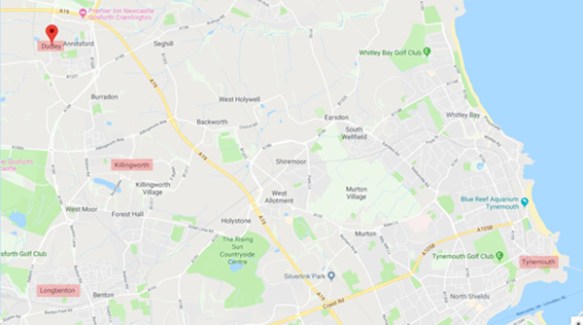
The answer is that they are all correct.  Killingworth (St John) is the church where Jonah was buried.  Before 1837 (pre-civil BMDs) the parish would have been the only place where his death (burial) was recorded.  But since 1837 the death is officially recorded at the relevant Registration District, and in this case that was Tynemouth.  Longbenton was the actual place of death given on public online trees by other people researching this family, but without further information I still couldn’t be sure this was my man.  Hoping that a known family member would be recorded as the informant, I sent for the death certificate, and I was in luck: Jonah’s son Christopher registered the death.  But I had another surprise too: Jonah actually died in yet another place: Dudley, which falls within the Longbenton sub-Registration District (where the death was actually registered), the Killingworth ecclesiastical parish and the Tynemouth Registration District!

One person, one death, four places of death; and all of them correct, depending on the focus of the record.

You may be absolutely certain that your ancestors lived in Village ‘X’, but the actual parish may be centred on an adjacent village ‘Y’, and it is here that, prior to 1837, the main BMB (Baptism, Marriage, Burial) record will be recorded.  Of course, even after 1837, people were still baptised, married and buried in churches, so you’ll still need to be aware of the connection between your ancestor’s abode and the nearest parish.  However, any such religious rites will now form a (very useful!) secondary record: since 1837 the introduction of civil BMDs means that the official record of all Births, Marriages and Deaths will be under the Registration District within which the event took place.

So which place should we record?  I record them all, but in slightly different places.  This is how I do it:

For civil birth and death registrations after 1837:
I copy the information directly from the General Register Office website. I then paste this into the notes section of the birth or death event on that person’s profile page, amending it by inserting the word ‘age’ for deaths, and the phrase ‘mother’s maiden name’ for births.  So this is what it says for Jonah:
SHEPHARD, JONAH, age 60. GRO Reference: 1889  M Quarter in TYNEMOUTH  Volume 10B  Page 147

However, if I do buy the certificate or if, through any other means (e.g. cemetery record, family documents), I know the actual residence at time of birth/death, I record that as the person’s place of birth/death.  For Jonah this is ‘Dudley’, or ‘Dudley, Longbenton’.

Parish records:
These generate a new event relating to a religious rite:

  • a baptism, which is not the same as the birth,
  • a marriage (plus banns),
  • a burial, which is not the same as death.
  • (Note: If you’re lucky, the vicar will also have recorded the actual date of birth or death, and you can insert these into the appropriate place on your ancestor’s profile.)

For these BMBs, I record the place where the event took place, and below that, in the event notes, I record any other information to be found on the relevant record.  For example:

Joseph Lucas was baptised at Mill Hill Chapel in Leeds in 1754.  That’s the place I record on the baptism event, and it would be tempting to record ‘Leeds’ as place of birth.  However, the record itself reads: ‘Joseph ye son of Nathaniel Lucas and Sarah, of Woodhouse’.  I transcribe this and add it to the notes for the baptism. This now also becomes evidence for Joseph’s actual place of birth, which is not Leeds as the baptism record set might have us believe, but Woodhouse (now very much part of Leeds, but in 1754 this was a separate village).  Woodhouse and Leeds are less than a mile apart, and some might think this is splitting hairs, but having this exact place of birth information for Joseph helped me solve a mystery relating to his origins and later apprenticeship and marriage.

All this applies whether the parish record is dated before or after 1837.  After that year you might use a combination of these parish and civil records to end up with several places, as I did with Jonah, but the basic fact remains that they can all be separated out:

  • Joseph’s place of birth was Woodhouse, and his place of baptism was Leeds, Mill Hill Chapel.
  • Jonah’s place of death was ‘Dudley’ or ‘Dudley, Longbenton’, his place of burial was Killingworth Saint John, Northumberland, and his death was officially recorded at Tynemouth.

In my next post I’ll share some really useful online resources to help you find parishes and Registration Districts, and to work out their boundaries.

Norwich’s medieval churches

Highly decorative medieval church

St Stephen  (Shame about the wheelie bin)

In a previous post we looked at why some of our historic English towns/cities had so many churches, and some of the implications of that for our family research.  I explained then that it was a chance entry on the 1861 census about one of the parishes within the city of Norwich that had brought all this to my attention.

Since discovering my Norwich ancestry, I’ve had several opportunities to visit the city and to photograph all the churches of interest in my family research.  On my last visit my trusty camera and I covered about 40km on foot, so I think by now I’m quite familiar with the lay of the land!  I can personally attest to (a) the beauty of these churches, and (b) the fact that often they’re situated literally paces from each other.  (How I came to cover 40km, then, in this area of a little over one squre mile, I can’t explain.  But the iPhone Health App doesn’t lie….)

Why were so many of these churches such fine buildings?

To answer that we must travel back in time to the origin of the English textile trade.  A significant part of this trade was based in Norwich and the surrounding lands, from where large quantities of woollen cloth were exported to Flanders in exchange for the finer and better finished cloth produced by the Flemish weavers.  Norwich’s geographical location was an important factor in its success.  Not only did the city’s proximity to the North Sea coast facilitate easy export of goods to the continent, but also Norwich benefited from several waves of migration, initially from the Low Countries, later also including Huguenot silk weavers from France.  There is evidence of the presence of migrant settlers in nearby Worstead as early as 1134.  However, it was the second wave of migration, dating from the 14th century, when Queen Philippa, wife of Edward III, invited the ‘goode and trew weevers’ of Flanders to come over in large numbers, that helped to establish Norwich as England’s second city.  Thanks to these people, who became known as the ‘Strangers’, the early, primitive manufacture of woollen cloth in England was gradually transformed, with new techniques and higher quality standards.  Eventually, the manufacture of linen and woollen textiles in England would reach such a level of perfection that it was acknowledged throughout Europe as the best available, preferred to that of any other country.  Textiles woven in Norwich were considered the crème de la crème.

Fine medieval great church overlooking colourful market stalls

St Peter Mancroft, Norwich’s ‘Greater Church’, overlooking the market square which has been in continuous use for almost 1000 years

It was the wealthy cloth merchants who built the churches, clearly as a demonstration of their social standing and wealth; and as a reflection of the size, wealth and importance of the city; but also undoubtedly as a means of easing the way to heaven when the time came.  The distinctive feature is that most of the churches were built from locally found flint.  Several combine this with highly skilled, elaborate limestone flushwork.

Inside, too, the wealth of the merchants was amply demonstrated.  By the second half of the fourteenth century, an inventory of the ornaments of all the churches in the archdeaconry of Norwich shows the abundance of silk vestments and high altar palls owned by 46 of the churches.  By the time of the Reformation these treasures had increased many times over.  Norwich’s civic and ecclesiastical records show that following the decision of Parliament in 1643 to rid the nation’s churches of the last vestiges of Roman Catholicism, many fine paintings, crucifixes, statues, stained glass, seating, vestments and organ pipes were removed, smashed, destroyed and publicly burnt.  For the most part, though, the churches themselves remained standing.

Baptismal font with highly decorative wooden canopy

Baptismal font inside St Peter Mancroft where my 3xG grandfather was baptised. The highly decorative wooden canopy is an 1887 reconstruction

T. Kirkpatrick’s sketch of the North East Prospect of the City of Norwich gives an idea of what the city looked like in 1723.  Although several of the 63 original churches had been demolished in the 16th century, and a further one would follow in 1887, Hochstetter’s map demonstrates that by 1789, 36 churches remained.  That was also the year my 4xG grandparents were married at St Peter Mancroft.  Their son, my 3xG grandfather, would be baptised there six years later.

During the Second World War, Norwich’s beauty and historical significance, as highlighted in Baedeker’s guide, marked it out as a target for the Luftwaffe High Command.  The raids on the city that took place between 27th April and 19th October of 1942, continuing sporadically until 6th November 1943, became known as the Baedeker raids.  Accounting for 60 per cent of lives lost through air raids in Norwich during the war, and causing damage then requiring £1,060,000 worth of repairs, the raids were also responsible for the loss of five of the medieval churches, although St Julian, of particular historical significance as the late 14th century residence of Dame Julian of Norwich (whose work The Revelations of Divine Love is the first known book to be written in English by a woman) was rebuilt.

Today, then, 31 of the historic churches remain within the ancient, crumbling city walls, and Norwich can claim the largest collection of urban medieval churches of any city in Western Europe north of the Alps.  However, the majority of them no longer serve as chuches.  Three are under the care of The Churches Conservation Trust (search for ‘Norwich’ to find them) and one is in private ownership.  Since 1973, a further eighteen, managed by the Norwich Historic Churches Trust, have been brought back into use as community, cultural and arts centres.

St Michael Coslany church, showing richly decorated facades

Nicholas Groves has written an excellent book about The Medieval Churches of the City of Norwich, which has accompanied me on all my meanderings across the city.  It’s widely available in Norwich bookshops.  I bought my copy in the little bookstore within St Peter Mancroft.

Divorced, Bigamist, Bereaved

I bought this book primarily because I was confused by the historic application of the law on bigamy.  I knew of a ‘seven-year rule’ for spouses living apart and a ‘presumption of death’ if there had been no contact during this seven-year period, but I also knew there was more to it than that.  What, exactly, were the rules for remarriage without divorce in our ancestors’ times?  As confusing as this might be for us, I quickly learned that it was frequently misunderstood by our ancestors too.

The full title of Rebecca Probert’s book is Divorced, Bigamist, Bereaved: the family historian’s guide to marital breakdown, separation, widowhood and remarriage: from 1600 to the 1970s.  In it, she sets out the law, including changes over this period, in five chapters: Divorced, Separated, Bigamist, Bereaved and Remarriage to the Same Person.  The rules are illustrated with actual cases and contemporary newspaper stories, as well as question and answer sections.

It’s as well to start with the law on divorce, since it was the inaccessibility of that for most people that forced many to resort to the alternative, non-legal options.  In England and Wales, the Reformation hadn’t changed the central tenet that marriage, once validly entered into, was indissoluble except by death.  However, from the 1660s, wealthy men were able to secure private Acts of Parliament allowing them, on the grounds of adultery of the wife, to consider the marriage at an end, and to remarry as if their erstwhile spouse were ‘naturally dead’.  Even at the time it didn’t go unnoticed that the rich could effectively buy their right to the freedom to remarry, while the poor faced serious criminal charges and severe punishment if they did the same.

It wasn’t until 1858 that the possibility of divorce was opened up to all.  Even so, the court and legal costs, travel expenses to London to the Court for Divorce and Matrimonial Causes, and the travel and accommodation expenses of all witnesses if the petition was contested, would clearly put this remedy out of reach for the vast majority of people.  And even then, prior to 1937 the only ground on which a man could divorce his wife was adultery; while until 1923 a woman could bring an action for divorce only on the grounds of adultery combined with an aggravating factor, being: incest, bigamy, cruelty, desertion, rape, sodomy or bestiality.

Little surprise, then, that so many of us come across ancestors who seem to have remarried without having divorced the original spouse.  Of course they are easier for us to spot in the censuses than before 1841.  We find them ‘married’ with a new spouse, although we can clearly see their original spouse, still very much alive, a few streets away, ‘widowed’, ‘unmarried’ or perhaps also ‘married’ to someone new. Whatever the circumstances, any such marriage is bigamous, and in earlier times the punishment would have been death, transportation, imprisonment or branding.  In the absence of a divorce / private Act of Parliament dissolving the former marriage, the only airtight ground for remarriage was the confirmed death of the original spouse.  However, by the early 19th century the courts developed a presumption that a spouse who had not been heard of for seven years could be presumed dead.  This, then, is the origin of the much-misunderstood ‘seven-year rule’.  However, even then, there was an expectation that the remaining spouse genuinely believed their husband/wife to be dead, and had made efforts to find them.  Simply living apart for seven years did not qualify.  And even after an absence of many, many years, if the absent spouse turned up alive, the marriage would once more be valid, any interim marriage void, and any offspring of that second marriage retrospectively illegitimised.

Alongside situations like this there are of course cases of bigamy where the perpetrator’s behaviour is blatantly criminal – bigamy with intent to defraud the new spouse out of her inheritance; ‘spontaneous’ bigamy (speeded up by obtaining a licence) designed purely so that the perpetrator could have his wicked way, with the full intention of leaving her the next day…  In time, the courts would come to distinguish between those acting with such criminal intent and those who simply didn’t understand, or who at the very least were just trying to move on with their lives after a failed union.  The latter would still be found guilty, the second marriage still void, but the actual punishment much reduced.

Rebecca Probert cites letters in newspaper advice columns requesting guidance on whether remarriage in certain situations would be legal.  There’s no doubt that people didn’t understand the law; or if they did, they saw little to respect in a system so absurd that different rules regarding the sanctity of marriage applied to the haves and the have-nots.  Gradually, this came to be understood even by the courts, and after World War I the law started to move towards the divorce provisions we have today.  (Incidentally, if you watched the final episode of A House Through Time series 2 (Newcastle), the expert who talked to David Olusoga about the post-WW1 bigamy and divorce situation was Rebecca Probert.  Perfect timing! 😊)

It definitely helps to understand the context when we come across questionable behaviour by our ancestors.  It’s easy to have this mental picture of a bigamist as the person in the driving seat – the one who decides to marry twice (or more), stringing all other parties along and leaving havoc in their wake.  But this book introduces us to those who married bigamously because they were the ones who had been deserted, when finding a new partner was their own best chance at survival.  Take as an example a woman whose husband has deserted her and her young children.  With little chance of being able to support her family long-term, she has the choice of relying on the charity of the parish Guardians – which may lead to admission to the workhouse or at the very least having the children taken away and sent as ‘parish apprentices’ to the northern textile mills (see previous post about Robert Blincoe); or marrying again.  And yet in marrying again – probably the preferred option from the persepctive of the local parish Guardians – she would be committing bigamy.

Although I started this book wanting to understand more about the law surrounding bigamy, it has helped several other puzzles fall into place.  In particular, I’ve made my peace with my natural 2xG grandmother whose divorce petition was… not absolutely truthful.

This is an easy and enjoyable book, to read through once to get the overview, and then to keep on your bookshelf to consult when you need the detail, as new ancestral marital situations come to light.

Click the book cover image to find this book on Amazon.co.uk
(Affiliate link)

The many historic parishes of Norwich (and other fine cities)

Years ago, someone told me Norwich had 52 churches (one for each Sunday of the year) and 365 pubs (one for each day of the year).  An interesting fact I probably would have thought no more of, had it not been for discovering my own ancestral roots in that beautiful city.

My 3xG grandfather, Thomas, was from Norwich, and it was there that he met and married my 3xG grandmother (not a local).  They had five children before moving to Yorkshire, where a further nine children would follow.  In the 1861 census their daughter Emily, now in Leeds, gave what at first I considered a strange response to the question about place of birth: ‘Norfolk St Martin Norwich’.  A church…?  Why on earth would she give as her birthplace the name of the church where, presumably, she was baptised?

I suspect some of you will already know the answer – particularly if you have ancestral or other connections to historic towns like Winchester, York and Exeter.  But to me it was a puzzle; and to find the explanation we first have to go back to the 11th century.  It seems towns which developed at that time tend to have many small parishes, while those developing just 100 years later are more likely to have one large parish.

Norwich dates from Saxon times.  At the time of the Norman Conquest it was one of the largest towns in England with a population of over 5,000.  When the city walls were built (1280-1340), enclosing an area a little over one square mile, the population had increased to 10,000 people.  And yet, records show that there were around 58 churches – far more than required to accommodate the worshipping needs of a population that size.  A fascinating map, created using contemporary documents, shows the original churches of Norwich existing during the 13th century or earlier.

This was of course before the English Reformation.  The Church of Rome had taken hold, but the old ways of thinking were not yet forgotten.  This preference for many parishes may be explained by the practice of cults of specific saints, each bringing protection in the event of specific circumstances.  Hence the greater the number of saints venerated, the greater the protection.  Note too, the number of churches dedicated to Anglo Saxon or Celtic saints – e.g. Edmund, Etheldreda and Ethelbert (actually East Anglian), Cuthbert, Swithun.  There is comfort and strength in familiarity.

Those pre-13th century churches are not the same buildings that exist today.  Their present-day counterparts were mostly built in the 15th century.  I’ll say more about them in a later post, but an 1819 map shows that they were built on the same sites and tended to retain the same dedications.  As you can see, as at 1819, only 36 churches are shown.  Several had been demolished in the 16th century.  Prior to that there had at one time or other been as many as 63.  The number of pubs given in that old local saying is inaccurate too: there were, at one time, more than 500.  So, for balance, I give you an 1892 Drinker’s Map!

Of course none of this explains why my 3xG aunt Emily felt the need to record the scene of her baptism on the census.

The answer is all connected with the topic of my last post: the parish.  If I had only known it back then, Emily was flagging up that, at the time of her birth – 1829 – it was the parish that had responsibility for recording the population, and in so doing it exercised not only spiritual but also secular control.  In Norwich, as in Lincoln and York (47 parishes each), Oxford (20 parishes), Exeter (29), Thetford (22), Winchester (57), Canterbury (17) and the City of London (a whopping 126 parishes in the square mile!) it really would have mattered which parish you had been born in, or had in some other way since birth achieved legal ‘settled’ status.  It was the parish where you had settlement rights that had a duty to provide if you fell on hard times.  Even though my 3xG aunt Emily had long since left Norwich, it would have been natural to think of her origins not in the city as a whole but in the Norwich parish of St Martin at Oak.

That list of towns in the paragraph above is not exhaustive.  You may have ancestral ties to another town with a similar parish arrangement; and if so, what follows applies to your research too.

For us as genealogists, there are two points to come out of this:
The first is a bit of a pain.  It was the individual parishes that kept records, and these records are still arranged at county record offices by parish.  Therefore if you find yourself in the local archives looking for 18th century records relating to an ancestor from Norwich, York, Lincoln, Exeter, London, etc you may have to look through many sets of parish records before you find them.  (I do indeed have an ancestor known only to have been born in ‘London, Middlesex’, circa 1816….. horrors!)  Even if you have information, if your ancestor moved around within the city, you may have to look at the records of several parishes.

The second point is much nicer.  Clearly, these parishes covered a very small, if densely populated, geographical area.  In the absence of records with street names and addresses, through these various sets of parish records we can see more or less where our ancestors lived at different stages of their lives.  Hence I can use baptism, marriage and burial records to see that my 4xG grandmother, Hannah, was born in Norwich in St James Pockthorpe, was living in St Peter Mancroft when she married, and thereafter lived in a total of five parishes all within a quarter of a mile of that, eventually dying in the parish of All Saints.

One final point – and maybe it’s just me – but I love the names of these old churches!  They tell us so much about the history of the place, from the Anglo-Saxon and Celtic saints outlined above; to St Mary Unbrent: properly called ‘St Mary in combusto loco’, or ‘in that part of the city burnt in the great fire of 1004’; to St John Maddermarket – one of my favourites, since it refers to the market selling madder and other natural dyestuffs for use in the local production of woollen cloth.

PS. I’ve started a new category with this post: Intermediate genealogy skills, since I think if you get to the stage of researching parish records in the county archives you’ve definitely moved on from Beginner.  Whatever stage you’re at in your family research – happy hunting!

Parish records

So far we’ve talked a lot about Civil BMDs – Birth, Marriages and Deaths – the registration system that came into operation in 1837.  But this wasn’t the first system for keeping track of the population.  A different system had been in operation since as early as 1538.

In that year, during the reign of Henry VIII, Thomas Cromwell ordered that every baptism, marriage and burial in the land was to be recorded.  Although the order wasn’t immediately universally implemented, certainly by the end of the century all parishes would have been keeping records.  The focus, as you can see, was slightly different to the post-1837 civil system.  What was recorded were the religious rites rather than the biological events, so we have baptisms rather than births, and burials rather than deaths.  Or to put it another way, BMBs rather than BMDs.

The information recorded in early records was often minimal in the extreme.  Examples might be a burial of ‘Widow Smith’, with the date recorded; or perhaps a baptism of ‘John, son of Joseph Brown’.  No other identifying facts.  These are the types of records that tend to bring our research to a full stop, particularly if there are several John Browns being baptised in the same parish in a likely time period.  Others, however, are more helpful, perhaps including the mother’s name, or the ‘abode’ (road, area or outlying village) of the family.  (And don’t forget my hero, the wonderful vicar of Tadcaster mentioned in my last post!)

Of course, not all these early records have survived.  Inevitably, some were lost, some became so fragile or damaged as to be illegible, yet more will have been destroyed.  However, from 1598 a second copy of the records had to be made, for the information of the Bishop.  These are known as ‘Bishop’s Transcripts’.  Their use for us as genealogists is twofold.  Firstly, even if the parish records have been lost / damaged / destroyed, there’s a good chance that the Bishop’s Transcripts (BTs) will have survived (or vice versa).  Secondly, if the handwriting on one copy is illegible (or at least difficult to our modern eyes) we have the possibility of a second copy to compare it with.

It’s worth getting to know which of the subscription websites include parish registers or BTs (with images of the original documents) for areas of interest to your research.  For example, I know that Ancestry provide West Yorkshire parish registers, whereas FindMyPast provide the BTs for the whole of Yorkshire.  For my Norfolk ancestors, both of these sites include both parish registers and some BTs.  Of course, the originals will be found (plus micro-fiches of them) at the relevant county records office.

There are some important points to come out of all this:
First, unless you find you’re connected to a noble line, you’re unlikely to get your tree back any further than the commencement of parish recording of BMBs in 1538.  (And often, you won’t manage to get it even as far back as that.)

Second, the significant unit is the parish, which may not be the same as the town/village, etc.  Remember, too, that parishes could change as populations changed over time.

Third, this record-keeping role for the parishes points to an important fact.  Prior to the introduction of civil BMDs in 1837, the parish’s role was both spiritual and secular; it was the local administrative unit.  In addition to parish registers for BMBs, you’ll also find vestry minutes, parish accounts and records relating to administration of the Poor Law, settlement rights, apprenticeships and a whole range of other secular responsibilities.  Without the regular decennial census, which was not introduced until 1841, these are the types of records we need to draw upon as we start to research pre-1837/1841.  What happened in 1837 was the separation of the spiritual and the secular.  Of course people continued to marry, to baptise their children, and to be buried at the church, but the recording of these rites assumed less importance in daily life as the state assumed responsibility for keeping track of its population.

Look at the records!

Okay, hands up…. How many of you accept the transcription of a record without actually going to look at the image of the original?

I know I used to do this when I first started.  The error of my ways was pointed out to me by an experienced genealogist who was researching the same surname as me and thought we may have a connection.  We didn’t, but he spotted that my 4xG grandfather, Joseph, had married Anne Hobson and not, as I had recorded, Anne Stolson.  It was the correct record, but instead of going to look at the image – which was, after all, only a click away – I had accepted the transcriber’s deciphering of the old text.

So there’s the first reason why you should always view the original with your own eyes:
Transcriptions are not always correct
This isn’t a dig at transcribers.  Usually, they get it right.  And old handwriting can be hard to read.  Take this baptism entry, for example.  Can you make out where William, son of Joseph Armitage was born?

Text in secretary hand from an ancient baptism register

Surnames and place names can be particularly difficult to work out, since the word isn’t necessarily familiar to you, and all the more so if you’re not familiar with the geography of the place.

So have you worked it out yet…?
I couldn’t.  I had to ask for help on a genealogy forum.  I thought it said ‘Pols Parke’, but there was nothing on the modern day map that suggested such a place might have existed.
It’s Idle Parke.  As soon as it was pointed out to me I could see it.

So that leads us nicely onto a second reason for looking at the originals:
It will help you to get used to reading old handwriting
You can start by using the transcription as a ‘parallel text’, helping you to compare the antiquated letters – but always remembering that what’s transcribed may not be correct, of course.

Sometimes transcriptions are spectacularly wrong
According to record sets on both Ancestry and FindMyPast, my 5xG grandfather and all his siblings were baptised simultaneously at St James Pockthorpe in Norwich and at Necton in north west Norfolk.  This confused me greatly.  Eventually, I asked on a Norfolk genealogy forum – it seemed unlikely, but was Necton by any chance a chapelry of St James Pockthorpe?  With help from a genealogist with local knowledge I realised that the ‘Necton’ records – a transcript-only set, i.e. there was no image for me to see – were the work of one organisation and the entire parish register had been mis-attributed to Necton. The baptisms had all taken place at St James Pockthorpe, and this had been correctly attributed in a different set that luckily included images.

If it doesn’t feel right, stop, think, ask for help.

Even if the transcription is absolutely accurate…
There may be far more information on the document than the transcriber had ‘fields’ to write it in
The transcript of the Tadcaster baptismal register in the Yorkshire Baptisms record set circa 1780s at FindMyPast records the names of the child and parents, the date of birth and baptism, the denomination and the parish.  Click on the image, however, and a double page spread of the original register reveals:

  • The father’s name and occupation; his own father’s name, occupation and parish; also his mother, with the name, occupation and parish of her father.
  • The mother’s name; her father’s name, occupation and parish; and the name of her own mother, along with her mother’s father’s name, occupation and parish.
  • The date and day of the week of the birth.
  • The date and day of the week of the baptism.

This is highly unusual.  Most of my baptisms from this period don’t even give the mother’s name.  (I am just a little bit in love with that old vicar of Tadcaster! :D)

Then, following on from my last post
You may be able to step back from the record, to look for the bigger picture
The transcript of my 7xG grandfather’s baptism in the Yorkshire Bishop’s Transcript of Baptisms record set at FindMyPast includes his name, the name of his father (Thomas), the date of the baptism and the parish.  On the face of it, that’s exactly what the original image says too, although it’s in Latin.  However, there is something important hiding in full view: a list of churchwardens, along with their signatures.  One of them is Thomas, and I can see by comparing his signature with the rest of the page (particularly the formation of the letters of his son’s surname in the baptism record) that the whole page is in Thomas’s hand.  My 8xG grandfather, born around 1648, wrote not only English but also Latin!  (I’ve since confirmed this by comparing with the handwriting on another longer document.)  There is no transcription that will tell you that!

All that – just a click away!
Familiarise yourself with the record sets that include images of the originals, and those that are just transcripts.  For example, I know that the West Yorkshire, Church of England set on Ancestry always includes the image, whereas the England, Select Marriages set, while providing the same basic information, includes no images.  Certain record sets don’t even include the dates and places – simply the names of key people.  These are of no use whatsoever.

Always choose the images collection where it’s available, and look at the record.  Check the information for yourself.  It’s daft not to. 🙂

What can death records tell us about life?

In a previous post about Death Certificates I talked about a whole range of alternative records that could provide sufficient information about a person’s death to make purchasing the official certificate unnecessary. Today I want to return to this topic but with a different focus: to consider how these same records, purportedly confirming a person’s death, might tell us a great deal more about their life.

We know that after 1837 Death Certificates record specific information: the deceased’s name, age, place and cause of death, occupation (husband’s occupation if a married woman or widow) plus description/relationship and residence of informant.

Yet these facts of the deceased’s death start to give us clues about how they lived.  Did they live to a ripe old age or die young?  Does the cause of death suggest anything other than natural causes, e.g. an occupation-related disease, an accident, a suicide?  Was the informant a close relative?  If not the spouse or adult son/daughter, was it a sibling, indicating that the family remained close both geographically and in kinship?  If we then also add in some of the alternative sources of information about deaths (I listed them in that previous post), we might find we can learn a surprising amount of additional information.  Here are four quite different examples from my own research:

Coroner’s Reports
On 17th March 1898 my 2xG grandfather, Edward, took his own life.  The death of a person in unexpected, unexplained or violent circumstances triggers a Coroner’s hearing.  Where records of these survive they will be at the local Archives/ Record Office.  Sometimes they are quite brief, but Edward’s isn’t.

The Coroner interviewed four people: the bridge turner who was the last person to see Edward alive: the coal boat master who found his body in the water; and the woman who strip-washed and laid him out.  The principle interviewee was Edward’s daughter, my great grandmother, Jane.  Between the four of them they provide information about what happened that day.

But Jane also talks about how Edward was in life.  She paints a picture of him in the days and weeks leading up to his death.  He smoked his tobacco but had a serious, ongoing bronchitis condition (they probably hadn’t worked out the connection by then); he received 3 shillings a week from the Poor Law Guardians; he had a life insurance policy with the Prudential (I wonder if they paid out for suicides).  She visited him daily, and had seen a change in his behaviour – he had become very ‘irritable and childish’ during the past 3-4 weeks.

I learned that Edward lived in a ‘yard’, above a stable.  He had given notice but had not yet left.  A few days before Edward’s suicide, the occupier of the stable below had ‘insulted him’, causing him to fear that the stable occupier would return on St Patrick’s Day to break all his windows.  Whatever happened, and whatever was at the root of the animosity, it was clearly weighing heavily on Edward’s mind.

The reference to St Patrick’s Day is intriguing.  What was the significance?  Edward’s first wife was Irish, but she was long dead; and although I’ve never found Edward’s baptism, family legend has it that ‘he went back to the place where he was born to drown himself’.  Have I been looking in the wrong place: could Edward have been Irish?  Edward is the enigma that keeps on giving.

Obituaries
If your ancestor was particularly grand or achieved something noteworthy in their life, you may find an obituary in the local/ national newspaper or other publication.

My 4xG uncle Edwin Wade, was Lord Mayor of York in 1864-65.  A successful surgeon-dentist, he was active for many years in local politics, a ‘mover and shaker’ in many public bodies, and an early investor in the railway company.  I hadn’t appreciated just how much of a pillar of the community he had been until I read his obituary in the York Herald, 13th December, 1889.  (FindMyPast newspaper search.)  There, I learned that Edwin was also senior Justice of the Peace and associated with public bodies such as the Lunatic Asylum, School for the Blind, York Tourists’ Society, York Savings Bank and the Merchant Taylor’s Company.

Edwin’s funeral was a huge event.  As the cortège passed through the streets of York, the whole city came to a standstill.  Blinds were drawn on the Mansion House and other public as well as residential buildings; shutters were closed on local businesses.  A comprehensive list is given of the York great and good who attended, and also all family members.  This helped me to track down a number of marriages and other connections.

Wills
For any ancestors who died since 1858, you can search the government’s wills and probate website to see if they left a will.  Be sure to enter your search (surname and exact year of probate – which may be after the year of death) in the correct section: 1858-1996; 1996 to present; or soldier’s wills.  Once you’ve identified the correct person on the ‘Probate Calendar’ you can order a digital copy of the actual will (cost £10) which will be emailed to you.

Wills can tell us a huge amount about our ancestors and their families, and I’ve ordered quite a few over the years.  However, in the example that follows, just the information on the Probate Calendar was enough to solve my current problem:

I had traced one of my lines back to a William Wade in York, and I knew his wife (my 3xG grandmother) was Jane, but wasn’t yet sure either of Jane’s maiden name or of William’s parents.  One of the possible marriages was to a Jane Cass in Huntington, daughter of Thomas, an innkeeper.  Possible parents for William were John Wade and Sarah; and if this was correct, I had found baptisms for all of William’s siblings.  I entered all this on my tree, noting that it was not yet proven.  Some time later I found a likely death for Thomas Cass, and then an entry on the Probate Calendar:

Entry on UK Probate Calendar, 1860

I could have ordered the actual will and I’m sure I will, eventually.  However, although this short entry told me only one thing I didn’t know about Thomas (he left ‘Effects under £300’), it proved without doubt that all parts of my hypothesis about this line were correct.  It linked my known 3xG grandfather William Wade to Thomas Cass, and even included William’s older brother, Edwin.  Strange I thought at the time, to name the  brother of your son-in-law as the chief executor…  Of course, that was before I knew that Edwin Wade was your all-singing all-dancing politician, board member, soon to be Lord Mayor of York, and in general the man to trust if you wanted something done!

Monuments, epitaphs, etc, in churches
For reasons that deserve a separate post it’s not always clear if our ancestors were Nonconformists.  For years I couldn’t find a baptism record for my 3xG grandfather, John Ingham.  Eventually a possible emerged.  Everything made sense: the location (Morley), the year, even the names of the parents and siblings which I could see repeated in his own children.  The only problem was that adult John seemed to be Church of England.  He married Betty in her C of E parish church (Calverley), and all their children were baptised accordingly.  But this baptism was in an Independent chapel.  I dithered for a long time over whether to accept this record as John’s.  In the meantime, continuing to research other lines, I gradually realised that a lot of my other ancestors came from Calverley and adjacent villages – and they were all Nonconformists.  There seems to have been large communities of different Nonconformist congregations in a triangle taking in Calverley, Pudsey (Betty’s actual birthplace) and another village called Idle. Might there also have been some sort of connection between these congregations and that of Morley, where the possible baptism for John took place?

It was a memorial inscription that made everything fall into place, erected in 1880 to the memory of Betty’s brother Abraham Gamble, by his wife Elizabeth.

How on earth could this have helped?  Well, it’s to be found in Pudsey (Betty’s birthplace), on the wall of the Wesleyan Methodist Church, thereby confirming Nonconformity in Betty’s wider family.  It followed that my 3xG gradparents Betty and John might have met on social events between their respective congregations, and therefore the unexpected Nonconformist baptism record for John could be correct.  Together with all the other information, I was now happy to accept the John on the baptism record as my John.  It may seem tenuous, but afterwards, I did find that Betty and Abraham’s mother, Hannah, had also been baptised in the Morley chapel, moving to Pudsey after marriage.  The connection between the two families was an old one; but it was that memorial inscription that tipped the balance of probabilities for me.

As I hope these examples illustrate, we can look upon these death-related records as simply a confirmation of names, dates and places.  Or we can really look at them, wringing out every last clue to better understand our ancestors’ lives.

Do you have any similar examples?  Or are there perhaps as yet unseen clues lurking in the death records on your tree?

The Real Oliver Twist

After finding my orphaned great grandfather and his brother in the local workhouse I wanted to learn more about how life was for them.  I remembered from ‘A’ level history the distinction between the ‘deserving’ and ‘undeserving’ poor; and it seemed that a six-year-old orphan could not in any scenario be painted as ‘undeserving’.  But did they know kindness?  Were they well-clothed and properly fed?  Was life constrained on all sides by rules?

Think of a small boy in a Victorian workhouse, and chances are you’ll end up with Oliver Twist.  This, then, was my first port of call.  But it wasn’t much help: of the 53 chapters in Dickens’s novel only six deal with his time in the workhouse, after which he sets off to London to find himself in the care of Fagin, Artful et. al.  (If you’ve not read it, I can tell you they’re all significantly less cuddly than they seem in Lionel Bart’s musical.)

More recently I came across John Waller’s book, The Real Oliver Twist, and felt sure this would provide me with the information I wanted.  Reviewed in The Guardian as ‘a compelling history of the lives of workhouse children in the industrial revolution’, I assumed it would be a collection of testimonies by former workhouse children, inspectors, etc., looking at different aspects of life inside the system.  But no.  It is in fact, the astonishing, heart-breaking but ultimately inspiring story of the actual, real Oliver Twist – the boy whose story is thought to have inspired Charles Dickens to write his novel.

His name was Robert Blincoe, and he was born around 1792, probably out of wedlock, in St Pancras, at that time a rural parish just outside London.  For some reason, he believed himself to be the illegitimate son of a vicar, and found comfort in that.  John Waller sets out his story in six parts, the first of which does deal with Robert’s workhouse years.  It helps to understand that the Poor Law system at this time was based upon each parish looking after their own.  The workhouse was legally obliged to feed, clothe and house workhouse inmates, but life was dictated by rules, and there was no room for the tenderness and kindness that would help a child to thrive.  Records show that the St Pancras workhouse, designed to accommodate about 50, in fact had 450 inmates by 1787, and half of these were children.  It was dirty, smelly, a breeding ground for disease, and shortly after Robert’s departure the buildings were declared unfit and perilous.  Nevertheless, Robert was adequately dressed and fed, receiving a pint of milk porridge for breakfast, bread and cheese for supper and a hot lunch which included meat four times a week – a far better diet than many struggling families outside the workhouse.  He was also taught basic literacy skills.

St Pancras, like every other parish, would do whatever required to offload paupers to other parishes.  In the case of pauper children they did this by way of apprenticeship.  This was not the fine apprenticeship system that resulted in a young man skilled in the ‘Art and Mystery’ of Tailoring, Carpentry, Physick, or other trade.  ‘Parish apprentices’, as the workhouse children were known, were offloaded to employers requiring their nimble fingers and little bodies to do whatever couldn’t be done by an adult.  The fact that often, their employment didn’t prepare them for meaningful work in adulthood was neither here nor there.  Chimney sweeping was a prime example, and the smaller the boy the better.  However, chimney sweeps were notorious for cruelty towards their young charges.  It was normal for a sweep’s boy to sleep on the floor of his master’s cellar, with only his tattered clothing and soot bag for warmth.  Often they would go barefoot, with bent legs, respiratory conditions; and one particularly horrific occupational hazard was scrotal cancer.  Six-year-old Robert was so desperate to leave the workhouse that when news broke of the impending visit of a group of master sweeps, he managed to sneak in alongside the selected group of slightly taller boys, hoping to be chosen.  He wasn’t, and was as devastated to be left behind as the chosen ones were to leave.

By the first decade of the 19th century, with the Industrial Revolution well under way, a new method of offloading workhouse children was found.  Parish apprentices would be carted off to work in the northern mills.  This was eventually how Robert left St Pancras, in the company of 31 other boys and girls.  What followed is dealt with in parts two and three of Waller’s book, when Robert and the other children were sent first to Lowdham Mill near Nottingham, and then to Litton Mill in Tideswell, Derbyshire.

There is only one way to describe the use of pauper children in the textile mills.  It was slave labour.  The children were forced to work up to sixteen hours a day, and sometimes all night.  There was no pay, except occasionally a penny for working even longer hours when deadlines required.  They were housed in an adjacent apprentices’ house, where they would return, exhausted, at the end of the day, often too tired to eat their woefully inadequate diet – porridge made with milk, or often with just water, and stale rye bread or oatcakes.  Barefoot, and wearing the coarsest of dusty, greasy clothing, the smallest children were forced to work as ‘scavengers’, picking up any loose cotton that fell to the floor below the fast-moving machines.  It goes without saying that this was dangerous work.  Yet all this was justified by the moneyed classes who seem genuinely to have believed that pauper workers were a race apart, unable even to feel physical pain as they themselves would.  One incident stands out:  One of the St Pancras girls, Mary Richards, got her apron caught in the loom shaft:

[Robert] saw her whirled round and round with the shaft – he heard the bones of her arms, legs, thighs, etc. successively snap asunder, crushed, seemingly, to atoms, as the machinery whirled her around and drew tighter and tighter her body within the works, her blood was scattered over the frame and streamed upon the floor, her head appeared dashed to pieces – at last, her mangled body was jammed in so fast, between the shafts and the floor, that the water being low and the wheels off the gear, it stopped the main shaft.  When she was extricated, every bone was found broken – her head dreadfully crushed – her clothes and mangled flesh were, apparently, inextricably mixed together, and she was carried off quite lifeless.

(from John Brown: A Memoir of Robert Blincoe, page 26)

Amazingly, Mary survived, but would remain severely disabled and unemployable for the rest of her life.  There was no compensation for workplace accidents; Mary was thrown on the scrap heap and would have to depend on payouts from the people of Lowdham parish.

Incidents of this kind were not uncommon.  Children might lose fingers or even arms in the machinery.  Even if they didn’t, they were subjected to severe beatings from the overlookers.  Robert’s entire body was almost permanently covered in bruises.  He was made to stand outside, naked, in the cold; was hung from a low beam over moving machinery; and had heavy hand vices and pincers hung from his ears.  By the age of 21, when he was released from his ‘apprenticeship’ he was knock-kneed, his lower legs splaying out to the sides.  Walking would be increasingly difficult as his life progressed. He was also small, with a body disproportionate to the size of his head; and his ears would forever bear the scars of the vices and pincers.

The difference between Robert and perhaps most parish apprentices is that he instinctively knew all this was wrong.  Throughout his fourteen years’ servitude he tried several times to escape and to alert the authorities to the sadistic torture and working conditions endured by the children.  Often, this resulted in even worse treatment for himself, yet he continued.  In fact Acts of Parliament did set down minimum conditions in the mills, but the mill owners were powerful: the country was becoming rich by their efforts, and so the means by which they achieved their output was respectfully overlooked.  Upon his release, Robert worked for short spells in several mills, always moving on because conditions were not to his liking.  Eventually, in his mid-twenties and now in Manchester, he decided the only way to take control of his life was to save every penny he earned, and set up his own waste cotton business.

So how do we know all this about Robert Blincoe?
Somehow his story reached John Brown, a writer of apparent independent means yet suffered from severe ‘melancholy’ and identified with the underdog.  After meeting Robert in 1822 he knew that here, in this small, twisted and scarred yet temperate rather than bitter man, he had found the ideal ‘poster boy’ for the ‘short time’ cause – the struggle to reduce the hours worked in factories and mills from 15 or 16 hours per day to twelve or even ten.  It’s to this nationwide campaign that Waller’s story – parts 4 and 5 – now moves.  Having interviewed Robert and worked his notes into a Memoir, John Brown passed his manuscript to Radical London publisher Richard Carlile.  By the time it was published in 1828 in Carlile’s Radical newspaper The Lion, John Brown had taken his own life.

Publication brought Robert’s story to hundreds of textile workers, artisans, trades unionists and Radical politicians.  As it was told and retold, many corroborated not only his account, but also added their own experiences to the cause.  Significantly, the testimony of all who worked under him evidenced that he never resorted to the violence and cruelty that had been his lot during his formative years.  In April 1832, Manchester trades union leader John Doherty printed an extract from the Memoir in his Radical newspaper, and later that year published the whole thing in pamphlet form.  You can read A Memoir of Robert Blincoe, An Orphan Boy; Sent from the Workhouse of St Pancras, London, at seven years of age, to endure the Horrors of a Cotton Mill, through his infancy and youth, with a minute detail of his sufferings, being the first memoir of the kind published. By John Brown, in its entirety here.

Robert Blincoe was now the poster boy not only for the campaign highlighting working conditions for children, but also for factory reform and the short time cause.  Over the following years the tide started to turn against the cruellest excesses of capitalists and mill owners.  In April 1833, as part of the Commission for Inquiring into the Employment of Children in Factories, four teams of commissioners, each comprising two civil servants and a physician, were sent to the country’s main industrial cities.

Photo taken circa 1858 of man aged about 60.

One of these commissioners was Dr Bisset Hawkins; and it was in Manchester’s York Hotel that he sat with ‘small manufacturer’ Robert Blincoe to hear his story first-hand.  After learning so much of him through the over-blown language of John Brown, reading his own words for the first time, noting his gentle manner and ‘hearing’ his, by now, Lancashire accent, was like meeting an old friend.  It would not be until 8th June, 1847, though, that the Ten Hours Bill finally passed into law.  The photograph, left, was taken around 1858. Robert Blincoe died in 1860, having secured his children positions far exceeding the offspring of his former, cruel, and now bankrupt, employers.  (Yaay! Go Robert!)

Charles’s Dickens’s Oliver Twist; or, The Parish Boy’s Progress, was published in instalments in 1837-39.  Although there is no absolute proof that Dickens had read Robert Blincoe’s Memoir, it’s almost certain that he did.  There is the same gentle, innately good boy who rises from the workhouse to a better life, the same blood connection (never proven in Robert’s case) to a higher class of person (given the Victorian belief in the innate badness of paupers, this was the only believable explanation for Oliver’s goodness).  Also included is a narrow escape from a master sweep looking to take on an apprentice.  What is absolutely certain, however, is that Fanny Trollope’s The life and adventures of Michael Armstrong, the factory boy, penned after visiting the Manchester factories in 1832 and taking away a copy of the Memoir, was heavily based on Robert Blincoe’s life.

John Waller’s work is magnificent in its breadth of detail.  Using John Brown’s Memoir as his starting point, he is able to verify almost every statement using parish and other records, also corroborated by testimonies of other victims of the system.  Alongside Robert Blincoe’s biography, he also explores the life of John Brown and other key players in the Radical and factory movements.  As the story moves from the personal to the wider campaign for improvement of workers’ conditions, this, too, is fully discussed.  (I wish I could have read it all those years ago when I was doing my history ‘A’ level!)  The book will be of interest to anyone looking to understand more about the Poor Law system, parish apprentices, the Industrial Revolution, conditions in textile mills (one of my interests) and ultimately the success of the campaigns for improvement of working conditions.

It didn’t of course, give me the information I wanted about life as a workhouse orphan in the 1870s and 1880s.  The search for that continues!


Note: The book seems to be out of print, but very inexpensive copies are available second hand from Amazon Marketplace.  Click the image above.