Our female ancestors

Sometime in the early 1970s my mum decided she wanted a sewing machine.  I went with her to one of the big department stores, where a very knowledgeable woman showed us a few models and demonstrated the features.  Having decided on a particular machine, my mum went over to the cash desk.  She wanted to pay on HP (‘Hire Purchase’) over several months.  That was when the fun started.  My mum, aged fortysomething and in full-time employment, was not allowed to sign the HP contract.  Since she was married, only her husband could sign.  I was too young to understand the implications of all this, or of course to know the long history of women’s place in society, but I could tell from the combination of frustration, anger and embarrassment writ large across my mother’s features that it wasn’t a good thing.  There was nothing to be done though.  We had to go home, and my dad had to go into town later that afternoon to sign the documents and bring home the machine.

Yet only a hundred years earlier the lot of a married woman had been much worse.  It was only during the lifetime of my mother’s grandmother that women started to make gains.  Before the Married Women’s Property Act of 1870 married women were not allowed to keep their own earnings, while prior to the 1882 Married Women’s Property Act all of a woman’s property and possessions passed to her husband when she married.  Before the 1882 Act, the only way a woman could retain property and finances was to remain single or, after the death of her husband, to avoid remarriage.  Even then she didn’t necessarily have the final say in decisions relating to her children, and of course she didn’t have the right to vote.

I’ve traced approaching 240 direct ancestors in my family tree.  Almost half of these are women.  And yet I know far less about these grandmothers of mine than I do about their husbands.  Even if the mother is named on the baptism record, it’s the father’s occupation that is recorded, while census records list the occupation of most women as ‘Unpaid domestic duties’.

I’d been thinking about this for a while.  It seemed the only way I might ever know more about my female lines was to read about social history, and to apply what I learned to my ancestors, based on what I knew of the occupation and social status of their husbands.  So I was interested to find two books dedicated to female ancestors:
Margaret Ward’s The Female Line (2003) focuses on women’s lives 1800 to 1950.
Adèle Emm’s Tracing Your Female Ancestors (2019) deals with the period 1815 to 1914.

Both, then, cover the perfect period for the genealogist who has used census and civil registration records to trace their ancestors back to the beginning of the 19th century, and would now like to get to know these ancestors a bit better, before perhaps taking the plunge and learning about the earlier records needed for the Georgian period and beyond.

The Female Line has information arranged over eight chapters, each ending with a ‘finding out more’ section with ideas for further research, including the whereabouts of records, further reading and other ideas.  Chapters include photographs and fashion; marriage; widowhood and remaining single; politics and the vote; charitable work; crime; work and war.

Tracing Your Female Ancestors has information arranged over six chapters, including birth, marriage and death; education (for all classes of society); crime; daily life (including housing, recreation, illness); work and emancipation (including the general opening up of options for women).  Links to various sources are found throughout the text, and each chapter ends with a bibliography.

Both books end with a very useful timeline of key events impacting on women’s lives.

Clearly there’s a lot of overlap in topics covered, and inevitably much of what is written is about the generalities.  For example regarding fashion and dress, even without photos of your ancestor you can still get an idea of what a woman of her time, class and occupation might have worn by looking at books and photos.  Similarly, unless your ancestor’s marital relations were recorded in newspapers, court records and the like, then the best you can hope for is an understanding of what being married meant for her in terms of autonomy, finances, etc.

There is also the issue that ‘woman’ is not, and never was, a homogenous group.  There was a world of difference between the life and expectations of a wealthy woman, a middle class woman, the wife/daughter of a skilled tradesman and a pauper.  Equally, some of the facts of a woman’s life applied equally to her husband, father and male children – living accommodation, the penal process, Education Acts and Factory Acts, for example.  So what both writers try to do is to highlight the issues and then to draw out of these the particular impact upon women and their daughters.  Some crimes, for example, are more likely to be committed by a woman, whilst others that are more likely to be committed by a man will nevertheless impact greatly on his wife and family if he is imprisoned or transported.

Regarding work, the point is made by both authors that our female ancestors were unlikely to be described in the censuses with reference to any paid employment, even if they were enormously successful, or if the household depended on their contribution.  A gentleman ought to be able to provide for his wife and family.  Hence Elizabeth Gaskell, by then a successful and accomplished author for two decades, was described in the 1861 census as ‘Wife’.  Lower down the social scale, our foremothers may have been written off on successive censuses with the term ‘Unpaid domestic duties’, but unless she was middle class or had a private income, chances are that she would have done some work alongside that, either full or part time, and either within or outside the home.  Prior to the industrial revolution, women and children would all have a part to play in supporting the husband-father in his cottage trade.  A husband might be a fully trained weaver but his children might card the fleece, and his wife might spin the yarn.  Later, women might be employed in the local mill or factory – so location will be an important factor – cotton mills in Lancashire, lace in Nottingham, mining in Wakefield, agricultural work in rural areas, and so on.  And of course there is always cleaning to be done in a wealthier person’s house.  Sometimes wives whose husbands had a family business, like a draper’s shop or a grocers would be listed on the census as Assistants or ‘Helps out in family business’.  Women might take years out to raise children, or work fewer hours when the children went on to school, but the idea that our great grandmothers only ever took care of home and family in the form of ‘Unpaid domestic duties’ is inaccurate.  Whatever they did, though, they would never earn as much as men doing the same work.  These are the kinds of issues raised in the chapters of these two books.

These are not intended to be books that will answer all our questions.  As family researchers, we might find some of the topics irrelevant to our own research.  However, both books are a good introduction to a lot of topics, and packed with ideas for general reading and sourcing original documents.  Both provide an overview of the various topics, including the kind of records you might want to explore, where to find them, and further reading.  It may still be that you won’t find any specific records naming your female ancestors, but you will have a lot more idea about how she lived.  In my own case, I have both found and better understood some records as a direct result of reading these two books.

So which of these books might be best for you?  In what ways do they differ?

The most obvious differences are in dates of publication, size and price.  With a publication date of 2003, Margaret Ward’s book could be considered out of date.  Of course, the records and events haven’t changed since then, but certainly the online availability of records has.  Published in 2019, Adèle Emm’s work is bang up to date.  (In fact it was published as I was reading Margaret Ward’s.)  It’s also much longer, with 220 pages including index, as opposed to 112.  On the other hand, it costs almost twice as much, with a RRP of £14.99 as compared with £7.95.  As a result it contains much more information, both in terms of scope and also in the inclusion of far more examples taken from actual records in various parts of the country.

My recommendation is that, despite the comparative age of The Female Line, if you’re still very much a beginner at family history, you might prefer her shorter, gentler book.  If you are confident and enjoy social history then like me, you’ll get a lot more out of Tracing Your Female Ancestors.

Click on either image to find that book on Amazon.co.uk.
(Affiliate link)

The Acts of Enclosure

THE GOOSE AND THE COMMON

The law locks up the man or woman
Who steals the goose from off the common
But leaves the greater villain loose
Who steals the common from off the goose

The law demands that we atone
When we take things we do not own
But leaves the lords and ladies fine
Who take things that are yours and mine

The poor and wretched don’t escape
If they conspire the law to break
This must be so but they endure
Those who conspire to make the law

The law locks up the man or woman
Who steals the goose from off the common
And geese will still a common lack
Till they go and steal it back

Authors unknown, circa 1700s

The first two verses of this rhyme popped up in my newsfeed on Facebook recently.  It was being circulated as a commentary on certain present-day events, but I recognised immediately its original meaning.

This is a seventeenth protest rhyme against enclosure of land in the English countryside.  A little googling resulted in this fuller version, although as with any such rhyme passed on by word of mouth, a number of versions have survived.

Although this rhyme is thought to date from the 18th century, the process of enclosure started in England as long ago as the 13th century. The term ‘enclosure’ (or, to use the archaic spelling, ‘inclosure’) refers to two distinct practices: firstly, the consolidation of smallholdings into larger farms, and secondly, the fencing off of formerly ‘common land’, which would from that time be owned privately.  The rhyme refers to the latter.

The point about ‘common land’ is that it is for the use of all local folk.  They could perhaps graze animals there, or hunt the odd rabbit or goose as an addition to whatever they could grow on their own small plot of land.  Enclosure of the land meant all hunting, grazing, fishing and other rights would now be for the amusement and benefit of the landowner.  Henceforth, the shooting of a wild animal on that private land by someone whose ancestors had been doing this for centuries as a perfectly respectable way of supplementing mealtimes would be ‘poaching’, punishable by the law, and resulting in imprisonment or even transportation.  What land did remain for the common good was often of poor quality and unsuitable for grazing.

During the Georgian era this process of enclosure speeded up, and from 1773 enclosure was by Act of Parliament.

The process of enclosure had several consequences, not only for our countryside but also for the development of English society as a whole.  Understandably, the process of enclosure itself was met with resistance, resulting in bloodshed and criminalisation of individuals.  Larger farms opened the way for more efficient farming practices, resulting in a surplus of labour.  Life became harder and families became hungrier in the rural areas at exactly the same time as the great industrial northern towns and cities were starting to boom.  In this way we can see that enclosure contributed to the ‘push’ factors away from the rural lands at exactly the same time as the industrial revolution created the ‘pull’ factors.  This certainly is borne out by my own family history.

Most of us, I’m sure, will have agricultural labourers in our ancestry.  Some genealogists complain that ‘ag labs’, as they’re referred to, are pretty much all they have.  I can understand their frustration, because unless our ag labs had regular run-ins with the law there is often very little information to be found about them.  We might easily imagine they lived small, uninteresting lives.  But it’s little things like this rhyme that let us know this was not necessarily so.  Our ancestors were fully aware that their lands were being taken and their rights eroded.  They were aware of the unjustness of what was happening.  It might even be imagined that the chanting or singing of this rhyme would be considered seditious.  In any event, just this little bit of background information may help us to think differently about an ancestor with a history of poaching convictions.

Evidence: part 2

In my last post I wrote about different types of information that we might draw upon to build our family trees: original and derivative records, and primary and secondary sources.  If you haven’t read that post, you might want to read it now.  Today’s offering builds on it, by considering:

  • How can we use these types of evidence together to build a conclusive case?
  • When can we be sure we really have the right person and the facts straight?
  • How much evidence is enough?

There is no straightforward answer.  Some advise you should aim for three pieces of evidence.  I don’t agree.  Sometimes one piece of evidence is so conclusive it’s all we need.  Quality is more important than quantity.  Other times we find ourselves conducting an ongoing investigation that can take years.

What follows is two case studies that illustrate my own experience of building a hypothesis, finding possible answers, and eventually finding that one final, convincing piece of information.

Case study 1: Who are Joseph’s parents?
As an inexperienced genealogist I came to a brick wall with one of my lines.  My 3x great grandfather was Joseph Lucas, and census records indicated he was born around 1787.  Joseph’s baptism record provided his father’s name – also Joseph – and from there I was able to find Joseph senior’s marriage, his wife’s name (Anne) and the names of all their children.  Since Joseph senior died before censuses commenced I had no way of knowing his age.  Several Joseph Lucas’s were baptised in the parish, all within a few years, and any one of them could have been my Joseph.  With nothing to indicate the name of his father, how could I narrow them down?

One of the potential baptisms, in 1754, interested me because of the father’s name: Nathaniel. My 4xG grandparents, Joseph and Anne, had a son with the same name.  Checking all the children of this older Nathaniel and his wife Sarah, I found that alongside their son Joseph (potentially my 4xG grandfather) they too had named a son Nathaniel.  In fact, six of my Joseph’s twelve children shared names with the children of Nathaniel and Sarah.  Given the importance of naming traditions, I thought I was on to something.  But there was a catch.  That 1754 baptism was Nonconformist.  What’s more, Nathaniel’s family lived at the opposite side of Leeds from where I knew my Joseph raised his family.  Two far more experienced researchers insisted I was wrong, one on the grounds of the Nonconformity; the other citing geography: ‘These are the Woodhouse Lucas’s; ours are the Hunslet Lucas’s.’  Consulting online trees, I could see that this was a problem no one had solved.

This coincidence of names was too much for me to let it go, but it was only a hypothesis, requiring further proof that I didn’t have.  I did add Nathaniel, Sarah and all their children as the family of my 4xG grandfather Joseph, but knowing that others thought I was wrong, I didn’t want to take the line back any further.  I left it for several years.

By the time I came back to look at this line I was more experienced, knowledgeable and confident.  This is what happened next:

First, I found the baptism of Joseph’s wife, my 4xG grandmother, Anne.  Her father was called Leonard… the same name she and Joseph gave their first son.  So if they named their first son after Anne’s father, surely their second son, who was Nathaniel, was indeed named after Joseph’s father…?

Next, I found a record for Leonard senior on the Register of Duties Paid for Apprentices’ Indentures, 1710-1811.  Anne’s father Leonard, it turned out, was a master tailor… just like Joseph was.  Might Anne and Joseph have met as a result of Joseph learning his trade at the side of Anne’s father?  I’ve never found a record proving that Joseph was apprenticed to Leonard, but from wider reading I knew it was not uncommon for apprentices to marry the master’s daughter; and Joseph’s marriage to Anne is at exactly the right time to coincide with the end of Joseph’s apprenticeship.

Consulting a map of the period, I could see that Leonard’s home in Chapeltown was less than a mile from Woodhouse where Nathaniel and Sarah were raising their family – a reasonable distance for their son to walk daily during his apprenticeship.

Initially, the baptism records I used for Joseph and Ann’s children were transcripts, found on FamilySearch.  Now I found the originals on Ancestry.  Looking at each one, I now saw that the earlier children were born in Chapeltown, consistent with the couple living with Leonard while Joseph developed his skills following apprenticeship.  Using these same baptism records, I was able to work out exactly when Joseph and Anne moved from Chapeltown to Hunslet, which is where Joseph set up his own business, and where their descendants would remain for the next few generations.

There was no longer any doubt: my 4xG grandfather Joseph Lucas is the son of Nathaniel and Sarah Lucas, baptised in a Nonconformist chapel in 1754; and later abandoning that practice.  All of this was worked out using primary sources: the original records (baptism, marriage, apprenticeship) and the map.  Initially, the derivative records (transcripts of the baptism records) gave me sufficient information to develop my hypothesis, but had not provided the detail that enabled me to see where Joseph and Anne were living when each child was born.  That alone would have provided some important evidence (that Joseph was not originally from Hunslet) when I first started to formulate this hypothesis.  Wider reading, including an understanding of the apprenticeship system both generally and in Leeds (where the system was slightly different) enabled me to draw conclusions from the apprenticeship record.

One final piece of evidence has come to light recently: a DNA match with a distant cousin further back along the line from Nathaniel and Sarah.

Case study 2: The Symondsons of Starbotton
My 8x great grandfather is Thomas Symondson.  He married my 8x great grandmother Agnes at St Mary’s church in Kettlewell in Yorkshire’s Wharfedale on 19th February 1674/75, and their first child, my 7x great grandfather Lister Symondson, was baptised in the same church on 21st July 1678.

Thomas’s own baptism cannot be found.  Based on his marriage year of 1674/75, a birth year around 1645-1655 seems likely.

Looking at other online trees connected to Thomas and Lister, one tree in particular caught my attention.  It was compiled by someone with a wide interest not just in this family but in the whole of the area known as Wharfedale.  Over time, this person is working through every register from all parishes within Wharfedale, and transcribing them.  The result is not only an online tree at Ancestry, but also a dedicated (free to use) website including every person ever traced within Wharfedale (all 408,794 of them!) and a list of their key life events with dates.  A life’s work indeed, and of the highest quality.  In other words, everything on the tree and the website has been compiled from original records (primary sources), but what I was seeing was derivative.

On this tree and related website, Thomas is listed as one of five sons: Lawrence, born 1639 in Giggleswick; Christopher, born circa 1640 in Kettlewell; Lister, born 1641 in Gisburn; then Thomas himself, born circa 1649 in Kettlewell; and finally Anthony, born 1656 in Kettlewell.  Baptism records for Lawrence and Lister indicate that the father is Christopher Symondson.

From wider reading (secondary sources) I knew that the period in question was a turbulent one in English history.  Referred to as the Interregnum, it is the period commencing with the execution of Charles I in 1649 and ending with the Restoration of Charles II in 1660.  During these years responsibility for the registration of births, marriages and burials was removed from the clergy and given to a ‘Parish Register’.  With the Restoration of the monarchy in 1660, the clergy resumed their role in keeping the registers.  However, many of the registers of the Interregnum were not handed back to the incumbent or, regarded as invalid, they were destroyed.  The result is that although some of the records of the period survive, many do not.  This is almost certainly the reason for the missing records for this family, and if so they would never be found.

From the records that have survived we know that Lawrence and Lister are brothers, and their father is Christopher Symondson.  It is also clear from naming patterns that there is a family connection between this Christoper, Lawrence and Lister, and my 8xG grandfather Thomas, who would go on to name his own sons Lister and Christopher.  But is that relationship one of father/son/brother?  Or could it be a little more distant, for example cousins?  What I needed was some form of 17th century evidence that would magically link Thomas to any one of Christopher, Lawrence or Lister, as their son/brother.

Reader, I found it!  🙂

Lister left a will.  On 23rd February 1693/94 Lister willed his entire estate to his wife Mary, and after Mary’s death to their only daughter Barbary.  In the event of Barbary’s death without issue, the estate would pass (with some conditions attached) to ‘my brother Thomas Symondson and his heirs’.  The will was signed in the presence of three men, each of whom signed or left his mark.  These three men included Thomas Symondson.  (As a potential beneficiary of the will, today this would render the will invalid, but it seems in 1693/4 this rule had not yet come into being.)  As luck would have it, I already had a sample of my 8xG grandfather Thomas’s handwriting.  In 1678, at the time of his son Lister’s baptism, Thomas was churchwarden and it was he who prepared the Bishop’s Transcript of all baptisms, marriages and burials in the parish for that year.  I therefore have a whole page of his handwriting, together with two samples of him writing his own name – once to indicate the father (himself) of the baptised child Lister Symondson, and then to witness the truth and accuracy of the register.  By comparing the handwriting on these two original records I can see that the Thomas Symondson who witnessed his brother’s will and the one known to be my 8xG grandfather is the same man, and by extension, my 9xG grandfather is Christopher.

*****

One final note: I wouldn’t want to you to think all my genealogical problems are solved.  In these two examples – and many others – perseverance paid off.  But I do have many more examples of brick walls that have so far proven insurmountable.  Some of them will eventually be solved, I’m sure, but sometimes we do have to accept, finally, that the records no longer exist.

Evidence: part 1

Last time I wrote about a family history document written several decades ago by a distant cousin and passed to me very recently by her nephew.  Although full of mistakes, it was still of much value to me.  Firstly, my own research broadly agreed with the names and places mentioned, and where there were discrepancies I was confident that these were down to my late distant cousin mis-remembering family stories: my research was correct. Second, although her claims about past wealth cannot be borne out by evidence so far available to me, there were sufficient verifiable facts that some aspects are worthy of further investigation.  And finally, the more recent accounts, which related to my great grandfather, his birth mother and their families, were essentially family gossip, things I would never learn by reading official records.  These are the parts of her story I value most.  I learned a lot about my great grandfather.

Following on from that, I thought it worthwhile to look a little deeper at different types of evidence, why some carry more weight than others, and how there can nevertheless be value in all.

Historians make an important distinction between primary and secondary sources.  As genealogists we tend to focus more on the distinction between original and derivative records.  And yet there is overlap between all of these categories.

Primary sources are created at the time of an event, or not long afterwards.  For us as genealogists these include original records from official sources, such as:

  • birth certificates
  • baptism records
  • marriage records
  • death certificates
  • wills
  • property documents, e.g. deeds
  • apprenticeship records
  • court records
  • 1911 census (and subsequent censuses, as they are released)

but they will also include such things as:

  • photographs of people and places
  • letters
  • memoirs
  • diaries
  • spoken accounts by people who played a part in the event

Secondary sources tend to be published works in which the author describes, summarises, discusses or in some way draws upon information gathered from other sources (primary or other secondary).  A secondary source may be produced many years after an event, and the author may have had no physical connection whatsoever with the original event.  Examples might include:

  • historians’ texts based on research about a person, locality, event or period of interest
  • literature contemporaneous to the events, e.g. Dickens, Elizabeth Gaskell
  • modern historical novels and films based on sound research

One advantage of such sources is that the author can benefit from an overview.  S/he may know and understand much more than any one particular individual could have at the time.  There is also the benefit of hindsight, not to mention objectivity.

Derivative records are records created after the event but based directly on an original record.  As such, there is scope for error, based on illegibility of the original text, carelessness, or anything in between.  Examples we regularly come across include:

  • transcriptions of original records
  • indexes of record collections
  • census records, 1841-1901
  • Note that a photocopy of an original document remains, for our purposes, an original.

So far everything seems quite straightforward, but the picture is not quite as clear-cut as it seems.  Let’s consider some anomalies and grey areas.

Why is the 1911 census an original record, yet the earlier ones are not?
Since you’re reading this blog, you almost certainly know that when we find the 1911 census return for one of our ancestors, we see a single sheet completed by the head of household and relating to the members and accommodation of that household.  Undoubtedly, this is an original record and primary source.  By contrast, for the earlier censuses what we see is a long list of all residents in a specific locality, arranged by household, and organised according to the route the enumerator took as he walked from house to house, collecting the information.  You might have explained this difference with reference to the illiteracy rates: that since a great many people were unable to read and write, the enumerator simply arrived on the doorstep and wrote down the information he was given.  But this is not true.  Individual records were created for each property, and this was then transcribed onto the lists we see today.  The original sheets were destroyed.  In other words, all we have left for these earlier censuses is the derivative record.  This might explain some inconsistencies.  Off the top of my head: my great grandfather George appears as Enoch in the 1891 census.  Was this a mistranscription, or did George object to nosy-parkers coming to ask him questions?  My great grandparents’ second child is referred to in the 1881 census as Jane (female).  He was actually John, a boy.

Birth, Marriage and Death certificates: Are they original records?
You would think so.  But no, they are not necessarily so.  Imagine yourself registering a death in 1851.  You would go to the local Registrar’s office.  They would record all the information, give you your copy, keep the original for themselves and then send a third copy to the General Register Office in London.  Of course, there were no photocopiers: the only way to do this was to write it out by hand.  In other words, when we buy BMDs online from the GRO, what we receive is a facsimile of a copy of the original record, i.e. a true copy of a derivative record, and not the original itself.  You can choose instead to buy your BMDs from the local Register Office.  However, some don’t offer this service, while others don’t have the capacity for creating facsimiles of the originals: what we receive is a modern handwritten or typed copy of the original – again, a derivative record.  Perhaps this might explain an odd discrepancy you may have come across?

Bishop’s Transcripts: are they original or derivative?
BT’s are an interesting grey area.  They are the copies of parish registers that, from 1598 until around 1800, church ministers were required to keep and send annually to the diocese office.  Even if a parish’s records from this period have not survived, there is the chance that the BTs have.  They are contemporaneous with the originals, and if not actually written in the hand of the cleric, then at least by a churchwarden who may have known the individuals involved.  As copies, strictly speaking they are derivative records and may contain transcription errors.  However, sometimes they contain more information than the originals, and are often invaluable in providing a second chance in deciphering 17th or 18th century handwriting.

Are original records necessarily correct?
No.  Even an original record can only be as good as the information given in the first place.  In past centuries many people would have had no idea how old a deceased person was.  Any inconsistencies between age at time of death and the age you know to be correct can often be put down to this, provided all other details are correct.  Equally, sometimes false information is knowingly given, such as the tweaking of an age for a marriage, the falsification of marital status for a bigamous ceremony, and the pretence of marital status on birth registrations when the parents are not in fact married.

Think also about what is ‘truth’.  A contemporary newspaper report might be considered an original record.  We can expect a court reporter to faithfully summarise what happened during a trial.  But what about a war correspondent?  Their reports would inevitably be limited by what they actually saw and knew, what they felt was suitable for public retelling, and all this within the context of government censorship.  Is it true if it is not the full truth?  Is it of value nevertheless?  Yes, because all of these limitations are part of the context.

Indexes
The wonderful thing about online genealogy sources (Ancestry, FindMyPast, FreeBMD, etc) is that the records are indexed.  As a result they are very easy to find.  We just type in a few key facts and we’ll be rewarded with a selection of possible records.  So much easier than going to the local County Records Office and sifting through decades of data stored on microfiche.  However, the indexes themselves are a derivative record: a list of each individual record to be found within the source.  As such they can and do include errors.  My great grandfather, born in Leeds, is indexed on the FMP 1911 census index with a birthplace of Scotland.  Consequently, it took me from 2011 until 2018 to find him.  I have also found a very clearly written ‘Alfred’ listed on the index as ‘George’, and indeed an entire collection indexed under Northamptonshire rather than Norfolk.  (When straightforward searches fail to return results, try searching instead for another family member – the one with the least common name.)

Contemporary values, ideas and gossip
One of the fascinating things about my late distant cousin’s story was the clarity with which she expressed the prejudices of her time.  While on the one hand expressing pride that a member of the family had been involved with offering assistance to late 19th century Jewish refugees, there was an undercurrent of anti Irish / Roman Catholicism.  This distinction does seem to be in keeping with other vibes I’ve picked up from this period in my home town.  In this respect the issue of truth and accuracy can sometimes take a back seat, in the sense that while we need to know the facts, in order to understand the society of the time, we also need to know what people thought, what they valued, what was scandalous.  Our own 21st century values may be completely irrelevant if we’re trying to understand why an ancestor pursued a particular course of action.  A word of caution, too, about family stories: they are not always true, although from my experience it seems there is often an element of truth in them.

Some conclusions
For us as genealogists it’s the detail that’s all-important.  If we don’t get the names, places, dates and relationships correct, nothing else will be correct.  So for us, seeing the original records with our own eyes is always the goal.

Derivative records are valuable in pointing us to the existence of the original, in providing us with information about the contents, and indeed where the originals no longer exist.  But it’s worth noting when only a transcript has been seen.

Other primary sources enable us to draw our own conclusions about the life and times of our ancestors, while secondary sources add valuable context and aid understanding

Where there are discrepancies: look at the records, step back, and decide for yourself if there is sufficient compatibility with your existing evidence for the discrepancies to be down to human error, misunderstanding, illiteracy or even censorship.  Rather than trying to prove yourself right, try to prove yourself wrong.

Next time we’ll think about how much is ‘enough’ evidence.  I’ll provide some case studies showing how all these types of evidence can be used together to build hypotheses and ultimately to overcome doubts and reach sound conclusions.

Here’s why we should look at online trees!

One of my early posts considered the merits of consulting other people’s online trees.  After outlining various dangers and pitfalls, I explained that I do often look at them, but importantly, everything that goes on my tree has been fully researched and verified by me.  If there are no records to support someone’s information, it will never find its way onto my own tree, other than perhaps marked as a plausible hypothesis requiring more research.

But more recently I’ve been using trees in another way – not to search for names, dates and events, but to try to work forwards from a person I’m interested in to the ‘Home’ person (the person whose tree this is).  If it seems like the tree owner is a direct descendant of my person of interest I sometimes write to ask if they can help me with some family stories or information or even if they have photographs.  Of course I’m always prepared to share what I have too, and although usually all I can offer is my research, maybe I have some interesting stories they don’t seem to have.

Sometimes they don’t reply.  Sometimes they do, but it turns out their connection is not as close as I thought.  I think we both had a good laugh when someone replied to say that yes, my person was on her tree, but he was described by Ancestry’s relationship calculator as ‘the father-in-law of the father-in-law of the great-aunt of her husband’!  I have to say too that on occasion people have been keen to take what I had to offer and then never given me whatever they had in return.

But sometimes I strike it lucky.  Here’s a couple of examples:

*****

My great grandfather, George, died in 1940, but it seemed no photograph of him had survived.  After many years of asking any second cousins I came across, I finally found the tree of a descendant of my great uncle, the son with whom George lived in his later years.  If anyone had a photograph of him, surely she would.

I was right.  But along with a photo of George, she had inherited his entire family album, with photos of our grandfathers and their other brothers together, plus some correspondence with my granddad from his travels with the Army.  Some of the photos helped me to piece together a couple of mysteries.

My new second cousin doesn’t share my interest in past centuries and social history, but she loved all the stories I’ve been able to pull together about the more recent generations; and so in return for these lovely photos we spent a few weeks getting to know each other and sharing what we knew.  We’re still in touch.

*****

A few months back I wrote (here and here) about my unlucky-in-love biological 2x great grandmother, Annie Elizabeth.  The point of the two blogposts was to use her story to illustrate several aspects of marriage law (elopement, bigamy, adultery, desertion, divorce, domestic violence and separation) that had been touched on in my reviews of two books (here and here) by Rebecca Probert.

Alongside those blogposts I wrote a fuller version of the story for my own family.  In that version I questioned, for example, whether there might have been problems at home following Annie Elizabeth’s mother’s remarriage, and if that might have been the reason for the fifteen year-old eloping with someone she barely knew.  I could see that her mother and step-father were living apart by 1871.  I also wondered if Annie Elizabeth’s first child, my great grandfather (another George) who was brought up by his paternal aunt, might have known who his true parents were.  I really thought these were things I would never know.

A few months ago I broke down a brick wall surrounding Annie Elizabeth’s parents, and this new information also included finding a sister, Martha.  Following through on a family tree linked to Martha, I found a descendant.  Bearing in mind that my knowledge of Annie Elizabeth is based entirely on records and documents found through research, to the extent that I didn’t even know if my great grandfather knew she was his mother, surely a direct descendant of her sister would know more.  Perhaps there would even be a photo of this lady whose life I have found so interesting…

The gentleman I wrote to turned out to be my 3rd cousin once removed and the great grandson of Annie Elizabeth’s sister.  He sent me a short family history written by his late aunt Amy – my second cousin twice removed – together with some notes of his own research based on what she wrote.

Now Amy’s family history is not going to get any prizes for accuracy.  It’s full of mistakes and half-truths.  There are people and places that fit with my research, but names are not quite right, and there is a strong suggestion of riches in our lineage that the available facts don’t bear out.  All this is forgiven: she didn’t have access to the records we’re able to take for granted, and her account has value in itself as a testament to the stories that must have been passed down to her.

Having said that, there were some absolute gems of information.  Reading her account, it felt like Amy was reaching out across the decades to verify for me the truth of several of my hunches.  I found that not only did my great grandfather George know that Annie Elizabeth was his mother, but he remained part of the family.  Annie Elizabeth’s mother was known to him as his grandmother.  Regarding my hunch that my Annie Elizabeth may have married in haste to flee an unpleasant home life, Amy describes the stepfather as ‘a rotter’ who, in one of his bad moods, set fire to a wooden chest full of family papers and other treasures, and made his wife and two daughters (Annie Elizabeth and Martha) watch it burn.  As for Annie Elizabeth’s second husband, who would later assault her, and whose demeanour in court did not impress the judge or the news reporters, there is a whole side story about him, his drinking, his ‘swelled-headed’ arrogance and his mean nature, all of which complements the picture I had built in my mind about him, based purely on the records.

There’s still a lot of information to be mined from Amy’s account, and some other things to check out, but I feel so lucky to have been given this little window onto the life of my great grandfather and his birth mother.

*****

I hope these stories will encourage you to think about using online trees in this way.

Deep ancestral DNA testing

How far back have you got with your family tree?  150 years…?  300 years…?
How about two hundred thousand years…?!

One of my goals for 2019 was to develop my understanding of DNA for genealogy.  I became interested in this in 2013 but hadn’t made much progress.  Although the main type of DNA testing used for genealogy is autosomal, my introduction was through learning about two other tests: mitochondrial and Y-chromosome.  In future posts I’ll say more about my experience so far of using autosomal testing alongside traditional documentary research.  But today I want to start by going back to the beginning… both in terms of my own DNA journey and indeed almost to the beginnings of the human race.

Please note: I couldn’t even pretend to be an expert in what follows.  There’s a reading list at the end if you want to explore further.

Meeting the Izzards
Back in February 2013 I watched a two-part BBC series called Meet the Izzards.  Actor/ comedian/ campaigner Eddie Izzard took two DNA tests: a mitochondrial test which would follow his mother’s mother’s mother’s etc line all the way back through time; and a Y-chromosomal DNA test which would reveal the same for his paternal line.  At the time of writing, the programmes are available on YouTube:

Episode 1, dealing with his maternal line
Episode 2, dealing with his paternal line

Mitochondrial and Y-chromosome DNA inheritance
We all receive mitochondrial DNA (mtDNA) from our mothers, but only females pass it on to their own children.  Sons receive it, but can’t pass it on.  Y-DNA, on the other hand, passes only from father to sons.  The daughters never receive it.

So my brother and I can each take a mitochondrial test, and they would reveal exactly the same information about our maternal line deep origins.  But only I have passed it on.  His children have received the mitochondrial DNA of their own mother.  On the other hand, only my brother received our father’s Y-DNA.  He has passed that on to his sons but not to his daughter.  My sons have received the Y-DNA of their father (but not, of course, his mtDNA).  If I want to find out about my direct paternal line, I have to ask a male relative either in my direct paternal line or descended directly from that line to do it for me – my brother, nephew, father, grandfather, paternal uncle, a cousin who is the son of a paternal uncle, etc.

As a man, Eddie Izzard was able to take both tests: the mitochondrial and the Y-chromosomal.  It was his journey that inspired me to embark on my own.

Haplogroups and ‘clan mothers’
After watching the TV programmes I read Bryan Sykes’ book: The Seven Daughters of Eve.  Fellow of Wolfson College, and Emeritus Professor of Human Genetics at the University of Oxford, Sykes was a pioneer in the extraction of mitochondrial DNA from ancient human remains.  In this book, aimed at the non-scientific reader, he outlines how he did this, as well as some of the research findings flowing from that:

We all have one common ancestral mother.  She lived 200,000 years ago in Africa, and is referred to in DNA circles as ‘Mitochondrial Eve’.  We are also all descended from a common ancestral father.  He too lived in Africa, and is referred to as Y-chromosome Adam.  (DNA from Y chromosomes is harder to extract and was developed a little later, but there are parallel findings to the following for Y-chromosome testing.)

About 60,000 years ago, some of Mitochondrial Eve’s descendants crossed over the Red Sea, leaving Africa for the first time.  So started the worldwide human diaspora.  Some of our forebears headed north, some east, some west – obviously a gradual migration, taking thousands of years.  It wasn’t until about 40,000 years ago that the first anatomically modern human beings entered what we now call Europe, but they came via different routes.  Thanks to DNA, scientists are now able to trace their progress.

Sykes found that the vast majority of (indigenous) modern Europeans can trace their mitochondrial DNA to one of seven women – these are the ‘Seven Daughters of Eve’ referred to in the title of his book.  Scientifically, the terminology is that modern Europeans fall into one of seven mitochondrial haplogroups: U, X, H, V, T, K and J.  However, since the point of Sykes’s book was to bring the science to a more general audience, he focuses not on the scientific terminology of seven ‘haplogroups’, but on those seven women living way back in the distant past, with whom these seven distinct haplogroups originated.  He even gives them names, each one corresponding to the letter of the haplogroup she heads up: Ursula corresponds to Haplogroup U, Xenia to Haplogroup X, Helena to H, Velda (V), Tara (T), Katrine (K) and Jasmine corresponds to Haplogroup J.  While each of these women was a descendant of our common mother ‘Mitochondrial Eve’, if you are of indigenous European descent, one of these seven women will be your (many times) great grandmother.

Later, with additional data from Scandinavia and Eastern Europe, Sykes added Ulrike as an 8th clan mother/ haplogroup.  But the science continues to develop, and it seems the precise number and arrangement of haplogroups is not yet fixed.  There are also an additional 29 haplogroups worldwide, all with ‘clan mothers’ named by Sykes and each associated with a different geographical area or native people.  You can read more about this here.

The science bit
It is the mitochondrial DNA we receive that identifies each of us as belonging to one of these haplogroups, and this mitochondrial genome usually passes unchanged from one generation to the next.  Periodically, however, it mutates.  (This isn’t a bad thing; it just means it changes.)  It is this mutated (slightly changed) version that will now be passed on by that line, and all descendants of this woman from this point onwards will be distinguishable as a different branch (or ‘subclade’) of the line.  These mutations, or ‘markers’ are what DNA specialists look for when analysing the mitochondrial genome for ancestry purposes.  By comparing these markers with other testers and with the DNA signatures typical of people in particular geographical regions, and then by calculating how far back in time each mutation occurred, it’s possible to suggest the broad migratory routes our ancestors appear to have taken to get from Africa 60,000 years ago to where we are now.  What this means is that rather than simply being of haplogroup U, X, J, etc, we are each identifiable as part of a subclade, such as J1 or J2, and even smaller sub-groupings than that, like J2a1a1a2.  (i.e. everyone in haplogroup J2 is descended from the one same many-times grandmother, but if you share a subclade with another person, like J2a1a1a2, then you also share a much closer common maternal ancestor.)

Combining DNA research with other disciplines
What really fascinates me about all this is how DNA evidence is now used in combination with archaeology, palaeontology, anthropology, linguistics and other disciplines to push back the frontiers of knowledge of our deep ancestry.  Here are some examples:

  • DNA has proven conclusively that although early modern humans and Neanderthals lived separately, about 55,000 years ago they did produce some joint offspring. Consequently, today the average European has just less than 2% Neanderthal DNA, while people whose origins lie in Asia, Australia and the Americas have an average of just over 2% Neanderthal DNA.  It’s possible that this is where we get (amongst other traits) our straight hair and our ability to retain weight (– this was a good thing 55,000 years ago).
  • Mitochondrial DNA has helped to solve a mystery about the apparent annihilation of Celtic as the language of Britain prior to the Anglo-Saxon invasions. The almost complete disappearance of the Celtic language from England, leaving it only in the West of the British Isles, was suggestive of the massacring of the people.  And yet DNA shows this did not happen.  Only the language was lost; the people remained.
  • Comparisons of mtDNA and Y-DNA in the British Isles has also shown that not all Viking invasions were violent. If the reverse were true, there would be a great deal of Viking Y-DNA and very little Viking mitochondrial amongst the British people, but this is not the case.  Therefore many Viking incomers were couples who came peaceably and settled.
  • It was mtDNA sequencing that proved the skeleton found under a car park in Leicester was that of King Richard III. His mitochondrial DNA, as received from their mother, was passed down through the female line from his sister to two relatives alive today.

Can this help with our documented family trees?
The autosomal DNA test – the one usually taken by people researching their family trees – gives us a complete 360-degree picture of the bits of DNA we’ve inherited from each ancestor of the last five generations or so.  Mitochondrial and Y-chromosome testing won’t help with this.  Since both types of DNA pass largely unchanged down the male or female line, our mitochondrial and/or Y-DNA links us back thousands of years to specific individual women and men whose names we will never know.  An mtDNA test, then, will verify that at some point we shared an ancestral mother, but the very slow mutation rate of this type of DNA means that it may be possible only to narrow this person down to a 500-year period.  A Y-chromosome test has a slight advantage in that it passes along exactly the same route as the surname.  Assuming, then, that there have been no adoptions, no elective name changes and no ‘non-paternity events’, a Y-DNA tester can expect to find they match with others of the same surname.  The sharing of the Y-DNA shows that they are definitely related on the paternal line.

Certainly for me, the decision to take a mtDNA test was separate to my interest in my family tree, stemming from a curiosity about my deep ancestral origins.

Further reading
Trust me – these are all aimed at non-scientists! (But I recommend starting with Meet the Izzards on YouTube.)

Bryan Sykes: The Seven Daughters Of Eve
Bryan Sykes: Blood of the Isles – outlining how DNA has contributed to understanding the nature and implications of successive invasions of the British Isles.
Sykes has also written a number of other books about various aspects of DNA.

Karin Bojs: My European Family: The First 54,000 Years – a fascinating, and up to date account of how genealogists, geneticists, anthropologists, linguists and other experts are working together to make sense of the deep history of the human family.  Karin Bojs is science editor of a Swedish newspaper, and in this work uses the general information to make sense of not only her own roots but also those of Sweden and Europeans more generally.

Blaine T. Bettinger: The Family Tree Guide to DNA Testing and Genetic Genealogy – aimed at genealogists who are not scientists, this book covers mitochondrial, Y-chromosomal, autosomal and X-chromosonal DNA, explaining the science and then, importantly, how we can apply the results in our family research. Blaine T. Bettinger also has a blog and a YouTube channel.  He has helped me to make sense of a lot of this DNA stuff, and I’ll definitely be mentioning him again when I write about autosomal DNA for genealogy in the future.

*****

Edited August 2020
My posts about DNA are aimed at complete beginners and aim to provide information in manageable chunks, each post building on previous ones. Click [here] to read all of them in order, or to dip in and out as you wish. You’ll also find lots of resources and useful links

Developing genealogy skills

September is just around the corner, and my brain still connects that month to new academic years and new beginnings.  So this seems as good a time as any to write about setting ourselves goals for becoming better family history researchers.

Goals don’t have to be huge.  They can be as simple as deciding to do something different, like visiting the National Archives to look at great great grandfather’s military medical record.  I regularly set myself these types of goals.  But some of my personal challenges do involve a lot more effort.  At the end of last year I realised there were two big issues I needed to spend time on: understanding Irish records, and developing my use of DNA for genealogy.  I decided to spend this year trying to develop my DNA application skills and leave Ireland until the following year.

I need to understand things on a deep level.  What will suit you wouldn’t necessarily suit me, and vice versa.  If you’re more of a visual thinker you might be able to work with less information than I need.  But whatever level you’re at, and whatever your learning style, here are a few ideas you might want to think about to help move yourself forward.

Practice makes perfect
In other words, just get on and do it, make mistakes, learn from them, and over time you’ll improve.  This is the best way to build confidence and get to know the records, how the software or the online site works, and so on.

Watch videos
Building on the last point, if you google your subscription site name + how to do XXXX, you’ll probably find a ‘How to’ video that answers your need.

But neither of these will help build your knowledge of alternative records, contemporary issues in society, and so on.  You’ll become a whizz with the tree-building, but to move you on to the next level as a researcher you’re going to need something else.

Ask for help
Your nearest central library might have a local history reference library with knowledgeable staff. Some of them even do short courses.
Your local County Records Office will have an archivist as well as librarians and other staff who can advise.
If you can get to your nearest FamilySearch Family History Centre, the volunteers there may be able to help.

Join a group
If you still live in the area where your ancestors lived, is there a local family history group?
If you can make daytime meetings, your local U3A might have a genealogy group (free to members of U3A).

Reading
I try to have one book related to an aspect of genealogy on the go at any time.  It might be aimed specifically at genealogy, at local history, focused on a specific historical period or event, or even fiction but set in a time and place of interest to me.  It all helps to build knowledge and understanding, and I’ve come across some completely unexpected nuggets of information that have solved all kinds of riddles in my tree.  As one example, I was reading The Real Oliver Twist, reviewed in a previous post, because I wanted to learn more about my great grandfather’s early life, growing up as an orphan in a workhouse.  But while reading I came across the name of one of the leaders of the Chartist movement, and realised another of my ancestors had been named after him.  This not only solved the mystery of why this person, with no Irish ancestry that I could find in any part of his tree, had a very Irish forename and middle name, but also indicated that his quite lowly parents were striving for a better life.  Then, towards the end of the book, I came across a very clear explanation of the position of a sizar at Cambridge University, which had been the status there of another of my ancestors.

Online courses
If you enjoy studying and respond well to structured learning with deadlines you might consider doing a genealogy course. There’s a range of options, from one-off short courses to programmes that build up to a qualification.

I know of three online course providers:
The one I studied with is Pharos Tutors.  They offer individual courses on a wide range of genealogy topics, and for many of them you can choose to be assessed or simply to study, take part in online group discussions, etc, but with no assessment.  If you want a qualification, there’s an Intermediate level course (which is what I did), comprising ten of the individual courses, and you just pay for them as you book each one.  There’s also an Advanced course.  At the time of writing they’re having a sale.  Until 31st August 2019, if you use the code AUGUST20, you can get 20% off any course not taken for assessment.  So if you wanted to give them a try before perhaps thinking about doing the certificated course, now is a good time to do that.

The other two course providers are not in England, but are both available online.  Strathclyde University offers an 8-week online Beginner to Intermediate Level Genealogy course, which they say covers sources from across the world with an emphasis on research within the British Isles.  If you have Scottish as well as English ancestry, it might be worth checking this out.  They also offer a range of more advanced courses.

If you have some Irish ancestry and would like to get to grips with Irish records, you might be interested in the online Certificate in History of Family and Genealogical Methods run by the Irish Ancestry Research Centre at the University of Limerick.

It’s also a good idea to keep a look-out for MOOCs.  These ‘Massive Open Online Courses’ are free and available online for anyone to do.  Sometimes they’re ‘self-paced’, while others have definite start and end dates with group interaction.  There was a brilliant one, much-loved by genealogy enthusiasts, offered by Strathclyde through futurelearn.  Unfortunately it’s not currently available (I suspect it may have been expanded and is now being presented as the certificated course above) but it would be worth googling ‘genealogy MOOC’ every now and then to see if another one becomes available. Just be sure any you choose relate to your country of interest.  e.g. I just found one about Understanding UK Birth, Marriage & Death Certificates offered (free of charge) by Lucy Hayden of Family Ancestry Tips.  I don’t know anything about it – you’d need to check it out for yourself and see if it meets your needs.

*****

I’ll now be taking a short break from the blog.  When I return I’ll be reducing the frequency of my posts slightly, from one per week to three per month.  So I’ll be back on 1st September, and after that will aim to post on the 1st, 11th and 21st of each month.

Targeted searches on Find My Past

Last week’s post was about different levels of ‘taking control’ when searching on Ancestry, and this week we’ll try the same thing on Find My Past.

As with Ancestry, we’ll look at searches in the following order:

  1. A general search from an ancestor’s profile page
  2. A general search from the top menu bar
  3. Narrower searches, focusing on a particular category of record
  4. Focusing right down on one particular record set.

Again, the point is that by increasingly taking control of what your search focuses on, you’re improving the level of your own research.

As with Ancestry, you can follow a lot of what’s written here by working through it on Find My Past even if you’re not a subscriber.  Obviously, you won’t be able to see the actual records.

And finally – if you already know all about general searches and homing in on categories, skip to point 4.  There might be something new for you there. 🙂

*****

In Find My Past, then:

1. A general search from an ancestor’s profile page
Simply click ‘Search’ from an ancestor’s profile.  I’m sticking with my GG grandfather, John Groves, born 1847 in Kinver, Staffordshire, and moving to Leeds, where he died in 1894.  This search returns 6,449 records for my perusal, but there is also a reminder of how many hints I have for this person.  Unlike Ancestry, this search filters only by name and dates, not by place, and only two on the first page of these 6,449 records are correct (although half of the hints are correct).

2. A general search from the top menu bar
From the top menu bar, click on Search, then Search All Records.  An ‘All Categories’ search form opens:


Here, you can input name, years of birth and death, and also a year for any specific event (which might be a marriage, a census year, etc).  For each year, you can instruct the search engine to search for that year exactly, or to search plus or minus 1, 2, 5, 10, 20 or 40 years.  Unlike Ancestry, FindMyPast will stick within those parameters chosen by you.  However, Ancestry allows us to add more events with dates, and a place for each one.  Here on FindMyPast, we’re allowed only one place name at a time.  Since my GG grandfather John lived in different parts of the country, what I have to do is search in stages.  My first search, for Kinver, returns only one record, and it’s not my John.  Changing the place name to Aston, where I know he also spent some time, returns 61 records, of which the first is correct.  Finally, changing the place to Leeds provides 128 results.  Four of the top five are correct.

The main difference here between Find My Past and Ancestry is that FMP does require a more targeted approach from the outset, focusing first on place A and years x-y, then on place B and years y-z, and so on.  Even so, my general searches returned a lot of records.

3. A narrower search, focusing on a particular category of record
Let’s now move to searching by category.  We can start with that first general search from the profile page, but this time when we get to the results page (the one with 6,449 records) we can refine the search using the categories at the left of the screen and by adding in the location.  Remember that in FindMyPast we need to keep changing the location if our ancestor moved around the country, and do a new search.

There are three things to notice:
First, you’ll probably find that far fewer records are returned.

Second, just as we can instruct the search engine to focus on a very narrow or a very wide span of years, we can also broaden the area of search, up to 100 miles from the named location. Although this doesn’t really help me with John, who migrated from one part of the country to another, it’s useful if, for example, you suspect your ancestor lived their whole life in Norfolk, but kept moving around for work.

Third, looking at the menu of categories to the left of screen, we can see how many records have been found within each category; and if we click on any one of those categories we can refine further, seeing exactly how many records there are in each sub-category.  So, for example, for John Groves, dates as above, and a location of up to 50 miles around Kinver, I’m offered 483 results, 4 of which are in the military category, and I can see just by looking at the categories on the left of the screen that these are all Regimental & Service Records.  This really helps us to home in on records that interest us.

As with Ancestry, we can also perform the same search by category from the top menu bar.  Click on Search and then choose your category.  Again as with Ancestry, the next screen will vary depending on the selected category.  For example, the Census, Land & Surveys category has an option to include another household member in your search, and the Travel & Migration category includes departure and destination countries/ports.  There’s also a dedicated category for the 1939 Register.  I’m going to search for John in the Birth, Marriage & Death category, using name, birth and death years, and the exact location Leeds.  There are 10 results: 1 death, 1 burial and 8 marriages.  The death and burial are correct.  Bearing in mind I hadn’t input any year for a marriage, I’m offered 8 likely dates between 1866 and 1893.  One of them is correct: 1874.  However, even though I performed my search in Births, Marriages & Deaths, I can switch to any of the other categories at any time, and I can see at a glance the numbers of records in each of those categories by looking at the list to the left of screen.

4. Focusing right down on one particular record set.
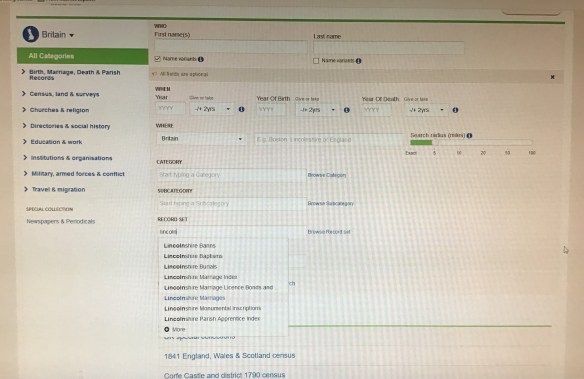
This targeting on Find My Past is very sophisticated, enabling a far more precise search than on Ancestry.  Because of this, I rarely need to home in on a specific record set (the equivalent of the Card Catalogue facility on Ancestry), but if you want to, you can do this.  Start with a search from the top menu bar.  You can do this in All Categories or in any of the individual ones, but for this exercise you’ll get more results if you stick with All Categories.  Towards the bottom of the page you’ll see there’s a box for inputting a specific record set.  You can type in the exact record set name if you know it, or just a keyword.  (Apologies for the image quality – I had to photograph the screen to avoid losing the pop-up record set suggestions when I clicked for a screen grab.)


Start to type in the name of your town, city or county of interest, and see what record sets there are.  You can do this even if you’re not a subscriber, so it’s useful if you’re deciding which subscription service to choose.  Of course, you can only view the actual records if you’re a subscriber.

*****

So, I hope there has been at least something new for you as we’ve looked at targeting our searches over the past two weeks.  And having explored special record sets on Ancestry’s Card Catalogue and on Find My Past, I hope you’ve found something interesting to help you progress your research.

Targeted searches on Ancestry

In a previous post we looked at the usefulness of hints as a way of finding records, as well as at the difference between Ancestry and Find My Past, in terms of the quality and focus of hints.

What I want to move on to now is searches instigated by you, the researcher.  We’ll look at this over two posts, this week focusing on Ancestry, and next week on Find My Past.  In each post we’ll consider searches in the following order:

  1. A general search from an ancestor’s profile page
  2. A general search from the top menu bar
  3. Narrower searches, focusing on a particular category of record
  4. Focusing right down on one particular record set.

What I’d like to draw to your attention is that, by increasingly taking control of what your search focuses on, you’re increasing the level of your own research.  You’re saying ‘I already know all about X, Y and Z, but I have a gap around A and B, and this is what I want to try to find out.’  This moves you on to intermediate level genealogy.

By the way, you can follow a lot of what is written here by working through it on Ancestry even if you’re not a subscriber.  Obviously, you won’t be able to see the actual records.

And finally – just to say – if you already know all about general searches and homing in on categories, skip to point 4.  There might still be something new for you there. 🙂

*****

In Ancestry then, let’s start with the kind of search most of us do when we’re just starting out as genealogists, or indeed when we’re just starting out with a new ancestor:

1. A general search of all records from an ancestor’s profile page
To do this, simply click ‘Search’ from an ancestor’s profile.  The search engine draws upon all the information you already have about your ancestor, using this as filters.  However, Ancestry treats all that information as ‘approximates’, resulting in years, places and even names on suggested records that are often way off beam.  It might also default to ‘Search all collections’ – including all overseas records as well as the UK ones.  And if you try to tighten up the search by moving the sliding scale to the right (see image below) to confirm you really do mean this exact surname, this exact place and year, more often than not it will tell you no matching records can be found.

.

So, from the profile page of my GG grandfather John Groves, a standard ‘Search’ automatically incorporating the search filters shown in the box to the left, returns 93,311 possible records.  Even if I change the filter from ‘All collections’ to ‘UK and Ireland’ only, I still get 34,360 possible records.  And whizzing down the first page of these 34,360 records, only two of them are correct.


2. A general search from the top menu bar
Go to the top menu bar on the screen, click on Search, and select Search All Records from the drop-down menu.  Sticking with John Groves, but this time typing in his name, birth year, birth place and place of residence, instead of allowing the search engine to copy over the info from his profile page, this time I’m offered a whopping 352,536 records from ‘All Collections’, or 127,706 if I amend the collections to ‘UK and Ireland’.

3. A narrower search, focusing on a particular category of record
Those first two searches have their uses, but I think we’ll all agree that a way of narrowing down would be useful.  We can start to do this by focusing on a particular category of record.  Again, we can do this from two places on the website:

If we’ve already started the general search by clicking through from our ancestor’s profile page, immediately below the search filters box to the left of the Ancestry screen we’ll see a list of categories.  Click on any one of these categories and you’ll see further options.  e.g. Click on Census and Voter Lists, and you’ll be offered a selection of decades to home in further; click on Birth, Marriage and Death, and you can select which of these three you’d like to focus on, and after that even specific record sets, and so on.

If, instead of starting with your ancestor’s profile page, you start your search with the drop-down menu at the top left of the screen (the place where we did that second type of general search, above), it works a little differently.  Now, depending on which of the categories you choose from the drop-down menu, you’ll be asked to input slightly different information.  For census searches you’ll be asked for name, birth, where they lived and details of family members; whereas for a military search the information required is just name, birth, death and likely years spent in military service.  Even though the number of records returned is still excessive, I find these more targeted searches a useful way of getting to the right record.

4. Focusing right down on one particular record set.
But there’s an even more focused way to search, and even if you already knew all of the above, this is something you may not know about.  You can actually search individual record sets.  The way to access these is from the drop-down search menu on the top menu bar.  Click on Search, and then from the drop-down menu select the second option up from the bottom: Card Catalogue.  This is where you can really get to know Ancestry’s record collections, find the ones more likely to help you and even develop your own favourites!  (Yes, I know that sounds very nerdy.)

So, you’ve clicked on Card Catalogue, and you have this screen (above) in front of you. As you see, you can still use filters (down the left) to help you home in on the record sets most likely to be of use to you.  And if you know the full name of the record set you want, simply type that into the ‘Title’ box.  You can then search just that record set.

But you can also use the keyword search, and this is really useful.  Try typing the name of a town or city of interest to you in that box.  If the town name doesn’t return any records, try the county.  Or you could also try specific words, such as ‘apprentices’ or ‘railway’ or ‘prison’.  Spend some time playing around and see what you can find that might be useful to you

This is one of my favourite functions on the entire Ancestry website, and some of the greatest breakthroughs in my family research have come from homing in on specific record sets and searching them to death!  My two very favourite record sets are Leeds, England, Beckett Street Cemetery, 1845-1987 – which includes so much information about the deceased that I never have to buy death certificates for ancestors buried there; and West Yorkshire, England, Select Apprenticeship Records, 1627-1894 – which includes many of my ancestors from the period and gave me a lot of insights into how apprenticeships worked in Leeds at the time, as well as helping to work out extended family relationships in one of my lines.  These are unlikely to become your favourite sets, of course, but wherever your ancestors were based, I hope you find something that will help you.

You can explore the Card Catalogue even if you’re not an Ancestry subscriber.  Something to bear in mind if you’re thinking of taking out a subscription and can’t decide which provider to go with.

Stop Press! Wills reduced!

I’ve talked before about the government’s online Find a Will service.

Well… Big News!  The cost of using this service has been massively reduced.  Instead of £10 per Will, the cost is now £1.50.

I don’t know about you, but that makes a huge difference to me. I’m normally very careful about buying Wills and BMD certificates, only buying when I know it will give me information that will help me to progress in some way.  But at £1.50 per Will, I can justify buying ones that have merely piqued my curiosity.  I don’t know if this reduced price will be permanent, but if you can, it makes sense to go through your ancestors and see if there’s a Will or two you need.  I’ve ordered eight.

Why might you need a Will?
It’s not about being nosy and seeing how much money and property they left – although of course that information will tell you a lot about the kind of lifestyle your ancestor might have enjoyed.  But in fact a Will can tell us a great deal about family networks.  There might be a child you hadn’t known about, or perhaps a complicated family network following divorce or separation.  There could be a share of the inheritance to a child who seemed to you to have fallen off the radar.  Prior to the 1882 Married Women’s Property Act, fathers might have made arrangements for their daughters, to avoid all the inheritance falling into the hands of an unknown future husband.  In other words, a Will might give us a lot of useful information.

Some tips on using the service
The online Find a Will service deals only with probate from 1858 to the present day.  You have to search in one of three categories:

  • Wills and Probate 1996 to present
  • Wills and Probate 1858-1996
  • Soldier’s Wills – these will usually only be on here if the person was killed in action.  However, some of them have been lost.

Make sure you have the correct section highlighted before you enter your search terms.

Screen grab from UK government's Find a Will website search page

Although the search field asks for year of death, the information is in fact arranged by year of Probate, i.e. the year the Probate documents were finalised.  This could be the year after death, or in some cases several years after death.  So remember to search the following year or two if you can’t find your ancestor in the year they actually died.

If you find your ancestor you’ll see a short statement of who he or she is, where they lived, when they died, when and where Probate was granted and the names of Executors. This will help you to identify the correct deceased person, and you will also need some of this information to be able to order the documents.

Bear in mind that the Executors are not necessarily the beneficiaries, so the people listed on this note are not the full story.  For that, you do need to buy the Will and Probate documents.  For example, I’ve just ordered the Will below.  I expect William Cass, son, and William Wade, son-in-law, to inherit, but not Edwin Wade, who is the very able older brother of William Wade but not directly related to the deceased.Entry on UK Probate Calendar, 1860

After you’ve entered the search terms, sometimes Irish and Scottish records come up before the English ones start.  Sometimes, too, you might find your ancestor listed on a page headed ‘Administrations’ rather than ‘Probate’.  This means your ancestor didn’t leave a Will: they died ‘intestate’.  If your ancestor died intestate but still had property of value to pass on, the courts would appoint an administrator to deal with the estate.  In other words, it would be dealt with via Administration rather than Probate.  There will still be documents relating to the sharing out of the inheritance, but there won’t be a personal statement from the deceased relating to how they want their property to be shared.

Finally – you’ve found your ancestor, you’ve ordered your documents and you’ve paid your £1.50 per Will.  What a bargain!  So what next?  You’ll receive a link by email within a week or two, which will take you to images of the original documents.  You will have 31 days to download your copy of each will.

*****

PS. You can now follow this blog by ‘Liking’ English Ancestors on Facebook. Just click below!