Ancestral Tourism 4: Houses & Business Premises

This is part four in my ‘Ancestral Tourism’ series. It follows on from Part 1: Churches and Churchyards, Part 2: Municipal & other Public Cemeteries and Part 3: Graves and Gravestones. The focus in this little series is on planning ahead so that you can spend the time when you’re there exploring, wandering, taking photographs and soaking up the vibes of the place.

In this post we’re looking at preparing for visiting former ancestral homes and business premises that are still standing. Trying to locate buildings no longer in existence will be covered in a future post.

Before you go

How do we know where our ancestors lived?
A range of documents may include the specific address or property name, or other clues as to the location of a former home or business of our ancestors. Examples are:

  • Church records, such as Baptism, Marriage, Burial and maybe wider parish records
  • Civil Registration: Birth, Marriage and Death Certificates
  • Census records
  • Correspondence between the person and an official body, sometimes found in archives, e.g. National Archives
  • Directories
  • Electoral Rolls
  • Family business records
  • Family documents, including letters and perhaps a family bible or other religious text
  • Immigration and Naturalisation documents
  • Military Records, including attestations and next of kin
  • Newspaper reports
  • Poll Books
  • Probate Records, Wills, etc
  • Property and Land records, including deeds, local tax, etc
  • Public and Municipal Cemetery registers
  • School records

It’s certainly easier to track our more recent ancestors.
For earlier generations, even where we find an abode in the examples above, often an exact ‘address’ was not used. A street name without house number, or for smaller places even just the name of the village or hamlet may be the closest we’ll get. During the second half of the 19th century we find more documents that include information to guide us to a specific property. Earlier this year I visited Kinver in Staffordshire, where my 2x great grandfather and some of his siblings were born. The image below shows the extent of Kinver now, as viewed from the churchyard high on a hill above the village. The main High Street, dating from medieval times, is clearly seen in the image. Most of the properties beyond that are more recent. ‘Somewhere in this photo’ is the closest I will ever get to knowing where my ancestors lived here – but I’m happy with that.

Kinver viewed from the church. © Janice Heppenstall

Beware! House names and even house numbers can change
Even when documents do bear a house number or name, these may have changed – particularly if there was much additional building in the twentieth century. I researched the history of a house built around 1837 in what is now a built-up area of the Isle of Wight. The house number is 21, and my clients had already done some research into the nineteenth century inhabitants of ‘number 21’. However, using maps and other documentation I found that the house became number 21 only in the early twentieth century. For the first eighty or so years it was number 3. The change had become necessary to accommodate new building over the previous decades.

Similarly, a few years ago, I visited York to see my family’s properties there. Census records had my 4xG grandparents at 58 Stonegate. I found the property and photographed it, but afterwards realised Stonegate had been renumbered. Eventually I worked out that their shop (and the floors above above, where they lived) had been this well-known corner plot, below, that was later taken over by Banks & Sons. I had been sitting right opposite this shop (in Betty’s tearoom, for those who know!) without knowing it was my ancestral home. It took a lot of research to work this out. But this is what happens when we don’t do our homework before we set off! Now I have to go back to York to step inside this lovely shop. Luckily, visiting York is never a chore.
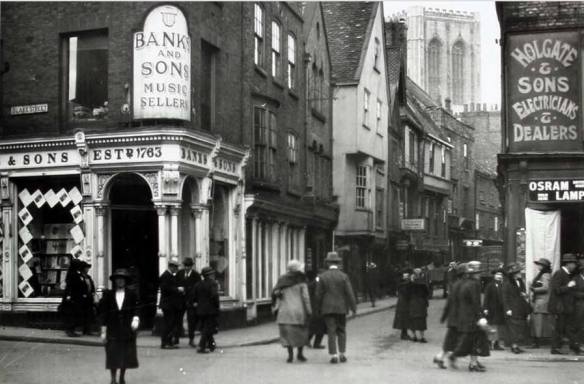
An early twentieth century scene from York, showing part of Stonegate and featuring the corner shop at that time occuped by Banks and Sons Music Sellers. York Minster is visible in the background
Junction of Stonegate with St Helen’s Square, York. Image in public domain, photographer unknown.

Changes in house name can be even more difficult to work with, particularly if several houses on the street seem to have changed name, and possibly more houses may have been built between the original ones.

So how can we be sure we have the right house?
Here are some ideas.

Photographs
If you’re lucky you may have an old family photo of the house. Even photos of people standing outside a property may provide visual clues in the form of distinctive architectural features. You can then use Google Street View to ‘walk’ along the road to find the property, if it’s still there.

Family and Local History groups on Facebook are also extremely useful for identifying the exact location of a photograph. I once witnessed someone posting an ancestral holiday snap and asking if anyone knew where in the world it could be. Within fifteen minutes it was identified as beneath a specific lamp post in a named piazza in Rome!

It’s also worth exploring whether there’s a website with old photos of your area of interest. The best one I know is Leodis, a photographic archive with over 62,000 images of Leeds, managed by the Local and Family History team at Leeds Libraries. I have found many old images of houses my ancestors lived in on there – in streets that now no longer exist. If you know of such a website for any of your areas of interest, please do share in a comment.

Maps
Mention has already been made of Google Street View. Modern day maps – including Google and other online maps – can be scrutinised alongside historic maps. My go-to place for online Ordnance Survey maps is here: https://maps.nls.uk/os/ I’ve written before about their Side-by-Side maps, but there are many other features. Something you could do is find a detailed historic map (the 25 inches to one mile series if possible) on the nls site, and see if you can compare the shapes of buildings then to existing buildings on satellite view now.

‘Walking the route’ with the census enumerator
With no photos and only documents to go on, it may be possible, using modern and contemporary maps, to ‘follow the route’ of a census enumerator. Using landmarks and occurences of smaller streets, you may be able to find the house, or at the very least to work out its general whereabouts, even if it’s not possible to narrow it down to a specific property.

Getting to know the neighbours
Using census returns for the street where your ancestors lived, it might be possible to track any changes in housenames or numbers of specific families whose occupation spans two or more decades. If the Jones family live at number 42, the Smiths at 44 and the Browns at 46, and then ten years later the same three families are at 58, 60 and 62, it is more likely that the numbering has changed than that all three families relocated together further along the same street. You can do the same thing far more accurately by consulting Electoral Registers. In the example above of my clients’ house starting out as Number 3 and eventually becoming Number 21, I could see from the Electoral Registers that this change happened in 1931. However, Electoral Registers are often not accessible online, meaning this may be something you could do only when you arrive in the area. Local archives and central libraries will usually have these registers.

What if your family’s presence predates the census?
Below is part of Starbotton, in Upper Wharfedale, where my period of interest, before 1750, predates the census. Before going I ‘walked the route’ using Google ‘Map View’ on one device and ‘Street View’ on another to be sure to cover the whole village. By the time I visited, last summer, I knew this small village like the back of my hand. However, I had no idea which house had been owned by my 8x great grandparents and later their son, my 7x great grandfather. Apart from church records and similar, indicating that the family lived in ‘Starbotton’, I was very lucky to come across a collection of property reports made over the years by the Yorkshire Vernacular Buildings Study Group. These, in turn, drew upon other property documentation at the County Record Office. I was able to identify several specific houses formerly owned by my wider ancestral family in Starbotton, and to pay special attention to them when I visited. I never did find out where my 7x and 8x grandparents lived, though, and it’s possible their house may no longer be standing. However, I can name the late seventeenth century inhabitants of around half of the properties, and I know that most of mine lived in the part of the village pictured below.
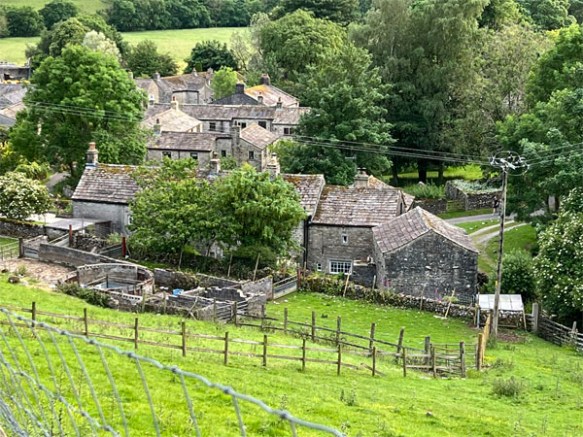
A rural village scene with seventeenth century stone houses surrounded by hills and trees
Part of Starbotton, Upper Wharfedale, Yorkshire. © Janice Heppenstall

When you arrive

If the occupants were in the garden I would probably chat to them, tell them about my connection and ask permission to photograph the house from the street. If they wanted to know more about who lived there I would tell them. If they were not there I’d take the photos anyway. Just taking a few photos, wandering up and down the street, touching the wall… I find all these things bring me closer to my ancestors who lived there.

If your ancestors had a shop or public house, if the school they attended is now a business centre, or if for some other reason their former home or premises are open to the public, it would be lovely to step inside and spend a little time there.

I also enjoy seeing historic buildings and landmarks that my ancestors would have known, and just getting a feel for the area and the local history. You can do this even if the house they lived in is no longer there.

Depending on the size of the place you’re visiting, and its historic importance or embracing of tourism, you might be able to pre-book a tour with an accredited guide.

If you can’t get there

It really does make a difference going there, but if that’s not possible, just doing the research outlined above will leave you knowing a great deal more about your ancestral homes and the localities they lived in. You can also take a screen shot of your ancestral properties using Google Street View, and of course connect with online and local groups to find out more and see if anyone has any photos.

*****

If you have other ideas please do leave a comment.

Getting the most from cemetery records

Today’s post is an interloper amongst my little ‘Ancestral Tourism’ series. It follows on from Part 1: Churches and Churchyards, Part 2: Municipal & other Public Cemeteries and Part 3: Graves and Gravestones. I’ve stepped away from the ‘Ancestral Tourism’ series here because this is something you can do online, whether you visit the grave or not – although it is, of course, also great preparation for a trip to the actual cemeteries.

The aim here is to show how the information from various records relating to burials, and even the same records on different platforms – including the gravestone itself if there is one – can be combined to give a greater depth of knowledge and understanding about an ancestor and their family. This technique of layering up information from different records works equally well with other aspects of an ancestor’s life, of course, but here I’m focusing on burial.

I hope this will be of interest to readers researching at Intermediate level, or moving on from Beginner to Intermediate level.

First, a comparison of records from two different cemeteries

Precisely what is included on the record varies from one cemetery to another, and possibly from time to time. I can illustrate this by comparing burial records for two of my ancestors: a 4xG grandmother and a 2xG grandmother. Both died after the introduction of Civil Birth, Marriages and Deaths, and I had already located the death entries on the General Register Office (GRO) online register, and bought one of the Death Certificates.

What the records include
This first record is from York’s Fulford Cemetery. It includes so much information that there is no need to buy a Death Certificate. CLICK FOR BIG!

Burial record of Sarah Wade, 14 Mar 1860, Fulford Cemetery York. Source: FamilySearch.org York: Cemetery Records 1837–1871, image 363/812

Here, we see that Sarah Wade, bottom entry, was buried in the York Public Cemetery at Fulford Road in 1860. She has the burial reference ID of 11,365 and is interred in Grave number 3837. She died on 9th March 1860 and was buried on 14th March. Sarah was 75 when she died and was the wife of John Wade, gentleman. They lived in Stonegate, York, but the number of the property is not given. Cause of death was pneumonia. The informant was Edwin Wade of 4 Coney Street, York. The final column is the name of the officiating minister.

There is more to this information than meets the eye. Sarah is the wife of John Wade. This means he is still living. You can see that the entry above Sarah’s describes the deceased, Emily Johnstone, as ‘Relict of the late Spearman Johnstone, Gentleman’. A less formal term would simply be ‘Widow’.

The second and third entries in this extract are both men. One is a Captain in the Militia; the other a Fishmonger. Men, then, are described by their Trade, Occupation or Profession. Women are described by their marital status, or ‘condition as to marriage’. The top entry is a child. Children are described as ‘Son/Daughter of’ followed by the father’s name.

The informant is not John the husband, but another man with the surname Wade, therefore probably related. He is in fact the oldest son of Sarah and John, and he is clearly used to signing documents with a flourish!

*****

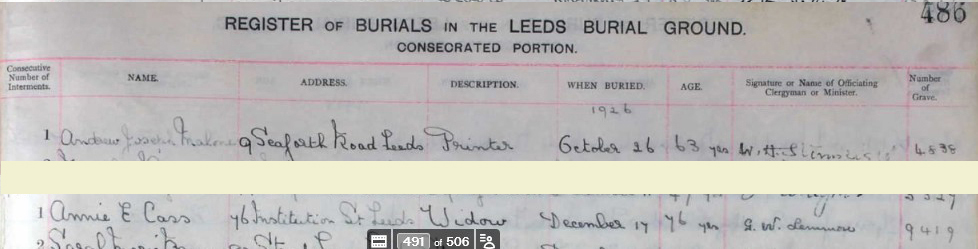
The next record is from Beckett Street Cemetery in Leeds.  The cream line just indicates where I have removed several lines from the page because it’s only Annie E Cass that we’re considering here.

Extract from a burial register dated 1926. The original image has been edited to remove several entries, leaving only the top one, plus the headings for each of the columns, and the record of Annie E Cass who was buried on 17th December 1926.
Burial record of Annie E Cass, 17th December 1926, Beckett Street Cemetery, Leeds.
Source: ancestry.co.uk Leeds, England, Beckett Street Cemetery, 1845-1987

In this record we see that Annie E Cass, bottom entry, was buried at The ‘Leeds Burial Ground’.  This is the same as ‘Beckett Street Cemetery’.  She was buried in the consecrated portion on 17th December 1926.  Address at time of death was 76 Institution Street, Leeds.  Annie was 76 years old and a Widow – again, we see that the top entry, a man, is described by his profession.  Annie in fact ran a business after her husband’s death 28 years earlier, but this is not mentioned.  The penultimate column is for the signature or name of officiating clergyman or minister, and finally we have the Grave plot number, which is 9419.

There is not as much information as on the Fulford Cemetery entry above.  We don’t have an informant or date of death, and the late husband’s name is not included.  We also don’t have a cause of death.  To cover all bases on this one we might want to purchase the Death Certificate. What we do know, however, is that Annie was buried in the Consecrated Portion of the cemetery. She was therefore Church of England. (I already knew that as I have her baptism record, but sometimes every little helps!)

*****

Gathering information from several documents and platforms

Now I’m going to home in on Annie, or Annie Elizabeth Cass to use her full married name. I want to see if I can add to my knowledge and understanding of her life and family by looking closely at all the records I can find relating to her burial.

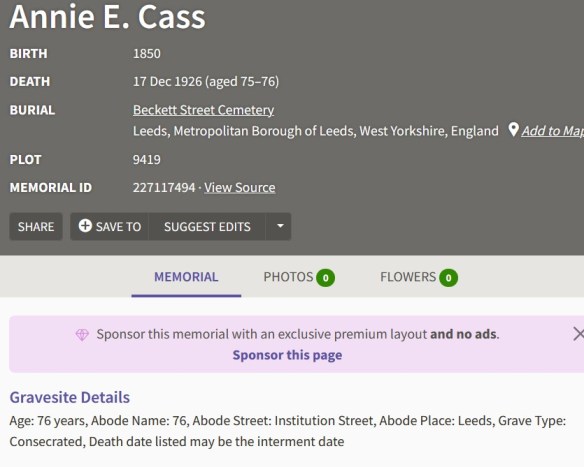
The information from FindAGrave (below) is a transcript compiled directly from Annie’s burial entry above. You can see that all the information is accurate, but the marital status is not included, and it is not clear whether Annie died on 17th December or was buried on that date. This is why seeing the original is always preferable, but if that’s not possible, a transcript is infinitely better than nothing. In fact I do already know that Annie died on 14th December, because I did previously buy a copy of her Death Certificate. I also know that she was in hospital when she died, not at her home in Institution Street; and I know which of her children was the informant, and his address at the time – which in turn tells me he was still living in December 1926.

Screenshot from FindAGrave showing information about the burial place of Anne E Cass, including the location of the plot and a transcript of information from the original burial register.
Extract from FindAGrave showing burial information for Annie E Cass. © FindAGrave

So why did I bother looking at FindAGrave?
In this case I had two reasons for doing so:

  • I wanted to see if there was a photograph of the gravestone;
  • I was creating a list of all my ancestors and their children buried at Beckett Street Cemetery, and since I already had information from the GRO online register about the deaths of each, the search process on FindAGrave is much quicker and easier than searching on Ancestry. The resulting list is below:
A table created in Word with a list of people, all with the surname 'Cass', and other information about each of them, specifically about their place of burial.

By compiling a list of all my ancestors and their children at this cemetery I was able to see which ones were buried in the same plots as other family members. Here, I identified six members of the Cass family, all in Plot 9419. I made similar lists for all my family members at various public and municipal cemeteries. This will make it easier to navigate the cemeteries when I visit.

The fact that Annie Elizabeth and her husband John William Cass were able to purchase a family plot tells me something about the financial situation of this family. Many of my ancestors at this time couldn’t do so. I already knew they had a family business so this was not a surprise. I expected, too, that there would be an inscribed headstone. However, although many of the entries at FindAGrave are accompanied by a photograph of the grave, this one isn’t.  My plan was to take a photograph when I visited myself.

Additional information on Friends of Becket Street Cemetery website
This was the point I had reached when I wrote my last post, about Municipal and Public Cemeteries; and that was when I found the fantastic Friends of Beckett Street Cemetery website.

Using the public search facilities on the Friends website, and bearing in mind I already had a lot of information about this family, including the plot number where they are buried, I was able to do the following:

  • View the cemetery register. I already had access to this register via my subscription to Ancestry.co.uk. so there was nothing new for me personally here.
  • Locate the grave on a map of the cemetery.
  • Locate the grave on a spreadsheet. Here, it is recorded that in fact there is no headstone for the family plot. This surprised me.
  • The spreadsheet also provided a tantalising promise of some extra information. I found there were seven people buried in this plot, rather than the six I already knew about. However, to see the list of people (and more) I needed to become a Friend of the cemetery. This costs £10 per year. Bearing in mind the number of ancestors I have in this cemetery, and the good work the Friends do, this was worth it.
  • Having paid the membership fee I could now view the names of all occupants of this plot, and use various methods of searching the dedicated Beckett Street Cemetery database, which yielded better results than searching on the huge Ancestry database.
  • There is also a virtual walk along the various paths so that you can locate and see the plot you’re interested in.

**Obviously, every ‘Friends Of’ group will provide different search facilities.**

Here’s the new information I got about this family, and how I was able to use it

The first thing to note is that the ‘Person ID’ on the FindAGrave website is a ‘FindAGrave’ ID. The cemetery Person ID/Reference is different, so I have amended my lists to include both.

Next, I was anticipating the the unknown additional person could be a missing child. My research showed that Annie Elizabeth lost four of her children in infancy, but on the 1911 Census she wrote that she had lost seven children and had six still living. I knew this to be inaccurate, because seven of the children were still living in 1911. However, this still suggests two missing babies. Might one of them be buried in the family plot?

Alternatively, could the extra person be Annie Elizabeth’s oldest daughter. Aged 40, she was still living with her mother in 1911 but was nowhere to be found in 1921. Had she died? It seemed inconceivable that she wouldn’t have been buried in the family plot.

The extra person turned out to be Annie Elizabeth’s mother-in-law, Elizabeth Cass. Elizabeth died in 1878. She is the mother of Annie Elizabeth’s second husband, John William Cass, and they are not my ancestors. Although I had her name and some brief details from a census record I had not researched her. This record provided her burial dates and also her address, which was the same shop and living quarters above the shop that I knew to be the home of Annie Elizabeth and husband John William Cass in the 1870s.

This prompted me to look for a burial record for Elizabeth’s husband, William Cass, located quickly on the Friends of Beckett Street Cemetery website. He too had died at the same address, five years earlier. Using death certificates and baptism records for several of Annie Elizabeth’s children, I was able to calculate that she had moved into the shop with her husband and children after the death of Elizabeth’s husband/ John William’s father. The possibility that they had taken over an existing family business was not something I had previously considered.

As for the missing deceased children – the little ones are still missing. I suspect Annie Elizabeth may have included stillborn children in her totals. I have long suspected that women did this on the 1911 Census as a way of commemorating their children who never had a proper burial.

However, this new information also prompted me to renew my efforts to find Annie Elizabeth’s oldest daughter. I found she had married shortly after the 1911 census and in 1921 was living with her husband and a daughter, whose life I will now have to follow through.

How strange that all this should be resolved as a result of examining cemetery records! Plus I am now a member of the Friends of Beckett Street Cemetery!

It all goes to show we should examine closely, keep an open mind, follow all leads and cross-reference. I hope you’ve found this useful, and that it might prompt you to look again at some of your mysteries.


Ancestral Tourism 3: How to read a cemetery

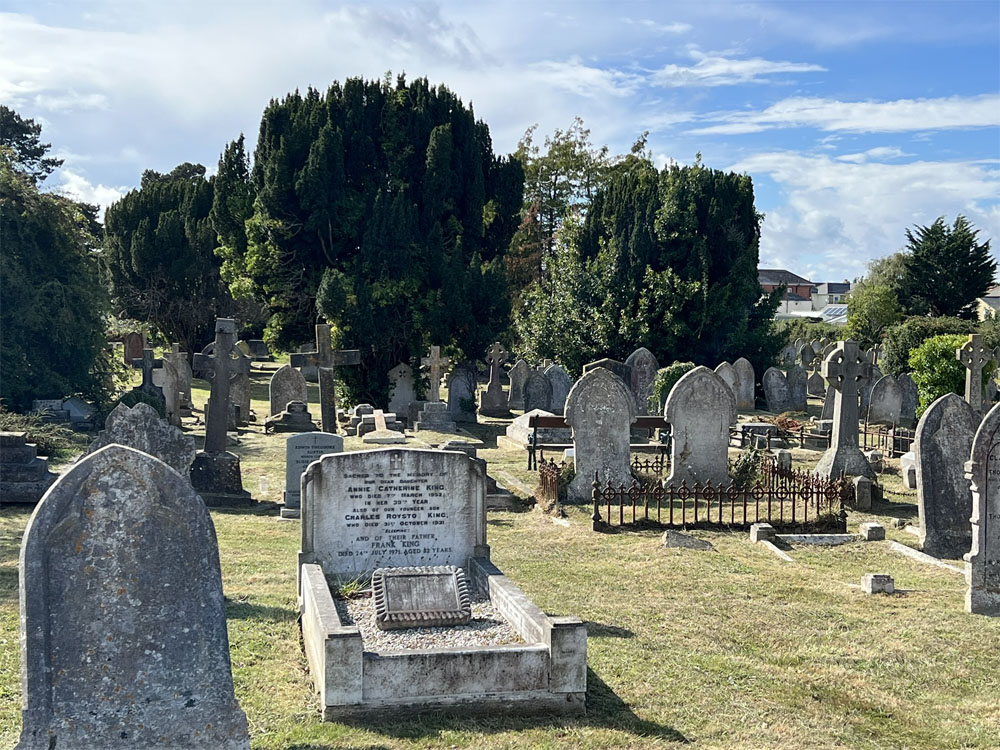
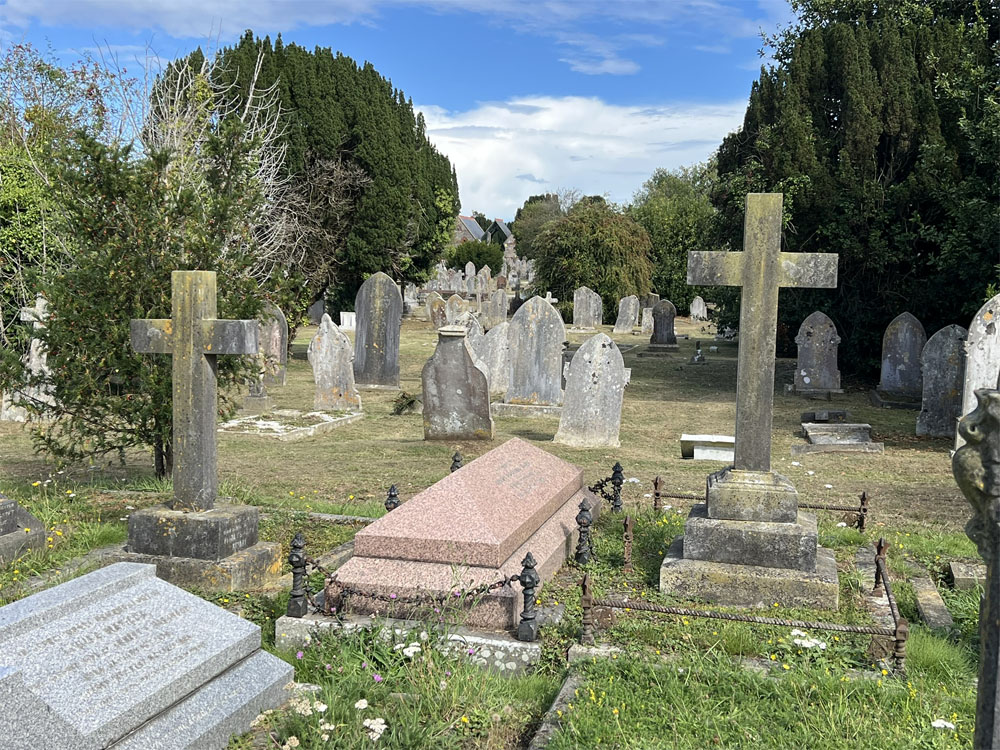
Ryde Cemetery, Isle of Wight. © Janice Heppenstall

This is the third in my ‘Ancestral Tourism’ series, and follows on from posts about preparing for visiting Churches and Churchyards and Public & Municipal Centuries featuring in our ancestry. In those previous posts, the focus was on knowing the history, finding the records and then finding any maps of the churchyards and cemeteries. In this post we’re going to be ‘reading’ the burial ground. What can we deduce from the location, the headstone (or absence of a headstone), the symbolism and anything else that will give us clues as to our ancestor’s life and social standing?

Please be prepared before applying what follows to your own family that there is a possibility that not all your ancestors will have well-kept headstones in peaceful and picturesque settings within the churchyard or cemetery. Some may have been buried with unrelated people in common graves, with or without a headstone. This is part of their story, and the story of the times in which they lived, but it can be upsetting to find.

Consecrated or Unconsecrated?

As outlined in my last post, from the middle of the nineteenth century the Burial Acts required that half of any new Municipal or Public cemetery was to remain ‘unconsecrated’. The other half would therefore be ‘consecrated’. What does this mean?

Consecrated

  1. Dedicated to a sacred purpose; made sacred; hallowed, sanctified.
  2. Dedicated, ‘sacred’ to a tutelary divinity.
  3. figurative. Sanctioned by general observance or usage.

Oxford English Dictionary (Online)

Although the online Oxford English Dictionary gives the above definition, in relation specifically to burial grounds in England and Wales it is a centuries-old term referring to land that has been blessed and set apart for Christian burial according to the rites of the Church of England (in Wales now, Church in Wales). ‘Unconsecrated’ referred to any portion not blessed or made sacred according to those rites. Before the mid-1800s, when most burials took place in the graveyard of the parish church, the official burial had to be conducted by an Anglican clergyman in accordance with the Church of England prayer book service. This applied even to those who had, in life, followed different religious practices. However, such people were not eligible for burial within the Consecrated area of the graveyard. They were buried in a separate Unconsecrated section. This applied also to babies who died before they were baptised and, before 1823, to suicides.

Also mentioned in my last post, the development of the new Public Cemeteries from the 1820s and Municipal Cemeteries from the 1840s coincided with a greater acceptance and recognition of different religious practices. Here, the term ‘Consecrated’ was kept but now, in the ‘Unconsecrated’ portion of the cemetery, the burial service itself was likely to have been carried out in accordance with the rites of the deceased’s religion. Today there is greater recognition of the different rites and practices developed by different religions and cultures in commemorating their dead. Although some dedicated cemeteries exist, there are also separate areas for specific faiths within public cemeteries. However, back when our ancestors were being buried it was simply ‘Consecrated’ or ‘Unconsecrated’, and eventually over time the terms ‘Anglican’ and ‘Nonconformist’ came to be used. Although in England and Wales today we use the latter term for Protestants who are not part of the Church of England, in earlier times it was used for anyone whose religious beliefs differed from the established church, the Church of England. It therefore referred also to Roman Catholics, for example. As can be seen from the image above and that below, separate registers were kept for these two sections of the cemetery.

Follow the clues

Finding your ancestor in one or the other may come as a surprise. If so, this is extra valuable information about your ancestors. Precisely what it tells you will depend on the context. For example, all in the same cemetery:

  • My Irish-born 2x great grandfather’s burial is recorded on the very page you see above. He was buried in the Unconsecrated part because he was Roman Catholic.
  • My 4x great uncle’s burial is also in the Unconsecrated part. This is because he and his family worshipped at the Wesleyan chapel.
  • I had a question mark about the denomination of an ancestor from Ulster. He was buried in the Consecrated portion of the cemetery, but his first child with his English, Anglican, wife was baptised in the Roman Catholic church. His burial seem to settle the question… or did it? There remains the possibility that he was simply not a church goer, and by the time of his death his adult children just didn’t know he was actually Roman Catholic.
  • The burial of another 2x great grandfather in the Anglican part of the cemetery in 1898 was interesting because he took his own life. This gave me a reason to research the burial of suicides. Suicides had traditionally been buried at a crossroads, sometimes with a stake through the heart. The Burial of Suicides Act, 1823, banned such practices. It permitted burial of suicides in consecrated ground, but only at night and without a Christian service. With the passage of the nineteenth century came a greater understanding of mental health, and the term ‘Of unsound mind’ came to be used by Coroners. In 1882, the 1823 Act was repealed, and replaced with the Internments (felo de se) Act. This permitted the burial of those who had taken their own lives at any hour and with the usual religious rites, including in a churchyard at any hour. However, suicide would not be decriminalised until 1961.

Burying in style!

There were great differences between the funeral and burial practices of rich and poor. For the wealthy, this could be a no-expense-spared event from start to finish: an opportunity to be seen to be ‘doing things properly’ according to the etiquette that had grown up around funerals. Obituaries in the newspapers will give you an idea of the size and scale of a grand funeral.

In the cemetery there are more clues. These include the location of the grave. A prime position with good views cost more. It may also have been possible to pay extra for a nine foot deep grave rather than the usual six feet, although you won’t be able to see that from the grave itself. A deeper burial was thought to help preserve the body.

A range of funerary monuments were also available, ranging from mausolea, cenotaphs, tomb chests and sculptures to headstones and more simple marker stones. Historic England have produced a guide to Caring for Historic Cemetery and Graveyard Monuments which includes descriptions of the various types.

If you’d like to know more about a whole range of roles, customs and traditions linked to death and funerals, Friends of Beckett Street Cemetery in Leeds have compiled an excellent overview of Victorian funeral traditions and etiquette. Some of these would have been de rigeur amongst the wealthier folk but others applied more widely. Even when I was growing up I remember people closing the sitting room curtains after a death in the home.

Symbolism

Victorians loved symbolism, and the various monuments and gravestones were the perfect canvas for this form of expression. On their website, Arnos Vale Cemetery, Bristol, make the point that when larger public cemeteries started to appear, much of the population was not literate. The symbols found on graves made them more meaningful for someone who may not be able to read the words. Even today, if we understand the symbolism, a whole new layer of understanding opens up to us as we walk amongst the gravestones. Perhaps there might be clues on the gravestones of some of your ancestors, letting you know what was important to them and their loved ones. You might even come across some symbolism pointing you to membership of the Freemasons or similar, which would then open up a new line of research for you. The Funeral Directors association and Family Tree Magazine have also published useful lists of symbolism and meanings.

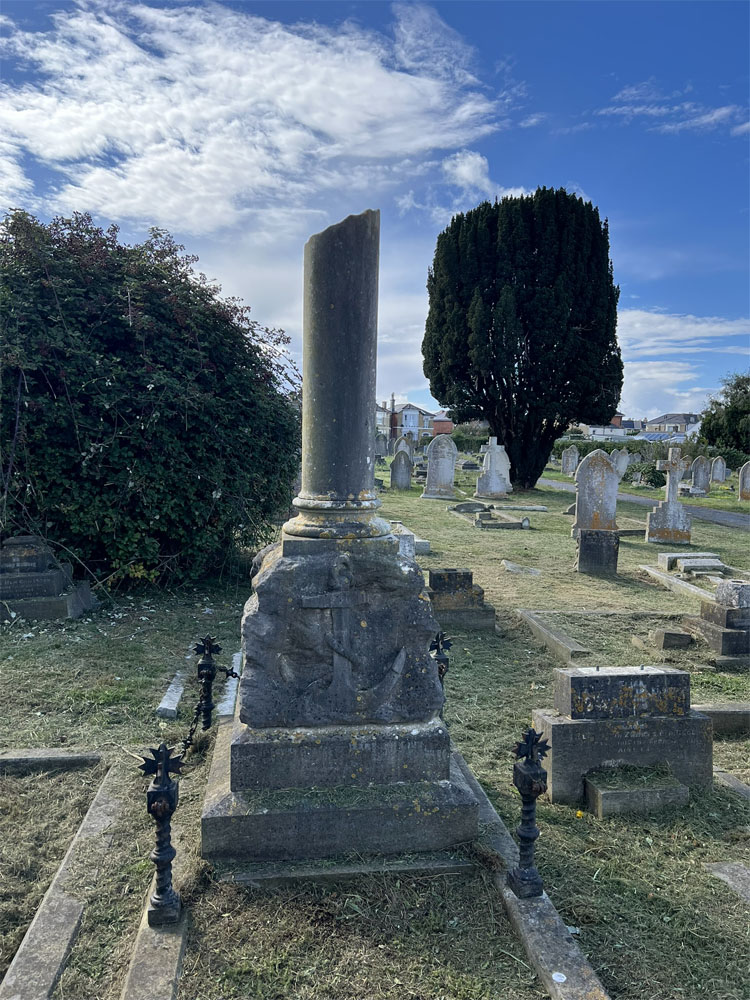
It was a surprise to walk around Ryde Cemetery after reading them and to note the symbolism on a lot of the stones and monuments. This ‘broken’ column represents a life cut short, and the anchor symbolises EITHER hope, steadfastness, and the secure connection to God or eternal life OR a seafaring life, perhaps with the Navy – or perhaps both. Since Ryde is on an island, either is possible and now I’m thinking I should have spent longer and read the inscription to find out more…

Symbolism of elaborate headstone in Ryde Cemetery, Isle of Wight. Image © Janice Heppenstall

Different types of grave

For those with the ability to pay for a private grave, there were:

  • single plots, intended for one person in a coffin
  • companion plots, intended for a couple, perhaps side by side
  • family plots, where several members of the same family can be buried together.

A certificate or “grave paper” documented the purchase. (I have one of these, purchased by a 2xG grandfather on the death of his wife in 1875.)

A purchased plot does not necessarily mean our ancestors will also have purchased a headstone, so you may need to navigate to your ancestor’s final resting place with the aid of only the plot number and a site map. The location of such plots, amongst others with headstones, should enable you to differentiate them from the common graves detailed below.

One of the motivations for the publicly-funded Municipal Cemeteries was the ability to provide for all social levels, including some lower cost options so that the labouring classes could afford to bury their dead with dignity.

A Common grave was a plot that belonged to the cemetery, not an individual or family, and was used to bury unrelated people. There were several different types of common grave, and the costs for the different types varied:

  • Lock-up graves: these were the cheapest type of grave. They were filled over the course of a few days as more bodies became ready for burial. Between each burial the soil was not replaced. Instead, a wooden ‘door’ was locked in place over the grave. When the grave had the required number of deceased people, the earth was piled on top. These were also called Open graves.
  • Public graves: like lock-up graves, these were filled up as newly deceased unrelated individuals became ready for burial. The difference is that these graves were refilled with earth after each new burial. They were therefore a little more expensive.
  • Note that ‘Pauper’s grave’ was not an official term and probably more rightly refers to the burial administration rather than to the grave itself – a Pauper’s burial. Essentially, before 1834, paupers were buried at the expense of the parish, and after that at the expense of the Board of Guardians. There was no unnecessary expense. The actual grave would have been one of the above types of common grave with no inscription, probably a lock-up grave where that was an option. Local authorities remain responsible today for the burial of a deceased person leaving no funds for a funeral and no one else to arrange it.
  • Inscription graves: For a small additional fee, a deceased person could be buried in a common grave but with a headstone inscribed with the name, date of death and age of every occupant. Some of the headstones may have had bodies arranged on both sides with inscriptions on both sides of the stone. These are a feature of the municipal cemeteries in Leeds – in fact every reference I have come across online relates to Beckett Street or another of the Leeds cemeteries. Here, they are known as ‘Guinea Graves’, that being the original cost of burial in one of these Inscription graves. If you are aware of this type of grave (Inscription or Guinea Graves) elsewhere in the country, please leave a comment saying where and by what term they are known – thanks.
Guinea Graves at Hunslet Cemetery © Stephen Craven at Wikipedia Commons

Some notes

For overseas readers (or very young British readers, perhaps!), a guinea was a British coin, originally minted in 1663 with a value of £1 (One Pound). Eventually it came to have the value of £1 – 1 s (One pound one shilling, i.e. 21 shillings). Even after the guinea coin ceased to circulate, the term remained as a unit of account worth 21 shillings. As late as the 1970s it was used for the quoting of professional fees and luxury items.

I have previously written about how to ‘read’ a Commonwealth War Graves Cemetery [here].

*****

I have become rather more fascinated with municipal cemeteries than anticipated! My next post will be about getting the most from different cemetery records, before returning in the post after that to Ancestral Tourism: houses and places our ancestors knew.

Ancestral Tourism 2: Public & Municipal Cemeteries

Ryde Cemetery, Isle of Wight. © Janice Heppenstall

This follows on from my last post: Ancestral Tourism 1: Churches and Churchyards. It focuses on locating and visiting graves of our ancestors whose final resting place is in one of the large municipal or other public cemeteries in our towns and cities rather than in a church graveyard.

First, a bit of history

The emergence of large public cemeteries is an interesting part of our social history, connecting with several other developments of the nineteenth century that will be familiar to local and family historians. The migrations and population booms of the eighteenth and nineteenth centuries created not only a lack of housing for the living but also of burial grounds for the dead – and all the more so in the growing industrial towns and cities. The historic churchyard burial grounds posed problems on several fronts: they were generally small, overcrowded, often laid out in a haphazard manner; and as knowledge of hygiene and sanitation developed, there were concerns about the spread of disease, particularly since in towns and cities these small burial grounds were generally alongside the church and surrounded by closely packed housing.

The initial response to this problem was to turn to the private sector. Throughout the 1820s and 1830s a number of ‘garden cemeteries’ were established to serve big industrial towns, including Manchester, Liverpool, Birmingham, Leeds, Sheffield, Newcastle and later, London. These cemeteries were private commercial ventures set up under individual Acts of Parliament. They were large, well-planned spaces, often designed by the same architects and landscape designers who created public parks. Some of these garden cemeteries may be well-known to us. They include Highgate in London, Undercliffe in Bradford and Arnos Vale in Bristol.

Some of the early cemeteries were developed by and for Nonconformists. As outlined in my last post, the general practice was for Nonconformists to be buried in the parish churchyard and the service officiated by the Anglican vicar. Many prominent philanthropic capitalists were Nonconformists, and by this time were able to use their wealth and influence to bring about changes including, here, the freedom to bury their dead and conduct services according to their own beliefs and traditions. Well-known Nonconformist cemeteries include Chorlton Row Cemetery in Manchester, which opened in 1821, Low Hill Cemetery in Liverpool, opened 1825, and Woodhouse Cemetery in Leeds, 1835. It is interesting to note that it was around the same time that the State removed control of recording births (or rather baptisms), marriages and deaths (or rather burials) from the Church of England and placed that responsibility with a new General Register Office: the introduction of Civil BMDs in 1837.

Generally speaking, though, these cemeteries were money-making enterprises, serving the upper and middle classes. There was no increase in provision for the labouring classes. The response from some local authorities was to develop more cemeteries but funded by public money. Early examples are St Bartholomew’s Cemetery in Exeter, which opened in 1837, Beckett Street and Hunslet Cemeteries in Leeds, both opened 1845, and Southampton Old Cemetery, 1846. This was the beginning of the Municipal Cemeteries – publicly funded, and owned/ managed by the local corporation.

The Metropolitan Burial Act of 1852, and other Acts of Parliament that followed, empowered local authorities to establish public cemeteries and close previous overcrowded burial grounds. The new cemeteries would have uniform hygiene standards and procedures for burial, would cater for all social levels, including some lower cost options for decent burials, and would offer burial options with dedicated areas for people of all religious affiliations. Half of any new cemetery was to remain unconsecrated, allowing for burials without the Church of England service. Later, in 1879, the The Public Health (Interments) Act made it a duty of local health authorities to provide cemeteries if local conditions required it.

Historic England have produced a List of Registered Cemeteries, arranged in date order. Information is provided for each, including design, designer, whether private or municipal, and important or interesting features.

There is also a nationwide map published by the Institute of Cemetery and Crematorium Management which includes every cemetery and crematorium in the land. I’ve checked out all the ones I know and they are all present and correct.

Since there is a similarity in records of these different types of public cemetery, the following notes about how to plan for your visit is intended to cover all of them. There are in any case differences from one cemetery to another, regardless of how they came into being.

Planning your visit

Allow plenty of time for this – there is a lot of research and planning to do!

Locating the records

  • Needless to say, the first thing you need is to know the cemetery in which your ancestor is buried. We’ll start by looking at who holds the records, moving on to which of them might be online.
  • Since Municipal Cemeteries are managed by the local authority, it is they who hold the records for these cemeteries. Often, this team is known as ‘Cemeteries and Crematoria’, or ‘Cems and Crems’ for short. You can find them online by using either of these phrases as search terms and adding the name of your town or city of interest.
  • Some local authorities offer a look-up service. For example, Leeds Cems and Crems provide a list of all cemeteries, together with opening date. They require the name of the deceased, the date of burial and the cemetery, and will ‘check the records and if the information is correct […] let you know the grave number and section or where in the grounds the cremated remains were strewn.’ Some Cems and Crems teams charge for this service; others do not.
  • Some local authorities have databases available online so you can check for yourself. For example, Birmingham Cems and Crems have separate online searchable databases for each of their twelve cemeteries.
  • Privately owned cemeteries keep their own records. Information can be accessed via their websites. For example, at the time of writing, Highgate Cemetery charges £40 for a search. However, they also state that copies of all their records are free to consult at Camden Local Studies and Archives Centre.
  • That said, digital images of the records of some cemeteries are available online. You might find records from your cemetery of interest on your genealogy subscription website; or try looking on FamilySearch. From the home page navigate to Search > Images > insert the name of your place of interest and then select the appropriate era from the drop-down list. From here, you will have to scroll through to see if the records you need are included, and if they are, you will need to browse through the images of the records. Knowing the death date or at least month of death will speed things up. I found all the records from York’s Fulford Cemetery on here – and they are excellent!
  • Transcripts of the records of your cemetery of interest may have been included on FindAGrave (free to use). I have found on there most of my ancestors and their families who were buried in a municipal cemetery, but it is primarily run by volunteers so is inevitably a work in progress.
  • There is also DeceasedOnline, which helps burial authorities and crematoria to convert their register records, maps and photographs into digital form and bring them together into a central searchable collection. There is a fee to see the individual records, and I have not used this website, but it is there as an option should you wish to use it.
  • Locating a Map of the Cemetery

    The cemetery records will hold certain essential information about your ancestor: name, address, date of burial, occupation. There may be more information, but this little lot will enable you to identify the person and be sure it’s your ancestor. There will be one other very important piece of information: the number of the grave or plot where your ancestor is buried.

    Armed with this, what you need now is a map. And on this point it’s a question of digging about online. Here are some places to look:

    • The cemetery’s own website, if they have one. Example: York’s Fulford Cemetery provide section maps on their website.
    • Local authority Cems & Crems may have pages for each of their cemeteries, possibly including maps. Example: Isle of Wight have plot maps of all their cemeteries available for download, for a fee.
    • A lot of the cemeteries have ‘Friends’, and these often have a website with maps. Examples: Friends of Beckett Street Cemetery have an astonishingly good series of online tools to help you locate and navigate your way to your ancestor’s plot. These include locations of plots, numbers and names of occupants in each, whether there is a monument or gravestone, and whether this has been photographed. A different approach is taken at Friends of Southampton Old Cemetery. They provide assistance in locating graves and request a small donation towards their conservation work. Some ‘Friends’ groups have even carried out research into the lives of those buried in the cemetery.
    • Local history or heritage groups may have websites with maps. One the best set of static maps I have found to date is for Ryde Cemetery by Ryde Social Heritage Group. Every plot is shown with the names of the occupants.
    • The local Family History Society may have mapped the cemetery. Example: Isle of Wight.
    • There may be a site map at the cemetery itself, but you will need to know this in advance to avoid disappointment.

Going alone or with a companion
In the course of researching this post I have located every one of my ancestors and all of their children buried in Municipal and Public Cemeteries. Armed with this information, including details of family plots, plus a better understanding of the significance of each of the cemeteries, I feel sufficiently well-informed to be able to make a decision as to whether to inflict a visit to any of them on my nearest, dearest, yet genealogically disinterested. Based on this, I consider one cemetery in Leeds with a single family plot of interest to be acceptable, and another in York with just three relevant family plots. The rest have far too many plots that I would need to visit; and although one – Beckett Street Cemetery in Leeds – may be acceptable on grounds of social history, I simply couldn’t put anyone else through the monotony of locating and visiting the number of graves. Definitely, these will have to be solitary trips for me.

Part of the problem leading to this decision is that although the nineteenth century cemeteries were intended as public landscapes, and are of great historic and heritage value, lack of funding means that many of them have now become neglected. It is here that ‘Friends of’ the individual cemeteries provide a valuable service, carrying out conservation and environmental work and delivering ecological benefits – but not every cemetery has a Friends group, and some are less active than others.

You might find that the ‘Friends of’ your cemetery of interest provide tours from time to time. It might be possible to arrange your visit to coincide with that, then stay on afterwards to visit your family’s graves. Interesting for you and they will appreciate the income.

If you can’t go

There is so much information to be found online. By doing the research outlined above, making full use of online material and even, where possible, via the ‘Friends of’ website, FindAGrave or a Facebook page, requesting a photo. You can also search online for images of the cemetery. Adding “wikimedia commons” to your search term will return a selection of images that are free to use provided you credit the photographer.

Be forewarned though that the inscription on images is not always legible. This could be because of sunlight conditions on the day, severe weathering over time, or possibly just because of the quality of the image when reduced for web use. The following wonderfully clear image is from FindAGrave, but some of the images of my family’s gravestones cannot be read at all.

Image © Rachel79; source: FindAGrave

*****

I hope this has given you some ideas for how to plan for a visit to a Municipal or Public Cemetery. Researching it has certainly focused my mind and I’ve found it fascinating. So fascinating, in fact, that I will be slotting in an extra couple of posts about cemeteries before progressing to finding about former homes and business premises of our ancestors in the post after that. 🙂

Hierarchies of evidence and thinking outside the box

I was recently asked to do some research to assist with an application for British citizenship by descent. Clearly, something like this requires a very high degree of certainty in the evidence, and doing it prompted me to compare my own standards of evidence to that expected by the Passport authorities.

Not all ‘evidence’ is equal
Essentially, government authorities are interested in official documents: Birth, Marriage and Death Certificates; official Immigration documentation; dated Ships’ Manifests; Naturalisation documentation; and official documentation for any name changes. There is a clear difference between these types of documents, made during or just after the event and reported to an official person or office, and documents requiring the individual or their representative to give information many years later. In the latter documents, the information may be inaccurate, mis-remembered or even false. We have to give higher credence to the former.

Working on this research I was mindful of the ‘Windrush generation’: people from the Caribbean who were invited to the UK to help rebuild post-war Britain between 1948 and 1971. A few years ago, many of these people had their legal status in the UK called into question. Some were deported back to their country of origin where, after five or more decades in the UK, they had no connections, no close family and little or no personal history. I was confused. They had been paying taxes and made pension contributions: they must have left a solid paper trail. It’s just a question of gathering together school records, NHS, National Insurance numbers, births of children, bank records and so on… right?

It transpired that the reason for these problems was that the Home Office did not keep records of the ‘Windrush’ people to whom it granted indefinite leave to remain in the 1970s. Consequently, they were now requiring each person to provide four pieces of evidence for each year they had been in the UK. If any of them could not do this, or if they had left the country for a period of two or more years and had not applied for UK citizenship since the granting of their right to remain, they would be found to have relinquished that right. That’s a huge burden of proof.

Thinking about all this, I realised that essentially, the difference between sound genealogy research for family interest, and that required for a government body like the Home Office, does not necessarily rest on the standard of the research; it’s about the respective goals of each. The goal of any form of research should be an objective search for the truth. In this case, we’re looking for evidence to prove or disprove a connection between one generation and the next. Yet the Passport authorities are gatekeepers, and their role is more akin to an audit: ‘We require originals or certified copies of documents A, B, C, D and E. Alternative documentation may be offered, but our decision is final.’ The default position is ‘No’, and the highly rigorous burden of proof is on the applicant.

If we, as genealogists, were so inflexible in our evidence requirements, we would pretty soon find many of our ancestral lines coming to a halt. One of the skills we need to develop is ‘thinking outside the box’. Getting to the truth is essential, but if we can’t find the standard documentation evidencing a connection between two people, we have to come at it from another direction. We find another way, and then we look at it in the round: taken together, does all this documentation point to X being the parent of Y? If there is any doubt, this must remain a ‘probable hypothesis’. For me, this is one of the most enjoyable parts of the research: the detective work, and the satisfaction when it all comes together and we can reflect on the creativity that went into working it all out. But in the event of an essential document being missing, would a Home Office civil servant be prepared to consider my ‘work-arounds’? This was something of which I had to be ever-mindful during that research.

Thinking of all this more generally, it presents a perfect opportunity to reflect on the varying ‘credibility’ of the different types of evidence we use to demonstrate a familial connection between named individuals. Let’s consider this now in relation to just one official document. Let’s say the Birth Certificate of person B, parent and therefore essential in the lineage from person A in another country to B’s own parent, person C who was a British-born UK citizen, is missing; and we don’t even know in which of the two countries person B was born. Perhaps the country in question didn’t have Civil Birth Registration at the time of the birth, or perhaps the records of the entire country were destroyed, as happened in Ireland. What does a Birth Certificate prove? And therefore, in its absence, what information is ‘lost’ and may need to be proven via another route?

I have a Birth Certificate in front of me. It includes:

  • Name and sex at birth
  • Date and place of birth
  • Name of both parents, including mother’s maiden name and father’s occupation
  • Name and address of informant, and the date on which it was registered.
  • Detail of the Registration District, some reference numbers, the name of the Registrar and, if this is the original, that person’s signature.
  • If I search for this birth online, I see a summary of some of that information, together with the volume and page of the entry in the England & Wales Civil Registration Birth Index.

It’s the official version of ‘the truth’ of the birth. Yet even official Birth Certificates are not necessarily entirely true. There are cases in the past of parents giving a later birth date to avoid paying a late entry fee. There are, of course, named fathers who are not the biological father. Historically, there might even have been grandmothers who registered the child as their own to avoid an official record of their very young daughter giving birth to a child out of wedlock.

Despite these possible inaccuracies, the Birth Registration is the accepted, official version of where and when a person was born. When trying to prove the right to citizenship on grounds of ancestry, it’s an essential document, but even when simply working in the pursuit of family history with no legal consequences, it’s a vital document. What alternative forms of evidence might we draw upon; and to what extent do these alternatives have equivalence with the original?

Baptism records
These usually link the named person to named parents and therefore demonstrate parentage. The baptism of a baby evidences that the child was born by the date of the event, and if the record includes the date of birth, a recent birthdate is highly likely to be correct. However, sometimes children are baptised as a group, when some of them will be older, even teenagers. They place the named people in that certain place at that certain time. What these ‘batch’ baptisms cannot do, however, is evidence the birthplace – town or even country – of the named person. They might also not evidence the parental link if, for example, one of the parents has remarried before the batch baptism, and that step-parent is named.

Census records
These link the person to their parents (or adoptive parents, or a step parent) and place them in the family setting. They can also help us to home in on a year of birth, and will also help us to narrow down the year of any migration (between countries or between different parts of the UK) since different children may have different birthplaces.

However, the information on censuses is provided by the head of household. At the strictest level of interpretation, all they really evidence in terms of location is that all the named people were at that address on the night of that census – and even that might not be true. For example, if your teenager was having a sleepover at a friend’s house you would probably include them at your home, even though they were actually ‘visiting’ at the other house. Here are three examples from the records to illustrate how what is recorded may not be true.

In the following example George Henry is recorded as having been born in Marshall Street, Leeds. The person who completed this census form was George Henry’s wife. She is my great grandmother, and I love her for all the extra, un-asked for, pieces of information she included on it! The name of the street, here, for example, was not required, but the fact that she wrote it really beefs up the likelihood that George was born there. Only, he wasn’t! He was born in Crewe, Cheshire; and all other censuses, together with his actual birth certificate, evidence that. I would assess this as a genuine mistake.

An entry on the 1911 Census of England and Wales.  The birthplace of the person is recorded as Marshall Street Leeds.
Click for BIG!

In the next example, Joseph Appleyard is shown living with three children. Daughter Rachel is 22, son Joseph is 17 and son James is one year old. However, James is not Joseph’s son. In fact he was born eighteen months after Joseph’s wife died. He is Rachel’s son, and the birth certificate shows this. Yet if the birth certificate could not be found this fact would be mere speculation. I would assess this as either a desire to cover up the birth out of wedlock OR possibly an assumption on the part of the enumerator.

Extract from 1851 census showing Joseph Appleyard with 3 children: a daughter Rachel, aged 22; a son Joseph, aged 17; and a son James, aged 1 year.

Finally, the following example shows an extract from the United States Census of 1930. Alice Edelson is the daughter of Solomon Rudow whose connection to family in the UK was featured in my last two posts. My research around Solomon and his family was focused on identifying a birthplace for him, so that it could be compared to that of his UK-based sister, and by extension, the likelihood of the family having roots in that place of birth. Given that this family immigrated to the US, the recording of Alice’s birthplace was important to my research. It would also, of course, be important in any application for citizenship back in the country of origin for descendants of Alice, where the number of generations since the birth of an ancestor on that soil is critical. Here, Alice’s place of birth is recorded as New York, yet in every other Census it is recorded as Poland or Russia.

Extract from 1930 US Census showing Aaron Edelson and his wife Alice.  Aaron is shown with a birthplace of Poland.  Alice's birthplace is given as New York.
Click for BIG!

Birth announcements in newspapers
We would certainly accept a newspaper announcement of the birth as evidence of the date, place and parentage of a child, and provided the announcement appeared in the newspaper shortly after the birthdate shown, there seems little reason for a legal authority to refuse to accept this, particularly if combined with other documentation pointing to the same facts.

Wills
A Will is unlikely to evidence country of birth, but can certainly evidence parentage or other familial connection, and possibly help to narrow down a birthyear. For example, a Will may refer to ‘my oldest child Isabelle’, thereby indicating that Isabelle was born before the second child, whose birthdate may be known, but probably after the marriage of the parents. This could narrow down a likely birthyear to just three or four years. Alternatively, a testator known to be the sister of Isabel’s mother, may refer to ‘my niece Isabel Bloggs’, thereby evidencing the parentage from a different direction.

Any record in an adoptive country in which someone provides place of birth
We have already looked at Census records, and noted how they might be incorrect. Working with Birth and Death records in a number of countries with a very large population of first or second generation immigrants, I note that information was often asked about the person’s place of birth, and even sometimes the place of origin of the parents. Death records in particular have weaknesses when it comes to this matter, since the information is necessarily provided by someone other than the deceased. For us as genealogists, this information can be very useful because it points us to where we might find a birth record. However, it might not be true: the informant may have guessed. The birthplace of a 3x great uncle of mine who was transported to Western Australia in 1867 was recorded on his death record as Yorkshire West Riding. All UK census records before his transportation indicate that he was born before the family migrated to England from Northern Ireland. He was very young at the time and may possibly have never known.

DNA
Provided the right ‘cousins’ have also tested, DNA can prove beyond any doubt that a person is descended from a parent, grandparent or great grandparent, but it will not of course evidence where the person was born.

Records relating to others
Marriage records for the parents and any records relating to other children, such as birth or baptism records, have value in helping us to home in on likely dates. They do not prove anything in relation to the birth of our person of focus (unless the Birth certificate in front of us is the twin of our person) but have value in helping us to build a picture.

To summarise
The more experienced we are, and the more we focus on getting to the truth of the matter, the better we become at finding and combining information from a selection of sources to build a picture of the facts. Individually, none of the above alternative records fully evidence all the facts on the Birth Certificate – although Birth announcements in the newspaper and very early Baptisms may come close. However, by combining evidence from several of them we may be able to arrive at a pretty close picture that we, as genealogists, can accept as proof of an individual’s date and place of birth and their parentage. Ultimately, the difference between the level of proof of an excellent genealogist and family historian researching for personal interest, and that required by government bodies such as the Passport Office may not rest on the research itself, but on the point at which the weight of the evidence is accepted by the authorities as tipping the balance. Nevertheless, this has been a useful comparison in encouraging us to hold a light up to our own standards and consider if they truly are watertight.

Using overseas records to learn about our ancestors in the UK

In my last post I showed how we can use DNA matches to home in on a common ancestral homeland. I then used a different DNA match to follow up on a document linking an immigrant entering the US with the name Nachman/ Nathan Zirklin to another with the name Solomon Rudow, to prove that these two men were, respectively, the son and brother of a certain Fanny Chirklin née Rudow in England.

In this post we remain with Solomon Rudow and Nachman/Nathan Chirklin, but leave the DNA behind, focusing now on documentation about them.

Now confident of the connection between Solomon and Fanny (brother), and also between Nathan and the Chirklin family in England (son), there was another way of using these connections. Certain documents in the US required citizens to provide information that was not, at that time, required of UK citizens. These relate to languages, countries of origin and on some documents, the naming of parents. It’s clear why this was necessary in the US at the beginning of the twentieth century. The large numbers of immigrant families from all over Europe meant that the authorities needed to know what languages were spoken, and what facilities needed to be put in place to accommodate the needs of these diverse populations. In my own family research – Irish migrants in my case – I’ve used this method to learn more about the life and language of my County Mayo ancestry through responses of ancestors of my DNA matches to questions asked on US censuses and death certificates. Now, I would be looking for information about Eastern European languages and Jewish migration. My goal here was not just to learn about Solomon and Nachman/ Nathan for their own sake, but more particularly what this said about their close family who, like them, had migrated from an area within modern-day Belarus but had settled in the UK. The fact that, through these US documents, I’ve learned that my own great great grandparents would have spoken Irish Gaelic rather than English, along with information needs of the London-based family of Solomon and Nachman/Nathan suggest that it would have been worthwhile if the UK authorities had included this on UK censuses too.

This is what I found.

Solomon
The following records were consulted, all via Ancestry.co.uk:

  • US City Directories: New York
  • US Federal Census 1910-1950
  • New York State Census 1915, 1936
  • New York Death Index

The following information was revealed:

  • No precise birthplace is given on any record so far located: he is from ‘Russia’.  Solomon was naturalised, but no Naturalisation record has been located online.
  • However, the Naturalisation application of Solomon’s daughter’s husband gives her place of birth in 1900 as Dzisna, Russia. In my last post it was established that at least two of Solomon’s sister’s children had been born in this town.
  • Two ‘mother tongues’ are given: Polish and Yiddish.  The language question is also asked with regards each individual’s parents (even if they are not in the US), and for them Solomon gives the same information: Polish and Yiddish. 
  • Initially, Solomon and his wife are unable to speak English. Despite immigrating in 1902, as of 1910 they still do not speak English. This changes by 1920.
  • In 1930 only, the birthplace changes – now all parties concerned are stated to have been born in Poland rather than Russia.
  • Solomon and his wife have seven children, all born in ‘Russia’, and no records located for any of them that gives a more precise birthplace.
  • If I had been able to locate a death certificate for Solomon, or indeed a gravestone, these would likely have confirmed the names of his parents.  Unfortunately these have not so far come to light.

Nachman/ Nathan
The following records were consulted, all via Ancestry.co.uk:

  • US City Directories, Minnesota
  • US WW1 Draft Registration Cards
  • Naturalisation documentation
  • US Federal Census 1930-1950
  • Illinois Death Index

The following information was revealed:

  • Once settled in the US, Nachman adopts the name Nathan and amends his surname to Sirkin.  My enquiries indicate that both Nachman and Nathan are names in use in the home countries, but since Nathan is also in common usage in the English-speaking world, a person originally named Nachman would often adopt the more usual ‘Nathan’ after immigration.
  • From Nathan’s US census records we learn that his birthplace, and that of both parents, is alternately Russia or Poland.  However, his actual place of birth is given on his Naturalisation Declaration: “Disna, Russia, Poland” (sic.), confirming without doubt his connection to the London Chirklins. 
  • On that declaration Nathan has to renounce all allegiance to his former nation, and here two nations are stamped: ‘The Republic of Poland’ and ‘The Present Government of Russia’.
  • Also on this document he gives his last foreign residence as Poland, but this is at odds with information on the ship’s manifest (see last post), and a period of eight months with his family in London seems probable.  A likely explanation is that the purpose of the US requesting the previous nations was not, in fact, about residence, but about allegiance; and Nathan had never sworn allegiance to the UK during his eight months of residence.
  • His mother tongue, and that of his parents, is given as Yiddish. 

Conclusions: What we can extrapolate from these US records about the UK Chirklin family?

Clearly, there is now a good deal of documented evidence for two distant family members: Fanny’s brother Solomon, and all his descendants in New York; and Marks and Fanny’s son Nathan, who settled in the US and did not marry.

We have evidence that, at least for a specified period when two of their children were born, the Chirklins lived in Dzisna, now in Belarus, but at various times considered to be in Russia and/or Poland.  If the descendants of the family would like to research further, we now know that a researcher local to this town would be the best starting point. A local researcher would understand all of the national and local history, including movement, settlement, persecution and emigration of Jewish families.

We also have evidence that Solomon was living in Dzisna, at least at the time his final daughter was born, in 1900. This seems to suggest the two families – the Rudows and the Chirklins – could have been settled in Dzisna, and may have known each other before the marriage of Marks Chirklin and Fanny née Rudow.

As mentioned above and in the previous post, Nathan’s entry on the 1907 ship’s manifest, and the reference to eight months living in London suggests a likely immigration date for the whole family of around July 1906.

We can also narrow down the original Cyrillic spelling of the Chirklin surname.  It is only the initial sound that is in question, since all versions of this surname end with IRKLIN or ERKLIN.  Enquiries via a Belarusian genealogy group on Facebook indicate that the likely original spelling would be Цирклин.  This is an important piece of information that might help in any ongoing search for records in Belarus.

Language, Culture and Nationality are also of interest.  Whilst Yiddish and Hebrew languages were to be expected, with a confirmed homeland of what is now Belarus, and usual birthplace citations as ‘Russia’ on UK records, the Polish language was unexpected.  Standing back, all of this explains the family belief that the Chirklins were from Lithuania or Poland.  What we are seeing here is evidence of the fluctuating borders and overlapping cultures between these countries.  This is evidenced by information on a few Wikipedia pages, although more in-depth research would provide further detail and will now be undertaken.

Drawing upon Solomon’s experience in New York where he would have been surrounded by people from the homelands and therefore did not develop his English as quickly as he might have hoped, it seems likely that the same would have applied to the Chirklins in London.

*****

Together with my last post, this shows how we can benefit in several ways from targetted research of distant cousins and closer relatives found via DNA matches. Although these two posts have focused on Eastern European and Jewish ancestry, I have used the same methods for Irish emigrés and indeed people within the UK who have a connection to my own ancestral lines. It’s a question of getting to know the basic records and learning what information is requested on each. We also need to bear in mind that online availability of these various record sets varied from state to state.

Many of us will have the odd ancestral family member who emigrated from or immigrated to the UK. If this applies to you, I hope you will find something in this post that will help you to progress.

Recording place names

In March I wrote about the additional layers to ‘geography’ that genealogists and historians have to be aware of. Today’s post builds on that, looking at how we might record information about places on our family trees in a way that makes sense not only for the logical flow of information about a person’s life, but also to the algorithms of any website we’re using to build our family tree.

The following are my own thoughts on this. How you choose to record places on your own tree is a matter for personal preference. My ideas are also based on personal experience of what works best when working with my online tree at Ancestry.co.uk. but the issues that inform this are not restricted to the Ancestry website, so if you have an online tree somewhere else some of the issues might be the same, others quite different.  The point is to develop a system that works for you, based on good practice but also one that the particular website’s search engine understands.

On Ancestry, there are two ways of adding new information/ ‘event’s to our tree. The first is by following Hints, by a Search from that profile page, or by starting a Search from the top menu bar. The second is when we enter new life events that we’ve located from different sources. Although we’re more likely to move onto this method as we progress, we’ll start here by looking at this first, because it’s here that we really need to think about what information the different ‘fields’, including specifically here, the Location field, are asking for.

Entering ‘Location’ information on a new life event

There are all kinds of reasons why you might be entering information yourself, rather than linking from information offered up to you by the website. Here are some examples:

  • You went to a cemetery and found a gravestone with dates and additional family members
  • You’re entering information from a family Bible, or from original Birth/ Marriage/ Death certificates or other special documents or artefacts handed down within your family
  • You found information on another website: genealogy website, Family History Society, newspaper archive, etc
  • You went to the local Record Office and found a record that relates to your ancestors, such as a Settlement Hearing

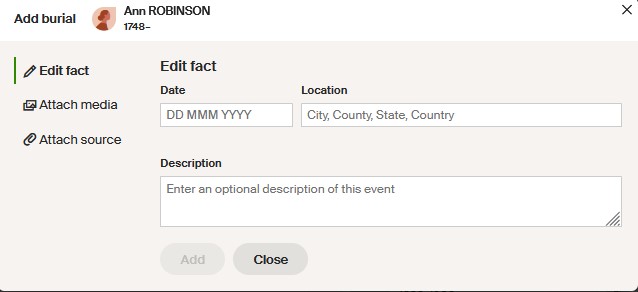
On Ancestry, to enter this kind of information, we click Add above the list of Life Events on the person’s profile page. A pop-up box appears: Add fact or event, with a list of life events to choose from, or you can make your own ‘Custom Event’.

Now we must fill in all the fields ourselves. Having to do this really makes us think about what the issues are, and why this may not be as straightforward as it might seem. Remember that in this post we’re just thinking about the Location.

In the pop-up box above, the words ‘City, County, State, Country’ is our hint as to how to arrange our place name. Of course, that’s based on the USA rather than UK, where we don’t have separate ‘states’.

Write place names as they are on the record, not what would be correct today
For example, today, Brighton is in East Sussex, but historically was in Sussex.  We should input the county as it is on the record, which before 1974 would have been Sussex.  Similarly, Gisburn was in the West Riding of Yorkshire, but since 1974 has been in Lancashire, so a 1980 birth should be recorded in Lancashire; a birth in the same house in 1970 would be recorded as Yorkshire.  Some of the newer counties didn’t even exist when the record was created.  For example, Wolverhampton, now in the ‘West Midlands’, was formerly in Staffordshire.

The further back we go, there may be even more archaic county names, for example, the Isle of Wight was in ‘the County of Southampton’. These ancient counties don’t work with Ancestry. I always record this as ‘Hampshire’, but would use the description box (see image above) to record that ‘the County of Southampton’ was given on the record.

Use official place descriptions, not ‘the way we referred to it in our family’
When I was little I used to write to my great uncle who lived in a village called Methley, about ten miles from Leeds.  My mother showed me how to write the address as ‘Methley, nr. Leeds, Yorkshire’. When I started my family tree it seemed important to me to preserve this memory, so I wrote ‘Methley, nr. Leeds, Yorkshire’ for the location of that great uncle.  This was my family history, after all! I also referenced every incidence of the main church in Leeds as ‘Leeds Parish Church’, that being how it was referred to locally. Sadly, algorithms don’t understand our happy memories! We can still include this information, but put it in the little box for ‘description of this event’ rather than in the ‘Location’ field.

When entering residence, limit this to the place, not the actual street address
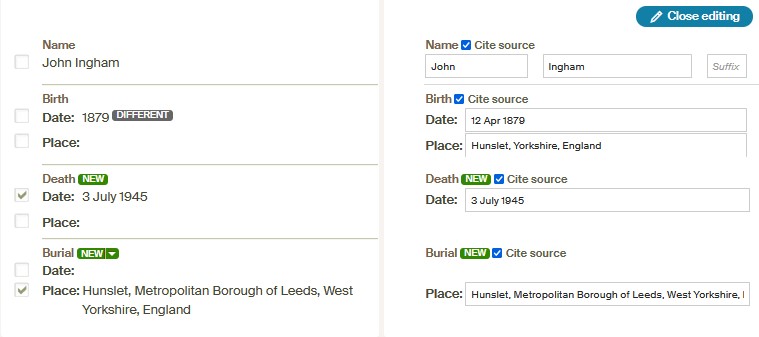
If you include the full address in the location, forever more when you write the place name, Ancestry will offer up every single address you’ve ever written in that location for you to select. Below, here’s what happens every time I write ‘Hunslet’. You can still write the full address if that’s the way you want to do it, but it’s better to put it in the Description box linked to the event. 

Recording church names for baptisms, marriages and burials
One of my ancestors was baptised at St Leonard’s church in Bilston, Staffordshire. If I write this information in the Location box on Ancestry, this could be confused with the town called St Leonards, which is in East Sussex. Similarly, St Helen’s church could be confused with the town of that name in Merseyside; St David’s after the Welsh city, and so on. For this reason I always put the placename first, then the church: Bilston, St Leonard, Staffordshire, England. Usually, I only include the church name when recording religious rites that took place within the church.

Recording the historic parish name in cities of multiple parishes
There is an important exception to the last sentence in my above ‘rule’. In larger historic towns and cities that developed around the 11th Century there tended to be many small parishes within the walls, and since the Anglican parish was also the administrative unit for secular administration, it’s useful to record this parish information for all events. I wrote about this previously, using Norwich as an example. There, prior to the introduction of Civil Births, Marriages and Deaths in 1837, I would record a birthplace and place of death like this: ‘Norwich, St Martin at Oak, Norfolk, England’. It is true and accurate, and it gives us additional information about where, precisely, in Norwich, the event occurred. The same applies for London, Winchester, York, and other historic towns.

When recording the Registration District doesn’t tell the true story
Since 1837, Civil Births, Marriages and Deaths are recorded within Registration Districts. You’ll find a list of every single Registration District (RD) that has existed since then on the UKBMD website [here]. Often, these make perfect sense. For example, a birth between 1837 and 1998 in the Wiltshire town of Devizes will have been registered in the RD of Devizes. However, as the UKBMD page for the Devizes RD shows, many other settlements in the area came within its boundaries. So if your ancestor was baptised in Pewsey, 11 miles to the east of Devizes but registered in Devizes, what location do you record for the birth? What if you also know from subsequent censuses that your ancestor was in fact born in the village of Sharcott that lies within the ancient parish of Pewsey? Which one would you record as this person’s place of birth? This is what I would do:

  • Record the birth as the actual village if I know it, but also add the General Register Office reference in the description box. This includes the RD of Devizes. e.g. Name xxx; Mother’s Maiden Name xxx; GRO Reference: 1837 D Quarter in DEVIZES IN THE COUNTY OF WILTS Volume 08 Page 250
  • Record the baptism with the name of the parish church in Pewsey.

Remember to add county and country
As you can see from my ‘Hunslet’ example, above, I didn’t always do this when I was starting out, and am still plagued by the fact!

The problem with simply writing the town or city is that many places in the New World settled by British migrants were given the names of former hometowns of the settlers. See what happens when I just type ‘Portland’.

In future searches, the search engine doesn’t know if we mean Portland in Dorset or one of these other Portlands, and may offer up all kinds of unrelated records.

If, instead, we consistently record the county and country, it helps the search engine and also helps us to keep our research tidy, enabling us to see at a glance where the person was.

If you’re an old hand at this family history research, all this is nothing new to you – but if so, please do share any examples from your own research, showing how you dealt with an unusual location situation. If you’re fairly new to researching your own family tree, I’m guessing you never knew there could be so much to recording someone’s ‘location’!

Linking a new event after searching on Ancestry

Most of the above points apply to building your own tree, whatever application you’re using to record the information. Let’s move on now to how information gets added to our trees when we’ve done a search on the Ancestry website. If you’re using a different subscription website for your tree the process will be different but the same issues may apply.

If we search for records from the person’s profile page, or by following a ‘Hint’, or by filling in details on the general search pages, when we find a record we want to add to our person’s profile page, the information fields will already be completed. This information is based on someone else’s transcription of the record, and how it was indexed. Here’s an example:

In this box information I already had, and new information, are separated out. Any differences between the two are highlighted. We can edit, accept or decline any changes to existing information. In the above example I decided to accept it as it is (although I can see a problem), and now, on this person’s profile page, if I click on the entry for his burial, I get a similar pop-up box as the one at the top of this post, but with some of the facts filled in – actually in this case, just the location:

The problem here is that the location for this record is not indexed in a way the Ancestry algorithms will understand. Hunslet is good. Leeds is sufficient without the ‘Metropolitan Borough of’ part (although I would not necessarily include ‘Leeds’). West Yorkshire did not exist in 1945; it is a county level authority that was created in 1974, so the county should just be ‘Yorkshire’. Although the country is the United Kingdom, since the law and administrative arrangements are different in Scotland and Northern Ireland, in ancestry research we usually just refer to England, Northern Ireland, Scotland or Wales, therefore the country here is England (which you can’t see because of the length of the location information) and is correct on this record. For me, this location should simply be ‘Hunslet, Yorkshire, England’, or ‘Hunslet, Leeds, Yorkshire, England’, and that is how I would amend it.

Yorkshire ‘Ridings’
Some of the old Yorkshire records include the ‘Riding’ in the indexing.  Unfortunately, Ancestry cannot cope with this at all. If we leave it in, the record entry will forever default to Riding in Northumberland – a place I cannot find on the map, but which has definitely caused me some problems over the years.  So my advice is to remove any reference to the Riding from old Yorkshire records.  If you want to include the Riding, do it in the ‘Description’ box attached to the Event.

Be vigilant!

The lesson here is that just because information is presented to you in a certain way, does not mean it is correct, and does not even mean it is algorithm-friendly on that website! If we have our own sense of what is needed for recording the location – what we personally would like, and what we have come to understand the website requires – we can record information more consistently, more correctly and in a manner that makes future Hints and Searches more effective.

I hope you’ve found something useful in all this.

April Fool’s Trees

Hand on heart, this is a family tree chart based on the plot of a well-known series of novels and TV adaptation.

Look closely!
I found myself breaking out in a cold sweat when I realised the DNA implications…

A drop line family tree chart based on the plot of a well-known book in which time travel features.

Some of you will know the series as soon as you look at the chart. Please don’t give it away in the comments in case it might spoil the enjoyment of someone yet to read it!

The rest of the trees in this post are genuine. The next three are from my own family tree. There’s something unusual about each of them. If you’re not practised at interpreting the symbols on family tree charts, look at each one to work out what’s happening before reading the explanation below each chart.

What’s happening here?

Drop line family tree showing two couples and one child of each.  After the death of the wife of one and the husband of the other, the remaining man and woman married.  Their children also then married.

Explanation: Joseph was married to Susanna and was widowed in 1865 when Susanna died. Jane was married to William and was widowed in 1872 when William died. After this, Joseph and Jane met, and they married in 1873. Through them, two of the children from their first marriages also met, and they married in 1874. So the children of this married couple are also a married couple.

What’s happening here?

Drop line family tree chart showing marriage of man to his late wife's niece, after death of the first wife

Explanation: Edwin and Mary Ann had two children, Frederick and Ada Harriot. Frederick had a daughter: Ada Mary. His sister, Ada Harriot married Richard Barton. Ada Harriot died in 1887. Four years later Richard remarried. His new wife was his niece-by-marriage, Ada Mary. Richard’s older children by his first wife are cousins of their new stepmother. They are half siblings and first cousins once removed to the children of that second marriage. The late Ada Harriot is great aunt to the children of her widower’s second marriage.

My natural tendency would be to put a diagonal ‘ = ‘ (indicating marriage) between Ada Mary and Richard on the line above. If I was sketching this out by hand that’s what I would do. However, it wouldn’t be ‘proper’… although I do think it illustrates more immediately what the situation is than this formal version, which keeps to set lines for the generations and has Richard and Ada Mary in their proper places, each therefore appearing twice.

This is an example of an avunculate marriage. It was actually forbidden in England and Wales until two years before Ada Mary’s death – and I suspect the couple knew this, since they married 200 miles from home. The Marriage (Prohibited Degrees) Relationship Act of 1931 removed the barrier to marriage between widowed uncle-by-marriage and niece.

What’s happening here?

Drop line family tree chart showing one woman with two marriages, and a son from each marriage.  These two sons (consecutively) both married the same woman.  Children were born to both these marriages.

Explanation: Harriet had two husbands: Marcus, and then when widowed she married John in 1862. She bore several children within each marriage, including Edward, son of Marcus; and Thomas, son of John.

Edward married (or possibly cohabited with) Jane. After Edward’s death, Jane married (or possibly cohabited with) Edward’s half brother, Thomas. Jane had seven children with Edward and one child with Thomas. This child was half sibling to the others, and also their cousin.

This marriage was also prohibited in England & Wales, until the passing of the Deceased Brother’s Widow’s Marriage Act in 1921. In the particular example above, no marriage record has been found for a marriage between Jane and either brother, so the forbidden marriage situation may not have been an issue.

The next one is based on an online article I saw a couple of weeks ago. You might have realised from the above that I have a fascination with people with multiple connections, and how to illustrate them in a family tree chart.

What’s happening here?

I shared a post about this family on my English Ancestors page on Facebook a couple of weeks ago. Here is a fuller article about the family, from The Independent. Identical twins Josh and Jeremy married identical twins Brittany and Brianna. Each of the couples had a baby early in 2021. As sons of two sets of identical twins (whose genetic information is identical) the children are cousins, but also, since it was exactly the same DNA that created both, they are genetic brothers. If they took an ancestry test they would show as brothers.

There is a serious side to looking at these unusual family trees. They help us to become more practised at using family tree symbols, as well as thinking about the most ‘elegant’ way to illustrate unusual relationships.

All of these family tree charts were drawn using PowerPoint. Doing this provides more control over what you include, and how to illustrate it, than a lot of the tree-building applications on genealogy software or websites. Online family history education providers like IHGS and the Society of Genealogists offer courses and one-off tutorials about using PowerPoint for tree-building. They include the functions of PowerPoint you will use, but also the rules about building pedigree charts, and the information to be included for each person. In the above charts I limited the information included to the story I wanted to tell, but a standard tree chart would include more. We also need to know about the standard abbreviations. In the first chart I had to make up a symbol – the one for ‘several generations between the two people shown’, but the rest are standard. Just a note that in the last tree I didn’t know if the two sets of twins actually have any siblings, but included them as a possibility just to highlight the difference in how we show single births and twins.

Hope you enjoyed. How about you – what unusual connections or multiple connections have you found in your trees?

Geography for Genealogists

My knowledge of the geography of places where I do genealogy research has come on in leaps and bounds over the years of doing this, and I’m sure it will be the same for most of you too. There are places I’ve never even visited in real life, yet can visualise their location on the map, together with surrounding villages or parishes. When we come across a likely record in an unfamiliar place, we need to assess the probability of this being our person.  Finding the place is a village just two miles from the expected location adds weight to that possibility. It goes without saying that maps, old and new, become our friend, but I thought it would be interesting to think of how ‘geography for genealogists’ differs from the geographical needs of regular people just finding their way from A to B or planning to visit a new area.

Essentially, of course, we need to understand the geography not only as it is today, but also as it was at different periods through history. It’s almost as if we have to peel back the layers to get to the place as it was during our period of interest.

Knowing all the names that apply to a specific place
Historically, our towns and villages have been organised into different administrative levels. We need to know what these are – what they were called, the nature of the administrative level bearing that name, the historical period in which it operated, and why each one is sometimes the place-name used… but not always. It all boils down to different types of record and where they were created. These different types of places and administrative levels include:

  • County
  • Hundred / wapentake / rape
  • Town or village
  • District
  • Parish
  • Diocese
  • Civil Registration District
  • Poor Law Union
  • Manor
  • Another name grouping places together, such as ‘Upper Wharfedale’ or ‘Cinque Ports’, or in Yorkshire the three Ridings.

Some of these are more important as we progress our trees further back; others come into play in the nineteenth century.

I wrote about some of these different administrative levels in a couple of posts back in 2019, and how confusing it can be to find a death recorded in two apparently different places – the parish and the registration district – particularly when neither of these named places is the known abode of the deceased. When we understand the function of all these administrative levels, these apparent ‘discrepancies’ fall into place. Even so, if we’re working with a new, unfamiliar area, we’re likely to have a bit of researching to do before it will all fall into place.

Good sources of information around all this include:

  • The UKBMD website, useful for helping you work out which Registration District your place of interest was in.
  • GENUKI has listings and information about all parishes, arranged by county.
  • FamilySearch Maps enables you to search for the parish on a map, to see other place names within the parish, to locate it in amongst adjacent parishes, and to see what ‘jurisdictions’ it fell within before or as at 1851, including the county, Registration District, diocese, Poor Law Union and others.
  • You’ll find useful information on Wikipedia, for example a search for “high peak district wapentake” returned this page about Hundreds of Derbyshire.
  • Also try FamilySearch Research Wiki, which you can access via the home page → Search → Research Wiki, or you can access simply by Googling “FamilySearch” and the name of a place you’re interested in. Using both methods, I searched for “Staffordshire”, and from there navigated to the parish of Kinver, which has a good selection of historical/geographical information about that parish.
  • The Manorial Documents Register on the National Archives Discovery pages enables you to search for manors by name or within specific parishes.
  • In addition to any old maps you can find, the National Library of Scotland Side by Side maps can really help you to pinpoint and understand where a specific place used to be.
  • A Family History or Local History group’s website is likely to have other relevant information.
  • And of course your search engine of choice.

Historic accent and dialect
An additional feature of ‘genealogical geography’ is that in a time when many people could not read and write, and even before that when rules for spelling were not as established as they are now, place names were written as they sounded, or as the scribe heard them. It can take much poring over online maps to work out what a placename was meant to be, or what we would call it today. It’s easier if you’re familiar with the local accent or dialect. One that had me stumped for years was ‘Aul Court Somersetshire’, recorded as grandfather’s place of origin on a Dade style baptism register in York. If it hadn’t been for a friend who used to live in this long-elusive and mysterious place, I would still not know that this is a reference to the parish of Walcot, today part of Bath. It does give us a bit of extra information though, about the person who gave this place-name to the clerk. She spoke with a Somerset accent with which the York-based clerk was unfamiliar.

Variations in information given about places
Sometimes our ancestors gave different information about key places on different records. Often, we can explain this by distance – and the same would apply today. If I lived in Tedburn St Mary, about 5 miles west of Exeter, and I was talking to someone in Exeter, I would say I lived in Tedburn St Mary. If I moved to Norwich and was asked where I was from, I might say ‘Exeter’. In other circumstances I might say ‘The West Country of England’.

Map showing the area around Hopperton in North Yorkshire, including the villages of Coneythorpe, Cowthorpe, Great Ouseburn and Little Ouseburn.

It would have been just the same for our ancestors who migrated.

However, this doesn’t explain why a person I previously researched gave his place of origin variously as ‘Coneythorpe’, ‘Cowthorpe’, ‘Hopperton’, Ouseburn’ and ‘York’. Even if we accept York as the nearest big place and therefore more likely to be reported to a stranger, it still doesn’t explain why this person gave so many tiny places as his birthplace on different documents.

We have to be prepared to think out of the box!

Some places have disappeared
Sometimes the only geographical indication that a place ever existed is a lane bearing that name, and presumably once leading to it. The only modern day indication of a place of significance to one of my 6x great grandfathers is a Service Station bearing that name. On these occasions we may just have to take what we can and accept that our place of interest is ’round about here somewhere’.

Knowing the lay of the land
Going further back in time, knowledge of other geological features such as mountain ranges could be useful in indicating where networks are unlikely to extend. Conversely, historic places such as abbeys, and the trading routes once linked to them, or the land holdings of important families, might explain why people did turn up in unexpected places.

***

Some of the above, of course, applies equally to local history, while the nature of the records we use means that some of the challenges are more prevalent for family historians. I’m sure you’ll be able to think of examples of all this from your own research, and perhaps other aspects of geography that have extra layers when researching our family histories. If you do, please do tell us about it in a comment.

Dade Registers

I write in praise of the Rev. William Dade, a Yorkshire clergyman who, from 1763 until his death in 1790, was curate, vicar, and rector of five parishes in the city of York and two in the East Riding of Yorkshire. In 1770, while curate of St Helen Stonegate in York, he devised a system of recording information on baptism and burial registers far superior to the usual records.

Entry by Rev William Dade at beginning of Baptism Register of St Helen Stonegate, York, in 1770.
Original data: Borthwick Institute for Archives, Ref PR-Y-HEL-3 Source: FindMyPast

So useful was Dade’s method that in 1777 the Archbishop of York required its introduction throughout the diocese. Unfortunately, the administration of the scheme was so much work for parish priests that many, particularly in more populated areas, refused to comply. I can see their point – and of course, sometimes the information is only as good as the informant’s knowledge. But even so, if you find examples of these in your ancestry you feel like you’ve struck gold!

The baptismal registers were to include:

  • Child’s name, seniority (e.g. first son), date of birth and baptism
  • Father’s name, profession, place of abode and descent
  • Mother’s name, maiden name and descent.
John Hunter Baptism Register entry, 1778, Tadcaster.
Original date at Borthwick Institute for Archives, Ref P.R. TAD / 8 Source: FindMyPast
Click for big!

Although the Archbishop of York’s request applied only to his diocese, the practice of recording more information than strictly required – just for personal satisfaction – was not unique to parishes within the diocese of York. Today, any register in which the clergyman habitually recorded extra information may be termed ‘Dade Registers’. They can be found throughout England. Their locations, together with start and end dates, are indicated on the Dade Map developed at Brigham Young University. So even if you don’t have ancestry in Yorkshire you might be lucky.

Rev. Dade applied similar diligence to his burial registers.

Margaret Simpson Burial Register entry, 1771, York St Helen Stonegate.
Original date at Borthwick Institute for Archives, Ref PR-Y-HEL-3 Source: FindMyPast
Click for big!

Below is an example from my own research that I simply couldn’t have done without this baptism record. It was the only way I could differentiate between two marriages, each involving a John Seymour and an Elizabeth, all married the same year in the same small parish.

After 1813 Rev. Dade’s system largely disappeared as the Church of England began recording baptisms and burials on pre-printed forms.  They were of course, much better than the usual pre-1813 registers, but I think you’ll agree that Rev. Dade was a cut above!

*****

I’m absolutely rushed off my feet with work and deadlines just now and for the rest of the year may not be able to publish more than one post per month. I’ll do my best, but we’ll have to see how it goes. I hope to be back to normal by the New Year.