Ryan Littrell’s ‘Reunion’ and Y-DNA in family research

I’ve just finished reading Ryan Littrell’s book Reunion: A Search for Ancestors, published in 2012. It’s an account of how, following a surprising find amongst old family papers, Ryan set about uncovering the story of his Scottish ancestors. A complete beginner in family history at the time, his interest was purely on his mother’s paternal line, the McDonalds.  He wanted to learn about the clan and whereabouts in Scotland his family originated.

If you have a Scottish clan ancestral line, particularly Clan McDonald/ MacDonald/ Macdonald or simply Clan Donald, then I think you’ll find this book interesting and helpful. It will also be useful to anyone wanting to know more about Y-DNA testing, and how it can be used in genealogy. Alongside this, you’ll see an example of an active Y-DNA surname project, and learn more about how you might be able to use this type of DNA testing in your own research.

None of the above apply to my own family research. For me personally, I realised as I was reading that there was a gap in my knowledge of Scottish history and particularly the Jacobite movement. I’ve since been exploring that, and this, broadly, will be the topic of my next post. Today’s post focuses on the Y-DNA.

After a more general introduction, from Chapter 8, Ryan’s story alternates between his developing knowledge about his own family and the Clan history. Starting with events of around a thousand years ago, the history moves forward in time as Ryan’s own research moves backwards so that at some point the stories meet. The documentary research was hampered by the fact of being spread over several counties in four different American states. At times a professional genealogist was hired to plough through documents in archives local to the places where his family had lived in the States. I did wonder at times why baptism registers were not mentioned. Perhaps they had been used, but they were not included in the account. In the UK, they would have been a starting point for any research prior to 1837.

So it was, really, the way the usual documentary research was used alongside Y-chromosome DNA (Y-DNA) testing that was the more interesting part for me. Used alongside wider Clan history reading, this was key in helping Ryan to home in on his ancestral home and indeed other Y-DNA testers descended from the same people.

How Y-DNA tests work
The main DNA test we use for genealogical research is autosomal. Autosomal testing is useful for finding ancestors and close blood relatives up to around five generations back. Y-DNA is different, and we use it in genealogy for a very specific reason.

Y-DNA is passed from fathers only to their sons. This means every male can be shown to be connected to his father, his paternal grandfather, great grandfather, and so on, right back through time. Passing largely unchanged down the male line, it links back thousands of years.

A Y-DNA test places each tester into a group known as a Haplogroup. Individual Haplogroups are often associated with specific parts of the world. For example Haplogroup E is primarily found in Africa, with some presence in other regions; Haplogroup O is primarily found in East and Southeast Asia. A number of Haplogroups are to be found in Europe. These include Haplogroup R, common in Europe and parts of Asia. At the very top of each of these Haplogroup lines is one man. We will never know the names of these individual men, but each one is the furthest ‘identifiable’ ancestor of every male sharing that broad Haplogroup.

Over time, there are mutations on the Y chromosome. We use these mutations to work out how far back two male testers share a common ancestor. If they both share a particular mutation this is evidence that their common ancestor lived after the mutation occurred. Another way of looking at this is that when mutations occur, a new branch in the Haplogroup occurs. If a mutation occurs for one brother in a family, his descendants will have the mutation but his remaining brothers and their descendants will not.

In this way, as a result of mutations, the wider Haplogroup can increasingly be subdivided, and this enables us to place a tester in ever more specific branches, or Subclades, of the Haplogroup. For example, the Haplogroup R has two branches, or subclades: R1 and R2. R1 is further subdivided into two descendent subclades: R1a and R1b.

Surname Projects
Since Y-DNA follows the direct paternal line, assuming that there have been no adoptions, no elective name changes and no ‘non-paternity events’, the line should coincide exactly with the surname. This has led to the creation of Y-DNA Surname Projects, often run by experienced leaders who may be able to recognise specific branches of the surname based on the very specific subclade as revealed by the Y-DNA test.

It was one of these Y-DNA surname projects that Ryan Littrell joined when he was carrying out his own research. Through them, he learned that the MacDonald clan, also known as Clan Donald, is associated with the R1a and R1b haplogroups. Testers potentially descended from a man named Somerled, who is important in the Clan’s history, are associated with the R1a haplogroup, while The Macdonalds of Sutherland, for example, belong to the R1b haplogroup, specifically the R-FTA93010 subclade.

As his connection to the McDonalds was through his mother rather than his father, Ryan was not able to test his own Y-DNA for this project. Instead, he needed to find a male member of his mother’s McDonald family who was prepared to test. His mother’s uncle was happy to do so, and it was his Y-DNA test results that Ryan worked with thereafter. Working with the surname group, these test results enabled Ryan to connect with a small number of testers whose origins could be traced to a specific village in the Scottish Highlands. Through connections and visits to the area, more McDonald men offered to test and they too shared the same subclade.

Ultimately, this combination of documentary research, Y-DNA testing, reading about the history of the clan and speaking with distant cousins who had grown up in the area, enabled the small group of distant cousins to work out where they fit into the history of the Clan.

You will have to read the book yourself to find out how, but I hope this account has enabled you to work out whether firstly this book and secondly Y-DNA testing might help you in your research.

Embracing 3rd and 4th cousin DNA matches!

I’ve often heard people who are interested in their family history say they won’t take a DNA test because they’re not interested in connecting with 3rd or 4th cousins: they just want to know about their own ancestors. This is a misunderstanding of how DNA matching works. The point is that we share 2x great grandparents with our 3rd cousins, and we share 3x great grandparents with our 4th cousins. Unless our ancestors have lived extraordinarily long lives and reproduced the following generation at scandalously early ages, none of those ancestors of ours will still be living. However, if we can connect with other people who are descended from them via siblings of our direct line, we might learn new stories about them that were passed down their line but not ours. We might even find new photographs or documents, or a family bible. If we’re not absolutely sure that we have the correct parentage assigned to one of our forbears, the DNA will prove that and help us to work out who the correct person is. If all this seems like an impossible puzzle – well, yes, there is a lot to learn. Sometimes the connection is very clear; other times we have to work hard to find it. But it’s worth it.

In my own family research I’ve used DNA to home in on birthplaces in Ireland (from where my ancestors migrated before the advent of civil registration and before the big fire in Dublin); to verify a hypothesis I had about a mysterious ancestor; to help several other people to find missing grandfathers; and to connect with people who had photos. However, this post is not about my own ancestry.

Today I’m going to share with you how I used three unknown DNA matches of a person whose DNA I manage:

  • to identify beyond doubt the birthplace in modern-day Belarus of certain named individuals;
  • to identify beyond doubt two family members, brothers of direct ancestors, about whom very little was known.

All this is published here with that person’s permission. 

The case is complicated because it involves several countries, constantly changing national boundaries, two continents, several languages and two types of script: the Latin script we use in English, and the Cyrillic script used in Russia and Belarus. It involves people of Jewish heritage, where the high incidence of endogamy can skew estimates of cousin matches, making them appear closer than they really are. At no time did I make contact with any of the DNA matches. All research was carried out using only the sparse information they each had on the trees linked to their DNA results as my starting point.

The research relates to Marks Chirklin, his wife Fanny Chirklin née Rudow and one of their daughters, who I will not name here. 

The Chirklins immigrated to the UK early in the twentieth century, and were believed by their living descendants to have come from Poland or Lithuania.  In the 1911 census their country of birth is recorded as ‘Russia’.  None of this is incompatible, since boundaries changed regularly.  However, the Russian Empire was huge, so this documentary evidence did nothing to permit a homing in on the actual birthplace of the family.

In all UK records the name of this family is written as Chirklin or Cherklin.  This too is not without complications.  For any of our ancestors originating in a non-English speaking country, names may have been anglicised.  If they have come from a place where an alphabet other than our Latin script is used, the complications are even greater.  Often in such cases we lack a letter to write the sounds required to pronounce the original word.  In the case of immigrants this will impact on names of people and also place-names.  As we shall see, both of these were an issue in this research.

Using records and DNA matches to locate a birthplace for the Chirklins

In the 1921 UK census Marks and Fanny gave their birthplaces as Vilna.  Vilnius is the capital of Lithuania, but ‘Vilna’ is a government district, or ‘Oblast’. Although it did include Vilnius, it was much larger, including territories in present-day Belarus as well as Lithuania.  At the time the family came to the UK it was part of the Russian Empire. 

However, in the same census, the now-married daughter of Marks and Fanny gave her birthplace as ‘Dishna, Russia’.  This was problematic for the linguistic reasons outlined above.  Just writing this down involved transforming the sounds of her homeland and somehow finding a way to make sense of these sounds in English language and script.  So ‘Dishna’ was unlikely to be entirely correct, but it was a starting point; and since the rest of the family were born in the Vilna Oblast, this narrowed down the search for a town within Vilna with a name that sounded like ‘Dishna’.

I had already noticed that the Chirklin descendant whose DNA I manage had two reasonably close DNA matches with names in their trees similar to Chirklin.  Specifically, those names were Tsirklin and Tzerklin.  One was in the US; the other location not known. Both were showing with a probability of a 2nd-3rd cousin match.  For reasons outlined above, this estimated match level needed to be taken with a pinch of salt to some extent.  Even so, a DNA match stretching back far enough to be just out of reach as far as our UK and US records are concerned seemed likely – perhaps a 3rd-4th cousin match.

Should my linking of Chirklin, Cherklin, Tsirklin and Tzerklin require any explanation, it’s easily explained by the linguistic conversion of the sounds of one language family to another.  There is often even a difference between the way surnames were recorded upon immigration into the US and immigration into the UK.  (For example the name pronounced phonetically in the US as Pet-Raow-Skee is both spelled and pronounced differently in the UK: Piotrowski and Pee-Ot-Roff-Skee.) In a new language which doesn’t have an equivalent sound, ‘Tz’ could easily be the same sound as ‘Ch’. 

I had no way of knowing how these Tsirklins and Tzerklins were connected to the Chirklins.  The family trees linked to the DNA results were sparse, and it seemed clear that any connection would be back in the old homeland.  What I could see, however, was that the earliest known Tsirklin was from ‘Volintsi’ in Belarus, and the earliest known Tzerklin from Polatsk in Belarus.  These towns are about 35 km apart – but Polatsk is a much larger town and could easily have been a ‘shorthand’ for “I come from a tiny settlement called XXX about 10 miles from Polatsk”.

Locating these on the map I then searched for ‘Dishna, Belarus’ and found it: Dzisna – just a short distance south of Volyntsy.  By combining the documentary evidence of the placename given on the 1921 census with the location of these reasonably close DNA matches with the same family name, we finally had a definite birthplace for this Chirklin daughter and possibly for her siblings and parents too.

Google map showing the locations of three towns in Belarus.  The towns are Volyntsy, Dzisna and Polatsk.  The place names are recorded on the map with Latin script and Cyrillic script.
Location of Volyntsy, Dzisna and Polatsk in Belarus. Google Maps.

There are various spellings of this town’s name.  I have come across Disna, Dysna, Dzisna (Polish), but also in the Russian Cyrillic script Дзісна in Belarusian (which is pronounced Dzisna, as in the Polish pronunciation), and Дисна in Russian, which would be pronounced as Disna. Today, the boundaries of the Oblasts have also changed.  Dzisna is now within the Molodechno Oblast of Belarus. 

Using records and a third DNA match to identify and locate two missing family members

In addition to the known siblings living with the family at the time of the censuses, the Chirklins were thought to have another son: Nathan.  The descendants of the family knew of him only from a reference on a memorial headstone.  He was generally assumed to have gone to America, but no one knew for sure.  One of the descendants found a new document via Ancestry.com, and thought this could be him.

The new document was a ship’s manifest, dated 1907, including the passenger Nachman Zirklin.  Could ‘Zirklin’ be yet another anglicisation of Chirklin/ Cherklin/ Tzerklin/ Tsirklin?  And could ‘Nachman’ be the missing person thought to be Nathan?

Entry for Nachman Zirklin on the Shop's manifest for his ship from Liverpool to Philadelphia, PA, arriving March 1907. The entry gives name, occupation of watchmaker, last residence of London and the name and address of an uncle with whom Nachman will be starying upon arrival.
Nachman Zirklin, Ship’s Manifest entry, March 1907, Liverpool to Philadelpia PA.
CLICK FOR BIGGER

According to the ship’s manifest, Nachman Zirklin was 21 years old in 1907 – the right sort of age to be the missing brother.  He was departing from Liverpool, bound for Philadelphia, PA, and his last place of residence was London, where he had lived for eight months.  The immigration date of the Chirklins into the UK was not known but was likely to be around this time.  Therefore if this Nachman was the correct person, this record would also give us a likely immigration date for the whole family of around July 1906.  Nachman’s birthplace is noted as ‘Lisna’, which is very similar to Disna and an easy mistake to make if the clerk has never heard of the place and has noted down what they thought the person with very little English has said, or indeed if that information is being copied from another document where the upper round stroke of the ‘D’ was very faint.

There was one other very interesting piece of information.  Nachman was heading for New York City, where he would be staying with his uncle, a Mr Rudoff.  Rudoff, of course, is a phonetic spelling of Rudow, which is, as we knew, the maiden name of Fanny, the mother of the Chirklin family in England.  It looked very much like Fanny had a brother in New York, and that her son Nathan/ Nachman was going to stay with him.

As luck would have it, there was another DNA match, estimated 2nd-3rd cousin, to a US-based person with Rudow ancestry.  Again the linked tree was very sparse, and while acknowledging the obvious surname link between that family and Fanny back in London, there were no clues at all as to how they might fit in.  The earliest known Rudow ancestor on that tree was a Solomon, with an estimated birth year of 1866 and a birthplace of ‘Russia’.  However, when I went now to look at this DNA match again I saw that the Ancestry algorithms had been hard at work, and had found a link between ancestors that this match didn’t even have on her tree and two people on the one I had created for the person whose DNA I manage.  The two people were Fanny’s parents.  I had been given their names by family members and knew nothing more about them.  However, Ancestry was suggesting these people were also the parents of Solomon Rudow in New York.  If correct, this would make Solomon Fanny’s brother, and therefore the uncle of Nathan/ Nachman. 

We should never simply accept hints on Ancestry or any other genealogy website.  Hints are suggestions, nothing more.  It’s up to us to prove or disprove them.  So I now set about researching Solomon Rudow of New York.  Through a series of US Federal and NY State censuses I tracked him from his arrival circa 1902 to his death in 1956.  On the 1906 US directory I found his address: right next door to that given the following year by Nathan/ Nachman as the address of his uncle Mr Rudoff, on the ship’s manifest.  We have our man!  This Solomon Rudow is indeed the uncle of Nathan Zirklin/ Chirklin, younger brother of Fanny née Rudow; and Nathan is the son of Marks and Fanny.

Extract from the family tree chart, showing all the people who have been named in the text of this blogpost.

This post has looked at how DNA was used to confirm birthplaces, plus connections to two missing people who had emigrated to the USA. In view of the lack of information amongst the living descendants of the Chirklin family, I couldn’t have proven any of this without the DNA.

While in this post we have been looking from England to find out more about people who went to America, in my next post I’ll be staying with Solomon Rudow and Nachman/ Nathan Zirklin/ Chirklin, and investigating what might be learned about the family back in England and their origins in Dzisna/ modern day Belarus by looking at the US records about the two of them.

Inferred Chromosome Mapping using DNA Painter

A new tool has been added at DNA Painter: the Inferred Segments Generator. If you have a parent, sibling, half sibling or a descendant of a sibling whose DNA test results are on any of the sites displaying the chromosome browser, then you can make use of this new tool. Just a note though that it won’t be of use to you if your grandparents are related, or if they’re from a group with a high level of endogamy: you have to have grandparents whose lines are clearly distinct.

If you have no idea what a chromosome browser is, take a look at my previous post [here]. What you need to understand for inferred chromosome mapping is that we have two copies of each chromosome: the copy we inherited from our father and the other from our mother. DNA Painter is all about helping us to separate out which of those two copies any specific DNA match segment should sit on. However, homing in on any one of those copies, the DNA on either the mother’s or father’s copy is a random mix of what they inherited from their own mother and father, and this is why we talk about ‘segments’ – we will have a ‘chunk’ of DNA from our father that came from his own father’s side, followed by another chunk from his mother’s side, and so on. So at any specific place on our two copies (maternal and paternal) of any specific chromosome, we have inherited DNA from either our grandmother or our grandfather. A DNA match means we have inherited exactly the same segment as our DNA cousin, but precisely where the segment match begins and where it ends is where one of us – me or my DNA cousin – has switched at that point in our DNA inheritance from one grandparent to the other.

Inferred chromosome mapping is simply about using this understanding alongside our DNA results in comparison with those of our parent, sibling or nephew/niece. Let’s say my brother and I both match second cousin A on our maternal line. We know that this shared DNA comes from our mother’s paternal line. Now let’s say my brother’s shared segment with second cousin A on one segment is longer than mine. We can infer that here, the DNA I inherited from our mother has switched from my maternal grandfather to my maternal grandmother. Now, when I get a new match on those segments that I have been able to allocate through ‘inferred mapping’ to my maternal grandmother, it greatly reduces the parts of my tree I have to look at in my efforts to locate any new matches.

In the short video below, Jonny Perl, founder and creator of DNA Painter, explains all of the above with diagrams. He then explains what his new Inferred Segments Generator is and how you can use it for inferred chromosome mapping. I’ve been able to use it so far for just two matches my brother and I share – a second cousin and a second cousin once removed (both on the same line) – and I’ve been able to ‘infer’ and allocate 195 centiMorgans worth of segments.

For those of you who are into DNA for genealogy – may you be blessed with many, many centiMorgans of inferred DNA!

*****

For the next three months I have a very heavy workload and will be reducing my posts to one per month, the 1st of July, August and September. From October I’ll be returning to my usual pattern of two posts per month. Until next time, have a good June.

DNA Painter Ancestral Trees

Fan tree created using DNA Painter
DNA Painter fan tree

Today I have pretty things for you!
For ages I wanted to create a colourful fan tree. I had no idea how to go about doing that but suspected it would involve a lot of work, so I was particularly impressed when, a while back, Jonny Pearl introduced the facility to do this very quickly and easily on his DNA Painter site.

I wrote about DNA Painter earlier this year as part of my mini-series on using chromosome browsers as part of DNA research for genealogy. As explained in that previous post, DNA Painter is brilliant for mapping out your DNA segments, but in theory even if you don’t intend at this stage to use the main DNA functions, you could still get your own colourful fan just by uploading your tree to the site. You do this by downloading the GEDCOM file from your online tree or your own software or simply by inputting the information manually.

Once loaded, your tree will appear as a pedigree with each of the lines colour coded. The DNA Painter default palette uses pretty much the same colours I use on Ancestry to assign known DNA matches to each of my great grandparents’ lines, but here on DNA Painter the default paternal grandmother and maternal grandfather colours were the wrong way round for me. It was very easy to flip the colours. Editing and building the tree is very straightforward too. You can hover over any ancestor to edit their information, add their parents or delete them, and you can mark them as a genetic ancestor – someone who is a common ancestor confirmed not only by paper trail but also by DNA. Fly your cursor over any ancestor and then select View/Edit → Edit or Add Notes to change any information about them, including the colours used for them and their ancestors.

From this point you can go to the three options at the top left hand corner of the screen: TREE / FAN / TEXT. Tree is the default – the pedigree. Text is a handy pedigree list of all your ancestors, with dates and places of birth and death. However for me the fan is the most exciting part. It only goes to 10 generations and I have some lines further back than that, so they are not included. Already, though, you can see at a glance how well you’re doing and where you have gaps.

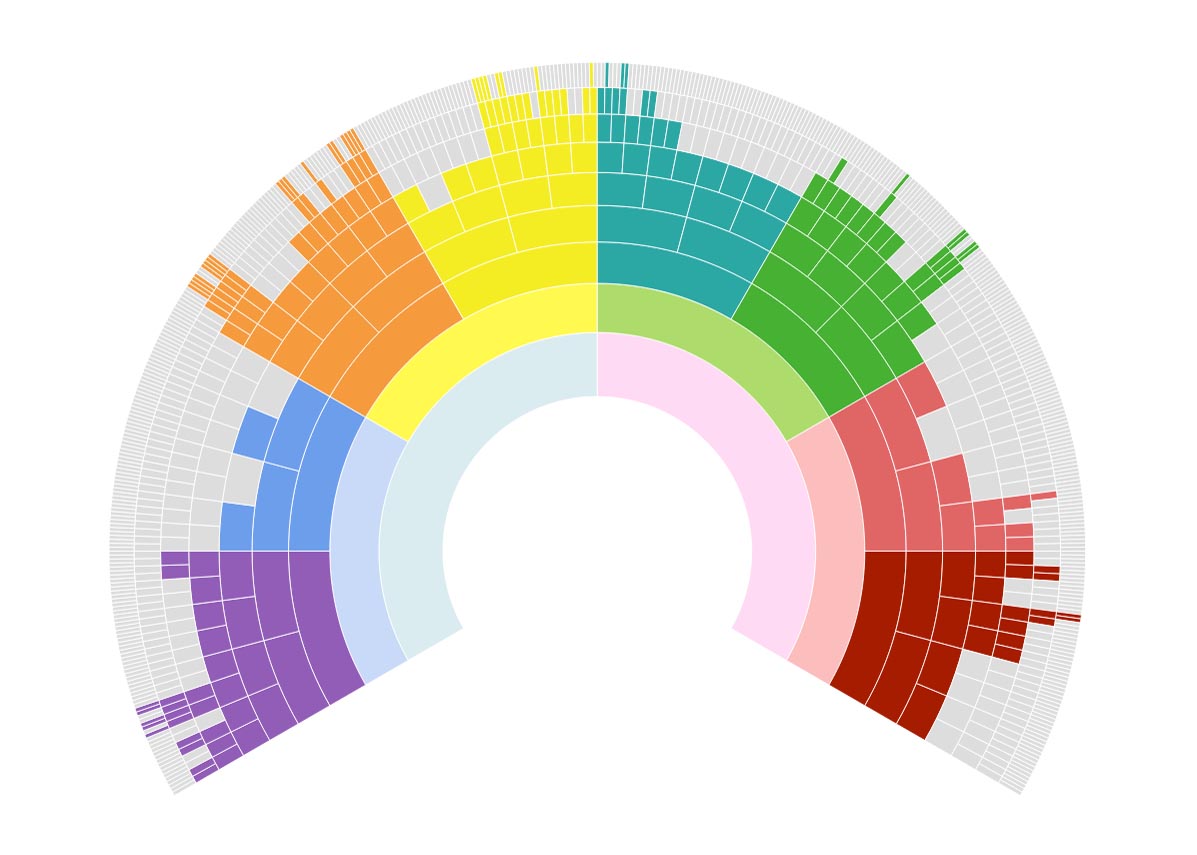
I’m sure the arrangement in the fan above is obvious, but in case it isn’t: from left to right, the colour blocks are pale blue for my paternal side and pink for maternal. Then I have blue for my paternal grandfather (with violet and blue for his ancestors); yellow for paternal grandmother (with orange and yellow for previous ancestors); green for maternal grandfather (with turquoise and green for his ancestors); and finally salmon pink for maternal grandmother, with deeper pink and browny pink for her ancestral lines.

For all versions of the fan tree shown in the images in this post, you can hover over any individual person’s ‘box’ to see their name, vital dates and their relationship to you. At the same time on the left of your screen you’ll see the lineage from that person to you. I couldn’t show this in these images because the screen shot process disables the hovering cursor.

You can also click on ‘Tree Completeness’ over at top right of the screen to get numbers and statistics of ancestors identified at each generational level. All the images in this post click for a bigger version, but you’ll definitely need to do that to see the info on this next image.

Screen grab of DNA Painter Ancestral Trees tool bar showing options for Tree view, DNA filters, Tree completeness and other options
DNA Painter Ancestral Trees toolbar

Moving along the toolbar options to ‘Dimensions’, these next two fan charts draw upon all the information you provided when you uploaded or built your tree. First, you can see all your ancestors colour-coded by the age at which they died.

Fan tree showing ancestors' ages at death
DNA Painter fan tree showing ancestors’ ages at death

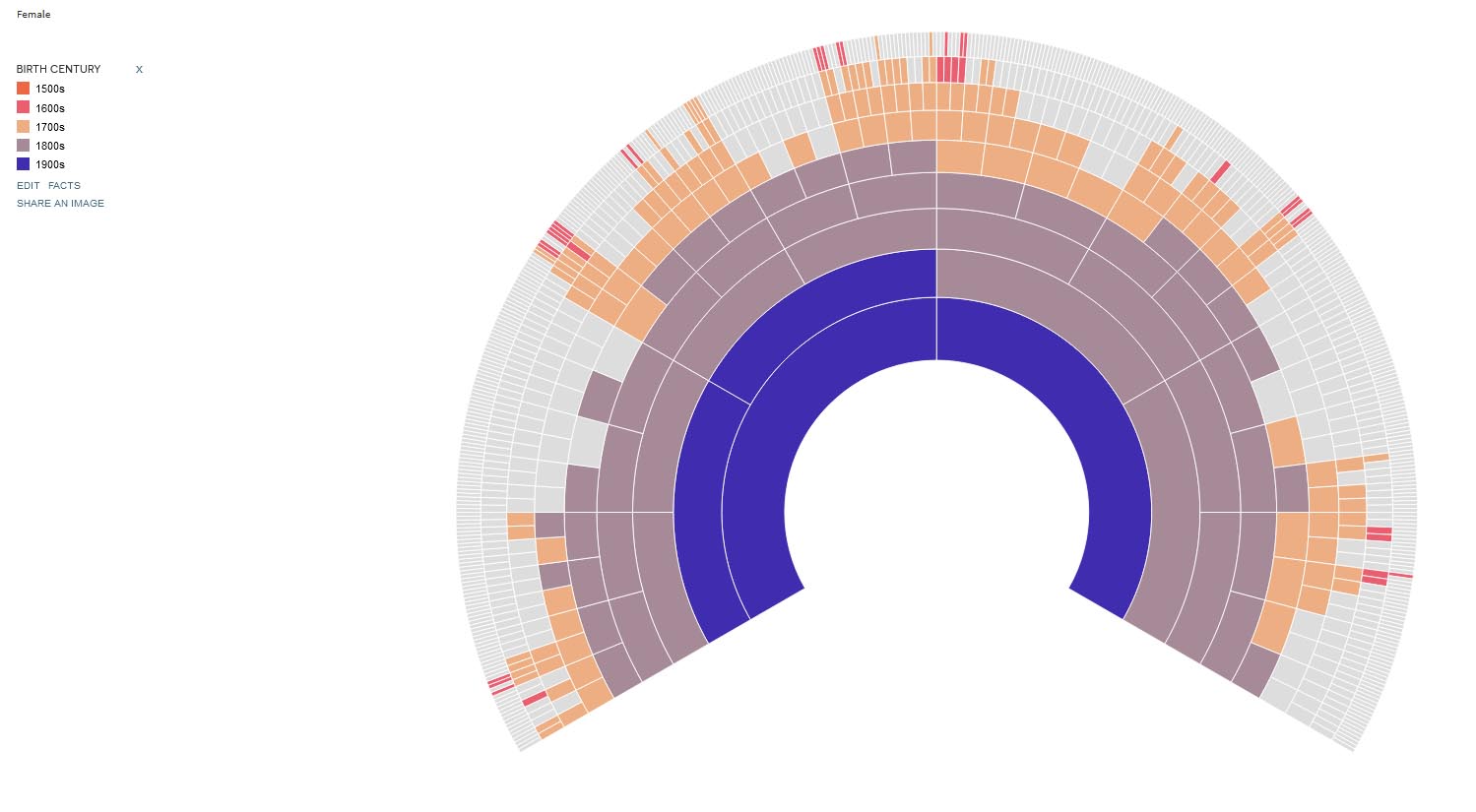
Next, ancestors colour-coded by the century in which they were born.

Fan tree showing century of ancestors' births
DNA Painter fan tree showing century of ancestors’ births

So far all the charts shown relate simply to the detail of your family tree. However, if you also work with DNA, you can make use of all the following fan charts:

On the upper toolbar, select DNA Filters. The first option is Show Genetic Ancestors. Provided you have already marked which of your ancestors are proven as genetically linked (see above) you will now see how you’re doing in terms of corroborating your documented tree through DNA matching. This is mine.

Fan tree showing ancestors with genetic link proven by DNA
DNA Painter fan tree showing ancestors with genetic link proven by DNA

My first ever DNA post was about deep ancestral DNA testing: mitochondrial DNA and Y-chromosome DNA. To recap very quickly, everyone inherits mitochondrial DNA from their mother – but only daughters pass it on. This means everyone can be sure that they share the same mitochondrial haplogroup as their mother, their mother’s mother, and so on right back through time. That is illustrated by the following chart. (In fact I have only been able to trace this line back to 3xG grandmother, but even though I don’t know her name, I do know that my 4xG grandmother has the same mitochondrial as me.)

Fan tree showing mitochondrial DNA inheritance
DNA Painter fan tree showing mitochondrial DNA inheritance

Y-chromosome DNA works exactly the same way, but only males inherit it, and obviously therefore only fathers pass it on. So the Y-DNA inheritance path is an exact mirror image of the mitochondrial, following father’s father’s father’s father’s line right the way back. (The chart below showing this is for a man whose DNA I manage. Obviously I can’t get this information from my own DNA.)

Fan tree showing Y-chromosome DNA inheritance
DNA Painter fan tree showing Y-chromosome DNA inheritance

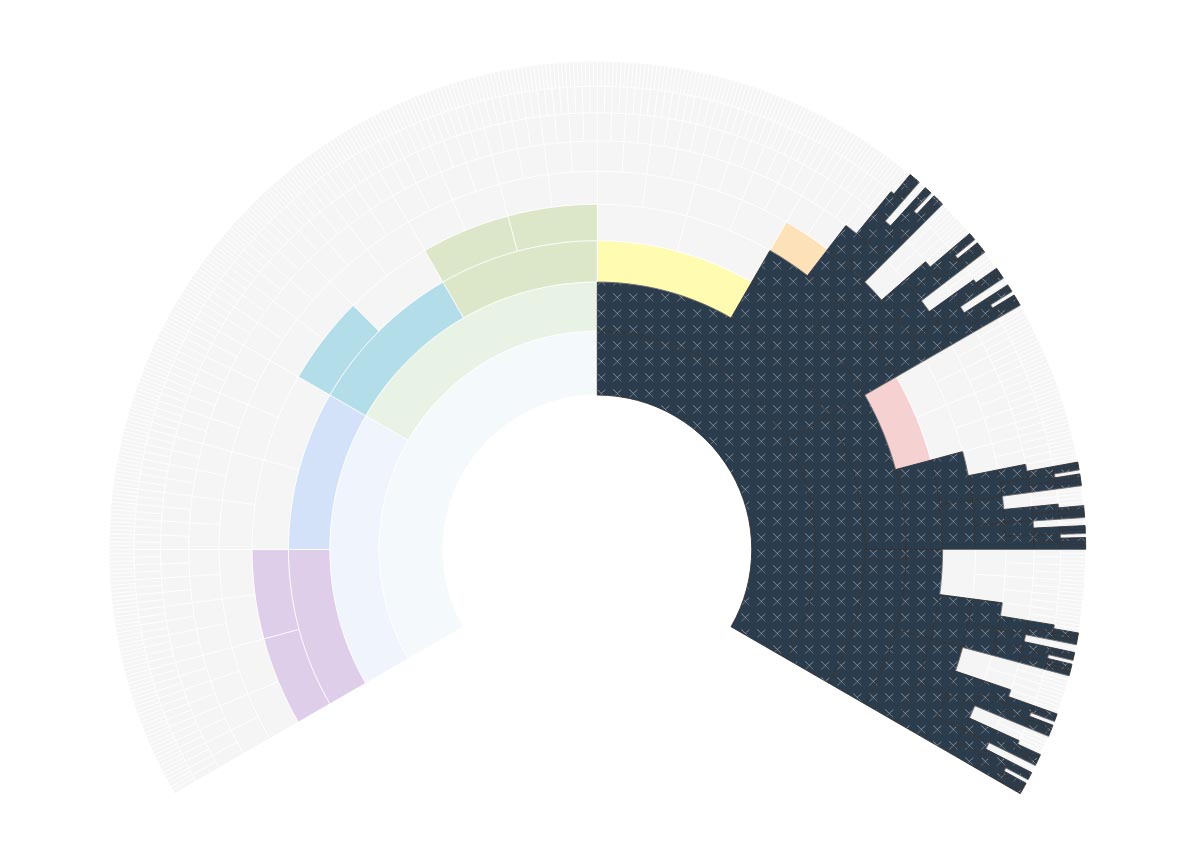
The second option in DNA Filters is Show X-DNA Path. At some point I’ll do a blogpost about X DNA. I haven’t done it so far because I don’t have many X matches to use as illustrations. If you already understand X-DNA inheritance patterns the meaning of the following two screenshots will already be clear, and when I do eventually write about this I’ll include them, since they illustrate perfectly the different inheritance patterns for females (the one immediately below)…

Fan tree showing X-DNA inheritance for females
DNA Painter fan tree showing X-DNA inheritance for females

… and males:

Fan tree showing X-DNA inheritance for males
DNA Painter fan tree showing X-DNA inheritance for males

Because of the dark colour used, it isn’t clear from these last two screen grabs that if you hover your cursor over the dark patch the intensity of colour reduces and you can see the individual ancestors’ names.

I don’t know about you, but I think all of this is pretty cool!

Will the real Edward Robinson please stand up?

When I started researching my tree my Mum told me what she knew about her family.  It wasn’t much, but enough to get me started.  Regarding her mother’s grandparents she could name only one, and even then only his surname: Robinson.  However, for the next 25 years, my GG grandfather Robinson – Edward, as I discovered – kept his origins a closely guarded secret.  The problem was that there were no documents to evidence his birth family.  He didn’t actually marry either of his ‘wives’, and if there was a baptism, I have never been able to find it.  Any of these records would have evidenced Edward’s father’s name, location and occupation. From 1851 onwards I collected a great deal of information about Edward, right up until his death in 1898. All censuses and other documentation are absolutely consistent with a birth year of 1826 – and with one exception, even consistent with a birthdate between 18th March and 3rd April 1826, but there was nothing at all to enable me to place him with a family.

Even before knowing Edward’s name, I grew up hearing stories about him.  He had a stall in Leeds market. My Grandma told me he paid a shilling for her mother, Jane, to go to school one day a week, and Jane used to play with gold sovereigns on the floor.  After Edward’s first wife, my GG grandmother Margaret died, he turned to drink and lost all his money.  There is truth in this: I unearthed drunk and disorderly reports and short spells in the slammer, but I rather suspect there was never that much money to lose.  Finally, my Mum told me that after losing all said money ‘he went back to The Crooked Billet where he was born, and threw himself in the river’.  This too is true.  I have the Coroner’s Report made the day after his death in 1898, although Edward actually drowned himself a couple of miles along from that spot.

It’s fair to say that Edward had a colourful life, and from 1851 I think I have the measure of him.  I even suspect that withholding information was a reflection of his personality: he probably didn’t trust the authorities, and maybe it has taken him all this time to trust me too!  Nevertheless, in amongst all of the above there were several clues:

  • Edward was born in 1826, or at the latest in 1827
  • In all records he gives his birthplace as Leeds
  • My mother’s story suggests a birthplace of Hunslet – not part of Leeds township at that time, but just across the river, and within the large ancient parish of Leeds.
  • There was a hint that he might actually have been born at the Crooked Billet inn in Hunslet.
  • Edward had two daughters: the younger, Margaret, was named after her mother.  Might the older, my great grandmother Jane, have been named after Edward’s own mother?

Two of these clues turned out to be red herrings, but they had me hooked for a while.  At the time of Edward’s birth the innkeeper at the Crooked Billet was John Robson.  Could that name somehow have morphed into Robinson?  No, it hadn’t: it seemed Edward could have been born *near* the Crooked Billet, but not *in* it.

As for Jane, there was an Edward of the right age living with a Jane old enough to be his mother in Hunslet at the time of the 1841 census.  However, searching the parish registers for a Robinson marrying a Jane in the parish in the years before 1826 returned only two records, both traceable in the 1841 and 1851 censuses living away from Leeds. 

Searching the parish registers for Edward’s baptism proved equally fruitless.  Ten Edward Robinsons were baptised in Leeds between 1825 and 1831.  There were also two marriage records in 1847 and 1867 that might possibly have been him.  I had long ago realised that the reason Edward and my GG grandmother Margaret didn’t marry was that she was already married to someone else.  Perhaps Edward too, had married another woman before meeting Margaret?  But no: the couples in these two records were still together in subsequent censuses when I knew Edward was with Margaret or, after Margaret’s death, I knew where he was.

It troubled me not being able to break down Edward’s brick wall, so a couple of weeks ago I decided to give him another opportunity to reveal his identity.  Using Ancestry, FindMyPast, TheGenealogist, FreeReg and FamilySearch, I listed every possible baptism for every Edward Robinson baptised in Leeds from 1824 to 1831.  I was able to discount a couple on the basis of location or father’s occupation; another died in infancy; and the rest I worked forwards through the 1841 and 1851 censuses.  I knew where my Edward was in 1851, so if any of these Edwards could be located elsewhere, they were not my Edward.  I was left with about three baptisms, and no way of choosing between them.  I then searched the 1841 census for any additional possibilities, and found two not accounted for in the baptisms.  One of these was my long-preferred Edward with Jane in Hunslet.  The other was Edward and sister Elizabeth, living in Hunslet with their parents Edward and Elizabeth.

At this point I did something I hadn’t had the opportunity to do on previous attempts to break through Edward’s brick wall: I turned to DNA.  Using the filters on the Ancestry website I searched amongst all my DNA matches for anyone with the surname Robinson and birthplace of Leeds in their trees.  I didn’t expect to find anyone.  I needed someone who had already traced their ancestry back to Edward’s parents, who had young Edward in their tree, who had taken the DNA test, and shared DNA with me – not guaranteed at 3rd or 4th cousin level.  It felt like searching for a needle in a haystack. But unbelievably I found someone: just one person, estimated at 5th to 8th cousin.  He had my Edward in his tree, born c.1826, living in 1841 with sister Elizabeth and parents Edward and Elizabeth.  This was, in other words, one of the families I had already identified as a possibility.  Unlike Edward, sister Elizabeth had a marriage certificate and a baptism record and had therefore been traceable quite easily back to her birth family. My DNA match, Elizabeth’s descendant, already had another bit of information on his tree too: a marriage record for Edward’s parents, and with that a maiden name for the mother: Clarebrough.  But could this just be coincidence? My match and I didn’t share very much DNA; this could be a case of confirmation bias. The next step was to do the same filtered search on Ancestry, but this time for the unusual surname Clarebrough and a birthplace of Leeds.  If I could find anyone amongst my DNA matches just one generation further back from Elizabeth Clarebrough but descended from a different sibling, then there was no doubt that this was my Edward…  Bingo!  A DNA match, and three more on MyHeritage.  Finally, after 25 years of trying, I have my Edward!

I hope there’s something in this account and the methodology to interest you. In those pre-census/ pre-Civil BMD days, listing all possible baptisms and then working each one forward to discount as many as possible can often solve the puzzle. In Edward’s case it didn’t, and without bringing in the DNA cavalry at this point I would never have been able to break through this brick wall.

DNA: GEDmatch

This is the last post in my 3-part mini-series about using chromosome browsers in genetic genealogy.  You’ll find links to all my previous DNA posts [here].

Today we’re talking about GEDmatch: an online service that allows you to upload your autosomal DNA data files from any of the testing companies and compare with people who have tested with different companies.  In other words, you’re not restricted to just comparing your Ancestry results with other Ancestry matches or your MyHeritage results with others who tested there: you can compare common matches with all the testing companies in one go.

Alongside this they also have a number of tools to help with analysis of these comparisons. The basic package of tools is free to use.  These include a chromosome browser, which is particularly useful if you tested with Ancestry, since they don’t provide one.  There are more advanced tools (called ‘Tier 1’), but there is a monthly fee to use them, currently US$10 per month.  You can subscribe just for one month at a time when you know you’ll have plenty of time to explore. 

GEDmatch doesn’t itself offer DNA tests.  They state that when you upload your data, the information is encoded, and the raw file deleted.  Even so, we should all always check Terms & Conditions when we upload our DNA data to any site, and be sure we’re happy.

Often people who upload to GEDmatch don’t know what to do next; and I know both from personal experience, and from discussion with my own DNA cousins, that at first sight it all seems pretty daunting.  So in this post I’ll talk you through what I consider to be the essential basic tools.  Once you’ve uploaded your DNA files you’ll find links to all these on your home page at GEDmatch, in the right hand sidebar:

Screen grab of GEDmatch sidebar showing package of free basic tools

All you need to make use of these tools is the kit number you’ll see on the left hand side under ‘Your DNA Resources’.  It starts with one or more letters followed by some numbers.  Copy that and then follow these links:

One-to-many DNA comparison
Click on the second ‘One-To-Many’ option, and on the new page that appears, paste your kit number in the box and click to display your results.  What you’ll get is a list of everyone on GEDmatch who matches you.  They are arranged in descending order of the size of your match.

Looking from left to right you’ll see your matches’ kit number, name or pseudonym, email, largest segment and total cM (this is the field by which the matches are arranged in decending order), likely number of generations to Most Recent Common Ancestor (MRCA) and some other information.  You might already recognise some of these people and be able to place them on your tree, together with your MRCA.

Screen grab of GEDmatch One to Many list, showing detail of matches to a number of other testers

Now we’ll move onto finding out more about some of these matches.  So pick the top one or another one near the top, and copy their kit number.  Then back at your GEDmatch home page, click on:

One-to-one Autosomal Comparison
Paste your own kit number in box 1 and your selected match’s kit number in box 2.  (Hint: after you’ve pasted your own number once you can bring it up again by double clicking on box 1, so on subsequent searches you’ll only need to input your match’s kit number.)

For these early searches leave the rest of this form in the default settings.  You can play around with them and learn more later.  Click compare.

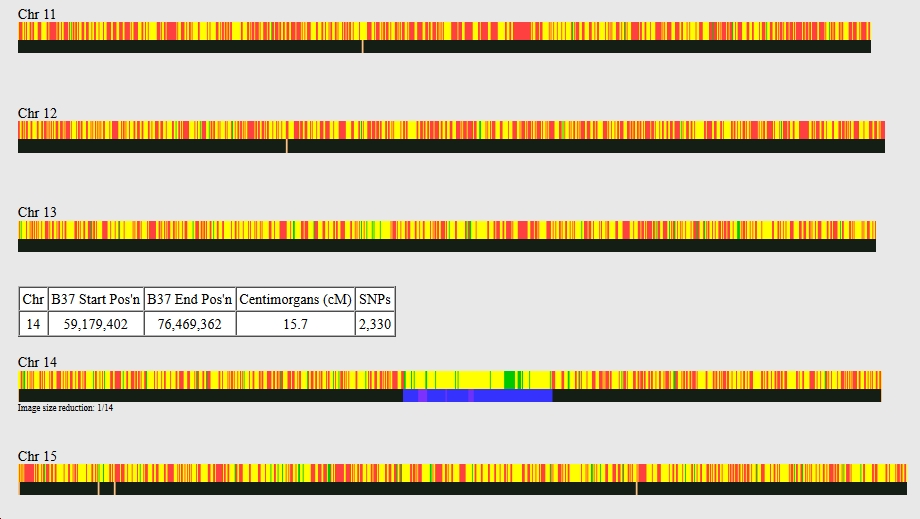
What you’ll get on the next page is a chromosome browser showing exactly where you and this person match.  For every chromosome with a matching segment you’ll also see a little box, showing start and end position of the segment and number of centimorgans (cM).  The image below shows just part of one of my match comparisons – Chromosomes 11 to 15.  As you can see, this person and I have a matching segment on Chromosome 14.

Screen grab from GEDmatch showing part of a One to One comparison in the chromosome browser

If you’re painting to DNA Painter, as described in my last post, this text in the little box is the information you need to paste to ‘paint’ the segments.  If you match on more than one chromosome you can go back to the input form and change ‘Graphics and Positions’ to ‘Position’ only.  This will remove the chromosome browser from the results and simply provide you with several little boxes of information that you can then copy all in one go.

Now, keeping those same two kit numbers, return to the home page and click on:

People who match both, or 1 of 2 kits
Again, enter your own number for kit 1 and your match’s for kit 2.
What you get this time is three lists:

  • people who match BOTH of you
  • people who match just you
  • people who match just kit 2, and not you.

It’s the list of people matching both of you that’s most obviously helpful.  If you can already place any of these shared matches this may help you to narrow down the part of your tree where you and this person have common ancestors.  However, thinking back to my previous post on chromosome browsers, matching a third person does not necessarily mean you all ‘triangulate’.  Certainly you share a common ancestor with each one, but it’s possible that the common ancestor they share with each other might be on a different line, not related to you at all.

If you’ve read my previous DNA posts or if you’ve already been using MyHeritage, you’ll see that this basic package of tools on GEDmatch is not dissimilar to the tools on there.  The One-to Many comparison equates to the MyHeritage DNA match list; The One-to-One autosomal comparison equates to MyHeritage’s chromosome browser; and the People who match both, or 1 of 2 kits roughly equates to the shared matches you see when you click to Review any of your matches.  The advantage of GEDmatch is that there is no fee to use these tools.  There is also the availability of the more powerful ‘Tier 1′ tools when you want to make use of them.  MyHeritage, on the other hand, combines all of their tools with availability of matches’ trees that you can compare with your own.  Plus they have the triangulation tool discussed two posts back.  In terms of enjoyment of use I would have to say I prefer MyHeritage’s DNA offering above all others, but GEDmatch is a powerful additional tool in your DNA toolkit, not least because not everyone has tested with/ uploaded their data to MyHeritage, and because of the availability of the Tier 1 when you feel ready to move on.

*****

My DNA posts are intended as a beginners’ guide, building up the information in order, in bite-sized chunks.  Click [here] to see them all in the order of publication.

DNA Painter

This is the second in my 3-part mini-series about using chromosome browsers in genetic genealogy.  You’ll find links to all my previous DNA posts [here].

My last post introduced chromosome browsers.  We looked at how to interpret the data revealed in the browser, how to use it for One-to-One or One-to-Many comparisons, and the importance of using this information in conjunction with documented trees.  We talked about the weakness of chromosome browsers, being that they are unable to distinguish between DNA from your maternal line and that from your paternal line.  MyHeritage have partly got round this by introducing a ‘Triangulation Tool’ which operates when using the chromosome browser in One-to-Many mode, highlighting when the matches being compared ‘triangulate’ – that is, when you and all the matches being compared are all descended from a common ancestor. 

What MyHeritage cannot tell you is which of your lines – maternal or paternal – this match is on.  You have to work that out yourself.  One other obvious issue – and this is by no means a weakness on the part of MyHeritage, but it is a drawback anyway – you can only use the Triangulation Tool on MyHeritage to compare segment data with people whose autosomal DNA was either tested with or has since been uploaded to MyHeritage.

DNA Painter is a third-party tool that helps you overcome these two difficulties.  It was created by Jonny Perl in 2017 and has gone from strength to strength.  It’s free to use provided you create only one profile.  If you want more than one profile, or if you want to use the advanced tools there is a charge.  I have seven profiles.

I cannot express enough how fantastic DNA Painter is.  For me, it’s right up there with seeing the Aurora Borealis.  I know that may sound excessive, but it’s true.

Briefly, the way DNA Painter works is this: when you’re comparing your DNA with another person’s using a chromosome browser you can download the segment data.  This data – whether it be from MyHeritage, FTDNA, 23andMe or GEDmatch – can then be uploaded to DNA Painter and ‘painted’ on your profile. Unlike a chromosome browser, DNA Painter has two lines for every chromosome – a paternal line and a maternal line so you can start to separate out your matches.  If you know which of your lines these segments are on – say, if you are painting a match with your maternal first cousin so you know this is on your maternal line – you can include this information, and these segments will be painted to your maternal copy of those chromosomes.

Blaine T Bettinger’s excellent video showing how to use DNA Painter was all I needed to get me started.  He covers how to paint segments, how to edit them, and other features (although there are more now than when this video was made in 2017).  I watched it through once, then again in short bursts alongside ‘painting’ my first segments, and after that it was all plain sailing.

So without further ado I’m going to suggest you watch this video. (The automatic start point is not right at the beginning – you’ll need to wind it back.)

Blaine T Bettinger: Mapping your Chromosomes with DNA Painter:

Just to be clear – you can’t use DNA Painter if your results are just on Ancestry.  You have to be able to see your results in a chromosome browser.  So if you tested with Ancestry you need to upload your data from there to MyHeritage or FTDNA or GEDmatch before you can use DNA Painter.

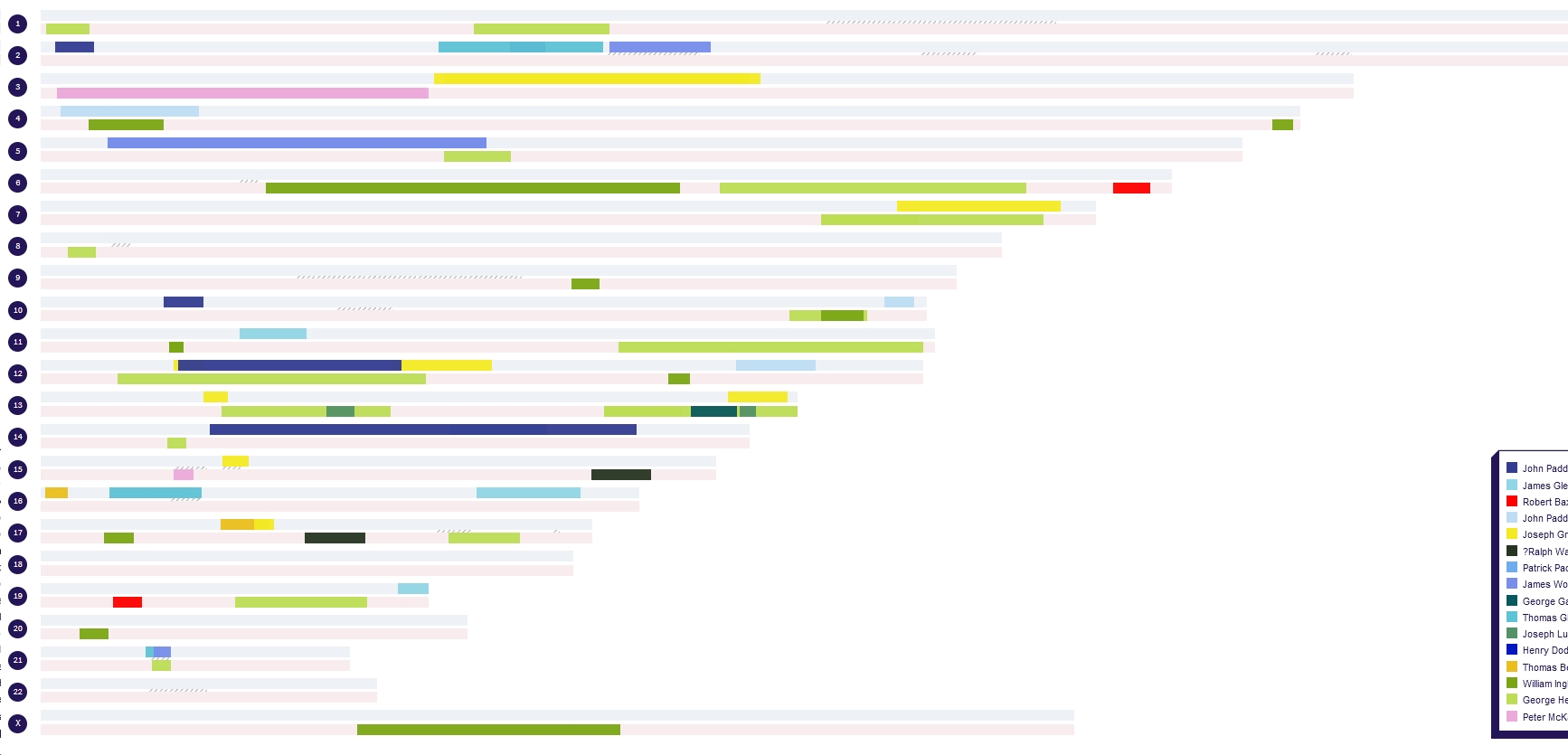
This is how my main profile on DNA Painter looks right now.  Click it to see a larger image:

Chromosome map from DNA Painter

The pale blue lines in the background represent the copy of each chromosome that I got from my father and the pale pink lines are for the copy I got from my mother.  By the time I found DNA Painter I had already confirmed a number of my matches on GEDmatch and MyHeritage. These were the ones I painted straight away. As these were known and confirmed matches I already knew our Most Recent Common Ancestor couple (MRCA) and I knew if the match sat on my maternal line or my paternal line so was able to paste them accordingly.  These known matches set the scene for anything else I paint.

More recently I allocated specific colours to each of my grandparents.  My paternal grandfather is shades of blue and my paternal grandmother yellow.  My maternal grandfather is green and my maternal grandmother red. You can see this on my profile: the blue and yellow shades are always on my paternal line, the green and red shades always on my maternal line.

Apart from my brother (he’s not on here; I made a separate profile for him) I have no matches at all closer than second cousin, so the nearest MRCAs for whom I have confirmed matches are at great grandparent level.  In my colour scheme the closer ancestors have a pale version of their allotted colour, and the further back generations have increasingly darker shades of that colour.  Again on my profile, look at the maternal line on chromosome 13.  You’ll see two long lines representing my great grandparents, and within them several shorter segments of darker green.  These darker segments are ancestors further back along these great grandparents’ lines whose DNA I’ve discovered because of matches with more distant cousins.  In fact these more distant matches have evidenced that the first long green segment on chromosome 13 is from my great grandfather, while the second long green segment is from his wife, my great grandmother. 

In every case I record the MRCA couple when I ‘paint’ the match, and these are shown in the table at the bottom right of the profile. 

If I have a segment already attributed to one of my copies of a chromosome – let’s say to my Dad’s paternal great grandparents and another match on that same segment comes along that seems to be from my Dad’s maternal line, then something is wrong.  While both of these relationships are consistent with my own paternal copy of that particular chromosome, it is not consistent with my Dad’s chromosome inheritance: one of these would be on his maternal copy and the other on his paternal.  He could not have passed on both of these copies to me on the same segment.

So – possibilities include:

  • I’ve made a mistake
  • My tree, or my match’s tree is wrong
  • There is a case of misattributed parentage (often referred to as an NPE – ‘non-paternity event’) somewhere along one of these lines in my own tree or my match’s tree
  • All of the above is absolutely in order but this person and I also match on my maternal line and that is where the segment is from
  • The segment is a piece of DNA belonging to a shared population group, such as Jewish or Irish

You make mistakes as you go but you can edit and change them very easily as new info comes in.

Here’s an example of a DNA match with a surprise and how I used DNA Painter to record it, changing my initial conclusions:

A and I matched at around 3rd to 4th cousin.  He was adopted but had found his birth mother and had an idea of who his father was.  Using my own tree and working back the tree of his suspected father I was able to confirm that we had MRCAs at 3xG grandparent level, making us 4th cousins.  The man A thought might be his father definitely was.  I added A to my list of confirmed matches and painted our segments to my profile.  Our match was on my paternal line, and painted yellow for my paternal grandmother’s ancestry.

After so many years of searching, A found it quite difficult to accept so easily that we had found his father, so I offered to work on three other close matches that triangulated with the two of us.  When A could see that other matches led to the same conclusion I thought he would be convinced.  The first two matches did indeed lead back to the same MRCA, and both of them were closer matches to A than they were to me – they are all descended from one of our 3xG grandparents’ sons, and I am descended from another.  A was happy: something shifted for him, and for the first time he really believed he knew his roots.  Then I moved on to the third of our common matches.  Starting with a small amount of information on this person’s online tree, I worked back until I found an overlap with A’s tree.  But it was confusing: A’s match with this person led up another of A’s lines – one that didn’t end with our confirmed 3xG grandparents.  It took a bit of working out (there was a lot of false information on census and marriage records and a nasty divorce) but eventually I was able to follow their common line… back to another set of my 2xG grandparents still on my paternal line, but this time my paternal grandfather.  A and I are cousins twice over: on both sides of my paternal line, both of these connections confirming different parts of A’s father’s line.  DNA Painter actually allowed me to record this information by keeping two of the segments yellow and changing the third segment we share to blue – it’s the pale blue segment you see on my paternal line towards the end of chromosome 12.  How amazing is that!

My main profile on DNA Painter is for confirmed matches only.  However, there are still a number of decent matches on MyHeritage, FTDNA and GEDmatch that I can’t place.  I didn’t want to lose sight of them, so I created a new profile for my mystery matches.  By comparing my mystery profile matches to other confirmed new matches from time to time, I’m able to narrow down our match, at the very least allocating some of them to either my paternal or maternal line or even moving them into my main profile.  More recently I decided to set up an Irish mystery matches profile which I hope in time will enable me to home in on distinct parishes or areas.

In the “Segment/Match Notes” I list how the match descends from the common ancestral couple, any relevant ID numbers, and anything else pertinent including other potential ancestral lines in common. This means that I list every generation beginning with the common ancestral couple and ending with the tester.

It occurs to me that chromosome mapping kind of turns it around so that it’s about mapping your DNA segments just as much as it is about proving your family tree.  I do know, though, that my chromosome map will never be complete.  My close family is too small.

******

It’s perfectly possible to make great DNA discoveries without even looking at a chromosome browser.  However, working with chromosome browsers and DNA Painter has done more than simply help me to sort out my matches.  It has helped me to visualise and better understand complex abstract information.  By viewing my matches in a chromosome browser I saw, for example, that the twenty-two chromosomes are all different lengths and numbered 1 to 22 broadly in that order of length.  I also saw and understood that the longer the segments, the closer the family connection.  Hence a lot of short segments indicates either that you are more distantly related, or you may simply share a lot of DNA as a result of being from an endogamous or close-knit community, going back centuries. I knew that the segments I was looking at came either from my mother or from my father, but it wasn’t until I started to use DNA Painter that I understand the maternal copy and paternal copy of each chromosome covers the full length of the chromosome.  Originally (because of the single grey line on the regular chromosome browser) I thought 50% of that line was from one parent and the other 50% from the other parent.

If you’re a visual person you too may find it easier and more enjoyable to work this way.  It is definitely more fun!

There is a DNA Painter User Group on Facebook with, at the time of writing, approaching 12,000 members, and there are very knowledgeable group members who will help with any questions. Jonny and Blaine are also on there.

*****

My DNA posts are intended as a beginners’ guide, building up the information in order, in bite-sized chunks.  Click [here] to see them all in the order of publication.

DNA: Chromosome mapping and chromosome browsers

This is the first part in the third and final ‘mini-series’ in my beginners’ guide to genetic genealogy.  You’ll find links to all the previous posts [here].

In this mini-series we’re moving on to something called ‘chromosome mapping’ and as an essential part of that we’ll be looking at my favourite tool: the chromosome browser.  We’ll focus on:

  • a definition of chromosome mapping
  • what a chromosome browser is
  • what it tells you about your match with another person
  • how we can use it to identify multiple matches who are descended from the same common ancestors
  • amount of shared DNA and length of segments as a guide to the closeness or remoteness of a match
  • ‘triangulation’
  • a case study illustrating how this can all work together

What do we mean by chromosome mapping?
When you have a number of confirmed DNA matches and you’ve identified Most Recent Common Ancestors (MRCA) for each of them, you have already started to allocate matches to different branches of your tree.  A second cousin, for example, becomes a ‘benchmark’ for more distant DNA matches along the same great grandparent line.  We can do this far more accurately if we can actually see the specific segments we share with that second cousin.  All these segments, we know, came to us (and to this second cousin) from that known set of great grandparents. If we now find a more distant match (say, a 4th cousin) on one or more of the same segments we can trace those specific segments back even further. Not only will this help to verify our documentary research going back to the next MRCA – likely to be around 3xG grandparents – but also we now know *which* of those previously identified great grandparents this specific segment of our DNA actually came from.  I find that very exciting.  However, before we can do any of this we need to be able to ‘see’ those segments, and for that we need a chromosome browser.

What is a chromosome browser?
Essentially, a chromosome browser is a visual representation of the parts of your DNA that you share with one or more other people.  It looks like a series of ‘stripes’ – one stripe for each of your twenty-two autosomal chromosomes.  If you tested with FTDNA or 23andMe there will be an additional stripe for the X chromosome.

The following is an example of one of my matches from MyHeritage.  I have removed name and contact details, but we’ll call this person A. 

Screen grab of DNA match information on My Heritage

The essential information provided here about my match with A on the general listing of all my matches is:

  • we share 155.4cM across eight segments
  • this equates to 2.2% of our autosomal DNA
  • the longest segment is 45.5cM
  • our estimated connection is ‘1st cousin twice removed – 2nd cousin once removed’

If I click on the pink ‘Review DNA Match’ button, I also see

  • a list of all the other people on the MyHeritage site who also match A and me
  • if A has a tree on MyHeritage I can look at that
  • lists of any surnames we have in common
  • a comparison of our ethnicities estimates
  • a chromosome browser representing our match

That’s a lot of information.

At its most basic level, the chromosome browser provides a graphical view of some of that information.  It doesn’t provide any surname or ethnicity data, but it does show exactly where, on your chromosomes, those shared segments are.

Below is that match with A as viewed in the chromosome browser.  The 22 grey lines represent me: my 22 autosomal chromosomes.  The segments where A and I match are those pink lines (segments) on chromosomes 1, 7, 11, 13, 17, 19 and 21.  Although you can’t see it on this screen grab image, if I hover my cursor over any of the pink segments while I’m on the MyHeritage website I can see exact locational information (start and end points).  I can also download all that information.

These segments are where A and I have inherited exactly the same DNA from the same ancestors.

Example of a chromosome browser (one to one)

Using the chromosome browser ‘One to Many’ function
A and I now have a lot of information about our match but although we know we’re fairly closely related we still can’t say which of our ancestors we both share. For that we need to look at our documented trees.  However, in this case, by a process of elimination of A’s close family members who have tested but don’t match me we have been able to conclude that we are connected on the one part of A’s tree about which nothing is known: a missing grandparent.  The chromosome browser may be able to help.

Using the ‘One to Many’ tool, we can use the chromosome browser to compare overlaps between our own DNA and that of several other people – up to seven matches all in one go at MyHeritage.  In the example below I’m looking at just two of my matches, comparing exactly where each of them matches me, and looking for any segments where all three of us match.  Again, the grey lines represent my 22 autosomal chromosomes.  The red segments show my match with A (you can see they are in exactly the same positions as in the above chart, although now they are coloured red).  The mustard segments are another person with whom we both match at a close level.  We’ll call that person B.

Example of a chromosome browser (one to many)

The chromosome browser here shows that I share more DNA with B (mustard) than I do with A (red), and the segments tend to be longer.  It also shows that I share lots of DNA with each of them that I don’t share with the other. However, there is one more very important piece of information: A, B and I all share exactly the same DNA in two positions: on chromosomes 7 and 13.  Taken as a whole this tells us:

  • All three of us are descended from the same fairly recent common ancestors.
  • Between the three of us, we have inherited different parts of the DNA of these common ancestors.  What we inherited has come down the line from them to us via our own parents and grandparents – and just to recap a key point from my post earlier this year (Asking other family members to test) siblings (in this instance our respective grandparents) inherit a lot of the same DNA but not exactly the same – which explains why A, B and I don’t all have exactly the same autosomal DNA from those ancestors
  • I am more closely related to B than I am to A
  • Since I have previously placed B as my second cousin I already know which set of great grandparents are our Most Recent Common Ancestors (MRCA).  Those two 3-way shared segments are proof that A is also descended from these same common ancestors.  As a result A now has a name for that missing grandparent
  • Also as a result, I now know that all those segments coloured red and mustard on my maternal line have come to me from that particular set of great grandparents

Triangulation
What we have just seen at chromsomes 7 and 13 is an example of triangulation.  To fully understand what this means, we need to understand a key point about chromosome browsers.  The chromosome browser represents each chromosome as a single grey line, but that one grey line belies that fact that we get two copies of each chromosome: one from our mother and one from our father.  The chromosome browser cannot tell these maternal and paternal lines apart.  Therefore when you look at a match on a chromosome browser the segments on those grey lines could be maternal or paternal.  They could even (more unusually) be a mix of both if your match is related to you via your maternal and your paternal lines.  We have to find some way of working out which.

If you’re working on MyHeritage the Triangulation tool helps with this.  It tells you if two or more people match with you at a given segment on the same copy of the same chromosome.  In other words – either on your maternal side or on your paternal side.  It still doesn’t tell you which side that is, but if you can work it out for at least one of the matches using your documented tree, then you know that this is also where the other ‘triangulated’ person matches you.

You can see how the triangulation tool works in the example above: there is a little box around the overlapping segments at chromosomes 7 and 13.  This is MyHeritage’s way of saying that these two segments of DNA shared by A, B and me are indeed on the same copy, and we are therefore descended from the same line.  A, B and I triangulate.

Segment length and amount of shared DNA as a guide to remoteness of the match
Obviously, these great grandparents from whom A, B and I inherited all these DNA segments, they too inherited their DNA from their own parents, and those parents from their parents, and back through time. Since we all inherit 50% of our autosomal DNA from our mother and the other 50% from our father, when my mother was born she recombined all of this DNA from the line we share with A and B with a whole new set of DNA from her other parent, and then I did the same.  This means that DNA shared with closer matches (and inherited from closer ancestors) tends to have longer segments: there have been fewer recombinations.  By contrast, shared segments with more distant matches have undergone more recombinations  – the DNA is mixed up with that of far more other ancestors – and so segments tend to be shorter.  Hence, alongside the total amount of shared DNA, we can also use segment length as a guide to closeness or remoteness of a match.

Once we have identified the MRCA (or MRCA couple) from whom we inherited a decent amount of autosomal DNA (as I did above with A and B) we can use that information to try to place other people who match us more remotely on any of the same segments.

Consequently, attributing a segment to one ancestral couple is not the end of the story because they got it from someone else – or rather one of them did.  Therefore when we use new, more distant, DNA cousin matches to take that segment (or part of it) back further, we can work out which of the closer ancestral couple it came from, and which of their ancestors they (and we!) got it from.

A more remote example – a work in progress!
The final image, below, shows another One-to-Many chromosome browser example.  This time the red lines are B (who was mustard in the last example) and the new person (mustard segments) is C.  You can see here that I share far fewer segments with C, and that the segments are shorter.  We actually share 31.9cM, and the longest segment is 17.4cM.  Using all the information outlined above, we can say that my match with C is more remote than my match with B.  Our estimated relationship is given as ‘3rd to 5th cousin’, suggesting MRCAs at 2xG grandparent to 4xG grandparent.  Importantly though, MyHeritage’s triangulation tool (the box on chromosome 11) tells me that this match with C is further back along that same line that I share with B.  If I can find where C and I connect I will know exactly which more distant ancestors these mustard-coloured segments of my DNA come from.  But of course, beyond that set of great grandparents that I share with B there are four GG grandparents, eight 3xG grandparents, sixteen 4xG grandparents, and so on.  Our MRCA could be any one of them.

So this one is still a work in progress.  By making contact with C, I was able to use the same triangulation process (with one of his closer cousins) to determine which of C’s great grandparent lines we match on.  So we know which of *his* great grandparents and also which of *my* great grandparents, but so far analysis and further building of his tree has drawn a blank.

Example of a chromosome browser (one to many)

I have reason to suspect that these short segments have come to me from an Irish 3xG grandmother along this line, precise origins unknown, but this is not my common ancestor with C.  If I can find an Irish connection along the relevant part of C’s tree, or indeed if I can find a definite Irish lineage for one or more additional people who triangulate with B, C and me along this line, then I may even be able to place this Irish 3xG grandmother’s origins in a specific part of Ireland.  I have some ideas for how to progress this, and if they work I’ll write about them in a future post.

In my next post I’ll be continuing this theme by looking at DNA Painter, a third-party tool that helps with the organisation of segment information.

*****

My DNA posts are intended as a beginners’ guide, building up the information in order, in bite-sized chunks.  Click [here] to see them all in the order of publication.

DNA: Proactive strategies for engaging with your match list

Today’s post is the last in my three-part mini-series on practical ways to make the most of your DNA results.  The first post, concentrating on what you can do right away, aimed to encourage you to get to know the layout of your testing company’s site and what resources there are attached to your DNA results.  The second looked at ThruLines (Ancestry) and Theory of Family Relativity (MyHeritage).  Throughout, the importance of constant reference to your family trees is emphasised.  DNA works alongside the genealogy; it doesn’t replace it.

Those first two posts focused on using the information being offered to you on a plate and trying to relate it to your own research.  In this third post it’s time to get more proactive.  Perhaps there’s a gap in your tree or a brick wall, and you want to see if you can use DNA to solve it.  Or perhaps there’s a mystery match of a decent size and you want to find where this person connects with you on your tree.  In other words, you’re now coming to the DNA with a question.

Before going any further I’m going to tell you about the limitations of my own DNA testing capability.  I have no surviving parents, grandparents, aunts, uncles or cousins, and only one brother.  Already this means I’m depending on second cousins testing.  Now as it happens I do have an unusually large number of second cousins.  One great aunt alone was the matriarch of eleven children and about 48 grandchildren.  But although I’ve had contact with some, I’ve never met any of them and certainly couldn’t approach any to ask if they would oblige by spitting into a tube for DNA testing purposes to serve my whim.  You’d think that out of so many second cousins some of them might have taken a DNA test anyway.  Well yes, I know of three.  I make good use of the results of two of them, but the other’s results are private.

Whenever I read books or blogposts from respected DNA authorities I’m in awe of the number of family members for whom they have DNA results.  It’s plain that some buy DNA tests in bulk when they’re on offer and simply dole them out to family members, all of whom willingly oblige.  Add into this mix the fact that DNA testing is far more popular in the US than it is in Europe, and you might start to get an idea of the gap between the kind of results these DNA gurus work with and the paltry results available to me.  Apart from my brother and the two second cousins, my closest matches are at 3rd cousin once removed distance and then we’re down to 4th cousins and a lot of matches in the 30-40cM range.

What all of the above means is that I have to work a lot harder to get answers from my DNA.  It also means that with perseverence, it is possible.  This genuinely is a case where if I can do it, so can you.  In fact chances are your matchlist will be stronger than mine.

So with all that in mind, here are some proactive ways you can engage with the information available on your match list and in the attached trees, and use this to confirm your research and/or break down brick walls.

Filtering
You can use the filter bar at the top of your match list to home in on focused information.

At Ancestry you can home in on unviewed matches; matches with common ancestors; matches with public / private / linked / unlinked trees; people you have already messaged, added to a group or made notes for; you can filter by relationship or shared cM; by date of test; and you can search for matches by name or with specific surnames or specific birthplaces in their trees:

Ancestry's DNA matchlist filter bar

MyHeritage allows you to filter by tree details (Theory of Family Relativity; Smart Matches; shared surname or birthplace; has a tree); by proximity of relationship; by country and ethnicity.  You can also sort by segment information, full name, and in recent order of testing.  And you can search by name or ancestral surname:

My Heritage filter bar for DNA matches

I’ve had some success using surname filters to find a common ancestral line, and also using birthplace filters to try to home in on a likely geographical area within Northern Ireland for an ancestral line with records suggesting two conflicting places of origin

Building trees
If you have a decent match that you don’t recognise and they have the beginnings of a tree attached to their results, you can try working their tree back yourself.  What you consider a ‘decent’ match will very much depend on how many close or extended family members you have on your matchlist.  You may, for example, consider that anything less than 80cM isn’t worth your time.  I will do it for much lower matches.

By way of example of what is possible.  I’ve done this, and found my connection with:

  • A 73cM match with only seven surnames (no first names) on the tree.  Our connection is 3C1R
  • A 55cM match with only the name of my match and the name of the person managing the DNA test, who was her son to, work with. Our connection is 4C1R.
  • A 53cM match with six entries on a tree – two of them private, one ‘unknown’, one with only a first name (which was not entirely correct), and two who were known by names other than the ones given at birth (!)  Our connection is 4C.

It isn’t always possible, but it often is.

If you want more ideas on how to progress these ‘Quick & Dirty’ trees, the following video (18:58 mins) might help get you started: Blaine Bettinger: Building Quick & Dirty Trees to Identify Genetic Matches

Remember that if you have close matches and both your trees are well-developed but you can’t find your common ancestors, then either your tree or your match’s tree is wrong, doesn’t go back far enough or sufficiently wide (siblings, half siblings, etc) OR you have uncovered a misattributed parentage in one of your trees. See my previous post about unexpected test results.  I have also started to look wider in my own tree building, bringing more lines forward in the hope of ‘meeting’ ancestors of distant cousins who haven’t yet been able to find their way further back.

Clustering
‘Clustering’ is the term used for grouping your DNA matches into groups using the ‘Shared Matches’ tool.  The idea is that the resulting ‘clusters’ will represent the distinct lines of your own family tree.  Clustering was developed  in 2018 by Dana Leeds.  Her technique, which became known as ‘The Leeds Method‘ uses a spreadsheet and you can read all about it on her website.

In 2019 MyHeritage introduced an Autocluster tool, based on the same principles, but saving a lot of time by generating the clusters for you at the click of a button.

Since then Ancestry have introduced a colour grouping facility to their match list and a system has been developed for using these as a clustering tool.  You can see this in operation in the following video: Larry Jones: How to Cluster your DNA matches With Ancestry’s New DNA Matches

The idea is that, by pointing to a common ancestral line, clustering narrows down where you have to look for your connection to these matches.  You can then focus on each of these family ‘clusters’ as a whole – look for connections in trees, perhaps even build one ‘Quick and Dirty’ tree for each cluster rather than a separate one for each mystery match you want to explore.

A problem I have with all of these clustering techniques is that I don’t have enough close matches to be able to set the systems up.  Dana Leeds bases her method on first cousin matches.  Larry Jones’s system on Ancestry is based on second cousin matches.  I don’t even really get going until 3rd and 4th cousin matches.  Nevertheless, I do run the Autoclusters report on MyHeritage from time to time, and I do make use of the colour groupings on Ancestry.  I have eight colours: one for each great grandparent, and I add matches to these groups either when I have a confirmed match or when, based on shared matches, a connection looks likely.

Asking family members to test
Back in July I wrote about how our family members’ test results can help us in our research. In that post I wrote about the different ways our various family members’ DNA can help us to isolate the branches of our tree.  If you’re lucky enough to have relatives who will take a test for you, that post will help you work out who to ask.

Chromosome mapping
If you tested with 23andMe or if you tested / uploaded your DNA results to MyHeritage, FTDNA or GEDmatch, you’ll be able to view your matches in a chromosome browser.  This takes us into a whole new range of possibilities for working with our DNA, and I have another little mini-series of posts about this planned for the spring of 2021.

*****

My aim for this mini-series of posts about practical application of your DNA results has been to provide sufficient basic information to enable you to start to work with your DNA and then to be able to ask informed, focused questions as you need to.  And trust me – you WILL need to!  I hope you’ve found it helpful.

*****

Note
My posts about DNA are aimed at complete beginners and aim to provide information in manageable chunks, each post building on previous ones. Click [here] to read all of them in order, or to dip in and out as you wish. You’ll also find lots of resources, useful links and book recommendations.

‘ThruLines’ and ‘Theory of Family Relativity’

For DNA testers who have attached a decent sized family tree to their test results, Ancestry and MyHeritage have tools that trawl through your matches to find common ancestors.

On Ancestry this tool is called ThruLines and it’s one of the three options on the main page when you enter the DNA part of your Ancestry site.  Click the green ‘Explore ThruLines’ tab, and you’ll find all your known direct ancestors up to and including 5xG grandparent.  Hover your curser over the ancestor to see if there are any matches and click on the ancestor to review the matches and decide for yourself if they are valid.

On MyHeritage the equivalent tool is called Theory of Family Relativity.  You’ll find them as they occur on your DNA match list, alongside those matches for whom ‘theories’ have been generated.  Just click the ‘Theory’ alert and review what’s being suggested.  Alternatively, you can use the filter bar at the top of your match list to see only matches for whom there is a ‘Theory’.  You’ll find it in the menu if you click on ‘All tree details’.

My Heritage filter bar for DNA matches

All you need to make use of these two tools is a well padded-out tree, and to have that tree linked to your DNA results.  You can have several sets of DNA results linked to the one tree and they will all work with ThruLines and Theories of Family Relativity.

In both cases – Ancestry and MyHeritage – the suggestions are based on your tree and your match’s tree.  They draw upon these and on other trees and records in their database to suggest how you may be related to your DNA matches through common ancestors. Hence although they will only show up if you and the other person are a DNA match, they are based on the genealogy, not the genetics.

These suggestions can be really helpful.  They are, however, ‘theories’, ‘suggestions’, ‘hints’.  We must review them and confirm (or otherwise) for ourselves. In this sense they are not dissimilar to the hints that pop up on our trees.

A ThruLines success!
Here’s a very recent (yesterday!) example from ThruLines that enabled me to break down a long-standing brick wall.  George Gamble is my 4xG grandfather.  He married my 4xG grandmother (Hannah) in 1790, when she was 20 years old.  I assumed he would be about the same age and was looking for a baptism between around 1760 and 1770.  When this ThruLine suggestion first popped up on my screen each of the two columns was headed by a different George Gamble – mine with an estimated birth year of 1765 and the one on the left with a birth year of 1749.  It didn’t make any sense, but I thought maybe the two Georges might be cousins, and this might lead me to my George’s father, so I clicked on the ‘other’ George.

That George was married to Susanna, but I noticed that they stopped having children in 1789 – the year before my George married Hannah.  Might Susanna have died in that year, perhaps in childbirth?  I checked for a burial for a Susanna Gamble, and there it was – about 14 weeks after the last birth – possibly milk fever?  I then checked all the occupation references for this other George.  He was a clothier – the same as my George.  The 1790 marriage entry for my 4xG grandparents refers to ‘George Gamble of this parish, clothier, and Hannah Brook of this parish, spinster’, but makes no reference to George’s own widowed marital status.  This was, however, undoubtedly the same person.  My 3xG grandmother Betty was from George’s second family, with Hannah; Phebe was from his first marriage to Susanna.  I amended George’s birth year to 1749, added in his first wife and children, and was able to take his line back another two generations.  Thrulines updates every 24 hours, and so today this new version of the chart has appeared: one George at the top of both lines, with a birth year of 1749.

Chart showing an example from Ancestry's ThruLines

The green entries on this ThruLines chart are significant.  My DNA match here has only fifteen people in her tree, and Ancestry’s system drew upon other trees to insert the connecting generations.

In the example above you’ll note that I didn’t just accept the suggestion.  I dug around, clarified, verified and decided for myself that this was a genuine connection.  In fact, being a ‘half 4th cousin 2x removed’, this match and I share very little DNA – only 8 centiMorgans.  With such a low match I would never have explored our connection without this nudge from Thrulines, and yet this chart enabled me to break down a decade-long brick wall.

Having said all that, in the interests of balance I will also say that the suggestions offered up by Thrulines and the Theory of Family Relativity are not always correct.

There are several reasons why this might be so.

‘Potential ancestors’ based on others’ trees may be wrong
As we have seen in the above example, if you or your match have a gap in your tree – for example if your line ends at a brick wall, or if your line goes back several generations further than your match’s, ThruLines actually fills in gaps. If these suggested ancestors are correct this can be a huge help, but they are not always correct.

One of my early posts on this blog was about the advantages and pitfalls of using public online trees.  A key point in that post was that just because it’s on someone else’s tree doesn’t make it right.  However, the way the algorithms work is that they go with the majority.  Your tree may be beautifully researched and documented and may be absolutely correct, but if six people have copied the wrong research it is that which will show up as the way to go.

Here’s an example.
In every census, my 3xG grandfather Joseph Groves gives an age consistent with a birth year of 1816 together with a birthplace of ‘London, Middlesex’. On his marriage certificate he gives his father’s name and occupation as ‘William Groves, gunsmith’.  However, there are no local ties to help me to navigate back to William, because as a young man Joseph leaves London, spends twenty years in the West Midlands and then relocates to Yorkshire.

An 1817 baptism record in Lambeth looked promising, and although the father’s name is Joseph rather than William it was worth following through.  However, this Joseph (the son) is still in London in 1841, by which time my Joseph has moved on to Staffordshire.  In any case, this part of London, south of the river, was referred to as ‘London, Surrey’, rather than Middlesex.  This is not my ancestor.

Despite this, and even though I have named my Joseph’s father as William, ThruLines persists in offering up Lambeth Joseph’s mother (Susannah) as my 4xG grandmother.  Note again, that because it’s a suggestion, Susannah’s thumbnail is green.  Clicking through and looking at the trees on which this suggestion is based I see a completely different family for Susannah and her son, Lambeth Joseph.  There is no doubt that this is not my Joseph and Susanna is not my 4xG grandmother.

Ancestry's ThruLines thumbnail example

You and your match may be distant cousins on more than one line
One of my DNA matches and I have two fairly close ancestral connections.  We are 4th cousins along my paternal grandmother’s line and 3rd cousins once removed along my paternal grandfather’s line.  I found the second link by accident when I was working on a third person we both link to.  There is no way ThruLines could have worked this out.  Its job is to trawl until it finds a match – one match.

This matters because we might look at other fairly close shared matches and assume that our match is along the same line.  It’s also particularly important if you start to use a chromosome browser – which I will cover in a future post.  Chromosome browsers enable you to use known segments as a basis for placing other unknown segments, so it really matters that you have attributed a segment to the right ancestors.  In this case, working with the chromosome browser, I have since been able to work out which segments shared with my double cousin belong to which line.

In case you think this is a rare scenario – it isn’t.  I have at least three more examples just like this in my tree.

You or your match may have made a mistake in your research We all make mistakes, and it’s important to be open to that possibility and to review if things aren’t looking right.

There may be an unknown misattributed parentage in one of your lines
Since the hints are based on trees rather than on analysis of segments the fact that two testers share DNA does nevertheless mean they are related elsewhere.

*****

I hope this little run through ThruLines and Theory of Family Relativity has demonstrated to you their obvious benefits.  All we have to remember is to use them as suggestions and to work through it and decide for ourselves if it’s real.

This video from Devon Noel Lee at Family History Fanatics might help to consolidate some of the above information for you.

*****

My posts about DNA are aimed at complete beginners and aim to provide information in manageable chunks, each post building on previous ones. Click [here] to read all of them in order, or to dip in and out as you wish. You’ll also find lots of resources and useful links