Ancestral Tourism 4: Houses & Business Premises

This is part four in my ‘Ancestral Tourism’ series. It follows on from Part 1: Churches and Churchyards, Part 2: Municipal & other Public Cemeteries and Part 3: Graves and Gravestones. The focus in this little series is on planning ahead so that you can spend the time when you’re there exploring, wandering, taking photographs and soaking up the vibes of the place.

In this post we’re looking at preparing for visiting former ancestral homes and business premises that are still standing. Trying to locate buildings no longer in existence will be covered in a future post.

Before you go

How do we know where our ancestors lived?
A range of documents may include the specific address or property name, or other clues as to the location of a former home or business of our ancestors. Examples are:

  • Church records, such as Baptism, Marriage, Burial and maybe wider parish records
  • Civil Registration: Birth, Marriage and Death Certificates
  • Census records
  • Correspondence between the person and an official body, sometimes found in archives, e.g. National Archives
  • Directories
  • Electoral Rolls
  • Family business records
  • Family documents, including letters and perhaps a family bible or other religious text
  • Immigration and Naturalisation documents
  • Military Records, including attestations and next of kin
  • Newspaper reports
  • Poll Books
  • Probate Records, Wills, etc
  • Property and Land records, including deeds, local tax, etc
  • Public and Municipal Cemetery registers
  • School records

It’s certainly easier to track our more recent ancestors.
For earlier generations, even where we find an abode in the examples above, often an exact ‘address’ was not used. A street name without house number, or for smaller places even just the name of the village or hamlet may be the closest we’ll get. During the second half of the 19th century we find more documents that include information to guide us to a specific property. Earlier this year I visited Kinver in Staffordshire, where my 2x great grandfather and some of his siblings were born. The image below shows the extent of Kinver now, as viewed from the churchyard high on a hill above the village. The main High Street, dating from medieval times, is clearly seen in the image. Most of the properties beyond that are more recent. ‘Somewhere in this photo’ is the closest I will ever get to knowing where my ancestors lived here – but I’m happy with that.

Kinver viewed from the church. © Janice Heppenstall

Beware! House names and even house numbers can change
Even when documents do bear a house number or name, these may have changed – particularly if there was much additional building in the twentieth century. I researched the history of a house built around 1837 in what is now a built-up area of the Isle of Wight. The house number is 21, and my clients had already done some research into the nineteenth century inhabitants of ‘number 21’. However, using maps and other documentation I found that the house became number 21 only in the early twentieth century. For the first eighty or so years it was number 3. The change had become necessary to accommodate new building over the previous decades.

Similarly, a few years ago, I visited York to see my family’s properties there. Census records had my 4xG grandparents at 58 Stonegate. I found the property and photographed it, but afterwards realised Stonegate had been renumbered. Eventually I worked out that their shop (and the floors above above, where they lived) had been this well-known corner plot, below, that was later taken over by Banks & Sons. I had been sitting right opposite this shop (in Betty’s tearoom, for those who know!) without knowing it was my ancestral home. It took a lot of research to work this out. But this is what happens when we don’t do our homework before we set off! Now I have to go back to York to step inside this lovely shop. Luckily, visiting York is never a chore.
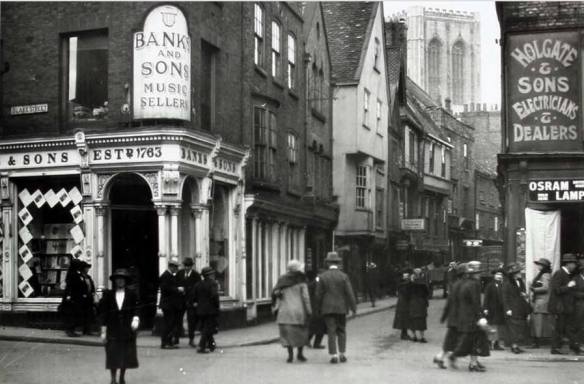
An early twentieth century scene from York, showing part of Stonegate and featuring the corner shop at that time occuped by Banks and Sons Music Sellers. York Minster is visible in the background
Junction of Stonegate with St Helen’s Square, York. Image in public domain, photographer unknown.

Changes in house name can be even more difficult to work with, particularly if several houses on the street seem to have changed name, and possibly more houses may have been built between the original ones.

So how can we be sure we have the right house?
Here are some ideas.

Photographs
If you’re lucky you may have an old family photo of the house. Even photos of people standing outside a property may provide visual clues in the form of distinctive architectural features. You can then use Google Street View to ‘walk’ along the road to find the property, if it’s still there.

Family and Local History groups on Facebook are also extremely useful for identifying the exact location of a photograph. I once witnessed someone posting an ancestral holiday snap and asking if anyone knew where in the world it could be. Within fifteen minutes it was identified as beneath a specific lamp post in a named piazza in Rome!

It’s also worth exploring whether there’s a website with old photos of your area of interest. The best one I know is Leodis, a photographic archive with over 62,000 images of Leeds, managed by the Local and Family History team at Leeds Libraries. I have found many old images of houses my ancestors lived in on there – in streets that now no longer exist. If you know of such a website for any of your areas of interest, please do share in a comment.

Maps
Mention has already been made of Google Street View. Modern day maps – including Google and other online maps – can be scrutinised alongside historic maps. My go-to place for online Ordnance Survey maps is here: https://maps.nls.uk/os/ I’ve written before about their Side-by-Side maps, but there are many other features. Something you could do is find a detailed historic map (the 25 inches to one mile series if possible) on the nls site, and see if you can compare the shapes of buildings then to existing buildings on satellite view now.

‘Walking the route’ with the census enumerator
With no photos and only documents to go on, it may be possible, using modern and contemporary maps, to ‘follow the route’ of a census enumerator. Using landmarks and occurences of smaller streets, you may be able to find the house, or at the very least to work out its general whereabouts, even if it’s not possible to narrow it down to a specific property.

Getting to know the neighbours
Using census returns for the street where your ancestors lived, it might be possible to track any changes in housenames or numbers of specific families whose occupation spans two or more decades. If the Jones family live at number 42, the Smiths at 44 and the Browns at 46, and then ten years later the same three families are at 58, 60 and 62, it is more likely that the numbering has changed than that all three families relocated together further along the same street. You can do the same thing far more accurately by consulting Electoral Registers. In the example above of my clients’ house starting out as Number 3 and eventually becoming Number 21, I could see from the Electoral Registers that this change happened in 1931. However, Electoral Registers are often not accessible online, meaning this may be something you could do only when you arrive in the area. Local archives and central libraries will usually have these registers.

What if your family’s presence predates the census?
Below is part of Starbotton, in Upper Wharfedale, where my period of interest, before 1750, predates the census. Before going I ‘walked the route’ using Google ‘Map View’ on one device and ‘Street View’ on another to be sure to cover the whole village. By the time I visited, last summer, I knew this small village like the back of my hand. However, I had no idea which house had been owned by my 8x great grandparents and later their son, my 7x great grandfather. Apart from church records and similar, indicating that the family lived in ‘Starbotton’, I was very lucky to come across a collection of property reports made over the years by the Yorkshire Vernacular Buildings Study Group. These, in turn, drew upon other property documentation at the County Record Office. I was able to identify several specific houses formerly owned by my wider ancestral family in Starbotton, and to pay special attention to them when I visited. I never did find out where my 7x and 8x grandparents lived, though, and it’s possible their house may no longer be standing. However, I can name the late seventeenth century inhabitants of around half of the properties, and I know that most of mine lived in the part of the village pictured below.
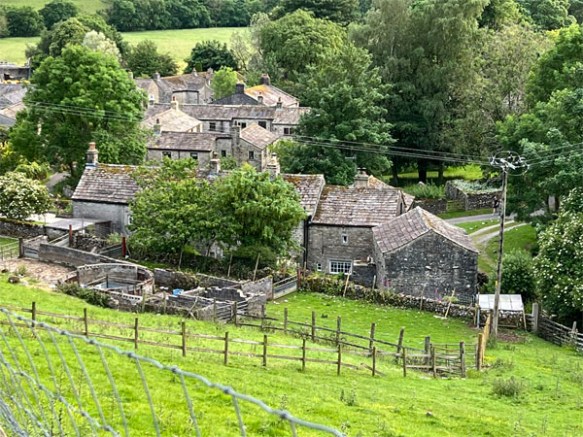
A rural village scene with seventeenth century stone houses surrounded by hills and trees
Part of Starbotton, Upper Wharfedale, Yorkshire. © Janice Heppenstall

When you arrive

If the occupants were in the garden I would probably chat to them, tell them about my connection and ask permission to photograph the house from the street. If they wanted to know more about who lived there I would tell them. If they were not there I’d take the photos anyway. Just taking a few photos, wandering up and down the street, touching the wall… I find all these things bring me closer to my ancestors who lived there.

If your ancestors had a shop or public house, if the school they attended is now a business centre, or if for some other reason their former home or premises are open to the public, it would be lovely to step inside and spend a little time there.

I also enjoy seeing historic buildings and landmarks that my ancestors would have known, and just getting a feel for the area and the local history. You can do this even if the house they lived in is no longer there.

Depending on the size of the place you’re visiting, and its historic importance or embracing of tourism, you might be able to pre-book a tour with an accredited guide.

If you can’t get there

It really does make a difference going there, but if that’s not possible, just doing the research outlined above will leave you knowing a great deal more about your ancestral homes and the localities they lived in. You can also take a screen shot of your ancestral properties using Google Street View, and of course connect with online and local groups to find out more and see if anyone has any photos.

*****

If you have other ideas please do leave a comment.
Ancestral Tourism 2: Public & Municipal Cemeteries

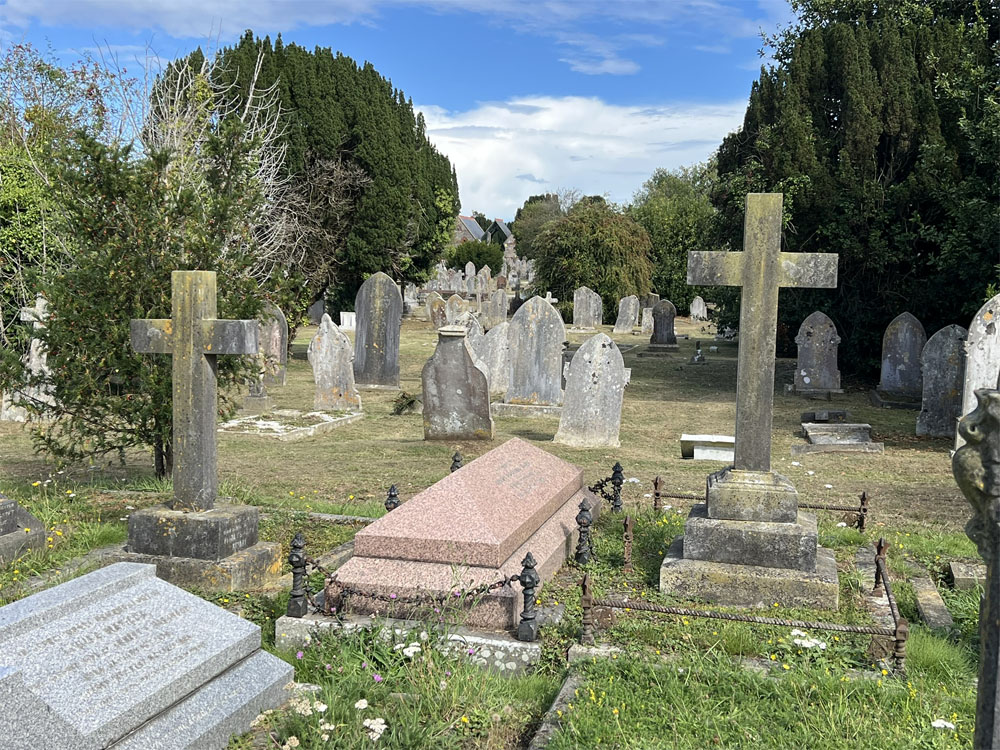
Ryde Cemetery, Isle of Wight. © Janice Heppenstall

This follows on from my last post: Ancestral Tourism 1: Churches and Churchyards. It focuses on locating and visiting graves of our ancestors whose final resting place is in one of the large municipal or other public cemeteries in our towns and cities rather than in a church graveyard.

First, a bit of history

The emergence of large public cemeteries is an interesting part of our social history, connecting with several other developments of the nineteenth century that will be familiar to local and family historians. The migrations and population booms of the eighteenth and nineteenth centuries created not only a lack of housing for the living but also of burial grounds for the dead – and all the more so in the growing industrial towns and cities. The historic churchyard burial grounds posed problems on several fronts: they were generally small, overcrowded, often laid out in a haphazard manner; and as knowledge of hygiene and sanitation developed, there were concerns about the spread of disease, particularly since in towns and cities these small burial grounds were generally alongside the church and surrounded by closely packed housing.

The initial response to this problem was to turn to the private sector. Throughout the 1820s and 1830s a number of ‘garden cemeteries’ were established to serve big industrial towns, including Manchester, Liverpool, Birmingham, Leeds, Sheffield, Newcastle and later, London. These cemeteries were private commercial ventures set up under individual Acts of Parliament. They were large, well-planned spaces, often designed by the same architects and landscape designers who created public parks. Some of these garden cemeteries may be well-known to us. They include Highgate in London, Undercliffe in Bradford and Arnos Vale in Bristol.

Some of the early cemeteries were developed by and for Nonconformists. As outlined in my last post, the general practice was for Nonconformists to be buried in the parish churchyard and the service officiated by the Anglican vicar. Many prominent philanthropic capitalists were Nonconformists, and by this time were able to use their wealth and influence to bring about changes including, here, the freedom to bury their dead and conduct services according to their own beliefs and traditions. Well-known Nonconformist cemeteries include Chorlton Row Cemetery in Manchester, which opened in 1821, Low Hill Cemetery in Liverpool, opened 1825, and Woodhouse Cemetery in Leeds, 1835. It is interesting to note that it was around the same time that the State removed control of recording births (or rather baptisms), marriages and deaths (or rather burials) from the Church of England and placed that responsibility with a new General Register Office: the introduction of Civil BMDs in 1837.

Generally speaking, though, these cemeteries were money-making enterprises, serving the upper and middle classes. There was no increase in provision for the labouring classes. The response from some local authorities was to develop more cemeteries but funded by public money. Early examples are St Bartholomew’s Cemetery in Exeter, which opened in 1837, Beckett Street and Hunslet Cemeteries in Leeds, both opened 1845, and Southampton Old Cemetery, 1846. This was the beginning of the Municipal Cemeteries – publicly funded, and owned/ managed by the local corporation.

The Metropolitan Burial Act of 1852, and other Acts of Parliament that followed, empowered local authorities to establish public cemeteries and close previous overcrowded burial grounds. The new cemeteries would have uniform hygiene standards and procedures for burial, would cater for all social levels, including some lower cost options for decent burials, and would offer burial options with dedicated areas for people of all religious affiliations. Half of any new cemetery was to remain unconsecrated, allowing for burials without the Church of England service. Later, in 1879, the The Public Health (Interments) Act made it a duty of local health authorities to provide cemeteries if local conditions required it.

Historic England have produced a List of Registered Cemeteries, arranged in date order. Information is provided for each, including design, designer, whether private or municipal, and important or interesting features.

There is also a nationwide map published by the Institute of Cemetery and Crematorium Management which includes every cemetery and crematorium in the land. I’ve checked out all the ones I know and they are all present and correct.

Since there is a similarity in records of these different types of public cemetery, the following notes about how to plan for your visit is intended to cover all of them. There are in any case differences from one cemetery to another, regardless of how they came into being.

Planning your visit

Allow plenty of time for this – there is a lot of research and planning to do!

Locating the records

  • Needless to say, the first thing you need is to know the cemetery in which your ancestor is buried. We’ll start by looking at who holds the records, moving on to which of them might be online.
  • Since Municipal Cemeteries are managed by the local authority, it is they who hold the records for these cemeteries. Often, this team is known as ‘Cemeteries and Crematoria’, or ‘Cems and Crems’ for short. You can find them online by using either of these phrases as search terms and adding the name of your town or city of interest.
  • Some local authorities offer a look-up service. For example, Leeds Cems and Crems provide a list of all cemeteries, together with opening date. They require the name of the deceased, the date of burial and the cemetery, and will ‘check the records and if the information is correct […] let you know the grave number and section or where in the grounds the cremated remains were strewn.’ Some Cems and Crems teams charge for this service; others do not.
  • Some local authorities have databases available online so you can check for yourself. For example, Birmingham Cems and Crems have separate online searchable databases for each of their twelve cemeteries.
  • Privately owned cemeteries keep their own records. Information can be accessed via their websites. For example, at the time of writing, Highgate Cemetery charges £40 for a search. However, they also state that copies of all their records are free to consult at Camden Local Studies and Archives Centre.
  • That said, digital images of the records of some cemeteries are available online. You might find records from your cemetery of interest on your genealogy subscription website; or try looking on FamilySearch. From the home page navigate to Search > Images > insert the name of your place of interest and then select the appropriate era from the drop-down list. From here, you will have to scroll through to see if the records you need are included, and if they are, you will need to browse through the images of the records. Knowing the death date or at least month of death will speed things up. I found all the records from York’s Fulford Cemetery on here – and they are excellent!
  • Transcripts of the records of your cemetery of interest may have been included on FindAGrave (free to use). I have found on there most of my ancestors and their families who were buried in a municipal cemetery, but it is primarily run by volunteers so is inevitably a work in progress.
  • There is also DeceasedOnline, which helps burial authorities and crematoria to convert their register records, maps and photographs into digital form and bring them together into a central searchable collection. There is a fee to see the individual records, and I have not used this website, but it is there as an option should you wish to use it.
  • Locating a Map of the Cemetery

    The cemetery records will hold certain essential information about your ancestor: name, address, date of burial, occupation. There may be more information, but this little lot will enable you to identify the person and be sure it’s your ancestor. There will be one other very important piece of information: the number of the grave or plot where your ancestor is buried.

    Armed with this, what you need now is a map. And on this point it’s a question of digging about online. Here are some places to look:

    • The cemetery’s own website, if they have one. Example: York’s Fulford Cemetery provide section maps on their website.
    • Local authority Cems & Crems may have pages for each of their cemeteries, possibly including maps. Example: Isle of Wight have plot maps of all their cemeteries available for download, for a fee.
    • A lot of the cemeteries have ‘Friends’, and these often have a website with maps. Examples: Friends of Beckett Street Cemetery have an astonishingly good series of online tools to help you locate and navigate your way to your ancestor’s plot. These include locations of plots, numbers and names of occupants in each, whether there is a monument or gravestone, and whether this has been photographed. A different approach is taken at Friends of Southampton Old Cemetery. They provide assistance in locating graves and request a small donation towards their conservation work. Some ‘Friends’ groups have even carried out research into the lives of those buried in the cemetery.
    • Local history or heritage groups may have websites with maps. One the best set of static maps I have found to date is for Ryde Cemetery by Ryde Social Heritage Group. Every plot is shown with the names of the occupants.
    • The local Family History Society may have mapped the cemetery. Example: Isle of Wight.
    • There may be a site map at the cemetery itself, but you will need to know this in advance to avoid disappointment.

Going alone or with a companion
In the course of researching this post I have located every one of my ancestors and all of their children buried in Municipal and Public Cemeteries. Armed with this information, including details of family plots, plus a better understanding of the significance of each of the cemeteries, I feel sufficiently well-informed to be able to make a decision as to whether to inflict a visit to any of them on my nearest, dearest, yet genealogically disinterested. Based on this, I consider one cemetery in Leeds with a single family plot of interest to be acceptable, and another in York with just three relevant family plots. The rest have far too many plots that I would need to visit; and although one – Beckett Street Cemetery in Leeds – may be acceptable on grounds of social history, I simply couldn’t put anyone else through the monotony of locating and visiting the number of graves. Definitely, these will have to be solitary trips for me.

Part of the problem leading to this decision is that although the nineteenth century cemeteries were intended as public landscapes, and are of great historic and heritage value, lack of funding means that many of them have now become neglected. It is here that ‘Friends of’ the individual cemeteries provide a valuable service, carrying out conservation and environmental work and delivering ecological benefits – but not every cemetery has a Friends group, and some are less active than others.

You might find that the ‘Friends of’ your cemetery of interest provide tours from time to time. It might be possible to arrange your visit to coincide with that, then stay on afterwards to visit your family’s graves. Interesting for you and they will appreciate the income.

If you can’t go

There is so much information to be found online. By doing the research outlined above, making full use of online material and even, where possible, via the ‘Friends of’ website, FindAGrave or a Facebook page, requesting a photo. You can also search online for images of the cemetery. Adding “wikimedia commons” to your search term will return a selection of images that are free to use provided you credit the photographer.

Be forewarned though that the inscription on images is not always legible. This could be because of sunlight conditions on the day, severe weathering over time, or possibly just because of the quality of the image when reduced for web use. The following wonderfully clear image is from FindAGrave, but some of the images of my family’s gravestones cannot be read at all.

Image © Rachel79; source: FindAGrave

*****

I hope this has given you some ideas for how to plan for a visit to a Municipal or Public Cemetery. Researching it has certainly focused my mind and I’ve found it fascinating. So fascinating, in fact, that I will be slotting in an extra couple of posts about cemeteries before progressing to finding about former homes and business premises of our ancestors in the post after that. 🙂

Recording place names

In March I wrote about the additional layers to ‘geography’ that genealogists and historians have to be aware of. Today’s post builds on that, looking at how we might record information about places on our family trees in a way that makes sense not only for the logical flow of information about a person’s life, but also to the algorithms of any website we’re using to build our family tree.

The following are my own thoughts on this. How you choose to record places on your own tree is a matter for personal preference. My ideas are also based on personal experience of what works best when working with my online tree at Ancestry.co.uk. but the issues that inform this are not restricted to the Ancestry website, so if you have an online tree somewhere else some of the issues might be the same, others quite different.  The point is to develop a system that works for you, based on good practice but also one that the particular website’s search engine understands.

On Ancestry, there are two ways of adding new information/ ‘event’s to our tree. The first is by following Hints, by a Search from that profile page, or by starting a Search from the top menu bar. The second is when we enter new life events that we’ve located from different sources. Although we’re more likely to move onto this method as we progress, we’ll start here by looking at this first, because it’s here that we really need to think about what information the different ‘fields’, including specifically here, the Location field, are asking for.

Entering ‘Location’ information on a new life event

There are all kinds of reasons why you might be entering information yourself, rather than linking from information offered up to you by the website. Here are some examples:

  • You went to a cemetery and found a gravestone with dates and additional family members
  • You’re entering information from a family Bible, or from original Birth/ Marriage/ Death certificates or other special documents or artefacts handed down within your family
  • You found information on another website: genealogy website, Family History Society, newspaper archive, etc
  • You went to the local Record Office and found a record that relates to your ancestors, such as a Settlement Hearing

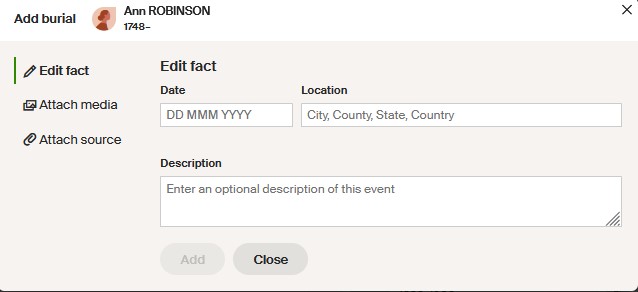
On Ancestry, to enter this kind of information, we click Add above the list of Life Events on the person’s profile page. A pop-up box appears: Add fact or event, with a list of life events to choose from, or you can make your own ‘Custom Event’.

Now we must fill in all the fields ourselves. Having to do this really makes us think about what the issues are, and why this may not be as straightforward as it might seem. Remember that in this post we’re just thinking about the Location.

In the pop-up box above, the words ‘City, County, State, Country’ is our hint as to how to arrange our place name. Of course, that’s based on the USA rather than UK, where we don’t have separate ‘states’.

Write place names as they are on the record, not what would be correct today
For example, today, Brighton is in East Sussex, but historically was in Sussex.  We should input the county as it is on the record, which before 1974 would have been Sussex.  Similarly, Gisburn was in the West Riding of Yorkshire, but since 1974 has been in Lancashire, so a 1980 birth should be recorded in Lancashire; a birth in the same house in 1970 would be recorded as Yorkshire.  Some of the newer counties didn’t even exist when the record was created.  For example, Wolverhampton, now in the ‘West Midlands’, was formerly in Staffordshire.

The further back we go, there may be even more archaic county names, for example, the Isle of Wight was in ‘the County of Southampton’. These ancient counties don’t work with Ancestry. I always record this as ‘Hampshire’, but would use the description box (see image above) to record that ‘the County of Southampton’ was given on the record.

Use official place descriptions, not ‘the way we referred to it in our family’
When I was little I used to write to my great uncle who lived in a village called Methley, about ten miles from Leeds.  My mother showed me how to write the address as ‘Methley, nr. Leeds, Yorkshire’. When I started my family tree it seemed important to me to preserve this memory, so I wrote ‘Methley, nr. Leeds, Yorkshire’ for the location of that great uncle.  This was my family history, after all! I also referenced every incidence of the main church in Leeds as ‘Leeds Parish Church’, that being how it was referred to locally. Sadly, algorithms don’t understand our happy memories! We can still include this information, but put it in the little box for ‘description of this event’ rather than in the ‘Location’ field.

When entering residence, limit this to the place, not the actual street address
If you include the full address in the location, forever more when you write the place name, Ancestry will offer up every single address you’ve ever written in that location for you to select. Below, here’s what happens every time I write ‘Hunslet’. You can still write the full address if that’s the way you want to do it, but it’s better to put it in the Description box linked to the event. 

Recording church names for baptisms, marriages and burials
One of my ancestors was baptised at St Leonard’s church in Bilston, Staffordshire. If I write this information in the Location box on Ancestry, this could be confused with the town called St Leonards, which is in East Sussex. Similarly, St Helen’s church could be confused with the town of that name in Merseyside; St David’s after the Welsh city, and so on. For this reason I always put the placename first, then the church: Bilston, St Leonard, Staffordshire, England. Usually, I only include the church name when recording religious rites that took place within the church.

Recording the historic parish name in cities of multiple parishes
There is an important exception to the last sentence in my above ‘rule’. In larger historic towns and cities that developed around the 11th Century there tended to be many small parishes within the walls, and since the Anglican parish was also the administrative unit for secular administration, it’s useful to record this parish information for all events. I wrote about this previously, using Norwich as an example. There, prior to the introduction of Civil Births, Marriages and Deaths in 1837, I would record a birthplace and place of death like this: ‘Norwich, St Martin at Oak, Norfolk, England’. It is true and accurate, and it gives us additional information about where, precisely, in Norwich, the event occurred. The same applies for London, Winchester, York, and other historic towns.

When recording the Registration District doesn’t tell the true story
Since 1837, Civil Births, Marriages and Deaths are recorded within Registration Districts. You’ll find a list of every single Registration District (RD) that has existed since then on the UKBMD website [here]. Often, these make perfect sense. For example, a birth between 1837 and 1998 in the Wiltshire town of Devizes will have been registered in the RD of Devizes. However, as the UKBMD page for the Devizes RD shows, many other settlements in the area came within its boundaries. So if your ancestor was baptised in Pewsey, 11 miles to the east of Devizes but registered in Devizes, what location do you record for the birth? What if you also know from subsequent censuses that your ancestor was in fact born in the village of Sharcott that lies within the ancient parish of Pewsey? Which one would you record as this person’s place of birth? This is what I would do:

  • Record the birth as the actual village if I know it, but also add the General Register Office reference in the description box. This includes the RD of Devizes. e.g. Name xxx; Mother’s Maiden Name xxx; GRO Reference: 1837 D Quarter in DEVIZES IN THE COUNTY OF WILTS Volume 08 Page 250
  • Record the baptism with the name of the parish church in Pewsey.

Remember to add county and country
As you can see from my ‘Hunslet’ example, above, I didn’t always do this when I was starting out, and am still plagued by the fact!

The problem with simply writing the town or city is that many places in the New World settled by British migrants were given the names of former hometowns of the settlers. See what happens when I just type ‘Portland’.

In future searches, the search engine doesn’t know if we mean Portland in Dorset or one of these other Portlands, and may offer up all kinds of unrelated records.

If, instead, we consistently record the county and country, it helps the search engine and also helps us to keep our research tidy, enabling us to see at a glance where the person was.

If you’re an old hand at this family history research, all this is nothing new to you – but if so, please do share any examples from your own research, showing how you dealt with an unusual location situation. If you’re fairly new to researching your own family tree, I’m guessing you never knew there could be so much to recording someone’s ‘location’!

Linking a new event after searching on Ancestry

Most of the above points apply to building your own tree, whatever application you’re using to record the information. Let’s move on now to how information gets added to our trees when we’ve done a search on the Ancestry website. If you’re using a different subscription website for your tree the process will be different but the same issues may apply.

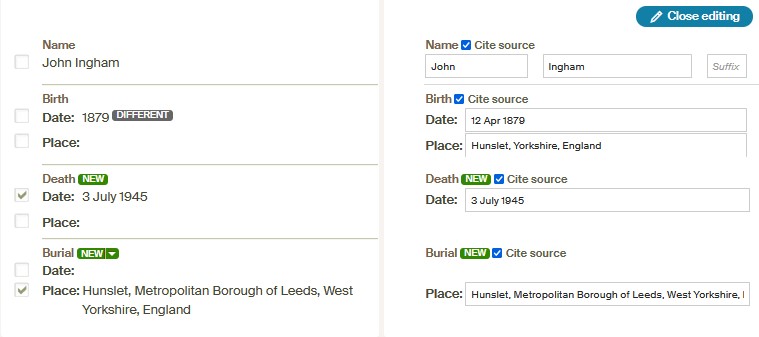
If we search for records from the person’s profile page, or by following a ‘Hint’, or by filling in details on the general search pages, when we find a record we want to add to our person’s profile page, the information fields will already be completed. This information is based on someone else’s transcription of the record, and how it was indexed. Here’s an example:

In this box information I already had, and new information, are separated out. Any differences between the two are highlighted. We can edit, accept or decline any changes to existing information. In the above example I decided to accept it as it is (although I can see a problem), and now, on this person’s profile page, if I click on the entry for his burial, I get a similar pop-up box as the one at the top of this post, but with some of the facts filled in – actually in this case, just the location:

The problem here is that the location for this record is not indexed in a way the Ancestry algorithms will understand. Hunslet is good. Leeds is sufficient without the ‘Metropolitan Borough of’ part (although I would not necessarily include ‘Leeds’). West Yorkshire did not exist in 1945; it is a county level authority that was created in 1974, so the county should just be ‘Yorkshire’. Although the country is the United Kingdom, since the law and administrative arrangements are different in Scotland and Northern Ireland, in ancestry research we usually just refer to England, Northern Ireland, Scotland or Wales, therefore the country here is England (which you can’t see because of the length of the location information) and is correct on this record. For me, this location should simply be ‘Hunslet, Yorkshire, England’, or ‘Hunslet, Leeds, Yorkshire, England’, and that is how I would amend it.

Yorkshire ‘Ridings’
Some of the old Yorkshire records include the ‘Riding’ in the indexing.  Unfortunately, Ancestry cannot cope with this at all. If we leave it in, the record entry will forever default to Riding in Northumberland – a place I cannot find on the map, but which has definitely caused me some problems over the years.  So my advice is to remove any reference to the Riding from old Yorkshire records.  If you want to include the Riding, do it in the ‘Description’ box attached to the Event.

Be vigilant!

The lesson here is that just because information is presented to you in a certain way, does not mean it is correct, and does not even mean it is algorithm-friendly on that website! If we have our own sense of what is needed for recording the location – what we personally would like, and what we have come to understand the website requires – we can record information more consistently, more correctly and in a manner that makes future Hints and Searches more effective.

I hope you’ve found something useful in all this.

Geography for Genealogists

My knowledge of the geography of places where I do genealogy research has come on in leaps and bounds over the years of doing this, and I’m sure it will be the same for most of you too. There are places I’ve never even visited in real life, yet can visualise their location on the map, together with surrounding villages or parishes. When we come across a likely record in an unfamiliar place, we need to assess the probability of this being our person.  Finding the place is a village just two miles from the expected location adds weight to that possibility. It goes without saying that maps, old and new, become our friend, but I thought it would be interesting to think of how ‘geography for genealogists’ differs from the geographical needs of regular people just finding their way from A to B or planning to visit a new area.

Essentially, of course, we need to understand the geography not only as it is today, but also as it was at different periods through history. It’s almost as if we have to peel back the layers to get to the place as it was during our period of interest.

Knowing all the names that apply to a specific place
Historically, our towns and villages have been organised into different administrative levels. We need to know what these are – what they were called, the nature of the administrative level bearing that name, the historical period in which it operated, and why each one is sometimes the place-name used… but not always. It all boils down to different types of record and where they were created. These different types of places and administrative levels include:

  • County
  • Hundred / wapentake / rape
  • Town or village
  • District
  • Parish
  • Diocese
  • Civil Registration District
  • Poor Law Union
  • Manor
  • Another name grouping places together, such as ‘Upper Wharfedale’ or ‘Cinque Ports’, or in Yorkshire the three Ridings.

Some of these are more important as we progress our trees further back; others come into play in the nineteenth century.

I wrote about some of these different administrative levels in a couple of posts back in 2019, and how confusing it can be to find a death recorded in two apparently different places – the parish and the registration district – particularly when neither of these named places is the known abode of the deceased. When we understand the function of all these administrative levels, these apparent ‘discrepancies’ fall into place. Even so, if we’re working with a new, unfamiliar area, we’re likely to have a bit of researching to do before it will all fall into place.

Good sources of information around all this include:

  • The UKBMD website, useful for helping you work out which Registration District your place of interest was in.
  • GENUKI has listings and information about all parishes, arranged by county.
  • FamilySearch Maps enables you to search for the parish on a map, to see other place names within the parish, to locate it in amongst adjacent parishes, and to see what ‘jurisdictions’ it fell within before or as at 1851, including the county, Registration District, diocese, Poor Law Union and others.
  • You’ll find useful information on Wikipedia, for example a search for “high peak district wapentake” returned this page about Hundreds of Derbyshire.
  • Also try FamilySearch Research Wiki, which you can access via the home page → Search → Research Wiki, or you can access simply by Googling “FamilySearch” and the name of a place you’re interested in. Using both methods, I searched for “Staffordshire”, and from there navigated to the parish of Kinver, which has a good selection of historical/geographical information about that parish.
  • The Manorial Documents Register on the National Archives Discovery pages enables you to search for manors by name or within specific parishes.
  • In addition to any old maps you can find, the National Library of Scotland Side by Side maps can really help you to pinpoint and understand where a specific place used to be.
  • A Family History or Local History group’s website is likely to have other relevant information.
  • And of course your search engine of choice.

Historic accent and dialect
An additional feature of ‘genealogical geography’ is that in a time when many people could not read and write, and even before that when rules for spelling were not as established as they are now, place names were written as they sounded, or as the scribe heard them. It can take much poring over online maps to work out what a placename was meant to be, or what we would call it today. It’s easier if you’re familiar with the local accent or dialect. One that had me stumped for years was ‘Aul Court Somersetshire’, recorded as grandfather’s place of origin on a Dade style baptism register in York. If it hadn’t been for a friend who used to live in this long-elusive and mysterious place, I would still not know that this is a reference to the parish of Walcot, today part of Bath. It does give us a bit of extra information though, about the person who gave this place-name to the clerk. She spoke with a Somerset accent with which the York-based clerk was unfamiliar.

Variations in information given about places
Sometimes our ancestors gave different information about key places on different records. Often, we can explain this by distance – and the same would apply today. If I lived in Tedburn St Mary, about 5 miles west of Exeter, and I was talking to someone in Exeter, I would say I lived in Tedburn St Mary. If I moved to Norwich and was asked where I was from, I might say ‘Exeter’. In other circumstances I might say ‘The West Country of England’.

Map showing the area around Hopperton in North Yorkshire, including the villages of Coneythorpe, Cowthorpe, Great Ouseburn and Little Ouseburn.

It would have been just the same for our ancestors who migrated.

However, this doesn’t explain why a person I previously researched gave his place of origin variously as ‘Coneythorpe’, ‘Cowthorpe’, ‘Hopperton’, Ouseburn’ and ‘York’. Even if we accept York as the nearest big place and therefore more likely to be reported to a stranger, it still doesn’t explain why this person gave so many tiny places as his birthplace on different documents.

We have to be prepared to think out of the box!

Some places have disappeared
Sometimes the only geographical indication that a place ever existed is a lane bearing that name, and presumably once leading to it. The only modern day indication of a place of significance to one of my 6x great grandfathers is a Service Station bearing that name. On these occasions we may just have to take what we can and accept that our place of interest is ’round about here somewhere’.

Knowing the lay of the land
Going further back in time, knowledge of other geological features such as mountain ranges could be useful in indicating where networks are unlikely to extend. Conversely, historic places such as abbeys, and the trading routes once linked to them, or the land holdings of important families, might explain why people did turn up in unexpected places.

***

Some of the above, of course, applies equally to local history, while the nature of the records we use means that some of the challenges are more prevalent for family historians. I’m sure you’ll be able to think of examples of all this from your own research, and perhaps other aspects of geography that have extra layers when researching our family histories. If you do, please do tell us about it in a comment.

Witness names on marriage registers

One of my DNA cousins – now a good friend – was bridesmaid recently for her sister. The wedding was very low key – so low key in fact that my cousin’s first task was to wander around on the day to find a second person to witness the marriage. Astonishingly, the person she found was not only the doppelgänger for the bride’s daughter (who lives on the other side of the planet), but also had almost exactly the same surname as the maiden name of the bride and bridesmaid – just one letter out, and in fact the ‘usual’ spelling of that surname.

Of course, after wishing the bride and groom well and congratulating my cousin for an excellent job as bridesmaid, my pressing thoughts were for future generations who would see the photos and believe the witness was the daughter; then see the witness signature, become confused and finally assume she was another family member from the bride’s paternal line. Pity the genealogists of the future who will work back many versions of this ancestral line, certain they must have missed something, and starting again from scratch…!

It was the 1753 Marriage Act (also referred to as the Hardwicke Act, since it was promoted by the Lord Chancellor, Lord Hardwicke) that introduced, amongst other things, the requirement for at least two witnesses to be present at the marriage ceremony. From the year of the implementation of that Act in 1754 you’ll see the printed forms, three to a page, and including space for signatures of the bride, groom and witnesses. The later format, with two marriages to a page, commenced in July 1837.

The essential role of the witnesses was and remains to be present for the declarations and vows, and to witness the bride, groom and officiant signing the wedding certificate. Of course, back in 1754 the officiant was the parish priest. The only exceptions to this were for Jews and Quakers, who were allowed to conduct marriages in their own places of worship and with their own officants. Since 1837 there have been other possibilities.

As evidenced by the wedding of my distant cousin, it’s not necessary for the bride or groom to know the people acting as witnesses. They don’t require identification. The only requirements are that each witness can speak English sufficiently to understand the ceremony; and has the mental capacity to understand what’s taking place. However, even that is not set down in legislation.

So that’s the rules. Now let’s think about how we can use witnesses in our research. They are an often-overlooked piece of information; yet at the very least they can add colour to our knowledge of family, kinship and friendships. We’ll start with the more straightforward ideas and progress to more advanced levels of genealogy.

Recent generations: matching signatures to photos
Starting with more recent generations, this is when marriages had become something to celebrate, often with bigger, family affairs. Often it was the best man and maid of honour/ chief bridesmaid who were witnesses, although not necessarily. If we’re lucky we might have a photograph to put faces to the names, or if we know all the faces, to compare who seems to have what role in the photo and on the paperwork. Looking at my own parents’ marriage certificate (and the photos) I see my uncle and a friend of my mum’s who remained a lifelong friend of the family – I knew her well. As well as being witnesses and best man/ maid of honour, they would also go on to be two of the godparents for my older brother. For my paternal grandparents the witnesses are the bride’s brother (my great uncle) and a friend of the bride – again a name I recognise as being a lifelong friend of my grandmother, but she was not one of the bridesmaids. My maternal grandparents chose the bride’s sister and a name I don’t know, but presumably a friend of my granddad. In these situations there may be little ‘research’ to be done, but it’s interesting to see who they chose, and to compare with the photos.

Marriage Register example from the period 1754 to 1837. In this example one of the witnesses is a 'Regular', who signed a lot of the marriage entries of this period when the bride and groom arrived with only one witness.
Robert Hargraves is one of the ‘regular’ witnesses for this parish at this time. The other witness is presumably known to the couple and makes her mark.

Some witnesses are ‘regulars’
For older marriages, often siblings or parents are witnesses. However, sometimes, when you look through a marriage register, it becomes clear that one or even both of the witnesses was a ‘regular’, witnessing quite a few of the marriages. Once we realise that, we know we needn’t bother to try to research that person’s involvement with the family.

Why would the couple turn up for church with just one witness? Well, just like our modern day couple at the top of this post, what was important to them was the marriage contract. For our modern couple it was a personal affair and they were happy to keep it that way; for couples in the eighteenth or nineteenth centuries there simply wasn’t the tradition of big, showy weddings.

Sometimes, though, we can read between the lines and see a bigger reason.

Elopement
James and Annie Elizabeth married in 1866. Both gave their age as 18, but in truth Annie Elizabeth was not quite 15½. Although marriages under the age of 21 were legal, they could only take place with the express permission of the bride’s and/or groom’s parents. Presumably, neither James nor Annie Elizabeth had this parental permission. Effectively it was an elopement. The one witness they had for the ceremony was James’s older sister, Mary Elizabeth. The other was the parish ‘regular’ witness. We might understand that Mary Elizabeth thought eighteen was an acceptable age, and can only guess at how she might have responded if she knew Annie Elizabeth was only fifteen!

Comparing signatures
If you can access an image of the actual register present at the event you’ll see the actual signatures of the bridge, groom and witnesses. Even if some of the various parties couldn’t sign, they might have had their own quite unique mark. You then have an additional layer of evidence – an actual signature that you can compare with other documents where the same person has signed. By ‘actual register’ I mean a digital image of the one the parties actually signed. Clearly, this is not a transcript; but equally it is not the copy of a post-1837 Marriage Certificate you’ll get from the General Register Office: they are contemporary copies of the original. Parish Registers are often available online via subscription website or at the Record Office on microfilm. If your ancestors married at the Register Office you would need to speak to the local Registrar’s Office to find out what they have.

For older marriages, often witnesses were siblings or parents
Here’s an example of this from a piece of research I’m currently working on. There are two women with the same surname. Sarah is the focus of the research. We have the 1815 baptism and therefore parents’ names of Margaret, but not for Sarah. Both sisters will go on to baptise their children into the Methodist tradition. However, the local Methodist registers commence the year before Margaret’s baptism but after the year consistent with Sarah’s age on the censuses. If we can prove that Sarah and Margaret are sisters, then we will have Sarah’s parents. There are several pieces of information that suggest familial ties. These include Margaret’s mother’s name, which also is Sarah; Methodism; the common place of worship; the physical proximity of Sarah after marriage, to Margaret and to Margaret’s father. However, the starting place for all this pondering, and perhaps the most important piece of the jigsaw is that Margaret was one of the witnesses to Sarah’s marriage, indicating a close connection of some kind, even if we don’t yet know for sure precisely what that connection is.

A witness who connects two generations
Benjamin was transported to Van Diemens Land in 1834, and died there in 1841. He was a widower when he was transported, and left behind two teenage boys: James and Samuel,. Documents created upon arrival in Hobart indicate that he was very worried about their well-being. Following through on the boys, I found a possible marriage for James – although he was only seventeen at the time. It was one of the witness signatures that reassured me that this was the right James. John Marshall, who had witnessed Benjamin’s marriage eighteen years earlier, was now witnessing Benjamin’s son James’s marriage. This also suggests, perhaps, that John Marshall kept a watchful eye on the boys after their father’s departure.

So these are some of the ways we can make use of witness names and signatures. If you’re at an early stage in your genealogy research, I hope you’ll now take note of these names whenever you find a marriage. They could be important somewhere down the line! If you’re at a more advanced stage… do you have any examples to share of how witnesses have helped progress your research? If so, please let us know in the comments.

Do you need to buy the Civil BMDs?

Civil Registration of Births, Marriages and Deaths (BMDs), together with the districts, offices and officers required for the administration of the new system, was introduced on 1st July 1837. In theory, these life events of any ancestor or family member born after that date, or if they’re older, marrying or dying after that date, should have been notified to the appropriate local office and recorded by the state. That said, registration was not actually mandatory until 1875, and in the early years there was confusion. People were used to registering births (or baptisms), marriages and deaths (or burials) with the church, and it took a while for some to realise they now needed to register at a government office. However, certainly by 1875 everyone should have been registered using the appropriate channels, and the civil BMDs are an invaluable resource for anyone researching their family history.

But does that mean we *need* them? Let me explain my thoughts.
As genealogists we start with what we know and we work backwards. The period leading back to 1837 is the easier part, when we can compare and cross-reference family members listed on the censuses and the 1939 Register with the civil records of Births, Marriages and Deaths and probably Baptisms, Marriages and Burials within the parish church. Obviously, then, this is where we start as beginners, and where we make our mistakes. One thing I’ve noticed, over the years of seeing posts from inexperienced researchers online, is an assumption that it’s necessary to buy all the certificates. That’s a huge outlay. If we exclude ourselves and our parents but include all other direct ancestors born or still living after 1837, this could amount to 4 grandparents, 8 great grandparents, 16 GG grandparents and maybe 32 GGG grandparents. That’s 60 ancestors, each with perhaps a birth certificate, one or more marriages, and a death certificate… possibly as many as 150-190 certificates to buy at £11 each (or £7 if a PDF is available). That’s £1650 – £2090. If we wanted to add in the records for all children born to our direct line, the cost would be astronomical. Taking one of my grandparents as an example, I counted back all direct ancestors and children born to them after 1837: one hundred and eleven people. Times that by four to get a rough estimate for all my grandparents, and that would be four hundred and forty four people, all with births, deaths and maybe marriages. There’s no way I could have justified that outlay.

We need to work out alternative ways of getting the same, or most of the same, information. Our starting point, then, should be to know what information is on each historic certificate.

Civil Birth Certificate
This includes:

  • Registration District, Sub-district and official reference numbers
  • Where and when born
  • Name (if decided at time of registration)
  • Sex
  • Name and surname of father
  • Name, surname and maiden surname of mother
  • Occupation of father
  • Signature, description and residence of informant
  • When registered
  • Signature of registrar
  • Any name registered after registration

Civil Marriage Certificate
This includes:

  • Registration District, Sub-district and official reference numbers
  • Where solemnized
  • When married
  • Name and surname of bride and groom
  • Age of both
  • Marital condition at time of marriage (bachelor, spinster, widowed)
  • Rank or Profession of both
  • Residence of both at the time of marriage
  • Father’s Name and Surname of both, together with fathers’ Rank or Profession

Civil Death Certificate
This includes:

  • Registration District, Sub-district and official reference numbers
  • When and where died
  • Name and surname
  • Sex
  • Age
  • Occupation
  • Cause of death
  • Signature, description and residence of informant
  • When registered
  • Signature of registrar

Do we need all this information? Is it available anywhere else?
As a beginner I realised that my primary need was to move my research back in time, while ensuring I had the right people… alongside the need not to bankrupt myself! Therefore at that stage I could dispense with cause of death, for example, but I did need to know the parents’ names to help me move backwards and ensure I had the correct people. So here are a few examples of certificates I did buy, and others I didn’t, on the basis that I could get the information I needed from other documents, and other information was not yet essential to my needs.

Church of England marriage registers – the information on these is exactly the same as on the civil marriage certificate. If digital images of the original CofE parish register is available online via your genealogy website of choice, then you don’t need to buy. In fact, the parish register entry is better, because you will definitely see the couple’s signatures (or marks), and signatures could be used later for comparison with other documents. The only civil marriage certificates I have ever bought are those from Catholic churches (which unfortunately are still not widely available other than via the actual parish administrator or occasionally via local record offices), another that was solemnised in a Nonconformist chapel, and one other marriage for which I could find no digital images of the parish register available online.

Births – If you know the mother’s maiden name and if you have census returns showing all children of the family and their places of birth, you will probably be able to find all the births on the GRO Online indexes. You may also find some additional children who never made it to a census. The online index doesn’t give the actual date of birth; rather it gives the ‘quarter’ in which the birth was registered: M quarter being the three months ending March, J quarter being the three months ending June, and so on. As a beginner this may be sufficient for your needs, particularly for siblings of your ancestor. That said, you may find the additional information elsewhere. The 1939 Register includes the actual date of birth (for some reason it is often a year out, but the day and month are correct). You may also find more information on a baptism register entry: along with child’s name and date of baptism there will be both parents’ names, abode, father’s occupation and possibly the date of birth. A newspaper announcement of a birth will also give some of this information. In these early stages, where I did buy a birth certificate, this was to solve a puzzle. I bought one before the mother’s maiden name was included on the online index and I couldn’t find a marriage using only the father’s surname. (I still have never found the marriage.) Another was purchased because there was some intrigue surrounding the child’s actual birth parents (by the age of five he was informally adopted by another couple). Another, again, because of the inaccessibility of Catholic parish registers, and so on. If I could find almost all the information by other means that was acceptable.

Deaths – again, you can often narrow down the death to within a few months using the GRO Online indexes. Alongside the quarter and the registration district, the inclusion of age at death can help you to distinguish between deaths of other people of the same name – although we do need to allow for a little flexibility since the age is provided by the informant who may have guessed it. After 1858, you might also find the actual date of death and other useful information from the National Probate Calendar (without the need to purchase the Will, although at only £2 for a digital download I would get the Will anyway). What I really love, though, is a good municipal cemetery register. For example, my 4xG grandmother’s entry in 1860 at the York Fulford Road Cemetery (freely available on FamilySearch) gives her name and age at death, date of death, date of burial, the name of her husband and his ‘rank, trade or profession’, their residence, cause of death, the name and details of the informant and the officiating minister. Why on earth would I need to buy the death certificate?! This is the best register I’ve ever come across, but others come fairly close in terms of information recorded.

Again, even in my early years, there were times when the information I could get from the GRO index and the burial record wasn’t enough. For example, the death of a small boy with the very unusual yet exact same name as someone else in my tree, but in a completely unexpected location could only be confirmed as my family by the purchase of the civil death certificate. His sad death at such an early age also gave me additional information about his parents – that they had spent a short period in the early years of their marriage in a different county.

More advanced reseachers are likely to have different needs
All of the above relates to the nuts and bolts of building our family trees back to the introduction of Civil BMDs. There is no doubt that the information on each of the certificates will give us something useful to enable us to do this, but given the cost of each one, the goal so far has been to try to find that information elsewhere, even to go without a little information at this stage if most of it can be found using other documents.

As we progress, our needs change. Research becomes less about the nuts and bolts and more about the ‘family history’, or the stories of our ancestors’ lives. I will never need to buy the death certificate for that 4x G grandmother, or any of my other ancestors and wider family in the York Fulford Road Cemetery, but on occasion I’ve bought certificates for other individuals simply out of curiosity about their story. For example, the husband of a great aunt whose service record indicated he suffered a ‘severe shell gas wound’ in 1918 and who was not remembered with much love by wider family members. I read that many of the men who survived mustard gas attacks went on to die of tuberculosis, generally before or around the time of the outbreak of WW2. I could see that this person died in 1935 and wondered if TB was the cause. It seemed to me part of his story, an explanation perhaps for his behaviour, and part of the wider story of my own grandparents. So this was one of the certificates I bought more recently. Another story that intrigued me was the death six months apart of two GG grandparents, resulting in the orphaning of their large family and my own great grandfather being brought up in the workhouse from the age of six. I bought their death certificates just to find the two causes of death. Conversely, I’ll shortly be visiting the archives where microfiche copies of the Catholic registers for lack of availability of which I’ve already bought civil certificates. From these registers, I’ll be hoping to get names of the sponsors, which may help to broaden out my understanding of any other family members that came with these ancestors to England.

There are of course other examples like these ones, where I’m prompted by completion of ‘the story’ to buy the certificates, but in general I’m still of the ‘keeping costs to a minimum’ mentality. If you’re fairly inexperienced as a family history researcher I hope this has helped give you some pointers. If you’re an old hand it would be interesting to know how this compares with your own practice. Have you any examples of nuggets found in a unexpected source? Or perhaps of how eventually buying a certificate solved a mystery or completed a story? Do leave a comment!

Decoding surname variations

A question often asked by less experienced genealogists relates to the spelling of surnames. ‘We spell our surname ‘Beecroft’ but in the 1841 census I can see a family looking like my ancestors, but it’s spelled ‘Beacroft.’ Or something along those lines.

More experienced genealogists know that such spelling variations are generally easily explained by the fact that our ancestors may not have been literate. Or perhaps they were not fully literate, and although they were able to spell their name they didn’t have the confidence to correct an official. Or even – and this definitely happened – the official just assumed they would be illiterate and left a space for our ancestor to make their mark. In any of these circumstances it was the official who decided how the surname should be written, and they wrote what they heard. Sometimes the resulting name is even further removed from what’s expected because of the informant’s accent. My 2x great grandfather’s first daughter was named ‘Anice’ after her maternal grandmother, but his first wife, although registering the birth in Leeds, had grown up in London. What the clerk at the Registrar’s Office heard was ‘Hinnis’, so that was how she was recorded. Since, obviously, I was working backwards in time, I hadn’t yet found the wife’s birth family, so it took a little while for me to work this out.

Then again, some surnames have changed over the years to become separate ‘branches’ of the root name. My surname, Heppenstall, originates in the small village of Heptonstall near Hebden Bridge in West Yorkshire. The transition to ‘Heppenstall’ is easily explained by the Yorkshire accent, but although the spelling of my branch has been settled since the early 19th century, there is still an entry for my great grandparents on one of the censuses for ‘Heptonstall’. My great grandfather knew how it should be written, but his ingrained mistrust of the authorities won over, so he left them to write it as they wished, threw in a false forename, and presumably had a chuckle at their expense. One hundred years later, at Beginner-Genealogist-Me’s expense too. Bless him…

So… to any less experienced genealogists reading this – look at the entire record. If all the forenames match, all the ages and places of birth look right, and the occupations are in keeping; and all that differs is the slight misspelling of the surname, then there’s a strong likelihood that this is the correct family.

But now we’re going to travel further back in time… to the years when spelling was very much down to who was doing the writing, the rules were not particularly fixed, even fewer people were literate, names could be written several ways even within one document, and the writing was quite different to what we’re used to. (Take a look at this Wikipedia entry about the spelling of William Shakespeare’s surname, and you’ll see that he is known to have signed his name at least four different ways.) Yes, we’re now well and truly in Advanced Genealogy territory…

I’ve recently been doing a lot of research about the Lucas family of Woodhouse in Leeds. Since around the second quarter of the eighteenth century the spelling of this surname has been fixed as ‘Lucas’.  Prior to this time, other spellings are also found.  In Leeds these include ‘Lukas’, ‘Lucus’, ‘Lukes’, etc. However, in nearby parishes there are other families with essentially the same name but recorded as ‘Lookes’, ‘Loukes’, ‘Lowkes’ and ‘Looks’. 

These are contemporary documents and differences are purely down to the spelling chosen by the clerk. As genealogists we have to accept this and go with the flow. However, when working with search engines and indexes it can be complicated further by mis-transcriptions. During this current research I came across ‘Luras’, ‘Lutas’ ‘Sucas’ ‘Levas’ and the mis-transcription of ‘Sykes’ as ‘Lucas’. These are all perfectly understandable, although they do indicate that the transcriber wasn’t fully familiar with seventeenth century handwriting styles.

More unexpected was the recording of the name as ‘Lukehouse’, ‘Lukhouse’ and ‘Luckhouse’. In fact, when I first came across this I thought it was unlikely to be my family and only pencilled it in. Gradually, more records with these spellings appeared, and although I didn’t really understand why, I was sure this was my family. It was a chance sighting of a Wikipedia entry that helped me make sense of it all. I was trying to identify the precise location of an area of Woodhouse known as Woodhouse Carr, and a Google search led me to the Woodhouse, Leeds Wikipedia page. The entry starts with information about the origin of the name ‘Woodhouse’, and then this: ‘Locals refer to it as Wudhus’.

Immediately it all made sense. My ancestors did not pronounce their name ‘Luke-house’, to rhyme with ‘Wood-house’.  Rather, the reverse was true.  In fact I do vaguely remember hearing that pronunciation when I was growing up; and it would have been all the more so in the seventeenth century.  Hence, a clerk, upon hearing a local pronunciation of ‘Lucas from Woodhouse’ as ‘Lucus from Wudhus’, might conclude that, like Woodhouse, the individual’s name should properly be recorded with the ending ‘-house’. Drawing further on all this, and the spelling of the first syllable as ‘Luck’, I now strongly suspect my ancestors pronounced their name ‘Luckus’. How wonderful to be able to ‘hear’ their accents through an entry in the baptism register!

So what does all this mean for us, searching for our ancestors? Here are my tips.

  1. Keep a list of all the spellings of this surname in records you’ve already identified.
  2. Take a look online at one of the surname alternative finders, where you enter a surname and see lots of variants. Variant Names on We Relate and Free BMD Search Names are useful. Admittedly some of the names returned will seem pretty unlikely, but at least you can then choose from a wide range of possibles.
  3. Since a name index is only as good as the transcriptions of surnames entered into it, use more than one website to search. If necessary I use Ancestry, FindMyPast, FreeBMD, FreeReg, FreeCen and FamilySearch. The last four in that list are free to use, and sometimes have given better transcriptions than the commercial sites. You may also find transcriptions made by local family history societies, and these are likely to be of good quality.
  4. Make sure you understand how to use each individual website’s search engine to achieve what you want. For example, Ancestry’s search engine treats most searches as ‘approximate’ unless you tell it to be more specific. So a search for ‘McKay’ will return records for ‘McCoy’, ‘McCay’, Mackay’, etc. However, at FindMyPast the search engine is far more focused. If you want surname variants, you have to tick a box to tell it that’s what you want.
  5. You may also be able to use wildcards, so ‘Sm?th’ will look for ‘Smith’ but also ‘Smyth’.
  6. Even with surname variants, you may feel the number of variations you’ve found for your surname of interest far exceed what could be expected of one pass of a search engine. With my Lucas research I might tick surname variations but then input ‘Lucas’, then ‘Lukas’, then ‘Luckhouse’ and then ‘Lukehouse’.
  7. And finally, if all that fails – there may be nothing for it but a line-by-line search of the register, being as broad in your approach as you think fit. Again, with my Lucas research, when doing line-by-line searches in the early 18th century and earlier I now consider pretty much any surname beginning with an ‘L’, having a ‘K’ sound in the middle and ending with an ‘S’ sound.

Changes to the Find A Will website

Oh my goodness! What have they done to the online GRO Find a Will service?!

I haven’t had reason to order a post-1858 Will for ages, so I didn’t know about the changes until I saw the video below. But before moving on to that, in case all this is new to you here’s a bit of introductory information about Wills.

Before 1858 Wills were dealt with by the Church courts – finding them can be a challenge because there was a whole hierarchy of courts; and where your ancestor’s Will was proved depended on where they lived, where they held land, the value of their estate and a number of other factors. That’s a topic for another post.

After 1858 Wills came under the jurisdiction of civil probate courts: one Principal Probate Registry, a number of local Probate Registries and a single, central index which is available online and is searchable. In other words, if your ancestor died in or after 1858 and had something to leave to their descendants, their Will or Administration papers will be much easier to find. These are the Wills we’re talking about here.

The central index is known as the National Probate Calendar. Often, seeing that will give you all the information you need. For example, the entry for my GG grandmother’s second husband provides his full name, his address, his occupation, the date of death, the regional Probate Registry where probate was granted, the names of two men to whom it was granted, and the value of his effects.

That’s a lot of information, and it may already fill some gaps for you. It will certainly enable you to narrow down the entries and be sure you have the right person. However, particularly when you’re at the fairly early stages of your research and trying to keep costs down, you may be happy just to leave it at that.

Before we move on, there are a couple of notes about these entries:
First, the National Probate Calendar arranges information according to the year probate was granted, not the year of death. This is particularly important to note because when you watch the video you’ll see the online search asks you for the year of death and limits the search to that one year. You can start with that, but always be prepared to move forwards a year (or maybe more) if the person you’re looking for doesn’t show. In my example above this person died on 11th December 1898, but probate was not granted until 26th January of 1899. 1899, then, is the year under which he’s to be found.

Second, the people named (the people to whom probate is granted) are not necessarily the people who are inheriting. They are the executors (or administrators). They may be the same people as those inheriting, but may not. In the example above, the two men named as executors were just that. One was the deceased’s wife’s stepbrother; I’m not able to place the other. Again, even without sight of the will this gives me some interesting information: I know from other documents that the actual stepfather was abusive; I have no idea where he went after the 1861 census, but I know he was not living with his wife, my GGG grandmother. And yet here is evidence that his son from a former marriage maintained a kinship relationship with his stepsister, my GG grandmother.

If you have an Ancestry subscription you can see the National Probate Calendar with the full entry, including all the information above, and you can link it to your person’s profile. The record set is England & Wales, National Probate Calendar (Index of Wills and Administrations), 1858-1995

However, you can also see it using the government’s own Find a Will service, and if you want to order a copy of the Will, this is where you need to go. The cost of ordering is just £1.50. For this you get digital images of all the pages. Before ordering, please note that if your ancestor died intestate – that is, if he or she didn’t make a Will – this will be recorded on the entry as ‘Letters of Administration’ rather than ‘The Will’ (or sometimes just ‘Administration’ as opposed to ‘Probate’). If that is the case, obviously there is no Will to see, but the Letters of Administration will still give names of the administrators and those who will inherit.

So… if all this is new to you, I hope that has got you up to speed.

The GRO Find a Will website search facility has recently been changed, and it’s currently rather clunky! I’m going to hand you over to Dave Annal who has prepared a short video (8 minutes 57 seconds) that shows how he overcame the changes. I hope you find it useful – and that you find some ancestors’ Wills.

The 1921 Census of England and Wales

Happy New Year to you all!
Have you been looking at the 1921 Census?

In case there’s anyone reading this who doesn’t know, the 1921 Census for England and Wales was released to the public on 6th January.  It includes the Isle of Man and Channel Islands; members of the Armed Forces (wherever in the world they were stationed, apart from Scotland); Merchant Navy and fishing vessels in port on the night of the census or returning over the following day or so; plus visitors, tourists and people in transit.

This census is particularly important for us as genealogists: there won’t be another until 1951.  The 1931 census was burned in a fire during the Second World War; and because of the war, no census was taken in 1941.  We do of course have the 1939 Register to plug the gap, but it’s sad to know we won’t have another census to look forward to for the next 30 years.

The 1921 Census was taken on 19th June 1921, having been postponed from 24th April following the declaration of a state of emergency owing to coal miners’ strike action.  This was a period of great social change, following the 1914-18 War and, mirroring our own time, the Spanish Flu epidemic.  The women’s suffrage movement of the previous decade had started to pay off, and some women had won the right to vote – although this still depended on the woman in question being a householder in her own right or the wife of a householder.  With the return of the men after the War, there was a growing expectation of ‘Homes Fit for Heroes’; while the women who had kept the factories going during the absence of their menfolk were dissatisfied with the expectation that they should return to their kitchens as if nothing had ever happened.

Societal changes mean changes in the questions asked.  I was sad to see the loss of the 1911 questions regarding length of the present marriage and number of children born to that marriage including whether still living or since died.  Apparently this was removed because so many responded incorrectly – but I’m sure you’ll agree that their wonderful ‘incorrect’ answers gave us as genealogists so much information! The long-standing question about infirmity and nature of that infirmity has also been removed.  On the 1921 Census these are replaced with questions about:

  • age ‘in years and months’;
  • for children under 15, whether one or both parents has died;
  • the actual employer and work address;
  • an additional category for marital status: Married, Single, Widowed and now for the first time, Divorced;
  • for Welsh households, a question about language spoken. 

Of course, it isn’t just genealogists who have been eagerly awaiting the publication of these records.  While the main purpose of any census is to inform contemporary social policy development once the data is analysed and condensed into statistics, one hundred years on it’s time for local and social historians to do likewise.  They will take more of an overview; we, of course, are interested in the individual entries.

The contract to publish the 1921 Census was awarded to FindMyPast, who have exclusive rights for the first three years.  After this it’s likely also to be available on other genealogy subscription sites.  Initially, there’s an extra charge for viewing the records, but as with the 1939 Register, these charges will be removed when FindMyPast have recouped part of their investment.

That investment has been considerable: a team of specialists have worked for three years to digitise almost 38 million entires.  Between them they have carried out conservation work (repairing tears, ironing out creases, dealing with mould and insects) as well as scanning each household schedule – or photographing it if it was considered too fragile to scan.  After that each record was returned to its place within one of the 30,000 ledgers, and the digitised version of each record was transcribed and indexed.  You can learn more in the following short video.

Some family history enthusiasts are upset at the charges: currently £2.50 to view the transcript and £3.50 to view the original.  I’m not: I appreciate the huge amount of work involved.  There is no way the public sector could have financed this. Inviting tenders from the private sector was the only option; and without their investment this simply would not have become available to us.  That said, you can access it for free (via FindMyPast) if you can get to The National Archives at Kew, the National Library of Wales in Aberystwyth or Manchester Central Library.  The rest of us will have to make decisions, prioritise and find ways to keep costs down.  I decided to search only for direct ancestors (six households for me, five for my husband’s family) and to access only the original document.  For this you get the front and back of the household schedule (2 pages).  As a full FindMyPast subscriber I received a 10% discount on the £3.50 charge – hence eleven lots of £3.15, total £34.65.  There are other households I’d like to see but these will have to wait until FindMyPast remove the charges. In spending £34.65 I feel I’ve contributed to helping them recoup their investment.

Why choose the original rather than the cheaper transcript?  Because the original is always preferable.  Transcript errors do happen – and feedback to date suggests the transcriptions on the 1921 Census are the weakest link, which is a shame because a dodgy transcription of individuals’ names and birthplaces also impacts upon the efficacy of the index, hence search results.  That aside, I want to see my ancestors’ handwriting – and the errors they sometimes make when completing these forms can often give us other information and even an insight into their personalities. 

Of course when you’re paying to view individual documents it’s really important that you don’t rush in and pay for a record that turns out not to be your ancestors.  It’s therefore vital that you understand how the FindMyPast search engine works – it’s far more precise than Ancestry’s, and you have to be more precise in the search terms.  So here are a few tips:

First, with all this focus on the charges, it’s important to note that SEARCHING IS FREE. You can search the 1921 index all day long and it won’t cost you a penny. When it came online at one minute past midnight on 6th January I spent 30 minutes clicking around just looking for my families before I went to bed. I didn’t make my purchases until the next day, but using the hovering cursor technique (see below) I was able to draw upon the forename combinations to be sure that I had found the correct family. In other words, at the very least you can place your family and some specific members of that family in a certain locality without paying a penny.

FindMyPast have put a separate gateway into the 1921 Census on their header bar.  Click on this and you can immediately input name, birthyear and location.  However, this search will focus only on the exact information you give, so if for whatever reason the correct record is not returned you need to ask the search engine to be more flexible.  For this you go back to that first 1921 Census page and click on Advanced Search.

Now you can ask the search engine to offer surname variants, provide a span of birthyears, separate out the likely location in 1921 from the birthplace, and search with a variety of other terms.  You could choose to leave the location blank, or you can give a location and then gradually extend out from it, up to a maximum of 100 miles.

You can also use wildcards: for example since my surname is often mis-spelled (and I have an errant great grandfather whose Life Purpose was To Avoid The Census Enumerator By Any Means Available) I might try Heppen*, Hepp*, Hep*, H?p* and so on.  (No, it didn’t work; I still haven’t found him…..)  This is also useful if you have ancestors with foreign names that could easily be mis-transcribed – or indeed if your ancestors were gradually anglicising/ changing spellings of their names. 

Linked to the above – if your first search doesn’t succeed try a different family member – perhaps one with the most unusual name or (in the case of an immigrant family) the one with the most phonetic forename. When searching for one of my husband’s families I tried several family members before finding one of the children with the name spelled sufficiently as expected as to be recognisable by the search engine.

Once you have your selection of returned records move your cursor along the line, to the right, where you’ll find an icon for Record Transcript and another for Record Image.  Hover (don’t click!) your cursor over one of these icons, and you’ll see how many people are at the address, together with the first names of up to three of them.  You can use this information to help you decide if you have the right household.  Before buying I sometimes searched for several family members, checking the name combinations, before deciding this was definitely my family.

Something else you can do in Advanced Search is give priority to a certain search term. For example, you could input name (e.g. Ethel Jones) and birthyear (e.g. 1889) but leave everything else blank. Now you’ll get all the Ethel Jones’s born that year throughout the entire country. Or you could input Ethel Jones and Birmingham but leave the year blank – giving all the Ethel Jones’s in Birmingham across a wide span of ages. For my master enumerator-avoiding great grandfather I tried leaving all blank apart from name (with various wildcards) and his occupation, which was cooper. No…. nothing. But you might have more luck.

Paying to access the original image gives you more than the two sides of the household schedule your ancestors completed. At the bottom right of the page, click on ‘Open Filmstrip’. From here, once the charges are removed, we will be able to whizz backwards and forwards through the filmstrip with gay abandon, to see who the neighbours are – sometimes family are living very close by. But for now, there are additional features we can see. With the filmstrip opened, click on ‘Extra Materials’. These include the Enumeration District cover, a description of its boundaries and streets included, and a map.

If you’ve already been searching for family members on the 1921 Census I hope you’ve had some good finds.

Cousin Calculator

Cartoon by Vic Lee (2015) showing Einstein struggling to work out genealogical relationships

The difference between ‘second cousin’ and ‘first cousin once removed’ is not difficult to grasp.  The former is someone who shares the same great grandparents as you, whereas the latter is EITHER the child of your cousin OR you are the child of their cousin.  But in non-genealogy circles it’s surprising how many people get this muddled.  In fact I remember, myself, referring to my cousin’s children as my second cousins.  So this week here’s a little something for less experienced genealogists – or indeed for anyone having trouble calculating cousin relationships.  This becomes all the more important if you start to work with DNA and need to place likely matches, but there’s a DNA-specific cousin calculator to help with that aspect.  Today’s post is all about understanding how and why our cousins are ‘removed’.

The following ‘Cousin Calculator’ chart is really quick and easy to use (instructions down the right side).  It’s available from FamilySearch.  Click the link to download a higher resolution copy for your own use.

Grid enabling quick calculations of cousin relationships

This is really helpful in pointing you to the answer, but it still doesn’t explain why and how these people are so many times ‘removed’; and understanding this seems to me to be the main difficulty for many people.  I hope the following explanation will help.

It’s all about different generational ‘levels’
We know that these cousins are on two distinct, direct lines of descent from the ancestors they both have in common.  As set out on the above chart, first cousins share the same grandparents, second cousins share the same great grandparents, third cousins share the same GG grandparents, and so on….  However, the above only holds good when there is no generational difference between the two cousins.  We talk about cousins being ‘removed’ when there is a generational difference between them.  First cousin once removed, second cousin three times removed, and so on.

In fact, as an old hand now, dealing with this, I don’t use a chart to identify cousin relationships.  I find it quicker to look at those two individual lines of descent and do a couple of quick calculations:

  • First, I identify the Most Recent Common Ancestor(s)
  • Then I count how many generations down from them to my ‘cousin’ in the other line.  This gives us the ‘2nd cousin’, ‘3rd cousin’, (or whatever) part of the relationship.
  • Next, if they are older than (more accurately, ‘on a generational level above’) me, I look to see who is their ‘opposite number’ in my line.  That is, which of my ancestors is on the same generational level?
  • And finally I count down how many additional generations from that ancestor to me.  The number of additional generations is how many times ‘removed’ we are.
  • If my ‘cousin’ on the other line is on a generational level below me, then I look for my own ‘opposite number’ in their line, and count down how many additional generations to them, to get the number of times ‘removed’.
Family tree showing two lines of descent

This little family tree shows two lines of descent from my 3xG grandparents, George and Mary.  I’m descended from their daughter Annie Elizabeth.  The other line is descended from their daughter Martha.  A couple of years ago I made contact with Martha’s great grandson, called [Son] on the tree, to ask if he had any photos of Martha and Annie Elizabeth that he might share with me.  He didn’t, but he did have a little ‘family history’ that his aunt [Amy] had written sometime during the 1950s.  What a find!  There were some inaccuracies in it, but it gave a real insight into my great grandfather George’s life – information I couldn’t have got from anywhere else and which really helped me to understand the family dynamics.

So – the key people in that little story are [Son], his aunt [Amy] and [Me]. 

Amy is the same generational level as my granddad John.   The two of them are three generations below their Most Recent Common Ancestors (MRCA), George & Mary.  In other words, George & Mary are their great grandparents, making John and Amy second cousins (2C)

To calculate my relationship to [Amy] I need to count down from John to myself – that’s two generations.  So [Amy] is my second cousin twice removed (2C2R)

However, if I want to calculate my relationship to [Son], I don’t use my granddad John as the benchmark, because [Son] is on the same generational level as my Dad.  The two of them are four generations below their MRCA couple, their 2xG grandparents (George & Mary), making my Dad and [Son] third cousins.  I am one generation below [Son’s] third cousin (my Dad), so [Son] and I are third cousins once removed (3C1R), and my children are [Son’s] third cousins twice removed (3C2R).

Half cousins
Sometimes we see the term ‘half cousin’ or even something like ‘half third cousin twice removed’.  Wow – Scary! 😀 

The important thing to remember here is that the ‘half’ relates to the MRCA couple.  One of the ancestral couple married twice.  One of these half cousins is descended from the first spouse and the other from the second.  The rest of the calculation is exactly as above.  If the ancestor had married more than twice the same would apply – all descendents from that ancestor but with different spouses would always be ‘half’ plus something: half 4C, half 3C3R, etc.

I don’t know if this helps, or if any of my experienced readers have another way, but that’s how I do it.  Either way, if you didn’t understand why some cousins are ‘half’ or ‘removed’, I hope you do now.