
My last post was about the Huguenots in Spitalfields in London’s East End. My intention was to move straight from that to the late nineteenth century and the Jewish migration when I know, from looking at census records, that conditions were very different from the elegant living of the Huguenots still in evidence today through the presence of their fine Georgian townhouses.
However, I found I hadn’t yet satisfied myself about how the area enjoyed by the Huguenot merchants and master weavers could become what it was by the 1880s. I needed to close that gap. That’s what this post is about.
As with the previous Spitalfields post, I am indebted to Dan Cruickshank and his excellent book: Spitalfields: The history of a nation in a handful of streets (2016) for much of the information that follows. He, too, highlighted this issue of wealth alongside poverty:
‘One of the defining features of Spitalfields life through the centuries is the extent to which is has constantly embodied paradox: great wealth alongside appalling poverty, beauty juxtaposed with squalor.’
Dan Cruickshank: Spitalfields (2012) page 323
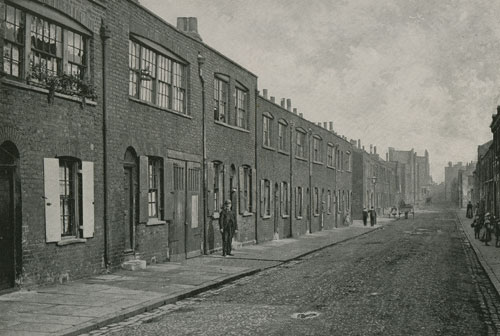
The previous post, then, focused mostly on the wealthier Huguenots – the merchants and master weavers who had the money and business acumen, and made the decisions about the direction of the silk weaving industry in Spitalfields. Today’s post comes down the social and weaving hierarchy to the journeyman weavers – the men and their families who actually did the weaving. They were paid by the completed piece and worked from their homes. Below is a typical street where such people lived. The wide window on the upper floor of the two houses closest to the camera mark them out as weavers’ cottages. The general look of the street indicates skilled artisan rather than wealth. By the time this photo was taken the street had fallen into serious levels of poverty. It has since been demolished.
Unrest, division and rioting
From the very beginning, away from the genteel homes of the Huguenot merchants and master weavers, disputes and unrest were often the order of the day in Spitalfields. The experienced journeyman silk weavers were well-organised and ever-ready to defend themselves. They were skilled artisans, and expected to be paid fairly for their work. We cannot condone their methods, but should bear in mind that no other way existed for them to achieve change. The power was with the merchants and master weavers – not just power and control of the business, but within society as a whole. For centuries the vote had been the preserve of those with property – beyond the reach of most artisans; and there were few peaceful means of demanding reform of country and society.
In 1675 the silk weavers of Spitalfields had rioted against the introduction of new machines. Later, the importing of inexpensive cotton from India brought more riots that included attacking women wearing dresses made of muslin, calico or linen, tearing the dresses from them or pouring ink or chemicals over them.
In the 1730s Irish weavers came to the area to work alongside the existing weaver workforce. Weaving in Ireland had developed significantly, in parallel with that in England, and for the same reason: Huguenot settlement. However, there, the cloth was linen and although most of the actual weavers were Roman Catholic, the industry was Protestant owned and managed. A series of punitive anti-Catholic laws gradually deprived them of any power, wealth and rights unless they converted to Protestantism. Their choice was to remain as second class citizens in their own land; to convert; or to leave. Many of those who came to settle on the edges of Spitalfields were impoverished unskilled workers, but the skills of the experienced weavers adapted to silk weaving.
All this led to new tensions and more riots. In weaving, as in other trades, the Irish workers were prepared to work for much less pay than the locals: as little as two-thirds or even half of the going rate. The Huguenot masters and merchants were hard businessmen. They took advantage of this, reducing wages for the existing working population. This, combined with general anti-Catholic hostility and additional segregation for some created by a language barrier, resulted in anti-Irish aggression and protests. It was said that, even in an area clearly spiralling into poverty, for more than a century the even more extreme poverty of the Irish in Spitalfields remained visible.
As the eighteenth century progressed and wages for skilled weavers continued to reduce, such was the anger amongst the weavers that they turned their modus operandi to forming ‘combinations’, stalking the streets in heavily-armed gangs and breaking into homes of master weavers to smash the looms and cut the woven silk upon them. The same fate was extended to any journeymen weavers believed to be working for lower rates. From 1765 such activity was punishable by death.
Protection for Spitalfields silks and silk weavers
However, alongside the public executions, in 1772 the government passed The Silk Manufactures Act, commonly known as the ‘Spitalfields Act’. Amongst other measures, this established that the wages of journeymen silk weavers within the legally recognised boundary of Spitalfields should be fixed by magistrates at Quarter Sessions. There were penalties on masters paying below the set rate, as well as for journeymen who demanded more. The number of apprentices any silk weaver could have at any one time was limited to two; and the ‘combinations’ were banned. The provisions applied only to male weavers, and were not extended to female weavers until 1811.
In addition to this, throughout the eighteenth century there were prohibitions on foreign silks, some aimed directly at luxury French items; and there were high tariffs and import duties on other related items that were not specifically banned.
The impact of the French Revolution
The years following the French Revolution were worrying times for the British government, who were concerned that the same fate should not befall the monarchy, aristocracy and status quo here. Given the melting pot of French Protestant Huguenots who had suffered at the ruthlessness of the monarch in France, alongside the Roman Catholic Irish population whose ancestors had suffered at the hands of the Protestant British upper echelons, together with the history of Radicalism amongst the English silk weavers, Spitalfields was considered a high risk for sedition and treason.
For the weavers, the now outlawed ‘combinations’ had been a means (albeit dangerous, violent and destructive) of ‘taking back control’ after suffering decades of increasing poverty and uncertainty. Now, in 1792, a new means of taking control was established: the London Corresponding Society. Their goal was the promotion of the reform of Parliament, and their existence highlights the decent levels of literacy amongst the men of humbler backgrounds who formed their membership. In general these were journeymen of English and Irish heritage rather than the Huguenot journeymen weavers. The London Corresponding Society, along with many other similar groups up and down the country, was outlawed by the Unlawful Societies Act of 1799. In the same year, the Combinations Act – aimed more widely, not just at silk weavers – banned any attempt to organise within work sectors, including collective bargaining.
An absence of flowers…
Alongside the radical groups, the Spitalfields community had enjoyed a whole range of cultural and intellectual interests, and various learned societies. These continued long after the earlier decades of prosperity when there was money to spare. In retrospect, it could be said the pastime of rearing flowers was a barometer for the living standards of the Spitalfields weavers. The weavers were known for displaying pots of home-grown flowers along the ledges of their weavers’ windows, arranged with evident artistry, and perhaps even providing artistic inspiration for their work. Many also had small flower gardens where they spent their leisure hours raising flowers or pigeons. The weavers’ love of songbirds is also well-documented. Of course, when times are hard, such pastimes will gradually cease, either for lack of money or lack of spare time when more hours must be worked to bring in the same amount of money. In 1795 John Thelwall wrote:
“[…] those gardens are now fallen into decay. The little summer-house and the Monday’s recreation are no more; and you will find the poor weavers and their families crowded together in vile, filthy and unwholesome chambers, destitute of the most common comforts, and even of the common necessaries of life.”
From John Thelwall: ‘On the Causes of the Late Disturbances’.
In: Dan Cruickshank: Spitalfields (2012)
The death throes of the Spitalfields silk industry
Since the end of the seventeenth century, the silk industry had somehow, and often uneasily, accommodated the tensions between the English Protestant, the Calvinist Huguenot and the Irish Catholic journeyman weavers. It had found a way to contain the hard-nosed business minds of the Huguenot masters and merchants and to balance that with a fairer system for the weavers. There were also protectionist measures in place to prevent, or at least reduce the threat of foreign imports.
John Thelwell wrote the above passage in 1795, but the first two decades of the nineteenth century seemed to herald a new ‘Golden Age’ of the silk trade in Britain. This was in no small measure thanks to the Napoleonic wars, and Napoleon’s plan to ban all Continental trade with Britain. This period of apparent success culminated, however, in the 1824 repeal of the Spitalfields Acts, and with that the removal of safeguards on journeymen’s wages. It also opened the way for increased use of machinery rather than cottage-based handlooms, and it was around this time that the French Jacquard mechanical loom entered the British weaving industry.
It wasn’t just the sudden flooding of the market with cheaper imports that harmed the silk industry in Britain. Fashions change. Women were looking for lighter, more practical dresses. Spitalfields silk, whilst undoubtedly stunningly beautiful, was created through a complex manufacturing process that produced a woven fabric resembling embroidery. It was heavy to wear, time-consuming and expensive to produce, and the dyes used in creating the floral designs meant the garments could not be washed for fear of colour runs. It was, really, the natural end of Spitalfields’s silk industry.
If you’re interested, this is a good time to watch Julia Sawalha’s episode of the BBC’s Who Do You Think You Are? Although Julia’s father is Jordanian (and the second part of her story here focuses on that), her mother is of French Huguenot descent.
The Huguenot story really gets under way at around 9 minutes.
From 11 minutes to 13:37 you’ll see actual examples of exquisite Spitalfields silks, with realistic floral decoration of the type designed by Anna Maria Garthwaite (mentioned in my last post) as recreated by the hands of the weavers.
After that there are some scenes filmed in the streets discussed in my last post, where the fine Huguenot houses are still to be found.
From around 18:22 the story focuses on the impact of the decline of the silk industry in Spitalfields, and on Julia Sawalha’s ancestor who was Huguenot, but a journeyman weaver rather than a moneyed master weaver.
Finally, from around 23 minutes there is historic information about why the Huguenots fled France
Poverty and deprivation
‘It is not in the power of language to describe their long and continued miseries not brought on by idleness, intemperance or a dissolute course of life, but human wretchedness absolutely produced by want of employment’
Dr William Hawes, Physician to the London Dispensary, 1792-93
Dr William Hawes recorded his thoughts, above, while witnessing the impact on the Spitalfields silk weavers of the severe trade crisis of 1792-93. The London Dispensary offered medical advice and medicines at minimal cost to the poor and needy of the area and remained in operation on that basis until the creation of the National Health Service. In 1797, such was the distress of the inhabitants that local philanthropists formed the Spitalfields Soup Society to to serve good quality soup, again at cost, to local people. By 1812, 6000 people were fed daily. Bearing in mind the creativity and curiosity that had thrived in Spitalfields when times were good, it is telling that in that same year – 1812 – a group of Quaker philanthropists, concerned at the widespread illiteracy levels, established a school for local children aged 6 to 14. The cost to parents was a penny per day. What all these initiatives had in common is that they were aimed at the ‘industrious’, or ‘deserving’ poor; and yet such was the poverty that increasingly, they were out of the reach of local people. After the repeal of the Spitalfields Acts in 1824, when thousands more weavers were thrown into destitution, few local families could afford the penny fee, and by the end of the 1830s the school had closed.
By 1839 the most skillful journeyman weavers in Spitalfields were earning around fifteen shillings a week – a fall of five shillings since 1823. However, for the less skilled ‘plain weavers’ the overall average appears to have been more like seven or eight shillings per week. By 1849 the average weaver’s wage was 5 shillings and sixpence per week. The nation’s response, from 1834, was the workhouse.
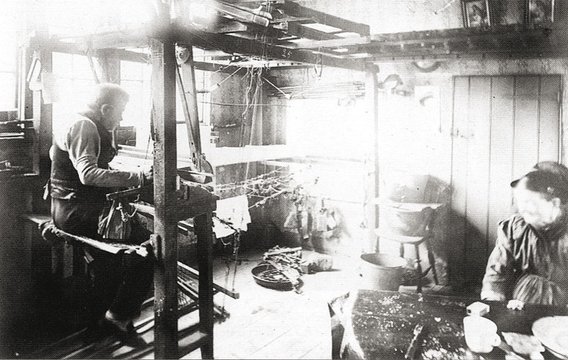
As the nineteenth century progressed, Spitalfields became increasingly densely populated. This came about through different means. First the existing houses, intended for one family, were occupied by several families. Even the fine Huguenot houses gradually fell into disrepair and over-occupation, although the merchants and master weavers themselves moved away, diversified their business interests and expanded their activities into other trades, other parts of the UK and in the New World. Second, the growing spaces and open areas behind terraces of housing were transformed into narrow alleyways crammed with very poor quality housing accessed via passages from the main street. In many parts of Spitalfields, the view along the streets may have seemed little changed, but behind them was a whole other world, with damp, cramped and filthy conditions created by overcrowding, poor building, inadequate water supplies and inability to pay for removal of ‘night soil’. Finally, to return to the weavers’ love of flowers, many of them had taken small plots of land where they could enjoy their hobby and relax in the sunshine. Often they erected small sheds or cabins on these plots. As conditions worsened for the weavers and other inhabitants of Spitalfields, these sheds were used as dwellings.
The Industrial Revolution
The severity of conditions in Spitalfields after the repeal of the Spitalfields Acts and onwards throughout the nineteenth century were just one half of a double whammy impacting the area. Alongside the collapse of the Spitalfields silk industry and consequential reduced income and unemployment, the population of the area continued to grow. While the population of the civil parish of Spitalfields (Christ Church) at the time of the 1831 census was 16,200, in 1834 the Poor Law authorities calculated the total population of the area of Spitalfields in its wider sense (that is, including the parishes of Bishopsgate-without-the-wall, St Dunstan Stepney, St Mary Whitechapel, St Leonard Shoreditch, and St Botolph Bishopsgate plus the Liberties of Norton Folgate and the Old Artillery Ground) at 64,141. This represented a doubling of the population in around three decades.
Of course, Spitalfields was not alone in experiencing such sudden population growth and extreme deprivation. As elsewhere, this was a time of push and pull factors, away from the rural areas and sucked into the large towns and cities where by now the Industrial Revolution was well underway and it was hoped work would be available. The additional issue for Spitalfields was that the work for the existing population had collapsed. Weavers without work went to work at the docks or tried to find other employment, or indeed ended up at the workhouse. The situation compares to that in Norwich where my own 3x great grandfather, also a silk weaver, found himself unable to secure work. More recently, we might compare it to the deep, generational unemployment and economic loss of people in the mining communities after the mass pit closures of the 1980s.
The gap has been bridged
The events and reasons behind the downward spiral of this once elegant and prosperous community into abject poverty and despair are now clear. It was into this new incarnation of Spitalfields that thousands of Jews fleeing persecution in Eastern Europe would arrive towards the end of the nineteenth century. Here, they would make their home while establishing themselves in their new country. That will be the topic of my next post.

