My granddad’s ‘housewife’

Army issue khaki 'housewife'

This is my granddad’s army sewing kit, known as a ‘housewife’, and dating from the period 1907-1919. As a young soldier, he had to learn to take care of his own uniform.  During the freezing cold winters of some of his tours, he also learned to knit – partly for something to fill the time, partly for the warmth afforded by the results.  Upon arriving back home late in 1919 he married my grandma, and when my mum came along it was he who passed these skills on to her, teaching her to mend and sew by hand and to knit.  Many years later, she – my mum – taught me.  From these humble beginnings my love of all kinds of needlework expanded and developed, straying far from my granddad’s knitting for warmth and sewing for necessity.  Eventually, in 2009, I started my first online blog which focused  on needlecrafts and other creative projects.  It has to be said, though, that by this time my ‘sewing kit’ occupied considerably more cupboard space than this little roll…

British Army khaki soldier's 'housewife', unrolled

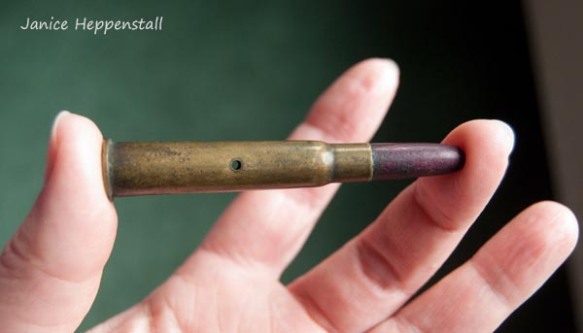
My granddad’s ‘housewife’ belongs to me now.  Although it’s standard issue, it is nevertheless a very personal item, and would have travelled with him to many parts of the world.  It bears his regiment and personal identification details, and contains everything he needed to keep his uniform in full working order: needles, thread, elastic, safety pins, spare buttons … and tucked away at the back of that pocket … what seemed to be a bullet!

.303 calibre Enfield rifle drill cartridge

So one day, back in 2012 I posted these photos on my needlework blog.  The point of the post was to highlight the link between my granddad’s sewing and knitting and my own needlework skills, which bizarrely I seem to owe to the British Expeditionary Force!

However, that blog post caused quite a stir!

A couple of readers pointed out that the bullet could be dangerous.  They advised me to investigate its safety.  But how do you investigate the safety of a hundred year-old bullet?  In the UK, gun ownership is strictly regulated, and my gun-related knowledge was and remains virtually non-existent.  (Is it a bit dense to say I assumed it was the action of the gun that propelled the bullet through the air, rather than the explosive properties of the bullet itself…?!)

So a local gun club was my first port of call.  In an email sent via their website I explained that I had an early 20th Century British Army bullet and asked for information as to where I should go to have it checked out.  I was surprised to receive, almost immediately, a telephone call from the club, advising me that the bullet could be dangerous.  It would not spontaneously explode, but if dropped at a certain angle it could do so.  Not only that, but it’s illegal to be in possession of even one bullet in the UK without a firearms licence.  So concerned was my adviser from the gun club that he would have driven over to my house to look at the bullet had it not been for the photograph I was able to point him to on the blog – the photo you see directly above.  After seeing this he thought it had been decommissioned.  This would make it both safe and legal – but he asked me to take it into the gunsmith for a second opinion.

I had walked past this gunsmith’s shop a hundred times without even knowing it existed.  Now (rather carefully!) I took in my bullet and they couldn’t have been more helpful.  It turned out that this isn’t in fact a bullet at all.  It’s a dummy, or ‘drill cartridge’.  My granddad would have used it for drills: for practising loading the rifle at speed.

By this time, in a highly unexpected turn of events, that post from my needlework blog had been shared by an enthusiast to his own firearms blog!  Consequently I now had a small international team of firearms experts advising behind the scenes.  The brass case, I learned, is the ‘cartridge’.  The four holes drilled into it indicate it will not fire.  (You can see straight through two of these holes in my photograph below.)  The ‘bullet’ is the red bit at the end, but a real bullet would have a cupronickel coating; this one is wood.  The reason my granddad kept it in his sewing kit was to avoid the risk of mixing it up with the live ammunition.

.303 calibre Enfield rifle drill cartridge

I was so grateful to everyone who got involved.   Of course I was relieved to know that ‘my bullet’ wasn’t dangerous – and that I didn’t have to give it up.  But I was equally delighted to have a little more information about my granddad’s time in the army.  Thanks to all these people, I now knew that the rifle my granddad used was a .303 calibre Enfield.  I already knew he was something of a crack shot – we have a number of spoons inscribed with his name, and a trophy – all won in Army shooting contests.  And in truth, as a firearms expert himself, he would not have kept this tucked away in his family home for more than fifty years if it had been dangerous to do so.

I share all this here for several reasons.  First of all, just look how much you can learn about a family member from one small item!  Secondly, it illustrates what a wonderful resource the Internet can be, not to mention the kindness of enthusiasts who really seemed to take this situation to heart, were keen to help and had genuinely been concerned for my safety.  But on top of all that, I thought you might appreciate the story.  🙂

Do you have a little something stuffed away in a drawer that you might be able to explore further?  You never know what you might learn!

Free documents and templates for genealogists

Do you like to use documents and templates to record information, alongside what you put on your online/ digital tree?  If so, you might be interested to know about these free resources.

The Photo Alchemist, whose business is providing a worldwide photo restoration and colorisation service, has restored eighteen beautiful, full colour templates and made them available to download for free on her website.  You’ll find them [here].  I’ve made templates for my own use in the past and they’re perfectly functional… but sometimes you want something more special, and these are certainly worth the extra ink!

If you’re on Facebook:
Genedocs Templates is a Facebook group with a mission to help anyone interested to ‘preserve a more meaningful and personalized family tree and legacy’.  There’s a huge range of downloadable documents and templates for you to use free of charge.  Examples include an Ancestor Outline List, a document to help you create an obituary and a ‘3-D trunk’ chart for you to add the names of your ancestors.

There’s also The Organised Genealogist.  As with the last suggestion, you have to ‘join’ the group.  Some of the templates are US-centric, but others are of wider application, and there are discussions about specific needs of group members in the discussion threads.

If you’re on Ancestry you’ll find a selection of downloadable charts [here].  These include a Family Group Chart as well as charts to help you keep on top of your own administration.

Family Tree Magazine has created 61 genealogy forms and shared them freely [here].  Again, some of their documents are focused on the US, but others will be of use to genealogists everywhere.

Family Tree Templates have provided a number of free tree templates [here].

If you still don’t see exactly what you’re after you might be able to use some of these as a starting point and create your own.

The future of the census

There has been talk in the media recently about the possibility that the upcoming 2021 census for England and Wales will be the last one.  Rising costs are cited, with an estimate that next year’s census, despite being the first to be taken primarily online, is likely to cost £1 billion.

For us as genealogists and family historians, the census is one of the most important records, providing us with a ten-yearly check-in on each of our ancestral families, and a useful comparison against birth, baptism, marriage and death records.  There is no doubt that the period from 1911 to 1841 is the most straightforward period for genealogical research.

Of course, the current discussion is a reminder that the census never existed for our benefit.  Those benefits to us are just a happy side effect.  Its purpose was, and remains, to help the government and local authorities to plan services with a reasonably up to date snapshot of what the country looks like.  With every passing decade, as our society has developed, become more complex and diverse, and as our attitude towards providing for diverse needs has changed, the questions on the census have become ever more detailed.  Nevertheless, as a genealogist, I was mortified when I first heard the headlines.

Digging around a little deeper, I found that in fact no decision has been taken about the future of the census.  Indeed Professor Sir Ian Diamond, the UK’s National Statistician and head of the Office for National Statistics, has said he would only recommend its termination if he finds a better option.

The issue seems to be centred not just around cost, but also around the effectiveness of a decennial snapshot when the reality is constant and accelerating demographic change.  The possibilities are therefore being explored of collecting the same sort of data but via other existing and constantly updated sources, such as GP registrations, council tax records and driving licences.

Counter to these arguments is the fact that demographers consider the census the ‘gold standard’ of population records.  They point to the inferiority of existing alternative record sources as the means for demographic mapping and planning, voicing concerns about, for example, the administrative difficulties in keeping lists up to date.  Their suggestion is that while their use would be beneficial in supplementing the richness of the decennial census, thereby overcoming the concern about the lengthy gap in updating data in an age of constant change, they are no match for the richness of the census data.  They also point out that as online census return becomes the norm, future costs should reduce.

The review is ongoing and Professor Sir Ian Diamond will give his opinion by 2023.  Ultimately, it will be the government that decides.

What might this mean for the future of family history and genealogy as a hobby?  Well, of course our own research will not be affected, but for future generations, tracing families could be more difficult.  At the very least it would be different, and I draw comfort from the commitment of the demographers to quality and richness of information.  Perhaps for our descendants it will simply be a case of accessing more record sets, each one focusing on a narrower aspect of our lives.  Electoral records, for example, will show all those of voting age living at an address, while GP registers will include children.  Nevertheless, I write this with some trepidation, having checked the online electoral registration record for myself at my current address and noted that a well-known actor of ‘Carry-On’ film fame (now deceased) is listed as having lived here with me!  Although the number of his house was the same as ours, his property was located in a little courtyard leading off the same road but with a different name.  Doesn’t bode well does it!

In fact we may soon find ourselves seeking alternatives to the census.  After the release of the 1921 census (anticipated January 2022), it will be thirty years before the next one.  The 1931 census was destroyed in a fire during World War 2, and the 1941 census was never taken.  Perhaps, in response to our needs, the commercial websites will start to index more of these alternative types of records for our use, and the changes a hundred years hence will be relatively seemless.

Before leaving the topic of the census, although admittedly going off at a complete tangent….
I recently came across an interesting article about a Harvard student who, working with his professor, has cracked the code used by the Incas in their ‘khipu’ textiles: knotted cords used for record keeping.  Gradually, it became clear that these were these were the Inca equivalent of census records. Bearing in mind that the Inca Empire reached its height of power in the 15th- and 16th-centuries, they were centuries ahead of us in this regard.  You can read this fascinating article [here].

When difficult stories emerge

A chance sighting of a World War One military service record set me off on a tangent.

The record belonged to a man who married one of my great aunts.  The two of them had eleven children, nine of whom survived to adulthood, and between them they produced a total of around forty grandchildren.  What follows is a very sad tale of an unhappy life and marriage, but out of respect to his descendants I shall refer to this man as Mr X.

Having joined up for military service in December 1915, Mr X endured three years of the horrors of war.  Today we’re aware that many of the young men who survived were sent home in 1918 with what we now understand as Post-Traumatic Stress Disorder, but back then the long-term impact was not understood.  We do know that when many of them returned home they were ‘changed’, quite ‘different’ from the young men who had gone away to fight for King and Country a few years earlier.  Perhaps this was the reason for Mr X’s anger and the violence that he inflicted on his wife and young family.

However, Mr X’s life was blighted not only by PTSD.  A note on his service record states that on 20th September 1918, while in France, he suffered a ‘severe shell gas wound’.  It’s likely that this involved actual physical injury from the explosion/ shrapnel combined with effects of mustard gas.

I started to research…

It seems Germany commenced large-scale use of gas as a weapon in January 1915.  Initially, the artillery shells they fired contained liquid xylyl bromide tear gas.  Other forms of gas followed, including chlorine and the deadly phosgene.  However, by 1917 the most common chemical agent used was sulfur mustard, known as ‘mustard gas’.

The purpose of the mustard gas was not to kill the enemy: only about 2-3% of victims actually died.  Rather it was used to harass, disable and disorientate, and to pollute the battlefield.  Being heavier than air, mustard gas settled to the ground as an oily liquid where it sank into the soil, remaining active for several days, weeks, or even months, depending on the weather conditions.  Those exposed to it would start to vomit, while their conjunctiva and eyelids swelled until they were forced shut, leaving the victims temporarily blinded.  This is what had happened to the rows of blinded soldiers we see in WW1 photos, walking in long rows each with an arm on the shoulder of the man in front.

Mustard gas didn’t depend on inhalation to be effective: any contact with skin was sufficient.  Moist red patches would appear immediately, erupting into blisters over the following 24 hours.  Higher concentrations could burn flesh to the bone, particularly if it found its way to the eyes, nose, armpits and groin, where it dissolved in the natural moisture of those areas.  Other symptoms included severe headache, increased pulse and fever.  Internal and external bleeding could follow, as the gas attacked the bronchial tubes, stripping off the mucous membrane.  Blistering in the lungs could lead to pneumonia.  Without doubt, the effects of mustard gas attack were unspeakably painful; and those who were fatally injured could remain like this for four or five weeks before relief came in the form of death.

For the majority who didn’t actually die, many were nevertheless scarred for life.  Respiratory disease and failing eyesight were common post-war afflictions.  Many, although recorded as fit, were left with scar tissue in their lungs, and this left them susceptible to tuberculosis.  It’s now known that around the time of the Second World War, many of the surviving 1918 casualties did indeed die of tuberculosis.

Mr X died in 1935.  Was this the cause of his death?  It’s clear that the seventeen years back in Blighty were not happy, healthy ones for him.  I spent time looking at online trees, hoping that someone might have uploaded a copy of his death certificate, or at least given the cause of death in their notes, but no one had.  What I did read, both as notes on trees and in written accounts circulated by his grandchildren, was that he was badly affected by WW1, physically disabled, and that he took to drink.  He was a big man, and his wife was tiny.  He was violent, and she was no match for him.

Mr X isn’t part of my direct line.  He isn’t even a blood relative, so I wouldn’t normally buy a certificate for his death, but eventually it seemed like an important part of his story was missing.  Finally, I bought the certificate.  His death was recorded as ‘natural causes’, an acute inflammation of the pancreas: it seems it was the drink that did for him in the end.  I still think, though, there’s a good chance that had the awfulness of his life not driven Mr X to drink, he might have died a year or so later, from TB.

I have so many thoughts about Mr X.  I don’t think many people would have mourned his passing, although his wife, now free of him but widowed and with ten mouths to feed, must have felt she was tossing about somewhere between the devil and the deep blue sea.  The 1930s were a hard time for working class people, but in a time when many were suffering, it seems this family really stood out as being poor as church mice.  We can’t discount the possibility that Mr X might just have been a violent, unpleasant bully.  But surely the more likely reason for his behaviour is the horrors of war torturing him for the rest of his days.

Mrs X’s life too was transformed from whatever it might have been to a life of anger, violence, harsh words and little love, and perhaps she too was experiencing a form of PTSD after her treatment at the hands of her husband.  Those who remember her tend to speak of a strange, solitary and unloving person.  I never met her, and indeed our families seem to have parted ways during these inter-war years.  The philosophy of the time was ‘you don’t interfere between man and wife’.  Thankfully this approach has gone out of fashion.  Mrs X needed support.  Mr X had needed support too.

Family research isn’t always about loving families and happy memories.  Sometimes life is terrible, unfair and unbearable.  But even when faced with the most unpleasant of individuals, even though we can’t forgive and shouldn’t excuse their behaviour, we can at least try to look for the person inside and how they got to be who they became.  And we can send them some love.

The road to universal suffrage

Despite all the commemorations in 2018 to mark a century of women having the vote, genuine universal suffrage on equal terms didn’t happen until 1928.  Over a period of about a hundred years, there were huge changes in our ancestors’ rights to representation at Westminster.

When we know who was entitled to vote and on what basis, finding one of our ancestors on an electoral register or in a poll book for a particular year means we have valuable information about them and their status within society.  With that in mind I thought it would be worth taking a look at the progression of reforms that started in 1832 with the Great Reform Act and ended in 1928.

If your ancestor appears on electoral documentation prior to 1832, they almost certainly held freehold property.  However, this restrictive qualification meant that by 1780 only 214,000 people in England and Wales – fewer than 3% of the population – had the right to vote.  Of course, virtually all were men.  It was around this time that reform groups committed to ‘universal’ (male) suffrage began to come together, and pressure for parliamentary reform began to mount.  It wasn’t just the property qualification that made the system unrepresentative: despite the growth of certain industrial towns and cities, and the reduced or even non-existant populations of formerly flourishing Tudor towns, constituency boundaries had not changed for centuries.  Consequently, economically powerful manufacturers and businessmen in places like Leeds, Birmingham and Manchester had no political representation in Westminster, while landowning families in ‘rotten boroughs’ benefitted from almost personal representation by one or even two MPs.

If one of your ancestors was entitled to vote you’ll find him (or before 1832, very occasionally her) on the Electoral Registers and Poll Books for each of the general elections.  These differ in that the former shows who was entitled to vote, while the latter, published after the poll, actually records how each person voted.  The right to a secret ballot was introduced by the 1872 Ballot Act, so it’s only before this date that you’ll find a Poll Book.  You’ll find these documents at local record offices and central libraries, and some are also on Ancestry (Search → Card Catalog → enter search terms ‘Poll’ or ‘Electoral’) and FindMyPast (Search → A-Z of Record Sets → enter search terms ‘Poll’ or ‘Electoral’).

In the days when the right to vote depended on freehold possession of land, you’ll see the location of that land.  If this isn’t where your ancestor was residing you’ll find their place of residence too.  Often, the right to vote of gentlemen in the boroughs depended on their owning land in the wider county.

Beware, though, of jumping to conclusions.  Since the earlier Electoral and Poll Books include only the village or area where the individual lives, not his actual address, sometimes you can’t be absolutely certain that the person listed is your ancestor: you need additional information.  Compare the following two examples:

The 1741 Electoral Register and Poll Book for the county of York shows Lister Symondson, clerk, living at Kirkby Overblow but records that the freehold property entitling him to vote was in nearby Pannall.  I can be sure that this is my 7xG grandfather, because I have his name, his occupation (which I know to be correct), his current residence (where he is vicar, and presumably living in the vicarage) and the location of his freehold, which is where I know he was curate for more than two decades before becoming vicar.  Although I’m able to use my existing knowledge to confirm that this is my Lister, the documents also give me new information: Lister held freehold property; he had the right to vote; and how he voted: Whig.

Compare this to Robert Mann, who is listed in the 1817 Poll Book for the county of Norfolk, living in Norwich but entitled to vote by virtue of freehold property in Great Yarmouth.  This person may be my 4xG grandfather, who had lived in Norwich since at least 1789, but was baptised in Great Yarmouth and had family connections there.  He was a saddler / harness maker, having completed his apprenticeship in Wymondham, for which his family paid the princely sum of £31 10 shillings, suggesting they were financially sound.  But none of this gives me the kind of definite evidence I have with the previous example.  There is more than one Robert Mann living in Norwich at this time.  I have no evidence to suggest my Robert has freehold property in Great Yarmouth, and this Robert may or may not be mine.

Things start to change.

Representation of the People Act 1832
AKA: First Reform Act or Great Reform Act 1832

  • Changes were made to the constituencies, removing ‘rotten boroughs’ and creating 67 new contituencies to provide representation within Westminster for boroughs, including the large industrial towns and cities which had previously had no MP.
  • The vote was extended to all male householders within the boroughs who paid a yearly rent of £10 or more, also to some lodgers.
  • In the counties, the property qualification was broadened, to include small landowners, tenant farmers, and shopkeepers

Even in terms of extending the vote to men, then, the Great Reform Act was not so ‘great’.  The property qualification still meant that 6 out of 7 adult males were excluded from the voting process.  In addition, something I hadn’t appreciated until watching the BBC series Gentleman Jack last year: by defining a voter as ‘a male person’, the Great Reform Act in fact removed the franchise from a number of women landowners who had previously had that right.

More information here.

Representation of the People Act 1867
AKA: Second Reform Act 1867

  • In the boroughs, all male householders over the age of 21 were now granted the vote, as well as lodgers paying rent of £10 a year or more.
  • In the counties, the property threshold was reduced, and the vote was extended to agricultural landowners and tenants with very small amounts of land.

This Act made significant inroads towards universal male suffrage, doubling the electorate in England and Wales from one to two million men.

More information here.

It’s the 1868 General Election, then, where we’re likely to start to see more of our ancestors in the documentation, and by now actual addresses are given. This serves as an extra check-in between the 1861 and 1871 censuses.  A CD ROM of the Leeds Poll Book that I bought some years ago has paid dividends.  You might find something similar for your areas of interest through local family history societies.

Note: Although women were excluded from general elections, from 1869 all women ratepayers aged 21 and over had the right to vote in municipal (local) elections.  So if your female ancestor after that time was a shop or business owner or occupied her own home, you might find her on local authority electoral registers.

Representation of the People Act 1884
AKA: Third Reform Act 1884

  • Established a uniform (male) franchise throughout the country, bringing the counties in line with the 1867 borough householder and lodger franchise qualification.

However, about 40% of men still did not have the vote.  In addition of course, women were still completely excluded from the process.

More information here.

Representation of the People Act 1918

  • Almost all property qualifications for men were removed.
  • The vote was granted to women over 30 who were householders, wives of householders, occupiers of property with an annual rent of £5; and in university constituencies, to women graduates.
  • There were also important administrative changes, including the annual updating of the electoral register and instituting the present system of holding general elections on one day.  (Previously polling had been open for several days – in 1784, actually for 47 days!  Find this and other strange facts here!)

The electorate tripled from 7.7 million to 21.4 million, with women now accounting for 43% of the electorate.

More information here.

Representation of the People (Equal Franchise Act) 1928

  • With the lowering of the qualifying age to 21, women were granted full equality with male voters.

More information here.

If this is an avenue you hadn’t thought to explore before, I hope you make some interesting finds.  It would be lovely to read some of them in the comments.

You’ll find a list of General Elections from 1802 to the present day here.  You might be able to work out when each of your ancestors first voted.  Bear in mind that prior to the formation of the Labour Party (February 1900) there were only two parties: the Whigs (Liberals) and Tories.

Yorkshire Pudding

One hundred years ago today my grandparents were married.  In their honour I’m going to write about a much-loved staple of my homeland: Yorkshire Pudding.  After a little online research about its origins, I’ve been surprised at how one very simple recipe can tell us so much about social history.

The earliest written recipe was in a publication called The Whole Duty of a Woman, Or, An Infallible Guide to the Fair Sex.  The author is not named, which certainly means it was a woman.  You can read the entire book for free online via Google books, or if you prefer, a facsimile edition is also available as an actual book here. A handwritten note in the original indicates the first edition was 1701.  As the title suggests, this is far more than a recipe book.  Rather it’s a complete guide to what was expected of a woman of that time, in all aspects of her life, including Religion, Modesty, Behaviour towards Men and ‘A Wife’s Behaviour to a Drunkard’.

At this early stage it seems Yorkshire Pudding isn’t yet called ‘Yorkshire Pudding’.  In these pre-oven times, the entire thing is cooked over a fire but under the meat (shoulder of mutton).  The dripping from the almost-cooked mutton is allowed to drip into the pudding as it cooks, hence the original name, Dripping Pudding:

The next known reference is 1747, when Hannah Glasse published her Art of Cookery Made Plain and Easy.  This is also available to read for free online via Internet Archive or as an actual book here.

It’s now ‘Yorkshire Pudding’, and although more detail is given in the method, it’s still clearly the same recipe as the earlier version, cooked over the fire beneath ‘a good piece of meat’.

It’s clear from these descriptions that Yorkshire Pudding was something far more substantial than a dainty little accompaniment to a plate of roast beef, which is how it’s generally viewed today.  We can see that traditionally it was baked in a large tin, and then cut into portions for each person. The type of meat was not important.

Fast-forward 150 years, to when my grandparents were growing up, and the only thing that has changed is the availability of the oven.  Towards the end of the cooking of the Sunday roast, dripping from the meat was put into a large baking tray (a dedicated ‘Yorkshire Pudding tin’) and the batter then added.  In other words, the ‘dripping’ no longer dripped from above onto the baking pudding.  (Until reading these recipes I didn’t realise this was how ‘dripping’ got its name.)  But Yorkshire Pudding was not just for Sundays.  When the meat was cooked, all the leftover dripping would be poured into a pot and left to cool.  This was then used to start off the Yorkshire Pudding for the following days.  (It was also used as a sandwich filler.  My Dad used to take dripping sandwiches to work, on white bread, with salt and pepper.  This was not some kind of punishment: he really enjoyed it, although I can’t explain why.)

And now here’s the important bit: the reason everyone was eating so much Yorkshire Pudding wasn’t because they just couldn’t get enough of it (although a well-made Yorkshire Pudding is indeed a thing of beauty.)  No, it’s because it is traditionally served as a substantial starter – a plateful of nothing but the pudding, with gravy.  The whole point was to fill everyone up at low cost before they even got to the expensive meat and vegetables.

Moving on now to my own childhood, and this was still how we had Yorkshire Pudding.  My mother used small, shallow ‘Yorkshire Pudding tins’, one for each family member, so we each had an individual pudding served with gravy, before the main course.  We had this every week on Sunday, Monday and Tuesday, although gradually, this was whittled down to just Sunday lunch.  Another rule was that the Yorkshire Pudding tins were never washed.

So, to bring you right up to date, I don’t often make Yorkshire Puddings, but when I do, I’m fiercely traditional about their position in the meal as a starter.  I’m not traditional about the dripping though – I often use olive oil.  This may mean I will no longer be welcome back in Yorkshire.  I can see now that the dripping is an integral part of the dish, to the extent that its availability was the whole reason someone first got the idea to toss some batter into it.  I also wash the the tins. 🙂

So now it turns out there is a Yorkshire Pudding Day.  It’s the first Sunday in February, so if you’ve never made it and you’d like to give it a try you have a little over a week to prepare for the festivities.  (I’m not sure what the festivities will be!)

I was going to add my mother’s recipe, but I notice it doesn’t include accurate measurements, which may be a problem if you’ve never even heard of Yorkshire pudding before, let alone not made it.  So here is Mary Berry’s Yorkshire Pudding recipe.  It includes the same ingredients as my mother’s (although with sunflower oil instead of dripping) but with accurate amounts.

The only thing to add – of course! – is that these are best served as a starter, with gravy.  🙂

*****

It occurs to me that a section on special family recipes would be an excellent addition to a collection of life stories.  So if you’re thinking about writing your stories for future generations, what recipes would you include?

Telling our own stories

In July this year the Irish Central Statistics Office announced that the back page of their Census 2021 form will be left blank for each citizen to write their own personalised ‘time capsule’ message for future generations and historians.  This will be locked away for 100 years before being made available in 2121.  Imagine how excited we as genealogy enthusiasts would be, if we knew that the census about to be released would include not just our ancestor’s handwriting, but an actual message dedicated to us!

This is a world first.  No other country has ever done it.  But if you had the opportunity, what would you write?

Why not do it anyway?!

A couple of years ago I came across a list of prompts for writing about your own life.  Produced by FamilySearch, 52 Questions in 52 Weeks is designed to be tackled over a year.  There are also some additional questions in case you want to substitute any in the main list.  Of course, there are no rules.  Take as long as you like, and go off on whatever tangents are important to you.  It is good, though, to be guided through in these bite-size chunks.  If you’re lucky enough still to have older generations to talk to, why not ask them to do it too?

*****

I’ll be taking a break now, and will return on 24th January.  Until then, I’d like to thank you for accompanying me on my genealogy journey; and above all, I wish you a happy and peaceful Christmas and a very happy 2020.

The 1939 Register

I said in my last post that the 1939 Register was not a census.  It is, however, ‘census-like’, in that it includes some of the information normally included in our decennial censuses.

So what was it? 
This ‘National Register’ had a very specific purpose: to coordinate the war effort at home.  In December 1938 the decision was taken that, in the event of war, a Register would be compiled of every civilian in Great Britain and Northern Ireland.  Following invasion of Poland on 1st September 1939, Britain declared war on Germany on September 3rd.  Final preparations were then put in place for ‘National Registration Day’, including issuing forms to more than 41 million people and appointing enumerators to visit every household to collect the information.

What information is included?
Information was collected for the night of September 29th 1939.  For every civilian the following details were recorded:

  • Surname and other names
  • Address
  • Sex
  • Date of birth
  • Marital status
  • Personal occupation
  • There was also some official information (schedule number and sub number) plus, for institutions, a record of whether the individual was an Officer, Visitor, Servant, Patient or Inmate.

Anyone already engaged in military service on that date wasn’t included, even if they were currently billeted in their own homes. However, members of the armed forces on leave and civilians on military bases were included.

How was this information used?

  • To issue identity cards: It was a legal requirement to present your identity card upon request by an official, or bring it to a police station within 48 hours; also to notify the registration authorities of any change of name or address.  This requirement continued until 1952.
  • After January 1940, to issue ration books.  (Rationing finally ended in 1954)
  • To organise conscription and the direction of labour for the war effort
  • To monitor and control the movement of the population caused by military mobilisation and mass evacuation.
  • After the war, in 1948, it was used in the establishment of the National Health Service, serving as the NHS Central Register.  Until 1991, the Register was updated as people died or changed their names (on marriage or via deed poll).

Where is the Register kept?
Since the records were used by the NHS from its inception in 1948, the Register – 70,000 volumes containing more than 1.2 million pages of information – is kept at the Health and Social Care Information Centre.  It’s not available to the general public but is now fully indexed and searchable with images on both FindMyPast and Ancestry.  A transcript is also available at MyHeritage.

Why are some people not showing on the 1939 Register?
As mentioned above, anyone already on military service was not included in this Register.  However, conscription didn’t really get under way until January 1940, so most people who went on to serve in the armed forces will still be recorded here.

However, you’ll notice that a lot of the individual records are blanked out with a thick black line and the words ‘This record is officially closed’.  This is because the person may still be alive.  Since the Register was updated until 1991, the record of anyone born less than 100 years ago but dying prior to 1991 will have been opened automatically.  If your ancestor died since 1991 you can ask to have their individual record opened.  This is free for FindMyPast users, and can be done via the website upon submission of a digital copy of the death certificate.  If you’re not a FindMyPast subscriber you can use The National Archives Freedom of Information (FOI) request form to request a search of closed records from the 1939 Register, but there’s a charge (currently £24.35) for this.

How can we use it for genealogical research?
The information included is similar to the usual censuses, but covering fewer aspects of the person’s life and home.

It does, however, show exact date of birth, whereas the censuses simply give the person’s age.  (I have noticed, though, that even though the birthday is usually correct, the actual year of birth is sometimes a year out.)

As the Register was continually updated while National Registration was in force, it will include any change of name or address right up to 1952.

Since the Register was then used by the NHS, any changes of name were recorded until 1991.  This means you can search for a person using their name in 1939 or any subsequent changes – very useful for working out maiden names, previously unknown changes by deed poll or multiple marriages

However, there is an additional reason why the 1939 Register is so important to us as genealogists.  If we don’t know names of grandparents or great grandparents, getting back to 1911 when we can start to use the regular census information, can be difficult.  The 1939 Register gives us an extra chance of finding family members who were too young to be on the 1911 census but born by 1939 – and possibly still living with older family members who are on the previous census.

What’s more, after the forthcoming publication of the 1921 census (anticipated January 2022) this is the only surviving survey of the population until 1951.  The 1931 census was destroyed during WW2.  (Some accounts say it was during an air raid on London; others say it was a fire in 1942 not caused by enemy action, at the Office of Works in Hayes.)  The 1941 census never happened.

Find out more
You’ll find a lot more information about the 1939 Register in the research guide at The National Archives.

Making the most of the 1911 census

The 1911 census records the whereabouts of all persons on the night of 2nd April of that year.  It’s currently the most recent census available to us. although this will change within the next couple of years when the 1921 census is published.  (We do also have the 1939 Register, and that’s very useful but it’s not actually classed as a census.)

The really special thing about the 1911 census is that for the first time, what we see is the original household form, as completed by our ancestor.  For previous censuses these original forms were destroyed; all we see is an official’s listing of information as extracted from the originals.  So in 1911 we see our ancestors’ handwriting, and although some of their entries may have been struck through by the enumerator, we can still see what they intended to write.  Sometimes this is very enlightening.  See, for example, these five census forms returned by suffragists.  Sometimes it’s fun and quite sweet, such as these entries about household petsOther times our ancestors simply made a mistake, but somehow this still tells us something important about their lives.  (See several examples below.)

What information was collected?

As with the previous census (1901) the following information is requested:

  • Address
  • Name of each household member
  • Relationship to head of household (or ‘Head’)
  • Their age (recorded in the male or the female column)
  • Marital status
  • Occupation, and whether employed or self-employed
  • Place of birth (see note below)
  • Any infirmities.  (As with 1901, the categories of deaf and dumb; blind; lunatic; inbecile/feeble minded are offered – definitely not terminology acceptable to us today, and often probably a  poor description of the facts.  In an earlier census my 3G grandfather, formerly a tailor and innkeeper, was described as an imbecile.  I wonder if he had had a stroke.)

In addition, new for 1911:
Married women are asked:

  • how many years the marriage has lasted
  • how many children of that marriage were born alive; how many are still alive and how many have since died.

How does this help us?
This can be very enlightening.
My GG grandmother, although widowed for 19 years, responded to the question ‘How long has this marriage lasted’.  Her response led me to their marriage in Leeds and not, as I had previously assumed it would be, in Ireland.  This, in turn, placed their migrations to England to within the difficult years following the Potato Blight. and suggested they were probably not from the same town in Ireland.  In other examples, this response can help us to narrow down the year if there is more than one potential marriage for this couple. 

Regarding children, we must remember that children who are born and die between any two censuses will never appear on a census.  Therefore when we know the names, birthyears and birthplaces of all children who do make it on to a census we can check the General Register Office index and baptism records to see if the couple had any other children.  This new question about numbers of live births and subsequent deaths can therefore be used as a reference to ensure we find the right number of children using these other record sets.  However, in my research I’ve noticed at least two women who, despite exhaustive searches, state they gave birth to more children than records indicate.  I’ve come to the conclusion that these women may have included stillborn babies – and this tells us something about them, after all.  A fully grown baby who didn’t survive the birth is still a fully grown baby for the mother, perhaps with a name, even if only in her private thoughts.

Employment:

  • In addition to a statement of occupation of ‘all persons aged ten years and upwards’, information is now requested regarding the industry or service with which the employment is connected.
  • You will also see numbers written in blue, red or green ink alongside the occupation and industry entries.  These are occupation codes and industry codes, added by an official.  FindMyPast published a list of occupation codes as used in this census.  There is also a more in-depth list at histpop, which includes the industry codes.

How does this help us?
The first point to make is that of course the use of this information/ these codes was never intended to help us as descendants!  As with every census, the motivation is always to enable the government to plan for a changing population and society.  In this case, at this time of great change in industry and technology, the government needed to understand which industries were growing and which were in decline.

Having said that, if you’re having trouble reading or understanding an occupation or industry, checking the code might help.  The named industry may also provide a little extra information about the specific nature of the work your ancestor did.  For example, I can see that my great grandfather was a cooper (765) working for a brewer (938).  This differs from his employment in 1930 when I can place him as a cooper but working for a firm whose business was manufacture and supply of barrels.

This is another of those questions where people often provided more information than was needed.  It wouldn’t help the government in this instance to know your ancestor worked at Harding’s Mill… but it helps us!

Place of birth:

  • Place of birth has been included on the census since 1851.  However, now we also have birthplace codes.  You’ll find a list here.

How does this help us?
Again, we can imagine that recording of birthplace and comparison of this against current residence would have helped the government to understand migration patterns, particularly in light of the growth of major industrial towns and cities.  Again, the code may help if the handwritten entry is difficult to read.  In any case, birthplace is an issue worth approaching with the aid of a map (and a flexible approach to spelling).  Someone I’ve recently been researching has birthplaces variously described as Conethorp, Cowthorpe, Coneythorpe, Ouseburn, York and Hopperton.  They are all correct, except York.  In the 1911 census he is simply given the code 030, which stands for Yorkshire – East, North and West Ridings and seems to be a catch-all for any place too small to have its own code.

Birthplace too, has potential for over-provision of information.  My great grandmother gives the actual street address for each family member’s birth (but not necessarily the town!).  However she got her husband’s place of birth wildly wrong, locating him at a precise street in Leeds.  In fact he was born in Cheshire.

Nationality:

  • A statement of nationality is required for each person born in a foreign country
  • Again, there are codes.  They are listed at the bottom of the birthplace codes.

How does this help us?
The inclusion of nationality is a great bonus for us.  Right up to the 1901 census the birthplace of a person not born in the UK was simply recorded as a country, or even in earlier censuses as ‘Foreign parts’.  Now, countries, provinces and counties may be recorded.  The inclusion of my GG grandmother’s birthplace as Mayo and with the code 642 – Mayo Resident, was the only information I had leading me to her birth record.

Number of rooms in dwelling:

  • The householder is asked to provide number of rooms, including kitchen but excluding non-habitable spaces such as bathroom, scullery, closet, etc.

How does this help us?
It provides additional insight into the standard of living of our ancestors.  Again, I have my great grandmother’s attention to detail to thank for the information that their home consisted of 2 bedrooms, 1 ‘house’ and a coal place.  (This was crossed out by the enumerator and replaced with the number 3.)

British Army Personnel:

  • For the first time, the 1911 census includes British Army personnel stationed overseas.

How does this help us?
The census return gives a broad location.  For example, I can see my Granddad with a full listing of his batallion, but the location given is only ‘Egypt, Sierra Leone, South Africa and Sudan’.  Thanks to his Christmas card dated 1910 I can place him at Cairo.  But more than this, I have a list of all the people my Granddad lived with as his ‘family’ of sorts for many years.

Any other little clues?
Have a good look at all the information provided by your ancestor.  What can you deduce by reading between the lines? Here’s a couple of my finds:

  • My great grandmother (not the one mentioned above) was eleven years older than her second husband, but she reduced the difference by adding six years to his age.  She also assigned herself as head of household (and I suspect that in reality, this was probably the case) but this was changed by the enumerator.
  • My Irish GG grandmother’s census form was completed in two hands.  One is plainly the enumerator’s, who looked it over, made additions and signed to witness her mark.  But the rest is completed in a less flowery hand, probably her oldest son who, now widowed, was living with her.  Clearly, then, my GG grandmother was illiterate (- at least in English.  I wonder if her first language was Gaelic.)

Why not go back to the 1911 census for each of your ancestors living at that time and see if there is just a little more information you can wring out of it? 🙂

Some corner of a foreign field…

If I should die, think only this of me;
That there’s some corner of a foreign field
That is for ever England…

From: The Soldier by Rupert Brooke (1887-1915)

Writing these lines in 1914, Rupert Brooke could never have dreamed that one day they would come to evoke so strongly, for the people of his homeland, the young men killed in battle during the First World War.  Nor, having himself died in 1915, could he have envisaged the beautifully designed and lovingly tended cemeteries that were to rise up from the devastation of rat-infested, waterlogged Flemish battlefields in the corners of which he had helped to bury the fallen.

During the hostilities, around seven million civilians and ten million military personnel lost their lives.  Two of these were my great uncles.  They were amongst the 1,700,000 men who fell in defence of the Flemish town of Ypres (Ieper).  In 2014, wanting to make sense of their final moments, I went to Ypres.  On behalf of my late grandparents and great grandparents I wanted to visit their memorials.  In doing so, I crossed battlefields, walked in trenches and tried to imagine the horrors once witnessed by that now peaceful landscape.

Along the way I learned how to ‘read’ the war graves cemeteries.  Below, I share some of my discoveries.

All photos were taken at Poelkapelle, Tyne Cot, Essex Farm and Hooge Crater Commonwealth War Graves Cemeteries in West Flanders.

There are two types of war graves cemetery: battlefield and military.  These differ as follows: Apart from their smaller size, the hallmark of a battlefield cemetery is that the men lay exactly where they were buried by their brothers in arms during battle, only now with the addition of a permanent headstone.  (See below.)  When the larger military cemeteries, such as Poelkapelle and Tyne Cot were later created, many bodies were moved to these new sites and laid to rest in uniform rows, all facing the same direction.

The memorial stone in the foreground of the above image bears a closer look.  Private T Barratt, below, was awarded the Victoria Cross.  Apart from the soldier’s regiment and a cross, Star of David, or a Sikh, Hindu, or Muslim symbol, the Victoria Cross was the only other symbol permitted by the Commonwealth War Graves Commission on the headstones.

Close by, is the final resting place of Rifleman V J Strudwick, below.  His grave also receives a lot of attention.  You’ll see why – look for his age.

Notice also an inscription at the bottom of Rifleman Strudwick’s stone: Not gone from memory or from love.  Families of the deceased soldier were given the opportunity to have an epitaph engraved at the bottom of the headstone, to a maximum of 66 letters.  They could write their own words or choose from a number of ‘standard’ epitaphs selected by Rudyard Kipling.  However, whereas the headstone itself was provided by the Commonwealth War Graves Commission, any inscription had to be paid for by the family, at a cost of threepence half-penny for each letter.  My Great Uncle Joe’s stone, like that of Private Barratt VC, bears no inscription – the several shillings more, presumably, than their families could spare.


Next, the grave of a Jewish soldier, Rifleman M M Green.  In the Jewish tradition, visitors have left memorial Stars of David, and piled pebbles on the gravestone.


In the front row of the next image, seven stones are set closely together.  This is a communal grave for seven men killed in one blast – it was presumably not possible to work out precisely which body part belonged to which soldier.

Seven contiguous gravestones, indicating one large grave containing body parts of seven soldiers.

And here, one little plot bearing the found remains of eight whole men.  I won’t spell it out…

It was touching to see that local people continue to leave flowers and keepsakes, such as this rosary, on the graves of unknown soldiers.

The largest of all the Commonwealth military cemeteries anywhere in the world is Tyne Cot.  Alongside 11,954 actual graves, a further 34,959 British and New Zealand soldiers are commemorated on the Memorial to the Missing.  Added to the 54,896 men whose names are recorded on the Menin Gate, this brings the total of men missing in Ypres to 89,855.  Most of these men do not lie undiscovered beneath the heavy Flanders soil; many were found but not identified.  Their names are commemorated on the plaques of the Menin Gate or Tyne Cot, but they may also be buried in graves like the one above: A Soldier of The Great War.

One of these missing soldiers, my Great Uncle Cyril, is commemorated at the Menin Gate.

All of these grounds were given in perpetuity by King Albert I of Belgium in recognition of the sacrifices made in the defence and liberation of Belgium during the war.  Designed by Sir Reginald Bloomfield and Sir Edwin Lutyens, with input from Gertrude Jekyll and Rudyard Kipling, contrary to expectations they are not forlorn, tragic ‘corners of some foreign field’.  And yet nor do they glorify war.  On the contrary, they are beautifully tended, tranquil spots: places to meditate on the people whose lives were so cruelly cut short.