Finding Registration Districts and Parishes

In my last post I wrote about the different records produced by parishes and Registration Districts (RDs) in relation to births/baptisms, marriages and death/burials.

We’ve talked about parishes in recent posts, and the importance of their secular role alongside the spiritual.  We’ve also noted the existence of RDs in several past posts.  But what exactly is a Registration District?

In England and Wales, RDs came into being on 1st July 1837.  Until 1930 they were responsible for the registration of births, marriages and deaths.  The RDs didn’t always coincide with county boundaries, so they were grouped into ‘Registration Counties’.  This 1888 map of England and Wales shows counties, Registration Counties and Registration Districts.

If your ancestor lived in a big town or city, the RD might be quite obvious, e.g. Norwich.  However, some very large towns and cities were too big for just one RD.  What we think of as Leeds, for example, comprised several RDs over the period 1837-1930.

Since the introduction of civil registration closely followed the creation of Poor Law Unions, established by the Poor Law Amendment Act 1834, it was the boundaries of the Unions that became the boundaries for the Registration Districts.  For a while the RDs even included the word ‘Union’, so you may come across an ancestor’s BMD registration at e.g. ‘Sevenoaks Union’ or ‘Dudley Union’.  This does not mean your ancestor was born or died in the workhouse. The ‘Union’ part was dropped in relation to civil registration around 1860.  In fact this apparent link to the ‘Poor Law’ had deterred many people from taking advantage of the new possibilities for civil marriage in the Register Office.  RDs and Poor Law Unions were all abolished in 1930, by the Local Government Act 1929, and their responsibilities transferred to the county councils and county boroughs.

You can find Registration District boundaries very easily, on the UKBMD website.
Click on the county of interest, e.g. Yorkshire West Riding.
Then on the RD, e.g. Hunslet.
At the top of the page you’ll see information about when this RD was created, the area it covers and where the registers are now held.

I’ve chosen Hunslet for a reason…  It has to be said that some of the boundaries appear to have been drawn up by crazy people!  For a brief period, from 1845-1861, Hunslet seems to have been created as a sort of ‘miscellaneous Registration District’, including many unlikely villages that were later thankfully reorganised to more suitable RDs.  You can see all the changes in a table at the bottom of the page.  I was completely thrown on one occasion by a birth that seemed to have taken place simultaneously in Hunslet and Horsforth.  Shortly after the time of that birth, Horsforth was, very sensibly, passed to the Wharfedale RD.  It was this UKBMD web page that helped me untangle it all.

*****

So now you know where to look for RD boundaries, you might also appreciate a similar resource for parish boundaries.  There’s an excellent map resource available through FamilySearch.
Enter a location in the search box, e.g. Bilston
If there’s more than one place of that name, all will appear.  Click on the one you need, e.g. Bilston Staffordshire.
The parish will be pinpointed on the map, showing its boundaries, and an Info box lists other places within that parish, the dates from which Parish Registers and Bishop’s Transcripts are available, etc.
Jurisdictions provides information relating to the County, Diocese, ecclesiastical Province, etc that Bilston falls/ has come within.  You’ll also see that the RD and Poor Law Union are shown, which in this case are Wolverhampton.  So we now know that BMDs will be registered there in Woverhampton, not at Bilston.
Options suggests other things you can do on this page, e.g. obtain a list of neighbouring parishes.

A very useful source, I think you’ll agree, particularly as our research takes us further back in time.  Note though, that the jurisdictions given are as at 1851.  We already know that some RDs changed their boundaries after this time (e.g. Hunslet).  Other changes included the creation of new parishes as populations increased.  E.g. Killingworth, mentioned in my last post as the burial place of Jonah Shepherd, was still part of the parish of Longbenton in 1851, only becoming a parish in its own right in 1865, following the development of the local coal mining industry.  So always remember – Google is also your friend!
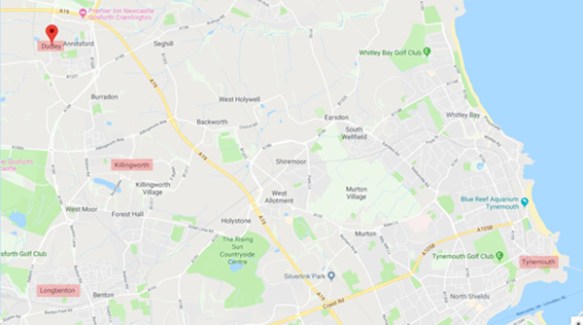
Untangling places, parishes and Registration Districts

Jonah Shepherd was born in Yorkshire but in the late 1850s moved with wife Alice and daughter Jane to Germany.  They were still in Germany in 1872 when Jane married.  However, around 1873, Jane and her new German husband moved, first to London and then to Northumberland, after which their lives are well-documented.  Jonah’s German-born son, Christopher, is also to be found in Northumberland, in records from 1881 onwards.  But Jonah and Alice seem to disappear.  The only (online) indication that Jonah may have returned to England is several death records in Northumberland in 1889.

Bearing in mind that the last positive placing of Jonah was 17 years earlier in Germany, my only reason for thinking he may be in Northumberland is that his adult children are there.  The search is complicated by the fact that the series of death records I see are all in the same year but in different places: Tynemouth, Killingworth, Longbenton.  Could any of these be the man I was looking for, and if so, which one?

The answer is that they are all correct.  Killingworth (St John) is the church where Jonah was buried.  Before 1837 (pre-civil BMDs) the parish would have been the only place where his death (burial) was recorded.  But since 1837 the death is officially recorded at the relevant Registration District, and in this case that was Tynemouth.  Longbenton was the actual place of death given on public online trees by other people researching this family, but without further information I still couldn’t be sure this was my man.  Hoping that a known family member would be recorded as the informant, I sent for the death certificate, and I was in luck: Jonah’s son Christopher registered the death.  But I had another surprise too: Jonah actually died in yet another place: Dudley, which falls within the Longbenton sub-Registration District (where the death was actually registered), the Killingworth ecclesiastical parish and the Tynemouth Registration District!

One person, one death, four places of death; and all of them correct, depending on the focus of the record.

You may be absolutely certain that your ancestors lived in Village ‘X’, but the actual parish may be centred on an adjacent village ‘Y’, and it is here that, prior to 1837, the main BMB (Baptism, Marriage, Burial) record will be recorded.  Of course, even after 1837, people were still baptised, married and buried in churches, so you’ll still need to be aware of the connection between your ancestor’s abode and the nearest parish.  However, any such religious rites will now form a (very useful!) secondary record: since 1837 the introduction of civil BMDs means that the official record of all Births, Marriages and Deaths will be under the Registration District within which the event took place.

So which place should we record?  I record them all, but in slightly different places.  This is how I do it:

For civil birth and death registrations after 1837:
I copy the information directly from the General Register Office website. I then paste this into the notes section of the birth or death event on that person’s profile page, amending it by inserting the word ‘age’ for deaths, and the phrase ‘mother’s maiden name’ for births.  So this is what it says for Jonah:
SHEPHARD, JONAH, age 60. GRO Reference: 1889  M Quarter in TYNEMOUTH  Volume 10B  Page 147

However, if I do buy the certificate or if, through any other means (e.g. cemetery record, family documents), I know the actual residence at time of birth/death, I record that as the person’s place of birth/death.  For Jonah this is ‘Dudley’, or ‘Dudley, Longbenton’.

Parish records:
These generate a new event relating to a religious rite:

  • a baptism, which is not the same as the birth,
  • a marriage (plus banns),
  • a burial, which is not the same as death.
  • (Note: If you’re lucky, the vicar will also have recorded the actual date of birth or death, and you can insert these into the appropriate place on your ancestor’s profile.)

For these BMBs, I record the place where the event took place, and below that, in the event notes, I record any other information to be found on the relevant record.  For example:

Joseph Lucas was baptised at Mill Hill Chapel in Leeds in 1754.  That’s the place I record on the baptism event, and it would be tempting to record ‘Leeds’ as place of birth.  However, the record itself reads: ‘Joseph ye son of Nathaniel Lucas and Sarah, of Woodhouse’.  I transcribe this and add it to the notes for the baptism. This now also becomes evidence for Joseph’s actual place of birth, which is not Leeds as the baptism record set might have us believe, but Woodhouse (now very much part of Leeds, but in 1754 this was a separate village).  Woodhouse and Leeds are less than a mile apart, and some might think this is splitting hairs, but having this exact place of birth information for Joseph helped me solve a mystery relating to his origins and later apprenticeship and marriage.

All this applies whether the parish record is dated before or after 1837.  After that year you might use a combination of these parish and civil records to end up with several places, as I did with Jonah, but the basic fact remains that they can all be separated out:

  • Joseph’s place of birth was Woodhouse, and his place of baptism was Leeds, Mill Hill Chapel.
  • Jonah’s place of death was ‘Dudley’ or ‘Dudley, Longbenton’, his place of burial was Killingworth Saint John, Northumberland, and his death was officially recorded at Tynemouth.

In my next post I’ll share some really useful online resources to help you find parishes and Registration Districts, and to work out their boundaries.

The many historic parishes of Norwich (and other fine cities)

Years ago, someone told me Norwich had 52 churches (one for each Sunday of the year) and 365 pubs (one for each day of the year).  An interesting fact I probably would have thought no more of, had it not been for discovering my own ancestral roots in that beautiful city.

My 3xG grandfather, Thomas, was from Norwich, and it was there that he met and married my 3xG grandmother (not a local).  They had five children before moving to Yorkshire, where a further nine children would follow.  In the 1861 census their daughter Emily, now in Leeds, gave what at first I considered a strange response to the question about place of birth: ‘Norfolk St Martin Norwich’.  A church…?  Why on earth would she give as her birthplace the name of the church where, presumably, she was baptised?

I suspect some of you will already know the answer – particularly if you have ancestral or other connections to historic towns like Winchester, York and Exeter.  But to me it was a puzzle; and to find the explanation we first have to go back to the 11th century.  It seems towns which developed at that time tend to have many small parishes, while those developing just 100 years later are more likely to have one large parish.

Norwich dates from Saxon times.  At the time of the Norman Conquest it was one of the largest towns in England with a population of over 5,000.  When the city walls were built (1280-1340), enclosing an area a little over one square mile, the population had increased to 10,000 people.  And yet, records show that there were around 58 churches – far more than required to accommodate the worshipping needs of a population that size.  A fascinating map, created using contemporary documents, shows the original churches of Norwich existing during the 13th century or earlier.

This was of course before the English Reformation.  The Church of Rome had taken hold, but the old ways of thinking were not yet forgotten.  This preference for many parishes may be explained by the practice of cults of specific saints, each bringing protection in the event of specific circumstances.  Hence the greater the number of saints venerated, the greater the protection.  Note too, the number of churches dedicated to Anglo Saxon or Celtic saints – e.g. Edmund, Etheldreda and Ethelbert (actually East Anglian), Cuthbert, Swithun.  There is comfort and strength in familiarity.

Those pre-13th century churches are not the same buildings that exist today.  Their present-day counterparts were mostly built in the 15th century.  I’ll say more about them in a later post, but an 1819 map shows that they were built on the same sites and tended to retain the same dedications.  As you can see, as at 1819, only 36 churches are shown.  Several had been demolished in the 16th century.  Prior to that there had at one time or other been as many as 63.  The number of pubs given in that old local saying is inaccurate too: there were, at one time, more than 500.  So, for balance, I give you an 1892 Drinker’s Map!

Of course none of this explains why my 3xG aunt Emily felt the need to record the scene of her baptism on the census.

The answer is all connected with the topic of my last post: the parish.  If I had only known it back then, Emily was flagging up that, at the time of her birth – 1829 – it was the parish that had responsibility for recording the population, and in so doing it exercised not only spiritual but also secular control.  In Norwich, as in Lincoln and York (47 parishes each), Oxford (20 parishes), Exeter (29), Thetford (22), Winchester (57), Canterbury (17) and the City of London (a whopping 126 parishes in the square mile!) it really would have mattered which parish you had been born in, or had in some other way since birth achieved legal ‘settled’ status.  It was the parish where you had settlement rights that had a duty to provide if you fell on hard times.  Even though my 3xG aunt Emily had long since left Norwich, it would have been natural to think of her origins not in the city as a whole but in the Norwich parish of St Martin at Oak.

That list of towns in the paragraph above is not exhaustive.  You may have ancestral ties to another town with a similar parish arrangement; and if so, what follows applies to your research too.

For us as genealogists, there are two points to come out of this:
The first is a bit of a pain.  It was the individual parishes that kept records, and these records are still arranged at county record offices by parish.  Therefore if you find yourself in the local archives looking for 18th century records relating to an ancestor from Norwich, York, Lincoln, Exeter, London, etc you may have to look through many sets of parish records before you find them.  (I do indeed have an ancestor known only to have been born in ‘London, Middlesex’, circa 1816….. horrors!)  Even if you have information, if your ancestor moved around within the city, you may have to look at the records of several parishes.

The second point is much nicer.  Clearly, these parishes covered a very small, if densely populated, geographical area.  In the absence of records with street names and addresses, through these various sets of parish records we can see more or less where our ancestors lived at different stages of their lives.  Hence I can use baptism, marriage and burial records to see that my 4xG grandmother, Hannah, was born in Norwich in St James Pockthorpe, was living in St Peter Mancroft when she married, and thereafter lived in a total of five parishes all within a quarter of a mile of that, eventually dying in the parish of All Saints.

One final point – and maybe it’s just me – but I love the names of these old churches!  They tell us so much about the history of the place, from the Anglo-Saxon and Celtic saints outlined above; to St Mary Unbrent: properly called ‘St Mary in combusto loco’, or ‘in that part of the city burnt in the great fire of 1004’; to St John Maddermarket – one of my favourites, since it refers to the market selling madder and other natural dyestuffs for use in the local production of woollen cloth.

PS. I’ve started a new category with this post: Intermediate genealogy skills, since I think if you get to the stage of researching parish records in the county archives you’ve definitely moved on from Beginner.  Whatever stage you’re at in your family research – happy hunting!