Researching military ancestors

As genealogists we’re all about honouring our ancestors, so it’s inevitable that when November comes around, thoughts turn to Armistice Day.  With this in mind, I was asked by my friend Jules to write about finding military records.  It’s a huge area, so I’m going to concentrate on Army records for the ranks in more recent conflicts, because that’s where I have most experience.  If your ancestor was a rank and file soldier in the First World War or the Boer War I hope you’ll find what follows useful. If the person you’re researching falls outside this narrow scope (e.g. they were in the Army but as an Officer, or in the Navy, etc.) I hope you’ll still find something of interest.  The records will be different, and arranged differently, but I hope that having seen the kinds of record discussed here, you’ll be able to look for equivalents, either with your genealogy subscription site or by getting to know what records exist at The National Archives (TNA).  I’ll talk about TNA at the end of this post.

If the person you’re researching served in WW2 it’s more complicated.  For reasons of confidentiality, you won’t be able to get hold of your ancestor’s WW2 record unless they are deceased and you are next of kin.  It’s a little easier if your person of interest has been deceased more than 25 years.  Find out how to get hold of WW2 records here.  There’s a charge of £30 for each record.  I’m sure that eventually these records, too, will be digitised and online, but not for at least another twenty years.

Today I’m going to look at the range of records and other information we might be able to use to start to understood our military ancestors’ experiences.  I’ll follow this up in my next post with a few case studies showing how I’m using these diverse information sources in combination to build a picture of the military careers of my family members.  And finally, I’ll draw November to a close with a post about Commonwealth War Graves Cemeteries.

What records exist, and where are they?
Many records exist about our military ancestors.  Most of them are held at The National Archives (TNA) and only a small proportion have been digitised for online availability through subscription sites.  There are also museums and archives dedicated to each of the services, and to specific army regiments.  A list of all the army museums is available at the Army Museums Ogilby Trust website.  A quick note about the Navy: the naval ‘equivalent’ to the regiment is the ship, so a sailor’s record includes lists of ships, dates and destinations.

It’s likely that your search for information about any military ancestor will begin online, using your subscription website.  However, what I hope to demonstrate is that you can still learn a lot about your ancestor’s experience even if the main person-specific records are not available.

At FindMyPast start by clicking on Search on the top menu bar, then select Military, Armed Forces and Conflict and enter the name and other details in the search form that appears on the next page.  You can further refine your search using the sub-categories listed at the left of your screen.

At Ancestry.co.uk start by clicking on Search on the top menu bar, then select Military.  On the next page you’ll find a search form, or you can further narrow your search by selecting a sub-category from the upper right sidebar.

When you’ve exhausted what these general searches have to offer, you could try more targeted searches, particularly on Ancestry (the better search engine on FindMyPast is likely to find all the available records using the search method outlined above.)  For a more targeted search on Ancestry, try browsing the specific data collections listed in the bottom left sidebar on that search form page, or by clicking on Search on the top menu bar, selecting Card Catalogue, and searching with a title or keywords.  Both these subscription websites have a lot of military collections.  If you use a different genealogy site, it will help you a lot to know how to do these types of targetted search on there.

What types of record might we find?

The Service Record
This should include attestation (joining up) papers, discharge papers and a summary of activity and conduct during the years of service.  This is the one we all hope to find because it will include a physical description as well as some information about family and civilian life, promotions and demotions, and the soldier’s service number.

However, not all service records have survived.  Sadly, about 60% of WW1 service records were destroyed during a bombing raid in 1940.

If the Service Record for your ancestor isn’t available, all is not lost.  You can still learn a lot about their military experience provided you can find their regiment and battalion.

Commonwealth War Graves
If your ancestor was killed in action during the First or Second World Wars they will be commemorated on the Commonwealth War Graves Commission (CWGC) website.

You’ll be able to search for them just by name or by advanced search.  If you’re planning to visit the cemetery, the information given even includes the exact location of your ancestor’s grave or commemoration tablet.  It will also include the regiment, battalion and soldier’s service number.

Soldiers’ Wills
If your ancestor died while serving in the British armed forces between 1850 and 1986, you may be able to obtain a digitised copy of their Soldier’s Will at the government’s online Find A Will service.  Remember that probate is not necessarily granted in the year of death, so if you can’t find what you’re looking for, try a year or two afterwards.

Unfortunately, not all the Soldier’s Wills have survived.  I found the will of one of my great uncles but not the other.  The accompanying notes, made at the time of processing the will, include the regiment, battalion and service number.

Medal rolls
Apart from details of medals awarded, medal rolls include name, regiment, rank and service number.  However, unlike the CWGC and the Soldiers’ Wills, there are no other identifying features (next of kin, etc), so unless the soldier’s name is unusual, you do need to know regiment or regimental number before you can be sure this is the right person.

Regimental War Diaries
Although as genealogists we love to find personal records about our family members, once we have the basic information about their regiment and battalion, we can learn a lot about their experiences by reading the regimental war diaries.  I found two regimental diaries online (here), and was able to follow the movements of my two great uncles right up to their deaths – although their names don’t appear in the diaries.

The National Archives
After exhausting all the available online records you could move onto the National Archives.
As mentioned above, it’s a huge archive, and you’ll find records there that are not (and probably never will be) available anywhere else.  The online search facility takes a bit of getting used to, but it’s worth the effort (and not just for military records) to learn how to use it, and how the records are arranged.

From the Home page you can click on Search the catalogue to search by name, but you’ll get far better results by doing a more targetted search, by which I mean narrowing it down to a specific collection, or ‘department code’. For example, the War Office records collection have the prefix WO, while Admiralty are recognisable by the prefix ADM.  Specific types of record are then assigned a number, so WO 97 is where you’ll find Chelsea Pensioners British Army Service Records 1760-1913; Royal Navy Officers’ Registers of Pensions and Allowances 1830-1934 are at ADM 23, and so on.

If you find any of these records using FindMyPast you’ll see this TNA reference on the citation under ‘series’, along with the exact reference for the document.  But if you’re trying to search for new records on TNA website, how do you know what department and series codes to use?  Well, you’ll find them (and lots more information) from the Home page if, before starting your actual search, you click on Help with your research.  This will enable you to home in on relevant categories, such as:

  • First World War
  • Second World War
  • Military and maritime

Click on one of these categories to refine your search, and then select from the range of focused topic guides.  Each guide will give you an overview of what records are kept by TNA, whether or not they are searchable, whether they may be viewed at TNA online, or perhaps through Ancestry or FindMyPast, etc.  Sometimes a visit to the archives at Kew (or paying for copies to be sent to you – which is very expensive) is the only way to see the records.  Amongst my treasured finds is a huge file about my great granddad’s medical record and military pension, which I was able to browse and photograph, including letters written by him.  It was far too personal to ever be included online.

Other ideas:

Family memorabilia and heirlooms
If you’re lucky you might have some cherished heirlooms that have been passed down in your family: medals, regimental publications, Soldier’s Small Book, a ‘death penny’, photos, letters and Christmas cards, etc.  By really looking at these you might be able to pick up other information.  (More about this in my next post.)

Visiting the graves and battlefields
If your ancestor/ family member was killed in action there will be a grave or a memorial on or near the battlefield.  It’s also likely that tours by knowledgeable local historians will be available.  You can learn an awful lot about their experience by joining one of these.

Wider reading about military history and specific battles
and
Films and documentaries relevant to your ancestor’s experience
When you know where the person you’re researching was on active service, you might find it interesting and enlightening to read relevant military history books or watch films and documentaries.

Evidence: part 2

In my last post I wrote about different types of information that we might draw upon to build our family trees: original and derivative records, and primary and secondary sources.  If you haven’t read that post, you might want to read it now.  Today’s offering builds on it, by considering:

  • How can we use these types of evidence together to build a conclusive case?
  • When can we be sure we really have the right person and the facts straight?
  • How much evidence is enough?

There is no straightforward answer.  Some advise you should aim for three pieces of evidence.  I don’t agree.  Sometimes one piece of evidence is so conclusive it’s all we need.  Quality is more important than quantity.  Other times we find ourselves conducting an ongoing investigation that can take years.

What follows is two case studies that illustrate my own experience of building a hypothesis, finding possible answers, and eventually finding that one final, convincing piece of information.

Case study 1: Who are Joseph’s parents?
As an inexperienced genealogist I came to a brick wall with one of my lines.  My 3x great grandfather was Joseph Lucas, and census records indicated he was born around 1787.  Joseph’s baptism record provided his father’s name – also Joseph – and from there I was able to find Joseph senior’s marriage, his wife’s name (Anne) and the names of all their children.  Since Joseph senior died before censuses commenced I had no way of knowing his age.  Several Joseph Lucas’s were baptised in the parish, all within a few years, and any one of them could have been my Joseph.  With nothing to indicate the name of his father, how could I narrow them down?

One of the potential baptisms, in 1754, interested me because of the father’s name: Nathaniel. My 4xG grandparents, Joseph and Anne, had a son with the same name.  Checking all the children of this older Nathaniel and his wife Sarah, I found that alongside their son Joseph (potentially my 4xG grandfather) they too had named a son Nathaniel.  In fact, six of my Joseph’s twelve children shared names with the children of Nathaniel and Sarah.  Given the importance of naming traditions, I thought I was on to something.  But there was a catch.  That 1754 baptism was Nonconformist.  What’s more, Nathaniel’s family lived at the opposite side of Leeds from where I knew my Joseph raised his family.  Two far more experienced researchers insisted I was wrong, one on the grounds of the Nonconformity; the other citing geography: ‘These are the Woodhouse Lucas’s; ours are the Hunslet Lucas’s.’  Consulting online trees, I could see that this was a problem no one had solved.

This coincidence of names was too much for me to let it go, but it was only a hypothesis, requiring further proof that I didn’t have.  I did add Nathaniel, Sarah and all their children as the family of my 4xG grandfather Joseph, but knowing that others thought I was wrong, I didn’t want to take the line back any further.  I left it for several years.

By the time I came back to look at this line I was more experienced, knowledgeable and confident.  This is what happened next:

First, I found the baptism of Joseph’s wife, my 4xG grandmother, Anne.  Her father was called Leonard… the same name she and Joseph gave their first son.  So if they named their first son after Anne’s father, surely their second son, who was Nathaniel, was indeed named after Joseph’s father…?

Next, I found a record for Leonard senior on the Register of Duties Paid for Apprentices’ Indentures, 1710-1811.  Anne’s father Leonard, it turned out, was a master tailor… just like Joseph was.  Might Anne and Joseph have met as a result of Joseph learning his trade at the side of Anne’s father?  I’ve never found a record proving that Joseph was apprenticed to Leonard, but from wider reading I knew it was not uncommon for apprentices to marry the master’s daughter; and Joseph’s marriage to Anne is at exactly the right time to coincide with the end of Joseph’s apprenticeship.

Consulting a map of the period, I could see that Leonard’s home in Chapeltown was less than a mile from Woodhouse where Nathaniel and Sarah were raising their family – a reasonable distance for their son to walk daily during his apprenticeship.

Initially, the baptism records I used for Joseph and Ann’s children were transcripts, found on FamilySearch.  Now I found the originals on Ancestry.  Looking at each one, I now saw that the earlier children were born in Chapeltown, consistent with the couple living with Leonard while Joseph developed his skills following apprenticeship.  Using these same baptism records, I was able to work out exactly when Joseph and Anne moved from Chapeltown to Hunslet, which is where Joseph set up his own business, and where their descendants would remain for the next few generations.

There was no longer any doubt: my 4xG grandfather Joseph Lucas is the son of Nathaniel and Sarah Lucas, baptised in a Nonconformist chapel in 1754; and later abandoning that practice.  All of this was worked out using primary sources: the original records (baptism, marriage, apprenticeship) and the map.  Initially, the derivative records (transcripts of the baptism records) gave me sufficient information to develop my hypothesis, but had not provided the detail that enabled me to see where Joseph and Anne were living when each child was born.  That alone would have provided some important evidence (that Joseph was not originally from Hunslet) when I first started to formulate this hypothesis.  Wider reading, including an understanding of the apprenticeship system both generally and in Leeds (where the system was slightly different) enabled me to draw conclusions from the apprenticeship record.

One final piece of evidence has come to light recently: a DNA match with a distant cousin further back along the line from Nathaniel and Sarah.

Case study 2: The Symondsons of Starbotton
My 8x great grandfather is Thomas Symondson.  He married my 8x great grandmother Agnes at St Mary’s church in Kettlewell in Yorkshire’s Wharfedale on 19th February 1674/75, and their first child, my 7x great grandfather Lister Symondson, was baptised in the same church on 21st July 1678.

Thomas’s own baptism cannot be found.  Based on his marriage year of 1674/75, a birth year around 1645-1655 seems likely.

Looking at other online trees connected to Thomas and Lister, one tree in particular caught my attention.  It was compiled by someone with a wide interest not just in this family but in the whole of the area known as Wharfedale.  Over time, this person is working through every register from all parishes within Wharfedale, and transcribing them.  The result is not only an online tree at Ancestry, but also a dedicated (free to use) website including every person ever traced within Wharfedale (all 408,794 of them!) and a list of their key life events with dates.  A life’s work indeed, and of the highest quality.  In other words, everything on the tree and the website has been compiled from original records (primary sources), but what I was seeing was derivative.

On this tree and related website, Thomas is listed as one of five sons: Lawrence, born 1639 in Giggleswick; Christopher, born circa 1640 in Kettlewell; Lister, born 1641 in Gisburn; then Thomas himself, born circa 1649 in Kettlewell; and finally Anthony, born 1656 in Kettlewell.  Baptism records for Lawrence and Lister indicate that the father is Christopher Symondson.

From wider reading (secondary sources) I knew that the period in question was a turbulent one in English history.  Referred to as the Interregnum, it is the period commencing with the execution of Charles I in 1649 and ending with the Restoration of Charles II in 1660.  During these years responsibility for the registration of births, marriages and burials was removed from the clergy and given to a ‘Parish Register’.  With the Restoration of the monarchy in 1660, the clergy resumed their role in keeping the registers.  However, many of the registers of the Interregnum were not handed back to the incumbent or, regarded as invalid, they were destroyed.  The result is that although some of the records of the period survive, many do not.  This is almost certainly the reason for the missing records for this family, and if so they would never be found.

From the records that have survived we know that Lawrence and Lister are brothers, and their father is Christopher Symondson.  It is also clear from naming patterns that there is a family connection between this Christoper, Lawrence and Lister, and my 8xG grandfather Thomas, who would go on to name his own sons Lister and Christopher.  But is that relationship one of father/son/brother?  Or could it be a little more distant, for example cousins?  What I needed was some form of 17th century evidence that would magically link Thomas to any one of Christopher, Lawrence or Lister, as their son/brother.

Reader, I found it!  🙂

Lister left a will.  On 23rd February 1693/94 Lister willed his entire estate to his wife Mary, and after Mary’s death to their only daughter Barbary.  In the event of Barbary’s death without issue, the estate would pass (with some conditions attached) to ‘my brother Thomas Symondson and his heirs’.  The will was signed in the presence of three men, each of whom signed or left his mark.  These three men included Thomas Symondson.  (As a potential beneficiary of the will, today this would render the will invalid, but it seems in 1693/4 this rule had not yet come into being.)  As luck would have it, I already had a sample of my 8xG grandfather Thomas’s handwriting.  In 1678, at the time of his son Lister’s baptism, Thomas was churchwarden and it was he who prepared the Bishop’s Transcript of all baptisms, marriages and burials in the parish for that year.  I therefore have a whole page of his handwriting, together with two samples of him writing his own name – once to indicate the father (himself) of the baptised child Lister Symondson, and then to witness the truth and accuracy of the register.  By comparing the handwriting on these two original records I can see that the Thomas Symondson who witnessed his brother’s will and the one known to be my 8xG grandfather is the same man, and by extension, my 9xG grandfather is Christopher.

*****

One final note: I wouldn’t want to you to think all my genealogical problems are solved.  In these two examples – and many others – perseverance paid off.  But I do have many more examples of brick walls that have so far proven insurmountable.  Some of them will eventually be solved, I’m sure, but sometimes we do have to accept, finally, that the records no longer exist.

Evidence: part 1

Last time I wrote about a family history document written several decades ago by a distant cousin and passed to me very recently by her nephew.  Although full of mistakes, it was still of much value to me.  Firstly, my own research broadly agreed with the names and places mentioned, and where there were discrepancies I was confident that these were down to my late distant cousin mis-remembering family stories: my research was correct. Second, although her claims about past wealth cannot be borne out by evidence so far available to me, there were sufficient verifiable facts that some aspects are worthy of further investigation.  And finally, the more recent accounts, which related to my great grandfather, his birth mother and their families, were essentially family gossip, things I would never learn by reading official records.  These are the parts of her story I value most.  I learned a lot about my great grandfather.

Following on from that, I thought it worthwhile to look a little deeper at different types of evidence, why some carry more weight than others, and how there can nevertheless be value in all.

Historians make an important distinction between primary and secondary sources.  As genealogists we tend to focus more on the distinction between original and derivative records.  And yet there is overlap between all of these categories.

Primary sources are created at the time of an event, or not long afterwards.  For us as genealogists these include original records from official sources, such as:

  • birth certificates
  • baptism records
  • marriage records
  • death certificates
  • wills
  • property documents, e.g. deeds
  • apprenticeship records
  • court records
  • 1911 census (and subsequent censuses, as they are released)

but they will also include such things as:

  • photographs of people and places
  • letters
  • memoirs
  • diaries
  • spoken accounts by people who played a part in the event

Secondary sources tend to be published works in which the author describes, summarises, discusses or in some way draws upon information gathered from other sources (primary or other secondary).  A secondary source may be produced many years after an event, and the author may have had no physical connection whatsoever with the original event.  Examples might include:

  • historians’ texts based on research about a person, locality, event or period of interest
  • literature contemporaneous to the events, e.g. Dickens, Elizabeth Gaskell
  • modern historical novels and films based on sound research

One advantage of such sources is that the author can benefit from an overview.  S/he may know and understand much more than any one particular individual could have at the time.  There is also the benefit of hindsight, not to mention objectivity.

Derivative records are records created after the event but based directly on an original record.  As such, there is scope for error, based on illegibility of the original text, carelessness, or anything in between.  Examples we regularly come across include:

  • transcriptions of original records
  • indexes of record collections
  • census records, 1841-1901
  • Note that a photocopy of an original document remains, for our purposes, an original.

So far everything seems quite straightforward, but the picture is not quite as clear-cut as it seems.  Let’s consider some anomalies and grey areas.

Why is the 1911 census an original record, yet the earlier ones are not?
Since you’re reading this blog, you almost certainly know that when we find the 1911 census return for one of our ancestors, we see a single sheet completed by the head of household and relating to the members and accommodation of that household.  Undoubtedly, this is an original record and primary source.  By contrast, for the earlier censuses what we see is a long list of all residents in a specific locality, arranged by household, and organised according to the route the enumerator took as he walked from house to house, collecting the information.  You might have explained this difference with reference to the illiteracy rates: that since a great many people were unable to read and write, the enumerator simply arrived on the doorstep and wrote down the information he was given.  But this is not true.  Individual records were created for each property, and this was then transcribed onto the lists we see today.  The original sheets were destroyed.  In other words, all we have left for these earlier censuses is the derivative record.  This might explain some inconsistencies.  Off the top of my head: my great grandfather George appears as Enoch in the 1891 census.  Was this a mistranscription, or did George object to nosy-parkers coming to ask him questions?  My great grandparents’ second child is referred to in the 1881 census as Jane (female).  He was actually John, a boy.

Birth, Marriage and Death certificates: Are they original records?
You would think so.  But no, they are not necessarily so.  Imagine yourself registering a death in 1851.  You would go to the local Registrar’s office.  They would record all the information, give you your copy, keep the original for themselves and then send a third copy to the General Register Office in London.  Of course, there were no photocopiers: the only way to do this was to write it out by hand.  In other words, when we buy BMDs online from the GRO, what we receive is a facsimile of a copy of the original record, i.e. a true copy of a derivative record, and not the original itself.  You can choose instead to buy your BMDs from the local Register Office.  However, some don’t offer this service, while others don’t have the capacity for creating facsimiles of the originals: what we receive is a modern handwritten or typed copy of the original – again, a derivative record.  Perhaps this might explain an odd discrepancy you may have come across?

Bishop’s Transcripts: are they original or derivative?
BT’s are an interesting grey area.  They are the copies of parish registers that, from 1598 until around 1800, church ministers were required to keep and send annually to the diocese office.  Even if a parish’s records from this period have not survived, there is the chance that the BTs have.  They are contemporaneous with the originals, and if not actually written in the hand of the cleric, then at least by a churchwarden who may have known the individuals involved.  As copies, strictly speaking they are derivative records and may contain transcription errors.  However, sometimes they contain more information than the originals, and are often invaluable in providing a second chance in deciphering 17th or 18th century handwriting.

Are original records necessarily correct?
No.  Even an original record can only be as good as the information given in the first place.  In past centuries many people would have had no idea how old a deceased person was.  Any inconsistencies between age at time of death and the age you know to be correct can often be put down to this, provided all other details are correct.  Equally, sometimes false information is knowingly given, such as the tweaking of an age for a marriage, the falsification of marital status for a bigamous ceremony, and the pretence of marital status on birth registrations when the parents are not in fact married.

Think also about what is ‘truth’.  A contemporary newspaper report might be considered an original record.  We can expect a court reporter to faithfully summarise what happened during a trial.  But what about a war correspondent?  Their reports would inevitably be limited by what they actually saw and knew, what they felt was suitable for public retelling, and all this within the context of government censorship.  Is it true if it is not the full truth?  Is it of value nevertheless?  Yes, because all of these limitations are part of the context.

Indexes
The wonderful thing about online genealogy sources (Ancestry, FindMyPast, FreeBMD, etc) is that the records are indexed.  As a result they are very easy to find.  We just type in a few key facts and we’ll be rewarded with a selection of possible records.  So much easier than going to the local County Records Office and sifting through decades of data stored on microfiche.  However, the indexes themselves are a derivative record: a list of each individual record to be found within the source.  As such they can and do include errors.  My great grandfather, born in Leeds, is indexed on the FMP 1911 census index with a birthplace of Scotland.  Consequently, it took me from 2011 until 2018 to find him.  I have also found a very clearly written ‘Alfred’ listed on the index as ‘George’, and indeed an entire collection indexed under Northamptonshire rather than Norfolk.  (When straightforward searches fail to return results, try searching instead for another family member – the one with the least common name.)

Contemporary values, ideas and gossip
One of the fascinating things about my late distant cousin’s story was the clarity with which she expressed the prejudices of her time.  While on the one hand expressing pride that a member of the family had been involved with offering assistance to late 19th century Jewish refugees, there was an undercurrent of anti Irish / Roman Catholicism.  This distinction does seem to be in keeping with other vibes I’ve picked up from this period in my home town.  In this respect the issue of truth and accuracy can sometimes take a back seat, in the sense that while we need to know the facts, in order to understand the society of the time, we also need to know what people thought, what they valued, what was scandalous.  Our own 21st century values may be completely irrelevant if we’re trying to understand why an ancestor pursued a particular course of action.  A word of caution, too, about family stories: they are not always true, although from my experience it seems there is often an element of truth in them.

Some conclusions
For us as genealogists it’s the detail that’s all-important.  If we don’t get the names, places, dates and relationships correct, nothing else will be correct.  So for us, seeing the original records with our own eyes is always the goal.

Derivative records are valuable in pointing us to the existence of the original, in providing us with information about the contents, and indeed where the originals no longer exist.  But it’s worth noting when only a transcript has been seen.

Other primary sources enable us to draw our own conclusions about the life and times of our ancestors, while secondary sources add valuable context and aid understanding

Where there are discrepancies: look at the records, step back, and decide for yourself if there is sufficient compatibility with your existing evidence for the discrepancies to be down to human error, misunderstanding, illiteracy or even censorship.  Rather than trying to prove yourself right, try to prove yourself wrong.

Next time we’ll think about how much is ‘enough’ evidence.  I’ll provide some case studies showing how all these types of evidence can be used together to build hypotheses and ultimately to overcome doubts and reach sound conclusions.

Here’s why we should look at online trees!

One of my early posts considered the merits of consulting other people’s online trees.  After outlining various dangers and pitfalls, I explained that I do often look at them, but importantly, everything that goes on my tree has been fully researched and verified by me.  If there are no records to support someone’s information, it will never find its way onto my own tree, other than perhaps marked as a plausible hypothesis requiring more research.

But more recently I’ve been using trees in another way – not to search for names, dates and events, but to try to work forwards from a person I’m interested in to the ‘Home’ person (the person whose tree this is).  If it seems like the tree owner is a direct descendant of my person of interest I sometimes write to ask if they can help me with some family stories or information or even if they have photographs.  Of course I’m always prepared to share what I have too, and although usually all I can offer is my research, maybe I have some interesting stories they don’t seem to have.

Sometimes they don’t reply.  Sometimes they do, but it turns out their connection is not as close as I thought.  I think we both had a good laugh when someone replied to say that yes, my person was on her tree, but he was described by Ancestry’s relationship calculator as ‘the father-in-law of the father-in-law of the great-aunt of her husband’!  I have to say too that on occasion people have been keen to take what I had to offer and then never given me whatever they had in return.

But sometimes I strike it lucky.  Here’s a couple of examples:

*****

My great grandfather, George, died in 1940, but it seemed no photograph of him had survived.  After many years of asking any second cousins I came across, I finally found the tree of a descendant of my great uncle, the son with whom George lived in his later years.  If anyone had a photograph of him, surely she would.

I was right.  But along with a photo of George, she had inherited his entire family album, with photos of our grandfathers and their other brothers together, plus some correspondence with my granddad from his travels with the Army.  Some of the photos helped me to piece together a couple of mysteries.

My new second cousin doesn’t share my interest in past centuries and social history, but she loved all the stories I’ve been able to pull together about the more recent generations; and so in return for these lovely photos we spent a few weeks getting to know each other and sharing what we knew.  We’re still in touch.

*****

A few months back I wrote (here and here) about my unlucky-in-love biological 2x great grandmother, Annie Elizabeth.  The point of the two blogposts was to use her story to illustrate several aspects of marriage law (elopement, bigamy, adultery, desertion, divorce, domestic violence and separation) that had been touched on in my reviews of two books (here and here) by Rebecca Probert.

Alongside those blogposts I wrote a fuller version of the story for my own family.  In that version I questioned, for example, whether there might have been problems at home following Annie Elizabeth’s mother’s remarriage, and if that might have been the reason for the fifteen year-old eloping with someone she barely knew.  I could see that her mother and step-father were living apart by 1871.  I also wondered if Annie Elizabeth’s first child, my great grandfather (another George) who was brought up by his paternal aunt, might have known who his true parents were.  I really thought these were things I would never know.

A few months ago I broke down a brick wall surrounding Annie Elizabeth’s parents, and this new information also included finding a sister, Martha.  Following through on a family tree linked to Martha, I found a descendant.  Bearing in mind that my knowledge of Annie Elizabeth is based entirely on records and documents found through research, to the extent that I didn’t even know if my great grandfather knew she was his mother, surely a direct descendant of her sister would know more.  Perhaps there would even be a photo of this lady whose life I have found so interesting…

The gentleman I wrote to turned out to be my 3rd cousin once removed and the great grandson of Annie Elizabeth’s sister.  He sent me a short family history written by his late aunt Amy – my second cousin twice removed – together with some notes of his own research based on what she wrote.

Now Amy’s family history is not going to get any prizes for accuracy.  It’s full of mistakes and half-truths.  There are people and places that fit with my research, but names are not quite right, and there is a strong suggestion of riches in our lineage that the available facts don’t bear out.  All this is forgiven: she didn’t have access to the records we’re able to take for granted, and her account has value in itself as a testament to the stories that must have been passed down to her.

Having said that, there were some absolute gems of information.  Reading her account, it felt like Amy was reaching out across the decades to verify for me the truth of several of my hunches.  I found that not only did my great grandfather George know that Annie Elizabeth was his mother, but he remained part of the family.  Annie Elizabeth’s mother was known to him as his grandmother.  Regarding my hunch that my Annie Elizabeth may have married in haste to flee an unpleasant home life, Amy describes the stepfather as ‘a rotter’ who, in one of his bad moods, set fire to a wooden chest full of family papers and other treasures, and made his wife and two daughters (Annie Elizabeth and Martha) watch it burn.  As for Annie Elizabeth’s second husband, who would later assault her, and whose demeanour in court did not impress the judge or the news reporters, there is a whole side story about him, his drinking, his ‘swelled-headed’ arrogance and his mean nature, all of which complements the picture I had built in my mind about him, based purely on the records.

There’s still a lot of information to be mined from Amy’s account, and some other things to check out, but I feel so lucky to have been given this little window onto the life of my great grandfather and his birth mother.

*****

I hope these stories will encourage you to think about using online trees in this way.

Targeted searches on Find My Past

Last week’s post was about different levels of ‘taking control’ when searching on Ancestry, and this week we’ll try the same thing on Find My Past.

As with Ancestry, we’ll look at searches in the following order:

  1. A general search from an ancestor’s profile page
  2. A general search from the top menu bar
  3. Narrower searches, focusing on a particular category of record
  4. Focusing right down on one particular record set.

Again, the point is that by increasingly taking control of what your search focuses on, you’re improving the level of your own research.

As with Ancestry, you can follow a lot of what’s written here by working through it on Find My Past even if you’re not a subscriber.  Obviously, you won’t be able to see the actual records.

And finally – if you already know all about general searches and homing in on categories, skip to point 4.  There might be something new for you there. 🙂

*****

In Find My Past, then:

1. A general search from an ancestor’s profile page
Simply click ‘Search’ from an ancestor’s profile.  I’m sticking with my GG grandfather, John Groves, born 1847 in Kinver, Staffordshire, and moving to Leeds, where he died in 1894.  This search returns 6,449 records for my perusal, but there is also a reminder of how many hints I have for this person.  Unlike Ancestry, this search filters only by name and dates, not by place, and only two on the first page of these 6,449 records are correct (although half of the hints are correct).

2. A general search from the top menu bar
From the top menu bar, click on Search, then Search All Records.  An ‘All Categories’ search form opens:


Here, you can input name, years of birth and death, and also a year for any specific event (which might be a marriage, a census year, etc).  For each year, you can instruct the search engine to search for that year exactly, or to search plus or minus 1, 2, 5, 10, 20 or 40 years.  Unlike Ancestry, FindMyPast will stick within those parameters chosen by you.  However, Ancestry allows us to add more events with dates, and a place for each one.  Here on FindMyPast, we’re allowed only one place name at a time.  Since my GG grandfather John lived in different parts of the country, what I have to do is search in stages.  My first search, for Kinver, returns only one record, and it’s not my John.  Changing the place name to Aston, where I know he also spent some time, returns 61 records, of which the first is correct.  Finally, changing the place to Leeds provides 128 results.  Four of the top five are correct.

The main difference here between Find My Past and Ancestry is that FMP does require a more targeted approach from the outset, focusing first on place A and years x-y, then on place B and years y-z, and so on.  Even so, my general searches returned a lot of records.

3. A narrower search, focusing on a particular category of record
Let’s now move to searching by category.  We can start with that first general search from the profile page, but this time when we get to the results page (the one with 6,449 records) we can refine the search using the categories at the left of the screen and by adding in the location.  Remember that in FindMyPast we need to keep changing the location if our ancestor moved around the country, and do a new search.

There are three things to notice:
First, you’ll probably find that far fewer records are returned.

Second, just as we can instruct the search engine to focus on a very narrow or a very wide span of years, we can also broaden the area of search, up to 100 miles from the named location. Although this doesn’t really help me with John, who migrated from one part of the country to another, it’s useful if, for example, you suspect your ancestor lived their whole life in Norfolk, but kept moving around for work.

Third, looking at the menu of categories to the left of screen, we can see how many records have been found within each category; and if we click on any one of those categories we can refine further, seeing exactly how many records there are in each sub-category.  So, for example, for John Groves, dates as above, and a location of up to 50 miles around Kinver, I’m offered 483 results, 4 of which are in the military category, and I can see just by looking at the categories on the left of the screen that these are all Regimental & Service Records.  This really helps us to home in on records that interest us.

As with Ancestry, we can also perform the same search by category from the top menu bar.  Click on Search and then choose your category.  Again as with Ancestry, the next screen will vary depending on the selected category.  For example, the Census, Land & Surveys category has an option to include another household member in your search, and the Travel & Migration category includes departure and destination countries/ports.  There’s also a dedicated category for the 1939 Register.  I’m going to search for John in the Birth, Marriage & Death category, using name, birth and death years, and the exact location Leeds.  There are 10 results: 1 death, 1 burial and 8 marriages.  The death and burial are correct.  Bearing in mind I hadn’t input any year for a marriage, I’m offered 8 likely dates between 1866 and 1893.  One of them is correct: 1874.  However, even though I performed my search in Births, Marriages & Deaths, I can switch to any of the other categories at any time, and I can see at a glance the numbers of records in each of those categories by looking at the list to the left of screen.

4. Focusing right down on one particular record set.
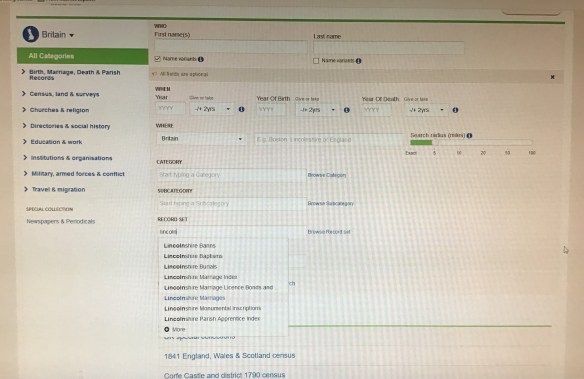
This targeting on Find My Past is very sophisticated, enabling a far more precise search than on Ancestry.  Because of this, I rarely need to home in on a specific record set (the equivalent of the Card Catalogue facility on Ancestry), but if you want to, you can do this.  Start with a search from the top menu bar.  You can do this in All Categories or in any of the individual ones, but for this exercise you’ll get more results if you stick with All Categories.  Towards the bottom of the page you’ll see there’s a box for inputting a specific record set.  You can type in the exact record set name if you know it, or just a keyword.  (Apologies for the image quality – I had to photograph the screen to avoid losing the pop-up record set suggestions when I clicked for a screen grab.)


Start to type in the name of your town, city or county of interest, and see what record sets there are.  You can do this even if you’re not a subscriber, so it’s useful if you’re deciding which subscription service to choose.  Of course, you can only view the actual records if you’re a subscriber.

*****

So, I hope there has been at least something new for you as we’ve looked at targeting our searches over the past two weeks.  And having explored special record sets on Ancestry’s Card Catalogue and on Find My Past, I hope you’ve found something interesting to help you progress your research.

Targeted searches on Ancestry

In a previous post we looked at the usefulness of hints as a way of finding records, as well as at the difference between Ancestry and Find My Past, in terms of the quality and focus of hints.

What I want to move on to now is searches instigated by you, the researcher.  We’ll look at this over two posts, this week focusing on Ancestry, and next week on Find My Past.  In each post we’ll consider searches in the following order:

  1. A general search from an ancestor’s profile page
  2. A general search from the top menu bar
  3. Narrower searches, focusing on a particular category of record
  4. Focusing right down on one particular record set.

What I’d like to draw to your attention is that, by increasingly taking control of what your search focuses on, you’re increasing the level of your own research.  You’re saying ‘I already know all about X, Y and Z, but I have a gap around A and B, and this is what I want to try to find out.’  This moves you on to intermediate level genealogy.

By the way, you can follow a lot of what is written here by working through it on Ancestry even if you’re not a subscriber.  Obviously, you won’t be able to see the actual records.

And finally – just to say – if you already know all about general searches and homing in on categories, skip to point 4.  There might still be something new for you there. 🙂

*****

In Ancestry then, let’s start with the kind of search most of us do when we’re just starting out as genealogists, or indeed when we’re just starting out with a new ancestor:

1. A general search of all records from an ancestor’s profile page
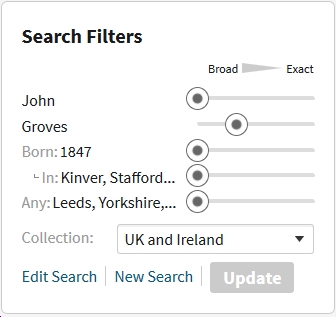
To do this, simply click ‘Search’ from an ancestor’s profile.  The search engine draws upon all the information you already have about your ancestor, using this as filters.  However, Ancestry treats all that information as ‘approximates’, resulting in years, places and even names on suggested records that are often way off beam.  It might also default to ‘Search all collections’ – including all overseas records as well as the UK ones.  And if you try to tighten up the search by moving the sliding scale to the right (see image below) to confirm you really do mean this exact surname, this exact place and year, more often than not it will tell you no matching records can be found.

.

So, from the profile page of my GG grandfather John Groves, a standard ‘Search’ automatically incorporating the search filters shown in the box to the left, returns 93,311 possible records.  Even if I change the filter from ‘All collections’ to ‘UK and Ireland’ only, I still get 34,360 possible records.  And whizzing down the first page of these 34,360 records, only two of them are correct.


2. A general search from the top menu bar
Go to the top menu bar on the screen, click on Search, and select Search All Records from the drop-down menu.  Sticking with John Groves, but this time typing in his name, birth year, birth place and place of residence, instead of allowing the search engine to copy over the info from his profile page, this time I’m offered a whopping 352,536 records from ‘All Collections’, or 127,706 if I amend the collections to ‘UK and Ireland’.

3. A narrower search, focusing on a particular category of record
Those first two searches have their uses, but I think we’ll all agree that a way of narrowing down would be useful.  We can start to do this by focusing on a particular category of record.  Again, we can do this from two places on the website:

If we’ve already started the general search by clicking through from our ancestor’s profile page, immediately below the search filters box to the left of the Ancestry screen we’ll see a list of categories.  Click on any one of these categories and you’ll see further options.  e.g. Click on Census and Voter Lists, and you’ll be offered a selection of decades to home in further; click on Birth, Marriage and Death, and you can select which of these three you’d like to focus on, and after that even specific record sets, and so on.

If, instead of starting with your ancestor’s profile page, you start your search with the drop-down menu at the top left of the screen (the place where we did that second type of general search, above), it works a little differently.  Now, depending on which of the categories you choose from the drop-down menu, you’ll be asked to input slightly different information.  For census searches you’ll be asked for name, birth, where they lived and details of family members; whereas for a military search the information required is just name, birth, death and likely years spent in military service.  Even though the number of records returned is still excessive, I find these more targeted searches a useful way of getting to the right record.

4. Focusing right down on one particular record set.
But there’s an even more focused way to search, and even if you already knew all of the above, this is something you may not know about.  You can actually search individual record sets.  The way to access these is from the drop-down search menu on the top menu bar.  Click on Search, and then from the drop-down menu select the second option up from the bottom: Card Catalogue.  This is where you can really get to know Ancestry’s record collections, find the ones more likely to help you and even develop your own favourites!  (Yes, I know that sounds very nerdy.)

So, you’ve clicked on Card Catalogue, and you have this screen (above) in front of you. As you see, you can still use filters (down the left) to help you home in on the record sets most likely to be of use to you.  And if you know the full name of the record set you want, simply type that into the ‘Title’ box.  You can then search just that record set.

But you can also use the keyword search, and this is really useful.  Try typing the name of a town or city of interest to you in that box.  If the town name doesn’t return any records, try the county.  Or you could also try specific words, such as ‘apprentices’ or ‘railway’ or ‘prison’.  Spend some time playing around and see what you can find that might be useful to you

This is one of my favourite functions on the entire Ancestry website, and some of the greatest breakthroughs in my family research have come from homing in on specific record sets and searching them to death!  My two very favourite record sets are Leeds, England, Beckett Street Cemetery, 1845-1987 – which includes so much information about the deceased that I never have to buy death certificates for ancestors buried there; and West Yorkshire, England, Select Apprenticeship Records, 1627-1894 – which includes many of my ancestors from the period and gave me a lot of insights into how apprenticeships worked in Leeds at the time, as well as helping to work out extended family relationships in one of my lines.  These are unlikely to become your favourite sets, of course, but wherever your ancestors were based, I hope you find something that will help you.

You can explore the Card Catalogue even if you’re not an Ancestry subscriber.  Something to bear in mind if you’re thinking of taking out a subscription and can’t decide which provider to go with.

Annie Elizabeth: marital relations masterclass continued

In my last post we left James having bigamously gone through a marriage ceremony with Margaret in 1872.  Margaret and James were leaving Leeds for Manchester.  Annie Elizabeth and her new man, John William, remain in Leeds and by 1881 there have been five more children, although four of them have died.  The family provisions business in the centre of town is doing very well.  However, contrary to all appearances, they are not married.  Annie Elizabeth is, in fact, still married to James.  And this wrankles.

Facts: divorce petition
On 22nd February 1881 Annie Elizabeth swears an affidavit as follows: that she was married to James in 1866 and had borne his child; that in February 1872 he had gone through a second marriage ceremony with Margaret; that this pretend and illegal marriage had been consummated; that James had committed adultery on that day and on diverse occasions since; and that he had deserted her without just cause, ever since leaving her destitute.  As Annie Elizabeth picks up the pen to sign this as a true version of her sworn affidavit, she is seven months pregnant with her seventh child by John William. The divorce petition is officially filed the following day.

James does not contest the charges.  The Decree Nisi is awarded on 5th July 1881 on the basis of adultery plus bigamy.  The hearing, reported over the following two days in newspapers in London, Leeds and Manchester, does include the true reason for James’s absence (7 years penal servitude).  However, the detail surrounding his release is economical with the truth: ‘In 1871 he was returned to Leeds, but instead of going home he went to the residence of another woman […] whom he afterwards married…’  ‘Severe comments’ are made on the conduct of James’s sister Mary Elizabeth who had been present at both marriages.  The Decree becomes Final on 17th January 1882.

Analysis
The hypocrisy, injustice and cruelty of this petition shocked me.  James had a great deal to lose, and although it’s true that he had bigamously ‘married’ another woman, he did so in the knowledge that Annie Elizabeth was with another man and had a child.  In other words, Annie Elizabeth had already committed adultery long before James did.

Only by understanding the contemporary grounds for divorce, was I able to make my peace with Annie Elizabeth.  Until 1923 a woman could bring an action for divorce only on the grounds of adultery combined with an aggravating factor, e.g. bigamy, cruelty, desertion.  Annie Elizabeth had no alternative but to cite bigamy and desertion alongside her claim of adultery.  She was, even so, taking a huge risk: as petitioner for divorce her behaviour must be seen to be unblemished.  Any petitioner found also to be an adulteress/ adulterer would be denied the divorce.  Having by now given birth to six of John William’s children, there could be no doubt that Annie Elizabeth was also an adulteress.

The fact of having the finances to file for divorce also sits uneasily with the claim that Annie Elizabeth has been left destitute.  Although the Marital Causes Act of 1857 had opened up the possibility of divorce to all, the cost of obtaining one remained out of the pocket of the vast majority of people.  The location of the Divorce and Matrimonial Causes Court in London meant that petitioners had to be willing and able to pay travel and living expenses for themselves, as well as respondents and any witnesses.

*****

Facts: Freedom to remarry
Annie Elizabeth and James are now divorced and free to marry.  James, having not contested the divorce, does not celebrate any change in his marital status by legally marrying Margaret, although the two of them will remain together for life.  It also seems there is no trial against him for bigamy.

For Annie Elizabeth and John William, however, the divorce enables them to put their life together in order.  Thanks to the relative anonymity afforded by life in a large, industrialised town, it would have been easy to disguise the fact that they were unmarried.  However, a marriage at this late stage might not go unnoticed.  They therefore marry in Halifax, on 23rd January 1882.  Annie Elizabeth’s marital status is correctly recorded as divorced, but a Halifax address is given as her residence.

Analysis: Why is James not prosecuted?
The criminal act of bigamy (regulated by the Offences against the Person Act 1861) is dealt with separately from the citing of bigamy as grounds for divorce.  By this time the granting of divorce on grounds of bigamy did not necessarily lead to a separate criminal prosecution.  It is, in any event, not in Annie Elizabeth’s interest to have the facts open to further scrutiny.

*****

Facts: Domestic Violence
Back in Leeds, Annie Elizabeth and John William have had more children.  By 1886, excluding George, there have been ten live births, although five of these have died.  All is not champagne and roses…

In March 1887 John William is arrested and charged with having assaulted Annie Elizabeth on three occasions by striking and kicking her.  On 1st and 2nd April, three Leeds newspapers carry reports of the hearing against him for domestic violence.  John William, ‘a respectably dressed man’, is said to have recently been frequently drunk.  His attitude does not endear him to the court: ‘When asked if he had anything to say, the accused replied in a flippant manner, “I have not been my own man.  It’s never too late to mend, is it?”’  The magistrate grants a separation order.  John William is fined £5 and ordered to pay Annie Elizabeth 15s per week.

The separation is temporary.  By March 1888 Annie Elizabeth and John William are reunited, since their final baby is born 31st December of that year.  At the time of the 1991 census they are still together.

Analysis
The Matrimonial Causes Act of 1878 enabled magistrates to grant protection orders to women who were victims of violence from their husbands.  These protection orders differed from ‘judicial separations’, which were granted in the High Court.  However, they amounted to the same thing, giving the woman custody of the children, and frequently including a requirement that the husband pay a regular sum of money to the wife.

*****

I hope this has helped you to see how, by reading around the subject, using the two books by Rebecca Probert, I was able to make sense of this very complicated series of situations Annie Elizabeth found herself in.  I wouldn’t do this amount of work for all my ancestors, but as I’m sure you’ve found for yourself, some of them leap out as having more to say.

As for Annie Elizabeth, John William dies in 1898, leaving her a further 28 years in which she seems, sensibly, to have decided enough is enough.  No more marital relations!

Annie Elizabeth & James: a marital relations masterclass

In this post and the next we have a case study in two parts: a sort of marital relations masterclass courtesy of my ill-starred biological GG grandparents.  I used Rebecca Probert’s books Marriage Law for Genealogists and Divorced, Bigamist, Bereaved to help me clarify the legalities.  I hope it will help you to look at any marital inconsistencies with fresh eyes.  You’ll also see how understanding the law and context of events can (sometimes!) help you see them from the viewpoint of your ancestors.

*****

The marriage
15th Jan 1866: James and Annie Elizabeth are married at St Peter’s church, Leeds.  It’s likely they have known each other only a few weeks: James is not long out of prison, having been sentenced in April 1865 to 8 months for larceny.  Both give their age as 18, but Annie Elizabeth is not quite 15½.  Their only witness is James’s older sister, Mary Elizabeth.  James and Mary Elizabeth sign; Annie Elizabeth (who we shall see from later documents is literate) only makes her mark.

Analysis: Is the marriage legal?
From the perspective of age?
Yes.  Until the Marriage Act 1929 the minimum age for marriage was 12 for girls and 14 for boys.  (After that Act it was raised to 16 for both.)

From the perspective of lack of parental approval?
Being under 21, both Annie Elizabeth and James were minors.  Not until 1970 would the age of majority be reduced to 18.  However, marriage after banns did not require an active, public statement of parental approval.  Rather the dissent of parents during the three-week period of the publishing of the banns would prevent the ceremony from going ahead.  Here, there was no voiced dissent, therefore the marriage was not invalidated by lack of consent.

From the perspective of elements of deceit?
What if James thought Annie Elizabeth was 18?  What about the fact that Annie Elizabeth was able to sign and yet didn’t?  The issue here would seem to be around the concept of ‘knowingly and wilfully’ failing to comply with the law, a concept introduced by the 1823 Marriage Act.  However, if it wasn’t a problem in the eyes of the law that Annie Elizabeth was just 15, then it’s likely that even if James thought otherwise this would not be an issue.  Similarly, although Annie Elizabeth may have been trying to distance herself in some way from the event by not adding her signature to the paperwork when she could have, a ‘mark’ was sufficient for the law.  In any case, we don’t know if Annie Elizabeth did deceive James; and even if she did, the fact remains that the marriage was not contested.  It is therefore valid.

*****

Two lots of nine months
4th June 1866: James is brought before magistrates at Dewsbury, charged with stealing a horse.  He is also ‘wanted’ in Leeds for another similar crime.  On 4th July he is found guilty and sentenced to seven years penal servitude.
At the time of the arrest Annie Elizabeth is about 4 months pregnant.  The baby, George, is born in November 1866.  By this time, James is serving an initial nine months under the ‘Separate’ system at Wakefield Convict Prison.  Designed to ‘break’ new prisoners, this involved keeping the individual in solitary confinement, allowing them to see and speak with only the prison warders.  Possibly he doesn’t even know he has a son.
By the time George is baptised in July 1867, James’s nine months under the Separate system are over and he has moved south for the next stage of his sentence.  Meanwhile, aged just 16, Annie Elizabeth is facing life as a single parent with no support, alongside the expectation that she respect the sanctity of her condition as a married woman.

Analysis: What are Annie Elizabeth’s options?
Could the marriage be annulled on the grounds of the falsifications?
No.  And to attempt to rely on them now could be an admission of perjury.

Might she have considered remarriage? 
There was great confusion at the time about the seven-year rule under which if, after a period of seven years of no contact the abandoned partner genuinely believed their spouse was dead, the marriage could be considered at an end.  Many focused only on the ‘seven years’ aspect of this rule, believing they were safe to marry after seven years living apart.  But a remarriage in such circumstances is always bigamous.  It would not have been a legal option for Annie Elizabeth.

*****

2nd April 1871: the census
James is an inmate at Chatham Public Works Prison.
Meanwhile, back in Leeds:
Little George has a new surname and is listed with his aunt Mary Elizabeth (she who witnessed the marriage) and husband.
Annie Elizabeth is eight months pregnant and listed as the wife of John William.  When their baby is born the following month, she will be baptised as the illegitimate daughter of Ann Elizabeth whose ‘absent husband was transported 5 years ago’.

Analysis: adoption and adultery
At some point between George’s baptism in July 1867 and the census of April 1871, George has been adopted by Mary Elizabeth and her husband.  This suggests he was given up by his mother either because she couldn’t support him, or because the new man in her life refused to support the child of another man.  Prior to The Adoption of Children Act of 1926, such informal adoptions in England and Wales were the norm. 

Has Annie Elizabeth committed a crime?
Not so many decades earlier, Annie Elizabeth and John William would have been hauled before the church courts and punished severely for adultery and fornication.  However, they have not gone through a marriage ceremony, therefore their relationship is not bigamous, and therefore no criminal act has occurred.

*****

James returns
14th December 1871: A Licence is signed for James’s early release: a reduction of 19 months for good behaviour.  He returns to Leeds.  Does he believe Annie Elizabeth will be waiting for him?  Is he shocked to find her with another man and new baby?  Or perhaps the last 5½ years have provided time enough for James to reflect on past errors, and he now wishes to move on with his life?

Analysis: What are James’s options?
Legally, James and Annie Elizabeth are still married.  However, it’s complicated: their son is now settled as the child of his sister and her husband, while Annie Elizabeth is living with another man, with whom she has a baby.  James has two legal options: to ask Annie Elizabeth to return to him, and presumably to accept her child as his own, or to divorce her.

Since 1858 (Matrimonial Causes Act 1857) divorce has been available in England and Wales.  From the perspective of the husband, the only ground for divorce is adultery, which in this case can easily be proven.  On the other hand, petitioning for divorce is far too costly for a labouring man, newly released from prison.  It is out of the question.

*****

What James actually does
14th February 1872: James marries Margaret.  Given the time lapse since his release from prison, they cannot have known each other more than a few weeks.  James gives a false name for his father.  The address given for both on the marriage certificate is Mary Elizabeth’s, where little George, now aged five, also lives.  No doubt James is aware of George’s true identity.
After the ceremony James and Margaret move to Manchester.

Analysis: What crimes has James now committed?
Legally, James has not remarried; rather he has ‘gone through a second marriage ceremony’.  It is that which is the definition of bigamy.  The ‘marriage’ to Margaret has no legal standing at all, and children born of that marriage will be illegitimate.

However, in ‘going through a second marriage ceremony’, James has not only committed the crime of bigamy; he has also violated the conditions of his Licence, which stipulate that he ‘abstain from any Violation of the Law’.  Any violation would result, in addition to any new sentence, in reimprisonment for the remaining months of the original sentence.

*****

The story continues next week…

Marriage Law for Genealogists

Last month I reviewed Rebecca Probert’s book Divorced, Bigamist, Bereaved.  Today’s book, Marriage Law for Genealogists, is by the same author.  The contents are pretty much summed up in the subtitle: ‘What everyone tracing their family history needs to know about where, when, who and how their English and Welsh ancestors married.’  Dealing with marriage law from 1600 to the present day, it applies to our English and Welsh ancestors only because English law doesn’t extend to other parts of the United Kingdom.

The first edition of this book pre-dated Divorced, Bigamist and Bereaved, and you might think it would have made sense for me to read and review them in that order too.  However, I had urgent divorce and bigamy knowledge requirements (which I will outline in next week’s post, a sort of marital relations masterclass provided courtesy of my natural GG grandparents…)

Rebecca Probert is a rare thing: a Professor of Law, the leading authority on the history of the marriage laws of England and Wales, and also a keen genealogist.  She is therefore able to debunk a number of common misunderstandings relating to marriage that have been published in other genealogy texts, and she does that in the first chapter.

One of the most important things I’ll take away from this book is the central point that the authorities actively wanted couples who wished to marry to be so.  There were indeed severe punishments for ‘fornication’, including excommunication (not to mention the eternal punishment in the hereafter), fines, the stocks and whipping. Marriage was also central to the operation of the Poor Law, in the sense that a wife and all legitimate children took their father’s settlement rights at birth.  Illegitimate children, on the other hand, took the settlement not of their mother, but of the parish in which they were born.  A destitute, unmarried family, therefore – even if the father were present – could be resettled in (i.e. sent back to) several different parishes – the father to his, the mother to the parish of her birth, and the children each to the parish in which they were born.  Legitimacy of children was also an important factor if there was property to be shared out after the death of the parents: illegitimate children (even if the parents remained together) would not inherit.  Younger, legitimate offspring would easily succeed in an action preventing the passing of a share of an inheritance to an older child born before the parents’ wedding.  It wasn’t until 1926 that children could be legitimised retrospectively by the eventual marriage of their parents.

So they are the downsides of not marrying; but what I hadn’t realised was that the Law would bend over as far backwards as possible to ensure that those who did go through a marriage ceremony would indeed be considered married, even if the ceremony fell short of certain statutory requirements.  These are dealt with over four chapters:
Who your ancestors married – including mental capacity, bigamy, divorce, same-sex marriage and the ‘prohibited degrees’;
How they married – including banns, licences, civil marriages and non-Anglican religious marriages;
When they married – including age restrictions, parental consent, and restrictions/ preferences for time of day, year and days of the week;
Where they married – including ‘clandestine’ marriages, with reasons for marrying in another parish, marriages at The Fleet, and marriage of English/Welsh nationals in other parts of the world.

I must admit that as I was reading this, at times I wondered what to do with the information I now had.  My concern is with the life and times of my ancestors, not with the impropriety or voidability of a happy union.  Take as an example the section on ‘prohibited degrees of kinship’ (chapter 3).  Contrary to popular belief, English Law has never forbidden marriage between cousins.  However, other close relatives have fallen within the ‘prohibited degrees’, and of course some still do.  These include siblings, parent/child, grandparent/grandchild and marriages between uncle/aunt and nephew/niece.  But prior to the first half of the 20th century the rule didn’t stop there: historically in the eyes of the church, upon marriage a husband and wife became ‘one flesh’.  Consequently, the in-laws were as much a part of one’s family as one’s own parents, siblings, etc.  Therefore in the event of the death of a spouse, remarriage to one of the in-laws from the above categories was also considered incestuous.  Whether such a marriage would be void, voidable or even valid, depended on the year in which the marriage took place – the rules changed several times over the centuries.  As it happens I do have at least two marriages in my tree that fall within the prohibited degrees on account of remarriage after the death of the first spouse to an in-law.  In one of these, I took the fact of being prepared to marry for a second time within the same family as evidence of a good relationship between my great grandmother and her mother-in-law, particularly as my grandmother was named after that mother-in-law (my GG grandmother).  So a happy thing.  I now understand that legally these marriages were void – as though they never happened, and any children of the union were illegitimate.  However, it seems no-one realised, and they died still ‘married’ and probably blissfully unaware that they had been living in sin these past decades.  Really, then – what difference does it make, other than as a saucy bit of gossip – which doesn’t interest me anyway?

I then realised I was looking at this the wrong way.  The usefulness of knowing about such rules is to help us to troubleshoot.  Yes, these two couples in my tree ‘got away with it’ and no harm was done.  But what if your 4xG grandfather Robert marries Sarah and then six months later marries Mary?  No possibility of divorce, no burial record showing for Sarah.  Is Robert a bigamist?  He may be, and it’s also possible that Sarah’s burial record has been lost or mis-transcribed.  But this book gives us the information to be able to think of other possibilities – an annulment, perhaps?  If we know of the rules around void and voidable marriages, when we see something that doesn’t sit easily, we can use our knowledge to start to explore what might have happened.  In this example we could look to see if the marriage might have been within the prohibited degrees, or perhaps there was another reason for an annulment.

One thing I’ll now be exploring is the possibility that some of my missing marriages may have taken place in a different part of the country.  Evidence presented in chapter 6 shows that a surprising number of couples married out of their county of residence, or at the very least in a different parish, perhaps because of a family connection with that parish.

So, to conclude, this is a very useful book, but one you have to work at, and not aimed at beginners.  Not only is it a harder read than Divorce, Bigamist, Bereaved, but also following through on the information presented will require a fair bit of research and thinking outside the box.  That said, it has already resolved a few questions for me; and with an idea of what to look out for, it will be a useful addition to my bookshelf when I need to consult for the detail.

Click the book cover image to find the book on Amazon.co.uk
(Affiliate link)

1752: the year the calendar changed

The Julian calendar was introduced in 45BC by Julius Caesar.  Based on a solar year, it had twelve months, but a miscalculation of 11 minutes resulted in a leap year formula that overcompensated to the extent that every 128 years, a whole day was added.  By the 16th century, astronomical events such as the equinoxes and solstices were falling ten days early, and since the timing of Easter was linked to the vernal equinox, it was increasingly becoming removed from its proper season.  To overcome these problems, in 1582 Pope Gregory XIII introduced the ‘Gregorian’ or ‘New Style’ Calendar.  Not all countries followed suit immediately.  In fact it wasn’t until 1927 when Turkey finally made the switch, that everyone was on board.  However, since the change-over involved cutting ten days from one month in the first year of adoption of the new calendar, countries that didn’t change over were ten days ahead of those that did.

It was in 1751-52, following the Calendar (New Style) Act of 1750, that the UK (and British dominions) adopted the Gregorian calendar.  By this time the UK calendar was eleven days out of sync with the astronomical events and seasons, and these days were removed in one fell swoop in September 1752.  In that year, September 2nd was followed by September 14th.  Many of our ancestors were distinctly unhappy about the loss of eleven days.  There was a genuine fear that their lives would be shortened by that number of days.  They were also concerned at the interference with the Church calendar, particularly with the moving of Easter, and on top of all that they objected to the imposition of what they viewed as the ‘popish’ calendar.  This may or may not have resulted in the ‘English Calendar Riots’ of 1752.  Many historians today view them as a sort of Georgian urban myth.

However, the removal of the eleven days was not the only important change to flow from the Act of 1750, and it is this other aspect that impacts upon us as genealogists.  Prior to 1752 the English year began on 25th March.  This was Lady Day, one of the four Quarter Days, the others being Midsummers Day (24th June), Michaelmas Day (29th September) and Christmas Day (25th December).  I first learned of Lady Day while studying Tess of the d’Urbervilles for English Literature A-level – it was the day tenancies changed and rents were due; and Tess, with her recently widowed mother and siblings, were evicted from their cottage.

Before 1752, then, December 31st and the next day, January 1st were in the same year.  The year continued until March 24th after which, on March 25th, the new year would begin.
The 1750 Act provided for a changeover involving the following series of steps:

  • 31st December 1750 was followed (as usual) by 1st January 1750, and 24th March 1750 was followed by 25th March 1751.
  • 1751 was a short year, running from 25th March to 31st December, then December 31st 1751 was followed by January 1st 1752.
  • Finally, with the removal of the eleven days in September 1752, September 2nd of that year was followed by September 14th.

For us as genealogists it’s the period between 1st January and 31st March in each year before 1752 that can confuse.  If you look at any parish register before this time you’ll see for yourself that the recording year did indeed start on 25th March and end on the 24th.  So if your ancestors married on 1st April 1632 and their first child was born on 1st February 1632, that child was born ten months after the marriage, not two months before it!  You might also have come across unlikely coincidences in record sets such as the birth of Elizabeth to parents James and Mary on 15th January 1732, and another Elizabeth to the same parents on 15th January 1733.  What really happened is that one transcriber amended the date to the Gregorian calendar and the other didn’t.

Historians and genealogists can get around this confusion by using a technique called ‘double dating’.  Any date after 25th March is recorded as usual (e.g. 1st April 1632).  However, any date from 1st January to 24th March is recorded in a way that recognises its position both within the Julian and the Gregorian calendars: e.g. 1st February 1632-33, or 1st February 1632/3.  If you’ve already got your research back to these earlier parish registers, you may decide to use this system.  However!!!! the online trees find it difficult to cope with.  After asking you repeatedly if you’re sure this date is correct, it will accept it but only show the earlier of the two years in the person’s profile.  Be strong!  It’s your tree!  😀

One final aside….
There’s another important side-effect of these changes, and one that remains with us today.  Formerly, being the start of the year as well as the first Quarter Day on which rents were due, Lady Day was also the start of the English tax year.  However, with the loss of the eleven days in September 1752, it was deemed appropriate to delay the collection of taxes to April 5th, thereby avoiding the loss of eleven days of tax revenue. That’s why, following another tweak to the calendar in 1800, the UK tax year starts on the surprising date of 6th April.  And after a quick revision online, I now see that the date in Tess of the d’Urbevilles is ‘Old Lady Day’: 6th April.  Is this an indication that a hundred years after the event, rural England hadn’t fully embraced the new calendar, or did landlords move the day rents were due to coincide with the new tax year…?