The many historic parishes of Norwich (and other fine cities)

Years ago, someone told me Norwich had 52 churches (one for each Sunday of the year) and 365 pubs (one for each day of the year).  An interesting fact I probably would have thought no more of, had it not been for discovering my own ancestral roots in that beautiful city.

My 3xG grandfather, Thomas, was from Norwich, and it was there that he met and married my 3xG grandmother (not a local).  They had five children before moving to Yorkshire, where a further nine children would follow.  In the 1861 census their daughter Emily, now in Leeds, gave what at first I considered a strange response to the question about place of birth: ‘Norfolk St Martin Norwich’.  A church…?  Why on earth would she give as her birthplace the name of the church where, presumably, she was baptised?

I suspect some of you will already know the answer – particularly if you have ancestral or other connections to historic towns like Winchester, York and Exeter.  But to me it was a puzzle; and to find the explanation we first have to go back to the 11th century.  It seems towns which developed at that time tend to have many small parishes, while those developing just 100 years later are more likely to have one large parish.

Norwich dates from Saxon times.  At the time of the Norman Conquest it was one of the largest towns in England with a population of over 5,000.  When the city walls were built (1280-1340), enclosing an area a little over one square mile, the population had increased to 10,000 people.  And yet, records show that there were around 58 churches – far more than required to accommodate the worshipping needs of a population that size.  A fascinating map, created using contemporary documents, shows the original churches of Norwich existing during the 13th century or earlier.

This was of course before the English Reformation.  The Church of Rome had taken hold, but the old ways of thinking were not yet forgotten.  This preference for many parishes may be explained by the practice of cults of specific saints, each bringing protection in the event of specific circumstances.  Hence the greater the number of saints venerated, the greater the protection.  Note too, the number of churches dedicated to Anglo Saxon or Celtic saints – e.g. Edmund, Etheldreda and Ethelbert (actually East Anglian), Cuthbert, Swithun.  There is comfort and strength in familiarity.

Those pre-13th century churches are not the same buildings that exist today.  Their present-day counterparts were mostly built in the 15th century.  I’ll say more about them in a later post, but an 1819 map shows that they were built on the same sites and tended to retain the same dedications.  As you can see, as at 1819, only 36 churches are shown.  Several had been demolished in the 16th century.  Prior to that there had at one time or other been as many as 63.  The number of pubs given in that old local saying is inaccurate too: there were, at one time, more than 500.  So, for balance, I give you an 1892 Drinker’s Map!

Of course none of this explains why my 3xG aunt Emily felt the need to record the scene of her baptism on the census.

The answer is all connected with the topic of my last post: the parish.  If I had only known it back then, Emily was flagging up that, at the time of her birth – 1829 – it was the parish that had responsibility for recording the population, and in so doing it exercised not only spiritual but also secular control.  In Norwich, as in Lincoln and York (47 parishes each), Oxford (20 parishes), Exeter (29), Thetford (22), Winchester (57), Canterbury (17) and the City of London (a whopping 126 parishes in the square mile!) it really would have mattered which parish you had been born in, or had in some other way since birth achieved legal ‘settled’ status.  It was the parish where you had settlement rights that had a duty to provide if you fell on hard times.  Even though my 3xG aunt Emily had long since left Norwich, it would have been natural to think of her origins not in the city as a whole but in the Norwich parish of St Martin at Oak.

That list of towns in the paragraph above is not exhaustive.  You may have ancestral ties to another town with a similar parish arrangement; and if so, what follows applies to your research too.

For us as genealogists, there are two points to come out of this:
The first is a bit of a pain.  It was the individual parishes that kept records, and these records are still arranged at county record offices by parish.  Therefore if you find yourself in the local archives looking for 18th century records relating to an ancestor from Norwich, York, Lincoln, Exeter, London, etc you may have to look through many sets of parish records before you find them.  (I do indeed have an ancestor known only to have been born in ‘London, Middlesex’, circa 1816….. horrors!)  Even if you have information, if your ancestor moved around within the city, you may have to look at the records of several parishes.

The second point is much nicer.  Clearly, these parishes covered a very small, if densely populated, geographical area.  In the absence of records with street names and addresses, through these various sets of parish records we can see more or less where our ancestors lived at different stages of their lives.  Hence I can use baptism, marriage and burial records to see that my 4xG grandmother, Hannah, was born in Norwich in St James Pockthorpe, was living in St Peter Mancroft when she married, and thereafter lived in a total of five parishes all within a quarter of a mile of that, eventually dying in the parish of All Saints.

One final point – and maybe it’s just me – but I love the names of these old churches!  They tell us so much about the history of the place, from the Anglo-Saxon and Celtic saints outlined above; to St Mary Unbrent: properly called ‘St Mary in combusto loco’, or ‘in that part of the city burnt in the great fire of 1004’; to St John Maddermarket – one of my favourites, since it refers to the market selling madder and other natural dyestuffs for use in the local production of woollen cloth.

PS. I’ve started a new category with this post: Intermediate genealogy skills, since I think if you get to the stage of researching parish records in the county archives you’ve definitely moved on from Beginner.  Whatever stage you’re at in your family research – happy hunting!

Little Michael, Joseph and Richard

Memorial to the Great Hunger in Ennystimon, Ireland

Gentlemen,
There is a little boy named Michael Rice of Lahinch aged about four years, he is an orphan, his father having died last year, and his mother has expired on last Wednesday night who is now about being buried without a coffin!! unless ye make some provision for such. The child in question is now at the workhouse gate expecting to be admitted. If not it will starve.
Robs S. Constable

Part of memorial to the Great Famine of 1845-1850 showing small orphaned boy waiting at a door.

There weren’t many records online when I first started my family tree, so for the first ten years I worked on it in fits and starts.  Each time I came back to it there were more collections available, but without easy access to the various Records Offices, progress was limited.

Everything changed in 2010; and this memorial was the catalyst.  It’s to be found a mile outside Ennystimon, in County Clare, directly opposite the hospital which was itself built on the grounds of the former workhouse.  It commemorates those who suffered and perished during the great potato famine of 1845-1850, referred to in Ireland as The Great Hunger or An Gorta Mór.

The memorial text is based on an entry in the Minutes of the Meetings of the Boards of Guardians for Ennistymon Union.  It references actual events of the bitterly cold morning of 25 February 1848.

As soon as I saw this memorial my heart broke for little Michael Rice.  Immediately, I understood why my GG grandparents had left Ireland and come to Leeds.  I had learned about the Potato Blight at school, so I have no idea why the penny hadn’t dropped sooner, but there and then I resolved that as soon as I got home I would honour their memory by returning to my family research and learning more about them.  Well… if you have Irish ancestry you may already understand that I was on a hiding to nothing.  The records simply don’t exist.  In fact it’s only within the last month that, through DNA, testing I’ve made some headway with my Irish folks.  However, before long I made a different, quite shocking discovery

I was searching the 1881 census for my great grandfather Joseph (an English great grandfather, not the Irish line).  Locating a likely record, I opened it up and found him, not within a family group, but a ‘scholar’ within an establishment of some sort.  I still remember the horror as, clicking left to turn the pages until I reached the name and address of the establishment, I saw that Joseph, along with one of his brothers, was in the local workhouse.  Joseph was eleven; his brother Richard was twelve.  Further investigation showed that in 1875, when Joseph was just five years old, his mother died.  Within six months his father was dead too.  Joseph had been in the workhouse since the age of six.  He was my flesh and blood version of little Michael Rice.  I remember dissolving in floods of tears, because Joseph was not some distant, faceless ancestor.  He was my father’s granddad; and I had photos of him – photos suggesting that despite his own tragic start in life, he spoiled his grandson.

Since that day, Joseph has had a special place in my life.  He has, indeed, many stories to tell, and I feel a strong connection to him.  Also since that day, this beautiful yet tragic memorial just outside Ennystimon has taken on additional meaning for me.  It represents the suffering of the Irish people at the hands of mother nature, heartless landlords and the uncaring policies of a remote government in Westminster; it represents my own ancestors who fled County Mayo with the hope of making a better life in Leeds; but it also represents little Joseph and Richard, and their fear and misery as they realised that, having just lost their parents, this, now, was to be their home.

St Mary’s Tadcaster: Hidden past

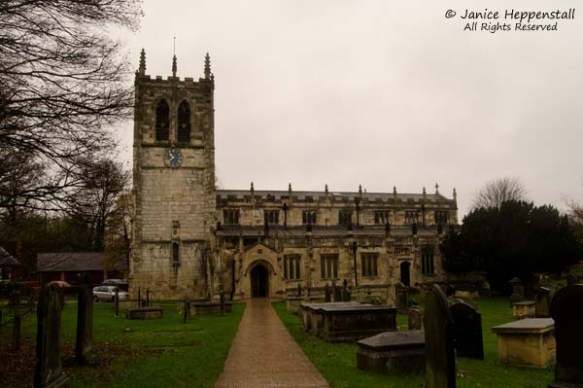
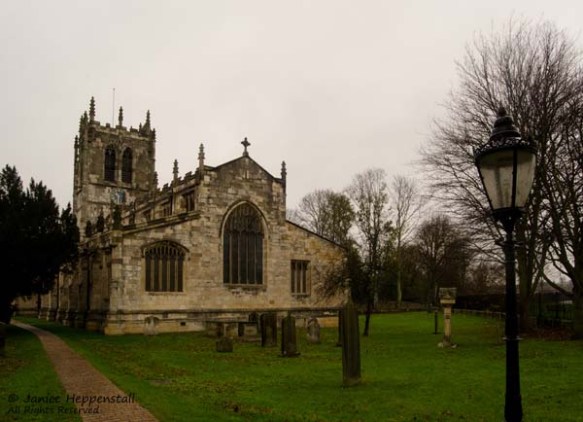
St Mary's church, Tadcaster

Whenever I’m working on an ancestor I try to get an idea of their life and surroundings by seeking out old photographs or paintings.  If there’s no chance of ever having a photograph of this ancestor (which obviously is most of them), then I use a photo of a building or place that had meaning for them as their profile picture.  Often that will be the church where they married or were baptised.  This is why I came to be in Tadcaster, drinking coffee in the oldest café in town, and taking photographs of the parish church, St Mary’s.

St Mary's church, Tadcaster.

Back home, I looked up the church on the Internet to find out more about it – when it was built, and so on.  It was then that I learned this little church has a surprising story to tell!

Originally built around 1150, the first church was burnt and sacked by the Scots.  It was rebuilt around 1380, with further additions bringing it to its present size and shape by about 1480.  And yet… this is not that church, not exactly.

The church stood next to the River Wharf, close enough that when the Wharf burst its banks, which seemingly it did frequently, the church was flooded.  To prevent this, in 1875 the decision was taken to take down the church, brick by brick, and rebuild it largely to the same shape and dimensions, four feet higher up the bank away from the river.  The work was completed in 1877.  It cost £8000 and was deemed to be a success.

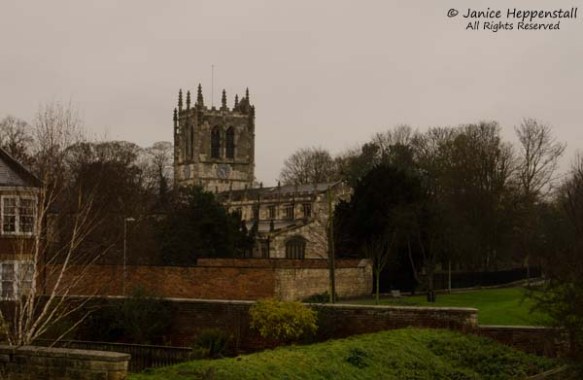
View of St Mary's church, Tadcaster, as seen from Tadcaster Bridge.

But do you notice how dreary and overcast it is in these photos?

It was 30th November 2015 when I took them.  It had been raining torrentially for days, and by Christmas there was still no end to it.  Exactly one month after I stood on the ancient bridge over the River Wharf to capture the scene above, it collapsed.  It had stood, connecting the two parts of the town, since around 1700.

But the church was safe, right…?  I mean, after all the careful taking apart and rebuilding at a safer spot four feet higher up the bank?

Well… not exactly.

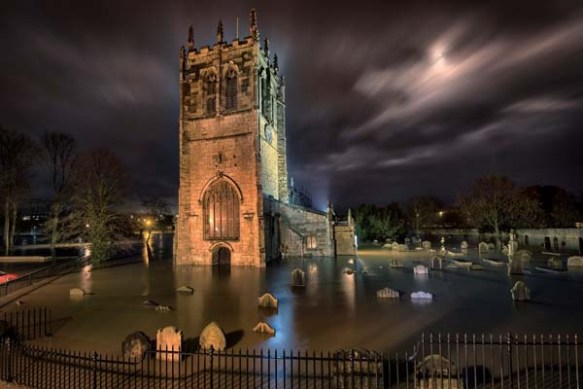
Church and churchyard flooded

One hundred and thirty eight years after the rebuilding of the church, the elements once again had the upper hand.

This fantastic photo was taken at the height of the floods, by Otley-based commercial photographer Giles Rocholl.  He previously gave permission for me to post this photograph on another blog.  (Yes, I know, it knocks the spots off mine!)