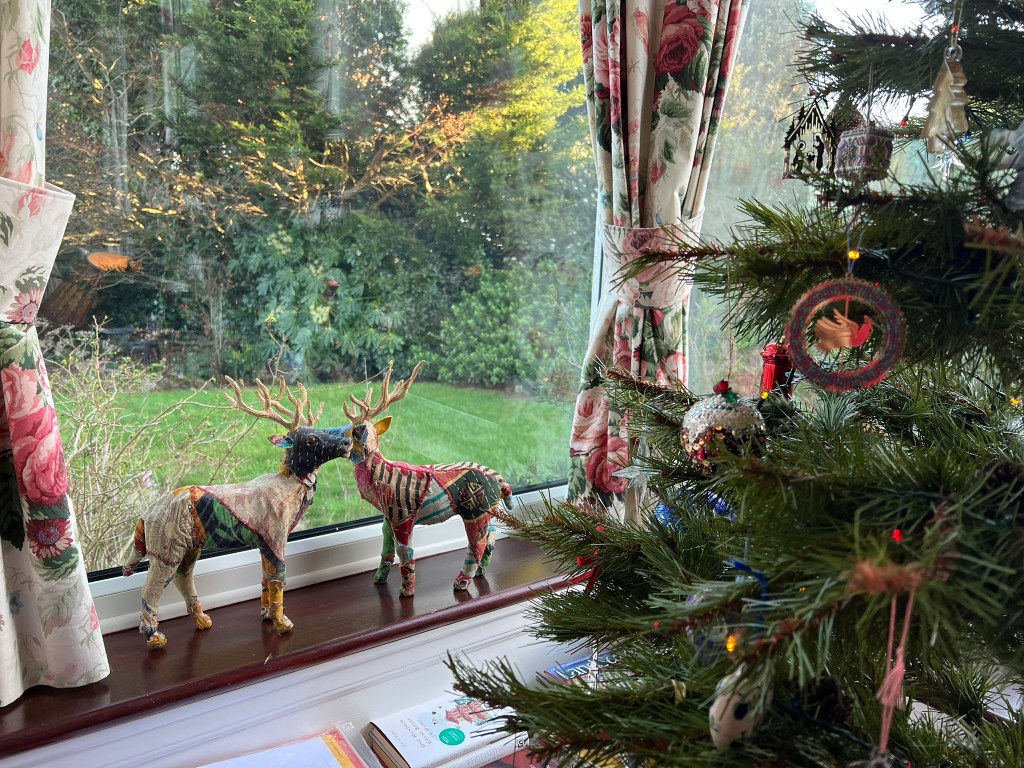
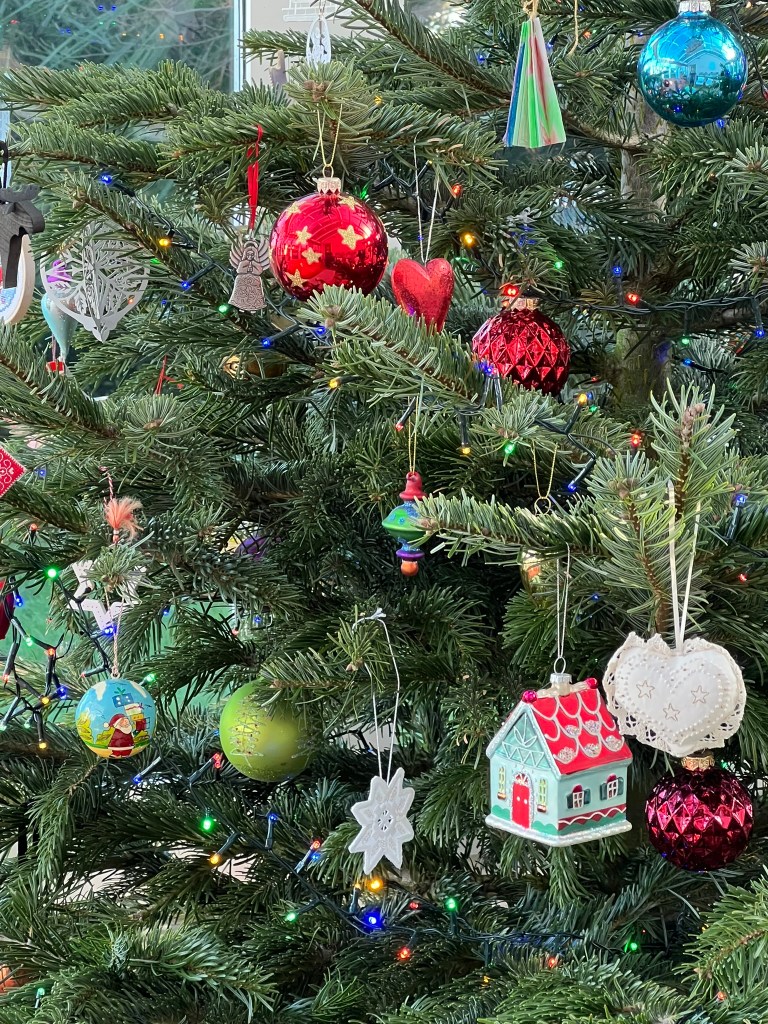
Getting to Christmas always feels like a marathon. So much to do to get everything ready before the arrival of family to spend a few days with us. I put a lot of time into baking Christmas cakes, cleaning and decorating the house. This takes a lot longer than most people would consider acceptable, because over the years my Christmas decorations have become my ‘thing’: my collection. It’s fair to describe this collection as sizeable. (Some might say excessive, but what do they know?!)
Unwrapping my ornaments each December is like being reunited with old friends. I read an article just before Christmas, about different approaches to tree decorating. I recognised myself as ‘the archivist’. Every piece has a story, or invokes a memory. Some were made by my children when they were little; quite a lot have been (and continue to be) made by me. Others were gifts, or bought by us on our travels. A few belonged to my parents; and even the ones that fall into none of those categories often have meaning.
I follow my mother’s tradition of leaving the decorations up until 6th January (Epithany), and my favourite time is the days between Christmas day and then, when everything looks beautiful and we can enjoy the results of all that preparation.
These ‘Twelve Days of Christmas’ would have been enjoyed long ago by our ancestors who, taking advantage of the dormant winter season, followed the proclamation of the 567 Council of Tours, that the twelve days from Christmas to Epiphany were to be kept as a sacred and festive season. This short video focuses on some of the traditions that may be new to overseas readers, but many of them are still present in some way in UK festivities.
For me, these are mostly quiet days, but we do like to have a gathering on Twelfth Night (5th January).
Although I consider the end of the Twelve Days as the day to take down the Christmas decorations, the tradition used to be to leave them up until the Eve of Candlemas on 2nd February. I inadvertently fell into this tradition when, in 2021, after the 2020 Christmas Covid lockdown, I needed to keep the joy going a bit longer. That year, on January 6th, I re-dressed one of my trees as a ‘January Tree’, removing all the Christmassy ornaments, but keeping bright reds and wintery decorations. Two years later I had my first little Christmas ‘Family Tree’ and ever since, I keep both of these trees throughout January every year.
If you celebrate Christmas, I hope you’ve had a happy one. If you needed quiet and tranquility, I hope you had that. If parties and community are your thing, I hope you enjoyed as many as you wanted. To all of you, I wish you a happy, healthy and successful New Year in 2026. I’ll be back in January with a new post.
I had intended to do a proper post earlier this month, but typing and spending time at the computer is still difficult for me as my wrist and hand heal following a break at the end of September. Everything’s going well and mobility is returning; it’s just taking a lot longer than I had assumed it would – and involving a lot more broken nights and tired days.
So the planned post can wait, but I just wanted to drop in to wish you all a happy festive period.
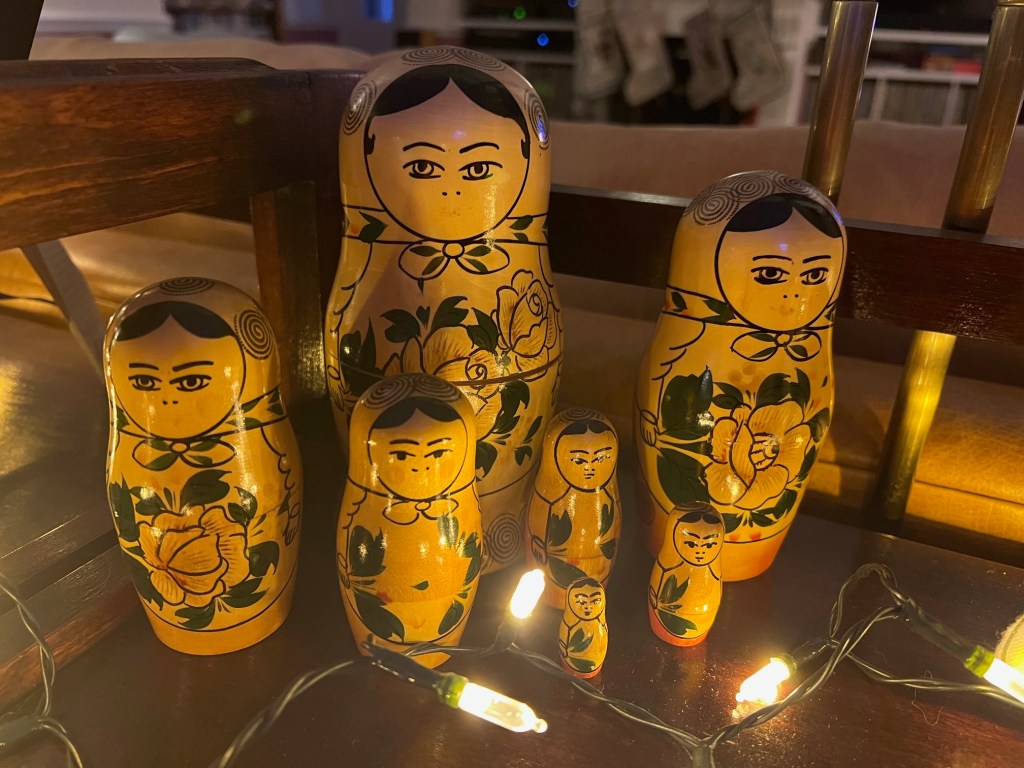
I bought these Matryoshka dolls 37 years ago when I went to Moscow. They spend most of the year nested, one inside the other, but I always get them all out at Christmas and put them on display alongside a less traditional set of nesting Santas.
Some people call these Babushka dolls, the word meaning ‘grandmother’ or sometimes ‘old woman’ in Russian. I like to think of this set as representing me and my direct maternal line. If I’m the smallest one, the next one up is my mother, then my grandmother. After that comes my great grandmother, Jane; my 2G grandmother Margaret and my 3G grandmother Mary. The last two were born in Ireland. One record for Margaret indicates her place of birth was Derry (Londonderry) OR Newry, both in what is now Northern Ireland, but that was circa 1823 and, Irish records being what they are, I’ve never been able to place her birth, nor locate a marriage for her mother Mary and father Robert. This also means that the largest of these seven Matroyshka dolls is unknown to me, and I would dearly love to know her name – the name of my 4x great grandmother. Finding out more about this line is something that is permanently on my To Do List, but it would involve getting to know a whole new set of unfamiliar records, and there are always other research projects to be getting on with.
My children would laugh if they saw this post. They say I can turn a discussion on any subject into genealogy – I’m sure this is something a lot of you are skilled in too. 😀
And so all that remains is to set aside the genealogy, and to wish those of you who celebrate a very Merry Christmas and a Happy, Healthy and Successful New Year. I hope to be able to write my planned post in January.
So go on then… you have a pile of cards to write and a hundred other things to do before Christmas Day. What do you write on your cards – ‘Christmas’, or ‘Xmas’?
I always write ‘Merry Christmas’ in full – at some point in my teen years I decided it was lazy not to write the full word. Your decision may have been for more serious reasons, like the campaign to “Keep the ‘Christ’ in Christmas” or concerns about the over-commercialisation and secularisation of the religious event, as seemingly represented by the word ‘Xmas’. All the more so because it’s well-known that in algebra ‘X’ stands in for ‘the unknown’.
It came as a surprise then, as my family research progressed, when I started to notice ‘X’ as an abbreviation for ‘Christ’ in church records.
In this extract from the parish register of Norwich St Martin at Oak, an 1819 Baptism entry was amended in 1836 to correct the mother’s name of Sophia: ‘This Xpn name sh[oul]d be Lucy…’
Instead of ‘Christian’, the letters ‘Xpn’ are used.
There are also of course many examples of the name Christopher being recorded as Xpher or Xpoferus. Thankfully, I have not found any document in which my 5x Great Grandfather Christopher Christian is recorded as Xpher Xpn. (Perhaps he is, but no one indexed it correctly!)
These seemed to me to fall foul on all counts – first, because this was supposed to be a solemn record and teenage me had already decided such documents needed to be written in full; and secondly in that these were *Church* records, where Christ was by definition at the forefront of procedings.
There had to be another explanation; and of course there is. In fact, in English ‘X’ was first used as a scribal abbreviation for ‘Christ’ in 1100; in 1551 ‘X’temmas’ appeared; and by 1721 ‘Xmas’ was in regular use as an abbreviation for ‘Christmas’. (See: Wikipedia: Xmas) It is thought that these abbreviations came about as a cost-saving practice: the cost of parchment was so expensive that any ways of saving space in the text were welcomed.
However, the history behind the abbreviation is even more susprising. The first letter is not actually Latin script, but a Greek X, pronounced Ch (as in ‘Christmas’). In the abbreviation for Christopher (Xpher) the second letter is not necessarily part of the ‘pher’: the Greek letter ‘ρ’ is pronounced ‘r’; and in Roman Catholic, Eastern Orthodox, Church of England and Episcopalian forms of Christianity, the ‘Xρ’ has long been an accepted abbreviation for Christ, or ‘Christos’ (Χριστός). Over time, in English scribal abbreviations, the second letter – the ‘ρ’/ ‘r’ – was dropped in the word ‘Xmas’.
So there you are - when we write ‘Xmas’, we’re not being lazy; we’re following a long tradition in Christian scripts of abbreviating using the ancient Greek alphabet.
And on that note all that remains is for me to wish you a very Happy Christmas (or Xmas, if you wish) and a Happy and Healthy New Year. See you in January.
This month sees a sort of completion – well more of an off-the-starting-blocks, really – of a long-thought-of project: my Christmas ‘Family Tree’. I’ve had this in mind about fifteen years, ever since I bought three Victorian style photo frames for hanging on the tree. Back then the idea was to put them on my main Christmas tree, and use them for three beautiful photos of my grandma and great grandmothers. I don’t know why it took me fifteen years to do it… Anyway, during this last year the plan expanded and I’ve been seeking out suitable little frames online. I didn’t want to use the standard ‘Christmassy’ photo frame tree ornaments. I really wanted them all to be ‘of the period’ for the photo they would contain, and since they are harder to find than you might imagine, to date I have only eleven. That said, I’m very happy with how it looks, and already have plans for more frames and photos from both sides of our family. It makes a lovely addition to our Christmas decorations.
I’ll be taking a break over the Christmas and New Year period but wherever you are, I wish those of you who celebrate a Happy Christmas, and to everyone a very happy, healthy and successful New Year.
Earlier this year I was thinking about how we could preserve our visual legacies in ways more likely to spark the interest of those who follow us. One of the ideas I wrote about was digital scrapbooking. It was back in August and September that I was tidying up and reorganising my digital photo archives, and making a start on digitising old family photos. I can report that progress has been good but there’s still a long way to go.
Alongside digitising the old photos I realised I could use my existing photo editing software for digital scrapbooking, and I’ve had lots of fun making digital scrapbook pages using some of the old photos. My brother’s birthday card this year was made this way and I’m so happy with how it turned out.
Today I’m combining this new-found digital scrapbooking interest with one of my personal Christmas traditions, which is that every year I’m compelled to try to photograph our four-legged family members wearing Christmas hats. I have to say that I enjoy this far more than the said four-legged family members, but George here does love posing for a photo and is prepared, up to a point, to accept the ignominy of wearing a hat if it means he can be the centre of attention.
Zoë Ball was asking about family Christmas traditions recently on BBC Radio 2. One listener shared that her mother buys a new toilet brush every year at Christmas time and on Christmas Day, before she puts it to use in the bathroom, the family holds a competition to see who can toss the new toilet brush into its holder… Makes my tradition of photographing the animals seem very tame! What about you? Do you have any special traditions that will be passed on? Are there any older family members with stories to tell about how they used to celebrate Christmas?
Whatever you’ll be doing over the remainder of 2021, whether you celebrate or not, and whether by the time Christmas arrives the latest COVID variant will yet again make family gatherings inadvisable, I wish you comfort, joy, peace and good health, now and in the year to come.
I’ll be back with my next post on 15th January 2022.
*****
Digital scrapbooking supplies used are from Life Chronicled: Christmas by Connie Prince; and Joyful by Ginny Whitcomb. Both sets were purchased from ScrapGirls. I have no connection to this store but terms of use require that I acknowledge the designers when posting online.
My first post this year was about my maternal grandparents who were married on 24 January 1920, three weeks after my Granddad returned from India. He had been away with the Army ten and a half years, and they had not seen each other since he went away shortly after proposing to the young lady who would be my grandmother. By the end of 2020 their first child, my uncle, was born.
I’ve been thinking about them a lot, recently: all those years my grandparents never got to be together. I suspect the hardest times were when my Granddad’s Regiment was posted to yet another exotic location with no home leave at all, and when he wrote each time to his fiancée to tell her his homecoming would be delayed yet again. That and Christmas, when he would have loved to be with her and his family. In a strange echo of the past, their son would write from India at Christmas 1945 to say how fed up he was to be delayed in India after the end of the Second World War, instead of being back home.
Back in 1914, when it was still thought the war would be over quickly, seventeen year-old Princess Mary wanted to send every soldier and sailor involved in the war effort a personal gift for Christmas. ‘Her Royal Highness the Princess Mary’s Sailors’ and Soldiers’ Fund‘ was created, and donations were invited from the general public. In a letter released by Buckingham Palace early in November 1914 and published in British and colonial newspapers, the princess wrote:
“I want you now to help me to send a Christmas present from the whole of the nation to every sailor afloat and every soldier at the front. I am sure that we should all be happier to feel that we had helped to send our little token of love and sympathy on Christmas morning, something that would be useful and of permanent value, and the making of which may be the means of providing employment in trades adversely affected by the war. Could there be anything more likely to hearten them in their struggle than a present received straight from home on Christmas Day?
Please will you help me?”
The gift was to be a small embossed brass box containing a number of small items. Most contained one ounce of pipe tobacco, twenty cigarettes, a pipe, a tinder lighter, Christmas card and a photograph of the Princess. For the non-smokers the brass box contained a packet of acid tablets, a khaki writing case with pencil, paper and envelopes, and the Christmas card and photograph. Boxes for the nurses contained the card and chocolate.
The response to the appeal was overwhelming. The cost of purchasing sufficient quantities of the gift box for 145,000 sailors and 350,000 soldiers was estimated at £55,000 – £60,000, but the appeal raised £162,591 12s 5d, meaning the gift could be sent to all British and Imperial service men and women: about 2,620,019 in all. The gift boxes were to be delivered in three waves: First all naval personnel and troops at the Front were to receive theirs before, on or shortly after Christmas Day. Wounded soldiers in hospital, men on furlough, prisoners of war (whose gifts were held in reserve) and nurses serving at the Front were also included in this first wave, as were widows and parents of soldiers killed in action. The wording on the card was ‘With Best Wishes for a Happy Christmas and a Victorious New Year from the Princess Mary and Friends at Home’
The second wave included all other British, colonial and Indian troops serving outside the British Isles; and finally in the third wave, all troops stationed in Britain. Second and third wave recipients were to receive their gifts during or shortly after January 1915 – although in reality some had to wait much longer than that. For them, the wording was amended to ‘With Best Wishes for a Victorious New Year from the Princess Mary and Friends at Home’. The front of the card bore the Princess’s monogram, with the year 1914 for the first wave and 1915 for the rest.
Princess Mary’s plan to give the service men and women ‘something that would be useful and of permanent value’ was a great success. The empty brass box was light and air-tight, but also of quite sturdy construction. It could be used to carry and keep safe small personal items such as money, tobacco and photographs throughout the rest of the war. Many of them, my Granddad included, treasured it for the rest of their lives. That’s his (now mine) you see photographed here, together with the original card from Princess Mary that indicates he received his in India as part of the second wave: it’s dated 1915 and bears the ‘Victorious New Year’ greeting.
As for the ‘Victorious New Year’, well that was a little longer coming…
You can read more about the Princess Mary Gift Fund Box, and see photograhs of some with the original contents, on the Imperial War Museum website, and on the Netley Military Cemetery website. They are a lot more sparkly than mine. I decided not to clean it.
*****
On that note, thoughts return to 2020, and to the present Christmas. As I write this, here in the UK hundreds of lorries are backing up at the ports; European hauliers, with no food and few facilities, are unlikely to make it home to be with their families for Christmas; and many people’s already scaled-down plans have been dashed following emergency measures announced after a mutation of the COVID-19 virus. Wherever in the world you are, and whatever changes from your usual festive arrangements you’ve had to make, I wish you a Safe and Peaceful Christmas and a Happy and Healthy New Year for us all.



 English Ancestors