I’m still not able to use my left arm for very much following breaking my wrist several weeks back, so today’s post is deliberately ‘typing light’. It’s a beginner’s level introduction to using Artificial Intelligence for genealogy.
I have to admit to having mixed feelings about Artificial Intelligence. I’m unhappy about its use in faking information, and about products of AI being passed off as someone’s work, for example using it to create an image, a video or a text without making clear that’s how the piece was created. In photography, for example, this seems to be devaluing genuine talent, when accusations of ‘fake!’ are called for an image that a fellow photographer can clearly see has been achieved through skill, planning and use of top-notch equipment.
That said, as genealogists working online, we already benefit from aspects of AI. Hints, Stories, Thrulines and Theories of Relativity, for example, are all brought to us courtesy of AI. Based on these, what we can say is that AI is useful but it is only a starting point. It must be used with caution. We must analyse and verify the information presented to us, but having done so it can be a great help.
The following FindMyPast video with Blaine Bettinger is a good introduction to how we might use AI more widely in genealogy. In the video, Blaine and Jen Baldwin introduce ways we can use it. They also set down a few guidelines:
AI is not the same as ‘Google’. It deals with words, not facts
In research, it’s useful as a starting point – for brainstorming
It’s like a torch, shining a light to guide us towards relevant information; our job then is to decide what’s relevant, what’s not, and where we need more information
Since it’s a new area, there remain concerns about its use: bias, ethics, plagiarism and copyright issues
Although that video is a good introduction to the themes, we need more information about practical ways to use it. In the follow-on video the same people discuss useful ‘prompts’. A prompt is what is written to outline the precise output the user is seeking. Prompts can be refined to move closer to the desired outcome. Through these example prompts, Blaine gives us an idea of how we could use AI. Some of them may not appeal to you at all; others might. It’s about each of us finding how AI could work for us – how it might help.
Those two videos are more than a year old, and it’s clear that a year is a long time in AI. However, they are useful starting points.
If this is something you’d like to explore there are two Facebook groups you might like to join:
You will quickly realise that everyone on the groups is still learning. Some are further along the line than others. A lot of the posts seem to be from people reporting on an experiment they’ve carried out to see how well AI can cope with a particular prompt or a particular approach.
There is also a podcast series: The Family History AI Show with Mark Thompson and Steve Little comes highly recommended and is bang up to date with the latest developments.
In my next post I’ll include some small experiments of my own. I’m very much at the starting point here. I’d like to find ways to make AI work for me, but I have some definite red lines, and other areas where I’m not sure how the output would be any better than simply doing it myself. I, for example, would never use AI for writing; and there are some research tasks in which I believe the time spent working on a document help me to get an in-depth understanding of a family. Simply reading a list of statements about its content wouldn’t give me that deep-dive familiarisation.
Have you used AI? Do leave a comment with your experiences.
It’s something I hear often when I tell people I’m a genealogist.
I always reply that the records are in fact, mostly free. Provided you know which archive they will be held in, you can book an appointment, walk in, and get looking.
Of course… you need to know how to search, and where to start, and you have to know about different record sets, and take into consideration that your ancestors might not have stayed in one place, so that even within that one archive you might have to guess at which parish they came from before the one you know about… because at the archive, although every volume or box of records is catalogued, individual entries within them are not indexed. The image below is, genuinely, all the boxes that were waiting for me (by advance request) on one of my trips to the West Yorkshire Archives in Leeds, together with part of my To Do List in the foreground. I think there were fourteen boxes all together for me to tackle over two full days.
Before the advent of the Internet, and dedicated websites for genealogy, this is how all family research was, but it was slow going and hard work. I’m going to explain the difficulties with reference to just two generations of one of my ancestral lines.
My 3x great grandfather, Thomas Mann, was born in Norwich, but I only learned this because I found his birthplace on the 1851 Census. My family had no idea that they had roots to that part of the country before this. Following up on this, I found Thomas’s baptism, and learned this took place at St Peter Mancroft, one of roughly fifty-eight parish churches in the square mile or so that we would now think of as Norwich’s city centre. From that record I found the name of his father: Robert, and mother: Hannah née Christian.
Later, after Thomas’s death, I found an entry for one of his daughters on the 1861 census. She gave her birthplace as Norwich St Martin at Oak. This was some years before Norwich’s baptism records were available fully indexed on any subscription website, but I found a way to browse records online, and in that way found several other baptisms for children of Thomas and my 3x great grandmother Lucy, all in Norwich St Martin at Oak; and that was how I learned that Thomas and his wife lived in that parish until they migrated to Yorkshire.
So far all this research has been led by the Censuses. If the censuses were not online I would have had to go the The National Archives in London. The originals are now no longer available to view, but presumably would have been prior to the digitisation… but without the indexing, how on earth would I find them? In 1830 the population of Norwich numbered around 36,000, while that of Leeds in 1851 (which is where they were when I first found reference to birthplaces in Norwich) was 249,992. Simply finding them at their house in Leeds could have taken months.
Back in Norwich, Thomas’s father, my 4x great grandfather Robert, died just before the 1841 census, so everything I know about him comes from baptisms of his children, plus his own baptism, marriage and burial records, a civil death record and an apprenticeship record. I’m confident that Robert lived his entire life within the county of Norfolk – and therefore all the local records relating to him are lodged at Norfolk County Record Office. He was baptised at Great Yarmouth, apprenticed to a master at Wymondham, and then moved to Norwich where he remained for the rest of his life. However, there, he moved around several of the fifty-eight parishes, marrying at St Peter Mancroft and baptising children there, plus others in the parishes of St Stephen, St Michael at Thorn and St Peter Parmentergate. Later, he moved to the parish of St Stephen and was buried at All Saints parish church. I know all this not because I spent many months scouring the free-to-consult records at the Norfolk Archives, but because I input a few details on the commercial Ancestry and FindMyPast websites and managed to work it all out from the selections of records returned for my consideration by their powerful search engines.
Robert’s children did not all remain in Norfolk. Apart from my own ancestor, Thomas, who travelled with his family to West Yorkshire and eventually ended up in Leeds, two sons joined the Royal Horse Artillery. One of those retired in Woolwich where he had a family; the other married a lady from Pontefract and he too eventually settled in Leeds after a military career involving the Battle of Waterloo. Leaving aside the information about the military years (mostly at The National Archives), that involves records from four more County Record Offices. And yet, apart from one Settlement hearing for my Thomas and his family, there is nothing in the archives at Norwich to suggest any of that: mentions in the records for those migrating individuals simply cease. Again, I learned about most of it with the click of a few buttons and browsing digital images of original records online, although I have also followed up some of this information in targetted examination of specific records at the Norfolk Archives and The National Archives. That research involved browsing through lots of images on microfiche, or examining the pages of original volumes in search of mentions of my people.
It’s the indexing that is so important. It points us directly to records that, based on our search terms, would appear to be relevant.
The records we find online are made available to the commercial websites by licence from the original archives; and they have to pay a small amount to the relevant archive every time someone clicks on the records. However, it is the commercial websites that photograph them and have them indexed. The archives hold far more than what we see online – even though the amount online is increasing all the time. It tends to be the more local and much older records that have not yet been (and perhaps never will be) photographed and indexed and made available online. However, having located an ancestor in a specific place, if we do visit the archives, thanks to all the online stuff, we can approach it with a To Do List or a Wish List of information we would like to locate and examine.
The following video gives an insight into the amount of work involved in photographing, alongside carrying out essential conservation work, for a huge nationwide record set like the census.
It’s true that some records or transcriptions of records are available freely online. Invariably, these are made available through the work of volunteers. Their work can help us enormously, and we must be grateful for the dedication of those who do this, either by giving their time to develop records of a big website like Family Search; as part of a local Family or Local History Society; or as a personal project/ labour of love. But we can’t expect everything to be done on a voluntary basis.
The big subscription websites do offer a valuable service. What they do is far more than simply taking public records and charging for them. The photographing, conservation and indexing of a large set of records is an enormous undertaking, involving professional archivist and conservationist input as well as teams of indexers. Quite simply, if they didn’t do this, it wouldn’t get done – there is just too much demand on public funding and this is way down the list. That’s not to say I agree always with the level of the charges, or the introduction of additional charges for some aspects of the service that used to be part of the original fee. I also would prefer that indexers with local knowledge were used. It is much easier to make out a scribbled place name if you know the area. Which seems like a good time to mention possibly the worst transcription/ indexing I’ve ever seen: a Land Army Index card. The name ‘Muriel’ was indexed as ‘Kendriel’; ‘Crescent’ was indexed as ‘Cusad’; ‘Beeston’ as ‘Beeka’; and the job ‘Edging Machine Operation’ as ‘Edjcing Hadine Dpersior’. I mean… those last three words just don’t exist!
Times are hard and not everyone can afford subscriptions. Back in June 2019 I wrote a blogpost about Genealogy on a Budget. I hope there’s some tips in there that will help to bring down the costs for everyone.
However, in general, the next time anyone tells us they think records about our ancestors are ours, and should be free… this is why they are not!
Only four days remain before the deadline of the Ministry of Justice consultation paper regarding proposals to destroy all post-1858 original Wills and related documents, with the exception of those of famous people, and to retain only digital files of the rest. The full consultation paper may be viewed here.
You can respond directly at the following address or by email: civil_justice_poli@justice.gov.uk
Will Storage consultation Ministry of Justice Civil Justice and Law Division, Postpoint 5.25 102 Petty France London SW1H 9AJ
The deadline for replies is this coming Friday, 23 February.
Below, is my own response in full, which was emailed this morning.
***
Response to the Ministry of Justice Open consultation paper: Storage and retention of original will documents, Published 15 December 2023
Question 3: Are there any reasons why the High Court should store original paper Will documents on a permanent basis, as opposed to just retaining a digitised copy of that material?
Yes. As a professional genealogist/ researcher working with documents in archives as well as online digitised copies of certain documents, I object strongly to proposals set down in the above consultation paper to destroy the majority of Wills and related documents after a prescribed period, replacing them with digital images of the same. My reasons are below.
Question 5: Do you agree that there is equivalence between paper and digital copies of wills so that the ECA 2000 can be used?
No. In archival terms paper wills and digital copies are not equivalent. Only the original is ‘the original’. A digital copy of that, no matter how perfect, is a stand-in: a ‘surrogate’. Even the citation appropriate for these types of documents is different: if a researcher is in the presence of the original document, the citation will be to that document and its location; if using a ‘digital copy’ of that, the citation requires extra information: what, precisely was viewed, via what website or other source, and when was it accessed? There is a reason for this: only the original can be guaranteed to include every mark and every page.
Digital preservation is not infallible. Despite the ‘huge advances that technology has made over recent years’ (Point 27) it does not follow that ‘digital copies of original documents can be extremely detailed and all relevant marks on the original will be retained in the digital version.’ JPEGs are ‘lossy’ files. Lossy compression compresses an image, making it smaller (and more economical) to store, but the trade-off is a permanent loss of detail. As a researcher who regularly downloads images from archives and commercial genealogy websites I know that those images are much-reduced JPEGs. Consequently, there are times when only the original will do, for example when comparing signatures with other documents to confirm this is the same person; or if a stain on the original document renders text illegible in digital format: in a good light, the eyes may be able to decipher the original.
Digital files can also corrupt, resulting in permanent loss of all contents. In any case, the technology available to us now may be surpassed in the not too distant future.
There is also the issue of human error. During the photographing process, it is possible to turn over two pages at once, to leave off useful information on the rear of a document, or even to omit an entire document. All researchers using online digital images will have experience of this. On occasion, too, documents may be incorrectly indexed, making the correct digital files very difficult to find. In 2023 entries on the GRO Births and Deaths registers were made available for direct download – a development greeted with delight by the genealogy world; and yet some of the digital photographs of the entries are not usable, owing to having been photographed at an angle, thereby cutting off essential information. The point with all these difficulties is that the original documents remain intact: they have not been destroyed. The digitisation is a great thing, but we need the originals too.
Question 4: Do you agree that after a certain time original paper documents (from 1858 onwards) may be destroyed (other than for famous individuals)?
No. History is not just about ‘famous people’. Concepts have changed. History is also about the many millions of others who were impacted by decisions of the powerful. Their Wills are important too.
Question 6: Are there any other matters directly related to the retention of digital or paper wills that are not covered by the proposed exercise of the powers in the ECA 2000 that you consider are necessary?
It is clear from the wording of the consultation paper that a rather narrow understanding of the enduring value of Wills and Probate documents is at play. Point 27 asserts that ‘All parties and courts will […] be equally able to rely on digital copies of wills to challenge the validity of that will or another as they would be if relying on the paper will.’ Undoubtedly that is true; and in this regard legal issues such as time limits for contesting a Will are relevant, and the comparison with time limits for retention of other Court documents (Point 45) is valid.
However, once Probate is granted, the Will and associated documents become public documents. As such, the original purpose of the Will and Probate documents is not its enduring value. It is not appropriate to restrict considerations to the immediate legal purposes and to the emotional attachment of the testator’s nearest and dearest. The wider value of a Will may become apparent many years into the future. Genealogists use them to learn about the immediate and wider family of the individual, their lifestyle and social standing. Historians and social scientists may take a much broader approach, for example examining Wills made by individuals in a particular location, or a particular ‘type’ of person, using their findings to draw conclusions about, and better understand that location, or our society more generally in the past.
Question 9: Do you agree with the principle that wills of famous people should be preserved in the original paper form for historic interest?
I agree of course that wills of famous people should be preserved, but not that this should be the exception to the rule of mass destruction.
The suggestion (Point 51) that this already happens for pre-1858 Wills is misleading and untrue. Before 1858, Probate was a matter for the ecclesiastical courts, and these valuable historic documents are stored in diocesan archives, with some original and copy Wills of the Prerogative Court of Canterbury held at The National Archives. While it is true that Prerogative Court of Canterbury: Wills of Selected Famous Persons have been separated out and stored in record series PROB 1, the implication that only these Wills have been kept is false. Not a single Will was destroyed; Wills of individuals not deemed ‘Famous Persons’ are archived within a different part of the collection.
Question 10: Do you have any initial suggestions on the criteria which should be adopted for identifying famous/historic figures whose original paper will document should be preserved permanently?
The mere posing of this question illustrates the problem: there is a value judgement linked to this. Since your values may be different to mine, who will decide? Might society’s assessment change over time? A suffragist in the nineteenth century might be considered a tiresome person, yet that same person today may be considered a trailblazer, playing an important part in the road to universal suffrage. What a travesty if it turned out this person’s Will was destroyed because they were not sufficiently ‘famous’, or their fame did not accord with contemporary values.
You may already know about the UK Ministry of Justice’s proposals to destroy original copies of post-1857 Wills after 25 years. The proposal is to retain only a digital copy of each Will. Information about the proposals is contained in the Ministry of Justice’s Consultation Paper, which you will find [here].
As genealogists we are all in favour of digitisation of documents, and easy availability online. The government’s online Wills and Probate service is an example of this, allowing us to search, and for just £1.50, to receive a digital copy of the relevant Will by email.
However good the digital image, though, there is a difference between it and the original document. In archivist terms, it is only the original which is the ‘original document’. The digital images we mostly use via subscription websites or indeed the GRO’s online Wills and Probate service, are termed ‘surrogates’. There is always the possibility that part of a document is not included, that one page is blurred, that part of one page is missing, or that a few handwritten words on the reverse that might just be the clue to a mystery are not included. As all of us who work regularly with genealogy websites know, it could be months or years before such a problem is noticed. If the original exists somewhere this can be resolved. However, if the original has already been destroyed, valuable information is lost for ever.
Genealogist and former archivist of many years at The National Archives, Dave Annal, has put together an excellent video in which he summarises in just over five minutes the main problems with these proposals.
My friend and colleague Richard Holt has taken a particular interest in this matter from before the launch of the present proposals and consultation by the Ministry of Justice. In his blogpost Justice for Wills and Probate Documents he writes about times in his research when only an original will do. Initially his concern was with the operation of the Freedom of Information request process, but since the launch of the proposals to digitise and destroy original post-1857 Wills, his concerns have increased, and these are covered in the second half of that blogpost.
I will not spend time adding my own thoughts to those of Richard and Dave, since I do agree with all they say. Indeed, online and via any groups that you are part of, you will find an increasing number of articles and robust responses from other genealogists, historians, archivists and societies/ associations linked to these fields.
You can also respond directly to the Ministry of Justice’s consultation. This option is open to anyone, anywhere in the world – and of course many people have UK ancestry so this affects all of us. Replies must be received by 23 February, using the email civil_justice_poli@justice.gov.uk or the following address:
Will Storage consultation Ministry of Justice Civil Justice and Law Division, Postpoint 5.25 102 Petty France London SW1H 9AJ
Finally, please share this information with others who you think will be concerned by these proposals.
As genealogists we know that the historic records we rely upon were not created with us in mind. Always, there was a significant contemporary reason behind the collection of data. The list of heads of household may have been compiled to keep track of who had paid taxes, or rentals. The list of adult males may have been required for selection of local militia. Parish registers, while being a record of religious rites, were also a means of keeping track of the population, and so on.
When the first censuses were carried out in 1801-1831 the purpose was to collect basic information about numbers of inhabited/ uninhabited houses, numbers of families occupying them, numbers of people (male/female) with a very basic breakdown of their occupations, and information about numbers of baptisms, marriages and burials. It was not until 1841 that names, ages and occupations of individual household members were collected, along with a rough indication of birthplace. The real need at that time was to get a handle on the size of the population (for military purposes and food requirements) and to understand migration within the country. Since then, with every new decade, changing societal conditions and increased understanding of links between, for example, living conditions and health, led to additional questions. In more recent decades, there has been a need to understand religious diversity, language needs as a result of immigration, gender identity, and so on. This then feeds into planning of services and facilities.
However, there has been another huge change in the past thirty years: information technology. Such is the ‘ready’ availability of timely data that the need for a decennial snapshot of the nation is in question. In June of this year the Office for National Statistics (ONS) produced a consultation paper on its proposals for The future of population and migration statistics in England and Wales.
In it, they explain their proposals to replace reliance on a decennial census, creating information that is essentially out of date as soon as it is published by instead using administrative data collected by a range of state organisations as a by-product of their work. This, they say, would enable the ONS to provide completely accurate, up-to-date information, when needed, and at a fraction of the cost. It is estimated that the cost of the 2021 Census was around £1 billion.
In response to these proposals a group of leading academics whose work draws heavily on data provided by the censuses have published an Open Letter in which they express their concerns.
Whereas we, as genealogists, are interested in personal information – and we’re not permitted to access that personal information until one hundred years have lapsed – impersonal statistical information from each census is released very soon after the information is collected. Already, a good deal of data is available following the 2021 census, and undoubtedly this is the data essential to the work of the sociologists, medical sociologists, criminologists, epidemiologists, social policy, population and health experts who signed the Open Letter.
Reading their letter, it is interesting to note that, despite the differences in our use of the census data, they broadly use the census in a very similar way to us: as a decennial benchmark against which the representativeness of other data may be assessed. For them, that would be statistics and other studies; for us it is Civil BMDs or parish register entries. Administrative data produced as a by-product of a service, they say, cannot fulfil this function. Although the census completion is not actually 100 percent, it is a legal requirement and completion is in fact very high. By contrast there is no mechanism for administrative data owners to be held accountable for the quality of their data. There are also opt-outs, not to mention the fact that some people are not even registered with the services in the first place and would therefore slip through the net. Their suggestion is that if the alternative ‘patchwork of administrative data’ is seriously to be considered as a replacement for the census, then at least in 2031 the two systems should be run in tandem, to ensure complete coverage and a smooth handover. They also assess that the cost of collection of data from these other sources and bringing them together as a seamless whole would be about the same cost as the decennial census.
Essentially, of course, our interest is in the genealogists of 2131 and beyond. It is with them in mind, as well as my own privacy concerns, that I am worried about the future of family history. The contents of our medical records and other information collected or created about us in the operation of public services should remain private – but a census is different. Whilst fully mindful of the real, administrative benefits to the nation of collecting all that information, on a personal level I enjoy sharing my information (my choice what to share) on the census. I think of it as a message to my descendants. In Ireland, last year, the 2022 Census even had space for a Time Capsule Message to be available to descendants in 2122. How wonderful would it be to open that!
Anyway… what do you think? Have you been involved in any of the consultation surrounding this? Do you have strong views either way? Do leave a comment.
One of my great grandfathers, George, was adopted. This was in the 1860s, so it was an informal arrangement and the couple who took him in were his biological father’s older sister and her husband, whose name was Feargus.
Feargus had a middle name: O’Connor; and although I was new to genealogy at the time of discovering all this, I already understood enough to know there was a strong likelihood that this was a maiden name, probably from his mother’s side and probably the two names indicating an Irish connection. However, following back Feargus’s mother’s and father’s lines for a few generations, I could see they were solid Yorkshire stock. No Irish, and no O’Connors. It was a mystery.
The solving of the mystery, when it came, was from a surprising source. But before going onto that, I want to tell you something about Feargus’s parents.
They were nail-makers, and they lived in the village of Hoylandswaine, not far from Barnsley. I found a little book published by the Barnsley Family History Society: The Nail-Makers of Hoylandswaine, collated and compiled by Cynthia Dalton. It includes not only the history of nail-making in Hoylandswaine, but a description of the life, together with potted biographies of the nail-makers recorded in the censuses. I learned that the life of a nail-maker was a hard one. Some had their own forges and worked as a family unit; others rented space in someone else’s forge; and yet more worked for a nail master on his premises.
Usually, the men started work at 6am, and might keep going until 10pm, with breaks only for meals throughout the day. Pay was low, and since some of the nail masters were also the village shopkeepers or inn-keepers who couldn’t resist squeezing a little extra profit from their workers, payment may have been made in the form of provisions from that other business. Women did the work too, for less money, and alongside taking care of the house and children.
Hoylandswaine nailers go rat-a-tat-tat, On thin watter porridge, and no’ much o’ that
Anon. (In: Cynthia Dillon: The Nail-Makers of Hoylandswaine)
It seemed a very small life: long hours of repetitive work, isolation, hardship, trapped by low wages and unscrupulous employment practices, and no power to change any of that. I wondered what time was left for enjoyment, or if life was one long slog from beginning to end; and then I set aside Feargus’s family and moved on to other lines.
It was years later – early 2019 – when the riddle of Feargus’s Irish connection was solved. It came while I was reading John Waller’s The Real Oliver Twist – the true story of pauper apprentice Robert Blincoe. Part two (p.79) begins with a quote – and I gasped when I saw the name:
‘Scores of poor children, taken from workhouses or kid-napped in the streets of the metropolis, used to be brought down by […] coach to Manchester and slid into a cellar in Mosley Street as if they had been stones or any other inanimate substance.’
Feargus O’Connor (1836)
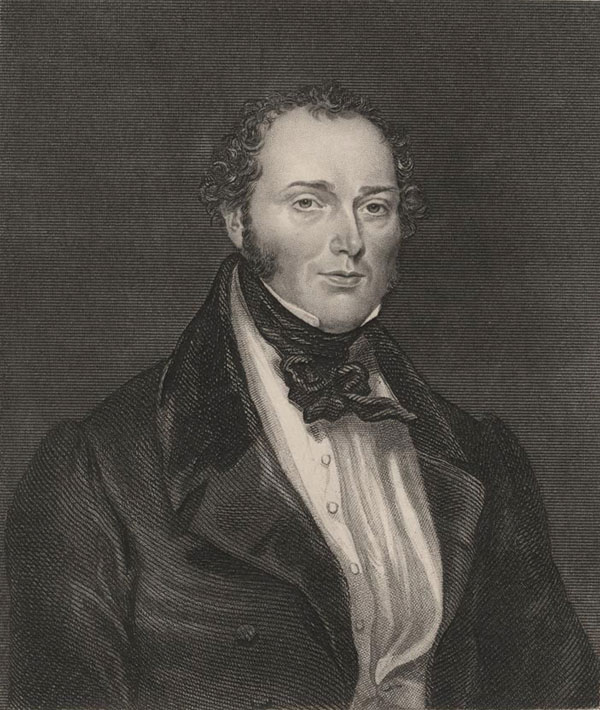
I looked him up… and realised I had known Feargus O’Connor all along – I learned about him in ‘A’ Level history at school, and in view of the Leeds connection (below) we would have spent some time on him, but my brain had mostly opted to remember the activities of ‘Orator’ Hunt.
Feargus Edward O’Connor (c.1796-1855) Stipple engraving portrait by unknown artist Source: Wikipedia. This file has been extracted from another file, Public Domain
Feargus Edward O’Connor was an Irish landowner and lawyer, elected as M.P. for Cork in 1832. (Ireland was part of the United Kingdom, so his seat was in Parliament at Westminster.) In 1835 he was re-elected but disqualified on the grounds that he had insufficient property to qualify as an M.P. (although it seems that was not so). It was from this time onwards that he began to agitate for radical reform in England, speaking at rallies and meetings and emerging as the leader of the Chartist cause. He campaigned for the ‘Five Cardinal Points of Radicalism’, which would later be five of the six points embodied in the People’s Charter. In 1837 he founded the radical Northern Star newspaper in Leeds; and then in 1840 was arrested for sedition, serving fifteen months in York Castle gaol.
1840 was the year my adoptive great great grandfather was born. His parents’ choice of name – Feargus O’Connor Heppenstall – speaks volumes. It turns out they did know the conditions in which they were working were unjust. They could imagine a better life. And what’s more, they knew of developments throughout the country and the movement for change; and through the work of Feargus O’Connor, they saw a way to achieve that. It turns out their lives were not so little after all. They were fighting for a better world at a time when that was much-needed; and I am proud of them.
In fact my tale is awash with Feargus O’Connors, all of them in Leeds. As a young man my adoptive great great grandfather Feargus made his way to Leeds and became a butcher. His adopted son, my great grandfather George, would go on to name his own first son Feargus O’Connor Heppenstall too, although I don’t think George was a political man, and believe this was a tribute to the man he considered his father rather than to the Chartist leader.
The original Feargus O’Connor was not a man without controversy. Undoubtedly charismatic, he was admired for his energy and powerful oratory, but also criticised for advocating physical force if necessary in order to achieve his goal of universal male suffrage. In this, he went further than the moderate line taken by other Chartists.
I was reminded of all this last week, while watching videos recorded by experts for All About That Place. One such expert was Mark Crail, who has a website and a blog about Chartist Ancestors, as well as a separate website about Trade Union Ancestors. There is also a page dedicated to the Six Points of the People’s Charter. Some of the articles focus on Chartism in different parts of the country; some on leaders. There are quite a few blog posts dedicated to Feargus O’Connor’s life and work. If your ancestors were in the industrial heartlands during the nineteenth century, or if you know they were active in the Trade Union movement, you might be interested to explore these sites.
This is what I love about family history. The most ordinary seeming people can have surprising stories to tell if you delve a little deeper. It is through these stories that we can learn about the lived experiences of people in different places, classes and at different times throughout our history.
Today is Day 2 of All About That Place. I’m sure at least some of you will already know about it, and have been watching videos. I hope you’re enjoying it as much as I am. For everyone else… this is time sensitive information!
All About That Place is a ten-day event to celebrate the 10th Anniversary of the Society for One-Place Studies. It has been developed through collaboration between the Society of Genealogists, the Society for One-Place Studies, Genealogy Stories, and the British Association for Local History. However, other organisations are sponsoring specific days.
The event is being run via a pop-up Facebook Group and YouTube channel. I couldn’t find a pop-up YouTube channel specific to the event but was guided via a request for information on Facebook towards the Society of Genealogists channel. However you access the videos, they last approximately ten minutes each, and a new one appears every hour of every day, between 8am and 7pm British Summer Time. However, the time is not critical, since each video will remain online until 1st October, after which some will disappear but others will remain a little longer – only until later in October though… which is why I said this is time sensitive. By late October this post will be obsolete…
There are over a hundred pre-recorded talks to watch. They are free. My plan was to watch only the ones that interested me, but so far almost all of them have done so. I didn’t expect this to be as brilliant as it is! Clearly a great deal of work has gone into organising it.
The talks so far have looked at maps, including some great websites where mapping resources are available – some of which I’m sure you’ll already know, but others will be new to you. There have also been introductions to the kinds of resources specific organisations hold, and how they can help you in your research, like the Society of Genealogists. Some videos are about specific One-Place Studies.
As this is all about the Society for One-Place Studies, what they really want is for you to be fired up and start your own Study. They are reporting a good few new registrations already, so from that perspective this has already been a success. However, the enthusiasm amongst people participating, hosting or like me just watching is tremendous. Although all these origanisations are in the UK, people are watching from other parts of the world, and some of the One-Place Studies are in other parts of the world too.
When I was preparing my last post about the GRO’s new option for instant-access digital downloads of the images for selected birth and death registrations, I had hoped to be able to include a downloadable template for you to use for your own records. It seemed it wasn’t possible for me to do that. So the next best thing is to show you how to create your own.
I created the template in my last post using Photoshop – just because I already had it open and wanted to tweak one of the images. If you already use Photoshop or something similar you won’t need me to show you how to do this. However, more of you are likely to have Word, so for anyone who’s more used to using Word for plain old typing and would like to know how to create a template, here’s a tutorial. I hope it’s useful to at least some of you.
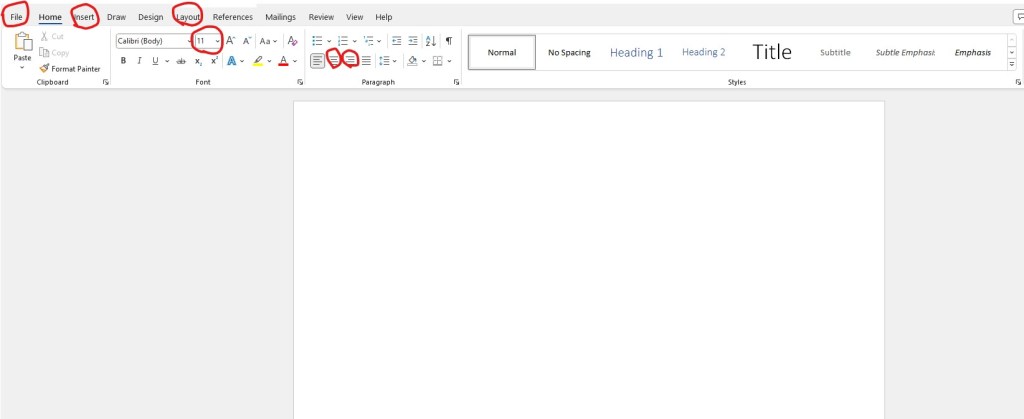
1. First, open a new document in Word. All the options from the top menu I’m about to mention are indicated below.
Click for bigger!
2. Next, change the layout of your document to landscape. To do this click Layout, then Orientation, then Landscape.
3. On this document, type whatever wording you would like. I went with: “Death Certificate Digital image download from GRO website Downloaded by [your name] on [leave this blank, date to be added to each new document when you use the template]”
4. Then adjust the size of the font by changing where it says ’11’ on the example above. I went with font size 36 for the title, 22 for the ‘digital image’ description, and 14 for the bottom line. You might find it easier to use the regular ‘title’ options on Word but I wanted to control the spacings between the rows so this way suited me better.
I then moved the bottom line down the page, using the return key a few times, before centering the top two lines and positioning the bottom line over to the right (see the two lower circled options indicated on the image above.
My document now looks like this.
For the rest of the template we need information from the GRO website.
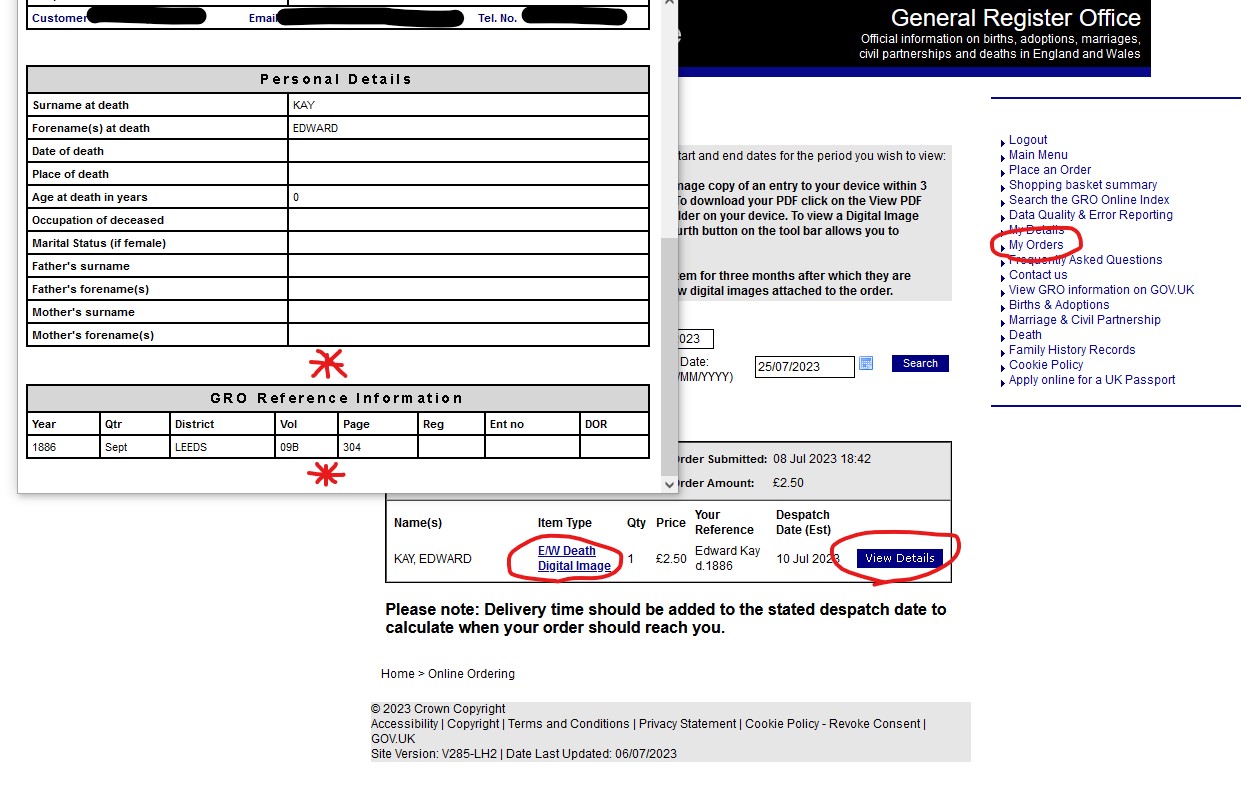
As explained in my last post, the downloads are available for three months after ordering/delivery. At the time of delivery you should get almost instant access to the images. However, I ordered mine a few weeks back, so I accessed all of the following information by going into ‘My Orders’ from the menu on the right.
5. From that page – which is what’s shown below – you can download your ‘E/W Death Digital Image’. But first, since our focus here is on creating a template, click on ‘View Details’, and scroll right to the bottom of the pop-up that appears at upper left of screen.
Click for bigger!
What we need is the GRO Reference Information (between the two red stars). Put your cursor at the beginning of the word ‘Year’, and highlight/copy everything along that line through to ‘Page’. Then paste this into your Word document just above your ‘Downloaded by…’ line. I centred this.
5. There is just one more thing to add to the template. We need a description of the columns, so that we can make sense of the information on the digital images from the death register as we download each one and insert it into our template. I copied that from the digital download page. Click on ‘E/W Death Digital Image’ (as circled with red on the above image), and you’ll find the digital image you’ve purchased, but above that there are the column headings. I screen-grabbed that and saved it. You can do the same thing, or you can click on the image I copied, below, to make it bigger, then right click and save to your own computer in a place you’ll find handy. The one I’ve included below has been lightened a little in Photoshop to make it easier to read the lettering. The one included in my example template at the bottom has not been lightened, so you can see the difference.
6. Either way, you now need to insert it into your Word document beneath the title and description lines. To do this, place your cursor a couple of lines below the ‘Digital image download from GRO website’ line, then click on Insert, then Picture, then ‘This Device’, and navigate to where you save the image to retrieve and insert it.
Click for bigger!
Your document should now look something like this.
7. You’ll now need to save this document, but instead of saving it as a regular Word document, click on File, then Save As, and then from the drop-down menu, save as a Word Template (.dotx).
As you get each new GRO digital download image from the Death Register, all you have to do is open the Template, download and insert the new image, and copy the date, quarter, district, volume and page details from the website (just as we copied the upper line in step 5. You’ll also need to insert the date. Remember to save each new record you create as a regular Word document.
Comparing this to the one I originally created in Photoshop, there are a few differences, but you can see how it all comes together.
If you like how this works for you, you can create another one for your Birth Register digital downloads.
I hope you found these instructions clear. Let me know how you get on.
I know a lot of you will already know this, but for those who don’t… The General Register Office website has made available reduced cost instant-access digital images of selected birth and death entries.
The ‘certificates’ available through this new Online View Digital Image Sevice are as follows: * Birth entries from 1837 up to 100 years ago * Death entries from 1837 to 1887
When you place an order using the GRO’s online indexes, where this new service is available (that is, for the year-spans indicated above), a new option will appear for ‘Digital Image’. Just click on the ‘button’.
There is a clear statement that these digital images have no “evidential” value. A paper certified copy is still required for official purposes. Examples given in the statement include ‘applying for a passport or driving licence, or where required to give notice of marriage/civil partnership’. None of these seem entirely applicable here! But in our research I can imagine someone requiring a certificate to evidence nationality of a great grandparent, or to demonstrate generational ancestral connection.
What you get The digital image you’ll receive is just the extract from the GRO’s central register, nothing more. So looking at the example below, which is a full, certified copy, you get a lot of important wrap-around information. When you take advantage of the new instant-access digital download all you get is the image in that central section, which is extracted from the GRO Death Register.
I really like having the official document, certainly for my direct line and anyone else whose story I’m following – but that’s expensive and I’m gradually buying only the ones I need. However, I decided this would be a great way to get information about causes of death for all the siblings who died in infancy over that fifty year period, 1837-1887, so I’ve made a start on that.
Remember though that even the full certified copy of a Birth, Marriage or Death certificate is still only a secondary source if you purchase it from the GRO. The original is kept at the local Registrar’s Office. (I wrote about this in a blog for the Pharos Tutors website, that you’ll find [here] )
As soon as your online payment goes through you can click on a link to see the image. I found it took a few minutes before I could actually download it to my computer.
Having done that it seemed to me there was some additional essential information I really did need to be able to record and cite this effectively, so I created a template in Photoshop that I can use every time I download one of these. It includes:
Title, making clear this is a digital download, since this does not have the same standing in law as a certified copy
Column headings describing the content of each column
The digital image
The GRO reference, including year, quarter, district, volume and page
The date I downloaded the digital image
This information transforms a useful digital image into a ‘source’, decribing what it is, and details of precisely where the original information is to be found, ensuring that anyone who wants to check my research in the future can find it again.
Having done this I’m still trying to decide if I’d be happy to have all my ancestors’ death certificates in this format. After all, for the cost of buying two of the full, certified copy versions I can get nine of these, and set into my template they don’t look so bad…..
If you’ve downloaded any of these instant access digital Birth or Death certificates, I hope you’ve found lots of interesting information.
When I started my journey into my family’s past I never expected to find riches and grand families. Indeed, what I love about genealogy is that it enables us to home in on the ‘little’ people, and to find the extraordinary in their seemingly ordinary lives. I soon realised that this ‘bottom up’ focus was the difference between Genealogy and the History I studied to ‘A’ Level at school. Yet we cannot really understand our ancestors’ lives without knowing something of that social and political backdrop which is the stuff of formalised history studies: the local history, the manorial system, changing governments and their legislation and increasingly, as we travel back further in time, the whims, decisions, abuses and power of the monarch.
Today, as the coronation of Charles III as King of the United Kingdom takes place at Westminster Abbey, I thought it would be interesting to focus on the kings and queens of England, Great Britain and the United Kingdom, and to see how that history merges with and indeed shaped the world our ancestors knew.
Let’s start with a YouTube video from UsefulCharts about the British Monarchy Family Tree: Medieval Kings of England & Scotland to Charles III. This deals with the succession of the monarchy from Anglo-Saxon times right through to present day.
At 30 minutes long, the video requires a little investment of time, but the family tree chart is absolutely brilliant, allowing the narrator to whizz up and down and from side to side as he explains very clearly the sometimes complex events and reasons leading to the passing of the throne from one king or queen to the next. Even if your grasp of all this is quite sketchy, you’re sure to meet people whose names you know, and you’ll start to see how they all fit together. In my case, studying heraldry and pedigrees, and getting to grips with the cataloguing of official documents according to the regnal years dating system forced me to familiarise myself with some of the medieval monarchs. However, in this chart you’ll also meet Macbeth, ‘Lady Macbeth’ and Duncan, as well as Alfred the Great; and you’ll be able to untangle the relationship between Aethelred the Unready and King Canute, and the events that led from them to the invasion of William the Conqueror. There were also some female monarchs about whom I knew very little: Lady Jane Grey, Queen Anne and – for shame – I am one of those people who thought Mary Queen of Scots and Mary I of England (the older sister of Elizabeth I, also known as ‘Bloody Mary’) were the same person. If you never really understood how William of Orange came to be next in line to the English throne, or how George I came to be king (he is in fact descended from the Stuarts and the Plantagenets, but not on the direct male line), this video will clarify everything. Finally, I hadn’t previously realised that it was the accession of Henry VIII to the throne that brought an end to the War of the Roses, since he was of both the House of York via his mother and that of Lancaster via his father. This also explains why the Tudor Rose, or Rose of England combines the red rose of Lancaster with the white rose of Yorkshire at its heart.
Other monarchs feature in events more personal to my own family research. For example Edward ‘The Black Prince’ has a special place at the heart of my home town, Leeds – although no one really knows why! A large bronze statue of the Prince in City Square was unveiled in 1903 to mark Leeds’s new city status. Then there’s Henry of Lancaster who, via a circuitous route, had inherited the Manor of Leeds. Consequently, in 1399 when he was crowned Henry IV, Leeds became a royal manor, remaining so until 1629. Watching the video I see that Edward The Black Prince is the older brother of Henry IV’s father – John of Gaunt, first Duke of Lancaster – who, as mentioned above, had by chance become lords of the Manor of Leeds… and that seems to be as close a connection as we’ll ever find. Nevertheless, the statue is much-loved, and on a personal note I’m pleased to have done my part in clearing that up…
My knowledge of the Jacobite Uprising has largely been informed by Diana Gabaldon’s Outlander series (it turns out I’m not as high brow as you might have imagined), and I already knew of a tenuous link from this to my own ancestry: on 24th September 1745, my 7x great grandfather, the Reverend Lister Simondson, was one of the Association at York Castle who pledged funds to raise a militia against the Jacobite Threat.
I wonder if this video sparks off any connections, tenuous or otherwise, to your own ancestry?
If you enjoyed the above video I also found a couple of shorter ones. The first focuses on the more recent connections: the descendants of Queen Victoria, who feature in the royal families of all of the European monarchies and kingdoms. You’ll see footage of George V and Tsar Nicholas: first cousins, and looking uncannily alike, as well as lookalikes Edward VII and his nephew Kaiser Wilhelm II (also therefore George V’s first cousin, as well as third cousin to Nicholas II).
And finally, a little more information about the descent of House names, and specifically Charles III’s technical connection via his father to the House of Glücksburg, although he will maintain the Windsor name. In both these videos you’ll see how marriages were far from love matches, but a means of building empires and wealth. In this they are simply grander and more pan-European examples of the kind of pedigree charts we have in this country.
You simply can’t do advanced genealogical research without having an understanding of the importance of this historical backdrop, and at least knowing where you can go to look it up, so if any of this is new to you, I hope you’ve found this little selection of videos useful and interesting. Preparing it has certainly clarified some things for me.
*****
On an unrelated matter… If any of you are in Leeds, and might be free for an hour next Thursday 11th May 2023, at lunchtime, I’ll be giving a talk about my research on one of my own ancestral lines, the kinds of records I used, and what I learned about seventeenth century Leeds and Woodhouse in the process.
If you’re interested, please see all the information and reserve a (free) ticket [here].