Annie Elizabeth & James: a marital relations masterclass

In this post and the next we have a case study in two parts: a sort of marital relations masterclass courtesy of my ill-starred biological GG grandparents.  I used Rebecca Probert’s books Marriage Law for Genealogists and Divorced, Bigamist, Bereaved to help me clarify the legalities.  I hope it will help you to look at any marital inconsistencies with fresh eyes.  You’ll also see how understanding the law and context of events can (sometimes!) help you see them from the viewpoint of your ancestors.

*****

The marriage
15th Jan 1866: James and Annie Elizabeth are married at St Peter’s church, Leeds.  It’s likely they have known each other only a few weeks: James is not long out of prison, having been sentenced in April 1865 to 8 months for larceny.  Both give their age as 18, but Annie Elizabeth is not quite 15½.  Their only witness is James’s older sister, Mary Elizabeth.  James and Mary Elizabeth sign; Annie Elizabeth (who we shall see from later documents is literate) only makes her mark.

Analysis: Is the marriage legal?
From the perspective of age?
Yes.  Until the Marriage Act 1929 the minimum age for marriage was 12 for girls and 14 for boys.  (After that Act it was raised to 16 for both.)

From the perspective of lack of parental approval?
Being under 21, both Annie Elizabeth and James were minors.  Not until 1970 would the age of majority be reduced to 18.  However, marriage after banns did not require an active, public statement of parental approval.  Rather the dissent of parents during the three-week period of the publishing of the banns would prevent the ceremony from going ahead.  Here, there was no voiced dissent, therefore the marriage was not invalidated by lack of consent.

From the perspective of elements of deceit?
What if James thought Annie Elizabeth was 18?  What about the fact that Annie Elizabeth was able to sign and yet didn’t?  The issue here would seem to be around the concept of ‘knowingly and wilfully’ failing to comply with the law, a concept introduced by the 1823 Marriage Act.  However, if it wasn’t a problem in the eyes of the law that Annie Elizabeth was just 15, then it’s likely that even if James thought otherwise this would not be an issue.  Similarly, although Annie Elizabeth may have been trying to distance herself in some way from the event by not adding her signature to the paperwork when she could have, a ‘mark’ was sufficient for the law.  In any case, we don’t know if Annie Elizabeth did deceive James; and even if she did, the fact remains that the marriage was not contested.  It is therefore valid.

*****

Two lots of nine months
4th June 1866: James is brought before magistrates at Dewsbury, charged with stealing a horse.  He is also ‘wanted’ in Leeds for another similar crime.  On 4th July he is found guilty and sentenced to seven years penal servitude.
At the time of the arrest Annie Elizabeth is about 4 months pregnant.  The baby, George, is born in November 1866.  By this time, James is serving an initial nine months under the ‘Separate’ system at Wakefield Convict Prison.  Designed to ‘break’ new prisoners, this involved keeping the individual in solitary confinement, allowing them to see and speak with only the prison warders.  Possibly he doesn’t even know he has a son.
By the time George is baptised in July 1867, James’s nine months under the Separate system are over and he has moved south for the next stage of his sentence.  Meanwhile, aged just 16, Annie Elizabeth is facing life as a single parent with no support, alongside the expectation that she respect the sanctity of her condition as a married woman.

Analysis: What are Annie Elizabeth’s options?
Could the marriage be annulled on the grounds of the falsifications?
No.  And to attempt to rely on them now could be an admission of perjury.

Might she have considered remarriage? 
There was great confusion at the time about the seven-year rule under which if, after a period of seven years of no contact the abandoned partner genuinely believed their spouse was dead, the marriage could be considered at an end.  Many focused only on the ‘seven years’ aspect of this rule, believing they were safe to marry after seven years living apart.  But a remarriage in such circumstances is always bigamous.  It would not have been a legal option for Annie Elizabeth.

*****

2nd April 1871: the census
James is an inmate at Chatham Public Works Prison.
Meanwhile, back in Leeds:
Little George has a new surname and is listed with his aunt Mary Elizabeth (she who witnessed the marriage) and husband.
Annie Elizabeth is eight months pregnant and listed as the wife of John William.  When their baby is born the following month, she will be baptised as the illegitimate daughter of Ann Elizabeth whose ‘absent husband was transported 5 years ago’.

Analysis: adoption and adultery
At some point between George’s baptism in July 1867 and the census of April 1871, George has been adopted by Mary Elizabeth and her husband.  This suggests he was given up by his mother either because she couldn’t support him, or because the new man in her life refused to support the child of another man.  Prior to The Adoption of Children Act of 1926, such informal adoptions in England and Wales were the norm. 

Has Annie Elizabeth committed a crime?
Not so many decades earlier, Annie Elizabeth and John William would have been hauled before the church courts and punished severely for adultery and fornication.  However, they have not gone through a marriage ceremony, therefore their relationship is not bigamous, and therefore no criminal act has occurred.

*****

James returns
14th December 1871: A Licence is signed for James’s early release: a reduction of 19 months for good behaviour.  He returns to Leeds.  Does he believe Annie Elizabeth will be waiting for him?  Is he shocked to find her with another man and new baby?  Or perhaps the last 5½ years have provided time enough for James to reflect on past errors, and he now wishes to move on with his life?

Analysis: What are James’s options?
Legally, James and Annie Elizabeth are still married.  However, it’s complicated: their son is now settled as the child of his sister and her husband, while Annie Elizabeth is living with another man, with whom she has a baby.  James has two legal options: to ask Annie Elizabeth to return to him, and presumably to accept her child as his own, or to divorce her.

Since 1858 (Matrimonial Causes Act 1857) divorce has been available in England and Wales.  From the perspective of the husband, the only ground for divorce is adultery, which in this case can easily be proven.  On the other hand, petitioning for divorce is far too costly for a labouring man, newly released from prison.  It is out of the question.

*****

What James actually does
14th February 1872: James marries Margaret.  Given the time lapse since his release from prison, they cannot have known each other more than a few weeks.  James gives a false name for his father.  The address given for both on the marriage certificate is Mary Elizabeth’s, where little George, now aged five, also lives.  No doubt James is aware of George’s true identity.
After the ceremony James and Margaret move to Manchester.

Analysis: What crimes has James now committed?
Legally, James has not remarried; rather he has ‘gone through a second marriage ceremony’.  It is that which is the definition of bigamy.  The ‘marriage’ to Margaret has no legal standing at all, and children born of that marriage will be illegitimate.

However, in ‘going through a second marriage ceremony’, James has not only committed the crime of bigamy; he has also violated the conditions of his Licence, which stipulate that he ‘abstain from any Violation of the Law’.  Any violation would result, in addition to any new sentence, in reimprisonment for the remaining months of the original sentence.

*****

The story continues next week…

Norwich’s medieval churches

Highly decorative medieval church

St Stephen  (Shame about the wheelie bin)

In a previous post we looked at why some of our historic English towns/cities had so many churches, and some of the implications of that for our family research.  I explained then that it was a chance entry on the 1861 census about one of the parishes within the city of Norwich that had brought all this to my attention.

Since discovering my Norwich ancestry, I’ve had several opportunities to visit the city and to photograph all the churches of interest in my family research.  On my last visit my trusty camera and I covered about 40km on foot, so I think by now I’m quite familiar with the lay of the land!  I can personally attest to (a) the beauty of these churches, and (b) the fact that often they’re situated literally paces from each other.  (How I came to cover 40km, then, in this area of a little over one squre mile, I can’t explain.  But the iPhone Health App doesn’t lie….)

Why were so many of these churches such fine buildings?

To answer that we must travel back in time to the origin of the English textile trade.  A significant part of this trade was based in Norwich and the surrounding lands, from where large quantities of woollen cloth were exported to Flanders in exchange for the finer and better finished cloth produced by the Flemish weavers.  Norwich’s geographical location was an important factor in its success.  Not only did the city’s proximity to the North Sea coast facilitate easy export of goods to the continent, but also Norwich benefited from several waves of migration, initially from the Low Countries, later also including Huguenot silk weavers from France.  There is evidence of the presence of migrant settlers in nearby Worstead as early as 1134.  However, it was the second wave of migration, dating from the 14th century, when Queen Philippa, wife of Edward III, invited the ‘goode and trew weevers’ of Flanders to come over in large numbers, that helped to establish Norwich as England’s second city.  Thanks to these people, who became known as the ‘Strangers’, the early, primitive manufacture of woollen cloth in England was gradually transformed, with new techniques and higher quality standards.  Eventually, the manufacture of linen and woollen textiles in England would reach such a level of perfection that it was acknowledged throughout Europe as the best available, preferred to that of any other country.  Textiles woven in Norwich were considered the crème de la crème.

Fine medieval great church overlooking colourful market stalls

St Peter Mancroft, Norwich’s ‘Greater Church’, overlooking the market square which has been in continuous use for almost 1000 years

It was the wealthy cloth merchants who built the churches, clearly as a demonstration of their social standing and wealth; and as a reflection of the size, wealth and importance of the city; but also undoubtedly as a means of easing the way to heaven when the time came.  The distinctive feature is that most of the churches were built from locally found flint.  Several combine this with highly skilled, elaborate limestone flushwork.

Inside, too, the wealth of the merchants was amply demonstrated.  By the second half of the fourteenth century, an inventory of the ornaments of all the churches in the archdeaconry of Norwich shows the abundance of silk vestments and high altar palls owned by 46 of the churches.  By the time of the Reformation these treasures had increased many times over.  Norwich’s civic and ecclesiastical records show that following the decision of Parliament in 1643 to rid the nation’s churches of the last vestiges of Roman Catholicism, many fine paintings, crucifixes, statues, stained glass, seating, vestments and organ pipes were removed, smashed, destroyed and publicly burnt.  For the most part, though, the churches themselves remained standing.

Baptismal font with highly decorative wooden canopy

Baptismal font inside St Peter Mancroft where my 3xG grandfather was baptised. The highly decorative wooden canopy is an 1887 reconstruction

T. Kirkpatrick’s sketch of the North East Prospect of the City of Norwich gives an idea of what the city looked like in 1723.  Although several of the 63 original churches had been demolished in the 16th century, and a further one would follow in 1887, Hochstetter’s map demonstrates that by 1789, 36 churches remained.  That was also the year my 4xG grandparents were married at St Peter Mancroft.  Their son, my 3xG grandfather, would be baptised there six years later.

During the Second World War, Norwich’s beauty and historical significance, as highlighted in Baedeker’s guide, marked it out as a target for the Luftwaffe High Command.  The raids on the city that took place between 27th April and 19th October of 1942, continuing sporadically until 6th November 1943, became known as the Baedeker raids.  Accounting for 60 per cent of lives lost through air raids in Norwich during the war, and causing damage then requiring £1,060,000 worth of repairs, the raids were also responsible for the loss of five of the medieval churches, although St Julian, of particular historical significance as the late 14th century residence of Dame Julian of Norwich (whose work The Revelations of Divine Love is the first known book to be written in English by a woman) was rebuilt.

Today, then, 31 of the historic churches remain within the ancient, crumbling city walls, and Norwich can claim the largest collection of urban medieval churches of any city in Western Europe north of the Alps.  However, the majority of them no longer serve as chuches.  Three are under the care of The Churches Conservation Trust (search for ‘Norwich’ to find them) and one is in private ownership.  Since 1973, a further eighteen, managed by the Norwich Historic Churches Trust, have been brought back into use as community, cultural and arts centres.

St Michael Coslany church, showing richly decorated facades

Nicholas Groves has written an excellent book about The Medieval Churches of the City of Norwich, which has accompanied me on all my meanderings across the city.  It’s widely available in Norwich bookshops.  I bought my copy in the little bookstore within St Peter Mancroft.

What can death records tell us about life?

In a previous post about Death Certificates I talked about a whole range of alternative records that could provide sufficient information about a person’s death to make purchasing the official certificate unnecessary. Today I want to return to this topic but with a different focus: to consider how these same records, purportedly confirming a person’s death, might tell us a great deal more about their life.

We know that after 1837 Death Certificates record specific information: the deceased’s name, age, place and cause of death, occupation (husband’s occupation if a married woman or widow) plus description/relationship and residence of informant.

Yet these facts of the deceased’s death start to give us clues about how they lived.  Did they live to a ripe old age or die young?  Does the cause of death suggest anything other than natural causes, e.g. an occupation-related disease, an accident, a suicide?  Was the informant a close relative?  If not the spouse or adult son/daughter, was it a sibling, indicating that the family remained close both geographically and in kinship?  If we then also add in some of the alternative sources of information about deaths (I listed them in that previous post), we might find we can learn a surprising amount of additional information.  Here are four quite different examples from my own research:

Coroner’s Reports
On 17th March 1898 my 2xG grandfather, Edward, took his own life.  The death of a person in unexpected, unexplained or violent circumstances triggers a Coroner’s hearing.  Where records of these survive they will be at the local Archives/ Record Office.  Sometimes they are quite brief, but Edward’s isn’t.

The Coroner interviewed four people: the bridge turner who was the last person to see Edward alive: the coal boat master who found his body in the water; and the woman who strip-washed and laid him out.  The principle interviewee was Edward’s daughter, my great grandmother, Jane.  Between the four of them they provide information about what happened that day.

But Jane also talks about how Edward was in life.  She paints a picture of him in the days and weeks leading up to his death.  He smoked his tobacco but had a serious, ongoing bronchitis condition (they probably hadn’t worked out the connection by then); he received 3 shillings a week from the Poor Law Guardians; he had a life insurance policy with the Prudential (I wonder if they paid out for suicides).  She visited him daily, and had seen a change in his behaviour – he had become very ‘irritable and childish’ during the past 3-4 weeks.

I learned that Edward lived in a ‘yard’, above a stable.  He had given notice but had not yet left.  A few days before Edward’s suicide, the occupier of the stable below had ‘insulted him’, causing him to fear that the stable occupier would return on St Patrick’s Day to break all his windows.  Whatever happened, and whatever was at the root of the animosity, it was clearly weighing heavily on Edward’s mind.

The reference to St Patrick’s Day is intriguing.  What was the significance?  Edward’s first wife was Irish, but she was long dead; and although I’ve never found Edward’s baptism, family legend has it that ‘he went back to the place where he was born to drown himself’.  Have I been looking in the wrong place: could Edward have been Irish?  Edward is the enigma that keeps on giving.

Obituaries
If your ancestor was particularly grand or achieved something noteworthy in their life, you may find an obituary in the local/ national newspaper or other publication.

My 4xG uncle Edwin Wade, was Lord Mayor of York in 1864-65.  A successful surgeon-dentist, he was active for many years in local politics, a ‘mover and shaker’ in many public bodies, and an early investor in the railway company.  I hadn’t appreciated just how much of a pillar of the community he had been until I read his obituary in the York Herald, 13th December, 1889.  (FindMyPast newspaper search.)  There, I learned that Edwin was also senior Justice of the Peace and associated with public bodies such as the Lunatic Asylum, School for the Blind, York Tourists’ Society, York Savings Bank and the Merchant Taylor’s Company.

Edwin’s funeral was a huge event.  As the cortège passed through the streets of York, the whole city came to a standstill.  Blinds were drawn on the Mansion House and other public as well as residential buildings; shutters were closed on local businesses.  A comprehensive list is given of the York great and good who attended, and also all family members.  This helped me to track down a number of marriages and other connections.

Wills
For any ancestors who died since 1858, you can search the government’s wills and probate website to see if they left a will.  Be sure to enter your search (surname and exact year of probate – which may be after the year of death) in the correct section: 1858-1996; 1996 to present; or soldier’s wills.  Once you’ve identified the correct person on the ‘Probate Calendar’ you can order a digital copy of the actual will (cost £10) which will be emailed to you.

Wills can tell us a huge amount about our ancestors and their families, and I’ve ordered quite a few over the years.  However, in the example that follows, just the information on the Probate Calendar was enough to solve my current problem:

I had traced one of my lines back to a William Wade in York, and I knew his wife (my 3xG grandmother) was Jane, but wasn’t yet sure either of Jane’s maiden name or of William’s parents.  One of the possible marriages was to a Jane Cass in Huntington, daughter of Thomas, an innkeeper.  Possible parents for William were John Wade and Sarah; and if this was correct, I had found baptisms for all of William’s siblings.  I entered all this on my tree, noting that it was not yet proven.  Some time later I found a likely death for Thomas Cass, and then an entry on the Probate Calendar:

Entry on UK Probate Calendar, 1860

I could have ordered the actual will and I’m sure I will, eventually.  However, although this short entry told me only one thing I didn’t know about Thomas (he left ‘Effects under £300’), it proved without doubt that all parts of my hypothesis about this line were correct.  It linked my known 3xG grandfather William Wade to Thomas Cass, and even included William’s older brother, Edwin.  Strange I thought at the time, to name the  brother of your son-in-law as the chief executor…  Of course, that was before I knew that Edwin Wade was your all-singing all-dancing politician, board member, soon to be Lord Mayor of York, and in general the man to trust if you wanted something done!

Monuments, epitaphs, etc, in churches
For reasons that deserve a separate post it’s not always clear if our ancestors were Nonconformists.  For years I couldn’t find a baptism record for my 3xG grandfather, John Ingham.  Eventually a possible emerged.  Everything made sense: the location (Morley), the year, even the names of the parents and siblings which I could see repeated in his own children.  The only problem was that adult John seemed to be Church of England.  He married Betty in her C of E parish church (Calverley), and all their children were baptised accordingly.  But this baptism was in an Independent chapel.  I dithered for a long time over whether to accept this record as John’s.  In the meantime, continuing to research other lines, I gradually realised that a lot of my other ancestors came from Calverley and adjacent villages – and they were all Nonconformists.  There seems to have been large communities of different Nonconformist congregations in a triangle taking in Calverley, Pudsey (Betty’s actual birthplace) and another village called Idle. Might there also have been some sort of connection between these congregations and that of Morley, where the possible baptism for John took place?

It was a memorial inscription that made everything fall into place, erected in 1880 to the memory of Betty’s brother Abraham Gamble, by his wife Elizabeth.

How on earth could this have helped?  Well, it’s to be found in Pudsey (Betty’s birthplace), on the wall of the Wesleyan Methodist Church, thereby confirming Nonconformity in Betty’s wider family.  It followed that my 3xG gradparents Betty and John might have met on social events between their respective congregations, and therefore the unexpected Nonconformist baptism record for John could be correct.  Together with all the other information, I was now happy to accept the John on the baptism record as my John.  It may seem tenuous, but afterwards, I did find that Betty and Abraham’s mother, Hannah, had also been baptised in the Morley chapel, moving to Pudsey after marriage.  The connection between the two families was an old one; but it was that memorial inscription that tipped the balance of probabilities for me.

As I hope these examples illustrate, we can look upon these death-related records as simply a confirmation of names, dates and places.  Or we can really look at them, wringing out every last clue to better understand our ancestors’ lives.

Do you have any similar examples?  Or are there perhaps as yet unseen clues lurking in the death records on your tree?

Little Michael, Joseph and Richard

Memorial to the Great Hunger in Ennystimon, Ireland

Gentlemen,
There is a little boy named Michael Rice of Lahinch aged about four years, he is an orphan, his father having died last year, and his mother has expired on last Wednesday night who is now about being buried without a coffin!! unless ye make some provision for such. The child in question is now at the workhouse gate expecting to be admitted. If not it will starve.
Robs S. Constable

Part of memorial to the Great Famine of 1845-1850 showing small orphaned boy waiting at a door.

There weren’t many records online when I first started my family tree, so for the first ten years I worked on it in fits and starts.  Each time I came back to it there were more collections available, but without easy access to the various Records Offices, progress was limited.

Everything changed in 2010; and this memorial was the catalyst.  It’s to be found a mile outside Ennystimon, in County Clare, directly opposite the hospital which was itself built on the grounds of the former workhouse.  It commemorates those who suffered and perished during the great potato famine of 1845-1850, referred to in Ireland as The Great Hunger or An Gorta Mór.

The memorial text is based on an entry in the Minutes of the Meetings of the Boards of Guardians for Ennistymon Union.  It references actual events of the bitterly cold morning of 25 February 1848.

As soon as I saw this memorial my heart broke for little Michael Rice.  Immediately, I understood why my GG grandparents had left Ireland and come to Leeds.  I had learned about the Potato Blight at school, so I have no idea why the penny hadn’t dropped sooner, but there and then I resolved that as soon as I got home I would honour their memory by returning to my family research and learning more about them.  Well… if you have Irish ancestry you may already understand that I was on a hiding to nothing.  The records simply don’t exist.  In fact it’s only within the last month that, through DNA, testing I’ve made some headway with my Irish folks.  However, before long I made a different, quite shocking discovery

I was searching the 1881 census for my great grandfather Joseph (an English great grandfather, not the Irish line).  Locating a likely record, I opened it up and found him, not within a family group, but a ‘scholar’ within an establishment of some sort.  I still remember the horror as, clicking left to turn the pages until I reached the name and address of the establishment, I saw that Joseph, along with one of his brothers, was in the local workhouse.  Joseph was eleven; his brother Richard was twelve.  Further investigation showed that in 1875, when Joseph was just five years old, his mother died.  Within six months his father was dead too.  Joseph had been in the workhouse since the age of six.  He was my flesh and blood version of little Michael Rice.  I remember dissolving in floods of tears, because Joseph was not some distant, faceless ancestor.  He was my father’s granddad; and I had photos of him – photos suggesting that despite his own tragic start in life, he spoiled his grandson.

Since that day, Joseph has had a special place in my life.  He has, indeed, many stories to tell, and I feel a strong connection to him.  Also since that day, this beautiful yet tragic memorial just outside Ennystimon has taken on additional meaning for me.  It represents the suffering of the Irish people at the hands of mother nature, heartless landlords and the uncaring policies of a remote government in Westminster; it represents my own ancestors who fled County Mayo with the hope of making a better life in Leeds; but it also represents little Joseph and Richard, and their fear and misery as they realised that, having just lost their parents, this, now, was to be their home.

Book Review: The Dead on Leave

I know where my mother was on 28th September 1936.  Aged only twelve, she had walked the short distance from her home to Holbeck Moor to watch as Oswald Mosley arrived, flanked by a thousand members of the British Union of Fascists (BUF).  The march commenced a mile or so away, at Calverley Street in the centre of Leeds, although the BUF had planned a longer route.  They had been forbidden by the authorities to march through the Leylands district, which for more than a century had been the ‘melting pot’ of Leeds, where newcomers, including Irish and Jewish immigrants, lived side by side with the working classes.  Even so, the night before the march, swastikas and slogans appeared throughout Leylands on shopfronts and businesses owned by Jewish residents.

By the time Mosley and his Blackshirts reached Holbeck Moor, 30,000 Leeds residents – most of them Communist Party members or Labour supporters – were waiting for them.  As Mosley took to the stage the crowd roared out The Red Flag.

I strongly suspect my grandparents didn’t know their daughter was there.  Decades later, she described the Blackshirts, hate written all over their faces, and expressed her pride for the men of Leeds who, having no time for fascism, threw stones in the direction of the stage.  She didn’t mention that Mosley was hit – I now know that the man who threw that particular stone was 19 year old John Hodgson from Leeds.  It’s astonishing what you can learn on the Internet!

By coincidence, exactly one week later, on Sunday 4th October, the far more famous Battle of Cable Street took place, as many thousands prevented Mosley from marching his Blackshirts through the East End.  My father in law, then a young man, was amongst those protestors.

It must have been about five years ago that I came across an article online about The Battle of Holbeck Moor.  I realised immediately this was the event my mother had told me about.  It was during an exchange of comments with the author of a similar article on the 28th September last year, commemorating 82 years since the event, that this novel, The Dead on Leave, was recommended to me.  It opens with events surrounding the Battle.

The 1930s was a difficult time for my mother’s family – an experience shared with many more throughout the land.  My granddad was out of work for several years, and it was perhaps from personal experience that on another occasion my mother made reference to the Means Test Investigators who would visit the homes of the unemployed.  ‘All of this would have had to go,’ she said, with an expansive sweep of her arm to indicate the china cabinet and its contents of treasures, almost all of sentimental rather than great financial value.  Again, the term ‘Means Test Investigator’ was not one she would have known.  So it was with interest that I learned a significant character in Chris Nickson’s novel was one of these Investigators.  Their powers were far greater than I had imagined, with authority to turn up unannounced, carry out thorough searches of the house and dock payments to the deemed value of any family ‘treasures’.

I didn’t expect to enjoy this novel; rather I was reading it to harvest facts about the period.  But I was immediately drawn in.  The characters were well-drawn, the sense of place spot-on, and the murder detective storyline gripping.  I got a real sense of Leeds as it was in the 1930s: the Depression, the ongoing tension between the Far Right and the Left, the rehousing of people from the old back-to-back housing to the local authority cottage estates with their spacious rooms and gardens, and even the high incidence of bronchial problems due to air pollution.  This was the ‘grim, industrial North’, after all; and my impression was that in the 1930s it was indeed grim.

I recommend this book to anyone with a historical interest in Leeds, the industrial North, the battle against fascism, or life in general during the 1930s Depression.  I’ve already found a whole series of police detective novels by the same author set in Victorian Leeds, and plan to start working my way through them too.

Click the image to find the book on Amazon (affiliate link).

Genealogy – why do it?

There must be as many combinations of reasons for doing genealogy as there are genealogists.  Here are mine.

Honouring my ancestors
I was always interested in history at school, but after discovering genealogy it struck me that what I learned back then was all about rich, important men, the decisions they made and only in the broadest terms the impact of those decisions on ordinary people.  I remember learning about famine in Ireland, for example; about the ‘Ten Hour Bill’; and about the gradual expansion of the electorate.  It never occurred to me that the Irish great grandmother I vaguely knew of might have had a connection to the famine – yet now I see the arrival of her parents in England did indeed coincide with those terrible events.  I’ve found records of various ancestors – male, of course – who voted in the early 18th century, and others who didn’t achieve that right until 1868.  And as for the ‘Ten-Hour Bill’, properly known as the Factories Act of 1847 – I see my ancestors leaving behind their cottage industry lifestyles and gradually homing in on Leeds as the Industrial Revolution kicks in.  I can only imagine their lives in those huge, noisy factories.  What I do see, however, is that prior to the Industrial Revolution, all my ancestors had respectable occupations – silk weaver, tailor, woollen weaver, yeoman, shopkeeper…  Each played an important part in their communities.  Many had undertaken apprenticeships and become masters of their crafts.  Their lives were self-determined.  And yet by the end of the Industrial Revolution most of them were described on records simply as ‘labourers’.  They had become anonymous cogs in a huge wheel driven by someone else.

History reflected in the people of one family
If I could sit down and have a cup of tea with my ancestors, the stories most would tell might seem small and mundane (although believe me, others have stories that would make your hair curl!)  But take a step back and the story they tell collectively is the history of the woollen industry in Leeds, the impact of the Industrial Revolution, Guild society in York, migration, military life, life and loss in wartime, the rise and decline of Nonconformity and so much more.  So much history just in the stories of one family – mine.  And no doubt many more in yours too.

Freeing my inner detective!
Researching a family tree is not just a matter of names, dates and places.  These are, of course, of vital importance – if you don’t get this right everything else will be wrong.  But I want more than this.  I want to know what their lives were like.  What happened locally that impacted upon my ancestors?  What were the conditions they lived in?  Even though most of their houses will no longer exist I enjoy walking the streets looking for old landmarks that they would have recognised, and looking at old photos of the area.  Speak to any genealogist and they will tell you of the pleasure in finally finding that long-sought-for missing piece of the jigsaw.

Connections
Whenever I delve into original records from my home town I come across surnames of people I used to know – children I was at school with, family friends, local businesses.  These are local surnames, not widely found elsewhere, and it’s strange to think that my ancestors and the ancestors of my contemporaries would have known each other three hundred years ago!  Some of those long-ago people whose surnames I recognise from school are in fact my ancestors, suggesting that some of my old friends were distant cousins.

Coincidences abound in family history.  I see from various records that my paternal great grandparents (dad’s dad’s parents) and my maternal great grandparents (mum’s mum’s parents) were all living in the same street, almost opposite each other, circa 1891-93.  They then went their separate ways, and it would be another sixty years before the families were united through the marriage of my parents.  I often wonder if they got on?!  What would they say if they knew their grandchildren would eventually marry?

Here’s a surprising figure: we each have 4096 10x great grandparents, and the number of direct ancestors we have between now and then totals 8190.  The further back we go the more people will share the same ancestors.  In other words – go far enough back and we are all one big family.  A sobering thought in these times of rising nationalism and ‘us’ against ‘them’.

Leaving something for my descendants
All of these people, and all of their experiences and decisions affected not only their own lives and the lives of their children, but ultimately resulted in me, my children and my descendants not yet born.  In choosing to honour the former I want to leave something for the latter.  I want to tell them the stories that lead from the past to them.

*****

So these are my reasons for researching my family tree.  Have you thought about why you want to do it, and what you’d like to achieve?

So why ‘English’ Ancestors?

This is a blog about English Ancestors – mine, and perhaps yours too.

But why ‘English’ ancestors?  Why not ‘British’?

Well, for the simple reason that whilst the principles and practice of ancestry will be the same the world over, the records and sometimes the knowledge required even for researching the various parts of the United Kingdom can be quite different.  My area of expertise is with English records.  I know, and am constantly learning more about, which English records would likely provide the information I need to help me progress.

That isn’t to say that my ancestry is entirely English.

I have connections to the island of Ireland – North and Eire – and would love to be able to trace my Irish roots further back in time.  Alas, the records can differ quite considerably from English ones.  What’s more, many – but not all – were destroyed in a huge fire at the Public Records Office in Dublin in 1922.  There’s also the issue of surnames: the same name may have been recorded in English or Gaelic, and with various spellings.  And on top of all that, records may never have existed in the first place.  I haven’t given up on my Irish roots; learning more about Irish family research is on the ‘To Do List’, but all my Irish forebears pre-date 1830, and I’ve accepted, sadly, that I may never find them.

So what about other parts of Great Britain?  I haven’t had much need to delve into the records of these nations, although there are as yet unproven hints of Scottish and Welsh ancestry in my research.  Scottish records too, have some differences in comparison with the English, with some Scotland-specific websites, such as Scotland’s People.  Even researching distant Welsh ancestors requires certain specialist knowledge; while the wide usage of certain surnames brings its own problems.  (My probable Welsh connections, for example involve the surnames Thomas and Jones, which I have found is like seeking a needle in a haystack!)

Researching our ancestry gives us knowledge and reason to celebrate every part of our roots.  Our ancestors’ stories and experiences are the back-story to our own lives: they are part of who we are.  Anyone who considers themselves ‘British through and through’ will likely have a mosaic of cultures and heritage running through their past.  I’m proud of my mysterious great great grandfather who seems to have hailed from Prussia.  I’m intrigued by the 10x great grandfather who likely reached these shores after fleeing religious persecution in Flanders or the Netherlands.  And being from Yorkshire, I’m delighted at the hefty chunk of Scandinavian in my DNA – my thousand year-old Viking roots.

But the English records are where most of my ancestors are to be found for the past few hundred years, and this is where my expertise has developed.  Since in this blog I hope, amongst other things, to show you how you can research your own family history, it seems appropriate to limit it to what I know best.

I hope you’ll join me. 🙂

Remembering

This is a new blog about remembering the past, honouring our ancestors and at times learning lessons from what has gone before.

It seems appropriate, then, to launch it on this Armistice Day of 2018, as we commemorate one hundred years since the end of the First World War. There are so many beautiful tributes to the young men – and women – who died during those four hellish years: national events like the torches at the Tower of London and local tributes up and down the country, many featuring hand-knitted and crocheted poppies.

In total, ten million military personnel plus seven million civilians from all sides lost their lives in The Great War,

This is my own tribute to them all, and in particular to two young men:

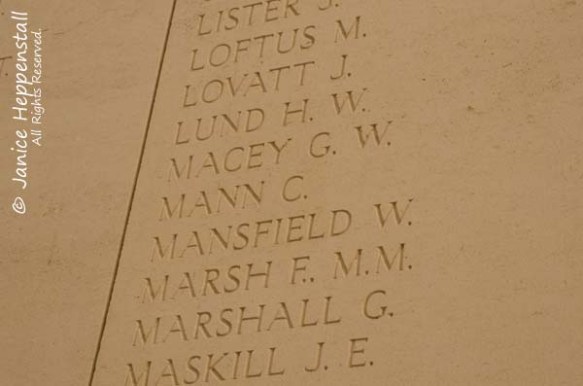
My great uncle Cyril Mann, killed at Passchendaele on 1st August 1917

Cyril Mann Inscription on Menin Gate

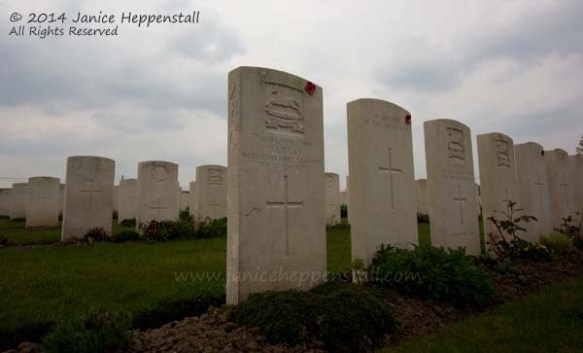
My great uncle Joseph Lucas, also killed at Passchendaele, on 9th October 1917.

Joseph Lucas grave at Poelcapelle

May they rest in peace, and may we and the politicians who represent us be ever mindful of the lessons of the past.

We have more in common than that which divides us
We are one human race