All About That Place

Advertising image for All About That Place, featuring the words 'Join All About That Place, a unique challenge event #OnePlace'

Today is Day 2 of All About That Place. I’m sure at least some of you will already know about it, and have been watching videos. I hope you’re enjoying it as much as I am. For everyone else… this is time sensitive information!

All About That Place is a ten-day event to celebrate the 10th Anniversary of the Society for One-Place Studies. It has been developed through collaboration between the Society of Genealogists, the Society for One-Place Studies, Genealogy Stories, and the British Association for Local History. However, other organisations are sponsoring specific days.

The event is being run via a pop-up Facebook Group and YouTube channel. I couldn’t find a pop-up YouTube channel specific to the event but was guided via a request for information on Facebook towards the Society of Genealogists channel. However you access the videos, they last approximately ten minutes each, and a new one appears every hour of every day, between 8am and 7pm British Summer Time. However, the time is not critical, since each video will remain online until 1st October, after which some will disappear but others will remain a little longer – only until later in October though… which is why I said this is time sensitive. By late October this post will be obsolete…

There are over a hundred pre-recorded talks to watch. They are free. My plan was to watch only the ones that interested me, but so far almost all of them have done so. I didn’t expect this to be as brilliant as it is! Clearly a great deal of work has gone into organising it.

The talks so far have looked at maps, including some great websites where mapping resources are available – some of which I’m sure you’ll already know, but others will be new to you. There have also been introductions to the kinds of resources specific organisations hold, and how they can help you in your research, like the Society of Genealogists. Some videos are about specific One-Place Studies.

As this is all about the Society for One-Place Studies, what they really want is for you to be fired up and start your own Study. They are reporting a good few new registrations already, so from that perspective this has already been a success. However, the enthusiasm amongst people participating, hosting or like me just watching is tremendous. Although all these origanisations are in the UK, people are watching from other parts of the world, and some of the One-Place Studies are in other parts of the world too.

Do give it a go!
Dade Registers

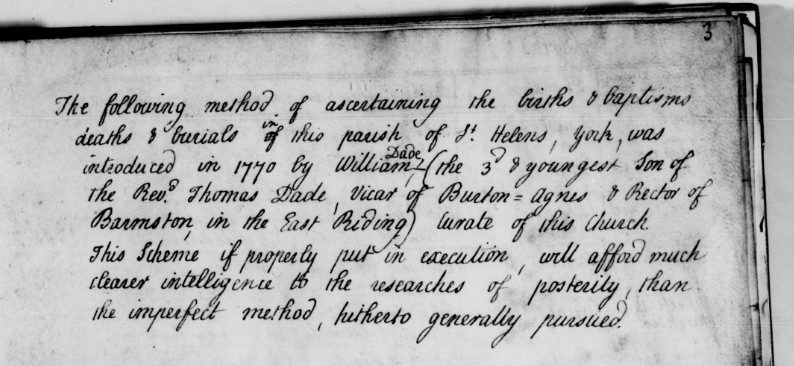
I write in praise of the Rev. William Dade, a Yorkshire clergyman who, from 1763 until his death in 1790, was curate, vicar, and rector of five parishes in the city of York and two in the East Riding of Yorkshire. In 1770, while curate of St Helen Stonegate in York, he devised a system of recording information on baptism and burial registers far superior to the usual records.

Entry by Rev William Dade at beginning of Baptism Register of St Helen Stonegate, York, in 1770.
Original data: Borthwick Institute for Archives, Ref PR-Y-HEL-3 Source: FindMyPast

So useful was Dade’s method that in 1777 the Archbishop of York required its introduction throughout the diocese. Unfortunately, the administration of the scheme was so much work for parish priests that many, particularly in more populated areas, refused to comply. I can see their point – and of course, sometimes the information is only as good as the informant’s knowledge. But even so, if you find examples of these in your ancestry you feel like you’ve struck gold!

The baptismal registers were to include:

  • Child’s name, seniority (e.g. first son), date of birth and baptism
  • Father’s name, profession, place of abode and descent
  • Mother’s name, maiden name and descent.
John Hunter Baptism Register entry, 1778, Tadcaster.
Original date at Borthwick Institute for Archives, Ref P.R. TAD / 8 Source: FindMyPast
Click for big!

Although the Archbishop of York’s request applied only to his diocese, the practice of recording more information than strictly required – just for personal satisfaction – was not unique to parishes within the diocese of York. Today, any register in which the clergyman habitually recorded extra information may be termed ‘Dade Registers’. They can be found throughout England. Their locations, together with start and end dates, are indicated on the Dade Map developed at Brigham Young University. So even if you don’t have ancestry in Yorkshire you might be lucky.

Rev. Dade applied similar diligence to his burial registers.

Margaret Simpson Burial Register entry, 1771, York St Helen Stonegate.
Original date at Borthwick Institute for Archives, Ref PR-Y-HEL-3 Source: FindMyPast
Click for big!

Below is an example from my own research that I simply couldn’t have done without this baptism record. It was the only way I could differentiate between two marriages, each involving a John Seymour and an Elizabeth, all married the same year in the same small parish.

After 1813 Rev. Dade’s system largely disappeared as the Church of England began recording baptisms and burials on pre-printed forms.  They were of course, much better than the usual pre-1813 registers, but I think you’ll agree that Rev. Dade was a cut above!

*****

I’m absolutely rushed off my feet with work and deadlines just now and for the rest of the year may not be able to publish more than one post per month. I’ll do my best, but we’ll have to see how it goes. I hope to be back to normal by the New Year.

