National Trust Birmingham Back to Backs

A row of houses built in the 1940s. At the left corner there is a shop window on the ground floor with the shop sign 'Backs to Backs' over the window.  Above the window is a road sign which reads 'Inge Street'.  To the right of the shop there are three houses, each with three storeys.  Between the first two of these houses a passage is visible leading to the back of the houses.
Image: Janice Heppenstall, 18 July 2025

I’ve wanted to visit the Back to Backs Museum in Birmingham for several years, and finally last week had the opportunity to do it.

Maintained and operated by the National Trust, the museum is located at the junction of Hurst Street and Inge Street, about ten minutes’ walk from New Street Station. On the map below – surveyed in 1887 – I have outlined the exact location and extent of the museum.

The ‘museum’ is actual nineteenth century housing. Building commenced in 1802, and by 1831 what we see on the map was complete. The three houses fronting onto Inge Street were numbers 51, 52 and 53, although the numbering seems to have changed over time. Initially known as Wilmore’s Court, the courtyard is accessed via a passage between two of the houses, and would become known as ‘Inge Street, Court 15’

Map showing the location of the National Trust Back to Back Museum in Birmingham. The map was published 1890. It centres on the junction of Hurst Street and Inge Street, and the exact location and extent of the National Trust properties are indicated.
Ordnance Survey 25 inch Warwickshire XIV.5 Surveyed: 1887, Published: 1890
Reproduced with the permission of the National Library of Scotland
CLICK HERE for link to original on nls website

Back to back housing is a particular interest of mine. During the nineteenth and early twentieth centuries, all of my family lived in back to backs. The difference was that as the nineteenth century progressed, there had been an acceptance that the arrangement of back to backs around courtyards was unhealthy – particularly as such housing was generally of poor quality and included very unhygienic shared toilet facilities. Hence back to back housing in Leeds came to be built in rows of parallel streets, making a huge difference in terms of airflow and the health benefits flowing from that.

If you have ancestors living in urban areas, particularly in the rapidly-growing industrial towns like Leeds, Manchester, Liverpool and of course Birmingham, you can tell if they lived in back to back housing by looking at a large scale map – the 25 inch to a mile, like the one shown above is best. Using census records and, later, precise addresses on other documents, you may be able to work out the exact location on a map. Back to backs are identfiable by the line across the middle of what would otherwise appear to be one house. Each unit between the various lines was a separate dwelling. So you can see on the above map that almost every house in this part of Birmingham was a back to back. You can also see that some of the properties fronted on to the streets. These, being healthier and less malodorous, had correspondingly higher rents. However, far more of the properties were built in the courtyards: Birmingham had 20,000 of them.

The Public Health Act of 1875 allowed, but did not compel, municipal corporations to ban construction of new back to backs. By this time back to backs made up 45 per cent of Birmingham’s total housing stock, housing 170,000 people. Building new properties to replace them would have been a huge undertaking. It was not until 1909 that Birmingham actually prohibited the building of new back to backs. As new housing estates were built, the old housing was gradually demolished. The area around Inge Street and Hurst Street was designated for redevelopment in 1930, and gradually the courts were pulled down. However, Court 15 remained, and was inhabited right up until 1967. By the 1980s this little group of houses at the corner of Hurst Street and Inge Street was recognised as an important part of the social history of Birmingham – and indeed the country – and in 1988 the court was listed as a Grade II building.

It was not just the back-to-back formation and the cramped, unhealthy courtyard arrangements that made this type of housing problematic. It was also the number-of-family-members to number-of-rooms ratio; and this combined with the tendency for householders to take in lodgers, who often shared rooms or even beds with family members. Court 15 regularly housed as many as 60 people at one time. On top of this, there was the fact that the buildings themselves were quickly and cheaply built. There were no nationwide building regulations in 1831, and even when they did come into force in the final quarter of the nineteenth century, they did not apply retrospectively.

In fact back to backs are nothing unusual to me. My home town of Leeds still has about 19,000 such properties – about one third of the original number; and they are very popular with people looking for starter homes or on a lower income and preferring their own ‘house with a front door’ rather than a flat. I have been in many. The difference is that these 19,000 remaining back to backs are the better quality specimens. Some of them have small gardens, some have cellars and attics, and all are of sound construction. I wanted to understand the problems of the presumably 38,000 that were demolished. It was for this reason that I wanted to visit the National Trust Back to Backs ‘museum’ at Court 15.

Visitors to the site must pre-book on a guided tour. You can find out more and book tickets on the National Trust/ Birmingham Back to Backs website. The tours last about 90 minutes and you have to be able to climb (lots of!) very steep, cramped stairs with sharp bends and narrow, pointy treads. For people with limited mobility there is an alternative ground floor tour which lasts around 60 minutes and takes in the ground floors of each property.

My tour did not disappoint – and in fact lasted two full hours. Our guide had grown up in similar housing a few streets away in the 1940s and 1950s and had actually known one of the residents of Court 15. He was generous in answering questions about life in the courts and even had a photograph of his family with a huge damp patch on the wall behind. There was nothing ‘nostalgic’ about the presentation: these were terrible places, life was hard and the streets were dangerous. We learned about sleeping with a pole to crush the bugs, we saw the most awful damp attic and the cellar where sometimes children slept, and we learned about actual families who lived in these houses and the lodgers who sometimes shared their beds. It was exactly what I needed to know to help with my Shackleton’s Fold One Place Study as well as my nineteenth century ancestry in Leeds and – just a short distance from Court 15 – in 1850s Aston.

You can take as many photos as you want while walking around the court and houses; and I did. However, this is a National Trust property, and it wouldn’t be right for me to include any of them here other than these two views that you can see from the street. So instead, I recommend that you visit! If you have ancestry in Birmingham or Aston, or anywhere else where back to back housing was considered ‘the solution’ to the rapidly increasing populations of the nineteenth century, I’m sure you would learn something from a visit to the Birmingham Back to Backs.

A red brick building built in the 1830s. It is a corner unit. On the ground floor there is a shop with the sign 'National Trust'. Above the shop window the road sign is 'Hurst Street'.
Image: Janice Heppenstall 18 July 2025

Additional Source:
National Trust publication: Back to Backs Birmingham, 2004 available at the NT Birmingham Back to Backs reception.

Meeting the people of Shackleton’s Fold

In Leeds last month, I spent two days in the Local History department of the wonderful Leeds Central Library. I had a big task to complete, started last year, that will help me progress my Shackleton’s Fold One-Place-Study.

Comprising only nineteen properties, Shackleton’s Fold existed for less than a hundred years. It was built around the mid-1840s, precise year not yet known; and from 1895 until demolition circa 1938, was populated by quite a lot of my family members.

There are various strands to this One-Place-Study. First, the properties themselves – poor quality Back-to-Backs, or rather ‘Blind Backs’, since Shackleton’s Fold comprised just two rows of houses, each with the door and windows only on the front. The back of the house, instead of joining onto another identical property with the windows and doors on the other side, was simply a solid wall. No windows, no doors, and no other house. My study will include contextual information about Back-to-Backs, the industrial era working class housing for which Leeds is famous. Next, there are of course the people who lived there: the family members who lived in each of the houses during the time they stood. I’m interested in their stories, as well as what their lives reveal more generally about the lot of the labouring classes in this part of Leeds, during the second half of the nineteenth and first half of the twentieth centuries.

Before I can delve into their stories I need to find out who they are, and that’s what I was doing in the library: compiling a list of everyone on the Electoral Registers and Ward Lists. The objective was to use these to fill the gaps between the decennial censuses. This would enable a fine-tuning of the periods of residence for each household. If a named head of household was present for the 1861 and 1871 censuses but not the 1881, the registers could allow me to pinpoint the exact year they moved out.

Cataloguing the voters of just nineteen houses for around ninety-five years didn’t seem like such a big task, particularly since at the beginning of the period none of the residents had the vote. However, it has taken three full library days for me to do it – and even now I’ll need to return to check a few omissions and discrepancies.

A scene from a library. A red book with the title 'Leeds Register of Electors, West Division, 1896' and showing the catalogue number, is being held upright.  On the desk is a handwritten notebook with lists of dates, and a laptop.  Other desks and library users are visible beyond

Throughout the nineteenth century the population of the Borough of Leeds grew rapidly. In 1861 it was 311,197, rising to 503,493 in 1891 and by 1931 – the last Census for which Shackleton’s Fold was inhabited – the population stood at 646,119. This meant that the arrangement of the registers had to change. The sheer numbers of voters in these various registers meant they had to be divided into manageable chunks. Navigating these was a huge task. For example, a volume might bear the title ‘Borough of Leeds Ward Lists 1881 Part 2’, but with no indication as to which parts of Leeds were in Part 1, Part 2, etc; and this meant each ‘Part’ had to be browsed until the area needed was located. There was no guarantee that the following year would be similarly arranged, so the whole process had to be repeated.

Header page for electoral register, bearing the title 'Borough of Leeds Polling District Number 31, Township of Wortley, Number 3 Division'.  A note below indicates that the list that follows is of people entitled to vote in any Parliamentary election throughout 1870

If you’ve worked with Electoral Registers you’ll know that they are further divided into specific polling districts. The only way to work out which one you need is to look at the most likely ones until you find streets with names you recognise as local to your place of interest. Once you’ve done that you might think you’ve cracked it, and you’ll be able to whizz through the rest in no time. However, these polling districts also change. For example, in 1870, Shackleton’s Fold was in Polling District No. 31. In 1894 it was in West Division Polling District No. 28; changed to District No. 32 by 1899; then District 33, later to 39 and so on.

Front page of The Ward List for the Holbeck Ward, Township of Wortley, Number 1 Division, for the year 1876-77.  The beginning of a list of people is visible below the header

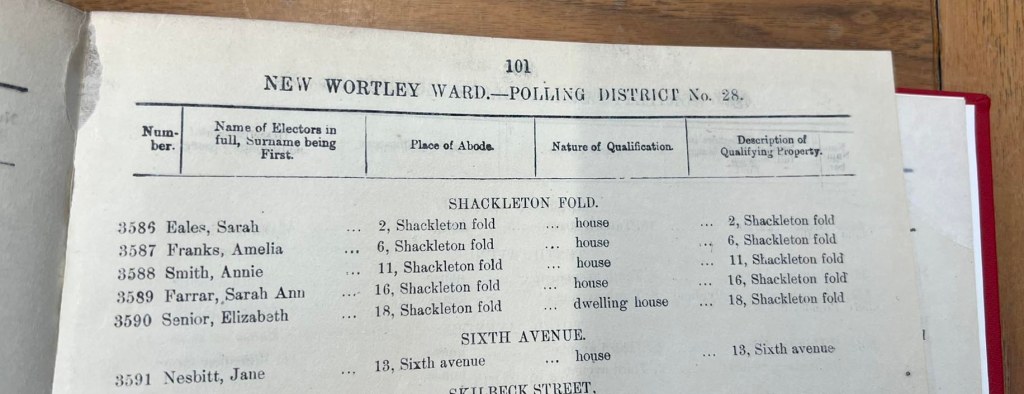
It gets worse! Electoral Registers list only those people entitled to vote in Parliamentary elections; and part of the appeal of a One-Place-Study for Shackleton’s Fold is that it existed throughout a period of great social change, including the move towards universal adult suffrage. During this time, some people were entitled to vote in Municipal but not Parliamentary Elections, and it’s interesting to chart the changes and know that behind each gain there was an important piece of legislation granting the vote to another group of people. This will definitely be covered in my One-Place-Study. However, since those entitled to vote only in Municipal elections could not be included in the Electoral Registers, there had to be another series of registers to list them. Therefore, alongside the Electoral Registers, there are also Ward Rolls, sometimes called Burgage Lists. Here, alongside the men included on the Electoral Registers, we find women and other men whose situation entitled them only to this local level of voting. Consequently there are (at least) two volumes of voters for every year. And guess what… the Polling Districts in the Ward Rolls have different names to those in the Electoral Registers! Shackleton’s Fold starts out in 1860 in ‘Holbeck Ward, Township of Wortley’. By 1874 it is the ‘Holbeck Ward Township of Wortley No. 3 Division’, and a couple of years later it’s No. 1 Division. By 1881 we have ‘Polling District No. 23 New Wortley Ward, Township of Wortley’, then ‘New Wortley Ward Polling District No 28’, and so on. By the 1920s even the township changes, to ‘Armley & Bramley’ and briefly to ‘Polling District MM Township of Leeds’.

As if that wasn’t difficult enough, it wasn’t until 1880 that voters were arranged by address. From this point forward, voters in Shackleton’s Fold are listed together, from number 1 to number 19. Before that year, locating each person involved line by line examination of every entry in the appropriate Polling District – once that had been found – and looking for the magic words ‘Shackleton’s Fold’, then making a note of the name of the person shown. Numbers of individual properties are not given, and since people often tended to move from house to house as their needs changed, there is no way of knowing for sure where each person resided other than at the decennial Census check-ins. Certainly from 1880 onwards the process was quicker, allowing for the speedy capturing of names and addresses with photographs of the relevant pages… at least, provided the Polling District hadn’t been renamed.

Top of page in Burgess List indicating that the named people who would follow were entitled to be enrolled as Burgesses, but not to be Registered as Parliamentary Electors

That said, for quite a few of the years, even after 1880, the women are listed in a separate part of the book, at the end of the entries for that polling district. Special mention must be made of the ‘Borough of Leeds Ward Lists 1872 Part 4’ in which, possibly because of a misunderstanding on the part of whoever compiled it into the one bound volume, locating the information involved examining every line on all 190 pages.

Extract from Burgess List showing the women who were entitled to vote in local elections.  These women were separated out from the male householders who, since 1867, had the right to vote also in Parliamentary elections
Women voters only. The men, who were now entitled to vote in Parliamentary as well as Municipal elections, were listed in the main part of the Ward Roll.

If you’ve ever worked with Electoral Registers, I’m sure some of the above will be familiar; but I suspect not so many of you will have been tracing the families of an entire street throughout a ninety-five year period! My advice to anyone planning on using Electoral Registers and Ward Rolls is: to allow far more time than you expect you’ll need; to understand the difference between the two, and their layout; and to make notes of the different Polling District names for each as you progress. This was a lesson hard learned for me, and explains why I now have a list of queries, and even a few volumes I now realise I missed.

That said, doing this is an essential foundation for everything that will follow. In addition to the decennial censuses from 1851 to 1921, the Electoral Registers and the Ward Rolls, I have information from The Borough of Leeds Poll Book. This was the first general election to be held after the passage of the Reform Act 1867, which enfranchised many male householders. Poll Books differed from Electoral Registers in that whereas the latter list who is entitled to vote, the former list not only who did actually vote, but also for whom they voted. It would not be until 1872 that the Secret Ballot was introduced, and so for many of our ancestors this is a once-only insight into their political affiliations. Other useful name-rich listings may include Directories and even addresses included on baptism and marriage registers. Luckily for me, for much of this period, all Church of England registers for Leeds are available on Ancestry.co.uk. – but not Roman Catholic or most Nonconformist registers.

These lists of people will form the basis of a database of every household, arranged alphabetically by surname. What I had really intended was simply to use these voter lists for fine-tuning periods of residence. I had anticipated that the real sources of information about the families would be the censuses. However, some residents lived in Shackleton’s Fold for only a very short period of time; and since all I have is the name of the head of household, there is no way of finding out more about them. The identity of a Thomas Brown, for example, who is listed on the Electoral Roll of 1871 and nowhere else – not even on the Census of that same year – will forever be unknown. However, Isaac Lord, also resident just briefly in 1870, turns out to have a sufficiently uncommon name for me to be able to track him down. Similarly, the juxtaposition of the head of household with his wife’s name on the Ward Lists may be sufficient to track a couple down via a marriage record.

My brain hadn’t flagged up that the lists themselves would also, with very little additional research required, witness the expansion of suffrage. It will be interesting to compare each increase of names with the relevant legislation. The lists even chart the final years of Shackleton’s Fold, helping me to narrow down the likely year of demolition. In 1938 only one resident remained, and by the following year he, too, was gone. Soon, Shackleton’s Fold would be no more.

If you want to follow progress on this One-Place-Study, you’ll find all blog posts and other information [here].

Remembering the Battle of Holbeck Moor

One of my motivations as a genealogist and family historian is to uncover – and pass on – stories from the past. A recent unexpected turn of events brought about a merging of a story from 1936 with my own life in 2024. In this post I’m going to tell you about both of these stories.

On 27th September 1936, Oswald Mosley, leader of the British Union of Fascists, organised a rally in Leeds. Accompanied by 1000 Blackshirts, his twin aims were to intimidate the Jewish communities based in Leylands, an area just to the north-east of Leeds city centre; and to drum up support for fascism amongst the working classes. The first of these aims was thwarted when the Leeds Watch Committee forbade any march through the Leylands area. However, the wider demonstration was allowed to go ahead. The Blackshirts’ march commenced right in the heart of Leeds. They then crossed the river into Hunslet, through to Beeston Hill – where they were joined by Mosley – and on to Holbeck Moor. Here, the plan was, Mosley would deliver a rousing speech.

The choice of Holbeck Moor was no accident. Holbeck and the adjacent areas of Hunslet and New Wortley were industrial areas with smoke-belching factories and railways lines interspersed with row upon row of poor quality back-to-back housing. This was the tail end of the Depression, and Mosley believed he would be able to drum up support for fascist politics. However, upon learning of the intended march, anti-fascist political activists spread the word. The Jews in Leylands were warned, and the presence of whoever was able, was requested at Holbeck Moor. When Mosley and his Blackshirts arrived, 30,000 Leeds residents were waiting for them.

Newspaper cutting with heading 'Injuries & Arrests at Fascist Meeting'. There is a photo of Oswald Mosley in uniform surrounded by men, and a police officer behind him. Beneath the image are the words 'Sir Oswald  Mosley at the demonstration on Holbeck Moor yesterday - Sir Oswald Mosley Among the Hurt in Leeds'.
From the article in The Leeds Mercury on Monday 28 September 1936. Source: FindMyPast.co.uk

When my Mum was in her eighties she told me about the day she saw Oswald Mosley march onto Holbeck Moor.  She lived half a mile from there, and in fact hers was just the kind of family Mosley was targetting, since her father had been unable to find regular work for several years. However, he understood very well that his lack of employment had nothing to do with Jewish people living in other parts of Leeds. Remembering clearly the events of that day, my Mum described the hate written all over the faces of the young Blackshirts. Mosley, she said, hadn’t reckoned on ‘the men of Leeds’, who were waiting on Holbeck Moor, armed with stones and determined to prevent him from speaking.  

It was some years after my Mum’s death that I came across an online article entitled ‘The Battle of Holbeck Moor’. At the time I was researching the events of the Civil War in Leeds, and thought this might have been one of the local battles associated with that; but as I read, I realised it was the event my mother had attended. This, in fact, gave me a date, and I was able to work out that she had been just twelve years old at the time… I wondered if her parents had known she was there! 

The article gave me more details about the event. Perhaps my Mum had told me about some of them, and perhaps I had forgotten. I learned that Mosley used a van as a makeshift stage, but that every time he tried to speak, 30,000 voices roared out ‘The Red Flag’ to drown him out. Clearly, as a young girl standing at the back of the crowd my Mum wasn’t an active participant in the event. For her, its importance was the impact it had on her developing understanding of the reality of fascism – something with which, unfortunately, everyone in attendance would have nine more years to become better acquainted. Certainly, it was clear that, nearly 70 years later, she remained proud of the fact that Leeds had defeated Oswald Mosley.  I left a comment at the end of the article, saying my mother had been there, and that her recollection of the event many years later tallied with the account. Then I added the info to my timeline about my Mum’s life and thought no more about it.

In August this year I received an email inviting me to be part of a special reception at the unveiling of a Leeds Civic Trust Blue Plaque commemorating the Battle of Holbeck Moor. I had been traced from that comment written some years earlier, and would be representing my mother. I was so happy to be invited to do this, and made preparations for the trip. I would be accompanied by my nephew and my second cousin and his wife. I was asked to write something about my mother for the display, to be kept permanently at the West Yorkshire Archives, and to provide some photos. Having done all that, I was then asked if I would be prepared to make a short speech on the day.

The rather surreal nature of this turn of events was not lost on me: the idea that one day in September 1936 my mother, then aged twelve, witnessed ‘the men of Leeds’ turning back the leader of the British Union of Fascists, and that 88 years later, her own daughter would be standing on the same spot talking about her was quite overwhelming. My Mum was never a political person but she always had a strong sense of right and wrong, and she knew that hatred and scapegoating had no place in politics. In life she had rarely done anything to attract attention, but now I wanted her story to be known.

I was due to travel up to Leeds on Saturday 28th September, ready for the ceremony the following day. Instead, on Friday evening, while putting the finishing touches to my preparations, I fell and broke my wrist.

Four people holding a Blue Plaque commemorating the Battle of Holbeck Moor.
Leeds MPs Fabian Hamilton, Richard Burgon and Hilary Benn, with Sam Kirk from Stand Up To Racism. Photo: P Heppenstall

The event on Sunday 29th September was well-attended. The unveiling was done by three Leeds Members of Parliament. It all went well, but I was not there. I was mostly lying on the sofa, asleep. Even now, I’m typing this with one hand.

Group of people. One of the people is holding a Blue Plaque commemorating The Battle of Holbeck Moor.  Others are holding photographs of family members.
Representatives of families of some of those who were present at the Battle of Holbeck Moor on 27th September 1936. Photo: C & J Battensby

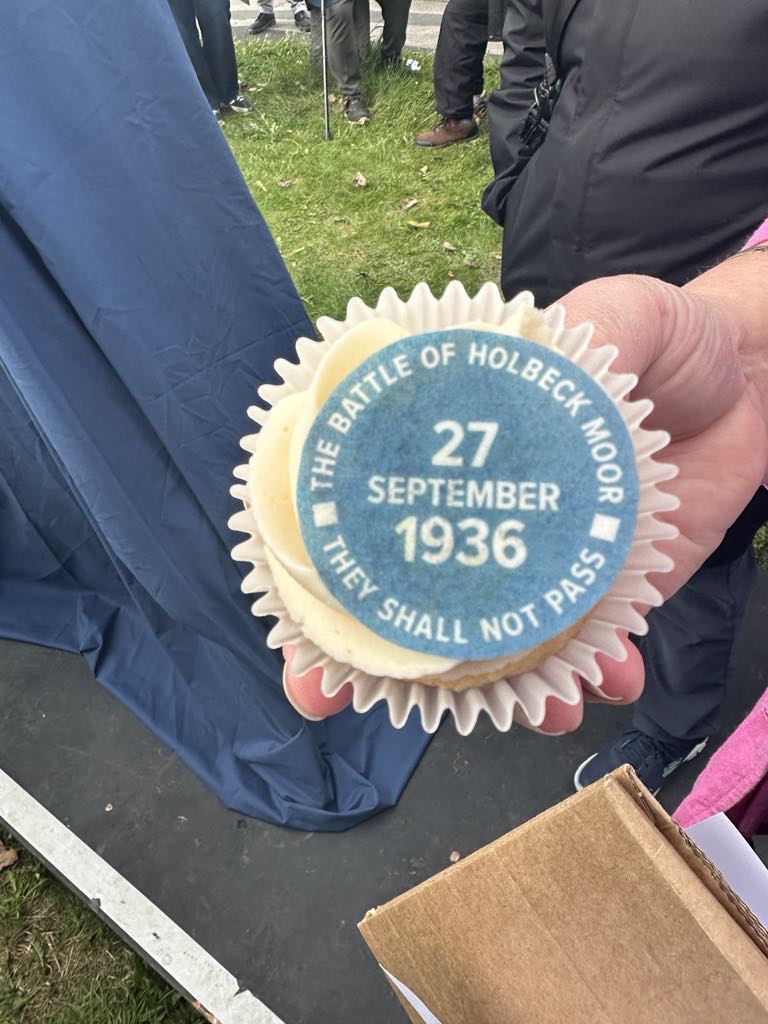
Several descendants of those present on the day had been traced, and were photographed together with photos of their family members. One of those represented had not attended the demonstration at Holbeck Moor, but was a Jewish pharmacist who gave First Aid to Blackshirts who had been injured by the stones. My nephew represented my Mum, his Grandma; and my speech was wonderfully delivered with his own twist by my second cousin. The two of them, plus my cousin’s wife, sent lots of photos and videos, and it almost felt like I was there. I was gutted to miss out on a Battle of Holbeck Moor cupcake!

A cupcake featuring a 'blue plaque' decoration, including the words: 'The Battle of Holbeck Moor - 27 September 1936 - They Shall Not Pass'
Blue Plaque cupcakes were given out after the ceremony! Photo: C & J Battensby

Of course I was very disappointed to miss the event, but the important thing is that on that day my Mum’s voice, representing 30,000 others, was heard. She would be very surprised to know she also got a mention in the local press, on the BBC and in a number of national papers, including The Guardian.

The Battle of Holbeck Moor was not the only clash between Mosley and anti-fascist demonstrators. Exactly one week later, the far better known Battle of Cable Street in London’s East End took place. By coincidence, one of those anti-fascist demonstrators was a young man who, several decades later, would become my father-in-law.

All of this came about because several people, including myself, left comments online in response to articles about the events at Holbeck Moor of 27th September 1936. As a result, this story is now owned by more family members who previously were not aware of their own family connection. More than that, the inclusion of the stories of those who attended brings a personal dimension to the history. And surely, breathing life into those memories of ordinary people is what researching family history is all about.

Leave comments! Tell the stories! You never know where it might lead.

Tracing history through parish registers

I’ve spent a lot of time, in recent weeks, analysing the baptism, marriage and burial registers of Leeds in the 17th century.

All English genealogists working at intermediate level and beyond know about ‘the Interregnum’ – the period from the execution of Charles I in 1649 to the Restoration of Charles II in 1660 – and the devastating impact this can have on tracing back generations who might have been baptised, married or buried during this period. But have you ever looked at the parish registers of your parishes of interest to see how such events played out on a more general basis in the records being kept?

Before starting this particular research I contacted the local archives and was told the registers for Leeds were complete. I then started to investigate the period more fully, through background reading, and found that the Interregnum was just one of a whole series of contemporary social and political factors impacting on the town.

First, Leeds had both economical and tactical significance in the English Civil War, which began in 1642.  The Battle of Leeds took place on 23 January 1643, and while the parish burial register indicates relatively few deaths, the vicar of Leeds was forced to flee the town.  

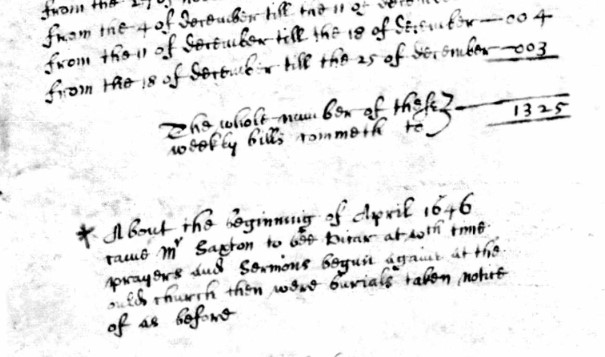
Two years later, an outbreak of the plague wiped out one fifth of the population of the township.  The overcrowded, close-built housing, and particularly that on lower ground by the river and becks (streams) where fulling and dyehouses, and housing for the humbler clothworkers were situated, was perfect breeding ground for the disease.  In March 1645/46 the situation was so serious that the parish church was closed, and no religious rites performed there for some weeks. 

Extract from Leeds parish burial register for March 1645/46, indicating lists of numbers buried buring the plague.
Extract from Leeds parish burial register:
‘About the beginning of April 1646
came Mr Saxton to the vicar at w[hi]ch time
prayers and sermons begun againe at the
ould church then were burials taken notice of as before’

If you have a subscription with Ancestry you can see the whole of this page, and the notes on the preceding page [here].

Next came the Interregnum, which lasted from January 1649 until May 1660.  During this period the church was effectively disestablished. Moderate Anglican clergy were replaced with those of Puritan persuasion.  Custody of the parish registers was removed from the ministers and given to civil parish clerks, and solemnisation of the marriage ceremony became an entirely civil function.  Bishops (and hence Bishop’s Transcripts) were abolished, and although records were kept they were often badly organised. When Restoration came in 1660, and the role of the church returned to its pre-Interregnum position, vicars often refused to accept the validity of records handed to them by the secular clerks. 

In a practical sense baptisms did continue, but it seems the previous arrangements for local chapelries to report names of those baptised to the main parish church collapsed.

Note on Leeds parish baptism register, February 1649, in which the scribe blames parents for neglecting to report baptisms in the local chapels to the main church
Extract from Leeds parish baptism register, February 1649:
‘The most of the children baptized at the several chappelles
in this parrish for this last yeare, are not to bee found in this
book, because their careles parents neglected to bring in their
names, and therefore let the children or such as want the names
hereafter blame them, who have beene often admonished of it and
neglected it’

If you have a subscription with Ancestry you can see this note in situ [here].

Simlarly – and note that this is the same hand as above – the recording of marriages brought about much displeasure:

Note on Leeds parish register, dated October 1659, in which the clerk blames prties to marriages and other ministers for the breakdown of the marriage registers.
Extract from Leeds parish marriage regiser October 1659:
‘Those that come hereafter to search about Registering of marriages
from the 8 of June last until this present 11 of October 1659 may
take notice that the persons married within that time took the liberty
either to marry without publishing as many did or else they went to Mr
Browne Curate of the ould church and got married there and at
several chappels in the parrish without ever acquainting the Registrer
or paying him his Dues, and therefore if any occasion fall out to make
search for such they may judge who is to blame. those and many others before took the same liberty
October 1659′

If you have a subscription with Ancestry you can see this note in situ [here].

More strife followed with religious division, and persecution interspersed with periods of greater tolerance.  The population of Leeds was largely split down the middle in terms of traditional Anglican and adherents of a more hellfire-and-brimstone approach to the scriptures.  This, too, meant that at various times ardent Royalist or committed Puritan ministers in turn were ejected from the church, bringing about further disruption in the registers.

As a consequence of the above, although in terms of coverage of years it is true that the Leeds parish registers have no gaps, in terms of the content of those years, not only are there significant gaps, but also (as you can see in the two images directly above) the uniform, neat handwriting of the Interregnum years belie the fact that these are the church clerk’s later transcriptions of the contemporary notes formerly made by the civil parish clerk.  (And we all know that transcriptions may include errors and omissions.)

Even when working in later periods, when faced with a selection of potential records that don’t quite fit, it’s important to remember that record sets may be incomplete.  Records may have been lost or damaged, may not be available online, may have been mis-transcribed and indexed, or may never have existed – sometimes through clerical error at the time and sometimes because of an issue of wider application such as those outlined above.  It has been fascinating to read about these events in textbooks and then see for myself the impact on the registers, but also sad to realise that some of those life events that failed to make it onto the parish registers may have been my own missing ancestors.

If you’d like to try this for yourself
I’ve found the easiest way to browse record sets (whether that be to examine them line-by-line in search of an ancestor, or to browse them looking for the impact of historical events as I have used them above) is on Ancestry, and the easiest ‘way in’ to browse any parish register is to go to an existing record for any ancestor from that record set (already in my online tree) and then use the links at the top of the page to go to the exact parish and year I want. In the example below, the record set is for the whole of West Yorkshire for the period 1512-1812. If I click on ‘Rothwell, Holy Trinity’ I can select any other parish I need from the drop-down menu. Then if I click on the year I can change that to the one I want. From that point I can browse the whole year of baptisms, marriages or burials for the parish. After a while you can easily work out roughly where the marriages or the burials start, and go straight to the appropriate pages for each year. Obviously this will only work for you if Ancestry have a licence with the relevant archives for your parish of interest.

Screenshot from Ancestry.co.uk showing top of page from Rothwell parish registers and title header bar

On FindMyPast, if records from your parish of interest are on there, you can move backwards and forwards from any page for a record you already have, but this is cumbersome, and there’s no way of knowing how many more pages remain of the year you’re currently looking at before you’ll get on to the following year. However, some of the record sets are ‘browsable’, and this is an altogether better experience but not all record sets are available yet to browse in this way. The difference is that ‘browsable’ sets have a ‘filmstrip’ facility (see bottom left on image below) which you can click to open, and then whiz back and forth along the pages, quickly homing in on the pages you want.

To find these browsable record sets, select ‘Search’ from the upper menu bar, and then ‘All Record Sets’. Type ‘browse’ in the upper left hand box, and you’ll see the numbers of records reduce to just those collections that are browsable. Then, in the box below, select ‘England’, and finally type in your place of interest. I entered ‘Norfolk, England’, and from the 50 record collections available I selected ‘Norfolk Parish Registers Browse’. On the next page you enter a year range (or leave it blank) and an event (baptism, marriage, etc) or leave it blank, and then the parish. I haven’t yet found any records of interest to me that are browsable, but this will be a good facility when more are added – and you might be luckier than me.

Front cover of a 'Banns Book' showing location of link to open 'filmstrip' facility

On FamilySearch (free to use, you just need to register for an account) a huge number of images are available to browse, but not all parishes are covered, and even if your parish is, there may be gaps. To find them, from the upper menu bar, click ‘Search’, then ‘Images’. On the next page type in the name of your parish. I tried several of my parishes of interest before finding one for which images were available: Great Yarmouth in Norfolk. It may ask you to select from a few options, and then click ‘Search Image Groups’. On the next page you’ll see precisely what they have. For Great Yarmouth it was just marriage registers, with an almost complete coverage from 1794-1899, but some gaps.

It would be great to hear if you have any successes with this. Have you come across a significant event in your town and then verified it through parish records?