Ancestral Tourism 4: Houses & Business Premises

This is part four in my ‘Ancestral Tourism’ series. It follows on from Part 1: Churches and Churchyards, Part 2: Municipal & other Public Cemeteries and Part 3: Graves and Gravestones. The focus in this little series is on planning ahead so that you can spend the time when you’re there exploring, wandering, taking photographs and soaking up the vibes of the place.

In this post we’re looking at preparing for visiting former ancestral homes and business premises that are still standing. Trying to locate buildings no longer in existence will be covered in a future post.

Before you go

How do we know where our ancestors lived?
A range of documents may include the specific address or property name, or other clues as to the location of a former home or business of our ancestors. Examples are:

  • Church records, such as Baptism, Marriage, Burial and maybe wider parish records
  • Civil Registration: Birth, Marriage and Death Certificates
  • Census records
  • Correspondence between the person and an official body, sometimes found in archives, e.g. National Archives
  • Directories
  • Electoral Rolls
  • Family business records
  • Family documents, including letters and perhaps a family bible or other religious text
  • Immigration and Naturalisation documents
  • Military Records, including attestations and next of kin
  • Newspaper reports
  • Poll Books
  • Probate Records, Wills, etc
  • Property and Land records, including deeds, local tax, etc
  • Public and Municipal Cemetery registers
  • School records

It’s certainly easier to track our more recent ancestors.
For earlier generations, even where we find an abode in the examples above, often an exact ‘address’ was not used. A street name without house number, or for smaller places even just the name of the village or hamlet may be the closest we’ll get. During the second half of the 19th century we find more documents that include information to guide us to a specific property. Earlier this year I visited Kinver in Staffordshire, where my 2x great grandfather and some of his siblings were born. The image below shows the extent of Kinver now, as viewed from the churchyard high on a hill above the village. The main High Street, dating from medieval times, is clearly seen in the image. Most of the properties beyond that are more recent. ‘Somewhere in this photo’ is the closest I will ever get to knowing where my ancestors lived here – but I’m happy with that.

Kinver viewed from the church. © Janice Heppenstall

Beware! House names and even house numbers can change
Even when documents do bear a house number or name, these may have changed – particularly if there was much additional building in the twentieth century. I researched the history of a house built around 1837 in what is now a built-up area of the Isle of Wight. The house number is 21, and my clients had already done some research into the nineteenth century inhabitants of ‘number 21’. However, using maps and other documentation I found that the house became number 21 only in the early twentieth century. For the first eighty or so years it was number 3. The change had become necessary to accommodate new building over the previous decades.

Similarly, a few years ago, I visited York to see my family’s properties there. Census records had my 4xG grandparents at 58 Stonegate. I found the property and photographed it, but afterwards realised Stonegate had been renumbered. Eventually I worked out that their shop (and the floors above above, where they lived) had been this well-known corner plot, below, that was later taken over by Banks & Sons. I had been sitting right opposite this shop (in Betty’s tearoom, for those who know!) without knowing it was my ancestral home. It took a lot of research to work this out. But this is what happens when we don’t do our homework before we set off! Now I have to go back to York to step inside this lovely shop. Luckily, visiting York is never a chore.
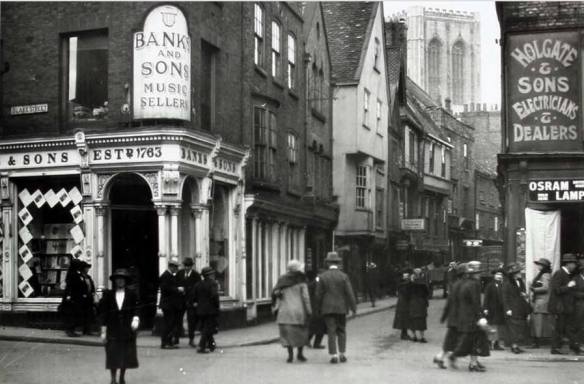
An early twentieth century scene from York, showing part of Stonegate and featuring the corner shop at that time occuped by Banks and Sons Music Sellers. York Minster is visible in the background
Junction of Stonegate with St Helen’s Square, York. Image in public domain, photographer unknown.

Changes in house name can be even more difficult to work with, particularly if several houses on the street seem to have changed name, and possibly more houses may have been built between the original ones.

So how can we be sure we have the right house?
Here are some ideas.

Photographs
If you’re lucky you may have an old family photo of the house. Even photos of people standing outside a property may provide visual clues in the form of distinctive architectural features. You can then use Google Street View to ‘walk’ along the road to find the property, if it’s still there.

Family and Local History groups on Facebook are also extremely useful for identifying the exact location of a photograph. I once witnessed someone posting an ancestral holiday snap and asking if anyone knew where in the world it could be. Within fifteen minutes it was identified as beneath a specific lamp post in a named piazza in Rome!

It’s also worth exploring whether there’s a website with old photos of your area of interest. The best one I know is Leodis, a photographic archive with over 62,000 images of Leeds, managed by the Local and Family History team at Leeds Libraries. I have found many old images of houses my ancestors lived in on there – in streets that now no longer exist. If you know of such a website for any of your areas of interest, please do share in a comment.

Maps
Mention has already been made of Google Street View. Modern day maps – including Google and other online maps – can be scrutinised alongside historic maps. My go-to place for online Ordnance Survey maps is here: https://maps.nls.uk/os/ I’ve written before about their Side-by-Side maps, but there are many other features. Something you could do is find a detailed historic map (the 25 inches to one mile series if possible) on the nls site, and see if you can compare the shapes of buildings then to existing buildings on satellite view now.

‘Walking the route’ with the census enumerator
With no photos and only documents to go on, it may be possible, using modern and contemporary maps, to ‘follow the route’ of a census enumerator. Using landmarks and occurences of smaller streets, you may be able to find the house, or at the very least to work out its general whereabouts, even if it’s not possible to narrow it down to a specific property.

Getting to know the neighbours
Using census returns for the street where your ancestors lived, it might be possible to track any changes in housenames or numbers of specific families whose occupation spans two or more decades. If the Jones family live at number 42, the Smiths at 44 and the Browns at 46, and then ten years later the same three families are at 58, 60 and 62, it is more likely that the numbering has changed than that all three families relocated together further along the same street. You can do the same thing far more accurately by consulting Electoral Registers. In the example above of my clients’ house starting out as Number 3 and eventually becoming Number 21, I could see from the Electoral Registers that this change happened in 1931. However, Electoral Registers are often not accessible online, meaning this may be something you could do only when you arrive in the area. Local archives and central libraries will usually have these registers.

What if your family’s presence predates the census?
Below is part of Starbotton, in Upper Wharfedale, where my period of interest, before 1750, predates the census. Before going I ‘walked the route’ using Google ‘Map View’ on one device and ‘Street View’ on another to be sure to cover the whole village. By the time I visited, last summer, I knew this small village like the back of my hand. However, I had no idea which house had been owned by my 8x great grandparents and later their son, my 7x great grandfather. Apart from church records and similar, indicating that the family lived in ‘Starbotton’, I was very lucky to come across a collection of property reports made over the years by the Yorkshire Vernacular Buildings Study Group. These, in turn, drew upon other property documentation at the County Record Office. I was able to identify several specific houses formerly owned by my wider ancestral family in Starbotton, and to pay special attention to them when I visited. I never did find out where my 7x and 8x grandparents lived, though, and it’s possible their house may no longer be standing. However, I can name the late seventeenth century inhabitants of around half of the properties, and I know that most of mine lived in the part of the village pictured below.
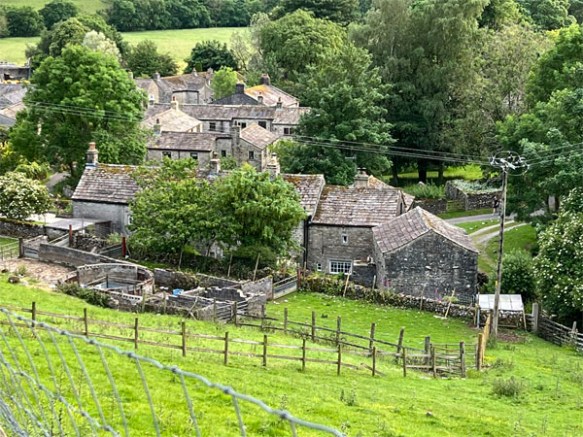
A rural village scene with seventeenth century stone houses surrounded by hills and trees
Part of Starbotton, Upper Wharfedale, Yorkshire. © Janice Heppenstall

When you arrive

If the occupants were in the garden I would probably chat to them, tell them about my connection and ask permission to photograph the house from the street. If they wanted to know more about who lived there I would tell them. If they were not there I’d take the photos anyway. Just taking a few photos, wandering up and down the street, touching the wall… I find all these things bring me closer to my ancestors who lived there.

If your ancestors had a shop or public house, if the school they attended is now a business centre, or if for some other reason their former home or premises are open to the public, it would be lovely to step inside and spend a little time there.

I also enjoy seeing historic buildings and landmarks that my ancestors would have known, and just getting a feel for the area and the local history. You can do this even if the house they lived in is no longer there.

Depending on the size of the place you’re visiting, and its historic importance or embracing of tourism, you might be able to pre-book a tour with an accredited guide.

If you can’t get there

It really does make a difference going there, but if that’s not possible, just doing the research outlined above will leave you knowing a great deal more about your ancestral homes and the localities they lived in. You can also take a screen shot of your ancestral properties using Google Street View, and of course connect with online and local groups to find out more and see if anyone has any photos.

*****

If you have other ideas please do leave a comment.

Housing the urban poor in 19th century England

“THE EDITUR OF THE TIMES PAPER
Sur, — May we beg and beseech your proteckshion and power. We are Sur, as it may be, livin in a Wilderniss, so far as the rest of London knows anything of us, or as the rich and great people care about. We live in muck and filth. We aint got no priviz, no dust bins, no drains, no water-splies, and no drain or suer in the hole place. The Suer Company, in Greek St., Soho Square, all great, rich and powerfool men, take no notice watsomdever of our complaints. The Stenche of a Gully-hole is disgustin. We all of us suffer, and numbers are ill, and if the Colera comes Lord help us.

Some gentlemans comed yesterday, and we thought they was comishioners from the Suer Company, but they was complaining of the noosance and stenche our lanes and corts was to them in New Oxforde Strect. They was much surprized to see the seller in No. 12, Carrier St., in our lane, where a child was dyin from fever, and would not believe that Sixty persons sleep in it every night. This here seller you couldent swing a cat in, and the rent is five shillings a week; but theare are greate many sich deare sellars. Sur, we hope you will let us have our complaints put into your hinfluenshall paper, and make these landlords of our houses and these comishioners (the friends we spose of the landlords) make our houses decent for Christions to live in. Preaye Sir com and see us, for we are living like piggs, and it aint faire we shoulde be so ill treted.

We are your respeckfull servents in Church Lane, Carrier St., and the other corts. Teusday, Juley 3, 1849.”

This letter was signed by fifty-four residents of the St Giles ‘rookery’ in London. Published on 5 July 1849 under the headline ‘A Sanitary Remonstrance‘.

***

The rapid expansion of our large industrial towns and cities started in the eighteenth century but was particularly so during the first half of the nineteenth, as increasing numbers of people migrated from rural areas and from Ireland. Between 1800-1850 the percentage of English citizens living in urban areas in the country as a whole increased from 30 to 50%, but in certain major industrial towns the growth was much greater. In Birmingham, between 1801 and 1851, the population increased from 71,000 to 233,000. In the same period Liverpool’s population grew from 82,000 to 376,000. In just one decade from 1821-31 Bradford’s population increased by 78%.

How on earth did these towns cope with housing and facilities for all these additional people? The simple answer is that they did not.

The thinking was that needs would be served by demand: employers would build factories, and speculative builders would build the housing needed for the incoming labourers. Of course the builders required a profit for their work, and the problem was that the workers were paid very little. Even the cheapest housing meant some workers were paying a quarter of a very meagre income on rent. By the end of the nineteenth century, nearly one third of the population would be considered ‘the very poor’.

There were several consequences. One was that purpose-built housing for the masses was of very poor quality, often built with just twenty or so years left on a land lease and deliberately built to last for just that length of time. Walls were the thickness of a single row of bricks, and the bricks themselves were often insufficently fired. Proper foundations were not dug out, meaning floor boards on the lower levels could be laid just a couple of inches above bare earth. In the Midlands and the North, back-to-backs became common. Each house had a party wall on three sides, with the door and windows only on the remaining side. Sometimes these were built in rows along parallel streets, but often they were arranged around courtyards, with the outer properties facing the street and the (cheaper) inner properties accessed via an alley or tunnel. Consequently, not only was there no possibility of air flow from one side of the house to the other, but the courtyard itself would have very little movement of air.

Room sizes were small, and despite the generally large family sizes, most purpose-built housing for the labouring classes had just two rooms: one up and one down, plus possibly an attic space. In the 1870s 43% of married women had 5 to 9 children; 18% had more than ten children. Hence as a matter of course, most individual family homes for the workers would be overcrowded.

As an alternative there was the option of repurposing existing housing. The large family homes built in the Georgian period for better-off families might now be sub-divided, with rooms on each floor let to different families. Repurposing in this way was always cheaper than purpose-built, but it did mean that the facilities and level of privacy originally intended for one family were now to be shared amongst several.

For the poorest of all, these already inadequate spaces were shared. Two, three or even more families would share small houses, designated rooms on a floor, or even one room.

Worst of all, the cellars of larger houses were rented out as dwellings – and even they might house more than one family. Some families even kept livestock in a pen alongside the family. There was, of course, no drainage. What’s more, the floors were bare earth and often they were below the water table, meaning they regularly flooded.

As the nineteenth century progressed and towns prospered, local authorities started to erect grand buildings as a testament to civic pride. Roads were widened to facilitate easier passage of large numbers of hansom cabs, and towns were redrawn to make way for railway lines and their stations. All of this required clearance of existing housing, and often the routes and locations selected specifically targetted the housing of the working classes. This was generally thought to be a good thing, since the housing was filthy, a health hazard and an eyesore. However, no new housing was built. Consquently, these grand developments meant worse overcrowding since more families had to cram into the buildings that remained. There were also raised rents, since unscrupulous landlords sought to take advantage of the scarcity of housing. In London, 120,000 people were displaced, and no new housing built to accomodate them.

Vast ‘rookeries‘, already unfit for human habitation, were the only areas available for the very poor. These were characterised by narrow alleyways and poorly-constructed multiple-storey dwellings crammed into whatever space was available. St Giles in London, where the signatories of the above letter to The Times lived, was a rookery. So too was the ‘Devil’s Acre’: the land on which Victoria Street in Westminster was built.

To this perfect storm of poor quality, inadequate housing, overcrowding and lack of ventilation, we must add one more fact of life: People need toilets.

The flushing toilet, or water closet, depends upon ready availability of water and a system of sewers, but it was not until the middle of the nineteenth century that these started to be installed as standard. Prior to that there were dry closets neutralised by earth or ashes; and cess pits. ‘Night soil’ would be collected by men whose job it was to take it to market gardens outside the towns, where it could be used as fertiliser. In some houses the cess pit was actually in the cellar, so that waste collected immediately below the floor boards of the ground floor dwelling rooms. Perhaps it was the rapid growth of towns and cities that meant these arrangements did not always go to plan, but we do know that collection of sewage and general waste was not always carried out. In one infamous rookery in Leeds called the Boot-and-Shoe Yard, no waste was collected for more than six months. When eventually this was remedied, over seventy cart loads were taken away. In any case, privies were shared between households – maybe as many as three hundred people, although the St Giles signatories claimed to have none at all: “We live in muck and filth. We aint got no priviz, no dust bins, no drains, no water-splies, and no drain or suer in the hole place.”

In 1842 serious concerns about the insanitary conditions in Leeds’s Boot-and-Shoe Yard led to the demolition of this rookery just off one of the main streets in the town. The 1841 census is therefore the only snapshot we have of the number and occupations of the residents. As can be seen from this extract, many of them were migrants from Ireland.

Extract from 1841 census showing entries for 12 individuals who were living in Leeds's Boot-and-Shoe Yard

Citation: 1841 Census of England and Wales. Original data: The National Archives. Source: Find My Past – the ‘I’ in the last column indicates those who were from Ireland

The popular view was that the muck and filfth was the fault of the residents, whose standards, lifestyle and morals were unacceptable.

It wasn’t until well into the second half of the nineteenth century that change gradually came. Prior to this there were no planning laws or building regulations. Gradually, local authorities were empowered to require builders to conform to certain minimum requirements, but many did not act on this because of the extra cost to the ratepayer. Increasingly it came to be understood that the health crisis and the housing crisis were two strands of the same issue, and permissive powers evolved into mandatory, but it would take the slum clearance and demolition programmes before finally these living conditions were consigned to the history books.

How can we make use of this information in our family history research?
Armed with this understanding of living conditions we can look for clues to learn more about the conditions in which our ancestors lived. Often, but not always, the worst conditions were occupied by immigrants. Here are some ideas:

Look for multiple households at one address in the census
In this extract from the 1901 census we see three households including 23 people living in one house. In fact this is only part of the return for number 5 Brick Lane: the rest are recorded on the following page. In total there are four households totalling 31 people. Three of the households have lodgers – a total of five lodgers altogether in the house.

Extract from 1901 census for 5 Brick Lane.  This shows 23 people from 3 households plus a lodger living at one address.  The rest of the inhabitants of this property are on the next page of the census and are not shown on this extract.

Citation: 1901 Census of England and Wales. Original data: The National Archives. Source: ancestry.co.uk

Look for families living in cellars
The houses in Liverpool’s Edmund Street had cellars, and as with many of the larger properties in Liverpool, these were let as separate dwellings. The main house at number 56 is a lodging house, with five lodgers, but another family is recorded in the cellar.

Extract from 1851 census showing a lodging house which also has a separate cellar let as a dwelling

Citation: 1851 Census of England and Wales. Original data: The National Archives. Source: ancestry.co.uk

Use the largest scale maps you can find to identify yards or courtyards, especially with back-to-backs
This small section of Lee’s Square is taken from an 1850 map of Leeds. Unfortunately the rest of the Square is on the next Ordnance Survey sheet. Thanks to the large scale of this map we can see individual properties. What we see is that most of the properties in Lee’s Square are back-to-backs. The property behind each abode has the door and windows looking out on to the street. The rents for those properties will be slightly higher. Although we can’t see from this map section, the privy will be inside the Square, also the water pump. This, added to the obvious lack of free-flowing circulation of air, will mean the inner properties are less healthy places to live than the outer.

Small extract from Ordnance Survey Town Plan of Leeds, Surveyed 1847, Published 1850.  The extract shows part of Lee's Square.  The markings on the buildings indicate that most of the properties are back-to-backs, and that Lee Square is a small courtyard formed of the inner facing properties.  The outer facing properties are on the surrounding roads.

Citation: Ordnance Survey Town Plan of Leeds, Surveyed 1847, published 1850. Reproduced with the permission of the National Library of Scotland. [Click here] for link to the full map.

Look for old photos of the addresses where your families lived
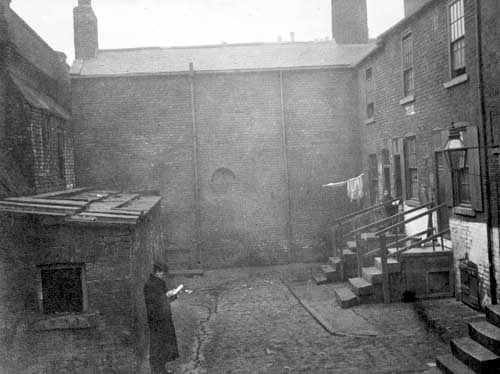
Ideally, you’ll be able to compare these with contemporary maps. The image below shows the same portion of Lee’s Square as you see on the map above. You can see the two sets of steps leading to the doors of two of the houses, and a cellar of some sort below. The photo is dated 1901 – fifty years after the map was surveyed and published, and the lean-to appears to have been added in the intervening years. The buildings on the southern side of the square seem to be lower and perhaps don’t have the substructure. This is of particular interest to me because my 2x great grandfather was living here in the 1890s. Thanks to a Coroner’s Report after his death I know that his house was above a stable, but it isn’t clear from this photo or its partner (looking east) where the dwellings above a stable would be.

Black and white photograph dated 1901 showing an old yard with two storey houses on each side and steps leading to three of the houses.  A man is standing outside a brick-built lean-to building on the left of the shot.  This may be a privy.

Citation: ‘Lee’s Square looking west, 1901’ Source: Leodis. [Click here] for link to image on Leodis website.

If you have ancestors who might be classed as ‘urban poor’ in the nineteenth century, I hope these ideas will help you.

All of this new research has been carried out as part of my One Place Study for Shackleton’s Fold.

I’m also developing a presentation on the subject of Housing the Urban Poor in 19th Century England. If this is of interest to you and your local or family history society, please take a look at my Public Speaking page, and follow the link at the bottom of that page to contact me.

***

Sources

David Olusoga & Melanie Backe-Hansen: A House Through Time, 2021. Picador, London

John Burnett: A Social History of Housing 1815-1970, 1978. David & Charles, Newton Abbot

Stanley D Chapman (Ed): The History of Working-Class Housing, 1971. David & Charles, Newton Abbot – this book has separate chapters on London, Glasgow, Leeds, Nottingham, Liverpool, Birmingham, South-East Lancashire/ Pennines, Ebbw Vale.

B R Mitchell and Phyllis Deane: Abstract of British Historical Statistics, 1962. Cambridge University Press.