
One of my motivations as a genealogist and family historian is to uncover – and pass on – stories from the past. A recent unexpected turn of events brought about a merging of a story from 1936 with my own life in 2024. In this post I’m going to tell you about both of these stories.
On 27th September 1936, Oswald Mosley, leader of the British Union of Fascists, organised a rally in Leeds. Accompanied by 1000 Blackshirts, his twin aims were to intimidate the Jewish communities based in Leylands, an area just to the north-east of Leeds city centre; and to drum up support for fascism amongst the working classes. The first of these aims was thwarted when the Leeds Watch Committee forbade any march through the Leylands area. However, the wider demonstration was allowed to go ahead. The Blackshirts’ march commenced right in the heart of Leeds. They then crossed the river into Hunslet, through to Beeston Hill – where they were joined by Mosley – and on to Holbeck Moor. Here, the plan was, Mosley would deliver a rousing speech.
The choice of Holbeck Moor was no accident. Holbeck and the adjacent areas of Hunslet and New Wortley were industrial areas with smoke-belching factories and railways lines interspersed with row upon row of poor quality back-to-back housing. This was the tail end of the Depression, and Mosley believed he would be able to drum up support for fascist politics. However, upon learning of the intended march, anti-fascist political activists spread the word. The Jews in Leylands were warned, and the presence of whoever was able, was requested at Holbeck Moor. When Mosley and his Blackshirts arrived, 30,000 Leeds residents were waiting for them.

When my Mum was in her eighties she told me about the day she saw Oswald Mosley march onto Holbeck Moor. She lived half a mile from there, and in fact hers was just the kind of family Mosley was targetting, since her father had been unable to find regular work for several years. However, he understood very well that his lack of employment had nothing to do with Jewish people living in other parts of Leeds. Remembering clearly the events of that day, my Mum described the hate written all over the faces of the young Blackshirts. Mosley, she said, hadn’t reckoned on ‘the men of Leeds’, who were waiting on Holbeck Moor, armed with stones and determined to prevent him from speaking.
It was some years after my Mum’s death that I came across an online article entitled ‘The Battle of Holbeck Moor’. At the time I was researching the events of the Civil War in Leeds, and thought this might have been one of the local battles associated with that; but as I read, I realised it was the event my mother had attended. This, in fact, gave me a date, and I was able to work out that she had been just twelve years old at the time… I wondered if her parents had known she was there!
The article gave me more details about the event. Perhaps my Mum had told me about some of them, and perhaps I had forgotten. I learned that Mosley used a van as a makeshift stage, but that every time he tried to speak, 30,000 voices roared out ‘The Red Flag’ to drown him out. Clearly, as a young girl standing at the back of the crowd my Mum wasn’t an active participant in the event. For her, its importance was the impact it had on her developing understanding of the reality of fascism – something with which, unfortunately, everyone in attendance would have nine more years to become better acquainted. Certainly, it was clear that, nearly 70 years later, she remained proud of the fact that Leeds had defeated Oswald Mosley. I left a comment at the end of the article, saying my mother had been there, and that her recollection of the event many years later tallied with the account. Then I added the info to my timeline about my Mum’s life and thought no more about it.
In August this year I received an email inviting me to be part of a special reception at the unveiling of a Leeds Civic Trust Blue Plaque commemorating the Battle of Holbeck Moor. I had been traced from that comment written some years earlier, and would be representing my mother. I was so happy to be invited to do this, and made preparations for the trip. I would be accompanied by my nephew and my second cousin and his wife. I was asked to write something about my mother for the display, to be kept permanently at the West Yorkshire Archives, and to provide some photos. Having done all that, I was then asked if I would be prepared to make a short speech on the day.
The rather surreal nature of this turn of events was not lost on me: the idea that one day in September 1936 my mother, then aged twelve, witnessed ‘the men of Leeds’ turning back the leader of the British Union of Fascists, and that 88 years later, her own daughter would be standing on the same spot talking about her was quite overwhelming. My Mum was never a political person but she always had a strong sense of right and wrong, and she knew that hatred and scapegoating had no place in politics. In life she had rarely done anything to attract attention, but now I wanted her story to be known.
I was due to travel up to Leeds on Saturday 28th September, ready for the ceremony the following day. Instead, on Friday evening, while putting the finishing touches to my preparations, I fell and broke my wrist.

The event on Sunday 29th September was well-attended. The unveiling was done by three Leeds Members of Parliament. It all went well, but I was not there. I was mostly lying on the sofa, asleep. Even now, I’m typing this with one hand.

Several descendants of those present on the day had been traced, and were photographed together with photos of their family members. One of those represented had not attended the demonstration at Holbeck Moor, but was a Jewish pharmacist who gave First Aid to Blackshirts who had been injured by the stones. My nephew represented my Mum, his Grandma; and my speech was wonderfully delivered with his own twist by my second cousin. The two of them, plus my cousin’s wife, sent lots of photos and videos, and it almost felt like I was there. I was gutted to miss out on a Battle of Holbeck Moor cupcake!
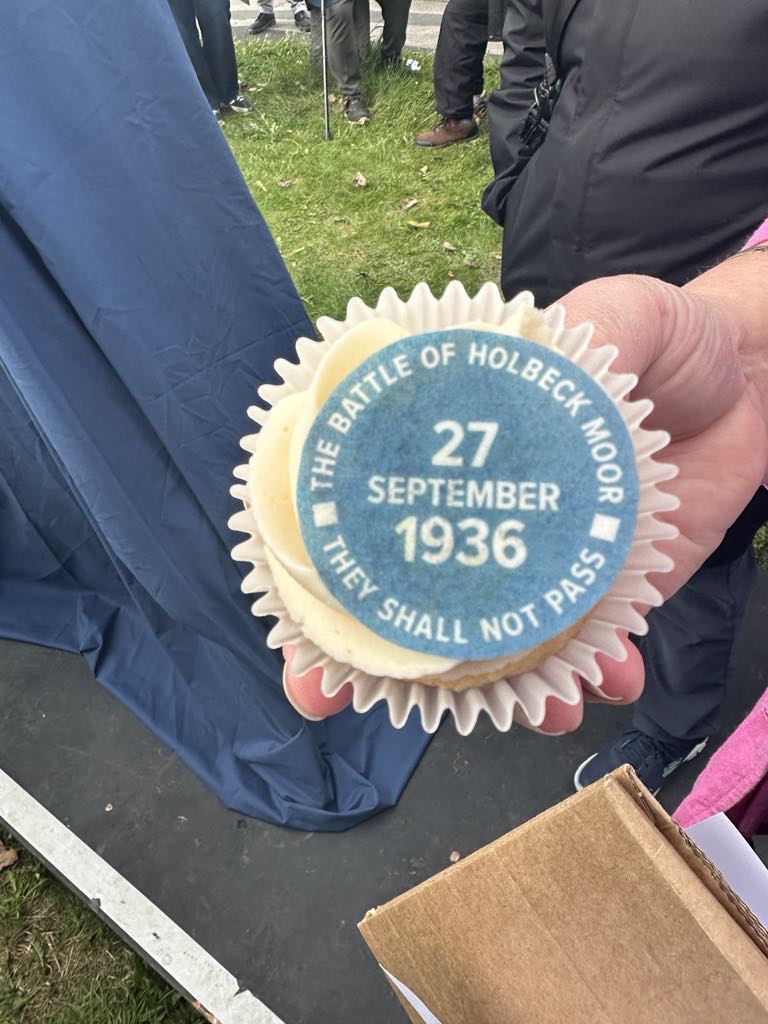
Of course I was very disappointed to miss the event, but the important thing is that on that day my Mum’s voice, representing 30,000 others, was heard. She would be very surprised to know she also got a mention in the local press, on the BBC and in a number of national papers, including The Guardian.
The Battle of Holbeck Moor was not the only clash between Mosley and anti-fascist demonstrators. Exactly one week later, the far better known Battle of Cable Street in London’s East End took place. By coincidence, one of those anti-fascist demonstrators was a young man who, several decades later, would become my father-in-law.
All of this came about because several people, including myself, left comments online in response to articles about the events at Holbeck Moor of 27th September 1936. As a result, this story is now owned by more family members who previously were not aware of their own family connection. More than that, the inclusion of the stories of those who attended brings a personal dimension to the history. And surely, breathing life into those memories of ordinary people is what researching family history is all about.
Leave comments! Tell the stories! You never know where it might lead.

 English Ancestors