Getting the most from cemetery records

Today’s post is an interloper amongst my little ‘Ancestral Tourism’ series. It follows on from Part 1: Churches and Churchyards, Part 2: Municipal & other Public Cemeteries and Part 3: Graves and Gravestones. I’ve stepped away from the ‘Ancestral Tourism’ series here because this is something you can do online, whether you visit the grave or not – although it is, of course, also great preparation for a trip to the actual cemeteries.

The aim here is to show how the information from various records relating to burials, and even the same records on different platforms – including the gravestone itself if there is one – can be combined to give a greater depth of knowledge and understanding about an ancestor and their family. This technique of layering up information from different records works equally well with other aspects of an ancestor’s life, of course, but here I’m focusing on burial.

I hope this will be of interest to readers researching at Intermediate level, or moving on from Beginner to Intermediate level.

First, a comparison of records from two different cemeteries

Precisely what is included on the record varies from one cemetery to another, and possibly from time to time. I can illustrate this by comparing burial records for two of my ancestors: a 4xG grandmother and a 2xG grandmother. Both died after the introduction of Civil Birth, Marriages and Deaths, and I had already located the death entries on the General Register Office (GRO) online register, and bought one of the Death Certificates.

What the records include
This first record is from York’s Fulford Cemetery. It includes so much information that there is no need to buy a Death Certificate. CLICK FOR BIG!

Burial record of Sarah Wade, 14 Mar 1860, Fulford Cemetery York. Source: FamilySearch.org York: Cemetery Records 1837–1871, image 363/812

Here, we see that Sarah Wade, bottom entry, was buried in the York Public Cemetery at Fulford Road in 1860. She has the burial reference ID of 11,365 and is interred in Grave number 3837. She died on 9th March 1860 and was buried on 14th March. Sarah was 75 when she died and was the wife of John Wade, gentleman. They lived in Stonegate, York, but the number of the property is not given. Cause of death was pneumonia. The informant was Edwin Wade of 4 Coney Street, York. The final column is the name of the officiating minister.

There is more to this information than meets the eye. Sarah is the wife of John Wade. This means he is still living. You can see that the entry above Sarah’s describes the deceased, Emily Johnstone, as ‘Relict of the late Spearman Johnstone, Gentleman’. A less formal term would simply be ‘Widow’.

The second and third entries in this extract are both men. One is a Captain in the Militia; the other a Fishmonger. Men, then, are described by their Trade, Occupation or Profession. Women are described by their marital status, or ‘condition as to marriage’. The top entry is a child. Children are described as ‘Son/Daughter of’ followed by the father’s name.

The informant is not John the husband, but another man with the surname Wade, therefore probably related. He is in fact the oldest son of Sarah and John, and he is clearly used to signing documents with a flourish!

*****

The next record is from Beckett Street Cemetery in Leeds.  The cream line just indicates where I have removed several lines from the page because it’s only Annie E Cass that we’re considering here.
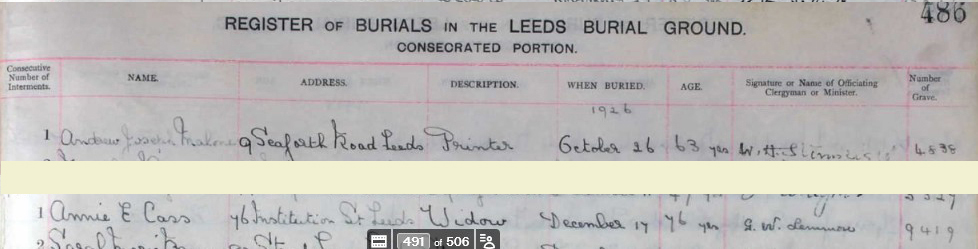
Extract from a burial register dated 1926. The original image has been edited to remove several entries, leaving only the top one, plus the headings for each of the columns, and the record of Annie E Cass who was buried on 17th December 1926.
Burial record of Annie E Cass, 17th December 1926, Beckett Street Cemetery, Leeds.
Source: ancestry.co.uk Leeds, England, Beckett Street Cemetery, 1845-1987

In this record we see that Annie E Cass, bottom entry, was buried at The ‘Leeds Burial Ground’.  This is the same as ‘Beckett Street Cemetery’.  She was buried in the consecrated portion on 17th December 1926.  Address at time of death was 76 Institution Street, Leeds.  Annie was 76 years old and a Widow – again, we see that the top entry, a man, is described by his profession.  Annie in fact ran a business after her husband’s death 28 years earlier, but this is not mentioned.  The penultimate column is for the signature or name of officiating clergyman or minister, and finally we have the Grave plot number, which is 9419.

There is not as much information as on the Fulford Cemetery entry above.  We don’t have an informant or date of death, and the late husband’s name is not included.  We also don’t have a cause of death.  To cover all bases on this one we might want to purchase the Death Certificate. What we do know, however, is that Annie was buried in the Consecrated Portion of the cemetery. She was therefore Church of England. (I already knew that as I have her baptism record, but sometimes every little helps!)

*****

Gathering information from several documents and platforms

Now I’m going to home in on Annie, or Annie Elizabeth Cass to use her full married name. I want to see if I can add to my knowledge and understanding of her life and family by looking closely at all the records I can find relating to her burial.

The information from FindAGrave (below) is a transcript compiled directly from Annie’s burial entry above. You can see that all the information is accurate, but the marital status is not included, and it is not clear whether Annie died on 17th December or was buried on that date. This is why seeing the original is always preferable, but if that’s not possible, a transcript is infinitely better than nothing. In fact I do already know that Annie died on 14th December, because I did previously buy a copy of her Death Certificate. I also know that she was in hospital when she died, not at her home in Institution Street; and I know which of her children was the informant, and his address at the time – which in turn tells me he was still living in December 1926.
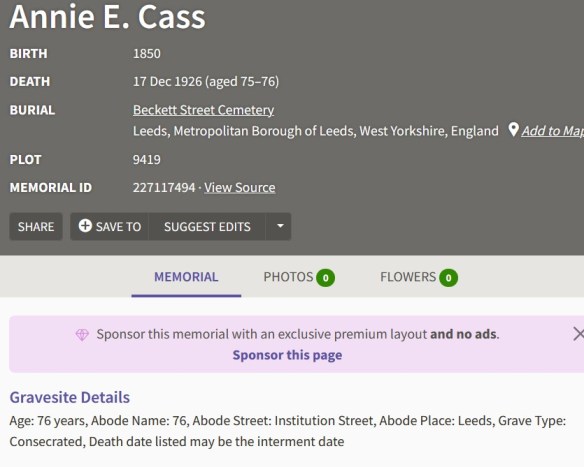
Screenshot from FindAGrave showing information about the burial place of Anne E Cass, including the location of the plot and a transcript of information from the original burial register.
Extract from FindAGrave showing burial information for Annie E Cass. © FindAGrave

So why did I bother looking at FindAGrave?
In this case I had two reasons for doing so:

  • I wanted to see if there was a photograph of the gravestone;
  • I was creating a list of all my ancestors and their children buried at Beckett Street Cemetery, and since I already had information from the GRO online register about the deaths of each, the search process on FindAGrave is much quicker and easier than searching on Ancestry. The resulting list is below:
A table created in Word with a list of people, all with the surname 'Cass', and other information about each of them, specifically about their place of burial.

By compiling a list of all my ancestors and their children at this cemetery I was able to see which ones were buried in the same plots as other family members. Here, I identified six members of the Cass family, all in Plot 9419. I made similar lists for all my family members at various public and municipal cemeteries. This will make it easier to navigate the cemeteries when I visit.

The fact that Annie Elizabeth and her husband John William Cass were able to purchase a family plot tells me something about the financial situation of this family. Many of my ancestors at this time couldn’t do so. I already knew they had a family business so this was not a surprise. I expected, too, that there would be an inscribed headstone. However, although many of the entries at FindAGrave are accompanied by a photograph of the grave, this one isn’t.  My plan was to take a photograph when I visited myself.

Additional information on Friends of Becket Street Cemetery website
This was the point I had reached when I wrote my last post, about Municipal and Public Cemeteries; and that was when I found the fantastic Friends of Beckett Street Cemetery website.

Using the public search facilities on the Friends website, and bearing in mind I already had a lot of information about this family, including the plot number where they are buried, I was able to do the following:

  • View the cemetery register. I already had access to this register via my subscription to Ancestry.co.uk. so there was nothing new for me personally here.
  • Locate the grave on a map of the cemetery.
  • Locate the grave on a spreadsheet. Here, it is recorded that in fact there is no headstone for the family plot. This surprised me.
  • The spreadsheet also provided a tantalising promise of some extra information. I found there were seven people buried in this plot, rather than the six I already knew about. However, to see the list of people (and more) I needed to become a Friend of the cemetery. This costs £10 per year. Bearing in mind the number of ancestors I have in this cemetery, and the good work the Friends do, this was worth it.
  • Having paid the membership fee I could now view the names of all occupants of this plot, and use various methods of searching the dedicated Beckett Street Cemetery database, which yielded better results than searching on the huge Ancestry database.
  • There is also a virtual walk along the various paths so that you can locate and see the plot you’re interested in.

**Obviously, every ‘Friends Of’ group will provide different search facilities.**

Here’s the new information I got about this family, and how I was able to use it

The first thing to note is that the ‘Person ID’ on the FindAGrave website is a ‘FindAGrave’ ID. The cemetery Person ID/Reference is different, so I have amended my lists to include both.

Next, I was anticipating the the unknown additional person could be a missing child. My research showed that Annie Elizabeth lost four of her children in infancy, but on the 1911 Census she wrote that she had lost seven children and had six still living. I knew this to be inaccurate, because seven of the children were still living in 1911. However, this still suggests two missing babies. Might one of them be buried in the family plot?

Alternatively, could the extra person be Annie Elizabeth’s oldest daughter. Aged 40, she was still living with her mother in 1911 but was nowhere to be found in 1921. Had she died? It seemed inconceivable that she wouldn’t have been buried in the family plot.

The extra person turned out to be Annie Elizabeth’s mother-in-law, Elizabeth Cass. Elizabeth died in 1878. She is the mother of Annie Elizabeth’s second husband, John William Cass, and they are not my ancestors. Although I had her name and some brief details from a census record I had not researched her. This record provided her burial dates and also her address, which was the same shop and living quarters above the shop that I knew to be the home of Annie Elizabeth and husband John William Cass in the 1870s.

This prompted me to look for a burial record for Elizabeth’s husband, William Cass, located quickly on the Friends of Beckett Street Cemetery website. He too had died at the same address, five years earlier. Using death certificates and baptism records for several of Annie Elizabeth’s children, I was able to calculate that she had moved into the shop with her husband and children after the death of Elizabeth’s husband/ John William’s father. The possibility that they had taken over an existing family business was not something I had previously considered.

As for the missing deceased children – the little ones are still missing. I suspect Annie Elizabeth may have included stillborn children in her totals. I have long suspected that women did this on the 1911 Census as a way of commemorating their children who never had a proper burial.

However, this new information also prompted me to renew my efforts to find Annie Elizabeth’s oldest daughter. I found she had married shortly after the 1911 census and in 1921 was living with her husband and a daughter, whose life I will now have to follow through.

How strange that all this should be resolved as a result of examining cemetery records! Plus I am now a member of the Friends of Beckett Street Cemetery!

It all goes to show we should examine closely, keep an open mind, follow all leads and cross-reference. I hope you’ve found this useful, and that it might prompt you to look again at some of your mysteries.


Ryan Littrell’s ‘Reunion’ and Y-DNA in family research

I’ve just finished reading Ryan Littrell’s book Reunion: A Search for Ancestors, published in 2012. It’s an account of how, following a surprising find amongst old family papers, Ryan set about uncovering the story of his Scottish ancestors. A complete beginner in family history at the time, his interest was purely on his mother’s paternal line, the McDonalds.  He wanted to learn about the clan and whereabouts in Scotland his family originated.

If you have a Scottish clan ancestral line, particularly Clan McDonald/ MacDonald/ Macdonald or simply Clan Donald, then I think you’ll find this book interesting and helpful. It will also be useful to anyone wanting to know more about Y-DNA testing, and how it can be used in genealogy. Alongside this, you’ll see an example of an active Y-DNA surname project, and learn more about how you might be able to use this type of DNA testing in your own research.

None of the above apply to my own family research. For me personally, I realised as I was reading that there was a gap in my knowledge of Scottish history and particularly the Jacobite movement. I’ve since been exploring that, and this, broadly, will be the topic of my next post. Today’s post focuses on the Y-DNA.

After a more general introduction, from Chapter 8, Ryan’s story alternates between his developing knowledge about his own family and the Clan history. Starting with events of around a thousand years ago, the history moves forward in time as Ryan’s own research moves backwards so that at some point the stories meet. The documentary research was hampered by the fact of being spread over several counties in four different American states. At times a professional genealogist was hired to plough through documents in archives local to the places where his family had lived in the States. I did wonder at times why baptism registers were not mentioned. Perhaps they had been used, but they were not included in the account. In the UK, they would have been a starting point for any research prior to 1837.

So it was, really, the way the usual documentary research was used alongside Y-chromosome DNA (Y-DNA) testing that was the more interesting part for me. Used alongside wider Clan history reading, this was key in helping Ryan to home in on his ancestral home and indeed other Y-DNA testers descended from the same people.

How Y-DNA tests work
The main DNA test we use for genealogical research is autosomal. Autosomal testing is useful for finding ancestors and close blood relatives up to around five generations back. Y-DNA is different, and we use it in genealogy for a very specific reason.

Y-DNA is passed from fathers only to their sons. This means every male can be shown to be connected to his father, his paternal grandfather, great grandfather, and so on, right back through time. Passing largely unchanged down the male line, it links back thousands of years.

A Y-DNA test places each tester into a group known as a Haplogroup. Individual Haplogroups are often associated with specific parts of the world. For example Haplogroup E is primarily found in Africa, with some presence in other regions; Haplogroup O is primarily found in East and Southeast Asia. A number of Haplogroups are to be found in Europe. These include Haplogroup R, common in Europe and parts of Asia. At the very top of each of these Haplogroup lines is one man. We will never know the names of these individual men, but each one is the furthest ‘identifiable’ ancestor of every male sharing that broad Haplogroup.

Over time, there are mutations on the Y chromosome. We use these mutations to work out how far back two male testers share a common ancestor. If they both share a particular mutation this is evidence that their common ancestor lived after the mutation occurred. Another way of looking at this is that when mutations occur, a new branch in the Haplogroup occurs. If a mutation occurs for one brother in a family, his descendants will have the mutation but his remaining brothers and their descendants will not.

In this way, as a result of mutations, the wider Haplogroup can increasingly be subdivided, and this enables us to place a tester in ever more specific branches, or Subclades, of the Haplogroup. For example, the Haplogroup R has two branches, or subclades: R1 and R2. R1 is further subdivided into two descendent subclades: R1a and R1b.

Surname Projects
Since Y-DNA follows the direct paternal line, assuming that there have been no adoptions, no elective name changes and no ‘non-paternity events’, the line should coincide exactly with the surname. This has led to the creation of Y-DNA Surname Projects, often run by experienced leaders who may be able to recognise specific branches of the surname based on the very specific subclade as revealed by the Y-DNA test.

It was one of these Y-DNA surname projects that Ryan Littrell joined when he was carrying out his own research. Through them, he learned that the MacDonald clan, also known as Clan Donald, is associated with the R1a and R1b haplogroups. Testers potentially descended from a man named Somerled, who is important in the Clan’s history, are associated with the R1a haplogroup, while The Macdonalds of Sutherland, for example, belong to the R1b haplogroup, specifically the R-FTA93010 subclade.

As his connection to the McDonalds was through his mother rather than his father, Ryan was not able to test his own Y-DNA for this project. Instead, he needed to find a male member of his mother’s McDonald family who was prepared to test. His mother’s uncle was happy to do so, and it was his Y-DNA test results that Ryan worked with thereafter. Working with the surname group, these test results enabled Ryan to connect with a small number of testers whose origins could be traced to a specific village in the Scottish Highlands. Through connections and visits to the area, more McDonald men offered to test and they too shared the same subclade.

Ultimately, this combination of documentary research, Y-DNA testing, reading about the history of the clan and speaking with distant cousins who had grown up in the area, enabled the small group of distant cousins to work out where they fit into the history of the Clan.

You will have to read the book yourself to find out how, but I hope this account has enabled you to work out whether firstly this book and secondly Y-DNA testing might help you in your research.

Getting started: Working back to 1837/1841

The Ancestry advertisements on television make it look so easy.  You might even imagine you’ll just have to type in a name and your entire family tree will magically appear, as Ancestry’s powerful computers work it all out before your very eyes.  It isn’t as easy as that.  It’s not even as easy as it looks on Who Do You Think You Are?  We don’t get to see all the records they discount before the celebrity clicks on the correct one!

But that said, it isn’t so very difficult either, not when you know how.  With a little practice you’ll get to know what information you’ll find on the various types of record, and how to use these records in conjunction with each other, confirming and adding to what you know as you work your way into your ancestors’ past.

In English family history research there’s a very definite change at 1837-1841.  More recently than this point we use one group of records, while going further into the past we must learn to find and use lots of other record sources.  Fortunately, since we work backwards from the present, it’s the easier system we must learn to use first.

To demonstrate how you can get your family back to the generations living as at 1837-41, I gave myself one hour to work on the ancestry of an old family friend about whose past I knew very little: just his name, approximate birth year, the area where he grew up, and the names of his mother and one of his brothers.  All sources identified are public records, readily available, but being deeply aware of privacy/ security issues, I chose this person because he died more than thirty years ago, has no descendants… and actually I think he would be pleased to have helped. 🙂

In the next post I’ll show you exactly how I did it, but for now I’ll introduce you to four websites.

Ancestry
Ancestry is a subscription genealogy website.  Operating from Utah, it’s the largest for-profit genealogy company in the world.  Ancestry does not ‘own’ the records you’ll find on its pages; the originals are kept in various archives throughout the country (or throughout the world if you have a ‘worldwide’ membership).  However, through Ancestry, you’ll be able to see digital images or transcripts of those original records.  You can also build your tree on the Ancestry website.

Find My Past
FindMyPast is a UK-based online genealogy service, and like Ancestry, provides subscribers with Internet access to digital images or transcripts of official genealogy records.  Again, there’s a facility to build your tree on the FindMyPast website.

There’ll be more to say about both Ancestry and FindMyPast in future posts.

Family Search
This website is created and provided by The Church of Jesus Christ of Latter Day Saints (Mormons).  Family history is important to followers of that faith so that they can have relatives from past generations retrospectively baptized into their church.  The website is free for anyone to use, but you must create an account and you must be signed in each time you use it.  FamilySearch holds transcripts of records rather than access to digital images of originals.  However, there are certain types of search when I know FamilySearch will more accurately return the records I need than the subscription websites.  There will be an example of this in the next post.

General Register Office for England and Wales
(GRO)  Here you can search the historical birth and death registers for England and Wales.  These start at 1837.  At the time of writing, the death register is searchable up to the year 1957; and births are searchable to 1917.  Birth, Marriage and Death Certificates may be ordered here, and for this there is of course a cost.  However, the searchable register itself includes information that may help you to progress your research without purchasing the certificate.  To use this site you have to create an account and you must be signed in, but there is no subscription charge.

In the worked example to follow in my next post, I limit my subscription searches to Ancestry, and to the following specific record categories: Census & Electoral Rolls; and Births, Marriages, Deaths.  I also make use of the free searches at FamilySearch and the GRO website.  The main types of record I will be looking for are:

  • Civil Birth, Marriage and Death (BMD) records – these commenced in 1837;
  • Census returns – from 1841 these include individual people, recorded in household groups.

Why not take a few minutes now to familiarise yourself with the two free websites.  And remember to keep this information to hand as you follow through the worked example in my next post.