Where there’s a Will there’s a way…

You might have noticed I’ve given a lot of thought on this blog to records related to our ancestors’ deaths. It started a couple of years ago when an increase in the cost of civil BMDs prompted me to write about what other kinds of records might be available that would give much of the same information – and sometimes more – thereby saving the cost of the death certificate.  Next came What Can Death Records Tell Us About Life? Death records have also featured here and there as evidence used in conjunction with other findings in my research to prove one hypothesis or another. The truth is I love a good death record. They can tell us SO much about a person, their life and family; and none more so than a Will.

The last two posts have focused on how to find Wills and Administration documents, both since 1858 and the far more cumbersome arrangements before the changes of that year. Today we’ll look at lots of ways we can use the Wills, particularly those from earlier centuries when there might be gaps in other record sets. They really are not just about how much money there was and who inherited it!

A Will can…

Substitute for a baptism
There was an example of this in a recent post when, finally, I found a father’s will in which he (Nathaniel) named and bequeathed land to my 6xG grandmother Jane, who I had long suspected was his daughter. Until this point I had built a good case but there was no definite evidence that they were father and daughter. Although, in the absence of a baptism record, I still have no definite birth year for Jane, the order in which Nathaniel refers to his two daughters indicates she is younger than her sister (baptised 1685), thereby supporting Jane’s own death record which suggests a birth year of 1687.

In another example, I suspected my 8xG grandfather, Thomas, was one of six siblings born to Christopher Simonson. I had baptisms for most of these siblings but not for Thomas, likely born during the Interregnum. In this example it was one of the brothers, Lister, baptised as son of Christopher in 1642, whose Will came to the rescue. In it, Lister specifically refers to ‘my brother, Thomas’. Thomas is a witness, scribe and co-executor to the Will, and by comparing handwriting to other known documents I can see this is definitely my Thomas.

Substitute for a marriage
Lister’s will worked overtime for me. In referencing his brother-in-law, Thomas Snell, he also made his will stand in for his own missing marriage record. Thomas Snell was his wife’s brother, therefore her maiden name was also Snell.

Substitute for a burial
It goes without saying that if Probate has been granted the testator has died! So even if we can’t find a burial record, we have a pretty good idea of the month and place of death. Sometimes the actual date of death is noted on the back of the bundle of papers.

Help you fill out the family of your ancestor
It may name sons, daughters, siblings, parents, cousins… There may also be people who seem to be family members but can’t yet be placed. All need to be noted and when possible can be inserted into your tree.

However, the absence of a child’s name does not imply a parting of the ways. Nor will the list of children necessarily include them all. A couple of years ago I wrote about my discovery that my 4xG grandfather John Wade’s Will made no reference at all to his daughters, leaving the family business and money only to his sons. The four sisters remained unmarried and lived together throughout their lives. It wasn’t until I obtained each of their Wills that I realised they had been well-cared for prior to their father’s death, in the form of railway stocks and shares. Father John’s arrangement ensured the daughters would retain their own money (and a level of independence) even if they married, while the family business would remain in the hands of his own sons.

Generally, though, wives and daughters will be named – offering us a rare sighting of the female family members in a time when documents usually omitted them completely.

Confirm family roots within a locality
Again, Lister gives value. In his Will he expresses his wish to be buried in the local churchyard, ‘as near to my Ancestors as possible’. This implies several previous generations in this parish. When I first read this I knew only of the father, and baptisms of the other siblings showed he had moved around the region. I now have two more generations before that, and ongoing wider research suggests a long association of this family with the area, although I’m yet to join the dots.

Suggest literacy levels
Although the shaky initials or ‘mark’ of the testator doesn’t necessarily mean they are unable to write (they may simply have been too weak to write at that precise time), certainly we can see which of the witnesses could write. Even official copies of Wills record who signed and who made marks. However originals provide additional clues: By comparing handwriting within the document and with others, you may even be able to work out if one of your ancestors wrote the document – even if maybe they could read and write in Latin.

Provide an insight into family relations
Generally, there is a sense of community at the time of writing and witnessing the Last Will and Testament of a sick relation. Death was part of life, and helping a family member or friend to put his affairs in order and ensure each other’s families were cared for was something done willingly. There is trust evident between the testator and those he chooses as his executors, or to assist a surviving spouse in the task. Occasionally, though, we might pick up on family tensions. In 1684 as my 8xG grandfather John Wilson divided up his lands and property between his five surviving sons, he included this final sentence: ‘And if any of my sayd sons their Executors or adm[inistrators] shall sue Molest or Trouble my sayd Executor for any greater Summe or Legacie then is given them by this my last Will and Testament that then the Legacie to them hereby given to bee voyd and noe more paid to them but Twelve pence.’  It seems John didn’t entirely trust his sons to behave well towards each other.

Hint at the testator’s religious views
Wills can, but do not necessarily reflect the testator’s religious views. They might instead reveal the scribe’s views. Alternatively, I have compared wills written within five years of each other but 40 miles apart, in which the similarity of overblown religious phrases in the opening lines suggests the two scribes were writing to an accepted formula.

Reveal how our ancestors lived
From 1530 to 1782 one of the probate/ administration requirements was that the executor should appoint three or four local men to value the deceased’s personal estate, and provide the probate court with a full ‘Inventory’: a detailed list of every single item of the deceased’s possessions, together with an assessed value for each. The Inventory relates only to the personal estate, i.e. it doesn’t include land and property; but since the list is generally organised room by room, including items found in outbuildings and barns, etc, it does indicate where the household included such buildings, how many living rooms and bedchambers and so on.

In the Will itself your ancestor may list houses, messuages, lands, etc. Comparison with contemporary maps may reveal exact locations of named holdings. He may also identify himself by occupation or standing. Not only does all this suggest a certain standard of living, but it may be compared with other record sets, such as occupations on baptisms or number of hearths listed on the Hearth Tax returns.

Show community networks
Occasionally we will find ourselves reading so many Wills from a small village that we recognise names of all those who regularly help out as scribes, witnesses, executors, takers of the inventories, and so on. We almost start to feel like we know all these 17th century inhabitants who were trusted community members and friends of our ancestors.

And finally… the bit we always expected the Will to be about:
Indicate how the land, property, goods and chattels were to be apportioned
Here we see how land was passed on according to the wishes of the testator and inheritance norms. We start to understand how, where the oldest son inherits the lion’s share, younger sons move progressively down the social hierarchy. There is also the possibility of bequests of small items treasured by the testator to a special person. (How wonderful would it be to recognise an item that your family still has!)

Alas…
Sadly, sometimes the bequests in the Will and the named beneficiaries prove you haven’t got the right person. I bought the Will of what I assumed was my 7xG grandfather Robert Lucas. He had a son named James in exactly the right place and at the right time to be my known 6xG grandfather, but when I read the Will there was no mention of James, just two daughters. It sent me back to the parish registers, and I found the little James I had assumed to be my ancestor had died not long after birth.

*****

Although most of the Wills are written in English, the further back you go, the more likely it is that you’ll need to be able to read old handwriting, but I think you’ll agree that with such riches available from scouring them, it’s worth the effort.

These are all examples of things I have learned from looking at Wills. Can you add anything more? Has something astonishing in an old Will ever helped you to break down a brick wall or make a great discovery?

Finding a pre-1858 Will

In my last post I mentioned that the arrangements for Wills and probate in England and Wales changed in 1858.  After the Court of Probate Act of 1857, Wills are generally much easier to find.  Before 1858, however, the arrangement was far more complicated.

Ecclesiastical Courts
Prior to the changes brought about by the 1857 Act, the granting of probate and letters of administration (if someone died without making a Will) was a function of the ecclesiastical courts.  However, there were more than 300 possible courts.  Before we can work out which one dealt with our ancestor’s estate we first need to understand the court hierarchy within the Church of England. 

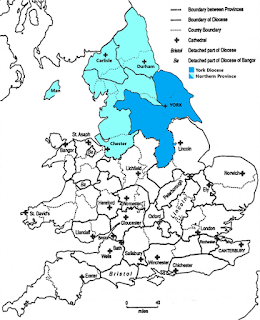
Between the Reformation and the mid-19th century there were twenty-seven dioceses in England and Wales. 

Map showing Church of England dioceses in England and Wales between the Reformation and the mid-19th century
Map showing C of E dioceses and provinces circa 1550 to mid-19th century

Then, as now, these were organised into two provinces, or archdioceses: York and Canterbury. The dioceses of York, Carlisle, Chester, Durham and Sodor & Man came within the province of York, the remainder fell within Canterbury.

Each of these dioceses were subdivided into archdeaconries, and it was generally here where matters of probate were decided.

However, there were many exceptions.  Some territories were instead under the jurisdiction of a manorial, ecclesiastical, royal or prebendary ‘peculiar’.  Elsewhere, jurisdiction might leap-frog the archdeaconry, resting instead with the bishop’s own ‘Consistory Court’. These probate rights were jealously guarded: they brought in an income.

[This map came from an article by Paul Wainwright about using York Diocese Cause Papers for family history research.]

The court to be used varied from parish to parish
Within each diocese there were of course many parishes, and even adjacent parishes could come under the jurisdiction of different Probate courts. The easiest way to find out the arrangements for your parish of interest is to use the online tool at FamilySearch.

  • Go to FamilySearch Maps and enter a location in the search box.
  • I’m going to use Kinver. Only one location, in Staffordshire, matches that name. That’s the one I need, so I’ll click on that.
  • A fairly basic map showing the boundaries of the parish appears. For Kinver, if I click to remove the pop-up box I can see that this parish included other places called Stourton and Compton.
  • However, we do need that pop-up box so I click the place name again over in the left sidebar and the box will reappear. What we’re interested in is Jurisdictions. Click on that, and fourth down in the list you’ll see Probate Court. For Kinver, we see that this parish comes under the diocese of Lichfield, and the Probate Court was the Court of the Bishop of Lichfield (Episcopal Consistory). In other words, this parish does not deal with the usual archdeaconry for probate matters.
  • For comparison, if I click on the adjacent parish of Wolverley, I’m now not only in a new county (Worcestershire) but also a new diocese: Worcester; and the Probate Court is the Court of the Dean and Chapter of Worcester. Back in Staffordshire, and back in the diocese of Lichfield, before 1846 my ancestors in Bilston would have used the Court of the Peculiar of Wolverhampton, and after that date would have used the Court of the Bishop of Lichfield (Episcopal Consistory).

Note that this information on FamilySearch Maps is good as at 1851. There may have been some changes, but generally this is a good place to start.

So you now have a picture of how complex the situation was, but at least we have a way of finding out which court dealt with the parish where our ancestor lived.

Probate took place where the testator held ‘property or noteworthy goods’
For most of our ancestors, once you’ve found the parish you know where to look for the probate or administration documents. However, technically, probate took place not where the testator died but where he or she held ‘property or noteworthy goods’.  What if your ancestor held land in several parishes or even several archdeaconries? The rule is quite simple: you go up a level in the church hierarchy until you reach the level that encompasses all the relevant lands. Hence, if a person held property in two archdeaconries within one diocese, probate was proved at the Bishop’s Consistory Court.  If property was held in more than one diocese, the Prerogative Court of Canterbury (PCC) or Prerogative Court of York (PCY) was used; and if in both provinces, probate at both was usual. 

The rule may be simple but the difficult part might be knowing all the places your wealthier ancestor held land.

Regardless of the above, for some circumstances the Prerogative Court of Canterbury was preferred or required

  • Serving soliders and sailors, and people who died abroad but held property in England and Wales.
  • From 1818-1858, if the deceased held stocks and shares, the Bank of England would only accept wills proved at the PCC.
  • The PCC was preferred by Nonconformists who wished to lessen the connection to the local Anglican church structures.
  • It was also preferred for reasons of prestige.

Finding the Wills
Building on that background information we’re now in a better position to look for our pre-1857 ancestors’ wills. As with the post-1857 National Probate Calendar, wills are indexed by year of probate which, if disputed, could be several years after death, so be prepared to search further than the actual year in which you know your ancestor died.  There is, unfortunately, no centralised index, so we must make use of finding guides (see below), but here are some pointers:

  • Wills proved at the archdeaconry or an ecclesiastical peculiar will usually be lodged with the relevant county archives.
  • Those proved at the bishop’s Consistory Court may be lodged with a separate diocesan archive.
  • Records of manor-peculiars can be difficult to locate. Being private papers, they could have been lodged out of county if the former lord of the manor had a principal home elsewhere. They might also have been lost, or simply never been made available to the public.
  • The National Archives hold registered copy wills for all probates made at the PCC between 1384 and 1858. These are not the original wills – you won’t see your ancestor’s signature – but they are copies of the original probates written into volumes by clerks at the church courts. You can search them [here]. At the time of writing (because of limited access to the National Archives at Kew) some of these are available to download free of charge. Some of them (but not all) are also available on Ancestry.co.uk in the record set England & Wales, Prerogative Court of Canterbury Wills, 1384-1858.
  • The Borthwick Institute in York holds half a million wills, dating from 1267 to 1858. Most of these are from Yorkshire and Nottinghamshire, but there are some from Cheshire, Lancashire, Westmorland, Cumberland, Northumberland and Durham. The index for all these documents from 1688 is available on Find My Past, with an easy link through to Borthwick for ordering digital copies of the originals. (Any probate documents will show up under Birth, Marriage & Death records.) Pre-1688 Wills are indexed separately, both at the Borthwick archives and also in a series of Yorkshire Archaeological Society publications available online through Internet Archive, starting with YAS Record Series Vol. 6: Index of wills in the York Registry, 1389 to 1514.
  • Other wills may be available online, but it all depends on licensing arrangements made between the archives and one of the subscription websites. For example, Ancestry has a record set called Yorkshire, England, Probate Records, 1521-1858 which includes probate documents for a manor-peculiar of interest to my research.

Finding Aids
These include:

FamilySearch maps

Smith, Cecil R. Humphery: The Phillimore Atlas and Index of Parish Registers – This is available on Ancestry.co.uk as the record set Great Britain, Atlas and Index of Parish Registers

J. Gibson & S. Raymond: Probate Jurisdictions: Where to look for wills 6th edition, The Family History Partnership, 2016 – This is an inexpensive booklet but is sometimes out of print. You can usually get second hand copies.  County record offices and local history libraries are also likely to have it.

Don’t forget that you can always ask the staff at the archives for advice if you get stuck.  I have only ever found them to be extremely helpful.

*****

This has necessarily been a whirlind tour.  I did a four-week course to learn how to find and use Wills, and if you wanted to do that too you can find the course [here].  But there is at least enough information here to get you started and I hope it helps.

Changes to the Find A Will website

Oh my goodness! What have they done to the online GRO Find a Will service?!

I haven’t had reason to order a post-1858 Will for ages, so I didn’t know about the changes until I saw the video below. But before moving on to that, in case all this is new to you here’s a bit of introductory information about Wills.

Before 1858 Wills were dealt with by the Church courts – finding them can be a challenge because there was a whole hierarchy of courts; and where your ancestor’s Will was proved depended on where they lived, where they held land, the value of their estate and a number of other factors. That’s a topic for another post.

After 1858 Wills came under the jurisdiction of civil probate courts: one Principal Probate Registry, a number of local Probate Registries and a single, central index which is available online and is searchable. In other words, if your ancestor died in or after 1858 and had something to leave to their descendants, their Will or Administration papers will be much easier to find. These are the Wills we’re talking about here.

The central index is known as the National Probate Calendar. Often, seeing that will give you all the information you need. For example, the entry for my GG grandmother’s second husband provides his full name, his address, his occupation, the date of death, the regional Probate Registry where probate was granted, the names of two men to whom it was granted, and the value of his effects.

That’s a lot of information, and it may already fill some gaps for you. It will certainly enable you to narrow down the entries and be sure you have the right person. However, particularly when you’re at the fairly early stages of your research and trying to keep costs down, you may be happy just to leave it at that.

Before we move on, there are a couple of notes about these entries:
First, the National Probate Calendar arranges information according to the year probate was granted, not the year of death. This is particularly important to note because when you watch the video you’ll see the online search asks you for the year of death and limits the search to that one year. You can start with that, but always be prepared to move forwards a year (or maybe more) if the person you’re looking for doesn’t show. In my example above this person died on 11th December 1898, but probate was not granted until 26th January of 1899. 1899, then, is the year under which he’s to be found.

Second, the people named (the people to whom probate is granted) are not necessarily the people who are inheriting. They are the executors (or administrators). They may be the same people as those inheriting, but may not. In the example above, the two men named as executors were just that. One was the deceased’s wife’s stepbrother; I’m not able to place the other. Again, even without sight of the will this gives me some interesting information: I know from other documents that the actual stepfather was abusive; I have no idea where he went after the 1861 census, but I know he was not living with his wife, my GGG grandmother. And yet here is evidence that his son from a former marriage maintained a kinship relationship with his stepsister, my GG grandmother.

If you have an Ancestry subscription you can see the National Probate Calendar with the full entry, including all the information above, and you can link it to your person’s profile. The record set is England & Wales, National Probate Calendar (Index of Wills and Administrations), 1858-1995

However, you can also see it using the government’s own Find a Will service, and if you want to order a copy of the Will, this is where you need to go. The cost of ordering is just £1.50. For this you get digital images of all the pages. Before ordering, please note that if your ancestor died intestate – that is, if he or she didn’t make a Will – this will be recorded on the entry as ‘Letters of Administration’ rather than ‘The Will’ (or sometimes just ‘Administration’ as opposed to ‘Probate’). If that is the case, obviously there is no Will to see, but the Letters of Administration will still give names of the administrators and those who will inherit.

So… if all this is new to you, I hope that has got you up to speed.

The GRO Find a Will website search facility has recently been changed, and it’s currently rather clunky! I’m going to hand you over to Dave Annal who has prepared a short video (8 minutes 57 seconds) that shows how he overcame the changes. I hope you find it useful – and that you find some ancestors’ Wills.

Layers of evidence

This post focuses on two issues.

First, it concerns ancestors who lived and died before the census and before civil registration of births, marriages and deaths.  After 1841, these records work together as regular check-ins to see how our ancestors are progressing.  Before 1837-1841 we have to find different record sets to do the same job. In the description that follows you’ll see that I was looking for something to compensate for the fact that a key baptism was missing. This is one of the big step-ups as we progress to intermediate level genealogy and beyond. It’s complicated by the fact that often these records don’t have universal coverage, and even if particular record sets do survive for your area of interest, whether they are available online or not depends on arrangements between your local records office and one of the online subscription websites. All of the information I refer to in this post was available online with the exception of the probate and administration documents, which were listed online at FindMyPast but the actual documents had to be ordered and purchased.

Secondly, in this post you’ll see how I start out with what can only be a hypothesis – based on a coincidence of names, approximate years and places. I gradually add in more evidence until finally I am in no doubt that my original hunch is true. I say ‘gradually’. This has taken a few years, and was only proven to my complete satisfaction a few weeks ago.

The hypothesis
My starting point is a likely but not proven father/ daughter relationship. The two people in question are my 6xG grandmother, Jane Dracupp, who married my 6xG grandfather James Lucas in Leeds in 1710, and Nathaniel Dracupp who was in the right place at the right time to be her father.  The surname is unusual, and this made connecting them much easier. However, Nathaniel is not the only Dracupp of an age to father children; it’s just that he seems to be the only one to have left his parish of birth and moved to Leeds.

I have never found a baptism for Jane.  There is, however, a record for Mary, daughter of ‘Natha Draycupp’, who was baptised in Leeds in 1685.  Given Jane’s marriage in 1710, a baptism of circa 1685 is consistent with her likely birth year.  She might have been born in 1683, or 1687, perhaps.  The father’s given name is also significant, since Jane and her husband James will go on to name their second son Nathaniel.  (I’ve written a lot about traditional naming patterns and how they can be used to home in on likely parents/ grandparents. See e.g. [here] and [here].) It looks very much like Nathaniel Dracupp will be Jane’s father, and Mary her sister.  But other than the circumstances of birthplace and approximate year, and the fact of Jane naming her son Nathaniel, there is no actual evidence.

Evidence that Nathaniel, Mary and Jane live close by
I had noticed Nathaniel’s name on a couple of Overseers Rate Books for the years 1713 and 1726 but no specific abodes were included, and when I first found them I didn’t spot that Nathaniel’s entries were in the same part of the Manor of Leeds where I knew James Lucas (and therefore Jane after marriage) to be living.  When I realised this I went through these records thoroughly, looking for all references to Nathaniel.  I also looked for James Lucas and for Mary’s husband, whose name was Jeremiah Myers.  I found them all living very close together, with Jeremiah/Mary and James/Jane seemingly occupying adjacent plots of land.  This was slightly complicated by the fact that James was entered under the name ‘James Lukehouse’, which might have been a different person altogether.  However, in my head I could hear a local pronunciation of the word which would rhyme ‘house’ with the ‘as’ in Lucas.  Again, this tipped the scales a little more towards the likelihood of my hypothesis, but it wasn’t definite proof – and indeed might have been considered clutching at straws!

Evidence of a kinship or friendship connection between Jane and Mary’s husband
Although I hadn’t been able to find burial records for Jane or James, I now found letters of administration for a James Lucas who died in 1722.  The existence of letters of administration means James died without making a Will, suggesting an unexpected death.  Whereas a Will often names all children of the deceased, together with spouse, and possibly other family members who might be brought in as executors, trustees or witnesses, letters of administration will have none of these things.  However, there will be a sworn undertaking by the widow and possibly other family members to carry out faithfully the requirements of the probate court (an ‘Administration Bond’), and of course these people will be named.  Often, it is only when we read these names that we know for sure that the deceased is actually the person we think it might be.  I was in luck.  The document was signed by my 6xG grandmother Jane Lucas; and one of the other signatories was Jeremiah Myers, suggesting a good connection between the two.  It really is starting to look now like Jeremiah could be Jane’s brother in law – meaning Mary would be Jane’s sister and therefore Nathaniel Dracupp would be her father.

Evidence indicating Jane’s approximate birth year
The death of my 6xG grandfather James at a comparatively young age suggested Jane might have remarried.  I found a likely marriage seven years later, in 1729: Jane Lucas and a John Smith.  I did think at this point that my luck had run out!  John Smith and Jane Smith?!  I would never be able to narrow them down!  However, trying to confirm all this I went back to the Overseers Rate Books and found John Smith listed on that same plot of land, adjacent to Jeremiah Myers.  (John and Jeremiah would continue to be listed as landholders at the same properties for some decades.) I also found a burial for Jane Smith in 1757.  The record gave Jane’s husband’s name (John Smith), the abode just as I expected it to be, and also an age at death of 70, which indicates a birth year of 1687 – just two years after the baptism of Mary Dracupp.  Further, the burial was recorded in Nonconformist records at the chapel where I knew the next generation of the family now worshipped. This was definitely my Jane.

To be honest by this stage I was happy to accept that all these happy coincidences pointed to Nathaniel being Jane’s father.

Evidence flowing from Nathaniel’s death
The Overseers Rate Books continue until 1809. However, after 1726 there is a gap in the records until 1741, and Nathaniel Dracupp is not seen again.  Did this suggest Nathaniel died between 1726 and 1741 – either way a good long life for a man born in 1657. Although a burial record for Nathaniel has not been found, there was a probate record that had intrigued me for some time: In 1741, probate was granted for a Nathaniel Dracupp in Wakefield. Wakefield is about 13 miles (20 km) from Leeds, and it hadn’t seemed likely that this was the same person. As mentioned above, although Nathaniel Dracupp is an unusual name, this man I now strongly suspected was my 7xG grandfather is not the only Nathaniel in the Dracupp family. Given that a 1741 death indicated Nathaniel would have been 84, I thought it likely that this Nathaniel might be another family member from the next generation. However, knowing now that Nathaniel was living in 1726 and no longer listed in the Rate Books from 1741, I felt confident to purchase the probate documents. I probably wouldn’t have done this without the knowledge from the previous step.

It was him! Nathaniel names his daughter Mary and son in law Jeremiah Myers. He also names their one child – which indicates that the other three I knew about must have died before he made his will in 1737. Next he names his daughter Jane and her husband John Smith. Finally!!! I have my proof! The order in which he names (and bequeathes property) is significant, in that it indicates Mary is older than Jane – so the birth year of 1687 suggested by Jane’s 1757 burial record is almost certainly accurate. Jane’s children are not named individually, but they are referred to as those who will inherit after John and Jane’s natural lives – an important point since otherwise the land could pass into John Smith’s family and leave Jane’s children without. Also named is Nathaniel’s second wife, of whom I had no previous knowledge. I suspect she might be the reason he moved to Wakefield – perhaps she had land there – but no marriage record has been found.

*****

I hope you’ve found this useful. As you can see, it was only Nathaniel’s will that proved beyond doubt that he was Jane’s father. Although even before finding it I felt there was a good case and was happy to consider him as such, the difference is that without that final piece of evidence we always have to be flexible, be prepared to have an open mind should new evidence come to light that points to a different father. I no longer have to do that. This case is closed. 🙂

The 1921 Census of England and Wales

Happy New Year to you all!
Have you been looking at the 1921 Census?

In case there’s anyone reading this who doesn’t know, the 1921 Census for England and Wales was released to the public on 6th January.  It includes the Isle of Man and Channel Islands; members of the Armed Forces (wherever in the world they were stationed, apart from Scotland); Merchant Navy and fishing vessels in port on the night of the census or returning over the following day or so; plus visitors, tourists and people in transit.

This census is particularly important for us as genealogists: there won’t be another until 1951.  The 1931 census was burned in a fire during the Second World War; and because of the war, no census was taken in 1941.  We do of course have the 1939 Register to plug the gap, but it’s sad to know we won’t have another census to look forward to for the next 30 years.

The 1921 Census was taken on 19th June 1921, having been postponed from 24th April following the declaration of a state of emergency owing to coal miners’ strike action.  This was a period of great social change, following the 1914-18 War and, mirroring our own time, the Spanish Flu epidemic.  The women’s suffrage movement of the previous decade had started to pay off, and some women had won the right to vote – although this still depended on the woman in question being a householder in her own right or the wife of a householder.  With the return of the men after the War, there was a growing expectation of ‘Homes Fit for Heroes’; while the women who had kept the factories going during the absence of their menfolk were dissatisfied with the expectation that they should return to their kitchens as if nothing had ever happened.

Societal changes mean changes in the questions asked.  I was sad to see the loss of the 1911 questions regarding length of the present marriage and number of children born to that marriage including whether still living or since died.  Apparently this was removed because so many responded incorrectly – but I’m sure you’ll agree that their wonderful ‘incorrect’ answers gave us as genealogists so much information! The long-standing question about infirmity and nature of that infirmity has also been removed.  On the 1921 Census these are replaced with questions about:

  • age ‘in years and months’;
  • for children under 15, whether one or both parents has died;
  • the actual employer and work address;
  • an additional category for marital status: Married, Single, Widowed and now for the first time, Divorced;
  • for Welsh households, a question about language spoken. 

Of course, it isn’t just genealogists who have been eagerly awaiting the publication of these records.  While the main purpose of any census is to inform contemporary social policy development once the data is analysed and condensed into statistics, one hundred years on it’s time for local and social historians to do likewise.  They will take more of an overview; we, of course, are interested in the individual entries.

The contract to publish the 1921 Census was awarded to FindMyPast, who have exclusive rights for the first three years.  After this it’s likely also to be available on other genealogy subscription sites.  Initially, there’s an extra charge for viewing the records, but as with the 1939 Register, these charges will be removed when FindMyPast have recouped part of their investment.

That investment has been considerable: a team of specialists have worked for three years to digitise almost 38 million entires.  Between them they have carried out conservation work (repairing tears, ironing out creases, dealing with mould and insects) as well as scanning each household schedule – or photographing it if it was considered too fragile to scan.  After that each record was returned to its place within one of the 30,000 ledgers, and the digitised version of each record was transcribed and indexed.  You can learn more in the following short video.

Some family history enthusiasts are upset at the charges: currently £2.50 to view the transcript and £3.50 to view the original.  I’m not: I appreciate the huge amount of work involved.  There is no way the public sector could have financed this. Inviting tenders from the private sector was the only option; and without their investment this simply would not have become available to us.  That said, you can access it for free (via FindMyPast) if you can get to The National Archives at Kew, the National Library of Wales in Aberystwyth or Manchester Central Library.  The rest of us will have to make decisions, prioritise and find ways to keep costs down.  I decided to search only for direct ancestors (six households for me, five for my husband’s family) and to access only the original document.  For this you get the front and back of the household schedule (2 pages).  As a full FindMyPast subscriber I received a 10% discount on the £3.50 charge – hence eleven lots of £3.15, total £34.65.  There are other households I’d like to see but these will have to wait until FindMyPast remove the charges. In spending £34.65 I feel I’ve contributed to helping them recoup their investment.

Why choose the original rather than the cheaper transcript?  Because the original is always preferable.  Transcript errors do happen – and feedback to date suggests the transcriptions on the 1921 Census are the weakest link, which is a shame because a dodgy transcription of individuals’ names and birthplaces also impacts upon the efficacy of the index, hence search results.  That aside, I want to see my ancestors’ handwriting – and the errors they sometimes make when completing these forms can often give us other information and even an insight into their personalities. 

Of course when you’re paying to view individual documents it’s really important that you don’t rush in and pay for a record that turns out not to be your ancestors.  It’s therefore vital that you understand how the FindMyPast search engine works – it’s far more precise than Ancestry’s, and you have to be more precise in the search terms.  So here are a few tips:

First, with all this focus on the charges, it’s important to note that SEARCHING IS FREE. You can search the 1921 index all day long and it won’t cost you a penny. When it came online at one minute past midnight on 6th January I spent 30 minutes clicking around just looking for my families before I went to bed. I didn’t make my purchases until the next day, but using the hovering cursor technique (see below) I was able to draw upon the forename combinations to be sure that I had found the correct family. In other words, at the very least you can place your family and some specific members of that family in a certain locality without paying a penny.

FindMyPast have put a separate gateway into the 1921 Census on their header bar.  Click on this and you can immediately input name, birthyear and location.  However, this search will focus only on the exact information you give, so if for whatever reason the correct record is not returned you need to ask the search engine to be more flexible.  For this you go back to that first 1921 Census page and click on Advanced Search.

Now you can ask the search engine to offer surname variants, provide a span of birthyears, separate out the likely location in 1921 from the birthplace, and search with a variety of other terms.  You could choose to leave the location blank, or you can give a location and then gradually extend out from it, up to a maximum of 100 miles.

You can also use wildcards: for example since my surname is often mis-spelled (and I have an errant great grandfather whose Life Purpose was To Avoid The Census Enumerator By Any Means Available) I might try Heppen*, Hepp*, Hep*, H?p* and so on.  (No, it didn’t work; I still haven’t found him…..)  This is also useful if you have ancestors with foreign names that could easily be mis-transcribed – or indeed if your ancestors were gradually anglicising/ changing spellings of their names. 

Linked to the above – if your first search doesn’t succeed try a different family member – perhaps one with the most unusual name or (in the case of an immigrant family) the one with the most phonetic forename. When searching for one of my husband’s families I tried several family members before finding one of the children with the name spelled sufficiently as expected as to be recognisable by the search engine.

Once you have your selection of returned records move your cursor along the line, to the right, where you’ll find an icon for Record Transcript and another for Record Image.  Hover (don’t click!) your cursor over one of these icons, and you’ll see how many people are at the address, together with the first names of up to three of them.  You can use this information to help you decide if you have the right household.  Before buying I sometimes searched for several family members, checking the name combinations, before deciding this was definitely my family.

Something else you can do in Advanced Search is give priority to a certain search term. For example, you could input name (e.g. Ethel Jones) and birthyear (e.g. 1889) but leave everything else blank. Now you’ll get all the Ethel Jones’s born that year throughout the entire country. Or you could input Ethel Jones and Birmingham but leave the year blank – giving all the Ethel Jones’s in Birmingham across a wide span of ages. For my master enumerator-avoiding great grandfather I tried leaving all blank apart from name (with various wildcards) and his occupation, which was cooper. No…. nothing. But you might have more luck.

Paying to access the original image gives you more than the two sides of the household schedule your ancestors completed. At the bottom right of the page, click on ‘Open Filmstrip’. From here, once the charges are removed, we will be able to whizz backwards and forwards through the filmstrip with gay abandon, to see who the neighbours are – sometimes family are living very close by. But for now, there are additional features we can see. With the filmstrip opened, click on ‘Extra Materials’. These include the Enumeration District cover, a description of its boundaries and streets included, and a map.

If you’ve already been searching for family members on the 1921 Census I hope you’ve had some good finds.

Wishing you comfort and joy

Digital scrapbook page featuring golden retriever dog wearing Father Christmas hat.

Earlier this year I was thinking about how we could preserve our visual legacies in ways more likely to spark the interest of those who follow us. One of the ideas I wrote about was digital scrapbooking. It was back in August and September that I was tidying up and reorganising my digital photo archives, and making a start on digitising old family photos. I can report that progress has been good but there’s still a long way to go.

Alongside digitising the old photos I realised I could use my existing photo editing software for digital scrapbooking, and I’ve had lots of fun making digital scrapbook pages using some of the old photos. My brother’s birthday card this year was made this way and I’m so happy with how it turned out.

Today I’m combining this new-found digital scrapbooking interest with one of my personal Christmas traditions, which is that every year I’m compelled to try to photograph our four-legged family members wearing Christmas hats. I have to say that I enjoy this far more than the said four-legged family members, but George here does love posing for a photo and is prepared, up to a point, to accept the ignominy of wearing a hat if it means he can be the centre of attention.

Zoë Ball was asking about family Christmas traditions recently on BBC Radio 2. One listener shared that her mother buys a new toilet brush every year at Christmas time and on Christmas Day, before she puts it to use in the bathroom, the family holds a competition to see who can toss the new toilet brush into its holder… Makes my tradition of photographing the animals seem very tame! What about you? Do you have any special traditions that will be passed on? Are there any older family members with stories to tell about how they used to celebrate Christmas?

Whatever you’ll be doing over the remainder of 2021, whether you celebrate or not, and whether by the time Christmas arrives the latest COVID variant will yet again make family gatherings inadvisable, I wish you comfort, joy, peace and good health, now and in the year to come.

I’ll be back with my next post on 15th January 2022.

*****

Digital scrapbooking supplies used are from Life Chronicled: Christmas by Connie Prince; and Joyful by Ginny Whitcomb. Both sets were purchased from ScrapGirls. I have no connection to this store but terms of use require that I acknowledge the designers when posting online.

DNA Painter Ancestral Trees

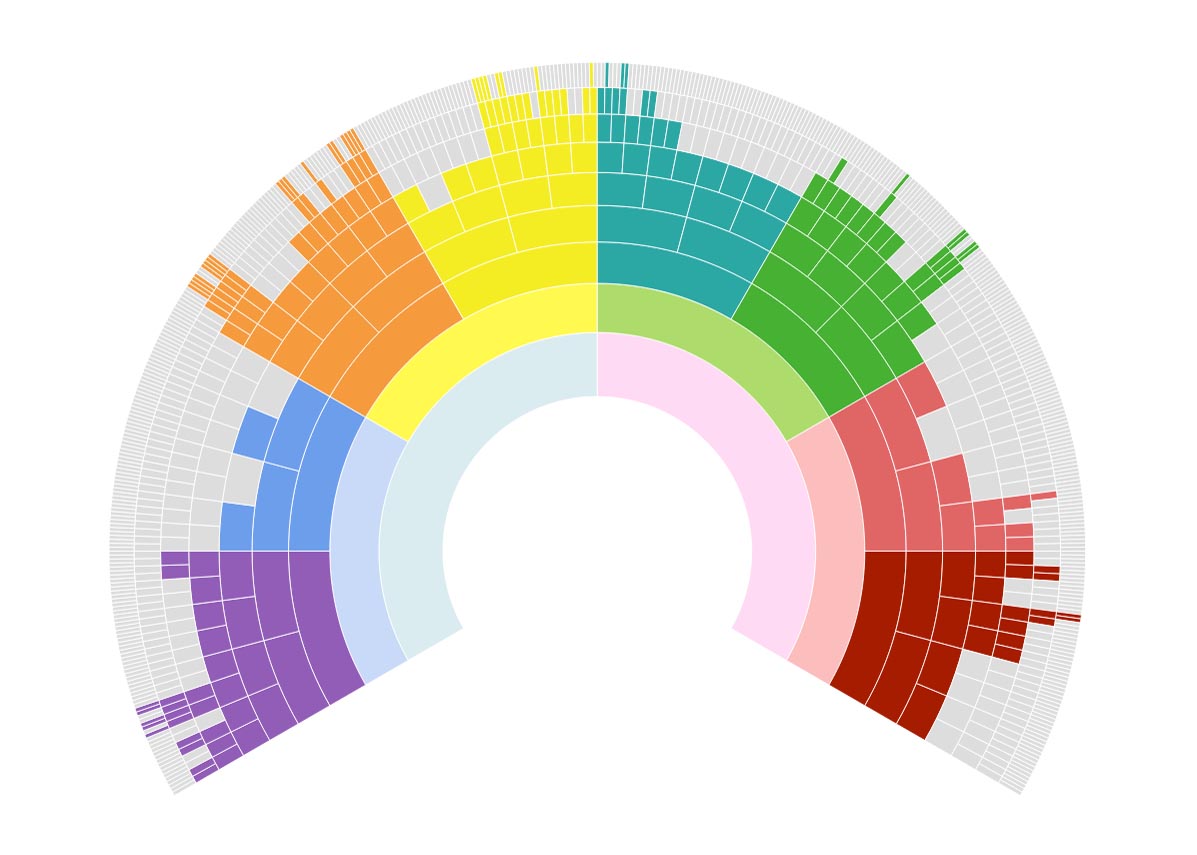
Fan tree created using DNA Painter
DNA Painter fan tree

Today I have pretty things for you!
For ages I wanted to create a colourful fan tree. I had no idea how to go about doing that but suspected it would involve a lot of work, so I was particularly impressed when, a while back, Jonny Pearl introduced the facility to do this very quickly and easily on his DNA Painter site.

I wrote about DNA Painter earlier this year as part of my mini-series on using chromosome browsers as part of DNA research for genealogy. As explained in that previous post, DNA Painter is brilliant for mapping out your DNA segments, but in theory even if you don’t intend at this stage to use the main DNA functions, you could still get your own colourful fan just by uploading your tree to the site. You do this by downloading the GEDCOM file from your online tree or your own software or simply by inputting the information manually.

Once loaded, your tree will appear as a pedigree with each of the lines colour coded. The DNA Painter default palette uses pretty much the same colours I use on Ancestry to assign known DNA matches to each of my great grandparents’ lines, but here on DNA Painter the default paternal grandmother and maternal grandfather colours were the wrong way round for me. It was very easy to flip the colours. Editing and building the tree is very straightforward too. You can hover over any ancestor to edit their information, add their parents or delete them, and you can mark them as a genetic ancestor – someone who is a common ancestor confirmed not only by paper trail but also by DNA. Fly your cursor over any ancestor and then select View/Edit → Edit or Add Notes to change any information about them, including the colours used for them and their ancestors.

From this point you can go to the three options at the top left hand corner of the screen: TREE / FAN / TEXT. Tree is the default – the pedigree. Text is a handy pedigree list of all your ancestors, with dates and places of birth and death. However for me the fan is the most exciting part. It only goes to 10 generations and I have some lines further back than that, so they are not included. Already, though, you can see at a glance how well you’re doing and where you have gaps.

I’m sure the arrangement in the fan above is obvious, but in case it isn’t: from left to right, the colour blocks are pale blue for my paternal side and pink for maternal. Then I have blue for my paternal grandfather (with violet and blue for his ancestors); yellow for paternal grandmother (with orange and yellow for previous ancestors); green for maternal grandfather (with turquoise and green for his ancestors); and finally salmon pink for maternal grandmother, with deeper pink and browny pink for her ancestral lines.

For all versions of the fan tree shown in the images in this post, you can hover over any individual person’s ‘box’ to see their name, vital dates and their relationship to you. At the same time on the left of your screen you’ll see the lineage from that person to you. I couldn’t show this in these images because the screen shot process disables the hovering cursor.

You can also click on ‘Tree Completeness’ over at top right of the screen to get numbers and statistics of ancestors identified at each generational level. All the images in this post click for a bigger version, but you’ll definitely need to do that to see the info on this next image.

Screen grab of DNA Painter Ancestral Trees tool bar showing options for Tree view, DNA filters, Tree completeness and other options
DNA Painter Ancestral Trees toolbar

Moving along the toolbar options to ‘Dimensions’, these next two fan charts draw upon all the information you provided when you uploaded or built your tree. First, you can see all your ancestors colour-coded by the age at which they died.

Fan tree showing ancestors' ages at death
DNA Painter fan tree showing ancestors’ ages at death

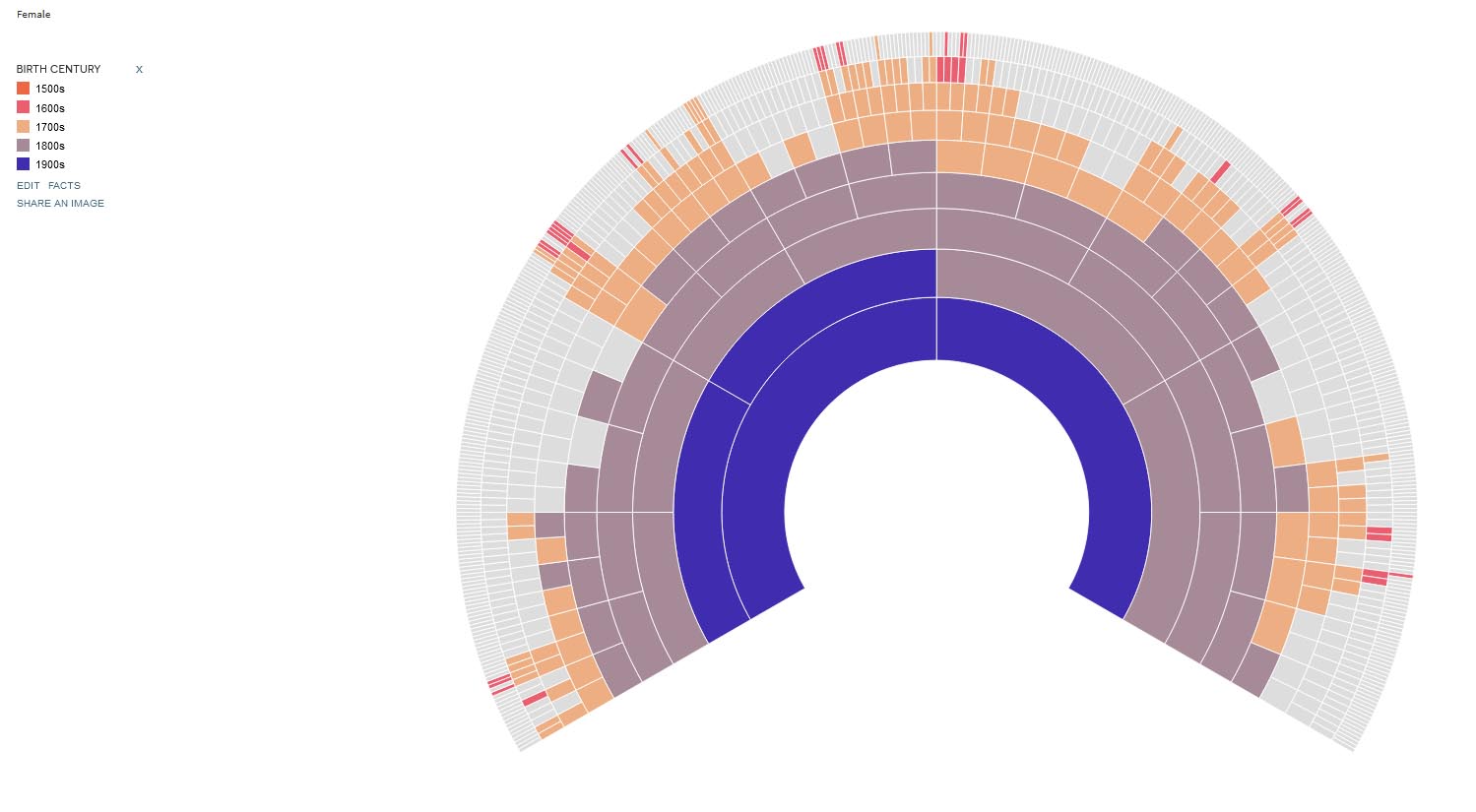
Next, ancestors colour-coded by the century in which they were born.

Fan tree showing century of ancestors' births
DNA Painter fan tree showing century of ancestors’ births

So far all the charts shown relate simply to the detail of your family tree. However, if you also work with DNA, you can make use of all the following fan charts:

On the upper toolbar, select DNA Filters. The first option is Show Genetic Ancestors. Provided you have already marked which of your ancestors are proven as genetically linked (see above) you will now see how you’re doing in terms of corroborating your documented tree through DNA matching. This is mine.

Fan tree showing ancestors with genetic link proven by DNA
DNA Painter fan tree showing ancestors with genetic link proven by DNA

My first ever DNA post was about deep ancestral DNA testing: mitochondrial DNA and Y-chromosome DNA. To recap very quickly, everyone inherits mitochondrial DNA from their mother – but only daughters pass it on. This means everyone can be sure that they share the same mitochondrial haplogroup as their mother, their mother’s mother, and so on right back through time. That is illustrated by the following chart. (In fact I have only been able to trace this line back to 3xG grandmother, but even though I don’t know her name, I do know that my 4xG grandmother has the same mitochondrial as me.)

Fan tree showing mitochondrial DNA inheritance
DNA Painter fan tree showing mitochondrial DNA inheritance

Y-chromosome DNA works exactly the same way, but only males inherit it, and obviously therefore only fathers pass it on. So the Y-DNA inheritance path is an exact mirror image of the mitochondrial, following father’s father’s father’s father’s line right the way back. (The chart below showing this is for a man whose DNA I manage. Obviously I can’t get this information from my own DNA.)

Fan tree showing Y-chromosome DNA inheritance
DNA Painter fan tree showing Y-chromosome DNA inheritance

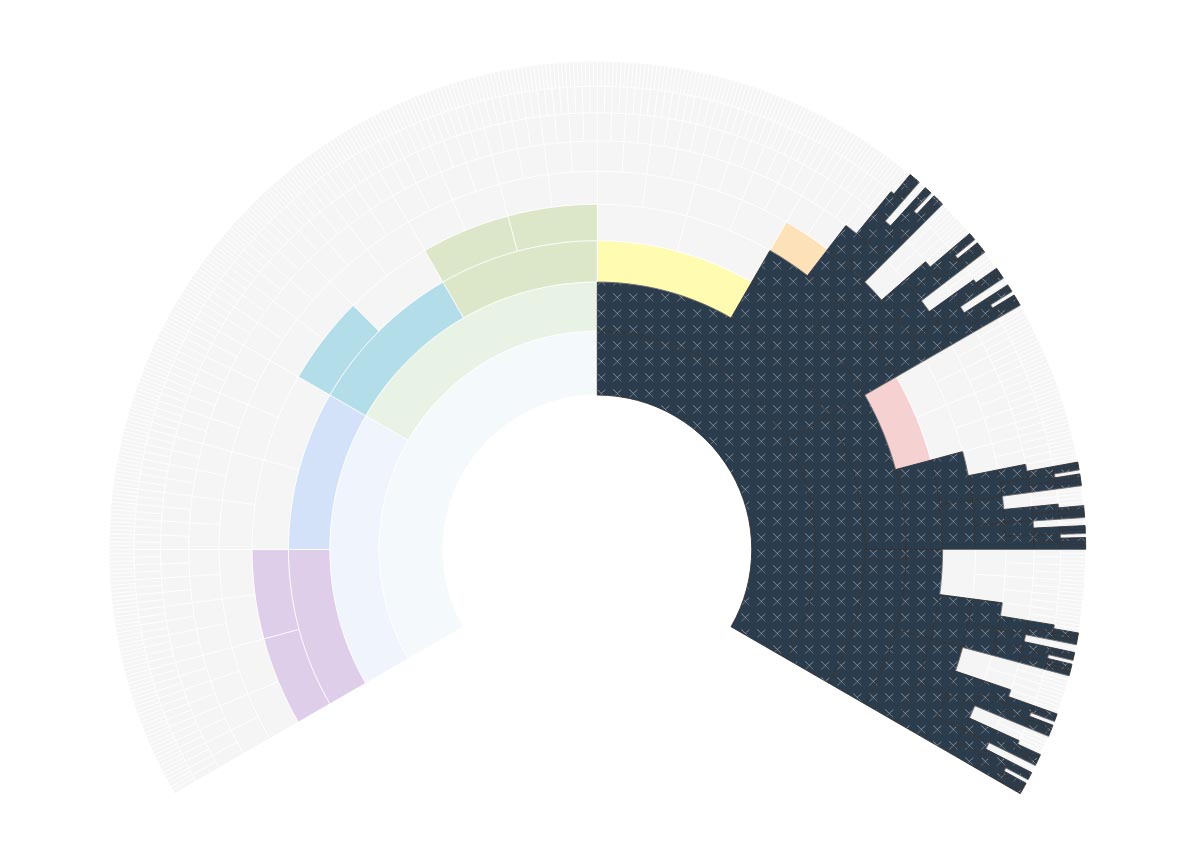
The second option in DNA Filters is Show X-DNA Path. At some point I’ll do a blogpost about X DNA. I haven’t done it so far because I don’t have many X matches to use as illustrations. If you already understand X-DNA inheritance patterns the meaning of the following two screenshots will already be clear, and when I do eventually write about this I’ll include them, since they illustrate perfectly the different inheritance patterns for females (the one immediately below)…

Fan tree showing X-DNA inheritance for females
DNA Painter fan tree showing X-DNA inheritance for females

… and males:

Fan tree showing X-DNA inheritance for males
DNA Painter fan tree showing X-DNA inheritance for males

Because of the dark colour used, it isn’t clear from these last two screen grabs that if you hover your cursor over the dark patch the intensity of colour reduces and you can see the individual ancestors’ names.

I don’t know about you, but I think all of this is pretty cool!

The Menin Gate and Last Post Ceremony

Menin Gate, Memorial to the Missing, at Ypres, Belgium
Ypres Menin Gate

Two or three minutes walk from the central Market Place in Ypres, stands the magnificent Menin Gate, Memorial to the Missing. It honours all the British and Commonwealth soldiers whose bodies were never found or remained unidentified in and around Ypres after the First World War. 

My first glimpse of the Menin Gate was a black-and-white postcard brought back by my great uncle who went there before I was born to remember his older brother, Cyril. Cyril is one of the 54,896 men – from the United Kingdom, Australia, Canada, India, South Africa and the West Indies – whose names are engraved on the Portland Stone panels. I now have that postcard, along with some photos and one of the death notices my great grandparents sent out to family and friends.

In April 1914, as the centenary of the Great War approached, I spent a few days in Ypres, learning about the final days not only of Cyril but of another great uncle too: Joseph. Like Cyril, Joseph lost his life in the Third Battle of Ypres, also known as Passchendaele. His remains lie in Poelcapelle Cemetery.

The Menin Gate, or in Flemish Menenpoort, was historically the eastern gate opening from the walled town of Ypres (Flemish: Ieper) in the direction of the town of Menin (Flemish: Menen). The grand archway now marking the road to Menen bears no resemblance whatsoever to the original gate – as the pre-1914 contemporary photograph below shows. In fact, the whole of Ypres had to be completely rebuilt after the war.

The two stone lions guarding the entrance to the town were removed during the war to prevent damage. They were presented to the Australian nation in 1936, in honour of the more than 36,000 Australian soldiers killed or wounded on the battlefields of the Ypres Salient.  They stand now at the entrance to the Australian War Memorial museum in Canberra.

Menin Gate, or Menenpoort, as it was before World War 1.
The Menin Gate (Menenpoort) before World War 1

The new gate and memorial was unveiled on 24th July 1927.  It was designed in classical style by Sir Reginald Blomfield, and features a central Hall of Memory (which is also the road), loggias on the north and south sides of the building, and staircases linking the two levels.

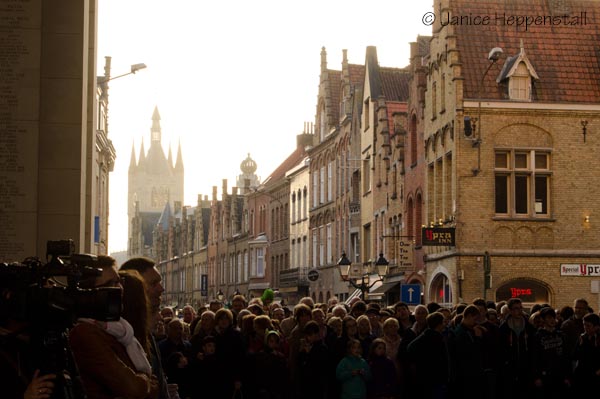
And yet the Menin Gate is not a sad, dusty old memorial.  It remains very much a part of daily life in Ypres.  Since 2nd July 1928 The Last Post Association has overseen a daily act of homage to those who fell in defence of the town.  Between 7.30pm and 8.30pm every evening, the road through the archway is closed, and as many as several hundred people gather.

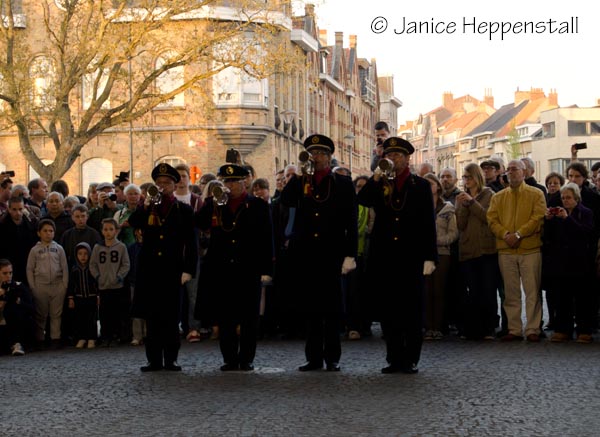
At 8pm promptly, wearing the uniform of the local voluntary Fire Brigade, the buglers of The Last Post Association sound the Last Post – the tune used to commemorate the war dead in Britain and in Commonwealth countries.

Four buglers sounding The Last Post at the Last Post Ceremony at the Menin Gate, Ypres.
Buglers at The Last Post Ceremony at Ypres

Marching bands, visiting dignitaries and delegations from organisations throughout the world come to Ypres to take part, and to lay wreaths. But even if not one single visitor attends, the ceremony still goes ahead.

Its significance to the people of Ypres is illustrated by the fact that this daily act of hommage was interrupted only during the years of German occupation during World War II, and was resumed on the very evening the town was liberated in 1944.  Today, on 11th November 2021, the 31,317th ceremony will take place.

These last two photos are from the 29,545th ceremony on 11th April 2014.

If only the world could reflect upon such bloodshed, loss of life and destruction; and resolve henceforth that hatred, violence and war will never be the answer.

Crowd gathered in the street at Ypres
Crowd gathered in the street at the Menin Gate, Ypres

Case study: Two ancestral lines, different naming patterns

In theory, we should be able to follow our paternal line with the same surname back through the generations, certain that it will continue beyond the earliest parish registers. If you (or a direct male descendant from your paternal line if you’re female) were to take a Y DNA test, then again in theory – provided there are no unexpected paternity events – you should even find the Y DNA haplogroup keeps step with the surname, right back through history. Our paternal line, though, does not comprise only endless lines of grandfathers. There is an equal number of grandmothers, and in just the same way that our foremothers married into the male surname and refreshed the gene pool, so too she refreshed the family’s traditions, recipes, ways of keeping house and, significantly for the topic of this post, the names given to children.

I wrote in two previous posts about naming patterns: the tradition of naming children in a specific order based on the names of their grandparents, parents and other significant family members. You’ll find those previous posts here (Irish) and here (English)

My last two posts have demonstrated that historically, women are significantly less likely to appear in official records. Their role was within the home, and in general the home was not a matter for public record. As we have seen, we have to get in the habit of reading between the lines regarding information about our female ancestors. For all these reasons their importance within society as a whole can easily be overlooked. Nevertheless they did have influence, even though their primary sphere of influence was domestic.

Today’s post will draw together all these topics. It’s a case study of a puzzle solved by focusing on traditional English naming patterns, and it highlights the importance and potential benefits for us as researchers of the merging of the women into the family.

When I was very young a fairly close member of my family married a lady with the same surname as his own. In more recent decades, as I progressed my genealogical research I found that this surname line on our side could be traced, still in Leeds, all the way back to the 17th century. I wondered if the same would be true for the paternal line of that lady marrying into my family, and if we would turn out to be distant cousins. Since this person is living I have changed the names. I shall refer to her as ‘Rose’, and to the surname we share as ‘Beccles’. Apart from these false names, all other information is accurate.

It was about ten years ago that I first started to work back ‘Rose’s’ paternal line. I knew her father’s name and was able to place him with his family in the 1911 census. From there, the preceding four generations were quite straightforward:

  • His father, Frank, residing with him in that 1911 census, was also located as a child in 1891;
  • Frank’s father, Samuel, residing with him in the 1891 census, was located with his own birth family in 1851-71.
  • Samuel’s father, Francis, was to be found with his birth family including father Samuel in 1841, and a baptism for Francis, son of Samuel was found in Leeds.
  • Samuel’s marriage a couple of years before that was also located, and his own baptism was in 1795. His father was Thomas.

I had now traced ‘Rose’s’ paternal line back to at least 1795, and I had the name of his father, Thomas. There was so far no connection between this and my own ‘Beccles’ line, but certainly both families were still in Leeds. I now needed a baptism for Thomas, probably around 1770; and this was where my research came to an end: there were too many Thomas ‘Beccles’ baptised in Leeds within a reasonable timeframe for me to be able to decide with certainty which was the correct one.

The solution came from an unexpected source. About five years later I discovered a new record set on Ancestry: the Leeds Township Overseers Records Apprenticeship Register. It seemed to start around 1740 and to continue until the end of the 18th century. I carefully searched the register, looking for any of my ancestors or their siblings, and found two of my ‘Beccles’ boys: my 4x great grandfather and his brother Nathaniel. It was Nathaniel’s entry that intrigued me: he was apprenticed to a master tailor by the name of Francis ‘Beccles’. I immediately started to wonder if there was some family connection between my Beccles line, known to be clothworkers, and this Francis.

Then I had my brainwave: ‘Rose’s’ ancestral ‘Beccles’ line and my own line had completely different forenames. Whereas the boys’ names repeatedly handed down in my line, prior to the 20th century, were Joseph, Nathaniel, Leonard and Benjamin, in ‘Rose’s’ line the naming tradition so far featured Samuel, Thomas and, significantly here, Francis. Could this master tailor, Francis ‘Beccles’, to whom my Nathaniel was apprenticed, be part of ‘Rose’s’ direct line?

I then started to wonder why this situation of two lines with completely different naming traditions might have come about, and the answer, when you think about it, is obvious. A surname is static. What gives it life is those who join it – in other words, the women who come into the family as wives. If we go back to the traditional naming patterns: the first son will take the name of the maternal or paternal grandfather; the second son will take the name of the other grandfather, and so on. What changes is that every wife at each new generation brings into the mix the name of her own father, her own mother and her own name. In my ‘Beccles’ line I knew who brought in Nathaniel, and I knew who brought in Leonard. These were the fathers’ names of my 6 x great grandmother and my 4x great grandmother. So now I needed to see if I could do the same for ‘Rose’s’ line, and if I could use this to help me find the correct baptisms for each generation further back. This would involve:

  • identifying all potential baptisms for Thomas ‘Beccles’, including the name and abode of the father;
  • guided by fathers’ names, abodes and dates, identifying baptisms of all other children born to these same men;
  • placing the children in age order so as to identify first-born and second-born sons (normally named for maternal and paternal grandfathers);
  • checking also the names of third-born sons (which should be the same as the father’s name, unless that name has already been used);
  • based on all this, identifying any family/families with strong similarities in children’s names with those given by Thomas and his wife to their children. i.e. In addition to the baptism for Thomas, was there also a Samuel, a Francis, and perhaps also daughters with names Thomas and his wife passed on;
  • homing in on the most likely family/families, using the date of the first-born child to identify a marriage, likely within two years previously. This would provide Thomas’s mother’s name;
  • and finally, looking for the baptisms of Thomas’s mother and father to ascertain their own fathers’ names.
  • And repeat, back through the generations.

Remember here that what we’re looking for is adherence to the traditional naming pattern. It may not hold good, but if it does it’s an extra bit of ‘evidence’ indicating your decisions so far have been valid. Remember also the extra value of finding the mother who brings a new name into the family, particularly if it’s an unusual name. It’s strong evidence that your research is correct.

For the avoidance of doubt, let me tell you – you really have to be ‘in the zone’ to do this!

But I did it! I found Thomas’s baptism. He was the first-born son of Samuel, the name given to Thomas’s own first-born son. Thomas himself was named for his maternal grandfather, Thomas. The master tailor Francis, whose name had started the alarm bells ringing turned out to be the nephew of this Samuel – son of his older brother George. So – our first identifiable ‘connection’ is that my 5x great uncle Nathaniel was apprenticed in 1789 to ‘Rose’s’ 1C6R (first cousin six times removed). I still haven’t found our common ancestor, but I’m working on it.

Using this method I managed to get ‘Rose’s’ paternal line back to the marriage of her 9xG grandparents in Leeds in the year 1627. When I passed all this information to ‘Rose’ she was astonished to see that two significant names still in her family – Frank (originally Francis) and George – had been handed down in her paternal line for several centuries. How amazing is that?!

Maiden names: a handy code breaker!

Today’s post follows on from the last, in that the focus is on women. However, here we’re looking at the presence or absence of maiden names in official documentation, and their inclusion within naming patterns. (I’ve previously written more fully about Irish and English naming patterns, and these will also feature in my next post.)

Inclusion or absence of maiden names on civil birth certificates
Less experienced family historians often need help with understanding precisely what is meant by maiden name entries on civil birth registers and certificates, so we’ll start with this.

Without even buying a birth certificate there’s a lot of information freely available on the General Register Office Online Index, if you know how to decipher it. Here’s a classic entry to start with: the inclusion of Frances Mann’s mother’s maiden name (MMN) on the following entry tells us not only that her maiden name is Sword, but by extension also indicates that the former Miss Sword is now married to Mr Mann, and that he is the father.

MANN, FRANCES    SWORD  
GRO Reference: 1846  S Quarter in HUNSLET  Volume 23  Page 287
Copyright GRO: Online Birth Index

Compare with this next entry. The absence of MMN (the ‘ – ‘) tells us that Albert Robinson was born out of wedlock. In other words, the MMN is the same as the child’s surname because the mother is not married.

ROBINSON, ALBERT      
GRO Reference: 1879  S Quarter in LEEDS  Volume 09B  Page 471
Copyright GRO: Online Birth Index

What about this one?

TAYLOR, ALBERT    TAYLOR  
GRO Reference: 1877  J Quarter in HUDDERSFIELD  Volume 09A  Page 386
Copyright GRO: Online Birth Index

Here we see that a MMN is given, but that it is the same as the child’s surname. This could mean two things: either the child is born out of wedlock, and the MMN is stated even though it is the same as the child’s surname; or the parents both had the same surname before marriage. In such a situation we would need to see the actual birth certificate (or marriage certificate) to be sure. If the parents are married the birth certificate would probably give the ‘Name, surname and maiden surname of mother’ as ‘[forename] Taylor, formerly Taylor‘; and the father’s details will of course be included.

Here’s another type of entry that less experienced researchers often have difficulty with: Under ‘Name, surname and maiden surname of mother’ you might see something like the following: ‘Margaret Robinson formerly Macanerny previously Baxter‘. This means the mother, Margaret Robinson, now married to Mr Robinson, was previously married to a Mr Macanerny. Before that, her maiden name was Baxter. It is the name Baxter that will be indicated online on the GRO Index, but to get that additional information you have to see the actual certificate:

ROBINSON, JANE    BAXTER  
GRO Reference: 1857  D Quarter in LEEDS  Volume 09B  Page 351
Copyright GRO: Online Birth Index

Understanding all of the above is great because it directs us to other life events and documents, or indeed indicates that such documents will not be found. Be aware though that an official document is only as true as the information provided by the informant. In the last example, the marriage between Margaret Baxter and Mr Macanerny was never dissolved, and twenty years of searching suggests she never actually ‘married’ Mr Robinson.

*****

We can now turn to ways in which people chose to include mothers’ maiden names when naming their children or indeed as a later choice of the individual him/herself.

Maiden names as middle names
It seems to have been during Victorian times that the fashion really developed for including the MMN as a child’s middle name. It did happen before this period, but seems to have increased in popularity amongst the middling and working classes at this time. Some families seem to have given the MMN only to the oldest son or possibly the oldest daughter; others gave the MMN as a middle name to all their children. It has nothing to do with legitimacy or otherwise of the child. In examples in my own tree, marriage dates clearly evidence that this was not in question. It is of course a bonus for the family historian, since it links without a shadow of a doubt the child to the mother’s lineage, and it’s particularly useful if the child was born prior to the introduction of civil registration in 1837. I have a 4x great aunt, for example, baptised in 1812 with the name Maria Thompson Wade, Thompson being the MMN. This is all the more helpful because the only record so far found for this baptism is a transcript, giving only the father’s name.

There are a few caveats to making use of this practice in our research though:

  • On occasion the name passed down, although originating as a mother’s maiden name, may not be this specific mother’s maiden name. It may have been handed down by tradition in the male family, possibly originating some generations back, e.g. with a great grandmother. I have a possible example of this in one of my lines, and it’s a mystery I’ve not yet been able to solve: a child baptised in 1737 with the name George Chilvers Christian yet definitely the son of Christopher Christian and Barbara née Aylmer.
  • The middle name may be mistranscribed as double-barrelled. A hyphen may even be adopted by choice of the individual in later life. So Thomas Beecroft Mann, surname Mann and MMN Beecroft, may possibly be indexed under the surname Mann or Beecroft-Mann, even though he considered his surname to be Mann.
  • Here’s a tricky one that took me a while to work out: my 2x great aunt married a man named Allen Whitworth Schofield. As far as I can see, all of their children were registered with one or two forenames followed by Whitworth Schofield. Some of the children (the ones who emigrated to the US) adopted this as a double-barrelled name in adulthood. Others didn’t but transcribers often assume this to be the case. In fact the origin in this case does indeed stem from illegitimacy. Allen was registered in 1843 with the surname Schofield, and the absence of MMN on the GRO index indicates that his mother was unmarried. Four years later his mother marries Mr Whitworth and from that time Allen is recorded on censuses with the surname Whitworth. Although Allen eventually marries with the surname Schofield he continues to use Whitworth as a middle name, and to honour his stepfather he gives this as a middle name to his children.

Maiden names as first names
The use of a MMN as a first name may continue for several generations. When eventually we find the origin it’s a real bonus, confirming our research back to this point. The aforementioned Thomas Beecroft Mann named one of his sons ‘Beecroft’. I have also come across a Horner Ingham, also his uncle Horner Ingham, their name originating with the marriage of their grandmother/mother Ann Horner to James Ingham.

Maiden name as surname with father’s name as middle name
In contrast with the use of the mother’s maiden name as a middle name, when these names are reversed this always indicates illegitimacy. (Please note that I’m referring here to the historic situation, and not to present day surname naming practices which may be quite different.) Historically, a child born out of marriage was baptised with the surname of the mother. If, shortly after that, the parents marry it is quite normal for the father’s name to be inserted as a middle name. Although this is what happened in the Whitworth Schofield example above, the gap between Allen’s birth and his mother’s marriage (four years) suggests her new husband is stepfather rather than biological father to Allen. However, when my 3xG grandmother, Annabella, was baptised in 1816, the parish register recorded her parentage as ‘Martha Walker, a single woman of Micklefield‘. Four months later, Martha married James Noble, and in all documentation after that the child was known as Annabella Noble Walker. It is the short gap between baptism and marriage that indicates James is more likely in this case to be the actual father. In fact I can’t understand why he just didn’t step up a few months earlier! DNA matches have now confirmed he is definitely my ancestor.

I have seen one early 20th century example of this in which for delicate reasons I won’t go into the mother and father were not able to marry. The child was given the mother’s surname and had no contact with or knowledge of the father who did nevertheless, we think, pay for the child’s upkeep. However, the inclusion of the father’s surname as a middle name was part of the little paper trail that was left for some genealogist (Me!) to track him down more than 100 years later and permit an acknowledgement of him as biological father.

Formalising a middle MMN as a double barrelled surname for reasons of family pride
And finally, I have one example in my tree of the mother’s maiden name being adopted as a double-barrelled surname for reasons of pride in that individual’s notable maternal ancestry. In that example the person clearly wished to emphasise his connection to his maternal grandfather and also to his mother’s brother, a rather dashing and highly accomplished uncle, whose biography the nephew went on to write.

*****

Have you come across any other unusual uses of maiden names? Have you been able to draw upon a historic maiden name to verify your research? If you can add anything to the above please do share in the comments.