Towards the end of last year I was contacted by a Professor from Utah’s Brigham Young University. She told me about the Early British and Irish Census Project at the university, which is being carried out by students on the Family History bachelor’s programme.
Although we tend to think of the first UK and Irish census as 1841, this is not strictly true. It is the first name rich census, with increasing amounts of information being collected about household members with every passing decade. However, before 1841, there were four additional censuses, in 1801, 1811, 1821 and 1831. The precise questions asked varied over the four censuses, but essentially, each parish was required to return numbers of inhabited/ uninhabited houses, numbers of families occupying them, numbers of people (male/female) with a very basic breakdown of their occupations, and information about numbers of baptisms, marriages and burials. Initially, some parishes declined to participate, and there were therefore always gaps in the data collected. However, over time there was a better understanding of the benefits to the nation of having this information and support, along with completion rates, grew.
Unfortunately, it is believed that only 791 returns for individual parishes have survived. These are listed in a publication published by University of Essex Department of History, which is available free of charge online: Authors: Richard Wall, Matthew Woollard and Beatrice Moring Title: Census schedules and listings, 1801-1831: an introduction and guide The document includes the whereabouts of all known surviving returns.
At Brigham Young University, the Family History students have started to extract the data from the surviving returns from these four censuses. They are using this to create a free, searchable database of all the pre-1841 census returns that contain named individuals: the Early British and Irish Census Project.
It’s still early days for this project, and this is why I postponed writing about it for a few months. However, there’s enough information on there now for us to be able to see how we will be able to make use of it. There are presently two different websites. The original is https://ebc.byu.edu/ . Reflecting the inclusion of Irish data, this will become https://ebic.byu.edu/ . However, at the time of writing both websites are online, and actually there is currently more information on the original version.
As I write this, the following records have been transcribed: Number of Parish Extractions: 425 Number of Parish Verifications: 384 Number of Households Today: 172,129 Number of Individuals Today: 271,623
This is across all four censuses, so there is a long way to go. However, you can try your own searches and see if any of your parishes have been included.
You can search by First name; Surname; Census Year; Parish/Town; County; and Household Occupation, which is Trade, Agriculture, Neither or Not Given. The name you will search for is the head of household: that is the only name included.
You don’t need to complete all fields. Given the gaps in coverage I’ve found it works well for me simply by searching by County and then scrolling through to see if any of my parishes of interest are included. You can click on the parish to find out more about it, the route taken by the enumerator, and about the condition of the documentation.
Search terms must be exact, so you may need to try several different spellings.
For example, I searched for “Middlesex”, leaving everything else blank. Since I wasn’t sure if my family of interest remained within one parish, I then narrowed down the county level returns not by parish but by surname. The surname in question was “Groves” but I’ve seen it as “Graves” and also without the final “s”, so I needed to do four separate surname searches: “Groves”; “Graves”; “Grove”; “Grave”. I didn’t find my family. It’s possible that the students on this project haven’t yet got around to the relevant parishes, but it’s equally possible that the data for the parishes where this family lived didn’t survive.
Another of my searches was for “Yorkshire”. I then simply scrolled down the parishes (there are a lot more on the earlier version of the website) and looked at all the ones where I have known ancestry. In Huntington, in 1821, I found the family of my 4x great grandfather Thomas Cass.
As you can see, there is very little information, but I can see there is one family in the household, and this comprises 2 males (not all ‘men’) and 4 females (not all ‘women’). The only name given is Thomas Cass, the head of household. Comparing this to my tree, I see this is Thomas and his wife Ann, plus four of their children: Thomas, Hannah, Ann, Sarah. The children are aged 1 to 6 years, so definitely not adults. Two more children are yet to be born, and these include my own 3x great grandmother. Armed with this small amount of information, I can confirm that this is the household of my 4x great grandfather rather than my 5x great grandfather of the same name. However, there is one discrepancy. In 1823 Thomas is listed in the Baines Directory as the victualler of the White Horse inn in Huntington, yet here his occupation is given as ‘Farm’. Did Thomas farm land alongside running the White Horse? Or had he not yet taken on the inn? That’s something to explore if I get the opportunity. Which just goes to show that even a sparse document might have a tiny piece of information that, together with everything else you know, might develop your knowledge.
I hope you find this useful – both now, and certainly into the future. The University of Essex online book (Wall et.al., linked above) is of course an excellent resource, but for the many of us who live some distance from our ancestral places of interest, popping in to the relevant archives or library takes a lot of time and advance planning, so Brigham Young University’s Early British and Irish Census Project will be a welcome addition. Fingers crossed we will all have at least one parish whose 1801-1831 census listings have survived!
Several weeks back I wrote about getting started with using AI for genealogy. Today I have a couple of examples of my own experimenting with using Artificial Intelligence. As emphasised in that previous post, I have some definite red lines: I have mixed feelings about AI and am unhappy about its use in faking information. I’m also not interested on any level in having AI do the writing for me. I enjoy the writing part; but you may not, and that could be something for you to explore.
Generating an image from a physical description My first experiment is to use a very detailed physical description of a long-deceased family member to try to create an image. Ideally, I would have both a very detailed official physical description and also a photograph of the same person so I can compare. A number of men in my direct line and siblings of direct line served in the British forces, and I do have photos of most of them. However, the physical descriptions are quite sparse. I also have physical descriptions of two ancestral family members who were in prison. One of these is accompanied by a photo dated around 1870 but again the physical description is quite minimalist. However, the physical description attached to the file of an ancestral cousin who was transported is amazing. His name is Benjamin Lucas. The description was written in 1834 and Benjamin died in 1840, so there is unfortunately no photograph to confirm or otherwise the accuracy of any resulting images.
This is Benjamin’s description. It is the fullest description I’ve ever seen on any prison or army record.
Tasmania Convict Records 1800-1893. Description List CON18/1
This is the text I used to generate the image: “Poor man age 43, dressed in clothes of 1834, with fresh complexion, small head, reddish hair and beard, oval face, medium high forehead, very light eyebrows with wrinkles between, grey eyes, large nose, medium wide mouth, small chin.”
I intended to use several free ‘text to image’ AI generators but found some difficult to navigate or unable to process such a lengthy instruction. I didn’t want to pay for any app at this experimentation stage. Eventually I achieved two initial images using Adobe Express. See below.
What do you think? I think the first one looks like Jean Valjean long after he was prisoner number 24601, when safely installed in Montreuil-sur-Mer as the mayor, but facially, and in poorer clothes – perhaps he could be my Benjamin.
AI generated image using Adobe Express
Or this one?
AI generated image using Adobe Express
I then changed the wording slightly to separate out the reddish hair and the reddish beard, leaving all other text the same. This was the result. I think he looks too young and, based on my research, lacks Benjamin’s disenchantment with life and his smoking and alcohol habits.
AI generated image using Adobe Express
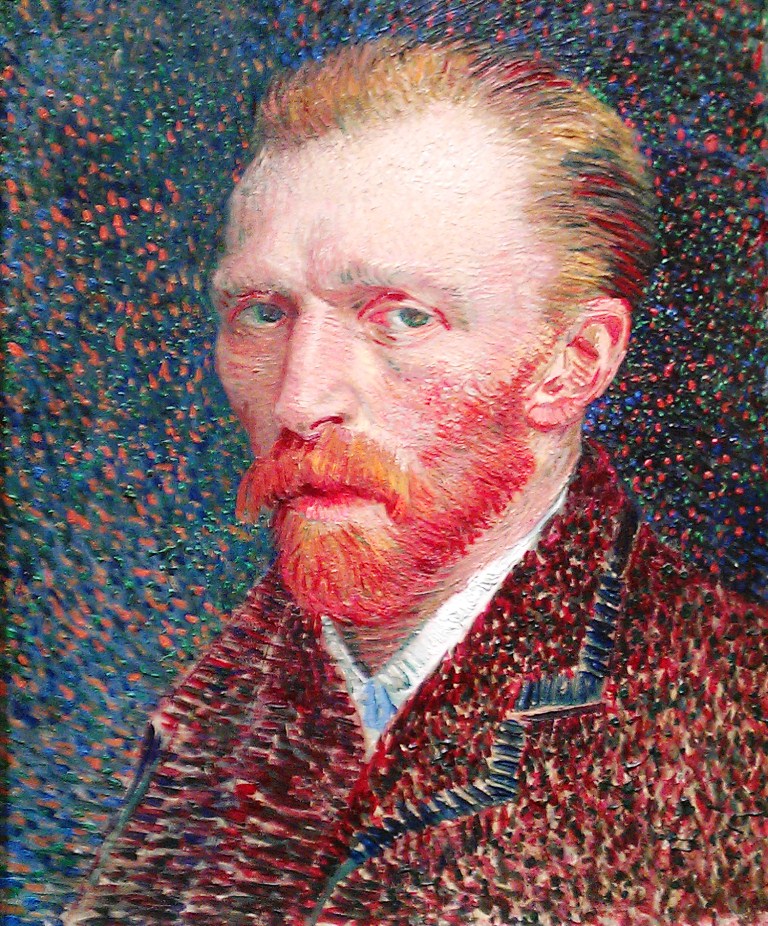
In my mind, before doing this, my image of Benjamin looked like these self-portraits of Vincent Van Gogh, only with less obviously red hair. Vincent was only 37 when he died, so just six years younger than when Benjamin’s physical description was noted. There is a ‘furtive’ look here that I like.
Vincent Van Gogh: Portrait with grey felt hat. 1887. Van Gogh Museum, Amsterdam
In this second self portrait by Van Gogh I homed in on the ‘haunted’ expression. Earlier, practising with a different app on my iPad, I asked for generation of an image based on this portrait ‘but with less defined cheekbones’. I was told my request contravened user standards! Oh dear…. I feel like a marked woman!
Vincent Van Gogh: Self Portrait 1887. Chicago art Institute
I don’t know what to make of this, and I don’t really see a use for it in my own research, but perhaps you will. See, what I really want is the face of Jean Valjean at the top, wearing the clothes of Van Gogh and his grey hat, and with the furtive look of Vincent #1 and the world-weariness of Vincent #2.
There’s a Canadian programme we’ve been watching via ‘Walter Presents’ on UK Channel 4 called The Sketch Artist (original French title ‘Portrait-Robo’) who achieves impossibly accurate images of perpetrators using AI, targetted questioning and her own artistry, and I was hoping for similar results, but there you are… she is a fictional TV character and I can’t compete. 🙂
Using AI to transcribe historical documents I will admit to having high hopes for this, but my initial experimentation came to nothing! Neither of the two seventeenth century documents I uploaded could be transcribed. 😦 This is going to take more research on my part, and I’ll return to it in a future blog post when I’ve done that. In the meantime, if you’ve had success with using AI for transcriptions, any website or App recommendations will be very useful and much appreciated.
Finally, an example that turns using AI on its head As part of a project called The Material Culture of Wills, a team at Exeter University is inviting volunteers to work alongside them in the transcription of 25,000 wills dating from 1540-1790. The research aims to explore how ownership of and attitudes towards objects changed during this period of economic transformation. However, the opportunity is also being seized to ‘train’ AI to read archaic handwriting, creating a huge data sample that will be available to the public. Volunteers are invited to proof read the work of the AI. You can find out more about it [here] and get started with proof reading. At the time of writing this, progress is well under way but very little on the earlier documents.
You can see [here] an example of what volunteers are being asked to do. The line underscored in red has been transcribed, and that transcription is shown below. You are asked to check the transcription and either agree it or amend it. If you can’t do it you simply refresh the page and get a different image. It’s quick and easy to do and you can do as many or as few as you like in whatever time you have available. The system gives the same image for checking to several volunteers, so there’s no need to worry about making an odd mistake. This is not using AI for yourself, but rather in helping AI to create better transcriptions (e.g. it is currently having trouble using capital letters) you will be practising your own paleography skills.
***
I’d be very interested to hear if you have successfully used AI for your own genealogy research, or if you’ve had success with different apps and packages from the two I’ve mentioned above. Please leave a comment if you have.
I had intended to do a proper post earlier this month, but typing and spending time at the computer is still difficult for me as my wrist and hand heal following a break at the end of September. Everything’s going well and mobility is returning; it’s just taking a lot longer than I had assumed it would – and involving a lot more broken nights and tired days.
So the planned post can wait, but I just wanted to drop in to wish you all a happy festive period.
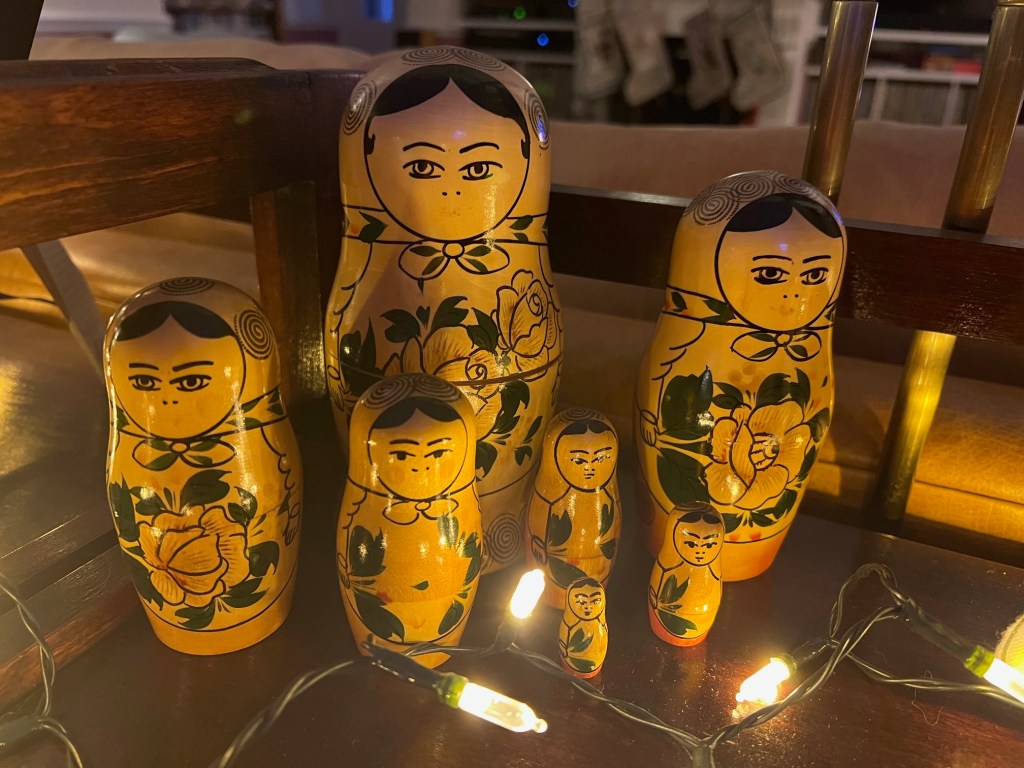
I bought these Matryoshka dolls 37 years ago when I went to Moscow. They spend most of the year nested, one inside the other, but I always get them all out at Christmas and put them on display alongside a less traditional set of nesting Santas.
Some people call these Babushka dolls, the word meaning ‘grandmother’ or sometimes ‘old woman’ in Russian. I like to think of this set as representing me and my direct maternal line. If I’m the smallest one, the next one up is my mother, then my grandmother. After that comes my great grandmother, Jane; my 2G grandmother Margaret and my 3G grandmother Mary. The last two were born in Ireland. One record for Margaret indicates her place of birth was Derry (Londonderry) OR Newry, both in what is now Northern Ireland, but that was circa 1823 and, Irish records being what they are, I’ve never been able to place her birth, nor locate a marriage for her mother Mary and father Robert. This also means that the largest of these seven Matroyshka dolls is unknown to me, and I would dearly love to know her name – the name of my 4x great grandmother. Finding out more about this line is something that is permanently on my To Do List, but it would involve getting to know a whole new set of unfamiliar records, and there are always other research projects to be getting on with.
My children would laugh if they saw this post. They say I can turn a discussion on any subject into genealogy – I’m sure this is something a lot of you are skilled in too. 😀
And so all that remains is to set aside the genealogy, and to wish those of you who celebrate a very Merry Christmas and a Happy, Healthy and Successful New Year. I hope to be able to write my planned post in January.
I’m still not able to use my left arm for very much following breaking my wrist several weeks back, so today’s post is deliberately ‘typing light’. It’s a beginner’s level introduction to using Artificial Intelligence for genealogy.
I have to admit to having mixed feelings about Artificial Intelligence. I’m unhappy about its use in faking information, and about products of AI being passed off as someone’s work, for example using it to create an image, a video or a text without making clear that’s how the piece was created. In photography, for example, this seems to be devaluing genuine talent, when accusations of ‘fake!’ are called for an image that a fellow photographer can clearly see has been achieved through skill, planning and use of top-notch equipment.
That said, as genealogists working online, we already benefit from aspects of AI. Hints, Stories, Thrulines and Theories of Relativity, for example, are all brought to us courtesy of AI. Based on these, what we can say is that AI is useful but it is only a starting point. It must be used with caution. We must analyse and verify the information presented to us, but having done so it can be a great help.
The following FindMyPast video with Blaine Bettinger is a good introduction to how we might use AI more widely in genealogy. In the video, Blaine and Jen Baldwin introduce ways we can use it. They also set down a few guidelines:
AI is not the same as ‘Google’. It deals with words, not facts
In research, it’s useful as a starting point – for brainstorming
It’s like a torch, shining a light to guide us towards relevant information; our job then is to decide what’s relevant, what’s not, and where we need more information
Since it’s a new area, there remain concerns about its use: bias, ethics, plagiarism and copyright issues
Although that video is a good introduction to the themes, we need more information about practical ways to use it. In the follow-on video the same people discuss useful ‘prompts’. A prompt is what is written to outline the precise output the user is seeking. Prompts can be refined to move closer to the desired outcome. Through these example prompts, Blaine gives us an idea of how we could use AI. Some of them may not appeal to you at all; others might. It’s about each of us finding how AI could work for us – how it might help.
Those two videos are more than a year old, and it’s clear that a year is a long time in AI. However, they are useful starting points.
If this is something you’d like to explore there are two Facebook groups you might like to join:
You will quickly realise that everyone on the groups is still learning. Some are further along the line than others. A lot of the posts seem to be from people reporting on an experiment they’ve carried out to see how well AI can cope with a particular prompt or a particular approach.
There is also a podcast series: The Family History AI Show with Mark Thompson and Steve Little comes highly recommended and is bang up to date with the latest developments.
In my next post I’ll include some small experiments of my own. I’m very much at the starting point here. I’d like to find ways to make AI work for me, but I have some definite red lines, and other areas where I’m not sure how the output would be any better than simply doing it myself. I, for example, would never use AI for writing; and there are some research tasks in which I believe the time spent working on a document help me to get an in-depth understanding of a family. Simply reading a list of statements about its content wouldn’t give me that deep-dive familiarisation.
Have you used AI? Do leave a comment with your experiences.
One of my motivations as a genealogist and family historian is to uncover – and pass on – stories from the past. A recent unexpected turn of events brought about a merging of a story from 1936 with my own life in 2024. In this post I’m going to tell you about both of these stories.
On 27th September 1936, Oswald Mosley, leader of the British Union of Fascists, organised a rally in Leeds. Accompanied by 1000 Blackshirts, his twin aims were to intimidate the Jewish communities based in Leylands, an area just to the north-east of Leeds city centre; and to drum up support for fascism amongst the working classes. The first of these aims was thwarted when the Leeds Watch Committee forbade any march through the Leylands area. However, the wider demonstration was allowed to go ahead. The Blackshirts’ march commenced right in the heart of Leeds. They then crossed the river into Hunslet, through to Beeston Hill – where they were joined by Mosley – and on to Holbeck Moor. Here, the plan was, Mosley would deliver a rousing speech.
The choice of Holbeck Moor was no accident. Holbeck and the adjacent areas of Hunslet and New Wortley were industrial areas with smoke-belching factories and railways lines interspersed with row upon row of poor quality back-to-back housing. This was the tail end of the Depression, and Mosley believed he would be able to drum up support for fascist politics. However, upon learning of the intended march, anti-fascist political activists spread the word. The Jews in Leylands were warned, and the presence of whoever was able, was requested at Holbeck Moor. When Mosley and his Blackshirts arrived, 30,000 Leeds residents were waiting for them.
From the article in The Leeds Mercury on Monday 28 September 1936. Source: FindMyPast.co.uk
When my Mum was in her eighties she told me about the day she saw Oswald Mosley march onto Holbeck Moor. She lived half a mile from there, and in fact hers was just the kind of family Mosley was targetting, since her father had been unable to find regular work for several years. However, he understood very well that his lack of employment had nothing to do with Jewish people living in other parts of Leeds. Remembering clearly the events of that day, my Mum described the hate written all over the faces of the young Blackshirts. Mosley, she said, hadn’t reckoned on ‘the men of Leeds’, who were waiting on Holbeck Moor, armed with stones and determined to prevent him from speaking.
It was some years after my Mum’s death that I came across an online article entitled ‘The Battle of Holbeck Moor’. At the time I was researching the events of the Civil War in Leeds, and thought this might have been one of the local battles associated with that; but as I read, I realised it was the event my mother had attended. This, in fact, gave me a date, and I was able to work out that she had been just twelve years old at the time… I wondered if her parents had known she was there!
The article gave me more details about the event. Perhaps my Mum had told me about some of them, and perhaps I had forgotten. I learned that Mosley used a van as a makeshift stage, but that every time he tried to speak, 30,000 voices roared out ‘The Red Flag’ to drown him out. Clearly, as a young girl standing at the back of the crowd my Mum wasn’t an active participant in the event. For her, its importance was the impact it had on her developing understanding of the reality of fascism – something with which, unfortunately, everyone in attendance would have nine more years to become better acquainted. Certainly, it was clear that, nearly 70 years later, she remained proud of the fact that Leeds had defeated Oswald Mosley. I left a comment at the end of the article, saying my mother had been there, and that her recollection of the event many years later tallied with the account. Then I added the info to my timeline about my Mum’s life and thought no more about it.
In August this year I received an email inviting me to be part of a special reception at the unveiling of a Leeds Civic Trust Blue Plaque commemorating the Battle of Holbeck Moor. I had been traced from that comment written some years earlier, and would be representing my mother. I was so happy to be invited to do this, and made preparations for the trip. I would be accompanied by my nephew and my second cousin and his wife. I was asked to write something about my mother for the display, to be kept permanently at the West Yorkshire Archives, and to provide some photos. Having done all that, I was then asked if I would be prepared to make a short speech on the day.
The rather surreal nature of this turn of events was not lost on me: the idea that one day in September 1936 my mother, then aged twelve, witnessed ‘the men of Leeds’ turning back the leader of the British Union of Fascists, and that 88 years later, her own daughter would be standing on the same spot talking about her was quite overwhelming. My Mum was never a political person but she always had a strong sense of right and wrong, and she knew that hatred and scapegoating had no place in politics. In life she had rarely done anything to attract attention, but now I wanted her story to be known.
I was due to travel up to Leeds on Saturday 28th September, ready for the ceremony the following day. Instead, on Friday evening, while putting the finishing touches to my preparations, I fell and broke my wrist.
Leeds MPs Fabian Hamilton, Richard Burgon and Hilary Benn, with Sam Kirk from Stand Up To Racism. Photo: P Heppenstall
The event on Sunday 29th September was well-attended. The unveiling was done by three Leeds Members of Parliament. It all went well, but I was not there. I was mostly lying on the sofa, asleep. Even now, I’m typing this with one hand.
Representatives of families of some of those who were present at the Battle of Holbeck Moor on 27th September 1936. Photo: C & J Battensby
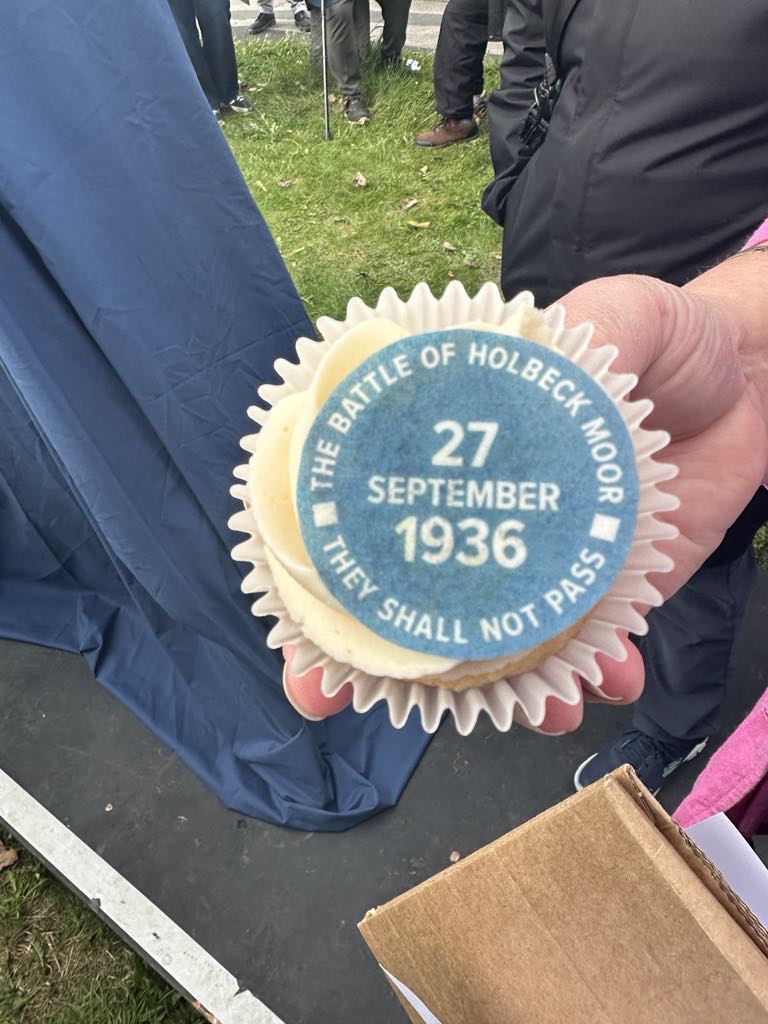
Several descendants of those present on the day had been traced, and were photographed together with photos of their family members. One of those represented had not attended the demonstration at Holbeck Moor, but was a Jewish pharmacist who gave First Aid to Blackshirts who had been injured by the stones. My nephew represented my Mum, his Grandma; and my speech was wonderfully delivered with his own twist by my second cousin. The two of them, plus my cousin’s wife, sent lots of photos and videos, and it almost felt like I was there. I was gutted to miss out on a Battle of Holbeck Moor cupcake!
Blue Plaque cupcakes were given out after the ceremony! Photo: C & J Battensby
Of course I was very disappointed to miss the event, but the important thing is that on that day my Mum’s voice, representing 30,000 others, was heard. She would be very surprised to know she also got a mention in the local press, on the BBC and in a number of national papers, including The Guardian.
The Battle of Holbeck Moor was not the only clash between Mosley and anti-fascist demonstrators. Exactly one week later, the far better known Battle of Cable Street in London’s East End took place. By coincidence, one of those anti-fascist demonstrators was a young man who, several decades later, would become my father-in-law.
All of this came about because several people, including myself, left comments online in response to articles about the events at Holbeck Moor of 27th September 1936. As a result, this story is now owned by more family members who previously were not aware of their own family connection. More than that, the inclusion of the stories of those who attended brings a personal dimension to the history. And surely, breathing life into those memories of ordinary people is what researching family history is all about.
Leave comments! Tell the stories! You never know where it might lead.
This post is published to coincide with the release of my video presentation for All About That Place 2024: The Rotten and Pocket Boroughs of the Isle of Wight.
The 15-minute video starts with an overview of some useful information and terminology about voting arrangements for counties and boroughs throughout the United Kingdom before the Reform Act of 1832. This could be of relevance to your research interests if you have ancestry or a special place of interest anywhere in the UK. The information presented below the video will help you to find out if your place was a borough or a parliamentary borough; and if the latter, what the voting arrangements were. It will also help you to work out if your place was a rotten or pocket borough, and why. Some of the linked articles are quick and easy to navigate and will provide the information you need. Others are longer, in-depth reads. I hope you’ll find it all useful and interesting.
If you’d like to know more about the three places on the Isle of Wight mentioned in the video, there are links to more information about them too.
Information about the ‘Unreformed House of Commons’ (before 1832)
Check if your place of interest was a borough: Wikipedia: Ancient Boroughs Here you’ll find information about the history of boroughs right back to Anglo-Saxon times. Towards the end there is a list of English boroughs during the period 1307-1660 and an incomplete list of Welsh boroughs (with a request for additional information). You’ll notice some surprising ommissions. e.g. Manchester was granted borough status in 1301 but lost it in a court case in 1359. Wikipedia: List of burghs in Scotland In this list the ‘earlier burghal history’ of each modern day burgh ‘from the coming into force of the Burgh Police (Scotland) Act 1892’ is included. This is not, therefore, a complete list of all ancient Scottish burghs.
For a more scholarly and in-depth look at medieval borough charters, see: John West: Town Records, 1983. London, Phillimore. Chapter 4: Medieval Borough Charters c.1042-1500. Here we learn, for example, that Birmingham, omitted from the Wikipedia article, was granted the right to hold a weekly market in 1166 but this is known only by virtue of alternative records: no charter has survived.
Check the voting qualification for your parliamentary borough (constituency): The voting qualification is given in the List of counties and boroughs indicated above, but See also: Wikipedia: Unreformed House of Commons Scroll halfway down the page for a description of the different types of borough franchise. Rural Historia: What is a Medieval Burgage Plot?
***Remember! Depending on the voting qualification type of your borough, there could be name-rich documents showing the names of the voters and how they voted.***
Check if your place was a ‘Rotten borough’ or ‘Pocket borough’: See: ECPPEC: Rotten Boroughs This article includes a map showing all the Rotten Boroughs. They are all in England. Wikipedia: Rotten and Pocket Boroughs There’s an interesting list of references to Rotten Boroughs in literature and popular culture at the end of this page. Wikipedia: List of constituencies enfranchised and disfranchised by the Reform Act 1832 The 1832 Reform Act did not resolve all ills in the political landscape, but it was a start. Some were disenfranchised entirely in 1832; for others, changes were made to their entitlement to political representation. History of Parliament Online: The Constituencies [1754-1790] A long read. Scroll down about one fifth of the page to reach the long section on The Boroughs. Dealing with each type of borough in turn (Freeholder, Corporation, etc) it shows how bribery, corruption and ‘patronage’ were at large in almost all of the boroughs at some level or another, not just in Rotten and Pocket boroughs. Examples of specific boroughs are given throughout so you may well find info about your place of interest here.
*****
Information about Newport, Newtown and Yarmouth on the Isle of Wight
Yarmouth Wikipedia: Yarmouth, I.O.W. History of Parliamentary Constituency Wikipedia: Yarmouth Town Hall, I.O.W. Visit Isle of Wight: Yarmouth C.W.R. Winter: The Ancient Town of Yarmouth, 1981, Isle of Wight Country Press, Newport. Viewed at: Isle of Wight Record Office. A.G. Cole: Yarmouth Isle of Wight, 3rd edition, 1951,Isle of Wight Country Press, Newport. Viewed at: Isle of Wight Record Office.
There is a detailed discussion of the three Isle of Wight boroughs in: Jack Donald Lavers: The Parliamentary History of the Isle of Wight 1779-1886, March 1991: M Phil thesis. Viewed at: Isle of Wight Record Office
Hallie Ribenhold: The Scandalous Lady W: an eighteenth century tale of sex, scandal and divorce. 2008, Vintage, London Relates the story of Lady Seymour Worsley and her abusive husband, Sir Richard Worsley, baronet, of Appuldurcombe House, wroxall, I.O.W. He was MP for Newport 1774-1784, then for Newtown 1790-93 and 1796-1801. A fascinating read, which encompasses the position of women before the Married Women’s Property Acts and the availability of divorce, as well as rotten and pocket boroughs in operation. With the backing of other landed families, the Worsley family regularly represented all three of the Island’s boroughs.
“THE EDITUR OF THE TIMES PAPER Sur, — May we beg and beseech your proteckshion and power. We are Sur, as it may be, livin in a Wilderniss, so far as the rest of London knows anything of us, or as the rich and great people care about. We live in muck and filth. We aint got no priviz, no dust bins, no drains, no water-splies, and no drain or suer in the hole place. The Suer Company, in Greek St., Soho Square, all great, rich and powerfool men, take no notice watsomdever of our complaints. The Stenche of a Gully-hole is disgustin. We all of us suffer, and numbers are ill, and if the Colera comes Lord help us.
Some gentlemans comed yesterday, and we thought they was comishioners from the Suer Company, but they was complaining of the noosance and stenche our lanes and corts was to them in New Oxforde Strect. They was much surprized to see the seller in No. 12, Carrier St., in our lane, where a child was dyin from fever, and would not believe that Sixty persons sleep in it every night. This here seller you couldent swing a cat in, and the rent is five shillings a week; but theare are greate many sich deare sellars. Sur, we hope you will let us have our complaints put into your hinfluenshall paper, and make these landlords of our houses and these comishioners (the friends we spose of the landlords) make our houses decent for Christions to live in. Preaye Sir com and see us, for we are living like piggs, and it aint faire we shoulde be so ill treted.
We are your respeckfull servents in Church Lane, Carrier St., and the other corts. Teusday, Juley 3, 1849.”
This letter was signed by fifty-four residents of the St Giles ‘rookery’ in London. Published on 5 July 1849 under the headline ‘A Sanitary Remonstrance‘.
***
The rapid expansion of our large industrial towns and cities started in the eighteenth century but was particularly so during the first half of the nineteenth, as increasing numbers of people migrated from rural areas and from Ireland. Between 1800-1850 the percentage of English citizens living in urban areas in the country as a whole increased from 30 to 50%, but in certain major industrial towns the growth was much greater. In Birmingham, between 1801 and 1851, the population increased from 71,000 to 233,000. In the same period Liverpool’s population grew from 82,000 to 376,000. In just one decade from 1821-31 Bradford’s population increased by 78%.
How on earth did these towns cope with housing and facilities for all these additional people? The simple answer is that they did not.
The thinking was that needs would be served by demand: employers would build factories, and speculative builders would build the housing needed for the incoming labourers. Of course the builders required a profit for their work, and the problem was that the workers were paid very little. Even the cheapest housing meant some workers were paying a quarter of a very meagre income on rent. By the end of the nineteenth century, nearly one third of the population would be considered ‘the very poor’.
There were several consequences. One was that purpose-built housing for the masses was of very poor quality, often built with just twenty or so years left on a land lease and deliberately built to last for just that length of time. Walls were the thickness of a single row of bricks, and the bricks themselves were often insufficently fired. Proper foundations were not dug out, meaning floor boards on the lower levels could be laid just a couple of inches above bare earth. In the Midlands and the North, back-to-backs became common. Each house had a party wall on three sides, with the door and windows only on the remaining side. Sometimes these were built in rows along parallel streets, but often they were arranged around courtyards, with the outer properties facing the street and the (cheaper) inner properties accessed via an alley or tunnel. Consequently, not only was there no possibility of air flow from one side of the house to the other, but the courtyard itself would have very little movement of air.
Room sizes were small, and despite the generally large family sizes, most purpose-built housing for the labouring classes had just two rooms: one up and one down, plus possibly an attic space. In the 1870s 43% of married women had 5 to 9 children; 18% had more than ten children. Hence as a matter of course, most individual family homes for the workers would be overcrowded.
As an alternative there was the option of repurposing existing housing. The large family homes built in the Georgian period for better-off families might now be sub-divided, with rooms on each floor let to different families. Repurposing in this way was always cheaper than purpose-built, but it did mean that the facilities and level of privacy originally intended for one family were now to be shared amongst several.
For the poorest of all, these already inadequate spaces were shared. Two, three or even more families would share small houses, designated rooms on a floor, or even one room.
Worst of all, the cellars of larger houses were rented out as dwellings – and even they might house more than one family. Some families even kept livestock in a pen alongside the family. There was, of course, no drainage. What’s more, the floors were bare earth and often they were below the water table, meaning they regularly flooded.
As the nineteenth century progressed and towns prospered, local authorities started to erect grand buildings as a testament to civic pride. Roads were widened to facilitate easier passage of large numbers of hansom cabs, and towns were redrawn to make way for railway lines and their stations. All of this required clearance of existing housing, and often the routes and locations selected specifically targetted the housing of the working classes. This was generally thought to be a good thing, since the housing was filthy, a health hazard and an eyesore. However, no new housing was built. Consquently, these grand developments meant worse overcrowding since more families had to cram into the buildings that remained. There were also raised rents, since unscrupulous landlords sought to take advantage of the scarcity of housing. In London, 120,000 people were displaced, and no new housing built to accomodate them.
Vast ‘rookeries‘, already unfit for human habitation, were the only areas available for the very poor. These were characterised by narrow alleyways and poorly-constructed multiple-storey dwellings crammed into whatever space was available. St Giles in London, where the signatories of the above letter to The Times lived, was a rookery. So too was the ‘Devil’s Acre’: the land on which Victoria Street in Westminster was built.
To this perfect storm of poor quality, inadequate housing, overcrowding and lack of ventilation, we must add one more fact of life: People need toilets.
The flushing toilet, or water closet, depends upon ready availability of water and a system of sewers, but it was not until the middle of the nineteenth century that these started to be installed as standard. Prior to that there were dry closets neutralised by earth or ashes; and cess pits. ‘Night soil’ would be collected by men whose job it was to take it to market gardens outside the towns, where it could be used as fertiliser. In some houses the cess pit was actually in the cellar, so that waste collected immediately below the floor boards of the ground floor dwelling rooms. Perhaps it was the rapid growth of towns and cities that meant these arrangements did not always go to plan, but we do know that collection of sewage and general waste was not always carried out. In one infamous rookery in Leeds called the Boot-and-Shoe Yard, no waste was collected for more than six months. When eventually this was remedied, over seventy cart loads were taken away. In any case, privies were shared between households – maybe as many as three hundred people, although the St Giles signatories claimed to have none at all: “We live in muck and filth. We aint got no priviz, no dust bins, no drains, no water-splies, and no drain or suer in the hole place.”
In 1842 serious concerns about the insanitary conditions in Leeds’s Boot-and-Shoe Yard led to the demolition of this rookery just off one of the main streets in the town. The 1841 census is therefore the only snapshot we have of the number and occupations of the residents. As can be seen from this extract, many of them were migrants from Ireland.
Citation: 1841 Census of England and Wales. Original data: The National Archives. Source: Find My Past – the ‘I’ in the last column indicates those who were from Ireland
The popular view was that the muck and filfth was the fault of the residents, whose standards, lifestyle and morals were unacceptable.
It wasn’t until well into the second half of the nineteenth century that change gradually came. Prior to this there were no planning laws or building regulations. Gradually, local authorities were empowered to require builders to conform to certain minimum requirements, but many did not act on this because of the extra cost to the ratepayer. Increasingly it came to be understood that the health crisis and the housing crisis were two strands of the same issue, and permissive powers evolved into mandatory, but it would take the slum clearance and demolition programmes before finally these living conditions were consigned to the history books.
How can we make use of this information in our family history research? Armed with this understanding of living conditions we can look for clues to learn more about the conditions in which our ancestors lived. Often, but not always, the worst conditions were occupied by immigrants. Here are some ideas:
Look for multiple households at one address in the census In this extract from the 1901 census we see three households including 23 people living in one house. In fact this is only part of the return for number 5 Brick Lane: the rest are recorded on the following page. In total there are four households totalling 31 people. Three of the households have lodgers – a total of five lodgers altogether in the house.
Citation: 1901 Census of England and Wales. Original data: The National Archives. Source: ancestry.co.uk
Look for families living in cellars The houses in Liverpool’s Edmund Street had cellars, and as with many of the larger properties in Liverpool, these were let as separate dwellings. The main house at number 56 is a lodging house, with five lodgers, but another family is recorded in the cellar.
Citation: 1851 Census of England and Wales. Original data: The National Archives. Source: ancestry.co.uk
Use the largest scale maps you can find to identify yards or courtyards, especially with back-to-backs This small section of Lee’s Square is taken from an 1850 map of Leeds. Unfortunately the rest of the Square is on the next Ordnance Survey sheet. Thanks to the large scale of this map we can see individual properties. What we see is that most of the properties in Lee’s Square are back-to-backs. The property behind each abode has the door and windows looking out on to the street. The rents for those properties will be slightly higher. Although we can’t see from this map section, the privy will be inside the Square, also the water pump. This, added to the obvious lack of free-flowing circulation of air, will mean the inner properties are less healthy places to live than the outer.
Citation: Ordnance Survey Town Plan of Leeds, Surveyed 1847, published 1850. Reproduced with the permission of the National Library of Scotland. [Click here] for link to the full map.
Look for old photos of the addresses where your families lived Ideally, you’ll be able to compare these with contemporary maps. The image below shows the same portion of Lee’s Square as you see on the map above. You can see the two sets of steps leading to the doors of two of the houses, and a cellar of some sort below. The photo is dated 1901 – fifty years after the map was surveyed and published, and the lean-to appears to have been added in the intervening years. The buildings on the southern side of the square seem to be lower and perhaps don’t have the substructure. This is of particular interest to me because my 2x great grandfather was living here in the 1890s. Thanks to a Coroner’s Report after his death I know that his house was above a stable, but it isn’t clear from this photo or its partner (looking east) where the dwellings above a stable would be.
Citation: ‘Lee’s Square looking west, 1901’ Source: Leodis. [Click here] for link to image on Leodis website.
If you have ancestors who might be classed as ‘urban poor’ in the nineteenth century, I hope these ideas will help you.
I’m also developing a presentation on the subject of Housing the Urban Poor in 19th Century England. If this is of interest to you and your local or family history society, please take a look at my Public Speaking page, and follow the link at the bottom of that page to contact me.
***
Sources
David Olusoga & Melanie Backe-Hansen: A House Through Time, 2021. Picador, London
John Burnett: A Social History of Housing 1815-1970, 1978. David & Charles, Newton Abbot
Stanley D Chapman (Ed): The History of Working-Class Housing, 1971. David & Charles, Newton Abbot – this book has separate chapters on London, Glasgow, Leeds, Nottingham, Liverpool, Birmingham, South-East Lancashire/ Pennines, Ebbw Vale.
B R Mitchell and Phyllis Deane: Abstract of British Historical Statistics, 1962. Cambridge University Press.
It’s something I hear often when I tell people I’m a genealogist.
I always reply that the records are in fact, mostly free. Provided you know which archive they will be held in, you can book an appointment, walk in, and get looking.
Of course… you need to know how to search, and where to start, and you have to know about different record sets, and take into consideration that your ancestors might not have stayed in one place, so that even within that one archive you might have to guess at which parish they came from before the one you know about… because at the archive, although every volume or box of records is catalogued, individual entries within them are not indexed. The image below is, genuinely, all the boxes that were waiting for me (by advance request) on one of my trips to the West Yorkshire Archives in Leeds, together with part of my To Do List in the foreground. I think there were fourteen boxes all together for me to tackle over two full days.
Before the advent of the Internet, and dedicated websites for genealogy, this is how all family research was, but it was slow going and hard work. I’m going to explain the difficulties with reference to just two generations of one of my ancestral lines.
My 3x great grandfather, Thomas Mann, was born in Norwich, but I only learned this because I found his birthplace on the 1851 Census. My family had no idea that they had roots to that part of the country before this. Following up on this, I found Thomas’s baptism, and learned this took place at St Peter Mancroft, one of roughly fifty-eight parish churches in the square mile or so that we would now think of as Norwich’s city centre. From that record I found the name of his father: Robert, and mother: Hannah née Christian.
Later, after Thomas’s death, I found an entry for one of his daughters on the 1861 census. She gave her birthplace as Norwich St Martin at Oak. This was some years before Norwich’s baptism records were available fully indexed on any subscription website, but I found a way to browse records online, and in that way found several other baptisms for children of Thomas and my 3x great grandmother Lucy, all in Norwich St Martin at Oak; and that was how I learned that Thomas and his wife lived in that parish until they migrated to Yorkshire.
So far all this research has been led by the Censuses. If the censuses were not online I would have had to go the The National Archives in London. The originals are now no longer available to view, but presumably would have been prior to the digitisation… but without the indexing, how on earth would I find them? In 1830 the population of Norwich numbered around 36,000, while that of Leeds in 1851 (which is where they were when I first found reference to birthplaces in Norwich) was 249,992. Simply finding them at their house in Leeds could have taken months.
Back in Norwich, Thomas’s father, my 4x great grandfather Robert, died just before the 1841 census, so everything I know about him comes from baptisms of his children, plus his own baptism, marriage and burial records, a civil death record and an apprenticeship record. I’m confident that Robert lived his entire life within the county of Norfolk – and therefore all the local records relating to him are lodged at Norfolk County Record Office. He was baptised at Great Yarmouth, apprenticed to a master at Wymondham, and then moved to Norwich where he remained for the rest of his life. However, there, he moved around several of the fifty-eight parishes, marrying at St Peter Mancroft and baptising children there, plus others in the parishes of St Stephen, St Michael at Thorn and St Peter Parmentergate. Later, he moved to the parish of St Stephen and was buried at All Saints parish church. I know all this not because I spent many months scouring the free-to-consult records at the Norfolk Archives, but because I input a few details on the commercial Ancestry and FindMyPast websites and managed to work it all out from the selections of records returned for my consideration by their powerful search engines.
Robert’s children did not all remain in Norfolk. Apart from my own ancestor, Thomas, who travelled with his family to West Yorkshire and eventually ended up in Leeds, two sons joined the Royal Horse Artillery. One of those retired in Woolwich where he had a family; the other married a lady from Pontefract and he too eventually settled in Leeds after a military career involving the Battle of Waterloo. Leaving aside the information about the military years (mostly at The National Archives), that involves records from four more County Record Offices. And yet, apart from one Settlement hearing for my Thomas and his family, there is nothing in the archives at Norwich to suggest any of that: mentions in the records for those migrating individuals simply cease. Again, I learned about most of it with the click of a few buttons and browsing digital images of original records online, although I have also followed up some of this information in targetted examination of specific records at the Norfolk Archives and The National Archives. That research involved browsing through lots of images on microfiche, or examining the pages of original volumes in search of mentions of my people.
It’s the indexing that is so important. It points us directly to records that, based on our search terms, would appear to be relevant.
The records we find online are made available to the commercial websites by licence from the original archives; and they have to pay a small amount to the relevant archive every time someone clicks on the records. However, it is the commercial websites that photograph them and have them indexed. The archives hold far more than what we see online – even though the amount online is increasing all the time. It tends to be the more local and much older records that have not yet been (and perhaps never will be) photographed and indexed and made available online. However, having located an ancestor in a specific place, if we do visit the archives, thanks to all the online stuff, we can approach it with a To Do List or a Wish List of information we would like to locate and examine.
The following video gives an insight into the amount of work involved in photographing, alongside carrying out essential conservation work, for a huge nationwide record set like the census.
It’s true that some records or transcriptions of records are available freely online. Invariably, these are made available through the work of volunteers. Their work can help us enormously, and we must be grateful for the dedication of those who do this, either by giving their time to develop records of a big website like Family Search; as part of a local Family or Local History Society; or as a personal project/ labour of love. But we can’t expect everything to be done on a voluntary basis.
The big subscription websites do offer a valuable service. What they do is far more than simply taking public records and charging for them. The photographing, conservation and indexing of a large set of records is an enormous undertaking, involving professional archivist and conservationist input as well as teams of indexers. Quite simply, if they didn’t do this, it wouldn’t get done – there is just too much demand on public funding and this is way down the list. That’s not to say I agree always with the level of the charges, or the introduction of additional charges for some aspects of the service that used to be part of the original fee. I also would prefer that indexers with local knowledge were used. It is much easier to make out a scribbled place name if you know the area. Which seems like a good time to mention possibly the worst transcription/ indexing I’ve ever seen: a Land Army Index card. The name ‘Muriel’ was indexed as ‘Kendriel’; ‘Crescent’ was indexed as ‘Cusad’; ‘Beeston’ as ‘Beeka’; and the job ‘Edging Machine Operation’ as ‘Edjcing Hadine Dpersior’. I mean… those last three words just don’t exist!
Times are hard and not everyone can afford subscriptions. Back in June 2019 I wrote a blogpost about Genealogy on a Budget. I hope there’s some tips in there that will help to bring down the costs for everyone.
However, in general, the next time anyone tells us they think records about our ancestors are ours, and should be free… this is why they are not!
I was recently asked to do some research to assist with an application for British citizenship by descent. Clearly, something like this requires a very high degree of certainty in the evidence, and doing it prompted me to compare my own standards of evidence to that expected by the Passport authorities.
Not all ‘evidence’ is equal Essentially, government authorities are interested in official documents: Birth, Marriage and Death Certificates; official Immigration documentation; dated Ships’ Manifests; Naturalisation documentation; and official documentation for any name changes. There is a clear difference between these types of documents, made during or just after the event and reported to an official person or office, and documents requiring the individual or their representative to give information many years later. In the latter documents, the information may be inaccurate, mis-remembered or even false. We have to give higher credence to the former.
Working on this research I was mindful of the ‘Windrush generation’: people from the Caribbean who were invited to the UK to help rebuild post-war Britain between 1948 and 1971. A few years ago, many of these people had their legal status in the UK called into question. Some were deported back to their country of origin where, after five or more decades in the UK, they had no connections, no close family and little or no personal history. I was confused. They had been paying taxes and made pension contributions: they must have left a solid paper trail. It’s just a question of gathering together school records, NHS, National Insurance numbers, births of children, bank records and so on… right?
It transpired that the reason for these problems was that the Home Office did not keep records of the ‘Windrush’ people to whom it granted indefinite leave to remain in the 1970s. Consequently, they were now requiring each person to provide four pieces of evidence for each year they had been in the UK. If any of them could not do this, or if they had left the country for a period of two or more years and had not applied for UK citizenship since the granting of their right to remain, they would be found to have relinquished that right. That’s a huge burden of proof.
Thinking about all this, I realised that essentially, the difference between sound genealogy research for family interest, and that required for a government body like the Home Office, does not necessarily rest on the standard of the research; it’s about the respective goals of each. The goal of any form of research should be an objective search for the truth. In this case, we’re looking for evidence to prove or disprove a connection between one generation and the next. Yet the Passport authorities are gatekeepers, and their role is more akin to an audit: ‘We require originals or certified copies of documents A, B, C, D and E. Alternative documentation may be offered, but our decision is final.’ The default position is ‘No’, and the highly rigorous burden of proof is on the applicant.
If we, as genealogists, were so inflexible in our evidence requirements, we would pretty soon find many of our ancestral lines coming to a halt. One of the skills we need to develop is ‘thinking outside the box’. Getting to the truth is essential, but if we can’t find the standard documentation evidencing a connection between two people, we have to come at it from another direction. We find another way, and then we look at it in the round: taken together, does all this documentation point to X being the parent of Y? If there is any doubt, this must remain a ‘probable hypothesis’. For me, this is one of the most enjoyable parts of the research: the detective work, and the satisfaction when it all comes together and we can reflect on the creativity that went into working it all out. But in the event of an essential document being missing, would a Home Office civil servant be prepared to consider my ‘work-arounds’? This was something of which I had to be ever-mindful during that research.
Thinking of all this more generally, it presents a perfect opportunity to reflect on the varying ‘credibility’ of the different types of evidence we use to demonstrate a familial connection between named individuals. Let’s consider this now in relation to just one official document. Let’s say the Birth Certificate of person B, parent and therefore essential in the lineage from person A in another country to B’s own parent, person C who was a British-born UK citizen, is missing; and we don’t even know in which of the two countries person B was born. Perhaps the country in question didn’t have Civil Birth Registration at the time of the birth, or perhaps the records of the entire country were destroyed, as happened in Ireland. What does a Birth Certificate prove? And therefore, in its absence, what information is ‘lost’ and may need to be proven via another route?
I have a Birth Certificate in front of me. It includes:
Name and sex at birth
Date and place of birth
Name of both parents, including mother’s maiden name and father’s occupation
Name and address of informant, and the date on which it was registered.
Detail of the Registration District, some reference numbers, the name of the Registrar and, if this is the original, that person’s signature.
If I search for this birth online, I see a summary of some of that information, together with the volume and page of the entry in the England & Wales Civil Registration Birth Index.
It’s the official version of ‘the truth’ of the birth. Yet even official Birth Certificates are not necessarily entirely true. There are cases in the past of parents giving a later birth date to avoid paying a late entry fee. There are, of course, named fathers who are not the biological father. Historically, there might even have been grandmothers who registered the child as their own to avoid an official record of their very young daughter giving birth to a child out of wedlock.
Despite these possible inaccuracies, the Birth Registration is the accepted, official version of where and when a person was born. When trying to prove the right to citizenship on grounds of ancestry, it’s an essential document, but even when simply working in the pursuit of family history with no legal consequences, it’s a vital document. What alternative forms of evidence might we draw upon; and to what extent do these alternatives have equivalence with the original?
Baptism records These usually link the named person to named parents and therefore demonstrate parentage. The baptism of a baby evidences that the child was born by the date of the event, and if the record includes the date of birth, a recent birthdate is highly likely to be correct. However, sometimes children are baptised as a group, when some of them will be older, even teenagers. They place the named people in that certain place at that certain time. What these ‘batch’ baptisms cannot do, however, is evidence the birthplace – town or even country – of the named person. They might also not evidence the parental link if, for example, one of the parents has remarried before the batch baptism, and that step-parent is named.
Census records These link the person to their parents (or adoptive parents, or a step parent) and place them in the family setting. They can also help us to home in on a year of birth, and will also help us to narrow down the year of any migration (between countries or between different parts of the UK) since different children may have different birthplaces.
However, the information on censuses is provided by the head of household. At the strictest level of interpretation, all they really evidence in terms of location is that all the named people were at that address on the night of that census – and even that might not be true. For example, if your teenager was having a sleepover at a friend’s house you would probably include them at your home, even though they were actually ‘visiting’ at the other house. Here are three examples from the records to illustrate how what is recorded may not be true.
In the following example George Henry is recorded as having been born in Marshall Street, Leeds. The person who completed this census form was George Henry’s wife. She is my great grandmother, and I love her for all the extra, un-asked for, pieces of information she included on it! The name of the street, here, for example, was not required, but the fact that she wrote it really beefs up the likelihood that George was born there. Only, he wasn’t! He was born in Crewe, Cheshire; and all other censuses, together with his actual birth certificate, evidence that. I would assess this as a genuine mistake.
Click for BIG!
In the next example, Joseph Appleyard is shown living with three children. Daughter Rachel is 22, son Joseph is 17 and son James is one year old. However, James is not Joseph’s son. In fact he was born eighteen months after Joseph’s wife died. He is Rachel’s son, and the birth certificate shows this. Yet if the birth certificate could not be found this fact would be mere speculation. I would assess this as either a desire to cover up the birth out of wedlock OR possibly an assumption on the part of the enumerator.
Finally, the following example shows an extract from the United States Census of 1930. Alice Edelson is the daughter of Solomon Rudow whose connection to family in the UK was featured in my last two posts. My research around Solomon and his family was focused on identifying a birthplace for him, so that it could be compared to that of his UK-based sister, and by extension, the likelihood of the family having roots in that place of birth. Given that this family immigrated to the US, the recording of Alice’s birthplace was important to my research. It would also, of course, be important in any application for citizenship back in the country of origin for descendants of Alice, where the number of generations since the birth of an ancestor on that soil is critical. Here, Alice’s place of birth is recorded as New York, yet in every other Census it is recorded as Poland or Russia.
Click for BIG!
Birth announcements in newspapers We would certainly accept a newspaper announcement of the birth as evidence of the date, place and parentage of a child, and provided the announcement appeared in the newspaper shortly after the birthdate shown, there seems little reason for a legal authority to refuse to accept this, particularly if combined with other documentation pointing to the same facts.
Wills A Will is unlikely to evidence country of birth, but can certainly evidence parentage or other familial connection, and possibly help to narrow down a birthyear. For example, a Will may refer to ‘my oldest child Isabelle’, thereby indicating that Isabelle was born before the second child, whose birthdate may be known, but probably after the marriage of the parents. This could narrow down a likely birthyear to just three or four years. Alternatively, a testator known to be the sister of Isabel’s mother, may refer to ‘my niece Isabel Bloggs’, thereby evidencing the parentage from a different direction.
Any record in an adoptive country in which someone provides place of birth We have already looked at Census records, and noted how they might be incorrect. Working with Birth and Death records in a number of countries with a very large population of first or second generation immigrants, I note that information was often asked about the person’s place of birth, and even sometimes the place of origin of the parents. Death records in particular have weaknesses when it comes to this matter, since the information is necessarily provided by someone other than the deceased. For us as genealogists, this information can be very useful because it points us to where we might find a birth record. However, it might not be true: the informant may have guessed. The birthplace of a 3x great uncle of mine who was transported to Western Australia in 1867 was recorded on his death record as Yorkshire West Riding. All UK census records before his transportation indicate that he was born before the family migrated to England from Northern Ireland. He was very young at the time and may possibly have never known.
DNA Provided the right ‘cousins’ have also tested, DNA can prove beyond any doubt that a person is descended from a parent, grandparent or great grandparent, but it will not of course evidence where the person was born.
Records relating to others Marriage records for the parents and any records relating to other children, such as birth or baptism records, have value in helping us to home in on likely dates. They do not prove anything in relation to the birth of our person of focus (unless the Birth certificate in front of us is the twin of our person) but have value in helping us to build a picture.
To summarise The more experienced we are, and the more we focus on getting to the truth of the matter, the better we become at finding and combining information from a selection of sources to build a picture of the facts. Individually, none of the above alternative records fully evidence all the facts on the Birth Certificate – although Birth announcements in the newspaper and very early Baptisms may come close. However, by combining evidence from several of them we may be able to arrive at a pretty close picture that we, as genealogists, can accept as proof of an individual’s date and place of birth and their parentage. Ultimately, the difference between the level of proof of an excellent genealogist and family historian researching for personal interest, and that required by government bodies such as the Passport Office may not rest on the research itself, but on the point at which the weight of the evidence is accepted by the authorities as tipping the balance. Nevertheless, this has been a useful comparison in encouraging us to hold a light up to our own standards and consider if they truly are watertight.
At the end of June/ beginning of July I spent a week in the Yorkshire Dales. We were based in Starbotton in Upper Wharfedale, which is the location of one of my two One-Place Studies. Although this was a holiday, not a research trip, we managed to fit in several places of importance in my family history, and I went off most early evenings for a walk around Starbotton.
I meant to write something about how it felt to be in this village I’ve spent so many hours thinking about, and how just being there moved on my understanding of the place. Then, one evening as I wandered around, I realised that sense of connection and immediacy would best be communicated through a short video.
What started out as one woman with very little by way of plan standing on a hill above a village and talking into a phone while recording a static scene… eventually turned into downloading video editing software, inserting additional images, creating intro and outro pages and finally launching a YouTube channel. The sound is a bit dodgy in places – it was windy and my phone doesn’t have one of those big fluffy microphone covers! – so I had to learn how to do subtitles too. I also made the mistake of recording in profile, but hopefully the extra images will compensate for that.
You don’t need a YouTube account to watch, but if you do, please give me a ‘Like’. I enjoyed the process very much and suspect there will be another video, so if you’re feeling kind and you have a YouTube account you might also like to ‘Subscribe’ to my channel – it’s all free of charge of course; it just means I’ll show up in your list if I publish something else.
Any constructive feedback would be much appreciated, particularly if you know about bitspeeds, frames per second and the like. Ideally, I need someone to tell me what settings I need to use for my exact phone model when I ‘produce’ the final version as an MP4. But that aside, here it is. I’m pleased with it, and hope you like it too. 🙂