Happy Christmas

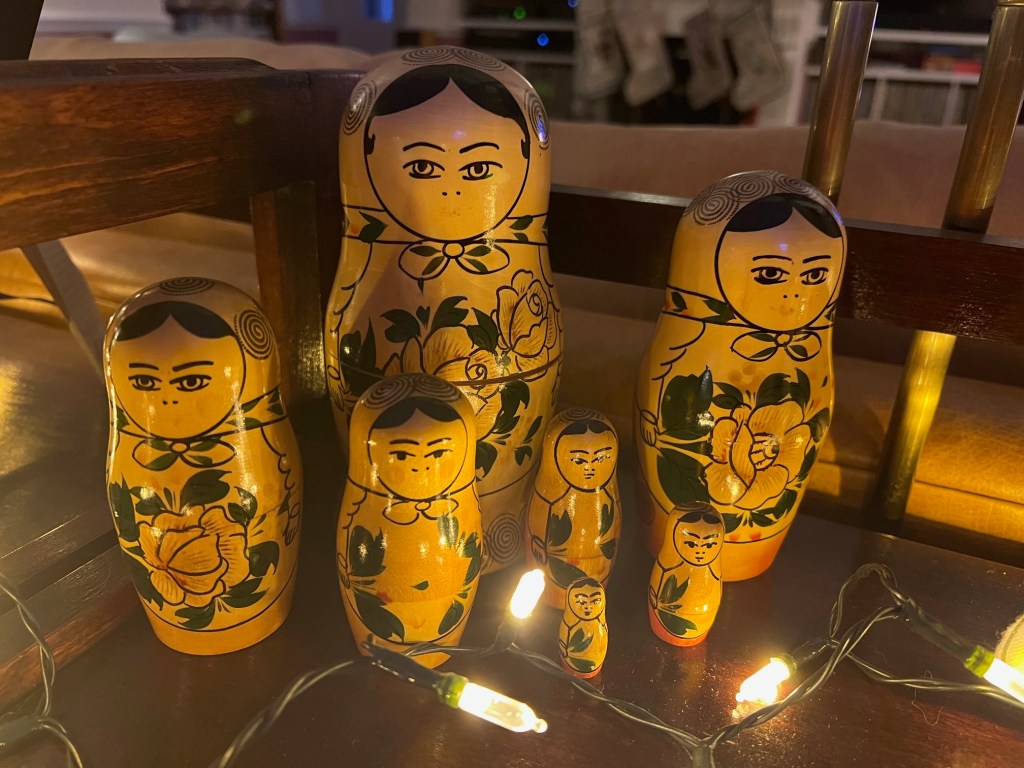
Set of 7 Russian Matroyshka dolls, also known as nesting dolls.  The dolls are shown here not nesting, but displayed amongst Christmas lights.

I had intended to do a proper post earlier this month, but typing and spending time at the computer is still difficult for me as my wrist and hand heal following a break at the end of September. Everything’s going well and mobility is returning; it’s just taking a lot longer than I had assumed it would – and involving a lot more broken nights and tired days.

So the planned post can wait, but I just wanted to drop in to wish you all a happy festive period.

I bought these Matryoshka dolls 37 years ago when I went to Moscow. They spend most of the year nested, one inside the other, but I always get them all out at Christmas and put them on display alongside a less traditional set of nesting Santas.

Some people call these Babushka dolls, the word meaning ‘grandmother’ or sometimes ‘old woman’ in Russian. I like to think of this set as representing me and my direct maternal line. If I’m the smallest one, the next one up is my mother, then my grandmother. After that comes my great grandmother, Jane; my 2G grandmother Margaret and my 3G grandmother Mary. The last two were born in Ireland. One record for Margaret indicates her place of birth was Derry (Londonderry) OR Newry, both in what is now Northern Ireland, but that was circa 1823 and, Irish records being what they are, I’ve never been able to place her birth, nor locate a marriage for her mother Mary and father Robert. This also means that the largest of these seven Matroyshka dolls is unknown to me, and I would dearly love to know her name – the name of my 4x great grandmother. Finding out more about this line is something that is permanently on my To Do List, but it would involve getting to know a whole new set of unfamiliar records, and there are always other research projects to be getting on with.

My children would laugh if they saw this post. They say I can turn a discussion on any subject into genealogy – I’m sure this is something a lot of you are skilled in too. 😀

And so all that remains is to set aside the genealogy, and to wish those of you who celebrate a very Merry Christmas and a Happy, Healthy and Successful New Year. I hope to be able to write my planned post in January.

Remembering the Battle of Holbeck Moor

One of my motivations as a genealogist and family historian is to uncover – and pass on – stories from the past. A recent unexpected turn of events brought about a merging of a story from 1936 with my own life in 2024. In this post I’m going to tell you about both of these stories.

On 27th September 1936, Oswald Mosley, leader of the British Union of Fascists, organised a rally in Leeds. Accompanied by 1000 Blackshirts, his twin aims were to intimidate the Jewish communities based in Leylands, an area just to the north-east of Leeds city centre; and to drum up support for fascism amongst the working classes. The first of these aims was thwarted when the Leeds Watch Committee forbade any march through the Leylands area. However, the wider demonstration was allowed to go ahead. The Blackshirts’ march commenced right in the heart of Leeds. They then crossed the river into Hunslet, through to Beeston Hill – where they were joined by Mosley – and on to Holbeck Moor. Here, the plan was, Mosley would deliver a rousing speech.

The choice of Holbeck Moor was no accident. Holbeck and the adjacent areas of Hunslet and New Wortley were industrial areas with smoke-belching factories and railways lines interspersed with row upon row of poor quality back-to-back housing. This was the tail end of the Depression, and Mosley believed he would be able to drum up support for fascist politics. However, upon learning of the intended march, anti-fascist political activists spread the word. The Jews in Leylands were warned, and the presence of whoever was able, was requested at Holbeck Moor. When Mosley and his Blackshirts arrived, 30,000 Leeds residents were waiting for them.

Newspaper cutting with heading 'Injuries & Arrests at Fascist Meeting'. There is a photo of Oswald Mosley in uniform surrounded by men, and a police officer behind him. Beneath the image are the words 'Sir Oswald  Mosley at the demonstration on Holbeck Moor yesterday - Sir Oswald Mosley Among the Hurt in Leeds'.
From the article in The Leeds Mercury on Monday 28 September 1936. Source: FindMyPast.co.uk

When my Mum was in her eighties she told me about the day she saw Oswald Mosley march onto Holbeck Moor.  She lived half a mile from there, and in fact hers was just the kind of family Mosley was targetting, since her father had been unable to find regular work for several years. However, he understood very well that his lack of employment had nothing to do with Jewish people living in other parts of Leeds. Remembering clearly the events of that day, my Mum described the hate written all over the faces of the young Blackshirts. Mosley, she said, hadn’t reckoned on ‘the men of Leeds’, who were waiting on Holbeck Moor, armed with stones and determined to prevent him from speaking.  

It was some years after my Mum’s death that I came across an online article entitled ‘The Battle of Holbeck Moor’. At the time I was researching the events of the Civil War in Leeds, and thought this might have been one of the local battles associated with that; but as I read, I realised it was the event my mother had attended. This, in fact, gave me a date, and I was able to work out that she had been just twelve years old at the time… I wondered if her parents had known she was there! 

The article gave me more details about the event. Perhaps my Mum had told me about some of them, and perhaps I had forgotten. I learned that Mosley used a van as a makeshift stage, but that every time he tried to speak, 30,000 voices roared out ‘The Red Flag’ to drown him out. Clearly, as a young girl standing at the back of the crowd my Mum wasn’t an active participant in the event. For her, its importance was the impact it had on her developing understanding of the reality of fascism – something with which, unfortunately, everyone in attendance would have nine more years to become better acquainted. Certainly, it was clear that, nearly 70 years later, she remained proud of the fact that Leeds had defeated Oswald Mosley.  I left a comment at the end of the article, saying my mother had been there, and that her recollection of the event many years later tallied with the account. Then I added the info to my timeline about my Mum’s life and thought no more about it.

In August this year I received an email inviting me to be part of a special reception at the unveiling of a Leeds Civic Trust Blue Plaque commemorating the Battle of Holbeck Moor. I had been traced from that comment written some years earlier, and would be representing my mother. I was so happy to be invited to do this, and made preparations for the trip. I would be accompanied by my nephew and my second cousin and his wife. I was asked to write something about my mother for the display, to be kept permanently at the West Yorkshire Archives, and to provide some photos. Having done all that, I was then asked if I would be prepared to make a short speech on the day.

The rather surreal nature of this turn of events was not lost on me: the idea that one day in September 1936 my mother, then aged twelve, witnessed ‘the men of Leeds’ turning back the leader of the British Union of Fascists, and that 88 years later, her own daughter would be standing on the same spot talking about her was quite overwhelming. My Mum was never a political person but she always had a strong sense of right and wrong, and she knew that hatred and scapegoating had no place in politics. In life she had rarely done anything to attract attention, but now I wanted her story to be known.

I was due to travel up to Leeds on Saturday 28th September, ready for the ceremony the following day. Instead, on Friday evening, while putting the finishing touches to my preparations, I fell and broke my wrist.

Four people holding a Blue Plaque commemorating the Battle of Holbeck Moor.
Leeds MPs Fabian Hamilton, Richard Burgon and Hilary Benn, with Sam Kirk from Stand Up To Racism. Photo: P Heppenstall

The event on Sunday 29th September was well-attended. The unveiling was done by three Leeds Members of Parliament. It all went well, but I was not there. I was mostly lying on the sofa, asleep. Even now, I’m typing this with one hand.

Group of people. One of the people is holding a Blue Plaque commemorating The Battle of Holbeck Moor.  Others are holding photographs of family members.
Representatives of families of some of those who were present at the Battle of Holbeck Moor on 27th September 1936. Photo: C & J Battensby

Several descendants of those present on the day had been traced, and were photographed together with photos of their family members. One of those represented had not attended the demonstration at Holbeck Moor, but was a Jewish pharmacist who gave First Aid to Blackshirts who had been injured by the stones. My nephew represented my Mum, his Grandma; and my speech was wonderfully delivered with his own twist by my second cousin. The two of them, plus my cousin’s wife, sent lots of photos and videos, and it almost felt like I was there. I was gutted to miss out on a Battle of Holbeck Moor cupcake!

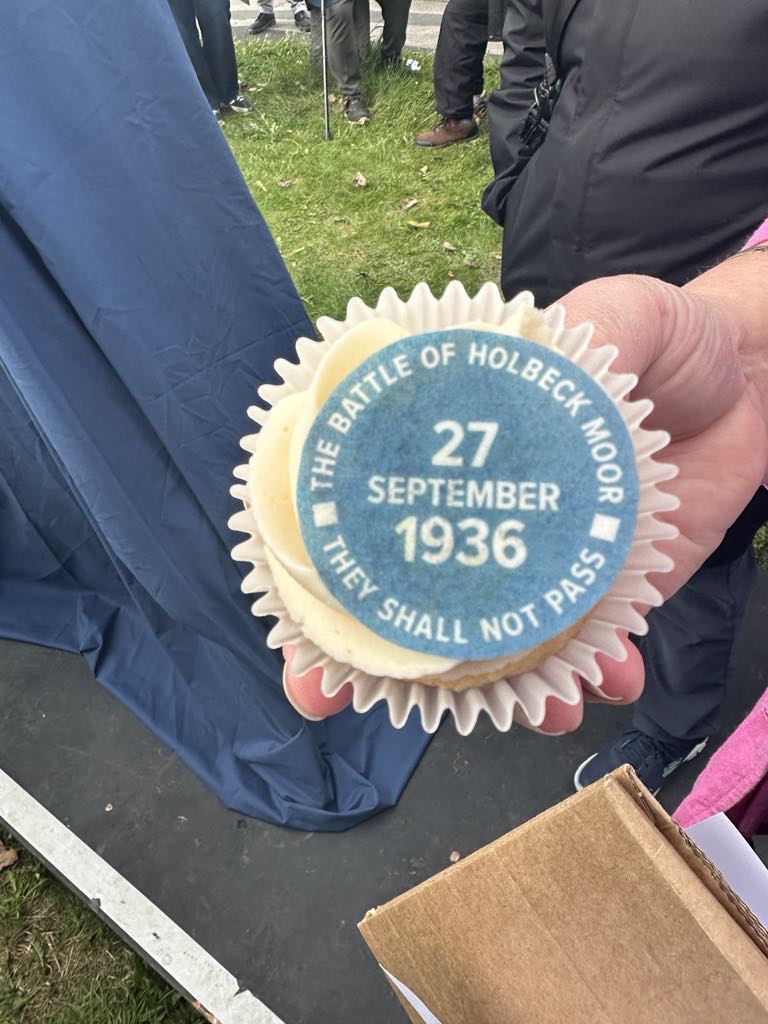
A cupcake featuring a 'blue plaque' decoration, including the words: 'The Battle of Holbeck Moor - 27 September 1936 - They Shall Not Pass'
Blue Plaque cupcakes were given out after the ceremony! Photo: C & J Battensby

Of course I was very disappointed to miss the event, but the important thing is that on that day my Mum’s voice, representing 30,000 others, was heard. She would be very surprised to know she also got a mention in the local press, on the BBC and in a number of national papers, including The Guardian.

The Battle of Holbeck Moor was not the only clash between Mosley and anti-fascist demonstrators. Exactly one week later, the far better known Battle of Cable Street in London’s East End took place. By coincidence, one of those anti-fascist demonstrators was a young man who, several decades later, would become my father-in-law.

All of this came about because several people, including myself, left comments online in response to articles about the events at Holbeck Moor of 27th September 1936. As a result, this story is now owned by more family members who previously were not aware of their own family connection. More than that, the inclusion of the stories of those who attended brings a personal dimension to the history. And surely, breathing life into those memories of ordinary people is what researching family history is all about.

Leave comments! Tell the stories! You never know where it might lead.

Starbotton

At the end of June/ beginning of July I spent a week in the Yorkshire Dales. We were based in Starbotton in Upper Wharfedale, which is the location of one of my two One-Place Studies. Although this was a holiday, not a research trip, we managed to fit in several places of importance in my family history, and I went off most early evenings for a walk around Starbotton.

I meant to write something about how it felt to be in this village I’ve spent so many hours thinking about, and how just being there moved on my understanding of the place. Then, one evening as I wandered around, I realised that sense of connection and immediacy would best be communicated through a short video.

What started out as one woman with very little by way of plan standing on a hill above a village and talking into a phone while recording a static scene… eventually turned into downloading video editing software, inserting additional images, creating intro and outro pages and finally launching a YouTube channel. The sound is a bit dodgy in places – it was windy and my phone doesn’t have one of those big fluffy microphone covers! – so I had to learn how to do subtitles too. I also made the mistake of recording in profile, but hopefully the extra images will compensate for that.

You don’t need a YouTube account to watch, but if you do, please give me a ‘Like’. I enjoyed the process very much and suspect there will be another video, so if you’re feeling kind and you have a YouTube account you might also like to ‘Subscribe’ to my channel – it’s all free of charge of course; it just means I’ll show up in your list if I publish something else.

Any constructive feedback would be much appreciated, particularly if you know about bitspeeds, frames per second and the like. Ideally, I need someone to tell me what settings I need to use for my exact phone model when I ‘produce’ the final version as an MP4. But that aside, here it is. I’m pleased with it, and hope you like it too. 🙂

Using wills to identify community networks

Diagram showing the networks provided by the Wills of three men in a small village in Wharfedale between 1693/94 and 1712/13, plus the Probate Register entry of another man.  The network seen through these documents includes a total of 36 people.

The ‘All About That Place’ event, as well as a short course I was doing at the same time: Progressing Your Local History Research (346) through Pharos Tutors, inspired me to start a couple of ‘One Place Studies’, and to register them with the Society for One Place Studies.

One of my studies, Starbotton in Wharfedale, focuses on the Early Modern period – roughly 1500-1750, although depending on the records available, it may end up homing in on just part of that period. Starbotton is part of the parish of Kettlewell and importantly, no parish registers for the period before 1698/ 1700 have survived. Although there are some Bishop’s Transcripts for the seventeenth century, survival of these records too is limited and patchy. This means I have no continuous register of any kind to use as a foundation for rebuilding the community of people in Starbotton before the last fifty years of my period of interest. The primary challenge will be to locate as many alternative sources as possible and then find ways to make them work together.

Prior to the Local History course my research in Starbotton had focused on my Simondson family. I already had Wills for three of the Simondson men who died between 1693/4 and 1712/13, plus the Probate register entry only for another, John, who died in 1705 and named Anthony as his executor. Christopher’s was a holographic Will, meaning a group of trusted family and friends gathered at his deathbed, helped him to organise his thoughts, and wrote up the document after his death, all of them signing to verify that the contents were the wishes of the deceased. The Wills of Lister and Christopher are accompanied by Inventories, which are also signed by everyone involved in that process.

Something I had previously noticed – both here and in another small village where I’ve accessed quite a few Wills – was the sense of community evoked through all the people involved in the Probate process – witnesses, executors, the men doing the inventory, bondsmen and so on – and that’s in addition to the named beneficiaries. They all pulled together to help each other at this time of need, and to ensure the wives and children were properly cared for.

With this in mind I decided to ‘map’ the network created by the three Simondson Wills, plus John’s Probate Register entry. Every fact, and every single person shown on the network chart at the top of this post came from a close reading of these Probate documents. I do have some additional information about some of the people, gained from other records. For example, it is Thomas Simondson who is my direct ancestor, and I have more information about him and his family, but his Will does not seem to have survived. I was surprised to find that, excluding beneficiaries, there were twenty people involved in this network-mapping process: nineteen men and one woman. Adding in the named beneficiaries brings the total to thirty-seven: eleven women/ girls and six men/ boys are named beneficiaries. This younger generation will make my job a bit easier since most of them undergo some religious rite or other that brings them into the period of the surviving parish registers.

Homing in on householders though – which in itself would be a great step forward – these Wills have given me a LOT of information about the village community. I do recognise most of the surnames and in some cases the first names too. Comparison with a transcript of the 1672 Lady Day Hearth Tax return, and also with a list of churchwardens from all available Bishop’s Transcripts indicates that most are from the parish. However, the parish includes Kettlewell as well as Starbotton, so there is still work to do in trying to separate out the two.

A person’s ‘community’ is not necessarily restricted to his or her village. In addition to the village community there will be wider networks too, based on friendships, marriages, worship (e.g. Nonconformists in rural locations would have a geographically wider network), business, market days, and so on. Based just on my Simondson family, I know that they had family connections throughout Wharfedale and into what is now Lancashire too. This also seems to me to be part of the history of a Place: where were the wider networks and connections? What were the reasons for this? And was it different for people from different social levels?

I’ve now located about ten more Wills for the same period for other testators living in Starbotton and will gradually collect and transcribe these, looking for overlaps, and comparing the findings to other records known to be for residents of Starbotton.

Not such ‘little’ lives after all…

One of my great grandfathers, George, was adopted. This was in the 1860s, so it was an informal arrangement and the couple who took him in were his biological father’s older sister and her husband, whose name was Feargus.

Feargus had a middle name: O’Connor; and although I was new to genealogy at the time of discovering all this, I already understood enough to know there was a strong likelihood that this was a maiden name, probably from his mother’s side and probably the two names indicating an Irish connection. However, following back Feargus’s mother’s and father’s lines for a few generations, I could see they were solid Yorkshire stock. No Irish, and no O’Connors. It was a mystery.

The solving of the mystery, when it came, was from a surprising source. But before going onto that, I want to tell you something about Feargus’s parents.

They were nail-makers, and they lived in the village of Hoylandswaine, not far from Barnsley. I found a little book published by the Barnsley Family History Society: The Nail-Makers of Hoylandswaine, collated and compiled by Cynthia Dalton. It includes not only the history of nail-making in Hoylandswaine, but a description of the life, together with potted biographies of the nail-makers recorded in the censuses. I learned that the life of a nail-maker was a hard one. Some had their own forges and worked as a family unit; others rented space in someone else’s forge; and yet more worked for a nail master on his premises.

Click here to see a surviving Hoylandswaine nail forge, now a museum.

Usually, the men started work at 6am, and might keep going until 10pm, with breaks only for meals throughout the day. Pay was low, and since some of the nail masters were also the village shopkeepers or inn-keepers who couldn’t resist squeezing a little extra profit from their workers, payment may have been made in the form of provisions from that other business. Women did the work too, for less money, and alongside taking care of the house and children.

Hoylandswaine nailers go rat-a-tat-tat,
On thin watter porridge, and no’ much o’ that

Anon. (In: Cynthia Dillon: The Nail-Makers of Hoylandswaine)

It seemed a very small life: long hours of repetitive work, isolation, hardship, trapped by low wages and unscrupulous employment practices, and no power to change any of that. I wondered what time was left for enjoyment, or if life was one long slog from beginning to end; and then I set aside Feargus’s family and moved on to other lines.

It was years later – early 2019 – when the riddle of Feargus’s Irish connection was solved. It came while I was reading John Waller’s The Real Oliver Twist – the true story of pauper apprentice Robert Blincoe. Part two (p.79) begins with a quote – and I gasped when I saw the name:

‘Scores of poor children, taken from workhouses or kid-napped in the streets of the metropolis, used to be brought down by […] coach to Manchester and slid into a cellar in Mosley Street as if they had been stones or any other inanimate substance.’

Feargus O’Connor (1836)

I looked him up… and realised I had known Feargus O’Connor all along – I learned about him in ‘A’ Level history at school, and in view of the Leeds connection (below) we would have spent some time on him, but my brain had mostly opted to remember the activities of ‘Orator’ Hunt.

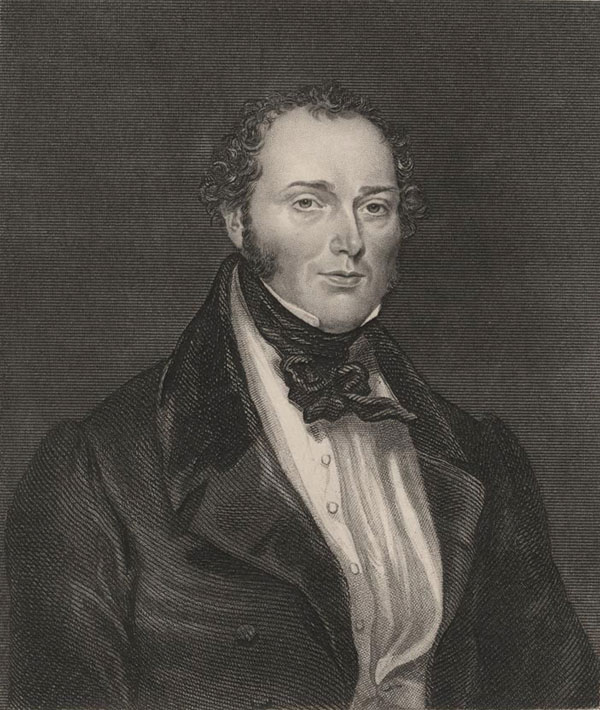
Stipple engraving portrait of Chartist leader Feargus Edward O'Connor.
Feargus Edward O’Connor (c.1796-1855)
Stipple engraving portrait by unknown artist
Source: Wikipedia. This file has been extracted from another file, Public Domain

Feargus Edward O’Connor was an Irish landowner and lawyer, elected as M.P. for Cork in 1832. (Ireland was part of the United Kingdom, so his seat was in Parliament at Westminster.) In 1835 he was re-elected but disqualified on the grounds that he had insufficient property to qualify as an M.P. (although it seems that was not so). It was from this time onwards that he began to agitate for radical reform in England, speaking at rallies and meetings and emerging as the leader of the Chartist cause. He campaigned for the ‘Five Cardinal Points of Radicalism’, which would later be five of the six points embodied in the People’s Charter. In 1837 he founded the radical Northern Star newspaper in Leeds; and then in 1840 was arrested for sedition, serving fifteen months in York Castle gaol.

1840 was the year my adoptive great great grandfather was born. His parents’ choice of name – Feargus O’Connor Heppenstall – speaks volumes. It turns out they did know the conditions in which they were working were unjust. They could imagine a better life. And what’s more, they knew of developments throughout the country and the movement for change; and through the work of Feargus O’Connor, they saw a way to achieve that. It turns out their lives were not so little after all. They were fighting for a better world at a time when that was much-needed; and I am proud of them.

In fact my tale is awash with Feargus O’Connors, all of them in Leeds. As a young man my adoptive great great grandfather Feargus made his way to Leeds and became a butcher. His adopted son, my great grandfather George, would go on to name his own first son Feargus O’Connor Heppenstall too, although I don’t think George was a political man, and believe this was a tribute to the man he considered his father rather than to the Chartist leader.

The original Feargus O’Connor was not a man without controversy. Undoubtedly charismatic, he was admired for his energy and powerful oratory, but also criticised for advocating physical force if necessary in order to achieve his goal of universal male suffrage. In this, he went further than the moderate line taken by other Chartists.

I was reminded of all this last week, while watching videos recorded by experts for All About That Place. One such expert was Mark Crail, who has a website and a blog about Chartist Ancestors, as well as a separate website about Trade Union Ancestors. There is also a page dedicated to the Six Points of the People’s Charter. Some of the articles focus on Chartism in different parts of the country; some on leaders. There are quite a few blog posts dedicated to Feargus O’Connor’s life and work. If your ancestors were in the industrial heartlands during the nineteenth century, or if you know they were active in the Trade Union movement, you might be interested to explore these sites.

This is what I love about family history. The most ordinary seeming people can have surprising stories to tell if you delve a little deeper. It is through these stories that we can learn about the lived experiences of people in different places, classes and at different times throughout our history.

Do you need to buy the Civil BMDs?

Civil Registration of Births, Marriages and Deaths (BMDs), together with the districts, offices and officers required for the administration of the new system, was introduced on 1st July 1837. In theory, these life events of any ancestor or family member born after that date, or if they’re older, marrying or dying after that date, should have been notified to the appropriate local office and recorded by the state. That said, registration was not actually mandatory until 1875, and in the early years there was confusion. People were used to registering births (or baptisms), marriages and deaths (or burials) with the church, and it took a while for some to realise they now needed to register at a government office. However, certainly by 1875 everyone should have been registered using the appropriate channels, and the civil BMDs are an invaluable resource for anyone researching their family history.

But does that mean we *need* them? Let me explain my thoughts.
As genealogists we start with what we know and we work backwards. The period leading back to 1837 is the easier part, when we can compare and cross-reference family members listed on the censuses and the 1939 Register with the civil records of Births, Marriages and Deaths and probably Baptisms, Marriages and Burials within the parish church. Obviously, then, this is where we start as beginners, and where we make our mistakes. One thing I’ve noticed, over the years of seeing posts from inexperienced researchers online, is an assumption that it’s necessary to buy all the certificates. That’s a huge outlay. If we exclude ourselves and our parents but include all other direct ancestors born or still living after 1837, this could amount to 4 grandparents, 8 great grandparents, 16 GG grandparents and maybe 32 GGG grandparents. That’s 60 ancestors, each with perhaps a birth certificate, one or more marriages, and a death certificate… possibly as many as 150-190 certificates to buy at £11 each (or £7 if a PDF is available). That’s £1650 – £2090. If we wanted to add in the records for all children born to our direct line, the cost would be astronomical. Taking one of my grandparents as an example, I counted back all direct ancestors and children born to them after 1837: one hundred and eleven people. Times that by four to get a rough estimate for all my grandparents, and that would be four hundred and forty four people, all with births, deaths and maybe marriages. There’s no way I could have justified that outlay.

We need to work out alternative ways of getting the same, or most of the same, information. Our starting point, then, should be to know what information is on each historic certificate.

Civil Birth Certificate
This includes:

  • Registration District, Sub-district and official reference numbers
  • Where and when born
  • Name (if decided at time of registration)
  • Sex
  • Name and surname of father
  • Name, surname and maiden surname of mother
  • Occupation of father
  • Signature, description and residence of informant
  • When registered
  • Signature of registrar
  • Any name registered after registration

Civil Marriage Certificate
This includes:

  • Registration District, Sub-district and official reference numbers
  • Where solemnized
  • When married
  • Name and surname of bride and groom
  • Age of both
  • Marital condition at time of marriage (bachelor, spinster, widowed)
  • Rank or Profession of both
  • Residence of both at the time of marriage
  • Father’s Name and Surname of both, together with fathers’ Rank or Profession

Civil Death Certificate
This includes:

  • Registration District, Sub-district and official reference numbers
  • When and where died
  • Name and surname
  • Sex
  • Age
  • Occupation
  • Cause of death
  • Signature, description and residence of informant
  • When registered
  • Signature of registrar

Do we need all this information? Is it available anywhere else?
As a beginner I realised that my primary need was to move my research back in time, while ensuring I had the right people… alongside the need not to bankrupt myself! Therefore at that stage I could dispense with cause of death, for example, but I did need to know the parents’ names to help me move backwards and ensure I had the correct people. So here are a few examples of certificates I did buy, and others I didn’t, on the basis that I could get the information I needed from other documents, and other information was not yet essential to my needs.

Church of England marriage registers – the information on these is exactly the same as on the civil marriage certificate. If digital images of the original CofE parish register is available online via your genealogy website of choice, then you don’t need to buy. In fact, the parish register entry is better, because you will definitely see the couple’s signatures (or marks), and signatures could be used later for comparison with other documents. The only civil marriage certificates I have ever bought are those from Catholic churches (which unfortunately are still not widely available other than via the actual parish administrator or occasionally via local record offices), another that was solemnised in a Nonconformist chapel, and one other marriage for which I could find no digital images of the parish register available online.

Births – If you know the mother’s maiden name and if you have census returns showing all children of the family and their places of birth, you will probably be able to find all the births on the GRO Online indexes. You may also find some additional children who never made it to a census. The online index doesn’t give the actual date of birth; rather it gives the ‘quarter’ in which the birth was registered: M quarter being the three months ending March, J quarter being the three months ending June, and so on. As a beginner this may be sufficient for your needs, particularly for siblings of your ancestor. That said, you may find the additional information elsewhere. The 1939 Register includes the actual date of birth (for some reason it is often a year out, but the day and month are correct). You may also find more information on a baptism register entry: along with child’s name and date of baptism there will be both parents’ names, abode, father’s occupation and possibly the date of birth. A newspaper announcement of a birth will also give some of this information. In these early stages, where I did buy a birth certificate, this was to solve a puzzle. I bought one before the mother’s maiden name was included on the online index and I couldn’t find a marriage using only the father’s surname. (I still have never found the marriage.) Another was purchased because there was some intrigue surrounding the child’s actual birth parents (by the age of five he was informally adopted by another couple). Another, again, because of the inaccessibility of Catholic parish registers, and so on. If I could find almost all the information by other means that was acceptable.

Deaths – again, you can often narrow down the death to within a few months using the GRO Online indexes. Alongside the quarter and the registration district, the inclusion of age at death can help you to distinguish between deaths of other people of the same name – although we do need to allow for a little flexibility since the age is provided by the informant who may have guessed it. After 1858, you might also find the actual date of death and other useful information from the National Probate Calendar (without the need to purchase the Will, although at only £2 for a digital download I would get the Will anyway). What I really love, though, is a good municipal cemetery register. For example, my 4xG grandmother’s entry in 1860 at the York Fulford Road Cemetery (freely available on FamilySearch) gives her name and age at death, date of death, date of burial, the name of her husband and his ‘rank, trade or profession’, their residence, cause of death, the name and details of the informant and the officiating minister. Why on earth would I need to buy the death certificate?! This is the best register I’ve ever come across, but others come fairly close in terms of information recorded.

Again, even in my early years, there were times when the information I could get from the GRO index and the burial record wasn’t enough. For example, the death of a small boy with the very unusual yet exact same name as someone else in my tree, but in a completely unexpected location could only be confirmed as my family by the purchase of the civil death certificate. His sad death at such an early age also gave me additional information about his parents – that they had spent a short period in the early years of their marriage in a different county.

More advanced reseachers are likely to have different needs
All of the above relates to the nuts and bolts of building our family trees back to the introduction of Civil BMDs. There is no doubt that the information on each of the certificates will give us something useful to enable us to do this, but given the cost of each one, the goal so far has been to try to find that information elsewhere, even to go without a little information at this stage if most of it can be found using other documents.

As we progress, our needs change. Research becomes less about the nuts and bolts and more about the ‘family history’, or the stories of our ancestors’ lives. I will never need to buy the death certificate for that 4x G grandmother, or any of my other ancestors and wider family in the York Fulford Road Cemetery, but on occasion I’ve bought certificates for other individuals simply out of curiosity about their story. For example, the husband of a great aunt whose service record indicated he suffered a ‘severe shell gas wound’ in 1918 and who was not remembered with much love by wider family members. I read that many of the men who survived mustard gas attacks went on to die of tuberculosis, generally before or around the time of the outbreak of WW2. I could see that this person died in 1935 and wondered if TB was the cause. It seemed to me part of his story, an explanation perhaps for his behaviour, and part of the wider story of my own grandparents. So this was one of the certificates I bought more recently. Another story that intrigued me was the death six months apart of two GG grandparents, resulting in the orphaning of their large family and my own great grandfather being brought up in the workhouse from the age of six. I bought their death certificates just to find the two causes of death. Conversely, I’ll shortly be visiting the archives where microfiche copies of the Catholic registers for lack of availability of which I’ve already bought civil certificates. From these registers, I’ll be hoping to get names of the sponsors, which may help to broaden out my understanding of any other family members that came with these ancestors to England.

There are of course other examples like these ones, where I’m prompted by completion of ‘the story’ to buy the certificates, but in general I’m still of the ‘keeping costs to a minimum’ mentality. If you’re fairly inexperienced as a family history researcher I hope this has helped give you some pointers. If you’re an old hand it would be interesting to know how this compares with your own practice. Have you any examples of nuggets found in a unexpected source? Or perhaps of how eventually buying a certificate solved a mystery or completed a story? Do leave a comment!

New Year, New Goals!

Hello everyone, and Happy New Year! I hope the festive period was happy, enjoyable, peaceful, comfortable – warm! – or whatever it was you needed.

I decided today to talk about setting goals for our family history research. I’m not talking about anything wild and vague, as often seems to be the case with New Year’s Resolutions, but I do always think of New Year as a fresh start, so for me this seems like a good time to be focusing on goals and how to formulate them so that they’re useful and achievable.

Let me illustrate with an example from my own family tree.

I have a brick wall at one of my 4x great grandfathers: William Moss, who married in Northallerton, Yorkshire in 1800 and died, also in Northallerton, in 1827. So far I’ve used only online records to research him. I could set myself a goal that ‘This year I will break through my brick wall with William Moss’. But, well… maybe I will and maybe I won’t. It depends on how much time I can give to it, of course; but more importantly, if further records relating to his life simply don’t exist, or are hidden away in a private collection then the chances are I will not succeed in this lofty goal. It’s better, instead, to express my goal as an objective, and to indicate a series of steps I will take to move towards this goal.

Let’s start with what I already know about William.

  • His burial record at Northallerton in November 1827 gives an abode of Northallerton and an age at death of 57. If correct, this indicates a birthyear of about 1770. Of course, it might not be correct, but it’s a starting point.
  • William married Elizabeth Bumby at Northallerton in January 1800. The record indicates that this was a first marriage for both parties, and that both were of the ‘parish and township’ of North Allerton. If the birthyear of 1770 is correct, this would indicate an age of around 29 or 30 for William at the time of marriage. Elizabeth, whose baptism is known, was about 24.
  • The marriage was by Licence. Since these had to be paid for, this generally indicates some at least minimal degree of wealth. William signed the register in a confident hand, as did five witnesses. Elizabeth made her mark.
  • I have found only one child for the couple: William, who was born 4 January 1801 and baptised at Northallerton two days later. The entry in the baptism register indicates that William senior is a blacksmith. This connects with what is known about Elizabeth, who comes from a long line of blacksmiths, but based in Thirsk, about 8 miles away. Elizabeth’s uncle, also a blacksmith, was one of the witnesses at the couple’s marriage in 1800.

That’s it.
Let’s now turn this into a ‘Research Objective’ with an action plan:

Research Objective: To carry out further research into the life of William Moss, born circa 1770, parish unknown; died November 1827, Northallerton, Yorkshire, with a view to finding his baptism and parents

  1. Carry out page by page examination of the Northallerton baptismal register (digital images of original records available online at FindMyPast in the record set Yorkshire Baptisms) from 1801 to 1820, with a view to locating any additional children born to William Moss and Elizabeth née Bumby.
  2. Purchase William’s will, probate 1828, together with additional probate documents, located via search on FindMyPast. Examine for any additional information about William, his family and his place of residence.
  3. Contact Borthwick Institute for Archives regarding availability of marriage licence. This may include an age for William. If age given is 29-30, this reinforces the age given at death. Examine for any additional information not included on transcript. (Note point 11 below – possibly Marriage Licences will comes under the diocese of Durham.)
  4. Carry out wider search on FindMyPast for William Moss plus variations, using birthyear of 1770 +/- 10 years, with gradual increases in location starting with Northallerton + 5 miles, then 10 miles, then 20 miles. Note locations of Moss surname within these areas, even if there seems to be no baptism for William.
  5. Note also that William junior (b.1801) married in Kingston upon Hull in 1823 (also by Licence). Could William jr. have relocated to Hull for an apprenticeship? Note that the 1823 Licence gives William jr’s occupation as ironmonger, which clearly has connections to the father’s trade of blacksmith. Might William senior and Elizabeth also have moved there for a period of years? By September 1824 (baptism of first child) William jr and his family have returned to Northallerton, where they remain until some time after the death of William senior (who is buried on the same day as the baptism of his son’s third child.) Therefore the possibility of a family removal en masse is consistent with this (even if unlikely) and wider connections to Hull may also be explored.
  6. If William senior’s will indicates any further children other than son William, searches will be carried out for their baptisms.
  7. At this stage (at the time of writing this plan) progress is delayed pending arrival of the 1828 Will and information about the survival or otherwise of William and Elizabeth’s 1800 Marriage Licence (awaiting reply to email). However, further investigation of a more general nature can be carried out as follows:
  8. Northallerton was a parliamentary borough/ constituency from 1640. However, there is no mention in Gibson & Rogers Poll Books finding guide of the survival/ whereabouts of any Poll Books from the period prior to 1832 specifically for Northallerton. Initial investigation indicates that in Northallerton the right to vote was vested in the holders of burgage tenements, of which there were roughly 200. Might William senior have had the vote, and might any Poll Book entry provide further information regarding his residence? (Awaiting email response from North Yorks Record Office).
  9. As a Borough, might there be any Apprenticeship records? Might William senior have completed an apprenticeship in Northallerton? Or perhaps in nearby Thirsk, where his wife Elizabeth was born and raised, and many of the family are blacksmiths? Equally, might William junior have completed an apprenticeship in Northallerton or in Hull? What records exist for these three boroughs, and if any exist, how much information is provided about the apprentice’s father?
  10. The Manorial Documents Register (MDR, National Archives) indicates seven manors for the parish of Northallerton. Can a map be located to show the whereabouts of each? Can any of them be discounted as a residence for William senior, based on information on marriage record that his residence was in the ‘parish and township’ of Northallerton? (Awaiting email from North Yorks Record Office). It is noted from the MDR that most manors have a good collection of surviving records including some that could help to locate William in the township. However, the Northallerton Borough Manor records unfortunately end in 1635. No further investigation to be carried out until receipt of information from Record Office.
  11. It is noted that for some aspects of the Church of England administration, Northallerton and the former Allertonshire were part of the diocese of Durham rather than (as expected) York. Clarify which aspects, and (bearing in mind that all records so far identified as relevant to this family are lodged with North Yorkshire Records Office and Borthwick, York) whether any record sets of potential use might be found still at Durham.
  12. Only one trade directory has been located for Northallerton for the period of William senior’s known life in that place: Baines Directory of 1823. William is not included. Might any other directories have survived? In 1823 William would have been about 53 and therefore expected still to be working as a blacksmith.
  13. The GENUKI page for Northallerton has been located, also the FamilySearch page and the Northallerton page of Parishmouse Yorkshire. These will be examined for any further information.
  14. A dedicated Family History Society has so far not been identified. However, the Northallerton & District Local History Society has a website and contact details.

So that is my research objective and action plan to date. Much of it has already been set in progress and at the present time I’m awaiting information in the form of William’s 1828 probate documents, and replies to several emails. I’m unable to do more until I have that information and (I hope!) can gather further clues.

The next stage, after all of the above has been worked through, will be a visit to the North Yorkshire Records Office, which is in Northallerton. However, that would would involve a very long journey, and while working on the above I realised I have a few other ancestral lines in the North Yorkshire area, also requiring some attention. It would make sense to work on each in turn, researching the local history, jurisdictions, availability of records and so on, and preparing a detailed action plan for each for a visit to the archives, probably in 2024. This timescale allows for a thorough yet leisurely approach, and a few days in Northallerton would be very nice!

By approaching goals in this way, refining the plans as required and making notes on findings, the time is not wasted even if our ancestors’ origins are not ultimately found. It will not be a failure. At the very least in doing this we’re eliminating avenues, familiarising ourselves with what records are available and hopefully gathering a little more information. New record sets are being made available online all the time, and perhaps at some point in the future something new will turn up, and a quick refresher with notes made now could enable that new information to slot easily into place.

What about you? Have you set yourself some New Year goals for your family history research? Is there a brick wall you’d love to smash? How are you approaching it? If you haven’t previously tried setting out your goals as objectives with detailed step-by-step plans, I hope the above helps.

Here’s a to a successful year – genealogical and otherwise – for us all.

The Family Tree

Bare branches hung with Christmas baubles, lights and tiny framed photos

This month sees a sort of completion – well more of an off-the-starting-blocks, really – of a long-thought-of project: my Christmas ‘Family Tree’. I’ve had this in mind about fifteen years, ever since I bought three Victorian style photo frames for hanging on the tree. Back then the idea was to put them on my main Christmas tree, and use them for three beautiful photos of my grandma and great grandmothers. I don’t know why it took me fifteen years to do it… Anyway, during this last year the plan expanded and I’ve been seeking out suitable little frames online. I didn’t want to use the standard ‘Christmassy’ photo frame tree ornaments. I really wanted them all to be ‘of the period’ for the photo they would contain, and since they are harder to find than you might imagine, to date I have only eleven. That said, I’m very happy with how it looks, and already have plans for more frames and photos from both sides of our family. It makes a lovely addition to our Christmas decorations.

I’ll be taking a break over the Christmas and New Year period but wherever you are, I wish those of you who celebrate a Happy Christmas, and to everyone a very happy, healthy and successful New Year.

The Western Front

Original World War 1 trenches on land surrounded by trees

It has become my tradition to focus on military ancestors for my mid-November post.  Today’s post continues that with the topic of trench warfare, which has become almost synonymous for us with The Great War and the Western Front.  Not all our military ancestors and family members were killed in action, and the topic of trench warfare gives us an opportunity to broaden our gaze and think of others who, although they returned home safely, suffered unimaginable terrors that often blighted the rest of their lives.

By 1914, advancements in ammunitions and artillery meant the mass infantry assaults of former grand battles were no longer an option.  Although field works and trenches had been used for centuries in military campaigns, they now came to the fore as a means of defence. They became longer, stretching out along entire fronts, and deeper – ideally about twelve feet deep. Their zig-zag construction prevented the enemy, should they access the trench, from firing along for more than a few yards. Typically, there would be several trench lines, each running parallel to the next, and connected by communications trenches. Hence the ‘front’ could extend up to a mile behind the first, or ‘outpost’ trench. It was through the communications trenches that food, ammunition, orders and indeed troops were delivered; also letters to and from home.

The distance between the opposing sides could be surprisingly narrow – sometimes as little as about thirty yards, but it could be as much as 250 yards. Between them was ‘No Man’s Land’, where coils of barbed wire were positioned as a means of slowing down the enemy, should they attack. If you’ve watched War Horse, you may remember that Joey the horse becomes tangled and seriously injured in the barbed wire as he runs to escape from the explosions and noise.

Although trenches gave cover for both sides, they also made for a long, gruelling war of attrition.  The point was to push forward your own front by gaining control of the enemy’s trench system. This meant daring and deadly attacks, forcing men to go ‘over the top’ of their own trench’s parapet, and run across No Man’s Land towards the opposing trench. An element of surprise was preferable, but the intense artillery bombardments generally preceding such raids gave the heads-up to the enemy that attack was imminent. This gave them time to bring up reinforcements and increased the likelihood of heavy losses for the attackers.  What’s more, land gained in an attack could be lost again in future enemy raids.  The hundred days of the Third Battle of Ypres (Passchendaele) for example, resulted in a gain for the British front line of just five miles.  The cost of those five miles was almost six hundred thousand lives, between the two sides.

These photographs were taken in 2014 at Sanctuary Wood Trench Museum (Hill 62) near Ypres, Belgium. The trenches are original, just as the farmer found them when he returned to reclaim his land at the end of the First World War, although there has more recently been work to preserve them. This is just one section of the trenches on the land – there were more. The photos show the zig-zag layout and the depth of the trenches. Visitors can walk in them – although I can guarantee that the experience of doing so will bear no comparison with that endured by our ancestors more than a hundred years earlier.

Original World War 1 trenches on land surrounded by trees

Reading through the Battalion War Diary for the Prince of Wales´s Own (West Yorkshire) Regiment: 49th Division, in which one of my great uncles was serving, the routine seems to have been roughly one week on the front line, one week off.  Away from the front, days were spent cleaning, drilling and training, relaxing, playing sport, and marching to new positions as required.  In the trenches it was a different matter.  Dysentry, cholera and typhoid fever were common, and trench conditions also attracted rats which got into the men’s food and nibbled at them when they were sleeping. Lice were prevalent, and constant scratching increased the likelihood of contamination of skin abrasions by lice faeces, resulting in trench fever. Also common was trench foot, caused by constant immersion of the feet in the dank, muddy water in the bottom of the trenches during and after heavy rainfall. While painful, this is preventable and treatable today, but during the conditions in the trenches in 1914-1918, the dead tissue often spread across one or both feet, sometimes requiring amputation.  Similarly, frostbite could result in the loss of fingers or toes.

Even without enemy action, there was always the possibility of it, and the stress caused what we now know as PTSD but was then called ‘shell shock’, as well as a type of gum infection called trench mouth.  In his War Diary entry for 29th July 1917, Lieutenant Colonel Charles Harold Tetley (again, West Yorks Regiment, 49th Division) wrote ‘Nothing to report – Steady shelling all day by both sides’.  I have tried to imagine how far from ‘normality’ conditions must stray for the one to equate to the other.

That same great uncle had a narrow escape when, following German deployment of mustard gas shells, men in his counterpart Battalion suffered such severe mustard gas effects that hundreds were evacuated to England and the land itself was rendered too dangerous for further activity. The goal of a mustard gas attack was not generally to kill but to harass and disorientate; only 2-3% of victims actually died. However, many who didn’t die were nevertheless scarred for life. Respiratory disease and failing eyesight were common post-war afflictions, and many eventually died of tuberculosis. 

It almost makes one feel that those whose lives were taken were the ‘lucky’ ones – luck being a relative concept in this scenario. I think we owe it to those who returned and were ‘changed’, to try to understand what they experienced. I know I would not have been one of the brave ones.

Section of original World War 1 trenches showing muddy water collected at bottom of trench

Sources

Kirk, Andrew, Leeds Rifles: The Prince of Wales’s Own (West Yorkshire Regiment) 7th and 8th Territorial Battalions 1914-1918: Written in Letters of Gold. 1917. Pen & Sword, Barnsley.

UK, WWI War Diaries (France, Belgium and Germany), 1914-1920: Prince of Wales´s Own (West Yorkshire) Regiment: 49th Division: Piece 2795/1: 1/7 Battalion West Yorkshire Regiment (1915 Apr-1919 May)

‘A Crysome child’

On 22nd August 1702 the child of one of my kinsmen was buried. The entry in the parish register reads ‘A Crysome child of George Lucas of Woodhouse Carr’. I imagined George going to the church and speaking to the vicar: ‘What is the child’s name, Mr Lucas?’ With a long sigh and a weary shake of the head, I could hear George replying: ‘Ayyy… it were a crysome child, ‘ardly drew breath before it were tekken…’ I took the entry on the register to mean that the baby had died even before George and his wife, Ann, had named him or her, and thought it a rather quirky find, that the vicar had recorded those words: a crysome child. I added the baby to my tree with the name A Crysome Child Lucas.

Well, I was partly right. And mostly wrong. It didn’t help that the entry was spelled ‘crysome’, which – look it up in any dictionary – means ‘characterised by crying or weeping; tearful; lamentful’. This was surely a frail, weak baby who was clearly in discomfort.

But it turns out that what the vicar should have written was ‘chrysom’ or maybe ‘chrisome’. The precise spelling varies, but the ‘h’ was important.

A chrysom (or chrisom) cloth was a white cloth or mantle. Symbolising purity, it was thrown over a child during baptism or christening. The cloth was annointed with ‘chrism’ – consecrated oil – and its practical purpose was to protect the oil from being accidentally rubbed off.

Part of a memorial monument showing three chrisom swaddled babies.

The image shows part of a monument to Thomas Selwyn 1546-1613, and his wife Elizabeth (Goring) of Friston Place. The full monument shows the two of them kneeling at a prayer desk, beneath which are three chrisom swaddled babies, all boys. Source: Wikipedia: Chrisom.

The baby’s family retained the chrisom cloth for one month after the baptism. This coincided with the mother’s return to society after giving birth. Today, the ‘churching’ of women is viewed as a thanksgiving and blessing for the delivery of the child and the mother’s survival, but until 1552 there was a purification element to this. Helen Osborne (Our Village Ancestors, p.30) writes that the baptised child would continue to be covered by the cloth until the mother was churched. For any baby dying during this period the chrisome cloth would be used as a shroud, and the baby would be termed ‘a Chrisome child’.

It follows from all of the above that a baptism was not the planned, family event into which it has since developed. Almost certainly, the mother would not have been present, since she would be temporarily away from society. Where the vicar also recorded the birthdate, it is clear that until the eighteenth century, babies were baptised as soon as possible. According to FamilySearch: Birth-Baptism Intervals, studies have shown that in the sixteenth century baptism was normally no more than a week after birth. However, from the mid-seventeenth-century onwards the interval gradually increased, one study for the period 1650-1700 indicating 14 days before 75% of children in the register were baptised. That said, I have several records from my own research clearly showing early 19th century babies being baptised on the day they were born. It was important, since tiny babies often died; and only a baptised child could enter the Kingdom of Heaven.

But back to 1702, and to George Lucas and his ‘crysome child’. Whilst preparing this post I googled the term with that exact spelling. One of the items returned was a Thoresby Society transcript of the Leeds Parish Registers, opened at page 180. That’s the parish where George buried his baby. On that page alone five ‘Crysome’ children were buried. Four more on page 179, five on page 178, and so on, all the way back to page 169 where the entry for George and his baby are to be found. That’s a lot of fathers to have the exact same conversation with the vicar about their own recently born, sickly, deceased child…

In fact the term ‘Chrisome’ (various spellings, but remember the ‘h’!) had come to be used for any baby dying before baptism. This puts a different spin on all those entries in the Leeds Parish Register. (None of this is restricted to Leeds, by the way; it’s just that this seems to be the only place where the ‘h’ is omitted in the records, resulting in ‘crysome’.) It made me think about the term ‘Christian name’, which was historically a religious personal name given on the occasion of a Christian baptism. Bearing in mind the church’s dual role in this respect – to baptise the child into the church and also to record the existence of an individual in accordance with the requirements of the state – there is the possibility of a punitive aspect to the recording of a child who has not been baptised, and therefore officially and religiously has no name, as merely ‘a Chrysome child’. We might assume any child so recorded is unbaptised, since a baptised child – even if a Chrysome child in the sense of dying within a month of baptism – would be recorded with his or her own Christian name. It seems comparable to the recording of a child born out of wedlock as ‘baseborn’ (or related terms). How much more difficult for the parents of this period to know that not only would their dead child never be allowed to enter into the Kingdom of Heaven, but also he or she would forever remain nameless in the eyes of God.

In the midst of all this pondering I watched the Season 11 finale of Call the Midwife, in which it was revealed that even in 1967 it was common for premature babies to be buried with another deceased person, this being the only way to make sure they had a proper Christian burial and resting place. There is no doubt that George’s unbaptised ‘Crysome child’ was buried, but I wonder if, as an extra pain for the parents to bear, it had to be in an unconsecrated part of the burial ground.

By way of conclusion I’d like to make a few points. First, it’s important that we keep an open mind about our interpretation of records. Something new may come along to make us think ‘hold on… I wonder if….’; and if it does we should explore it. Second, we need to learn about the society in which our ancestors lived and worked. The vital importance of the baptism, as revealed above, just doesn’t translate to our own modern society, but in former centuries it was the equivalence of a birth certificate, a proof for inheritance, settlement rights, and the only way to the Kingdom of Heaven. And finally – if we think laterally, we will find information to help us progress our family research in the strangest of sources. Thank you, Call the Midwife! 🙂

*****

I’ll be taking a break for the rest of April. I’ll be back with my next post on 1st May.