Getting the most from cemetery records

Today’s post is an interloper amongst my little ‘Ancestral Tourism’ series. It follows on from Part 1: Churches and Churchyards, Part 2: Municipal & other Public Cemeteries and Part 3: Graves and Gravestones. I’ve stepped away from the ‘Ancestral Tourism’ series here because this is something you can do online, whether you visit the grave or not – although it is, of course, also great preparation for a trip to the actual cemeteries.

The aim here is to show how the information from various records relating to burials, and even the same records on different platforms – including the gravestone itself if there is one – can be combined to give a greater depth of knowledge and understanding about an ancestor and their family. This technique of layering up information from different records works equally well with other aspects of an ancestor’s life, of course, but here I’m focusing on burial.

I hope this will be of interest to readers researching at Intermediate level, or moving on from Beginner to Intermediate level.

First, a comparison of records from two different cemeteries

Precisely what is included on the record varies from one cemetery to another, and possibly from time to time. I can illustrate this by comparing burial records for two of my ancestors: a 4xG grandmother and a 2xG grandmother. Both died after the introduction of Civil Birth, Marriages and Deaths, and I had already located the death entries on the General Register Office (GRO) online register, and bought one of the Death Certificates.

What the records include
This first record is from York’s Fulford Cemetery. It includes so much information that there is no need to buy a Death Certificate. CLICK FOR BIG!

Burial record of Sarah Wade, 14 Mar 1860, Fulford Cemetery York. Source: FamilySearch.org York: Cemetery Records 1837–1871, image 363/812

Here, we see that Sarah Wade, bottom entry, was buried in the York Public Cemetery at Fulford Road in 1860. She has the burial reference ID of 11,365 and is interred in Grave number 3837. She died on 9th March 1860 and was buried on 14th March. Sarah was 75 when she died and was the wife of John Wade, gentleman. They lived in Stonegate, York, but the number of the property is not given. Cause of death was pneumonia. The informant was Edwin Wade of 4 Coney Street, York. The final column is the name of the officiating minister.

There is more to this information than meets the eye. Sarah is the wife of John Wade. This means he is still living. You can see that the entry above Sarah’s describes the deceased, Emily Johnstone, as ‘Relict of the late Spearman Johnstone, Gentleman’. A less formal term would simply be ‘Widow’.

The second and third entries in this extract are both men. One is a Captain in the Militia; the other a Fishmonger. Men, then, are described by their Trade, Occupation or Profession. Women are described by their marital status, or ‘condition as to marriage’. The top entry is a child. Children are described as ‘Son/Daughter of’ followed by the father’s name.

The informant is not John the husband, but another man with the surname Wade, therefore probably related. He is in fact the oldest son of Sarah and John, and he is clearly used to signing documents with a flourish!

*****

The next record is from Beckett Street Cemetery in Leeds.  The cream line just indicates where I have removed several lines from the page because it’s only Annie E Cass that we’re considering here.
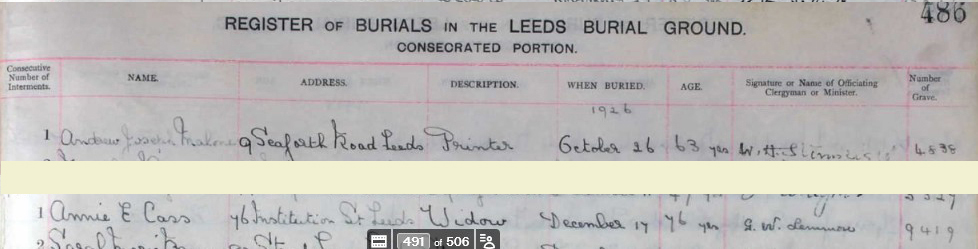
Extract from a burial register dated 1926. The original image has been edited to remove several entries, leaving only the top one, plus the headings for each of the columns, and the record of Annie E Cass who was buried on 17th December 1926.
Burial record of Annie E Cass, 17th December 1926, Beckett Street Cemetery, Leeds.
Source: ancestry.co.uk Leeds, England, Beckett Street Cemetery, 1845-1987

In this record we see that Annie E Cass, bottom entry, was buried at The ‘Leeds Burial Ground’.  This is the same as ‘Beckett Street Cemetery’.  She was buried in the consecrated portion on 17th December 1926.  Address at time of death was 76 Institution Street, Leeds.  Annie was 76 years old and a Widow – again, we see that the top entry, a man, is described by his profession.  Annie in fact ran a business after her husband’s death 28 years earlier, but this is not mentioned.  The penultimate column is for the signature or name of officiating clergyman or minister, and finally we have the Grave plot number, which is 9419.

There is not as much information as on the Fulford Cemetery entry above.  We don’t have an informant or date of death, and the late husband’s name is not included.  We also don’t have a cause of death.  To cover all bases on this one we might want to purchase the Death Certificate. What we do know, however, is that Annie was buried in the Consecrated Portion of the cemetery. She was therefore Church of England. (I already knew that as I have her baptism record, but sometimes every little helps!)

*****

Gathering information from several documents and platforms

Now I’m going to home in on Annie, or Annie Elizabeth Cass to use her full married name. I want to see if I can add to my knowledge and understanding of her life and family by looking closely at all the records I can find relating to her burial.

The information from FindAGrave (below) is a transcript compiled directly from Annie’s burial entry above. You can see that all the information is accurate, but the marital status is not included, and it is not clear whether Annie died on 17th December or was buried on that date. This is why seeing the original is always preferable, but if that’s not possible, a transcript is infinitely better than nothing. In fact I do already know that Annie died on 14th December, because I did previously buy a copy of her Death Certificate. I also know that she was in hospital when she died, not at her home in Institution Street; and I know which of her children was the informant, and his address at the time – which in turn tells me he was still living in December 1926.
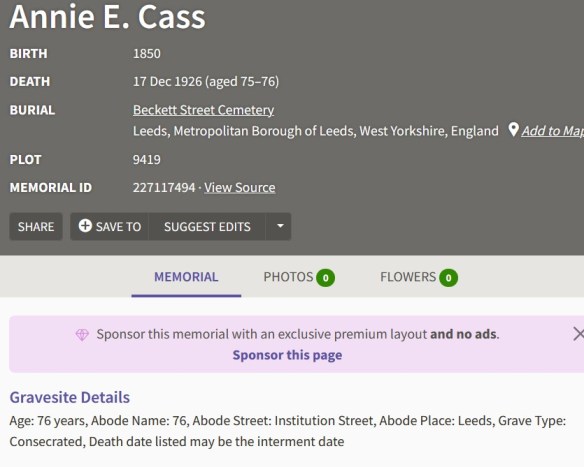
Screenshot from FindAGrave showing information about the burial place of Anne E Cass, including the location of the plot and a transcript of information from the original burial register.
Extract from FindAGrave showing burial information for Annie E Cass. © FindAGrave

So why did I bother looking at FindAGrave?
In this case I had two reasons for doing so:

  • I wanted to see if there was a photograph of the gravestone;
  • I was creating a list of all my ancestors and their children buried at Beckett Street Cemetery, and since I already had information from the GRO online register about the deaths of each, the search process on FindAGrave is much quicker and easier than searching on Ancestry. The resulting list is below:
A table created in Word with a list of people, all with the surname 'Cass', and other information about each of them, specifically about their place of burial.

By compiling a list of all my ancestors and their children at this cemetery I was able to see which ones were buried in the same plots as other family members. Here, I identified six members of the Cass family, all in Plot 9419. I made similar lists for all my family members at various public and municipal cemeteries. This will make it easier to navigate the cemeteries when I visit.

The fact that Annie Elizabeth and her husband John William Cass were able to purchase a family plot tells me something about the financial situation of this family. Many of my ancestors at this time couldn’t do so. I already knew they had a family business so this was not a surprise. I expected, too, that there would be an inscribed headstone. However, although many of the entries at FindAGrave are accompanied by a photograph of the grave, this one isn’t.  My plan was to take a photograph when I visited myself.

Additional information on Friends of Becket Street Cemetery website
This was the point I had reached when I wrote my last post, about Municipal and Public Cemeteries; and that was when I found the fantastic Friends of Beckett Street Cemetery website.

Using the public search facilities on the Friends website, and bearing in mind I already had a lot of information about this family, including the plot number where they are buried, I was able to do the following:

  • View the cemetery register. I already had access to this register via my subscription to Ancestry.co.uk. so there was nothing new for me personally here.
  • Locate the grave on a map of the cemetery.
  • Locate the grave on a spreadsheet. Here, it is recorded that in fact there is no headstone for the family plot. This surprised me.
  • The spreadsheet also provided a tantalising promise of some extra information. I found there were seven people buried in this plot, rather than the six I already knew about. However, to see the list of people (and more) I needed to become a Friend of the cemetery. This costs £10 per year. Bearing in mind the number of ancestors I have in this cemetery, and the good work the Friends do, this was worth it.
  • Having paid the membership fee I could now view the names of all occupants of this plot, and use various methods of searching the dedicated Beckett Street Cemetery database, which yielded better results than searching on the huge Ancestry database.
  • There is also a virtual walk along the various paths so that you can locate and see the plot you’re interested in.

**Obviously, every ‘Friends Of’ group will provide different search facilities.**

Here’s the new information I got about this family, and how I was able to use it

The first thing to note is that the ‘Person ID’ on the FindAGrave website is a ‘FindAGrave’ ID. The cemetery Person ID/Reference is different, so I have amended my lists to include both.

Next, I was anticipating the the unknown additional person could be a missing child. My research showed that Annie Elizabeth lost four of her children in infancy, but on the 1911 Census she wrote that she had lost seven children and had six still living. I knew this to be inaccurate, because seven of the children were still living in 1911. However, this still suggests two missing babies. Might one of them be buried in the family plot?

Alternatively, could the extra person be Annie Elizabeth’s oldest daughter. Aged 40, she was still living with her mother in 1911 but was nowhere to be found in 1921. Had she died? It seemed inconceivable that she wouldn’t have been buried in the family plot.

The extra person turned out to be Annie Elizabeth’s mother-in-law, Elizabeth Cass. Elizabeth died in 1878. She is the mother of Annie Elizabeth’s second husband, John William Cass, and they are not my ancestors. Although I had her name and some brief details from a census record I had not researched her. This record provided her burial dates and also her address, which was the same shop and living quarters above the shop that I knew to be the home of Annie Elizabeth and husband John William Cass in the 1870s.

This prompted me to look for a burial record for Elizabeth’s husband, William Cass, located quickly on the Friends of Beckett Street Cemetery website. He too had died at the same address, five years earlier. Using death certificates and baptism records for several of Annie Elizabeth’s children, I was able to calculate that she had moved into the shop with her husband and children after the death of Elizabeth’s husband/ John William’s father. The possibility that they had taken over an existing family business was not something I had previously considered.

As for the missing deceased children – the little ones are still missing. I suspect Annie Elizabeth may have included stillborn children in her totals. I have long suspected that women did this on the 1911 Census as a way of commemorating their children who never had a proper burial.

However, this new information also prompted me to renew my efforts to find Annie Elizabeth’s oldest daughter. I found she had married shortly after the 1911 census and in 1921 was living with her husband and a daughter, whose life I will now have to follow through.

How strange that all this should be resolved as a result of examining cemetery records! Plus I am now a member of the Friends of Beckett Street Cemetery!

It all goes to show we should examine closely, keep an open mind, follow all leads and cross-reference. I hope you’ve found this useful, and that it might prompt you to look again at some of your mysteries.


Meeting the people of Shackleton’s Fold

In Leeds last month, I spent two days in the Local History department of the wonderful Leeds Central Library. I had a big task to complete, started last year, that will help me progress my Shackleton’s Fold One-Place-Study.

Comprising only nineteen properties, Shackleton’s Fold existed for less than a hundred years. It was built around the mid-1840s, precise year not yet known; and from 1895 until demolition circa 1938, was populated by quite a lot of my family members.

There are various strands to this One-Place-Study. First, the properties themselves – poor quality Back-to-Backs, or rather ‘Blind Backs’, since Shackleton’s Fold comprised just two rows of houses, each with the door and windows only on the front. The back of the house, instead of joining onto another identical property with the windows and doors on the other side, was simply a solid wall. No windows, no doors, and no other house. My study will include contextual information about Back-to-Backs, the industrial era working class housing for which Leeds is famous. Next, there are of course the people who lived there: the family members who lived in each of the houses during the time they stood. I’m interested in their stories, as well as what their lives reveal more generally about the lot of the labouring classes in this part of Leeds, during the second half of the nineteenth and first half of the twentieth centuries.

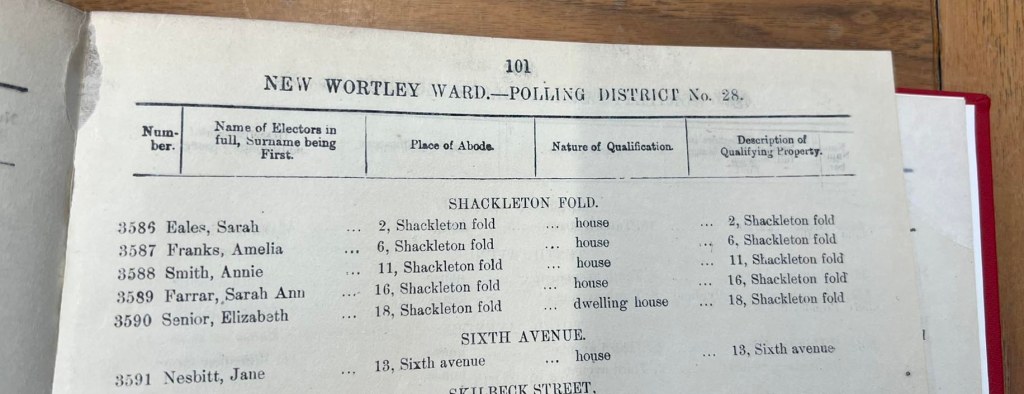
Before I can delve into their stories I need to find out who they are, and that’s what I was doing in the library: compiling a list of everyone on the Electoral Registers and Ward Lists. The objective was to use these to fill the gaps between the decennial censuses. This would enable a fine-tuning of the periods of residence for each household. If a named head of household was present for the 1861 and 1871 censuses but not the 1881, the registers could allow me to pinpoint the exact year they moved out.

Cataloguing the voters of just nineteen houses for around ninety-five years didn’t seem like such a big task, particularly since at the beginning of the period none of the residents had the vote. However, it has taken three full library days for me to do it – and even now I’ll need to return to check a few omissions and discrepancies.

A scene from a library. A red book with the title 'Leeds Register of Electors, West Division, 1896' and showing the catalogue number, is being held upright.  On the desk is a handwritten notebook with lists of dates, and a laptop.  Other desks and library users are visible beyond

Throughout the nineteenth century the population of the Borough of Leeds grew rapidly. In 1861 it was 311,197, rising to 503,493 in 1891 and by 1931 – the last Census for which Shackleton’s Fold was inhabited – the population stood at 646,119. This meant that the arrangement of the registers had to change. The sheer numbers of voters in these various registers meant they had to be divided into manageable chunks. Navigating these was a huge task. For example, a volume might bear the title ‘Borough of Leeds Ward Lists 1881 Part 2’, but with no indication as to which parts of Leeds were in Part 1, Part 2, etc; and this meant each ‘Part’ had to be browsed until the area needed was located. There was no guarantee that the following year would be similarly arranged, so the whole process had to be repeated.

Header page for electoral register, bearing the title 'Borough of Leeds Polling District Number 31, Township of Wortley, Number 3 Division'.  A note below indicates that the list that follows is of people entitled to vote in any Parliamentary election throughout 1870

If you’ve worked with Electoral Registers you’ll know that they are further divided into specific polling districts. The only way to work out which one you need is to look at the most likely ones until you find streets with names you recognise as local to your place of interest. Once you’ve done that you might think you’ve cracked it, and you’ll be able to whizz through the rest in no time. However, these polling districts also change. For example, in 1870, Shackleton’s Fold was in Polling District No. 31. In 1894 it was in West Division Polling District No. 28; changed to District No. 32 by 1899; then District 33, later to 39 and so on.

Front page of The Ward List for the Holbeck Ward, Township of Wortley, Number 1 Division, for the year 1876-77.  The beginning of a list of people is visible below the header

It gets worse! Electoral Registers list only those people entitled to vote in Parliamentary elections; and part of the appeal of a One-Place-Study for Shackleton’s Fold is that it existed throughout a period of great social change, including the move towards universal adult suffrage. During this time, some people were entitled to vote in Municipal but not Parliamentary Elections, and it’s interesting to chart the changes and know that behind each gain there was an important piece of legislation granting the vote to another group of people. This will definitely be covered in my One-Place-Study. However, since those entitled to vote only in Municipal elections could not be included in the Electoral Registers, there had to be another series of registers to list them. Therefore, alongside the Electoral Registers, there are also Ward Rolls, sometimes called Burgage Lists. Here, alongside the men included on the Electoral Registers, we find women and other men whose situation entitled them only to this local level of voting. Consequently there are (at least) two volumes of voters for every year. And guess what… the Polling Districts in the Ward Rolls have different names to those in the Electoral Registers! Shackleton’s Fold starts out in 1860 in ‘Holbeck Ward, Township of Wortley’. By 1874 it is the ‘Holbeck Ward Township of Wortley No. 3 Division’, and a couple of years later it’s No. 1 Division. By 1881 we have ‘Polling District No. 23 New Wortley Ward, Township of Wortley’, then ‘New Wortley Ward Polling District No 28’, and so on. By the 1920s even the township changes, to ‘Armley & Bramley’ and briefly to ‘Polling District MM Township of Leeds’.

As if that wasn’t difficult enough, it wasn’t until 1880 that voters were arranged by address. From this point forward, voters in Shackleton’s Fold are listed together, from number 1 to number 19. Before that year, locating each person involved line by line examination of every entry in the appropriate Polling District – once that had been found – and looking for the magic words ‘Shackleton’s Fold’, then making a note of the name of the person shown. Numbers of individual properties are not given, and since people often tended to move from house to house as their needs changed, there is no way of knowing for sure where each person resided other than at the decennial Census check-ins. Certainly from 1880 onwards the process was quicker, allowing for the speedy capturing of names and addresses with photographs of the relevant pages… at least, provided the Polling District hadn’t been renamed.

Top of page in Burgess List indicating that the named people who would follow were entitled to be enrolled as Burgesses, but not to be Registered as Parliamentary Electors

That said, for quite a few of the years, even after 1880, the women are listed in a separate part of the book, at the end of the entries for that polling district. Special mention must be made of the ‘Borough of Leeds Ward Lists 1872 Part 4’ in which, possibly because of a misunderstanding on the part of whoever compiled it into the one bound volume, locating the information involved examining every line on all 190 pages.

Extract from Burgess List showing the women who were entitled to vote in local elections.  These women were separated out from the male householders who, since 1867, had the right to vote also in Parliamentary elections
Women voters only. The men, who were now entitled to vote in Parliamentary as well as Municipal elections, were listed in the main part of the Ward Roll.

If you’ve ever worked with Electoral Registers, I’m sure some of the above will be familiar; but I suspect not so many of you will have been tracing the families of an entire street throughout a ninety-five year period! My advice to anyone planning on using Electoral Registers and Ward Rolls is: to allow far more time than you expect you’ll need; to understand the difference between the two, and their layout; and to make notes of the different Polling District names for each as you progress. This was a lesson hard learned for me, and explains why I now have a list of queries, and even a few volumes I now realise I missed.

That said, doing this is an essential foundation for everything that will follow. In addition to the decennial censuses from 1851 to 1921, the Electoral Registers and the Ward Rolls, I have information from The Borough of Leeds Poll Book. This was the first general election to be held after the passage of the Reform Act 1867, which enfranchised many male householders. Poll Books differed from Electoral Registers in that whereas the latter list who is entitled to vote, the former list not only who did actually vote, but also for whom they voted. It would not be until 1872 that the Secret Ballot was introduced, and so for many of our ancestors this is a once-only insight into their political affiliations. Other useful name-rich listings may include Directories and even addresses included on baptism and marriage registers. Luckily for me, for much of this period, all Church of England registers for Leeds are available on Ancestry.co.uk. – but not Roman Catholic or most Nonconformist registers.

These lists of people will form the basis of a database of every household, arranged alphabetically by surname. What I had really intended was simply to use these voter lists for fine-tuning periods of residence. I had anticipated that the real sources of information about the families would be the censuses. However, some residents lived in Shackleton’s Fold for only a very short period of time; and since all I have is the name of the head of household, there is no way of finding out more about them. The identity of a Thomas Brown, for example, who is listed on the Electoral Roll of 1871 and nowhere else – not even on the Census of that same year – will forever be unknown. However, Isaac Lord, also resident just briefly in 1870, turns out to have a sufficiently uncommon name for me to be able to track him down. Similarly, the juxtaposition of the head of household with his wife’s name on the Ward Lists may be sufficient to track a couple down via a marriage record.

My brain hadn’t flagged up that the lists themselves would also, with very little additional research required, witness the expansion of suffrage. It will be interesting to compare each increase of names with the relevant legislation. The lists even chart the final years of Shackleton’s Fold, helping me to narrow down the likely year of demolition. In 1938 only one resident remained, and by the following year he, too, was gone. Soon, Shackleton’s Fold would be no more.

If you want to follow progress on this One-Place-Study, you’ll find all blog posts and other information [here].

Remembering the Battle of Holbeck Moor

One of my motivations as a genealogist and family historian is to uncover – and pass on – stories from the past. A recent unexpected turn of events brought about a merging of a story from 1936 with my own life in 2024. In this post I’m going to tell you about both of these stories.

On 27th September 1936, Oswald Mosley, leader of the British Union of Fascists, organised a rally in Leeds. Accompanied by 1000 Blackshirts, his twin aims were to intimidate the Jewish communities based in Leylands, an area just to the north-east of Leeds city centre; and to drum up support for fascism amongst the working classes. The first of these aims was thwarted when the Leeds Watch Committee forbade any march through the Leylands area. However, the wider demonstration was allowed to go ahead. The Blackshirts’ march commenced right in the heart of Leeds. They then crossed the river into Hunslet, through to Beeston Hill – where they were joined by Mosley – and on to Holbeck Moor. Here, the plan was, Mosley would deliver a rousing speech.

The choice of Holbeck Moor was no accident. Holbeck and the adjacent areas of Hunslet and New Wortley were industrial areas with smoke-belching factories and railways lines interspersed with row upon row of poor quality back-to-back housing. This was the tail end of the Depression, and Mosley believed he would be able to drum up support for fascist politics. However, upon learning of the intended march, anti-fascist political activists spread the word. The Jews in Leylands were warned, and the presence of whoever was able, was requested at Holbeck Moor. When Mosley and his Blackshirts arrived, 30,000 Leeds residents were waiting for them.

Newspaper cutting with heading 'Injuries & Arrests at Fascist Meeting'. There is a photo of Oswald Mosley in uniform surrounded by men, and a police officer behind him. Beneath the image are the words 'Sir Oswald  Mosley at the demonstration on Holbeck Moor yesterday - Sir Oswald Mosley Among the Hurt in Leeds'.
From the article in The Leeds Mercury on Monday 28 September 1936. Source: FindMyPast.co.uk

When my Mum was in her eighties she told me about the day she saw Oswald Mosley march onto Holbeck Moor.  She lived half a mile from there, and in fact hers was just the kind of family Mosley was targetting, since her father had been unable to find regular work for several years. However, he understood very well that his lack of employment had nothing to do with Jewish people living in other parts of Leeds. Remembering clearly the events of that day, my Mum described the hate written all over the faces of the young Blackshirts. Mosley, she said, hadn’t reckoned on ‘the men of Leeds’, who were waiting on Holbeck Moor, armed with stones and determined to prevent him from speaking.  

It was some years after my Mum’s death that I came across an online article entitled ‘The Battle of Holbeck Moor’. At the time I was researching the events of the Civil War in Leeds, and thought this might have been one of the local battles associated with that; but as I read, I realised it was the event my mother had attended. This, in fact, gave me a date, and I was able to work out that she had been just twelve years old at the time… I wondered if her parents had known she was there! 

The article gave me more details about the event. Perhaps my Mum had told me about some of them, and perhaps I had forgotten. I learned that Mosley used a van as a makeshift stage, but that every time he tried to speak, 30,000 voices roared out ‘The Red Flag’ to drown him out. Clearly, as a young girl standing at the back of the crowd my Mum wasn’t an active participant in the event. For her, its importance was the impact it had on her developing understanding of the reality of fascism – something with which, unfortunately, everyone in attendance would have nine more years to become better acquainted. Certainly, it was clear that, nearly 70 years later, she remained proud of the fact that Leeds had defeated Oswald Mosley.  I left a comment at the end of the article, saying my mother had been there, and that her recollection of the event many years later tallied with the account. Then I added the info to my timeline about my Mum’s life and thought no more about it.

In August this year I received an email inviting me to be part of a special reception at the unveiling of a Leeds Civic Trust Blue Plaque commemorating the Battle of Holbeck Moor. I had been traced from that comment written some years earlier, and would be representing my mother. I was so happy to be invited to do this, and made preparations for the trip. I would be accompanied by my nephew and my second cousin and his wife. I was asked to write something about my mother for the display, to be kept permanently at the West Yorkshire Archives, and to provide some photos. Having done all that, I was then asked if I would be prepared to make a short speech on the day.

The rather surreal nature of this turn of events was not lost on me: the idea that one day in September 1936 my mother, then aged twelve, witnessed ‘the men of Leeds’ turning back the leader of the British Union of Fascists, and that 88 years later, her own daughter would be standing on the same spot talking about her was quite overwhelming. My Mum was never a political person but she always had a strong sense of right and wrong, and she knew that hatred and scapegoating had no place in politics. In life she had rarely done anything to attract attention, but now I wanted her story to be known.

I was due to travel up to Leeds on Saturday 28th September, ready for the ceremony the following day. Instead, on Friday evening, while putting the finishing touches to my preparations, I fell and broke my wrist.

Four people holding a Blue Plaque commemorating the Battle of Holbeck Moor.
Leeds MPs Fabian Hamilton, Richard Burgon and Hilary Benn, with Sam Kirk from Stand Up To Racism. Photo: P Heppenstall

The event on Sunday 29th September was well-attended. The unveiling was done by three Leeds Members of Parliament. It all went well, but I was not there. I was mostly lying on the sofa, asleep. Even now, I’m typing this with one hand.

Group of people. One of the people is holding a Blue Plaque commemorating The Battle of Holbeck Moor.  Others are holding photographs of family members.
Representatives of families of some of those who were present at the Battle of Holbeck Moor on 27th September 1936. Photo: C & J Battensby

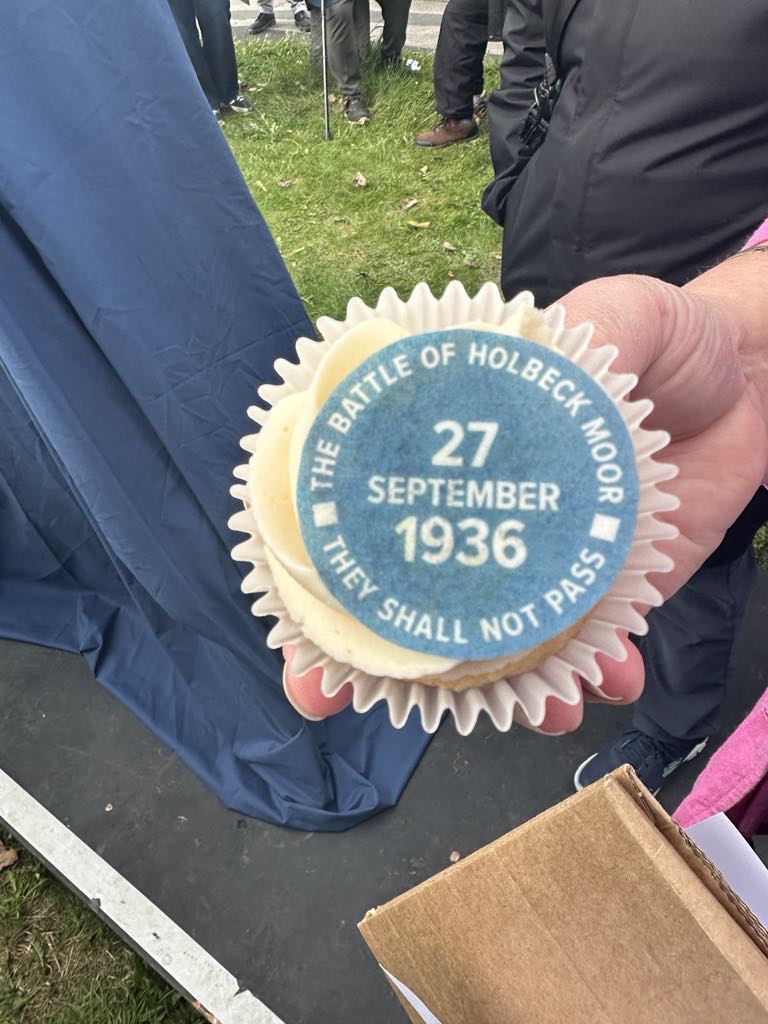
Several descendants of those present on the day had been traced, and were photographed together with photos of their family members. One of those represented had not attended the demonstration at Holbeck Moor, but was a Jewish pharmacist who gave First Aid to Blackshirts who had been injured by the stones. My nephew represented my Mum, his Grandma; and my speech was wonderfully delivered with his own twist by my second cousin. The two of them, plus my cousin’s wife, sent lots of photos and videos, and it almost felt like I was there. I was gutted to miss out on a Battle of Holbeck Moor cupcake!

A cupcake featuring a 'blue plaque' decoration, including the words: 'The Battle of Holbeck Moor - 27 September 1936 - They Shall Not Pass'
Blue Plaque cupcakes were given out after the ceremony! Photo: C & J Battensby

Of course I was very disappointed to miss the event, but the important thing is that on that day my Mum’s voice, representing 30,000 others, was heard. She would be very surprised to know she also got a mention in the local press, on the BBC and in a number of national papers, including The Guardian.

The Battle of Holbeck Moor was not the only clash between Mosley and anti-fascist demonstrators. Exactly one week later, the far better known Battle of Cable Street in London’s East End took place. By coincidence, one of those anti-fascist demonstrators was a young man who, several decades later, would become my father-in-law.

All of this came about because several people, including myself, left comments online in response to articles about the events at Holbeck Moor of 27th September 1936. As a result, this story is now owned by more family members who previously were not aware of their own family connection. More than that, the inclusion of the stories of those who attended brings a personal dimension to the history. And surely, breathing life into those memories of ordinary people is what researching family history is all about.

Leave comments! Tell the stories! You never know where it might lead.

Edward’s last journey

Family stories are not always true, but often there is truth in them.

I wrote in my last post about my elusive GG grandfather Edward Robinson. Last month, after a 25-year search, I was finally able to place him with his birth family. Throughout the search there had always been at the back of my mind my mother’s story – which must have had its origins with her own grandmother, Edward’s daughter Jane. The story was that when Jane’s mother died, after spending all his money on women and drink Edward went back to The Crooked Billet where he was born, and threw himself in the river. I knew The Crooked Billet, still a pub until fairly recently, and although I never went inside, whenever I drove past I would think of its connection to my family history.

Even with a one-line story such as this there may be several elements. I had long ago found evidence to show that my GG grandmother, did indeed die long before Edward – thirty years earlier to be precise. I had also found several drunk and disorderly charges, each resulting in several nights in Wakefield prison. What surprised me when I first researched Edward was that there was another long-term partner after my GG grandmother. Edward was with Hannah at least seventeen years, from before the 1881 census until his death in 1898. This was never passed down in the story. And finally, Edward’s act of suicide and the location is evidenced by his death certificate and the Coroner’s notes.

Only one element of this story remained to be proven: that Edward was born close by The Crooked Billet inn in Hunslet. Throughout the years of my search for Edward’s birth family I remained guided by this, but always open to the possibility it might not be accurate.

I now know that on his father’s side Edward is descended from generations of Edward and John Robinsons, all living in Hunslet in Meadow Lane, just across the river from Leeds township and marked on the map below with a blue dot. Edward’s family lived here at the time of his sister Elizabeth’s baptism 1822. They also, it turns out, had an older son, John, baptised in 1818, Meadow Lane being the place of residence given here too. At some point between sister Elizabeth’s birth in 1822 and brother John’s death in 1834 Edward sr. broke with tradition and moved with his family to Pottery Fields, marked on the map with a pink dot. The Crooked Billet inn was more than a mile away in Thwaite Gate, indicated with a red dot, right on the border with the parish of Rothwell. It isn’t looking like Edward would have been born there.

Map of Hunslet dated 1846-47. Note: This was a time of enormous and rapid industrial and housing development in the area. Even 20-30 years earlier it would have been more rural in character.

It is in fact Edward’s mother, Elizabeth Clarebrough’s family that is key to this puzzle. I’ve now traced her line back to my 11xG grandparents in the sixteenth century. The Clarebroughs are a long-established Rothwell family, located mainly in the Oulton and Woodlesford area. Elizabeth and her twin sister were eighth and ninth of thirteen children, although at least three of them did not survive to adulthood. Baptism and burial records indicate that the family relocated from Oulton between January and August 1791. The place they moved to was… Thwaite Gate in Hunslet, the exact location of The Crooked Billet. They were still there in 1805 when Elizabeth’s father was buried, and although by the time of Elizabeth’s mother’s death in 1830 she was living in Woodhouse Hill (indicated on the map with a green dot), she would seem to have remained close by the area around Thwaite. Even if a baptism record does somewhere exist for my GG grandfather Edward, the abode given will be the usual residence – Meadow Lane or Pottery Fields – and yet it is entirely reasonable to consider that his mother Elizabeth might have gone to stay with her own mother for the period of her confinement, and that he really was born right next to or at least close by The Crooked Billet.

Thinking more widely than this story for a moment – I wonder if this might sometimes be the key to locating missing baptisms? What if our ‘baptism-less’ ancestors who insist on census records that they were born in place X really were born there, because the mother had gone to be with her own mother for the birth, even though a baptism record will be found in place Y…? After all, the parish register records the name and abode of the father, not the actual place of birth. Quite apart from a truthful response to the question of the father’s own abode, it was in any case important for proof of settlement for a child to be registered in the correct parish.

Back to Edward, we can now fast forward to March 1898 when, the story goes, he left his home in Leeds township (marked orange on the map below) and drowned himself in the water by The Crooked Billet (red dot). In fact, thanks to several witnesses whose words are recorded in the Coroner’s notebooks, we can be more precise than that. South of Leeds the river Aire, being not fully navigable, is accompanied on its way to the Humber by the Aire & Calder Navigation canal. The Coroner’s notes, written the day after Edward’s death, evidence that Edward had walked along the water from Thwaite Gate in Hunslet and thrown himself in the canal close to Rothwell Haigh, at roughly the spot marked by the blue dot. Knowing what I know now about his mother’s origins, just a little further along the river, in and around Woodlesford and Oulton (green dot), knowing that as a twin her family’s connection to her sister and her children might have been particularly close, and knowing through burial records that the older generation retained a strong connection to the parish of Rothwell even after moving to Hunslet, I can imagine happy childhood days playing by the water, or walking the three miles or so along the water to visit family.

Edward’s Last Walk: Map of Leeds and Rothwell dated 1900

Of all my ancestors, Edward has been the hardest to love. Finally, working through his story with the additional information, and re-reading the Coroner’s notes, has helped me to make my peace with him. My impression of Edward was that he didn’t have a good life. He didn’t settle to a trade, and the deaths of two significant women in his life – his mother and his first wife, seem to have sent him off on self-destructive behaviour. My mother’s story, suggesting that in his despair, Edward was returning to his own roots to drown himself, was certainly true, but I now believe the attraction was not The Crooked Billet inn itself, but happy childhood memories with his mother and family by the water on the way to Rothwell.

*****

I’ll be taking a break from the blog for a few weeks. My next post will publish on 15th July.

Book Review: The Dead on Leave

I know where my mother was on 28th September 1936.  Aged only twelve, she had walked the short distance from her home to Holbeck Moor to watch as Oswald Mosley arrived, flanked by a thousand members of the British Union of Fascists (BUF).  The march commenced a mile or so away, at Calverley Street in the centre of Leeds, although the BUF had planned a longer route.  They had been forbidden by the authorities to march through the Leylands district, which for more than a century had been the ‘melting pot’ of Leeds, where newcomers, including Irish and Jewish immigrants, lived side by side with the working classes.  Even so, the night before the march, swastikas and slogans appeared throughout Leylands on shopfronts and businesses owned by Jewish residents.

By the time Mosley and his Blackshirts reached Holbeck Moor, 30,000 Leeds residents – most of them Communist Party members or Labour supporters – were waiting for them.  As Mosley took to the stage the crowd roared out The Red Flag.

I strongly suspect my grandparents didn’t know their daughter was there.  Decades later, she described the Blackshirts, hate written all over their faces, and expressed her pride for the men of Leeds who, having no time for fascism, threw stones in the direction of the stage.  She didn’t mention that Mosley was hit – I now know that the man who threw that particular stone was 19 year old John Hodgson from Leeds.  It’s astonishing what you can learn on the Internet!

By coincidence, exactly one week later, on Sunday 4th October, the far more famous Battle of Cable Street took place, as many thousands prevented Mosley from marching his Blackshirts through the East End.  My father in law, then a young man, was amongst those protestors.

It must have been about five years ago that I came across an article online about The Battle of Holbeck Moor.  I realised immediately this was the event my mother had told me about.  It was during an exchange of comments with the author of a similar article on the 28th September last year, commemorating 82 years since the event, that this novel, The Dead on Leave, was recommended to me.  It opens with events surrounding the Battle.

The 1930s was a difficult time for my mother’s family – an experience shared with many more throughout the land.  My granddad was out of work for several years, and it was perhaps from personal experience that on another occasion my mother made reference to the Means Test Investigators who would visit the homes of the unemployed.  ‘All of this would have had to go,’ she said, with an expansive sweep of her arm to indicate the china cabinet and its contents of treasures, almost all of sentimental rather than great financial value.  Again, the term ‘Means Test Investigator’ was not one she would have known.  So it was with interest that I learned a significant character in Chris Nickson’s novel was one of these Investigators.  Their powers were far greater than I had imagined, with authority to turn up unannounced, carry out thorough searches of the house and dock payments to the deemed value of any family ‘treasures’.

I didn’t expect to enjoy this novel; rather I was reading it to harvest facts about the period.  But I was immediately drawn in.  The characters were well-drawn, the sense of place spot-on, and the murder detective storyline gripping.  I got a real sense of Leeds as it was in the 1930s: the Depression, the ongoing tension between the Far Right and the Left, the rehousing of people from the old back-to-back housing to the local authority cottage estates with their spacious rooms and gardens, and even the high incidence of bronchial problems due to air pollution.  This was the ‘grim, industrial North’, after all; and my impression was that in the 1930s it was indeed grim.

I recommend this book to anyone with a historical interest in Leeds, the industrial North, the battle against fascism, or life in general during the 1930s Depression.  I’ve already found a whole series of police detective novels by the same author set in Victorian Leeds, and plan to start working my way through them too.

Click the image to find the book on Amazon (affiliate link).