Ancestral Tourism 3: How to read a cemetery

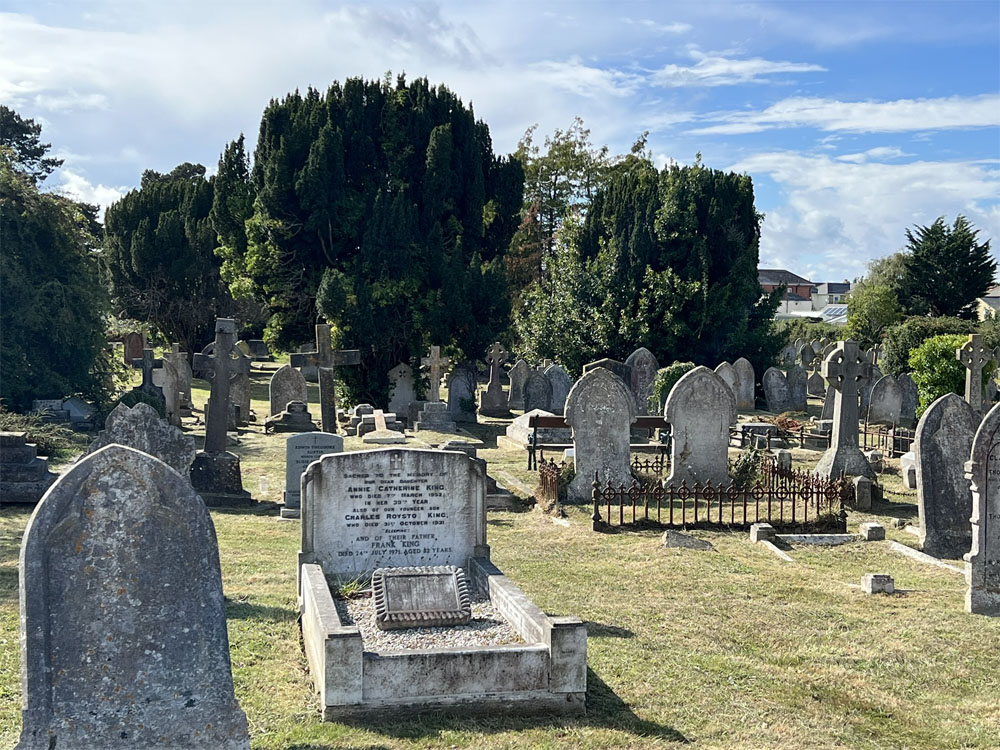
Ryde Cemetery, Isle of Wight. © Janice Heppenstall

This is the third in my ‘Ancestral Tourism’ series, and follows on from posts about preparing for visiting Churches and Churchyards and Public & Municipal Centuries featuring in our ancestry. In those previous posts, the focus was on knowing the history, finding the records and then finding any maps of the churchyards and cemeteries. In this post we’re going to be ‘reading’ the burial ground. What can we deduce from the location, the headstone (or absence of a headstone), the symbolism and anything else that will give us clues as to our ancestor’s life and social standing?

Please be prepared before applying what follows to your own family that there is a possibility that not all your ancestors will have well-kept headstones in peaceful and picturesque settings within the churchyard or cemetery. Some may have been buried with unrelated people in common graves, with or without a headstone. This is part of their story, and the story of the times in which they lived, but it can be upsetting to find.

Consecrated or Unconsecrated?

As outlined in my last post, from the middle of the nineteenth century the Burial Acts required that half of any new Municipal or Public cemetery was to remain ‘unconsecrated’. The other half would therefore be ‘consecrated’. What does this mean?

Consecrated

  1. Dedicated to a sacred purpose; made sacred; hallowed, sanctified.
  2. Dedicated, ‘sacred’ to a tutelary divinity.
  3. figurative. Sanctioned by general observance or usage.

Oxford English Dictionary (Online)

Although the online Oxford English Dictionary gives the above definition, in relation specifically to burial grounds in England and Wales it is a centuries-old term referring to land that has been blessed and set apart for Christian burial according to the rites of the Church of England (in Wales now, Church in Wales). ‘Unconsecrated’ referred to any portion not blessed or made sacred according to those rites. Before the mid-1800s, when most burials took place in the graveyard of the parish church, the official burial had to be conducted by an Anglican clergyman in accordance with the Church of England prayer book service. This applied even to those who had, in life, followed different religious practices. However, such people were not eligible for burial within the Consecrated area of the graveyard. They were buried in a separate Unconsecrated section. This applied also to babies who died before they were baptised and, before 1823, to suicides.

Also mentioned in my last post, the development of the new Public Cemeteries from the 1820s and Municipal Cemeteries from the 1840s coincided with a greater acceptance and recognition of different religious practices. Here, the term ‘Consecrated’ was kept but now, in the ‘Unconsecrated’ portion of the cemetery, the burial service itself was likely to have been carried out in accordance with the rites of the deceased’s religion. Today there is greater recognition of the different rites and practices developed by different religions and cultures in commemorating their dead. Although some dedicated cemeteries exist, there are also separate areas for specific faiths within public cemeteries. However, back when our ancestors were being buried it was simply ‘Consecrated’ or ‘Unconsecrated’, and eventually over time the terms ‘Anglican’ and ‘Nonconformist’ came to be used. Although in England and Wales today we use the latter term for Protestants who are not part of the Church of England, in earlier times it was used for anyone whose religious beliefs differed from the established church, the Church of England. It therefore referred also to Roman Catholics, for example. As can be seen from the image above and that below, separate registers were kept for these two sections of the cemetery.

Follow the clues

Finding your ancestor in one or the other may come as a surprise. If so, this is extra valuable information about your ancestors. Precisely what it tells you will depend on the context. For example, all in the same cemetery:

  • My Irish-born 2x great grandfather’s burial is recorded on the very page you see above. He was buried in the Unconsecrated part because he was Roman Catholic.
  • My 4x great uncle’s burial is also in the Unconsecrated part. This is because he and his family worshipped at the Wesleyan chapel.
  • I had a question mark about the denomination of an ancestor from Ulster. He was buried in the Consecrated portion of the cemetery, but his first child with his English, Anglican, wife was baptised in the Roman Catholic church. His burial seem to settle the question… or did it? There remains the possibility that he was simply not a church goer, and by the time of his death his adult children just didn’t know he was actually Roman Catholic.
  • The burial of another 2x great grandfather in the Anglican part of the cemetery in 1898 was interesting because he took his own life. This gave me a reason to research the burial of suicides. Suicides had traditionally been buried at a crossroads, sometimes with a stake through the heart. The Burial of Suicides Act, 1823, banned such practices. It permitted burial of suicides in consecrated ground, but only at night and without a Christian service. With the passage of the nineteenth century came a greater understanding of mental health, and the term ‘Of unsound mind’ came to be used by Coroners. In 1882, the 1823 Act was repealed, and replaced with the Internments (felo de se) Act. This permitted the burial of those who had taken their own lives at any hour and with the usual religious rites, including in a churchyard at any hour. However, suicide would not be decriminalised until 1961.

Burying in style!

There were great differences between the funeral and burial practices of rich and poor. For the wealthy, this could be a no-expense-spared event from start to finish: an opportunity to be seen to be ‘doing things properly’ according to the etiquette that had grown up around funerals. Obituaries in the newspapers will give you an idea of the size and scale of a grand funeral.

In the cemetery there are more clues. These include the location of the grave. A prime position with good views cost more. It may also have been possible to pay extra for a nine foot deep grave rather than the usual six feet, although you won’t be able to see that from the grave itself. A deeper burial was thought to help preserve the body.

A range of funerary monuments were also available, ranging from mausolea, cenotaphs, tomb chests and sculptures to headstones and more simple marker stones. Historic England have produced a guide to Caring for Historic Cemetery and Graveyard Monuments which includes descriptions of the various types.

If you’d like to know more about a whole range of roles, customs and traditions linked to death and funerals, Friends of Beckett Street Cemetery in Leeds have compiled an excellent overview of Victorian funeral traditions and etiquette. Some of these would have been de rigeur amongst the wealthier folk but others applied more widely. Even when I was growing up I remember people closing the sitting room curtains after a death in the home.

Symbolism

Victorians loved symbolism, and the various monuments and gravestones were the perfect canvas for this form of expression. On their website, Arnos Vale Cemetery, Bristol, make the point that when larger public cemeteries started to appear, much of the population was not literate. The symbols found on graves made them more meaningful for someone who may not be able to read the words. Even today, if we understand the symbolism, a whole new layer of understanding opens up to us as we walk amongst the gravestones. Perhaps there might be clues on the gravestones of some of your ancestors, letting you know what was important to them and their loved ones. You might even come across some symbolism pointing you to membership of the Freemasons or similar, which would then open up a new line of research for you. The Funeral Directors association and Family Tree Magazine have also published useful lists of symbolism and meanings.

It was a surprise to walk around Ryde Cemetery after reading them and to note the symbolism on a lot of the stones and monuments. This ‘broken’ column represents a life cut short, and the anchor symbolises EITHER hope, steadfastness, and the secure connection to God or eternal life OR a seafaring life, perhaps with the Navy – or perhaps both. Since Ryde is on an island, either is possible and now I’m thinking I should have spent longer and read the inscription to find out more…
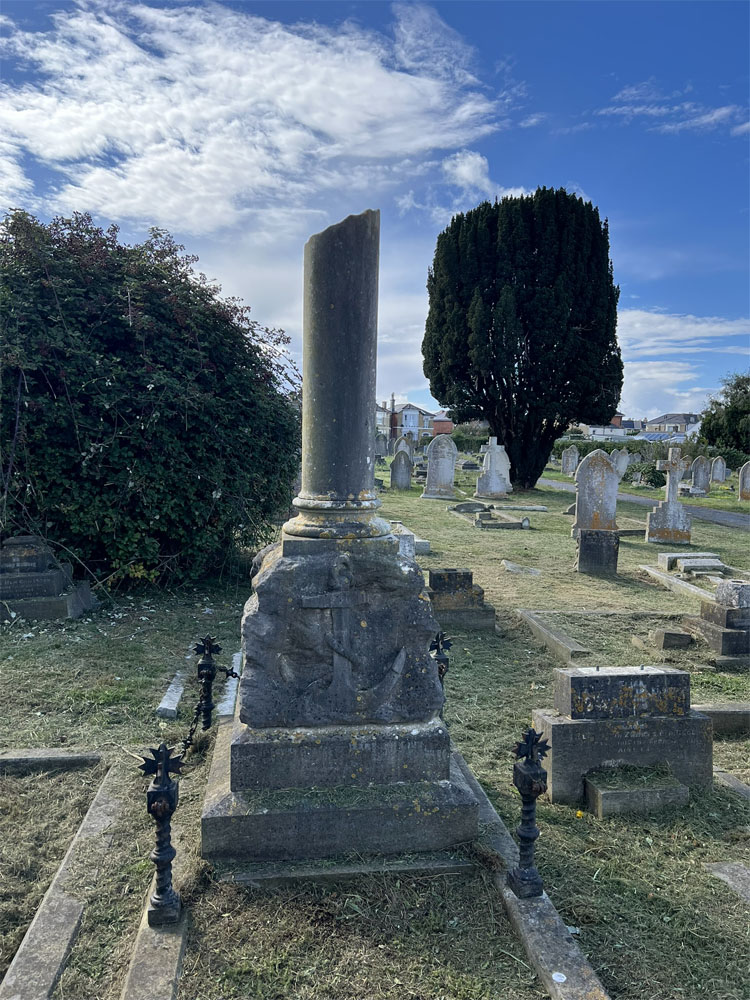
Symbolism of elaborate headstone in Ryde Cemetery, Isle of Wight. Image © Janice Heppenstall

Different types of grave

For those with the ability to pay for a private grave, there were:

  • single plots, intended for one person in a coffin
  • companion plots, intended for a couple, perhaps side by side
  • family plots, where several members of the same family can be buried together.

A certificate or “grave paper” documented the purchase. (I have one of these, purchased by a 2xG grandfather on the death of his wife in 1875.)

A purchased plot does not necessarily mean our ancestors will also have purchased a headstone, so you may need to navigate to your ancestor’s final resting place with the aid of only the plot number and a site map. The location of such plots, amongst others with headstones, should enable you to differentiate them from the common graves detailed below.

One of the motivations for the publicly-funded Municipal Cemeteries was the ability to provide for all social levels, including some lower cost options so that the labouring classes could afford to bury their dead with dignity.

A Common grave was a plot that belonged to the cemetery, not an individual or family, and was used to bury unrelated people. There were several different types of common grave, and the costs for the different types varied:

  • Lock-up graves: these were the cheapest type of grave. They were filled over the course of a few days as more bodies became ready for burial. Between each burial the soil was not replaced. Instead, a wooden ‘door’ was locked in place over the grave. When the grave had the required number of deceased people, the earth was piled on top. These were also called Open graves.
  • Public graves: like lock-up graves, these were filled up as newly deceased unrelated individuals became ready for burial. The difference is that these graves were refilled with earth after each new burial. They were therefore a little more expensive.
  • Note that ‘Pauper’s grave’ was not an official term and probably more rightly refers to the burial administration rather than to the grave itself – a Pauper’s burial. Essentially, before 1834, paupers were buried at the expense of the parish, and after that at the expense of the Board of Guardians. There was no unnecessary expense. The actual grave would have been one of the above types of common grave with no inscription, probably a lock-up grave where that was an option. Local authorities remain responsible today for the burial of a deceased person leaving no funds for a funeral and no one else to arrange it.
  • Inscription graves: For a small additional fee, a deceased person could be buried in a common grave but with a headstone inscribed with the name, date of death and age of every occupant. Some of the headstones may have had bodies arranged on both sides with inscriptions on both sides of the stone. These are a feature of the municipal cemeteries in Leeds – in fact every reference I have come across online relates to Beckett Street or another of the Leeds cemeteries. Here, they are known as ‘Guinea Graves’, that being the original cost of burial in one of these Inscription graves. If you are aware of this type of grave (Inscription or Guinea Graves) elsewhere in the country, please leave a comment saying where and by what term they are known – thanks.
Guinea Graves at Hunslet Cemetery © Stephen Craven at Wikipedia Commons

Some notes

For overseas readers (or very young British readers, perhaps!), a guinea was a British coin, originally minted in 1663 with a value of £1 (One Pound). Eventually it came to have the value of £1 – 1 s (One pound one shilling, i.e. 21 shillings). Even after the guinea coin ceased to circulate, the term remained as a unit of account worth 21 shillings. As late as the 1970s it was used for the quoting of professional fees and luxury items.

I have previously written about how to ‘read’ a Commonwealth War Graves Cemetery [here].

*****

I have become rather more fascinated with municipal cemeteries than anticipated! My next post will be about getting the most from different cemetery records, before returning in the post after that to Ancestral Tourism: houses and places our ancestors knew.
Ancestral Tourism 2: Public & Municipal Cemeteries

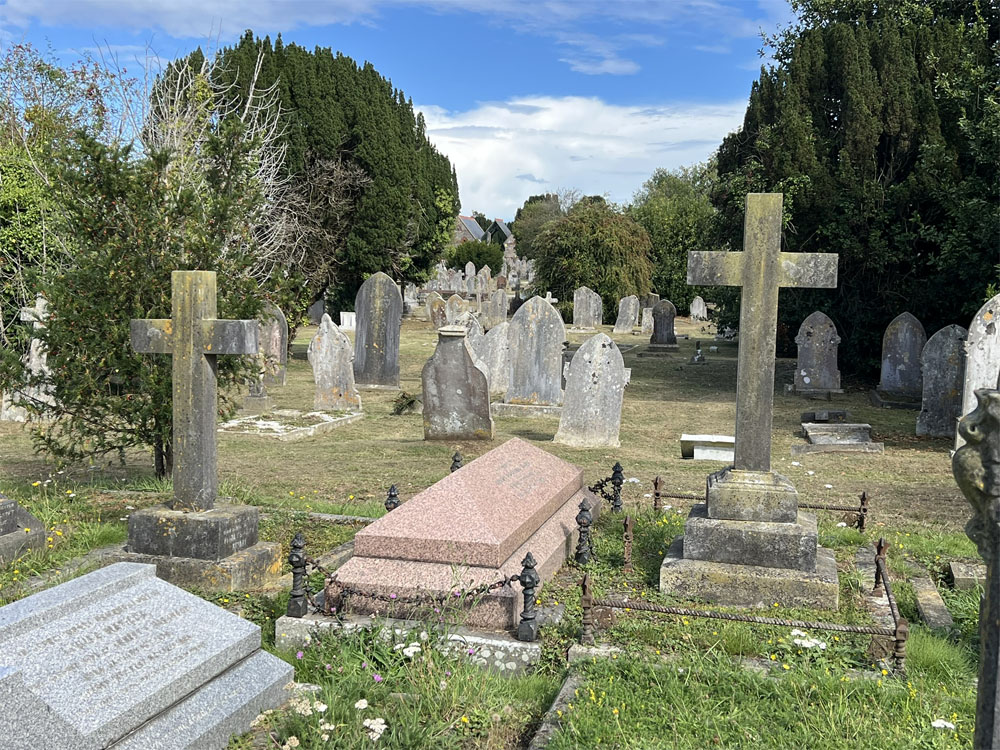
Ryde Cemetery, Isle of Wight. © Janice Heppenstall

This follows on from my last post: Ancestral Tourism 1: Churches and Churchyards. It focuses on locating and visiting graves of our ancestors whose final resting place is in one of the large municipal or other public cemeteries in our towns and cities rather than in a church graveyard.

First, a bit of history

The emergence of large public cemeteries is an interesting part of our social history, connecting with several other developments of the nineteenth century that will be familiar to local and family historians. The migrations and population booms of the eighteenth and nineteenth centuries created not only a lack of housing for the living but also of burial grounds for the dead – and all the more so in the growing industrial towns and cities. The historic churchyard burial grounds posed problems on several fronts: they were generally small, overcrowded, often laid out in a haphazard manner; and as knowledge of hygiene and sanitation developed, there were concerns about the spread of disease, particularly since in towns and cities these small burial grounds were generally alongside the church and surrounded by closely packed housing.

The initial response to this problem was to turn to the private sector. Throughout the 1820s and 1830s a number of ‘garden cemeteries’ were established to serve big industrial towns, including Manchester, Liverpool, Birmingham, Leeds, Sheffield, Newcastle and later, London. These cemeteries were private commercial ventures set up under individual Acts of Parliament. They were large, well-planned spaces, often designed by the same architects and landscape designers who created public parks. Some of these garden cemeteries may be well-known to us. They include Highgate in London, Undercliffe in Bradford and Arnos Vale in Bristol.

Some of the early cemeteries were developed by and for Nonconformists. As outlined in my last post, the general practice was for Nonconformists to be buried in the parish churchyard and the service officiated by the Anglican vicar. Many prominent philanthropic capitalists were Nonconformists, and by this time were able to use their wealth and influence to bring about changes including, here, the freedom to bury their dead and conduct services according to their own beliefs and traditions. Well-known Nonconformist cemeteries include Chorlton Row Cemetery in Manchester, which opened in 1821, Low Hill Cemetery in Liverpool, opened 1825, and Woodhouse Cemetery in Leeds, 1835. It is interesting to note that it was around the same time that the State removed control of recording births (or rather baptisms), marriages and deaths (or rather burials) from the Church of England and placed that responsibility with a new General Register Office: the introduction of Civil BMDs in 1837.

Generally speaking, though, these cemeteries were money-making enterprises, serving the upper and middle classes. There was no increase in provision for the labouring classes. The response from some local authorities was to develop more cemeteries but funded by public money. Early examples are St Bartholomew’s Cemetery in Exeter, which opened in 1837, Beckett Street and Hunslet Cemeteries in Leeds, both opened 1845, and Southampton Old Cemetery, 1846. This was the beginning of the Municipal Cemeteries – publicly funded, and owned/ managed by the local corporation.

The Metropolitan Burial Act of 1852, and other Acts of Parliament that followed, empowered local authorities to establish public cemeteries and close previous overcrowded burial grounds. The new cemeteries would have uniform hygiene standards and procedures for burial, would cater for all social levels, including some lower cost options for decent burials, and would offer burial options with dedicated areas for people of all religious affiliations. Half of any new cemetery was to remain unconsecrated, allowing for burials without the Church of England service. Later, in 1879, the The Public Health (Interments) Act made it a duty of local health authorities to provide cemeteries if local conditions required it.

Historic England have produced a List of Registered Cemeteries, arranged in date order. Information is provided for each, including design, designer, whether private or municipal, and important or interesting features.

There is also a nationwide map published by the Institute of Cemetery and Crematorium Management which includes every cemetery and crematorium in the land. I’ve checked out all the ones I know and they are all present and correct.

Since there is a similarity in records of these different types of public cemetery, the following notes about how to plan for your visit is intended to cover all of them. There are in any case differences from one cemetery to another, regardless of how they came into being.

Planning your visit

Allow plenty of time for this – there is a lot of research and planning to do!

Locating the records

  • Needless to say, the first thing you need is to know the cemetery in which your ancestor is buried. We’ll start by looking at who holds the records, moving on to which of them might be online.
  • Since Municipal Cemeteries are managed by the local authority, it is they who hold the records for these cemeteries. Often, this team is known as ‘Cemeteries and Crematoria’, or ‘Cems and Crems’ for short. You can find them online by using either of these phrases as search terms and adding the name of your town or city of interest.
  • Some local authorities offer a look-up service. For example, Leeds Cems and Crems provide a list of all cemeteries, together with opening date. They require the name of the deceased, the date of burial and the cemetery, and will ‘check the records and if the information is correct […] let you know the grave number and section or where in the grounds the cremated remains were strewn.’ Some Cems and Crems teams charge for this service; others do not.
  • Some local authorities have databases available online so you can check for yourself. For example, Birmingham Cems and Crems have separate online searchable databases for each of their twelve cemeteries.
  • Privately owned cemeteries keep their own records. Information can be accessed via their websites. For example, at the time of writing, Highgate Cemetery charges £40 for a search. However, they also state that copies of all their records are free to consult at Camden Local Studies and Archives Centre.
  • That said, digital images of the records of some cemeteries are available online. You might find records from your cemetery of interest on your genealogy subscription website; or try looking on FamilySearch. From the home page navigate to Search > Images > insert the name of your place of interest and then select the appropriate era from the drop-down list. From here, you will have to scroll through to see if the records you need are included, and if they are, you will need to browse through the images of the records. Knowing the death date or at least month of death will speed things up. I found all the records from York’s Fulford Cemetery on here – and they are excellent!
  • Transcripts of the records of your cemetery of interest may have been included on FindAGrave (free to use). I have found on there most of my ancestors and their families who were buried in a municipal cemetery, but it is primarily run by volunteers so is inevitably a work in progress.
  • There is also DeceasedOnline, which helps burial authorities and crematoria to convert their register records, maps and photographs into digital form and bring them together into a central searchable collection. There is a fee to see the individual records, and I have not used this website, but it is there as an option should you wish to use it.
  • Locating a Map of the Cemetery

    The cemetery records will hold certain essential information about your ancestor: name, address, date of burial, occupation. There may be more information, but this little lot will enable you to identify the person and be sure it’s your ancestor. There will be one other very important piece of information: the number of the grave or plot where your ancestor is buried.

    Armed with this, what you need now is a map. And on this point it’s a question of digging about online. Here are some places to look:

    • The cemetery’s own website, if they have one. Example: York’s Fulford Cemetery provide section maps on their website.
    • Local authority Cems & Crems may have pages for each of their cemeteries, possibly including maps. Example: Isle of Wight have plot maps of all their cemeteries available for download, for a fee.
    • A lot of the cemeteries have ‘Friends’, and these often have a website with maps. Examples: Friends of Beckett Street Cemetery have an astonishingly good series of online tools to help you locate and navigate your way to your ancestor’s plot. These include locations of plots, numbers and names of occupants in each, whether there is a monument or gravestone, and whether this has been photographed. A different approach is taken at Friends of Southampton Old Cemetery. They provide assistance in locating graves and request a small donation towards their conservation work. Some ‘Friends’ groups have even carried out research into the lives of those buried in the cemetery.
    • Local history or heritage groups may have websites with maps. One the best set of static maps I have found to date is for Ryde Cemetery by Ryde Social Heritage Group. Every plot is shown with the names of the occupants.
    • The local Family History Society may have mapped the cemetery. Example: Isle of Wight.
    • There may be a site map at the cemetery itself, but you will need to know this in advance to avoid disappointment.

Going alone or with a companion
In the course of researching this post I have located every one of my ancestors and all of their children buried in Municipal and Public Cemeteries. Armed with this information, including details of family plots, plus a better understanding of the significance of each of the cemeteries, I feel sufficiently well-informed to be able to make a decision as to whether to inflict a visit to any of them on my nearest, dearest, yet genealogically disinterested. Based on this, I consider one cemetery in Leeds with a single family plot of interest to be acceptable, and another in York with just three relevant family plots. The rest have far too many plots that I would need to visit; and although one – Beckett Street Cemetery in Leeds – may be acceptable on grounds of social history, I simply couldn’t put anyone else through the monotony of locating and visiting the number of graves. Definitely, these will have to be solitary trips for me.

Part of the problem leading to this decision is that although the nineteenth century cemeteries were intended as public landscapes, and are of great historic and heritage value, lack of funding means that many of them have now become neglected. It is here that ‘Friends of’ the individual cemeteries provide a valuable service, carrying out conservation and environmental work and delivering ecological benefits – but not every cemetery has a Friends group, and some are less active than others.

You might find that the ‘Friends of’ your cemetery of interest provide tours from time to time. It might be possible to arrange your visit to coincide with that, then stay on afterwards to visit your family’s graves. Interesting for you and they will appreciate the income.

If you can’t go

There is so much information to be found online. By doing the research outlined above, making full use of online material and even, where possible, via the ‘Friends of’ website, FindAGrave or a Facebook page, requesting a photo. You can also search online for images of the cemetery. Adding “wikimedia commons” to your search term will return a selection of images that are free to use provided you credit the photographer.

Be forewarned though that the inscription on images is not always legible. This could be because of sunlight conditions on the day, severe weathering over time, or possibly just because of the quality of the image when reduced for web use. The following wonderfully clear image is from FindAGrave, but some of the images of my family’s gravestones cannot be read at all.

Image © Rachel79; source: FindAGrave

*****

I hope this has given you some ideas for how to plan for a visit to a Municipal or Public Cemetery. Researching it has certainly focused my mind and I’ve found it fascinating. So fascinating, in fact, that I will be slotting in an extra couple of posts about cemeteries before progressing to finding about former homes and business premises of our ancestors in the post after that. 🙂