Instant-access Birth and Death certificate images

I know a lot of you will already know this, but for those who don’t…
The General Register Office website has made available reduced cost instant-access digital images of selected birth and death entries.

The ‘certificates’ available through this new Online View Digital Image Sevice are as follows:
* Birth entries from 1837 up to 100 years ago
* Death entries from 1837 to 1887

When you place an order using the GRO’s online indexes, where this new service is available (that is, for the year-spans indicated above), a new option will appear for ‘Digital Image’. Just click on the ‘button’.

A screen grab of a returned entry on the GRO Online Death Index, indicating the new 'Digital Image' option for ordering

These digital images cost just £2.50 each.

All the information you need to be able to order and retrieve your images is to be found in the GRO’s Online View Digital Image Service Guide.

There is a clear statement that these digital images have no “evidential” value. A paper certified copy is still required for official purposes. Examples given in the statement include ‘applying for a passport or driving licence, or where required to give notice of marriage/civil partnership’. None of these seem entirely applicable here! But in our research I can imagine someone requiring a certificate to evidence nationality of a great grandparent, or to demonstrate generational ancestral connection.

What you get
The digital image you’ll receive is just the extract from the GRO’s central register, nothing more. So looking at the example below, which is a full, certified copy, you get a lot of important wrap-around information. When you take advantage of the new instant-access digital download all you get is the image in that central section, which is extracted from the GRO Death Register.

An example of a certified copy of an Entry of Death

I really like having the official document, certainly for my direct line and anyone else whose story I’m following – but that’s expensive and I’m gradually buying only the ones I need. However, I decided this would be a great way to get information about causes of death for all the siblings who died in infancy over that fifty year period, 1837-1887, so I’ve made a start on that.

Remember though that even the full certified copy of a Birth, Marriage or Death certificate is still only a secondary source if you purchase it from the GRO. The original is kept at the local Registrar’s Office. (I wrote about this in a blog for the Pharos Tutors website, that you’ll find [here] )

As soon as your online payment goes through you can click on a link to see the image. I found it took a few minutes before I could actually download it to my computer.

Having done that it seemed to me there was some additional essential information I really did need to be able to record and cite this effectively, so I created a template in Photoshop that I can use every time I download one of these. It includes:

  • Title, making clear this is a digital download, since this does not have the same standing in law as a certified copy
  • Column headings describing the content of each column
  • The digital image
  • The GRO reference, including year, quarter, district, volume and page
  • The date I downloaded the digital image

This information transforms a useful digital image into a ‘source’, decribing what it is, and details of precisely where the original information is to be found, ensuring that anyone who wants to check my research in the future can find it again.

A template for recording a digital image of an entry on the Death Register along with essential source information.

Having done this I’m still trying to decide if I’d be happy to have all my ancestors’ death certificates in this format. After all, for the cost of buying two of the full, certified copy versions I can get nine of these, and set into my template they don’t look so bad…..

If you’ve downloaded any of these instant access digital Birth or Death certificates, I hope you’ve found lots of interesting information.
Witnesses, Sponsors, Beneficiaries and Executors

Not long after publishing my last post about witnesses at marriages, I came across A Tribute to Ted Wildy, and his Marriage Witness Indexes (MWI) on the GENUKI website. Commenced in July 1988, Ted Wildy’s UK Marriage Witness Index (MWI) was one of the first mechanisms for the sharing of genealogical information electronically, although it isn’t clear to me from what I’ve read how it was disseminated. Ted died in 1997, and since then much of the MWI seems to have disappeared. Looking online, there are still discussions about it every now and then, and an Australian excerpt from it for the state of Victoria is available online. In 2009 there was some talk of the wider Index being made available again but nothing came of it.

1988 long predates my own interest in genealogy. It wasn’t really until after the online publication of the 1901 Census that I got going. However, this topic has made me think – what a brilliant resource this would have been, had it been not only available all this time, but also revised and improved.

There would be great value too in indexing ‘sponsors’ on Roman Catholic baptism registers. Sponsors are the equivalent of godparents in Anglican baptisms, but unlike in the baptism registers of the latter, sponsors are actually named on the register – just as witnesses are named on marriage registers and certificates.

In another recent post I was writing about how women and their businesses were recorded (or not) in the Censuses. The connection of that topic to the present isn’t immediately obvious, I appreciate, but that post featured a lodging house keeper called Mary who unusually, even after marriage, continued to be recorded as such after her marriage at the age of 53. Having researched Mary’s life, what continues to intrigue me is how she, an unmarried woman, might have come to have sufficient funds to be able to lease a property and set up a lodging house in a desirable town before the age of 34. My hypothesis is that Mary might have worked as a maid and companion for a kindly old lady who left money to her in her Will. It’s just an idea, and I will almost certainly never know – because even if it were true, Wills are indexed in the name of the testator or testatrix, with no reference to beneficiaries or witnesses.

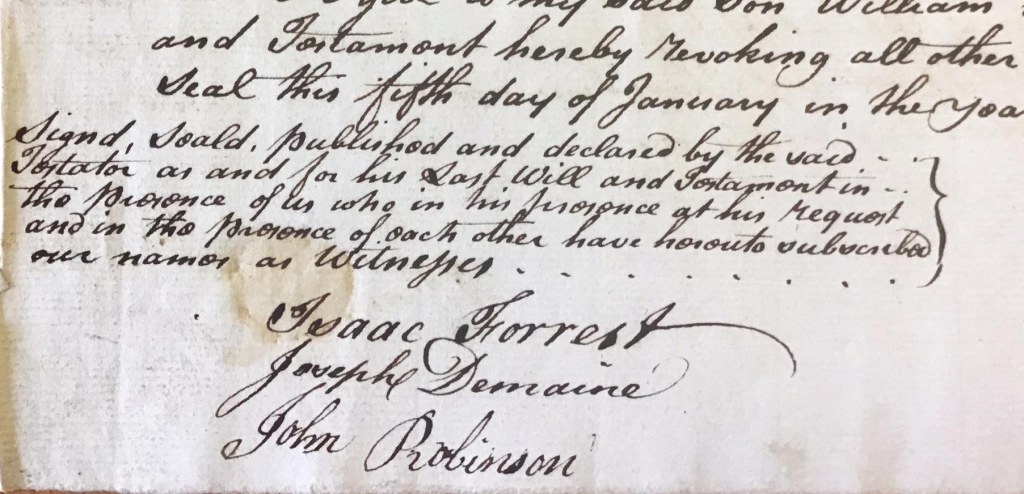
Part of a hand written Will which was written in 1781. This section shows the signatures of the witnesses.
These are the witnesses to the Will of my 6xG grandfather. None of them is a family member. Their inclusion on this document therefore tells a story of community and friendship networks.

In general, that’s fine. It is the personal affairs of the deceased with which we’re concerned when we look at a Will. What does it tell us about their standard of living and financial affairs? Are all the named family members as expected? Is there anyone new we hadn’t previously located? Can the references to individuals give us any further information about known family members – for example does the surname of ‘my dear brother in law’ help us to identify the maiden name of the testator’s wife? And of course, who are the beneficiaries? However, if none of those people are indexed, we will never be able to come at a Will from the opposite direction. If my hunch about Mary and the source of her funding were true (and who knows, perhaps it is!) there is absolutely nothing to point me to who the mystery testator or testatrix might be. Mary’s lodging house isn’t even located in the village of her birth. After first meeting her in her baptismal record, we know nothing of her until, at the age of 34, she is a householder paying Poor Rate in a town just over a hundred miles from her birthplace. A mysterious benefactor, if one exists, could be anywhere.

Indexing all of these categories of people would be really useful. It would give us information about location, networks, communities, family and friendship networks and other connections. It occurs to me that it would be especially useful for learning more about the lives of female ancestors, who may so often be completely absent from records. We know women were witnesses at marriages, and we know they were sponsors at baptisms; and yet we will only find them if we also know the bride and groom or the parents of the baby. As an example, the female witness, Madge, at my paternal grandparents’ wedding, was not related to my grandparents, and (from memory) I don’t believe she married. No-one tracing Madge would ever have reason to come across her in some random marriage register; and yet Madge and my grandmother were an important part of each other’s lives. Women did also occasionally inherit money from individuals whose connection to them is unrecorded in the sort of documentation in which we normally find them.

So… I started to check out if any such indexes are available.

FreeReg aims to provide free internet searches of baptism, marriage, and burial records. They depend on volunteers to transcribe records from parish registers, non-conformist records and other relevant sources in the UK, and are now including names of witnesses on marriage registers. That said, this is clearly a long process. Coverage is patchy, and not all transcriptions of marriage entries include witnesses. You can help with this venture by volunteering as a transcriber. (Note that this is distinct from FreeBMD, which is concerned with transcribing the Civil Registration index of births, marriages and deaths for England and Wales.)

Another resource is the Online Parish Clerks. However, not all the websites included in this link are still active, and only one – Cornwall OPC – seems to include the facility to search for witnesses at marriages.

Needless to say, it’s all about the availability and willingness of volunteers. Also, given the size of such an undertaking, I wonder if this is the sort of thing that is more likely to be done at a much smaller scale – perhaps for one parish or perhaps the work of a dedicated local Family History Society. I have of course come across many of these for marriage registers, but none that include witnesses; and certainly I haven’t come across indexes of Catholic baptism sponsors or other people mentioned in probate documents.

Have you? It would be interesting to know how common they are, and how their existence is publicised. If you have information to share, please do leave a comment.