
Every so often, you read a book that resonates deep within you, and for me one such book was The Real Oliver Twist by John Waller. I posted a review of it back in March 2019, and although it was one of my earliest posts for this blog, I’ve since referred to it in several more recent posts. This ‘real Oliver Twist’ – the real-life boy on whom Dickens is thought to have based his novel, is in fact called Robert Blincoe. Ever since reading his story I’ve considered him a hero.
Waller’s book was published in 2005. It runs to 450 pages, but his starting point for the work was a 68-page pamphlet written by John Brown and published in 1822 with the title A Memoir of Robert Blincoe. Born around 1792 in St Pancras and living as an orphan in the parish workhouse, in 1799 Blincoe, together with about fifty other children from the workhouse, was apprenticed by the Parish Overseers first to a cotton stocking manufacturer in Nottinghamshire and then to Ellis Needham, owner of Litton Mill in the parish of Tideswell in Derbyshire, where he remained until about 1813. Blincoe didn’t set out to publish a memoir. By the time he was approached by John Brown he was living in Manchester, married with children, and the owner of his own waste cotton business, but he had made no secret of his humble origins and the cruellest treatment imaginable he suffered as a pauper apprentice at Litton Mill.
Crucially and perhaps almost astonishingly, despite his experiences, Robert himself was a good man of unblemished reputation, who somehow knew right from wrong. Those who worked under him, either in his capacity as employer or as adult employee in someone else’s business, had only the highest praise for him. Following publication of the pamphlet in 1822, his story became the focus for campaigns highlighting working conditions for children and also for factory reform and the short time cause. Despite this, and even with plentiful evidence of the cruel excesses of capitalists and mill owners, it would not be until 1847 that the Ten Hours Bill passed into law.
With the benefit of almost two hundred years’ perspective, John Waller analyses the story in the pamphlet, verifies facts using original records, and sets the whole story in the context of social and political history. I cannot recommend it highly enough, and if I’ve whetted your appetite please read my earlier post to find out more.
Last month I had reason to revisit Robert Blincoe’s story – quite literally: during a week’s holiday in Derbyshire I walked part of the Monsal Trail. Here, along the deep ravine forged over millennia by the river Wye, Litton Mill still stands. Now beautifully restored and converted to luxury apartments, the setting of the former mill is breath-taking. A row of workers’ cottages adjacent to the building, probably also known to Robert, look out onto the river. This is a popular beauty spot within the Peak District, of great interest to geologists, walkers and rock climbers. A beautiful setting for a truly dreadful story. A get-away-from-it-all destination that, in Robert’s day, amounted to complete isolation. No-one was coming to rescue him and his fellow apprentices.

When I wrote that first post about Robert Blincoe I always intended to read the pamphlet that started the whole thing off. That original pamphlet, with the full title A Memoir of Robert Blincoe, An Orphan Boy; Sent from the Workhouse of St Pancras, London, at seven years of age, to endure the Horrors of a Cotton Mill, through his infancy and youth, with a minute detail of his sufferings, being the first memoir of the kind published, is available online via Internet Archive [here]. Finally, after my visit to Litton Mill, I read it.
I remembered the cruelty meted out to the children, the overwork, the inadequate food, both in terms of quality and quantity, and the lack of sleep. Now, reading the pamphlet I found it was much worse than I had understood from the excerpts in John Waller’s book. Children would routinely be required to work sixteen hours a day, but on Saturdays they worked until midnight, Sunday being a day of rest. On at least one occasion they worked a full twenty-four hours without break. The children were required to wash morning and night, but were not given soap. Since they worked with heavily greased machinery, plain water was no match for this; and since they were so hungry, the bran they were given instead of soap was eaten instead. Food was coarse, often mouldy and foul-smelling, but eaten anyway. The children would be bribed to keep working without a meal break during the day with the promise of a halfpenny – but often the halfpennies did not materialise. When they did the children bought food, collected for them by a kindly blacksmith who worked on the floor below. Insufficient clothing was provided, and the children were covered in lice. Effectively, they were commodities. If one died, no matter – there was an inexhaustible supply of them from more workhouse orphanages.
Wandering around the site, I tried to work out where the Apprentice House had stood. It is referenced in the 1822 pamphlet as accommodating two hundred, and standing about half a mile from the mill. Waller describes its location as across the river, and therefore in the adjacent parish of Taddington, meaning that burial of any children dying in the Apprentice House was the responsibility not of Tideswell but of that neighbouring parish. The building no longer stands, but given that the opposite bank of the river was, like the mill side, bordered by the steep ravine, it is difficult to imagine any reason for housing the apprentices there other than that given by Waller. There is no village nearby, no other form of habitation, and no road or obvious footpath. It would appear to be difficult to access from other parts of the parish of Taddington. Robert did recall that the children who died were buried half and half in the two parishes – so as not to attract too much attention at the number of them.

What was truly shocking, though, was the violence. Those were different times, and violence used as a means of ‘correction’ was acceptable. It can even be argued that overseers needed the children to work as quickly as possible so that they themselves were not punished for insufficient output. Hence the children were beaten to leave them in no doubt that slowing down was not an option. It’s difficult for us to think that way, but back then it was the norm. What wasn’t the norm, however, was the level of beating, the cruelty, and the enjoyment derived from this by the men in charge at Litton Mill. Children were made to dangle over moving machinery, having to lift their legs at the knee with every motion of the machine. They had clamps weighing up to one pound attached to their ears and noses, and were expected to work that way. Rollers were aimed at their heads. Supple leather belts with brass buckles were used to whip them. Teeth were filed. These, and other activities, were done for fun. The children were, in consequence, constantly covered in bruises, cuts and welts. When they did finally reach their beds it was often impossible to find a position they could lie in without pain from the injuries. If the acceptable use of beating was as a means of making the children work harder, then the thugs at Litton Mill were either too stupid or too evil to recognise that they and the children would produce more if they did not take time out for this particular form of ‘fun’.
Obviously all of this took its toll on the children’s health. Malnutrition and insufficient rest meant that some of the children’s bodies were deformed – Robert Blincoe included. Children were often sick, and many died. Why didn’t the doctor raise his concerns with the authorities? For the simple reason that the doctor, the magistrate, the magistrate’s clerk and the factory owners, in this case Ellis Needham, were all on the same side. They socialised together, as Robert found to his cost on two occasions when, as a teenager, he tried to alert the authorities to the cruelty at Litton Mill. The only outcome was more brutality. Knowing this, some prayed to God to take them during the night, there were suicide attempts, and some of the boys committed crimes, purely in the hope that their punishment would be transportation to Botany Bay, which they believed would be better than the cruelty they were enduring at the mill.
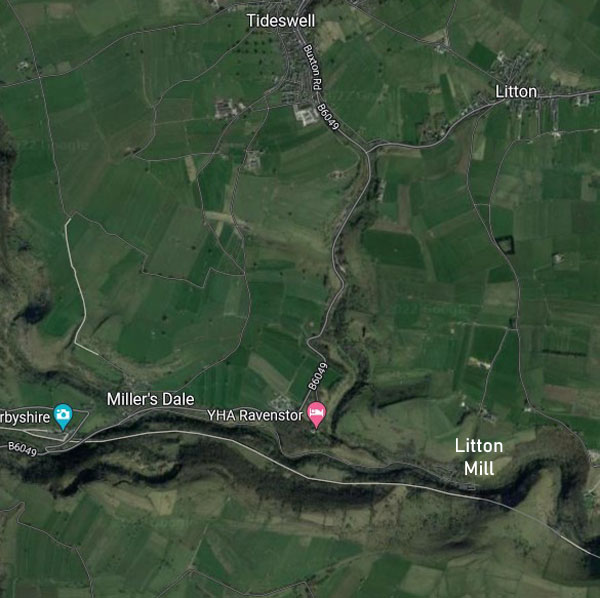
The steep ravine forming the valley of the river Wye alongside which Litton Mill is situated is shown.
As outlined above there is, ultimately, a happy ending to Robert’s story. He retained a sense of justice and was a good man; he married, established his own business and had children. His son won a scholarship and went to Cambridge, and one of his daughters made a very good marriage. Meanwhile, Ellis Needham was bankrupt in 1815 and died a pauper.
What can we, as family historians, take from Robert’s story?
Starting with the obvious and the specific, if you have ancestors in the Tideswell or Litton areas of Derbyshire – or in Lowdam, Nottinghamshire, location of the first mill to which the St Pancras children were apprenticed – you may recognise a name or two from the text. Even if your ancestors aren’t named, the story still serves as background history to the area where they lived. Today, Robert Blincoe is very much part of the history of Tideswell.
However, even if this part of the country has no relevance to your research – as is the case for myself – there is still much to be learned from reading texts like John Brown’s or John Waller’s. This can then be applied to the reality for your own ancestors.
If you have ancestors in Yorkshire, Lancashire or other areas where large-scale textile production was a major part of the local economy during the 19th century, understanding about life in a textile mill might be useful to you. Mills, for example, needed to be situated alongside water for powering the wheel, hence others were built in locations like Litton that we might now consider beauty spots but back then, with no local amenities other than what the mill owner chose to provide, increased the likelihood that children of workers would also be sucked in to the same work. Some might even be paid with tokens so that families had to buy their food and provisions at the mill owners’ shop.
More broadly, there is the social history, the operation of the Poor Laws, the Factory Acts and the apprenticing of parish and pauper apprentices. The nature of these apprenticeships is quite different from that of privately negotiated apprenticeships for sons of families who could pay. Robert Blincoe’s apprenticeship happened before the Poor Law Reform Act of 1834, when the earlier system of relief of the poor was coming under strain. Many parishes in the south sought to save money by offloading their orphans and children of paupers to the northern mills. My impression is that these mills could operate only because of the slave labour of the pauper children.
If you have an ancestor in the northern mills with no baptism record or identifiable parentage, it’s worth considering whether they might have been taken from the south to work in the mills. Conversely, if the sibling of an ancestor in the south disappears but no burial record is found, consider looking for them in the booming industrial towns in the Midlands or the North. They would have to remain living until 1851 for their place of birth to be confirmed on the census – Robert Blincoe gives his place of birth as London in the 1851 census.
 English Ancestors