
My 6xG grandparents John Christian and Rose Moss had five children:
First child John’s baptism is missing, but he died in 1733 and was buried 20th March. I have seen digitised images of the original record on Ancestry (record set: England, Church of England Baptism, Marriages, and Burials, 1535-1812) and FindMyPast (record set: Norfolk Burials) so I know for certain that this took place at St James Pockthorpe, Norwich.
However, according to record set: England, Select Deaths and Burials, 1538-1991, also on Ancestry, but licensed from FamilySearch, the burial took place on that same day but at Necton, Norfolk.
Second son Jonathan was baptised 25th August 1734. Again, digitised images of the original records on Ancestry (record sets: Norfolk, England, Church of England Baptism, Marriages, and Burials, 1535-1812 and Norfolk, England, Transcripts of Church of England Baptism, Marriage and Burial Registers, 1600-1935, this latter being Bishops Transcripts) and at FindMyPast (Record set: Norfolk Baptisms) leave me in no doubt that this took place at St James Pockthorpe, Norwich.
Yet according to England, Select Births and Christenings, 1538-1975, it too took place on the same day but again at Necton.
No baptism to be found for daughter Rose, but again digitised originals evidence her burial at Norwich St James Pockthorpe on 21st June 1737 – although there is also a separate indexing of the record on Ancestry under the name of Ross. And once again England, Select Deaths and Burials, 1538-1991 records the event at Necton.
No problems for the baptisms of sons Christopher and Philip: correctly recorded at St James Pockthorpe on all record sets. However, when it comes to Christopher’s second marriage in 1764, records for both the marriage and the banns, although having digitised images and correct transcriptions, are incorrectly attributed to the Northamptonshire county records office instead of the Norfolk archives.
Christopher already had a son by his first wife. This son, also Christopher, would eventually marry Jane Childs on 18 July 1788 at Norwich, St Andrew. I know this to be a fact. I have seen the digitised image of the originals on Ancestry (Record sets: Norfolk, England, Church of England Marriages and Banns, 1754-1936; and Norfolk, England, Transcripts of Church of England Baptism, Marriage and Burial Registers, 1600-1935) and at FindMyPast (Record set: Norfolk Banns And Marriages – separate records for the marriage and for the banns which were read on 25 May, 1 Jun, 8 Jun, 1788). All records indicate that both bride and groom are of the parish of Norwich St Andrew.
However, record set England Marriages 1538-1973, licensed by FamilySearch to FindMyPast, has three different transcripts for this marriage:
- 18 July 1788 at Catfield, Norfolk
- 8 June 1788 at Catfield, Norfolk
- 18 July 1788 at Norwich, Norfolk
*****
All of the above relates to just three generations of one line of my family. I have many similar examples, both in Norfolk and in Yorkshire – and possibly others that I just dealt with and corrected without really noticing. This is easier to do when you are both experienced as a genealogist and familiar with the lay of the land.
But we are not all experienced, and we are not all familiar with the geography of the areas where our ancestors lived. At the time of coming across some of the above errors I was lacking in both – at least at the time of discovering the Necton mysteries. When an entire generation of my family seemed to have been baptised simultaneously at both St James Pockthorpe in Norwich and at Necton, about 25 miles away – surely an impossibility in the 1730s? – I started to wonder if perhaps the church at Necton had some sort of connection to the parish of St James Pockthorpe in Norwich. Perhaps St James Pockthorpe was a grand church, and Necton was some sort of chapelry linked to it? Or perhaps my ancestors had family ties to Necton and the baptism was recorded there too. I have since visited St James Pockthorpe and know the former to be far from the truth, but at the time I remember posting a question about this on an online group. A more experienced genealogist pointed out to me that all of the wrong information had come from one provider, that these record sets were transcripts only, and that the true information could be seen and verified by looking at the images on all the other sets.
There are several points to take from all of the above, and for less experienced readers I hope there will be something to learn from this. The first is that even on the same subscription site the same event might be recorded in several different record sets. In the examples above, the same event has appeared in the original parish register entry, the contemporary bishop’s transcript based on that register, and a more modern transcription of that information that someone has made for ease of bringing genealogical information free of charge to a wider audience.
The second point is that not all record sets are equal. A transcription is much better than nothing, but it is far better to see the original image for yourself. It was only through seeing the original record in several of the record sets for St James Pockthorpe that I knew for sure the Necton entries were wrong. It was then through realising that the incorrect information all came from one source – the transcriptions licensed from FamilySearch – that I realised the potential dangers of relying on transcriptions. Ever since, when I rely on a transcription made by someone else I note that it was a transcript and where possible I note the location of the originals. Over time, often the originals will become available online. We need to get to know which are the best sets for our geographical areas of interest, and to rely on transcripts only when necessary.
Third is that we must engage with the information. In the other main example above, when records suggested that Christopher and Jane married in two different places on two different dates it made me pause for thought. It was unlikely that there were two Christopher Christians marrying two Jane Childs’s in Norfolk within a few weeks of each other. More likely that the different dates came about because of a record of the reading of the banns – and the lack of a field for the transcriber to record that this was the banns and not a marriage. It was also possible that that Christopher’s bride was from the parish of Catfield, therefore banns would be read at both places. It was only by reading the information on the records that I could see both Jane and Christopher were from the parish of Norwich St Andrew and the problem was in the transcription; but also that yes, the different dates arose because some of the records related to the banns.
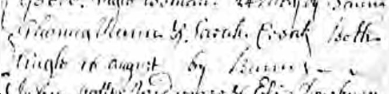
Fourth is that errors are not limited to transcription sets. Archaic handwriting may be difficult to read, and even when the original image is included in the set the names may be wrongly indexed. I spent many years looking for the marriage of a Thomas Mann to a Sarah Creak. (See above) Creak had been transcribed as Cook. If something looks unlikely, or if we’re drawing a blank, it makes sense to try the same search using a different record set or even a different index with another provider, such as FreeBMD, FreeReg or FreeCen.
And then there is the matter in the final example above, in which the entire record set has somehow been assigned to Northamptonshire. If you were unfamiliar with the geography of your ancestors’ homeland you might easily record the location of the originals as Northamptonshire records office instead of Norfolk, which wouldn’t be a good thing.
I hope there is food for thought in all that. Now that we have the perils of over-reliance on transcriptions out in the open, my next post will look at the matter from the other side – how we can use them effectively in our research.
 English Ancestors