
For many of us, there comes a time in our ancestral journey that we want to know more about the places where our ancestors lived. For the truly obsessed, this can take the form of a One-Place Study. However, for the majority of family historians, and indeed for many of our ancestors, simply visiting the place where they lived will be enough to provide that extra insight we’re looking for.
Bringing a companion
What might, for us, be termed ‘Ancestral Tourism’ could simply be an enjoyable day out for any family and friends accompanying us. The little stops and circuitous routes wouldn’t be too burdensome on companions, and might be thought to add dimension to a place.
I say this from a position of experience, since I’ve done quite a bit of visiting the ancestors over the years, often accompanied by my husband and dog. The trick is to intersperse the family history with other sightseeing and activities and, above all, to know where to draw the line. There are certain family history activities I would not expect anyone else to put up with. Obviously, visits to the archives and local history libraries fall within this bracket. I would also make a distinction between a small, picturesque churchyard and a huge, sprawling, possibly unkempt municipal cemetery. I would definitely walk alone around inner city industrial or derelict areas where ancestors used to live in streets and houses that no longer exist. For all of those, if I can’t make the time to go alone, I don’t go.
A bit of ancestral tourism can involve an hour’s diversion, or a full or half day during a week away. But whether we’re going alone or with companions, there are things we can do to plan ahead to ensure we make the most of our valuable time there.
What to see
There are certain buildings and features I home in on when visiting an ancestral town:
- the churches or chapels where my ancestors were baptised, married or buried;
- the churchyard;
- municipal and/or public cemeteries;
- former homes and work/business premises;
- historic buildings and landmarks, and just getting to know the area;
- pinpointing where an ancestral home that no longer exists used to be;
- if I’m alone, probably the local County Record Office.
Perhaps you have more suggestions or useful experiences? If so please do leave a comment.
Today’s post will deal with churches and churchyards. The rest will be covered in future posts.
The church
Most of us will never see a photograph or portrait of any of our ancestors beyond the generation living in the last quarter of the nineteenth century. I have long thought of the parish church as a stand-in.
I take several photographs of the church from outside, and then if possible move inside to sit awhile and take more photos. I have a particular connection with baptismal fonts. It seems very personal to me to know I’m standing exactly where my ancestors once stood, right before the font where their child, also my ancestor, was baptised. It’s almost like a portal to that long-ago time. I also photograph the altar and any other significant features. Some of the churches are of wider historical significance, and beautiful to see. You may also find monuments on the walls or around the church honouring the memory of your ancestors, or possibly inscribed flagstones.
Before you go
It cannot be emphasised enough that you need to allow plenty of time for this research stage. You may need to spend quite a bit of time tracking down this information.
- Chances are you already know which churches are important in your family history, since you’ll have records from the parish registers, but what we now need to do is look online to see if the church has a website. The Church of England has a site called A Church Near You which includes a page for each church. Some also have their own website with history and lots more information. There may also be information on a local history/ heritage website, or even a Facebook page.
- For other denominations, Roman Catholic churches may be listed by diocese at The Catholic Church. Baptist churches may be found via The Baptist Union of Great Britain. Quaker Meeting Houses can be located via Quakers in Britain, and so on. Alternatively, you can do an online search for a specific known church or chapel. Again, what we need from all this is the website.
- Really importantly, check when the church will be open. Some are open for visitors to walk in any time, but many open only on certain days or certain times of the day, like for a regular lunch or coffee morning. The website may specifically give times when visitors are not welcome to wander around, and clearly we must be mindful of services and private prayer. Obviously, we can photograph the exterior even if the church is closed, but it’s always disappointing not to be able to go inside – and all the more so if you could have organised your visit for the following day when it would have been open.
- Check that it is in fact the same church your ancestors used. It may have been completely rebuilt, or at least renovated or had later additions. Based on this information you may decide not to go – perhaps an image of the original church might be better for your needs.
- Baptismal fonts, too, may have been replaced. Again, it’s good to check this before you go.

St Mary’s church at Kettlewell in Yorkshire’s Upper Wharfedale has been rebuilt twice since the original Norman church was founded in 1120. Of that original twelfth century church, all that remains is the baptismal font. My 7x great grandfather was baptised at this very font (but in the original Norman church) in 1678.
Image: © Janice Heppenstall
A quick tip!
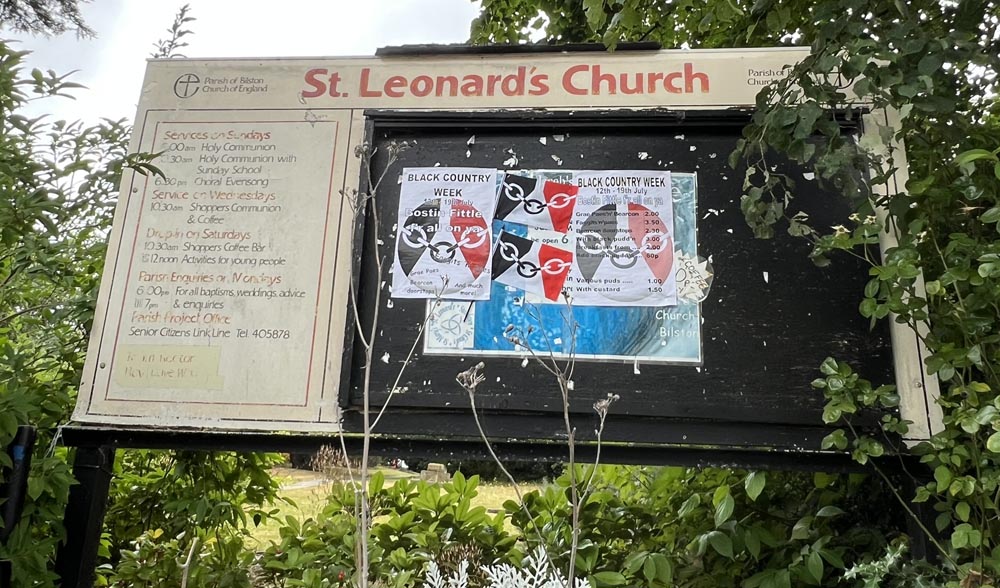
When visiting a lot of places on one trip you can easily forget which photos came from which church/ churchyard. I always take a photo of the noticeboard outside featuring the name of the church and other information.
If you can’t get there – or if the church has been rebuilt
- Even if you can’t visit yourself, much of the above information is still useful and interesting. I always feel more of a connection if I’ve taken the photographs myself, but you will generally be able to find images online. Searching for your church (or any building of interest) and adding “wikimedia commons” to your search term will return a selection of images that are free to use provided you credit the photographer.
- Paintings, sketches and engravings of a former church may also be located in this way, and while researching you might find other interesting information. Some of my ancestors were amongst the early dissenting worshippers at the Unitarian Mill Hill Chapel in Leeds. The present chapel was rebuilt around 1849, but images of the original chapel are to be found online. While following a link for one of these images I found [this article] and learned that some of the pillars of the original chapel were removed to a park in north Leeds. I will now have to try to work a visit to that park into a future ancestral tourism trip!
The churchyard
Strictly speaking, the cemetery alongside or adjacent to the church is referred to as the ‘churchyard’, ‘graveyard’ or ‘burial ground’. Before around the mid-1800s, most burials – and not just burials of Anglicans – took place in the graveyard of the parish church. Although other denominations kept their own records of deaths/burials, the official burial had to be conducted by an Anglican clergyman in accordance with the Church of England prayer book service. You will therefore find burials of ancestors of different faiths in the Church of England parish registers – and you may also find additional records in the registers of their usual places of worship.
The parish register will give the name of the deceased, date of burial and possibly some additional information, such as date of death; if a child, the father’s name; if a woman, the husband’s name; and possibly the cause of death. What it rarely says is where, exactly, the person is buried and that’s unfortunate because that’s what we need right now. I have seen references on parish registers to ‘in the churchyard’; and my 8x great grandfather’s burial record states that he is buried in the ‘South Ile’ [South Aisle] at Wakefield All Saints. There would once have been an inscribed flagstone, but these have long been replaced and no map survives. When I visited I walked up and down the aisle a few times, certain that he was there somewhere but not knowing exactly where. So to be sure of finding our ancestor’s resting place, what we need is a map.
![Extract from burial register, 1663. The extract is in seventeenth century handwriting and reads 'South Ile Will[ia]m Clareburne de Westgate buried eodem die'](https://englishancestors.blog/wp-content/uploads/2025/08/william-clareburne-burial-1663.jpg?w=1024)
Original data: West Yorkshire Archive Service; Reference: WDP3/1/3
Before you go … and this could take some time!
Find out if a map of the church and churchyard burials exists, and if so, where. Many thanks to friends/ colleagues at the South Central branch of AGRA for help with compiling this list:
- An original map could be held at the church or at the local County Record Office
- If at the Record Office, it is likely to be found under ‘Miscellaneous’ records for that particular parish.
- If an official original record doesn’t exist, there is the possibility that volunteers may have compiled something
- Some County Record Offices have maps compiled by their volunteers.
- A map may have been drawn up by ‘Friends of’ a particular graveyard.
- Often, the local Family History Society may have mapped a graveyard. You may need to be a paid member of the Society to access the information on their website; or you may find a map inside the church itself – it’s worth checking this before you visit.
- There is the possibility that a map may be incomplete
- An original map/record may be only partially complete.
- For maps created by volunteers, unless they were working with an official/ original list of plots and names, there is the possibility that they may only be able to include occupants of plots as seen on headstones, and that remains in unmarked plots may not be included.
- Even if the precise location of your ancestor’s grave is not known…
- based on parish registers, time periods, and denomination, a church official may be able to tell you in which section of the graveyard your ancestor was buried.
- Check if anyone in your family has a photograph of the headstone – making it easier to identify when you’re walking around the churchyard. Even a photograph of the unmarked grave may have clearly identifiable gravestones close by, thereby enabling you to work out the precise location of that unmarked grave.
- You may find information online at FindAGrave. Although FindAGrave does not have maps, it gives precise plot information. My experience is that they tend to have more records from municipal cemeteries and that parish graveyards are perhaps at this stage an ongoing project.
In the future, it may become easier! The Church of England has created a digital map and database of all burial grounds in England. This does not include specific burial plots. However, the National Burial Grounds Survey (which I wrote about HERE) is under way and will eventually build into a detailed map and record of all burial plots for all Church of England dioceses signing up to the scheme. You’ll find a map of progress HERE and more information elsewhere on that website.
If you can’t get there
You may still be able to get plot information via one of the above resources, and possibly a photo of the gravestone. A general photo of the churchyard may be available online.
*****
I hope this has given you some ideas for visiting ancestral churches and churchyards – or indeed an ‘Ancestral Staycation’. My next post will look at visiting public and municipal cemeteries.
 English Ancestors
Pingback: This week's crème de la crème - August 16, 2025 - Genealogy à la carteGenealogy à la carte
Good tips! I also take photos of the signs – very helpful for identifying photos later
LikeLiked by 1 person
Thank you!
LikeLiked by 1 person
Pingback: Ancestral Tourism 2: Public & Municipal Cemeteries | English Ancestors
Pingback: Ancestral Tourism 3: How to read a cemetery | English Ancestors
Pingback: Getting the most from cemetery records | English Ancestors
Pingback: Ancestral Tourism 4: Houses & Business Premises | English Ancestors
Pingback: Friday’s Family History Finds | Empty Branches on the Family Tree